Global AI Player Scouting Market Size, Share and Analysis Report By Type (Predictive Analytics, Performance Tracking, Player Recruitment, Injury & Fitness Analysis), By Application (Professional Football, Basketball, Cricket, Hockey), By Deployment (Cloud-Based, On-Premises), By End-User (Sports Clubs, Sports Academies, Scouts & Coaches), By Technology (Machine Learning, Computer Vision, Natural Language Processing (NLP), Deep Learning, Others), By Functionality (Player Performance Analysis, Talent Identification, Injury Prevention), By Regional Analysis, Global Trends and Opportunity, Future Outlook By 2025-2035
- Published date: Jan. 2026
- Report ID: 174741
- Number of Pages: 355
- Format:
-
keyboard_arrow_up
Quick Navigation
- Report Overview
- Top Market Takeaways
- Efficiency and Accuracy Statistics
- Drivers Impact Analysis
- Risk Impact Analysis
- Restraint Impact Analysis
- Type Analysis
- Application Analysis
- Deployment Analysis
- End-User Analysis
- Technology Analysis
- Functionality Analysis
- Europe Regional Analysis
- Opportunity Analysis
- Challenge Analysis
- Emerging Trends
- Growth Factors
- Investor Type Impact Matrix
- Technology Enablement Analysis
- Competitive Analysis
- Recent Developments
- Key Market Segments
- Report Scope
Report Overview
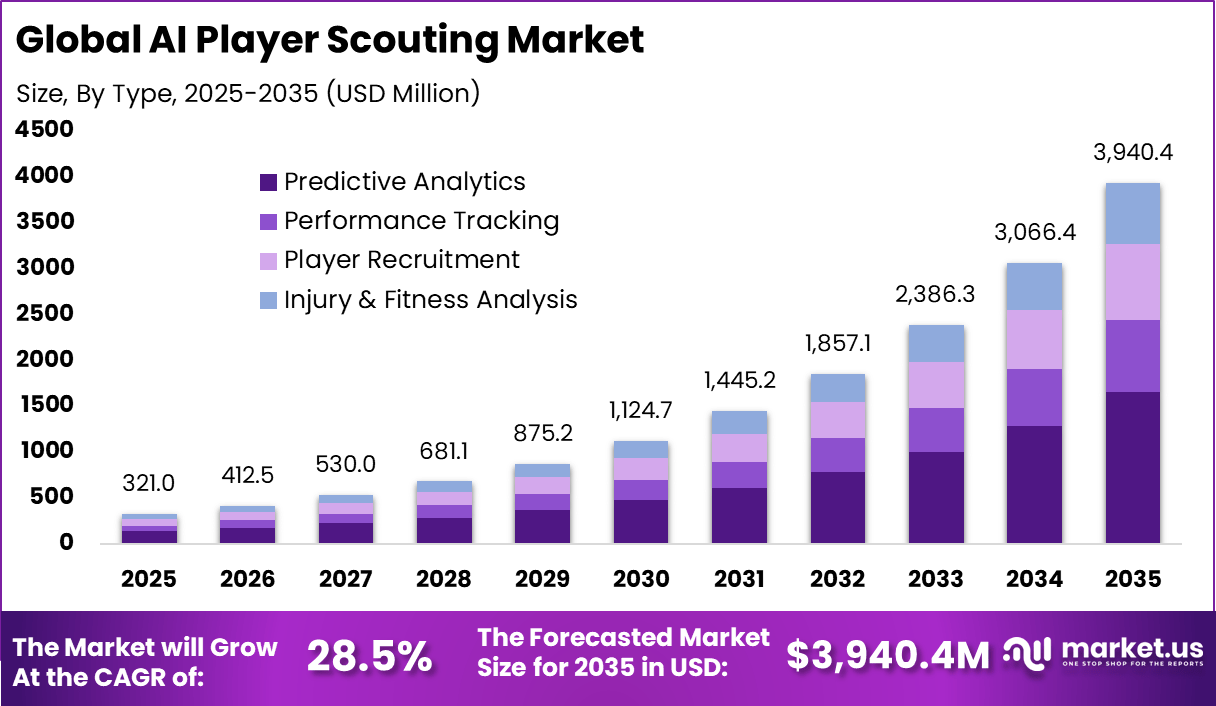
The Global AI Player Scouting Market size is expected to be worth around USD 3,940.4 Million By 2035, from USD 321.0 Million in 2025, growing at a CAGR of 28.5% during the forecast period from 2026 to 2035. Europe held a dominan Market position, capturing more than a 41.5% share, holding USD 133.2 Million revenue.
The AI player scouting market refers to the use of artificial intelligence to identify, evaluate, and compare athlete performance and potential. These solutions analyze large volumes of player data such as match statistics, video footage, physical metrics, and behavioral patterns. AI-based scouting tools are used by professional sports teams, academies, leagues, and talent development organizations. They support objective assessment and early identification of promising players. Adoption improves accuracy and efficiency in talent evaluation.
One major driving factor of the AI player scouting market is the need for objective and consistent talent evaluation. Human scouting can vary based on experience and perception. AI systems apply uniform evaluation criteria across players. This consistency improves fairness and accuracy. Objective analysis drives adoption among professional organizations. Another key driver is the growing availability of sports data and video content. Matches and training sessions generate extensive data streams. AI tools process this information efficiently at scale.
Demand for AI player scouting solutions is influenced by expansion of professional and youth sports programs. Clubs seek early identification of talent to gain competitive advantage. AI scouting supports long-term development strategies. Early insights improve recruitment planning. This demand continues to increase. Demand is also shaped by cost pressures in talent acquisition. Traditional scouting involves travel, staffing, and long evaluation cycles. AI tools reduce these costs by enabling remote and automated analysis.
Efficient scouting lowers operational expenses. Cost optimization strengthens demand. Computer vision technologies play a central role in AI player scouting adoption. These systems analyze video footage to track movement, positioning, and actions. Visual analysis provides detailed performance metrics. Improved accuracy enhances evaluation quality. Technology maturity supports adoption. Machine learning technologies also contribute by identifying performance trends and predicting potential.
Top Market Takeaways
- Predictive analytics leads by type with a 42.1% share, as clubs rely on data-driven forecasting for player potential and performance trends.
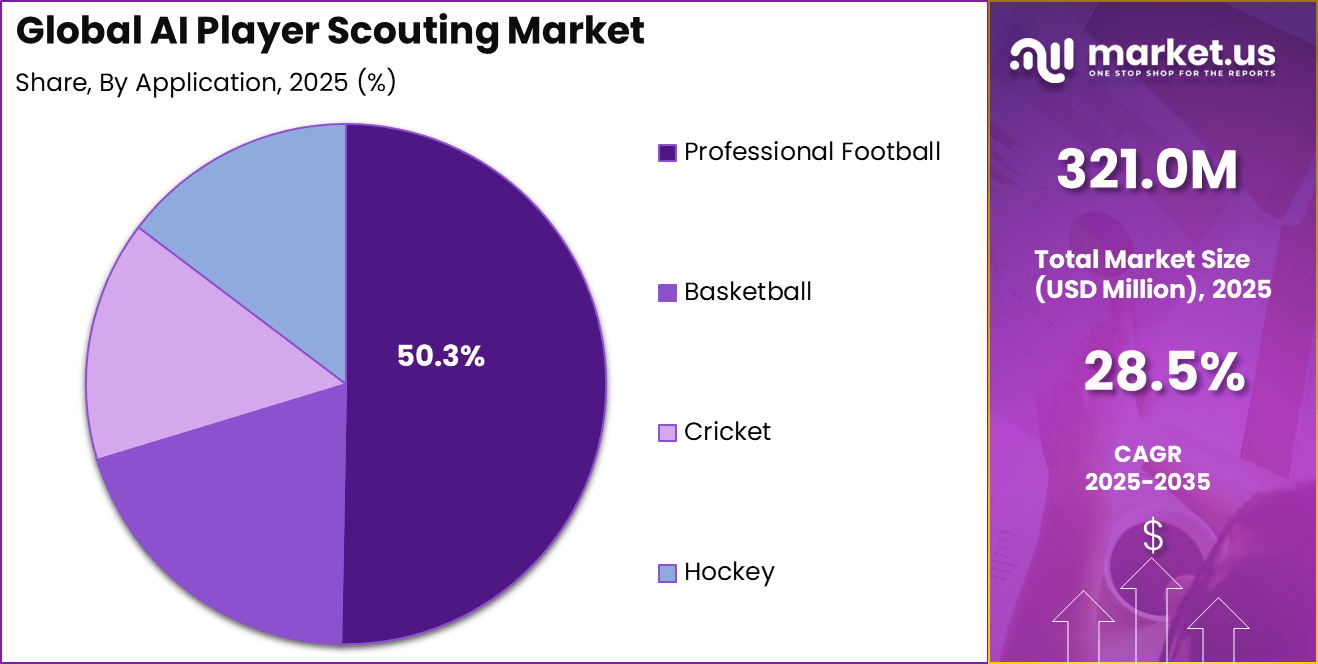
- Professional football dominates applications at 50.3%, supported by high investment in scouting, transfers, and competitive performance analysis.
- Cloud-based deployment accounts for 90.8%, reflecting preference for scalable access, real-time analytics, and centralized data management.
- Sports clubs represent 73.5% of end users, driven by direct need for talent evaluation, squad optimization, and recruitment efficiency.
- Machine learning leads technology adoption with 46.4%, enabling pattern recognition, player comparison, and predictive performance modeling.
- Talent identification holds 40.9%, highlighting focus on early discovery of high-potential players and youth development pipelines.
- Europe leads regionally with 41.5%, supported by strong football ecosystems and advanced analytics adoption.
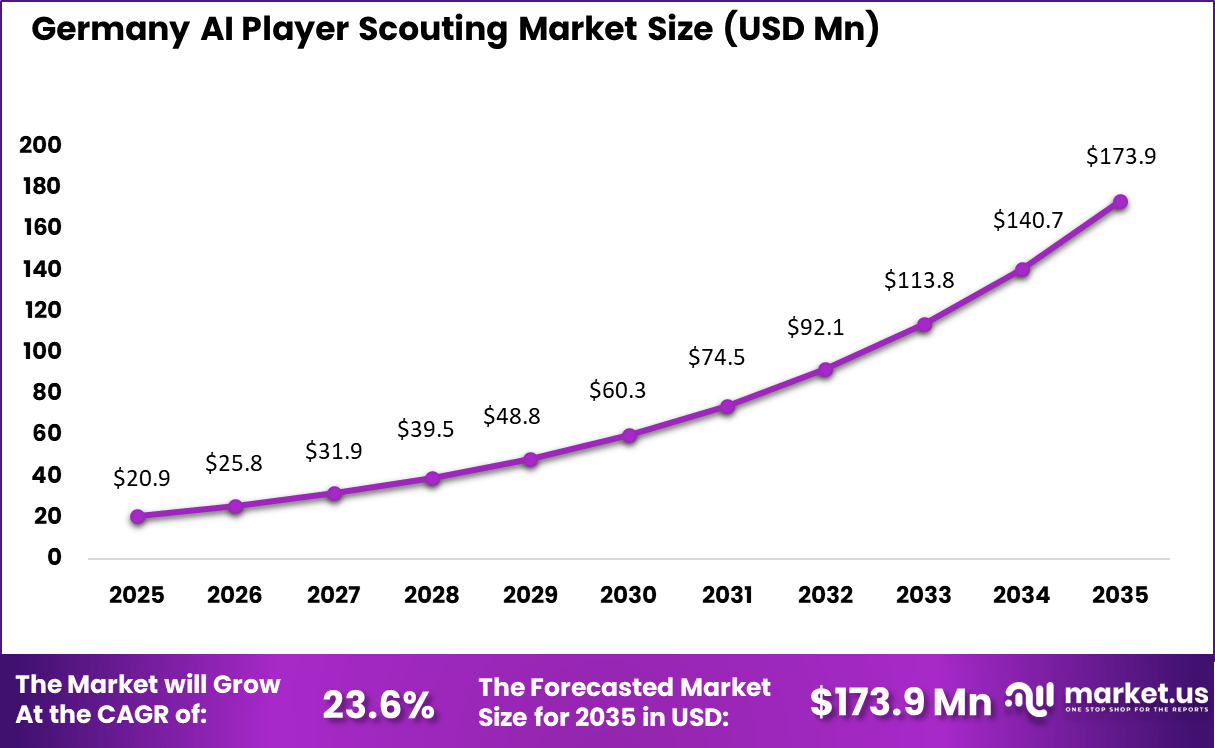
- Germany market activity reached USD 20.9 million, expanding at a 23.6% CAGR, driven by professional league investments and digital scouting tools.
Efficiency and Accuracy Statistics
- AI-based scouting tools identify player talent 3.2× faster than traditional manual scouting approaches.
- Automated analysis reduces video review time by up to 80%, processing more than 100 hours of footage within minutes.
- Player evaluation accuracy improves by as much as 87%, with talent identification accuracy rising 45% in structured academy programs.
- Recruitment costs decline by around 73% for organizations using AI-driven scouting systems.
- Predictive injury risk models achieve accuracy levels of up to 90%, supporting better player availability planning and long-term performance management.
Drivers Impact Analysis
Driver Category Key Driver Description Estimated Impact on CAGR (%) Geographic Relevance Impact Timeline Professionalization of sports analytics Data driven recruitment decisions ~7.2% Europe, North America Short Term Rising transfer market competition Need for accurate player valuation ~6.3% Europe Short Term Expansion of cloud analytics platforms Scalable scouting across leagues ~5.4% Global Mid Term Growth of youth development programs Early talent identification ~5.0% Europe, South America Mid Term Adoption of AI and machine learning Improved performance prediction ~4.6% Global Long Term Risk Impact Analysis
Risk Category Risk Description Estimated Negative Impact on CAGR (%) Geographic Exposure Risk Timeline Data quality limitations Incomplete or biased player datasets ~5.6% Global Short Term High model complexity Misinterpretation of AI insights ~4.7% Global Short Term Data privacy regulations Athlete data protection requirements ~3.9% Europe Mid Term Resistance from traditional scouts Cultural shift challenges ~3.2% Global Mid Term Dependence on league data access Licensing and API constraints ~2.6% Global Long Term Restraint Impact Analysis
Restraint Factor Restraint Description Impact on Market Expansion (%) Most Affected Regions Duration of Impact High subscription costs Budget limits for smaller clubs ~5.8% Emerging Markets Short to Mid Term Limited historical data coverage Gaps in lower tier leagues ~4.6% Global Mid Term Integration complexity Alignment with coaching workflows ~3.8% Global Mid Term Skill gap Shortage of data science talent ~3.0% Global Long Term ROI uncertainty Performance outcomes variability ~2.4% Global Long Term Type Analysis
Predictive Analytics – 42.1%
Predictive analytics holds a 42.1% share in the AI player scouting market, reflecting its growing importance in modern talent evaluation. This approach enables clubs and organizations to assess future player performance using historical data, match statistics, and behavioral patterns. Predictive tools help reduce uncertainty in scouting decisions and improve long-term roster planning.
The adoption of predictive analytics is driven by the need to identify potential risks and performance consistency before player acquisition. Clubs use these systems to forecast injury probability, career progression, and adaptability to different playing styles. This data-led approach supports more informed investment decisions in player development and transfers.
As data availability and analytical models improve, predictive analytics continues to gain acceptance across scouting departments. The ability to combine performance metrics with contextual insights strengthens decision accuracy. Over time, predictive analytics is expected to remain a core capability within AI-driven scouting platforms.
Application Analysis
Professional Football – 50.3%
Professional football accounts for 50.3% of AI player scouting applications, making it the largest adoption segment. Football clubs operate in a highly competitive environment where player performance directly impacts financial and sporting outcomes. AI tools help clubs analyze vast volumes of match and training data efficiently.
The sport’s global scale and structured league systems generate consistent and standardized data inputs. This allows AI systems to evaluate player positioning, movement patterns, and tactical awareness with high precision. Clubs rely on these insights to identify emerging talent and compare players across leagues.
Professional football organizations are also early adopters of digital technologies, supporting faster AI integration. The focus on performance optimization and youth development further strengthens demand. As competition intensifies, AI-based scouting remains a strategic priority in professional football.
Deployment Analysis
Cloud-Based – 90.8%
Cloud-based deployment dominates the AI player scouting market with a share of 90.8%. This dominance reflects the need for scalable, flexible, and remotely accessible scouting platforms. Cloud environments allow clubs to store, process, and analyze large datasets without heavy infrastructure investment.
Cloud-based systems support collaboration among coaches, analysts, and scouting teams across locations. Real-time access to insights improves decision-making speed during transfer windows and tournaments. These platforms also simplify system updates and integration with video analysis and performance tools.
The high adoption of cloud deployment is reinforced by cost efficiency and operational ease. Smaller clubs benefit from reduced entry barriers, while larger organizations gain scalability. Cloud-based delivery is expected to remain the preferred deployment model across the market.
End-User Analysis
Sports Clubs – 73.5%
Sports clubs represent 73.5% of end-user demand in the AI player scouting market. Clubs are directly responsible for talent identification, player acquisition, and performance development. AI tools help them manage these responsibilities with greater accuracy and efficiency.
The use of AI allows clubs to move beyond traditional scouting methods based on limited observation. Data-driven evaluations support objective comparisons across players and competitions. This reduces bias and improves consistency in recruitment decisions.
Clubs also use AI scouting systems to support youth academies and long-term development strategies. Early identification of talent helps optimize training investments. As clubs focus on sustainable performance, AI adoption continues to expand.
Technology Analysis
Machine Learning – 46.4%
Machine learning accounts for 46.4% of the technology share in AI player scouting. This technology enables systems to learn from historical player data and continuously improve prediction accuracy. Machine learning models identify complex patterns that are difficult to detect through manual analysis.
Clubs use machine learning to assess player efficiency, tactical contribution, and adaptability. These models evolve as new match data becomes available, improving reliability over time. The ability to process structured and unstructured data strengthens scouting depth.
As computational capabilities advance, machine learning remains central to AI scouting platforms. Its adaptability supports diverse use cases across leagues and player profiles. This positions machine learning as a foundational technology in the market.
Functionality Analysis
Talent Identification – 40.9%
Talent identification holds a 40.9% share, highlighting its importance as a core function of AI scouting solutions. AI systems help identify promising players at early stages by analyzing performance trends and potential indicators. This supports proactive recruitment strategies.
AI-driven talent identification improves visibility into under-scouted regions and lower-tier leagues. Automated analysis reduces reliance on physical scouting alone. Clubs gain access to broader talent pools with reduced operational effort.
The focus on early-stage talent discovery aligns with long-term player development goals. As competition for skilled players increases, AI-enabled talent identification becomes increasingly valuable. This functionality continues to shape scouting workflows.
Europe Regional Analysis
Market Share 41.5% | Germany 20.9 Million | CAGR 23.6%
Europe accounts for 41.5% of the AI player scouting market, supported by strong football culture and advanced analytics adoption. Clubs across the region actively invest in data-driven performance and recruitment systems. Structured leagues and youth development programs strengthen AI usage.
Region Primary Growth Driver Regional Share (%) Regional Value (USD Mn) Adoption Maturity Europe Competitive professional football ecosystem 41.5% USD 133.7 Mn Advanced North America Sports analytics commercialization 29.1% USD 93.4 Mn Advanced Asia Pacific Rising professional league investments 18.6% USD 59.7 Mn Developing Latin America Talent export and scouting demand 6.7% USD 21.5 Mn Developing Middle East and Africa Early sports digitization 4.1% USD 13.2 Mn Early 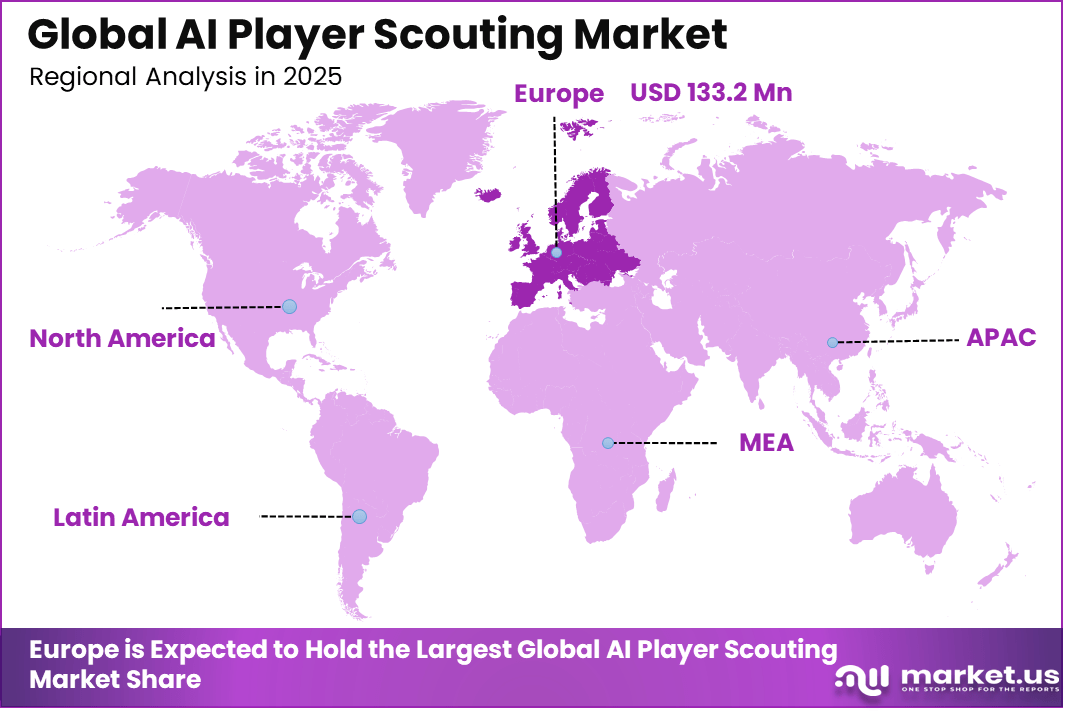
Germany contributes significantly with a market value of USD 20.9 million, driven by technology adoption and organized club structures. German clubs emphasize performance optimization and long-term talent pipelines. AI tools support these objectives through continuous player evaluation.
A CAGR of 23.6% reflects strong growth momentum across Europe. Rising competition, financial discipline, and digital transformation initiatives drive adoption. Europe remains a key region for innovation and expansion in AI player scouting.
Opportunity Analysis
Emerging opportunities in the AI player scouting market are linked to expanding applications beyond talent identification into holistic performance intelligence and player development pathways. AI platforms can support personalised training recommendations, injury risk assessment, and tactical fit evaluations that deepen value beyond transactional scouting outcomes.
The integration of AI insights with coaching systems, player wellness platforms, and analytics dashboards can enhance development programmes and long-term performance strategies. There is also opportunity in servicing emerging markets, amateur leagues, and international clubs that seek competitive advantage through accessible AI scouting tools, expanding the potential user base beyond elite professional tiers.
Challenge Analysis
A central challenge confronting this market relates to balancing algorithmic insights with human expertise and contextual interpretation. While AI systems can identify statistical patterns and performance signals at scale, human scouts and coaches remain essential for interpreting intangibles such as player mentality, leadership qualities, adaptability, and cultural fit within teams.
Ensuring that AI outputs complement rather than replace expert judgement requires thoughtful integration, transparent model explanations, and collaborative workflows. Misalignment between automated recommendations and human evaluation processes can erode trust and limit practical adoption across organisations that prioritise holistic talent assessment.
Emerging Trends
Emerging trends within the AI player scouting landscape include the incorporation of multi-modal data sources such as positional tracking, physiological sensors, match video, and contextual game analytics to build richer player profiles. Predictive modelling is increasingly used to forecast long-term player development trajectories, optimise recruitment timing, and assess comparative value against peer cohorts.
Another trend involves integration with virtual scouting platforms and digital marketplaces that connect AI insights with remote recruitment workflows, enabling teams to broaden talent search beyond local or traditional scouting networks.
Growth Factors
Growth in the AI player scouting market is supported by the professionalisation of sports analytics, escalating competition for elite talent, and increasing investments in performance technology across leagues. Advancements in wearable sensors, camera-based tracking systems, and real-time data collection provide richer datasets that enhance AI model accuracy and depth of insight.
The rising importance of evidence-based recruitment strategies and the desire to reduce scouting risk and cost reinforce enterprise adoption of intelligent scouting solutions. Continued innovation in artificial intelligence, data integration, and predictive analytics is expected to expand the applicability and strategic value of AI-powered player scouting across sports organisations of varied sizes and competitive levels.
Investor Type Impact Matrix
Investor Type Adoption Level Contribution to Market Growth (%) Key Motivation Investment Behavior Sports clubs Very High ~73.5% Competitive advantage Long term subscriptions Professional leagues High ~16% Standardized scouting frameworks Centralized adoption Player agencies Moderate ~6% Talent valuation insights Selective usage Training academies Moderate ~3% Youth development analytics Program based Media organizations Low ~2% Performance storytelling Limited adoption Technology Enablement Analysis
Technology Layer Enablement Role Impact on Market Growth (%) Adoption Status Machine learning models Performance and injury prediction ~6.8% Growing Predictive analytics engines Player potential forecasting ~6.1% Growing Cloud analytics platforms Scalable data processing ~5.2% Mature Computer vision Match and movement analysis ~4.3% Developing Data integration pipelines Multi source player data fusion ~3.1% Developing Competitive Analysis
Key players such as Wyscout, Stats Perform, and Opta lead the market through large scale player databases and AI driven analytics. Their platforms analyze match events, player movements, and historical performance. Clubs and federations use these insights for talent identification and transfer decisions. Strong data accuracy and global league coverage support adoption. Demand is driven by the need for objective and data backed scouting decisions.
Technology focused providers such as SkillCorner, Second Spectrum, and Hawk-Eye Innovations apply computer vision and AI models to track off ball movement and spatial awareness. IBM Sports strengthens the segment with advanced analytics and AI modeling. These solutions improve player comparison and tactical evaluation. Adoption is growing among professional clubs and high performance training centers.
Scouting and performance platforms such as Catapult Sports, StatsBomb, and InStat focus on integrated scouting and performance insights. Genius Sports supports data integrity and league partnerships. Other vendors including AiSCOUT expand youth and grassroots scouting. This competitive landscape supports innovation and wider use of AI in global player scouting.
Top Key Players in the Market
- StatsBreeze
- Wyscout
- SkillCorner
- AiSCOUT
- IBM Sports
- The Sports HQ
- Stats Perform
- Opta
- Prozone
- Track160
- Hawk-Eye Innovations
- Second Spectrum
- Catapult Sports
- StatsBomb
- Metrica Sports
- Scout7
- InStat
- Genius Sports
- Stratagem
- Soccerment
- Others
Recent Developments
- In February 2025, SkillCorner highlighted expanded tools for Excel, Tableau, Power BI, Streamlit, and Python, enabling clubs and agencies to work faster with tracking data and scale AI scouting workflows from academy to first team level.
- February 2025, Orreco entered a partnership with Kinduct to integrate athlete performance and recovery data platforms, giving teams a unified AI-driven data layer that feeds directly into recruitment and long-term player evaluation decisions.
Key Market Segments
By Type
- Predictive Analytics
- Performance Tracking
- Player Recruitment
- Injury & Fitness Analysis
By Application
- Professional Football
- Basketball
- Cricket
- Hockey
By Deployment
- Cloud-Based
- On-Premises
By End-User
- Sports Clubs
- Sports Academies
- Scouts & Coaches
By Technology
- Machine Learning
- Computer Vision
- Natural Language Processing (NLP)
- Deep Learning
- Others
By Functionality
- Player Performance Analysis
- Talent Identification
- Injury Prevention
Regional Analysis and Coverage
- North America
- US
- Canada
- Europe
- Germany
- France
- The UK
- Spain
- Italy
- Russia
- Netherlands
- Rest of Europe
- Asia Pacific
- China
- Japan
- South Korea
- India
- Australia
- Singapore
- Thailand
- Vietnam
- Rest of Latin America
- Latin America
- Brazil
- Mexico
- Rest of Latin America
- Middle East & Africa
- South Africa
- Saudi Arabia
- UAE
- Rest of MEA
Report Scope
Report Features Description Market Value (2025) USD 321.0 Mn Forecast Revenue (2035) USD 3,940.4 Mn CAGR(2026-2035) 28.5% Base Year for Estimation 2025 Historic Period 2020-2024 Forecast Period 2026-2035 Report Coverage Revenue forecast, AI impact on Market trends, Share Insights, Company ranking, competitive landscape, Recent Developments, Market Dynamics and Emerging Trends Segments Covered By Type (Predictive Analytics, Performance Tracking, Player Recruitment, Injury & Fitness Analysis), By Application (Professional Football, Basketball, Cricket, Hockey), By Deployment (Cloud-Based, On-Premises), By End-User (Sports Clubs, Sports Academies, Scouts & Coaches), By Technology (Machine Learning, Computer Vision, Natural Language Processing (NLP), Deep Learning, Others), By Functionality (Player Performance Analysis, Talent Identification, Injury Prevention) Regional Analysis North America – US, Canada; Europe – Germany, France, The UK, Spain, Italy, Russia, Netherlands, Rest of Europe; Asia Pacific – China, Japan, South Korea, India, New Zealand, Singapore, Thailand, Vietnam, Rest of Latin America; Latin America – Brazil, Mexico, Rest of Latin America; Middle East & Africa – South Africa, Saudi Arabia, UAE, Rest of MEA Competitive Landscape StatsBreeze, Wyscout, SkillCorner, AiSCOUT, IBM Sports, The Sports HQ, Stats Perform, Opta, Prozone, Track160, Hawk-Eye Innovations, Second Spectrum, Catapult Sports, StatsBomb, Metrica Sports, Scout7, InStat, Genius Sports, Stratagem, Soccerment, Others Customization Scope Customization for segments, region/country-level will be provided. Moreover, additional customization can be done based on the requirements. Purchase Options We have three license to opt for: Single User License, Multi-User License (Up to 5 Users), Corporate Use License (Unlimited User and Printable PDF) 
-
-
- StatsBreeze
- Wyscout
- SkillCorner
- AiSCOUT
- IBM Sports
- The Sports HQ
- Stats Perform
- Opta
- Prozone
- Track160
- Hawk-Eye Innovations
- Second Spectrum
- Catapult Sports
- StatsBomb
- Metrica Sports
- Scout7
- InStat
- Genius Sports
- Stratagem
- Soccerment
- Others
Our Clients

- 174741
- Jan. 2026