


Global AI in VR and AR Market Size, Share and Analysis Report By Component (Software, Hardware, Services), By Application (Training & Simulation, Gaming & Entertainment, Retail & E-commerce, Healthcare, Industrial Maintenance & Design, Others), By End-User (Enterprises, Consumers, Healthcare Providers, Educational Institutions), By Regional Analysis, Global Trends and Opportunity, Future Outlook By 2025-2034
- Published date: Jan. 2026
- Report ID: 172839
- Number of Pages: 359
- Format:
-
keyboard_arrow_up
Quick Navigation
Report Overview
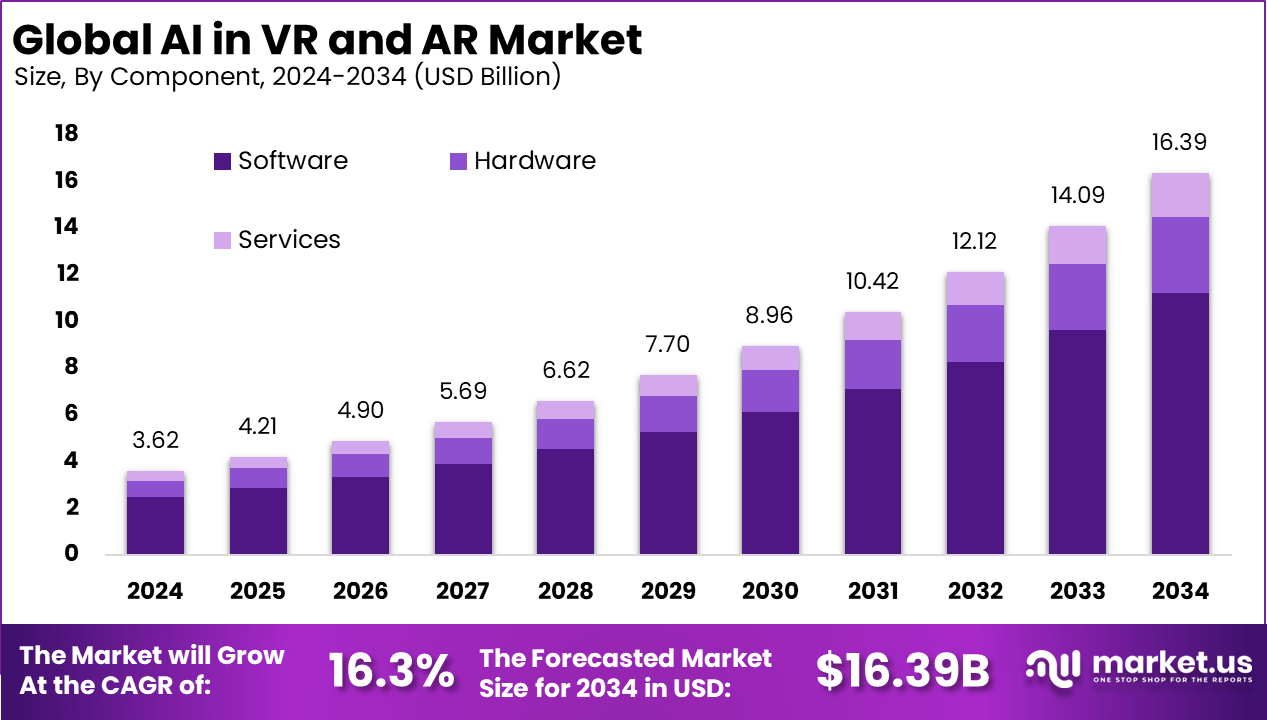
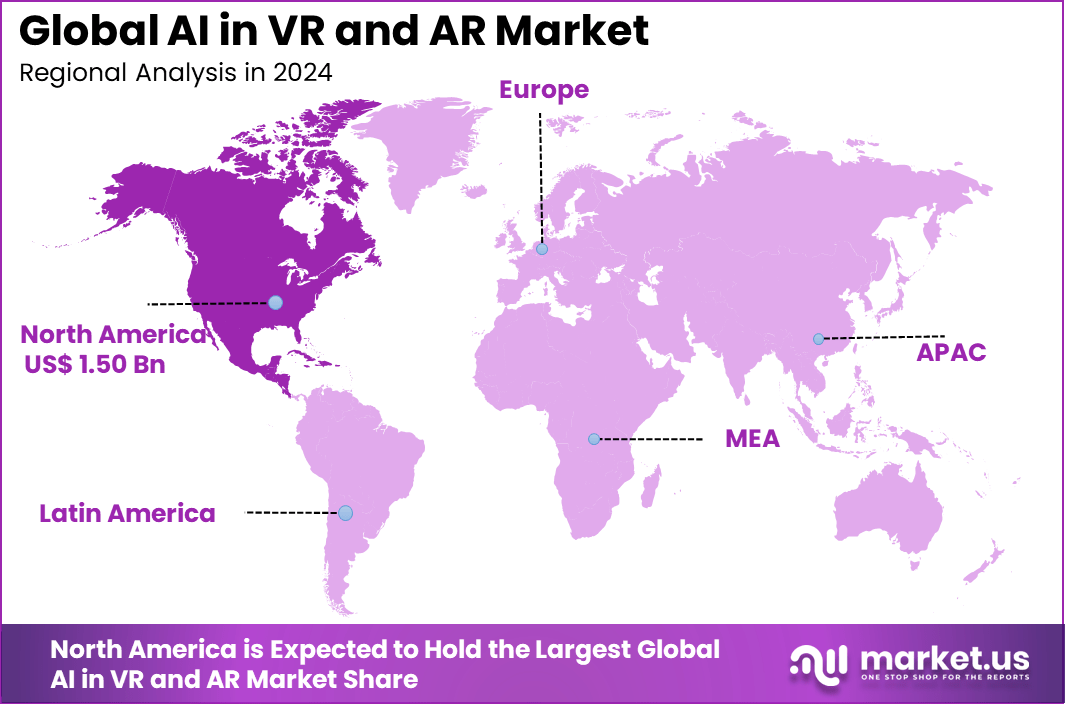
The Global AI in VR and AR Market size is expected to be worth around USD 16.39 billion by 2034, from USD 3.62 billion in 2024, growing at a CAGR of 16.3% during the forecast period from 2025 to 2034. North America held a dominant market position, capturing more than a 41.62% share, holding USD 1.50 billion in revenue.
AI in the virtual reality (VR) and augmented reality (AR) market refers to the integration of artificial intelligence technologies with immersive digital environments. In this context, AI enhances the functionality of VR and AR systems by enabling intelligent interactions, adaptive content, and real-time environmental understanding. These systems use machine learning, computer vision, natural language processing, and predictive analytics to create more responsive and personalized experiences.
The convergence of AI with immersive technologies is transforming how users perceive and interact with digital content in both simulated and real-world overlays. The adoption of AI within VR and AR extends across sectors such as gaming, healthcare, education, manufacturing, and retail. In gaming, AI enhances character behavior and environmental responsiveness, while in healthcare it supports training simulations and diagnostic overlays.
A primary driver of AI in VR and AR market expansion is the demand for more intuitive and immersive user experiences beyond static content delivery. AI enhances environmental perception, real time object recognition, and predictive responsiveness, which together create richer interaction models inside virtual and augmented environments. This capability is driving interest across industries that seek to differentiate customer engagement and internal process efficiency through advanced digital interfaces.
For instance, in October 2025, Magic Leap unveiled Android XR prototype AR glasses with Google, combining waveguide optics and microLED for stable, all-day visuals. This partnership emphasizes ecosystem collaboration over solo hardware, speeding AI-enhanced AR deployment for enterprise and consumer apps.
Demand for AI integrated VR and AR technologies is being shaped by the need for more personalized, adaptive, and context aware experiences among end users. In entertainment and gaming, users expect responsive environments that change based on individual behavior and preferences, augmenting engagement metrics. Industries such as retail embrace AI enabled AR to allow consumers to virtually try products and receive tailored suggestions, reducing purchase hesitation and returns.
Key Takeaway
- In 2024, software led the AI in VR and AR market with a 68.4% share, driven by demand for AI-powered content creation, analytics, and real-time interaction engines.
- Training and simulation accounted for 38.7%, reflecting strong adoption of immersive AI-driven environments for workforce training, education, and risk-free skill development.
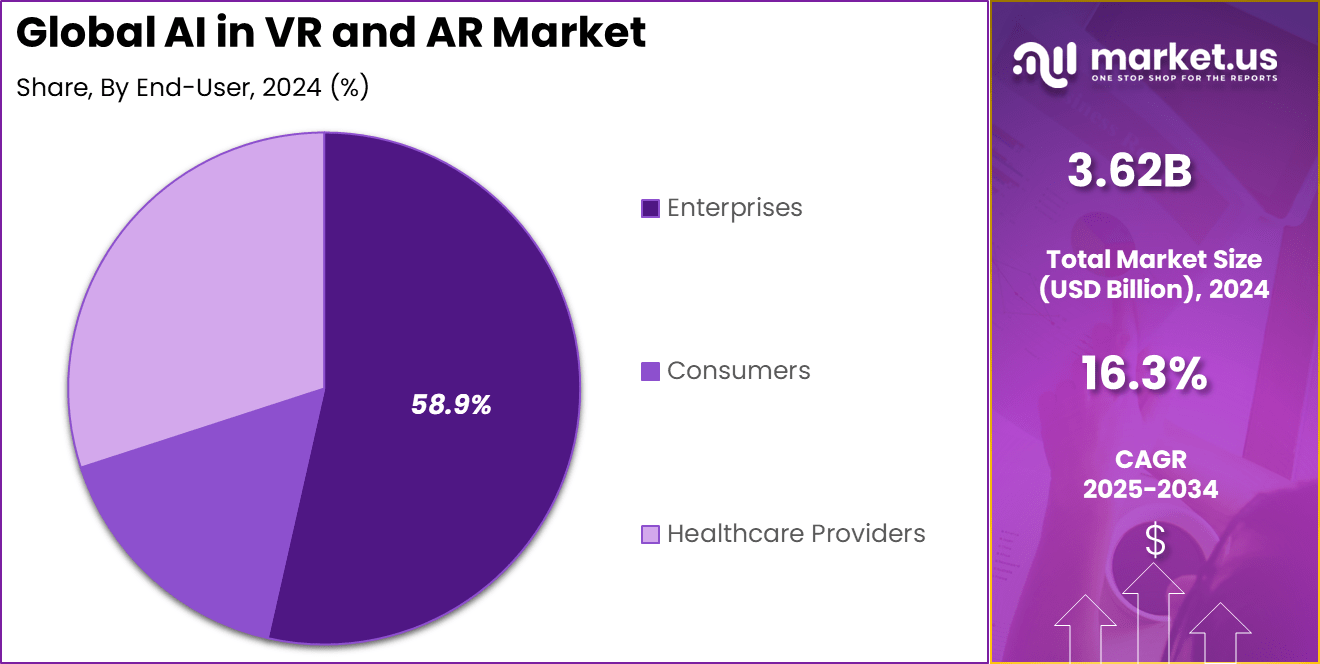
- Enterprises represented 58.9% of total demand, as organizations increasingly deploy AI-enabled VR and AR solutions for training, design, collaboration, and operational efficiency.
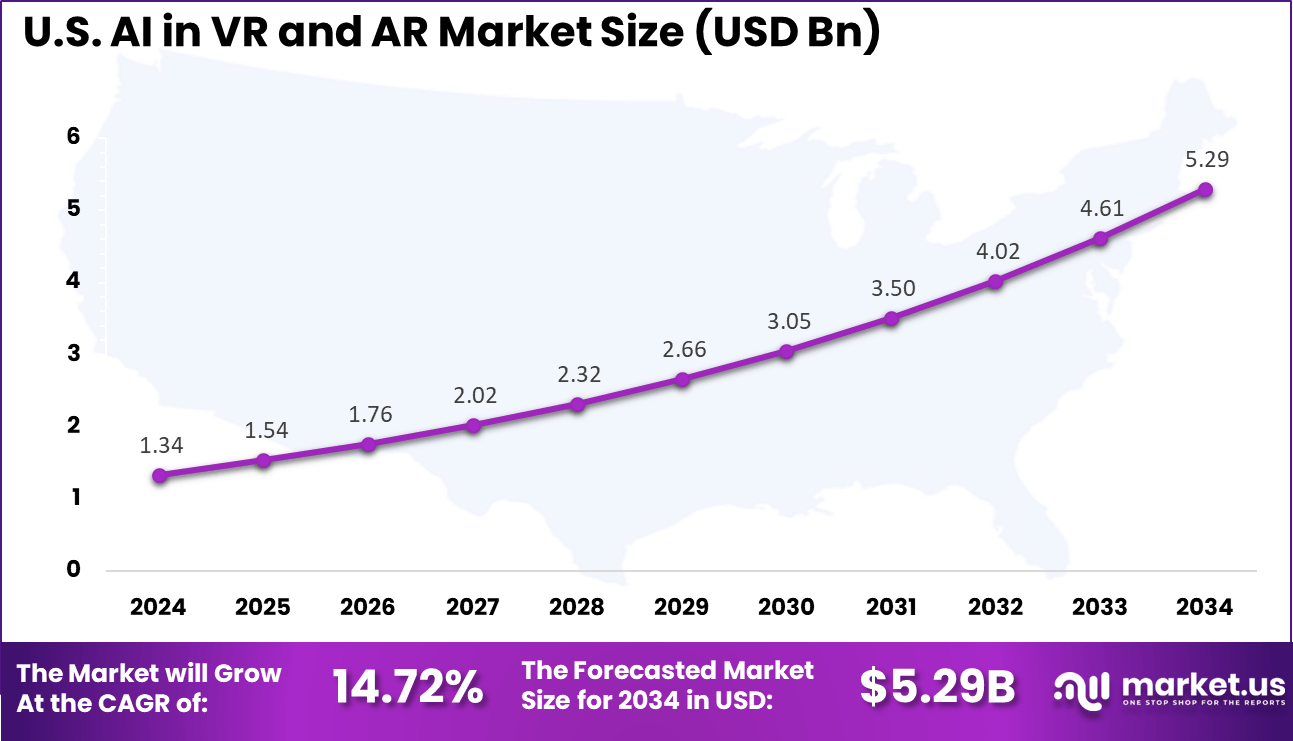
- The U.S. market reached USD 1.34 billion in 2024 and is expanding at a 14.72% CAGR, supported by enterprise investment and innovation in immersive technologies.
- North America dominated globally with over 41.62% share, backed by advanced digital infrastructure, early AI adoption, and strong presence of VR and AR solution providers.
Quick Facts
Global Adoption and Usage Rates
- AR user base: The U.S. is projected to reach 103.9 million AR users in 2026, up from 100.1 million in 2025. Globally, about 75% of the population is expected to be active AR users by early 2026.
- Mobile AR reach: Monthly active mobile AR users worldwide are expected to exceed 2 billion, driven largely by social media filters and retail applications.
- VR penetration: Global VR hardware penetration is estimated at 1.7% in 2026 and is expected to remain stable through 2027.
- Device shipments: Following a slowdown in 2025, headset shipments are forecast to rebound strongly in 2026 with around 87% growth as new product cycles resume.
Enterprise Adoption Statistics
- Fortune 500 integration: More than 75% of Fortune 500 companies already use XR for training, education, or production-related activities.
- Large enterprise usage: About 22% of large organizations actively use VR for training delivery, compared with 7% across organizations overall.
- Brand marketing: By 2026, nearly 75% of global brands are expected to adopt AR or VR in marketing initiatives.
- Productivity gains: AR-assisted workflows in maintenance and training report productivity improvements of 25-40%.
Consumer Usage and Preferences
- Shopping impact: Around 71% of consumers say they would shop more frequently with access to AR tools. AI-enabled AR try-ons are expected to reduce product return rates by up to 25% by 2026.
- AI-enhanced interaction: 78% of consumers prefer AR experiences enhanced with AI for real-time interaction and personalization.
- VR activity mix: Among VR users, 70% use it for gaming, 42% for entertainment such as films and TV, 35% for fitness and workouts, and 22% for creative arts.
U.S. AI in VR and AR Market Size
The market for AI in VR and AR within the U.S. is growing tremendously and is currently valued at USD 1.34 billion, the market has a projected CAGR of 14.72%. The market is growing due to rising demand for immersive training tools in enterprises, where software powers realistic simulations for skills like machine repair and emergency response.
For instance, in October 2025, Meta Platforms, Inc. unveiled advanced AI-powered smart glasses at Meta Connect 2025, featuring AI-enhanced object recognition, spatial mapping, and real-time AR interactions integrated with its social ecosystem. This launch from Menlo Park, California, reinforces U.S. leadership in consumer AR/VR by blending generative AI with lightweight hardware for everyday use.
In 2024, North America held a dominant market position in the Global AI in VR and AR Market, capturing more than a 41.62% share, holding USD 1.50 billion in revenue. This dominance is due to strong tech infrastructure and early adoption in key sectors like training and enterprise use. Businesses here lead with software-driven simulations that boost skills safely and cut real-world risks. Investments flow into smooth VR AR tools for healthcare and manufacturing, while skilled teams refine apps fast.
For instance, in January 2025, NVIDIA expanded Omniverse with generative physical AI models from Santa Clara, California, enabling synthetic data for robotics and vision AI. Partners like Siemens and Microsoft integrate this for industrial digital twins, solidifying North America’s AI-VR/AR dominance.
Component Analysis
In 2024, Software accounts for 68.4%, indicating that AI capabilities in VR and AR are mainly delivered through digital platforms. These software solutions enable intelligent interactions, object recognition, and real-time environment analysis. AI-driven software improves realism and responsiveness in virtual and augmented environments. Easy integration with existing VR and AR systems supports adoption. Software flexibility allows continuous feature enhancement.
The dominance of software is driven by rapid advancements in AI algorithms. Enterprises prefer software solutions that can be updated without replacing hardware. Software platforms also support scalability across multiple use cases. Centralized management improves operational efficiency. This sustains strong demand for AI software components.
For Instance, in September 2025, Meta Platforms, Inc. showcased generative AI tools at Meta Connect for building VR worlds without coding. These updates in Meta Horizon Studio let creators generate scenes and assets fast, cutting development time. Software now handles complex interactions smoothly, making immersive apps easier to launch.
Application Analysis
In 2024, Training and simulation account for 38.7%, making them the leading application segment. AI enhances VR and AR training by adapting scenarios based on user behavior. Simulation environments become more realistic and interactive. This improves skill development and retention. Organizations value immersive learning experiences.
Growth in this application is driven by demand for cost-effective training solutions. AI-powered simulations reduce reliance on physical training environments. Real-time feedback improves learning outcomes. VR and AR training also supports remote workforce development. This strengthens adoption across industries.
For instance, in February 2025, Microsoft Corporation expanded its IVAS program with Anduril for army training. The AR headset uses AI for real-time insights and soldier feedback in sims. It turns virtual drills into lifelike practice that builds skills without risks.
End-User Analysis
In 2024, The Enterprises represent 58.9%, highlighting their dominant role in market adoption. Organizations use AI-enabled VR and AR tools for training, design, and operations. Enterprise use cases require reliable and scalable solutions. AI improves decision-making within immersive environments. Businesses prioritize efficiency and accuracy.
Adoption among enterprises is driven by digital transformation initiatives. AI-powered immersive tools support workforce productivity. Enterprises seek measurable outcomes from VR and AR investments. Integration with business systems enhances value. This keeps enterprises as key users.
For Instance, in May 2024, Magic Leap, Inc. joined Google for XR enterprise tools. Their lightweight AR headset targets business training with better optics. Enterprises gain immersive workspaces for remote teams and hands-on practice.
Emerging Trend Analysis
The AI in Virtual Reality (VR) and Augmented Reality (AR) market is experiencing heightened adoption of intelligent spatial computing that enhances user interaction and environmental responsiveness. Artificial intelligence is increasingly being embedded within VR and AR systems to interpret user movements, gestures, and voice commands in real time, creating more intuitive and natural interfaces.
This development supports immersive experiences that feel personalized and interactive, particularly in training, gaming, healthcare, and visualization applications. As a result, AI-enabled VR and AR platforms are evolving from novelty tools into core drivers of digital experience design. Another emerging trend is the use of machine learning models to generate adaptive content and context-aware experiences within virtual environments.
AI systems analyze user behavior and environmental data to predict preferences, customize scenarios, and dynamically alter virtual elements to optimize engagement. This type of intelligent augmentation enhances both educational simulations and enterprise use cases by tailoring interactions to individual needs. The convergence of AI with VR/AR content engines is expanding beyond static digital overlays to fully adaptive experiential systems.
Key Market Segments
By Component
- Software
- Hardware
- Services
By Application
- Training & Simulation
- Gaming & Entertainment
- Retail & E-commerce
- Healthcare
- Industrial Maintenance & Design
- Others
By End-User
- Enterprises
- Consumers
- Healthcare Providers
- Educational Institutions
Regional Analysis and Coverage
- North America
- US
- Canada
- Europe
- Germany
- France
- The UK
- Spain
- Italy
- Russia
- Netherlands
- Rest of Europe
- Asia Pacific
- China
- Japan
- South Korea
- India
- Australia
- Singapore
- Thailand
- Vietnam
- Rest of Latin America
- Latin America
- Brazil
- Mexico
- Rest of Latin America
- Middle East & Africa
- South Africa
- Saudi Arabia
- UAE
- Rest of MEA
Top Driving Factors
The demand for enhanced user experience is a primary driver for AI in the VR and AR market. AI enables more natural interactions through gesture recognition, voice commands, and intelligent feedback, increasing the appeal of immersive systems. Improvements in computing power and edge processing capabilities have reduced latency, making complex AI-driven VR and AR applications feasible in real time.
The rise of connected devices and the proliferation of 5G networks further support the seamless integration of AI with immersive technology. Another key driver stems from the need for contextual and adaptive content delivery. AI algorithms can analyze user behavior to adjust virtual environments and present relevant information dynamically.
Cost reductions in sensor technologies and improved accessibility of development tools have lowered barriers to creating AI-enhanced VR and AR applications. Industry interest in digital transformation also pushes investment in intelligent immersive systems, reinforcing the growth momentum.
Restraint Analysis
One major restraint is the high cost associated with developing and deploying AI based VR and AR solutions. Combining artificial intelligence with immersive technology requires skilled talent, advanced hardware, and long development cycles. Smaller organizations may struggle to justify this investment due to budget limitations. As a result, adoption remains uneven across industries.
Another restraint is technical complexity related to system integration and data requirements. AI models need large volumes of accurate data to function effectively within VR and AR environments. Integrating these models with existing software systems can be challenging and time consuming. These technical barriers may slow implementation and limit scalability.
Opportunity Analysis
There is strong opportunity in using AI driven VR and AR solutions for professional training and workforce development. Simulated environments allow users to practice skills safely while AI provides real time feedback and performance evaluation. This approach reduces training costs and improves learning efficiency. Demand for virtual training is increasing across technical and operational roles.
Another opportunity lies in combining AI powered VR and AR with enterprise systems such as digital twins and remote assistance platforms. This integration enables real time visualization of data and guided decision making. Workers can receive contextual instructions while interacting with physical assets. Such applications improve accuracy, safety, and productivity in industrial environments.
Challenge Analysis
A key challenge is ensuring responsible use of artificial intelligence within immersive environments. AI systems influence how users perceive and interact with digital content, which raises concerns around privacy and data protection. Clear governance and transparent system design are required to maintain user trust. Without proper controls, acceptance may be limited.
Another challenge is the lack of standardization across VR and AR platforms. Differences in software frameworks and device compatibility can restrict content portability and system integration. Developers often need to customize solutions for each platform, increasing cost and complexity. Addressing interoperability issues is critical for long term market growth.
Key Players Analysis
Meta Platforms, Inc., Microsoft Corporation, Google LLC, and Apple, Inc. lead the AI in VR and AR market by integrating artificial intelligence into immersive hardware, operating systems, and developer platforms. Their solutions enable spatial computing, intelligent avatars, real time interaction, and advanced content personalization. These companies focus on ecosystem control, user experience, and large scale AI model integration.
NVIDIA Corporation, Unity Software, Inc., Epic Games, Inc., and Qualcomm Technologies, Inc. strengthen the market through AI accelerated graphics, real time rendering engines, and edge optimized chipsets. Their technologies power realistic simulations, intelligent environments, and low latency AR and VR experiences. These providers emphasize performance optimization, developer tools, and cross platform deployment. Increasing demand for high fidelity immersive content supports wider adoption.
Magic Leap, Inc., Varjo Technologies Oy, Ultraleap, Ltd., Niantic, Inc., Scope AR, and Talespin Reality, Inc. expand the landscape with AI driven hand tracking, industrial AR, location based experiences, and immersive training solutions. Their offerings target enterprise, education, and simulation use cases. These companies focus on precision, realism, and applied AI workflows. Growing use of VR and AR in training and operations continues to drive steady market growth.
Top Key Players in the Market
- Meta Platforms, Inc.
- Microsoft Corporation
- Google LLC
- NVIDIA Corporation
- Unity Software, Inc.
- Epic Games, Inc.
- Qualcomm Technologies, Inc.
- Magic Leap, Inc.
- Varjo Technologies Oy
- PTC, Inc.
- Apple, Inc.
- Ultraleap, Ltd.
- Niantic, Inc.
- Scope AR
- Talespin Reality, Inc.
- Others
Recent Developments
- In September 2025, Google previewed Android XR smart glasses prototypes with on-device Gemini AI for live translation and navigation, partnering with Samsung, Magic Leap, and others. This ecosystem push positions Google as the AR software backbone, enabling developers to build scalable AI experiences across hardware makers.
- In November 2025, Epic released Unreal Engine 5.7 with AI-assisted automation for large-scale VR worlds, including batch MetaHuman processing and an in-editor AI coding assistant. Studios report 50% faster asset creation, making high-fidelity AR/VR production more accessible for teams building immersive simulations.
Report Scope
Report Features Description Market Value (2025) USD 3.6 Bn Forecast Revenue (2035) USD 16.3 Bn CAGR(2025-2035) 16.3% Base Year for Estimation 2025 Historic Period 2020-2024 Forecast Period 2026-2035 Report Coverage Revenue forecast, AI impact on Market trends, Share Insights, Company ranking, competitive landscape, Recent Developments, Market Dynamics and Emerging Trends Segments Covered By Component (Software, Hardware, Services), By Application (Training & Simulation, Gaming & Entertainment, Retail & E-commerce, Healthcare, Industrial Maintenance & Design, Others), By End-User (Enterprises, Consumers, Healthcare Providers, Educational Institutions) Regional Analysis North America – US, Canada; Europe – Germany, France, The UK, Spain, Italy, Russia, Netherlands, Rest of Europe; Asia Pacific – China, Japan, South Korea, India, New Zealand, Singapore, Thailand, Vietnam, Rest of Latin America; Latin America – Brazil, Mexico, Rest of Latin America; Middle East & Africa – South Africa, Saudi Arabia, UAE, Rest of MEA Competitive Landscape Meta Platforms, Inc., Microsoft Corporation, Google LLC, NVIDIA Corporation, Unity Software, Inc., Epic Games, Inc., Qualcomm Technologies, Inc., Magic Leap, Inc., Varjo Technologies Oy, PTC, Inc., Apple, Inc., Ultraleap, Ltd., Niantic, Inc., Scope AR, Talespin Reality, Inc., Others Customization Scope Customization for segments, region/country-level will be provided. Moreover, additional customization can be done based on the requirements. Purchase Options We have three license to opt for: Single User License, Multi-User License (Up to 5 Users), Corporate Use License (Unlimited User and Printable PDF) 
-
-
- Meta Platforms, Inc.
- Microsoft Corporation
- Google LLC
- NVIDIA Corporation
- Unity Software, Inc.
- Epic Games, Inc.
- Qualcomm Technologies, Inc.
- Magic Leap, Inc.
- Varjo Technologies Oy
- PTC, Inc.
- Apple, Inc.
- Ultraleap, Ltd.
- Niantic, Inc.
- Scope AR
- Talespin Reality, Inc.
- Others
Our Clients

- 172839
- Jan. 2026









