


Market Overview
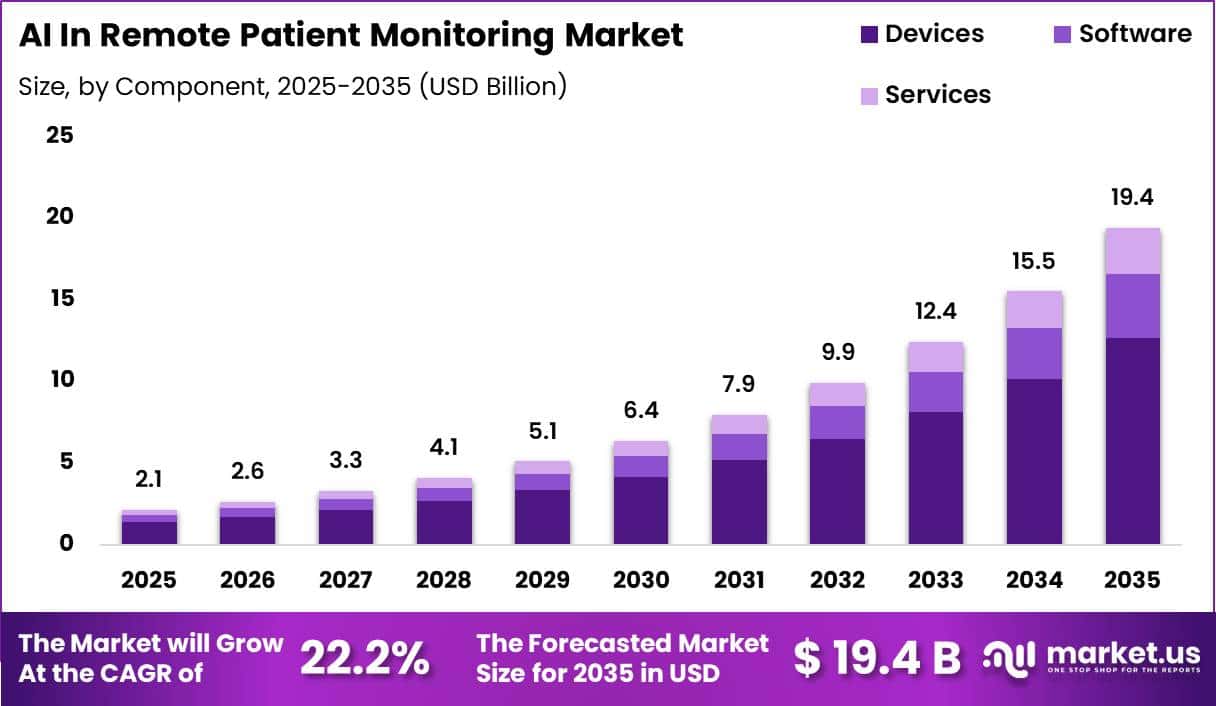
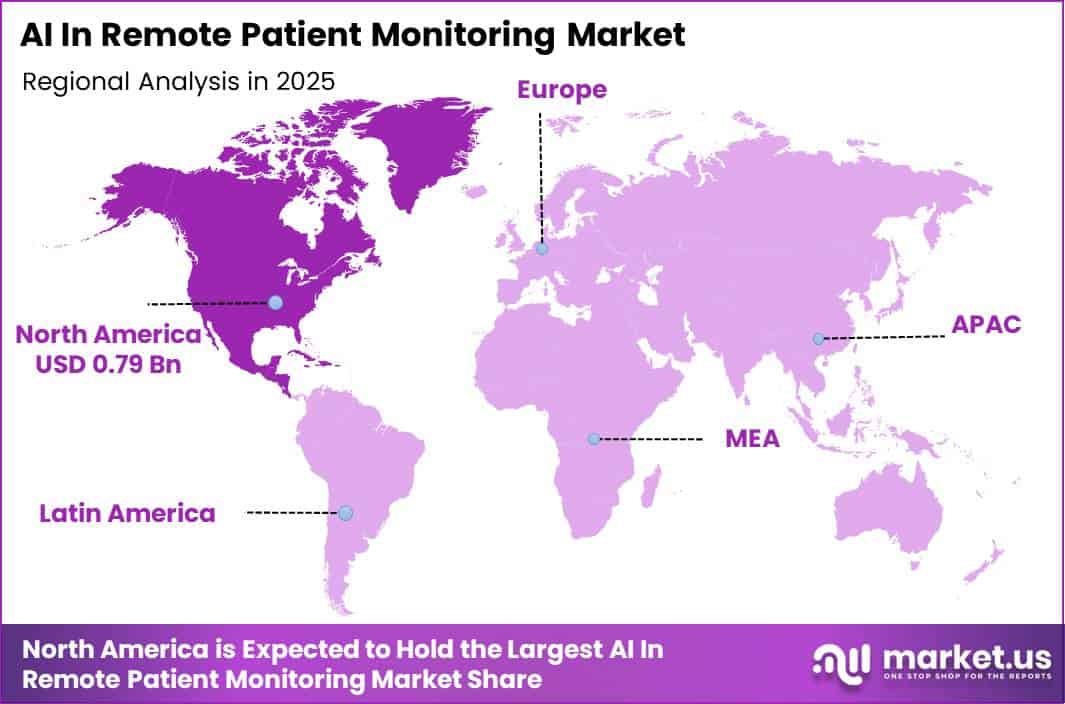
The Global AI in Remote Patient Monitoring Market size is expected to be worth around US$ 19.4 Billion by 2035 from US$ 2.1 Billion in 2025, growing at a CAGR of 22.2% during the forecast period from 2026 to 2035. In 2025, North America led the market, achieving over 37.55% share with a revenue of US$ 0.79 Billion.
The Global AI in Remote Patient Monitoring Market is transforming healthcare delivery by enabling continuous, data-driven monitoring of patients outside traditional clinical settings. Artificial intelligence integration with remote patient monitoring platforms allows healthcare providers to analyze real-time physiological data, identify early warning signals, personalize treatment plans, and improve chronic disease management.
According to the Centers for Medicare & Medicaid Services, remote patient monitoring enables patients to collect health information such as blood pressure, weight, and glucose levels through connected medical devices that automatically transmit data to healthcare providers for clinical decision-making. The increasing burden of chronic diseases is a major factor supporting AI-powered RPM adoption.
The Centers for Disease Control and Prevention reports that chronic diseases are leading causes of illness, disability, and death, with three out of four U.S. adults having at least one chronic condition and more than half experiencing multiple chronic conditions. AI-enabled monitoring solutions are increasingly used for cardiovascular diseases, diabetes, respiratory disorders, and elderly care by providing predictive analytics and automated alerts.
Technological advancements in wearable sensors, connected medical devices, cloud-based healthcare platforms, and machine learning algorithms are accelerating market development. AI systems can process large volumes of patient data, including heart rate, oxygen saturation, glucose readings, and activity patterns, helping clinicians make faster and more informed decisions.
Regulatory initiatives are also supporting digital health innovation, with the Food and Drug Administration expanding initiatives focused on digital health technologies for chronic disease management. Overall, AI-driven remote patient monitoring is becoming a critical component of value-based healthcare by improving accessibility, reducing unnecessary hospital visits, and enabling proactive patient management.
Key Takeaways
- Market Size: The Global AI in Remote Patient Monitoring Market size was US$ 2.1 billion in 2025. The market is estimated to grow to US$ 19.4 billion by 2035.
- Market Share: The Compound Annual Growth Rate (CAGR) of the market from 2026 to 2035 will be 22.2%.
- Component: Devices leads the segment, accounting for 65.40% of total component revenue.
- Clinical Application: Cardiovascular Monitoring leads the segment, accounting for 24.67% of total clinical application revenue.
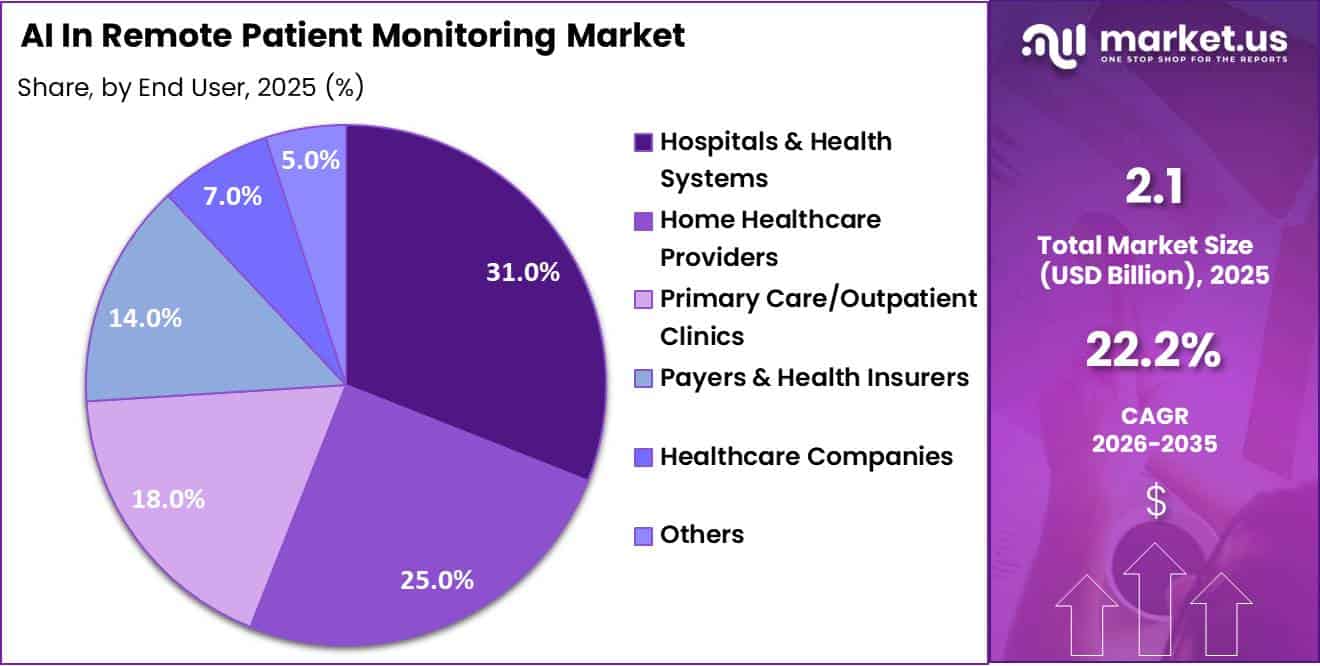
- End User: Hospitals & Health Systems lead the segment, accounting for 31% of total end-user revenue.
- Regional: North America is the dominant regional market, accounting for 37.55% of global revenue, holding US$ 0.79 billion in revenue in 2025.
Component Analysis
The Component segment of the AI in Remote Patient Monitoring Market is categorized into Devices, Software, and Services. Among these, the Devices segment dominates the market with a 65.40% share in 2025, driven by the growing adoption of wearable health trackers, smart medical devices, connected monitoring equipment, and IoT-enabled patient care solutions.
AI-powered devices such as smart glucose monitors, cardiac monitoring patches, pulse oximeters, and wearable sensors enable continuous collection of real-time health data, supporting early disease detection and personalized care management.
The Software segment accounts for 20.0% market share in 2025, supported by increasing demand for AI analytics platforms, cloud-based patient monitoring systems, predictive algorithms, and clinical decision-support tools. These software solutions help healthcare professionals analyze large volumes of patient data, generate alerts, and improve remote care outcomes.
The Services segment contributes 14.6% market share in 2025, including installation, maintenance, data management, technical support, and remote monitoring services. Growing healthcare digitization and the shift toward value-based care models are increasing demand for professional services that ensure effective implementation and long-term operation of AI-based remote monitoring platforms.
Clinical Application Analysis
The Clinical Application segment of the AI in Remote Patient Monitoring Market includes Cardiovascular Monitoring, Diabetes Management, Respiratory Monitoring, Oncology Remote Monitoring, Mental Health & Behavioral Monitoring, Post-operative & Home Recovery, Sleep Disorders & Neurological Monitoring, and Others.
Among these applications, Cardiovascular Monitoring dominates the market with a 24.67% share in 2025, supported by the rising prevalence of cardiovascular diseases and increasing demand for continuous heart health monitoring solutions. AI-enabled ECG monitoring, arrhythmia detection, blood pressure tracking, and predictive analytics are helping clinicians identify cardiac risks at an early stage.
Diabetes Management represents a significant application area due to increasing adoption of continuous glucose monitoring devices and AI-based glucose prediction technologies. Respiratory Monitoring is expanding through AI-enabled oxygen saturation tracking and connected respiratory devices for patients with chronic respiratory conditions.
Oncology Remote Monitoring is gaining importance as AI tools support symptom tracking, treatment response monitoring, and early identification of complications. Mental Health & Behavioral Monitoring is growing with AI-driven digital assessments and remote patient engagement platforms.
Additionally, Post-operative & Home Recovery, Sleep Disorders & Neurological Monitoring, and other applications are contributing to market expansion by improving long-term patient management and reducing hospital readmissions.
End User Analysis
The End User segment of the AI in Remote Patient Monitoring Market comprises Hospitals & Health Systems, Home Healthcare Providers, Primary Care/Outpatient Clinics, Payers & Health Insurers, Healthcare Companies, and Others.
The Hospitals & Health Systems segment dominates the market with a 31.0% share in 2025, driven by increasing adoption of AI-powered monitoring solutions for chronic disease management, post-discharge care, and reducing hospital readmission rates.
Hospitals are integrating remote monitoring platforms with electronic health records (EHRs) to improve clinical workflows and enable continuous patient observation. Home Healthcare Providers account for 25.0% market share in 2025, supported by the growing preference for home-based care, aging populations, and demand for convenient healthcare delivery models.
AI-enabled RPM solutions allow caregivers to monitor patients remotely while improving access to healthcare services. Primary Care/Outpatient Clinics contribute 18.0% market share, as physicians increasingly use remote monitoring tools for preventive care and chronic disease follow-up.
Payers & Health Insurers hold a 14.0% share, driven by reimbursement initiatives and cost-saving strategies focused on reducing emergency visits and hospitalizations.
Healthcare Companies represent 7.0% market share, with technology providers developing AI-driven healthcare platforms, while Others account for 5.0%, including research institutions and specialized healthcare organizations adopting remote monitoring technologies.
Key Market Segments
By Component
- Devices
- Wearable Devices
- Implantable Devices
- Portable and Handheld Devices
- Stationary Devices
- Software
- Services
By Clinical Application
- Cardiovascular Monitoring
- Diabetes Management
- Respiratory Monitoring
- Oncology Remote Monitoring
- Mental Health & Behavioral Monitoring
- Post-Operative & Home Recovery
- Sleep Disorders & Neurological Monitoring
- Others
By End User
- Hospitals & Health Systems
- Home Healthcare Providers
- Primary Care/Outpatient Clinics
- Payers & Health Insurers
- Healthcare Companies
- Others
Drivers
Chronic disease scale and earlier intervention economics
The addressable need for AI in remote patient monitoring RPM is expanding due to the large and rising chronic disease burden. CDC data indicates chronic diseases are the primary drivers of the USD 5.3 trillion in annual U.S. healthcare costs, with three in four adults having at least one chronic condition and over 50 % having two or more, while in adults aged 65 and older, more than 90 % have at least one chronic disease. This high disease density significantly strengthens the economic case for continuous monitoring systems.
In this context, RPM value shifts from simple data collection to AI-driven exception management, where continuous surveillance identifies deterioration early, prioritises high-risk patients, and reduces unnecessary clinical workload.
The strongest impact is seen in hypertension, heart failure, diabetes, COPD, and post-acute care transitions, where avoiding even a single hospitalization or emergency department visit can offset multiple months of RPM device and software costs.
Evidence from heart failure RPM programs supports this economic shift, with some studies reporting up to a 44 % reduction in ER visits and a 49 % reduction in mean hospitalization costs per patient during monitoring periods (2025 review), though outcomes remain heterogeneous across program designs. This variability reinforces demand for AI native RPM platforms that improve triage accuracy, adherence management, and risk scoring.
Overall, the scale of chronic disease combined with earlier intervention economics is accelerating adoption of intelligent RPM systems, particularly those that demonstrate measurable reductions in utilisation rather than passive monitoring alone.
| Driver | (~) % Impact on CAGR Forecast | Geographic Relevance | Impact Timeline |
|---|---|---|---|
| CMS reimbursement expansion for lower-intensity RPM episodes | +2.4% | North America core, US spill-over to payer-led models | Short term (≤ 2 years) |
| Chronic disease scale and earlier intervention economics | +2.1% | North America core, EU, APAC urban corridors, GCC | Medium term (2-4 years) |
| FDA AI lifecycle clarity and faster commercialization discipline | +1.8% | North America core, EU-adjacent compliance markets, APAC export hubs | Short term (≤ 2 years) |
| Connected diabetes and cardiometabolic monitoring demand surge | +1.7% | US, EU5, China, India, Southeast Asia, Latin America spill-over | Medium term (2-4 years) |
| Care-model shift from episodic follow-up to continuous triage workflows | +1.5% | North America core, UK, Nordics, Australia, advanced APAC systems | Medium term (2-4 years) |
| Cybersecurity and standards-led enterprise buying confidence | +1.1% | US, EU, Japan, South Korea, hospital-led procurement markets | Long-term (≥ 4 years) |
Challenge
Algorithm bias and validation load in AI-enabled RPM platforms
AI models used in remote patient monitoring systems depend heavily on historical EHR and connected device data, but chronic disease populations are highly heterogeneous across age, race, income, and geography. This makes bias detection and mitigation a continuous operational requirement rather than a one time validation step, effectively acting as a structural bottleneck to scale.
Regulatory expectations are also increasing. Vendors are now required to produce detailed impact assessment and risk management IRM documentation and subgroup performance analyses before enterprise deployment. This means models must be validated across multiple cohorts, such as patients with HbA1c greater than 9, multimorbidity clusters, and low-access populations, before procurement approval by large health systems.
Performance variation across subgroups is material. While RPM predictive models for heart failure and diabetes complications often achieve overall AUCs of 0.78 to 0.86, subgroup performance can drop to 0.65 to 0.70 in underrepresented populations. Correcting this requires iterative retraining cycles of 6 to 12 months per major release, often using datasets of 50,000 to 100,000 patient-months to reach acceptable fairness and reliability thresholds.
In parallel, FDA lifecycle guidance and post-market surveillance expectations are pushing vendors toward continuous monitoring of models in production, requiring ongoing tracking of millions of data points per month and formal documentation of performance drift and updates.
This increases AI RPM R and D and compliance costs by 15 to 25 %, slows product iteration by 1 to 2 release cycles per year, and contributes an estimated approximately 1.3 % point drag on potential CAGR.
Strategically, overcoming this requires scalable bias testing infrastructure, synthetic data augmentation, and multi-institution data collaboratives, capabilities that are still maturing and are expected to take around 4 years to become operationally efficient at scale.
| Challenge | (~) % CAGR Friction Drag | Geographic Relevance | Mitigation Horizon |
|---|---|---|---|
| Fragmented data integration | -1.8% | North America core, EU, APAC corridors | Medium term (2-4 years) |
| Clinical workflow adoption gap | -1.5% | North America core, EU hospital hubs | Medium term (2-4 years) |
| Algorithm bias & validation load | -1.3% | U.S. regulated markets, EU, select APAC | Long-term (≥ 4 years) |
| Reimbursement and coding complexity | -1.2% | U.S., Canada, EU payers | Medium term (2-4 years) |
| Cybersecurity & privacy overhead | -1.0% | Global, high-digitization health systems | Long-term (≥ 4 years) |
| Chronic disease data volume strain | -0.9% | Global diabetes & CVD clusters | Short term (≤ 2 years) |
Restraints
Complex evolving AI medical device regulation
The regulatory environment for AI-enabled remote patient monitoring RPM and software as a medical device SaMD solutions is becoming increasingly detailed and continuously evolving, particularly under FDA draft guidance on AI lifecycle management and AI-enabled device software functions, alongside EU AI Act and MDR alignment frameworks.
As a result, AI RPM tools that provide diagnostic or triage recommendations are more consistently classified as regulated medical devices, increasing compliance burden across development and commercialization.
In the U.S., premarket submission requirements can extend approval timelines by 12 to 24 months and add approximately 8 to 12 % to total development and validation costs. This includes mandatory post-market surveillance, structured reporting of algorithm updates, and detailed model change documentation.
In parallel, EU AI Act risk classification and conformity assessment requirements introduce additional obligations around transparency, data governance, and explainability artifacts.
Operationally, these requirements force vendors to build continuous monitoring infrastructure and audit-ready data pipelines, consuming roughly 10 to 15 % of engineering capacity that could otherwise be allocated to product innovation and market expansion.
Compliance functions, including regulatory affairs staffing, quality systems, and audit preparation, can increase operating expenditure by 20 to 30 % per solution, particularly for early-stage AI RPM companies.
Strategically, this regulatory complexity slows commercialization by delaying multi-country rollouts by 18 to 30 months, compresses early margin profiles, and discourages rapid scaling of AI-heavy RPM platforms.
Providers and payers often defer large-scale deployments until regulatory expectations stabilize, resulting in an estimated approximately 2.5 % point reduction in CAGR potential across key U.S., EU, and early adopting APAC markets over the next 2 to 4 years.
| Restraint | (~) % Impact on CAGR Forecast | Geographic Relevance | Impact Timeline |
|---|---|---|---|
| Complex, evolving AI medical device regulation | -2.5% | US, EU core, select APAC | Medium term (2-4 years) |
| Fragmented RPM reimbursement and coding volatility | -2.2% | US, EU mixed, emerging APAC | Short–Medium term (≤ 4 years) |
| Data privacy, cybersecurity, and HIPAA/GDPR compliance drag | -2.0% | US, EU, high-income APAC | Long-term (≥ 4 years) |
| Interoperability gaps with EHRs and legacy clinical workflows | -1.8% | US, EU, APAC urban corridors | Medium–Long term (≥ 3 years) |
| AI bias, clinical liability, and trust deficits among clinicians | -1.7% | US, EU, OECD markets | Long-term (≥ 4 years) |
| Device supply, connectivity, and digital divide constraints | -1.5% | Rural US, emerging APAC, LATAM, Africa | Short–Medium term (≤ 4 years) |
Opportunity
Multimorbidity risk orchestration in AI RPM platforms
The key medium term upside in AI-enabled remote patient monitoring RPM lies in multimorbidity orchestration, where systems evolve from single disease monitoring to integrated risk management across cardio, kidney metabolic, behavioural health, and musculoskeletal conditions.
This is increasingly aligned with CMS direction toward more holistic value-based care models that recognize overlapping chronic disease burdens rather than siloed condition management.
The opportunity exists because today’s RPM market remains fragmented by disease area, device category, and specialty workflows. As a result, there is substantial whitespace for cross-condition AI engines that can prioritize interventions based on combined risk trajectories instead of isolated threshold alerts.
An advanced multimorbidity platform that enables 7 to 14 days earlier deterioration prediction, increases appropriate intervention rates by 15 to 25 %, and supports cross-condition expansion across multiple chronic care programs could materially improve both clinical efficiency and payer economics. These improvements also enable stronger cross-sell dynamics across cardiovascular, metabolic, and behavioral health cohorts.
If successfully deployed at scale, such systems could justify an estimated approximately 2.1 % point uplift in CAGR, driven primarily by North America and the EU under value-based care contracts that reward reduced fragmentation, and increasingly by APAC markets where multimorbidity prevalence is rising alongside aging populations and urban disease clustering.
| Opportunity | (~) % Potential CAGR Upside | Geographic Relevance | Execution Window |
|---|---|---|---|
| Value-based chronic care bundles | +2.4% | North America core, UK, EU | Short term (≤ 2 years) |
| Diabetes AI-RPM specialty layer | +1.9% | North America core, APAC urban | Short term (≤ 2 years) |
| Short-cycle post-acute RPM | +1.6% | North America, EU, Gulf | Short term (≤ 2 years) |
| Low-friction SMB/provider SaaS | +1.3% | North America tier-2, EU | Medium term (2-4 years) |
| Multimorbidity risk orchestration | +2.1% | EU, North America, APAC | Medium term (2-4 years) |
| Emerging-market home monitoring | +1.5% | APAC, Latin America, MENA | Long term (≥ 4 years) |
Regional Analysis
In 2025, North America led the market, achieving over 37.55% share with a revenue of US$ 0.79 billion. The region’s dominance is attributed to the strong adoption of digital healthcare technologies, advanced healthcare infrastructure, increasing prevalence of chronic diseases, and widespread implementation of artificial intelligence-driven healthcare solutions.
The United States plays a major role in regional growth due to the presence of advanced hospitals, integrated electronic health record (EHR) systems, and favorable reimbursement frameworks supporting remote patient monitoring services.
Government initiatives, including expanded Medicare coverage for remote monitoring services by the Centers for Medicare & Medicaid Services (CMS), have encouraged healthcare providers to adopt connected monitoring technologies.
Europe represents a significant market, supported by increasing healthcare digitalization, aging populations, and government initiatives promoting telehealth and remote care delivery. Countries across the region are investing in AI-enabled healthcare platforms to improve chronic disease management and reduce healthcare system burdens.
The Asia Pacific region is expected to witness strong growth due to rising healthcare investments, increasing smartphone and internet penetration, and growing demand for affordable remote healthcare solutions. Countries such as Japan, China, and South Korea are adopting AI-based monitoring technologies to support elderly care and chronic disease management.
Latin America, the Middle East & Africa are gradually expanding with improving healthcare infrastructure, increasing awareness of digital health solutions, and government efforts to enhance remote healthcare accessibility.
Overall, global adoption of AI-powered remote patient monitoring is accelerating as healthcare systems shift toward preventive, personalized, and value-based care models.
Key Regions and Countries
North America
- The US
- Canada
Europe
- Germany
- France
- The U.K.
- Italy
- Spain
- Russia & CIS
- Rest of Europe
Asia Pacific
- China
- India
- Japan
- South Korea
- ASEAN
- Australia & New Zealand
- Rest of Asia Pacific
Middle East & Africa
- GCC
- South Africa
- Rest of Middle East & Africa
Latin America
- Brazil
- Mexico
- Rest of Latin America
Key Player Analysis
Suppliers in the global AI in remote patient monitoring market are pursuing competitive advantage through advanced platforms that analyze continuous physiological data using machine learning algorithms trained on longitudinal wearable sensor datasets.
These solutions are designed to identify early deterioration signals, predict acute exacerbation events, and generate actionable clinical alerts, enabling timely intervention for patients with cardiovascular, respiratory, and metabolic chronic diseases.
Key strategic priorities include the development of FDA-cleared AI algorithms that demonstrate improved clinical outcomes through prospective hospital and home monitoring studies. Seamless electronic health record integration is also being emphasized to embed alerts into existing clinical workflows.
In parallel, value-based economic models are being developed to demonstrate reductions in hospital readmissions, emergency department visits, and overall payer costs, supporting reimbursement and procurement decisions.
Investment is further directed toward multimodal sensor fusion combining ECG, photoplethysmography, accelerometry, temperature, and blood glucose data. Reliable cellular and Bluetooth connectivity, alongside patient engagement interfaces, is being strengthened to improve monitoring adherence.
Growing payer adoption of CMS CPT codes 99453, 99454, 99457, and 99458 is improving reimbursement visibility and supporting sustained institutional investment in AI-enabled remote monitoring programs through 2035.
Top Key Players
- BioIntelliSense
- Jorie Healthcare Partners
- HealthSnap Inc.
- Roche
- Dexcom
- CompuGroup Medical
- Abbott
- Kakao Healthcare Corp.
- Powerful Medical
- Idoven
- Viatom Technology Co., Ltd.
- Lepu Medical (Carewell China)
- AliveCor Inc.
- 100Plus
- Datos
- Credo Health AI
- Center Health
- Other Key Players
Recent Developments
- In January 2026, Abbott expanded its AI-powered continuous glucose monitoring and cardiovascular remote monitoring platform across North American and European hospital health system and home healthcare provider institutional buyers, targeting integrated chronic disease remote monitoring program deployment for diabetic and cardiac patient populations.
- In February 2026, Dexcom launched an enhanced AI analytics layer for its continuous glucose monitoring platform integrating predictive hypoglycemia and hyperglycemia alert algorithms, securing expanded payer reimbursement authorization across North American commercial insurance and Medicare remote monitoring program frameworks.
- In March 2026, BioIntelliSense secured a multi-year remote patient monitoring platform supply agreement with a leading North American hospital health system network, covering AI-powered continuous vital sign monitoring device deployment across post-operative and chronic disease management home recovery institutional patient programs.
- In May 2026, AliveCor Inc. expanded its KardiaMobile AI-powered personal ECG monitoring device distribution across Asia Pacific primary care clinic and home healthcare provider institutional buyers, targeting growing cardiovascular remote monitoring adoption among atrial fibrillation and hypertension patient populations across Japanese, South Korean, and Australian markets.
Report Scope
| Report Features | Description |
|---|---|
| Market Value (2025) | US$ 2.1 Billion |
| Forecast Revenue (2035) | US$ 19.4 Billion |
| CAGR (2026-2035) | 22.2% |
| Base Year for Estimation | 2025 |
| Historic Period | 2020-2024 |
| Forecast Period | 2026-2035 |
| Report Coverage | Revenue Forecast, Market Dynamics, Competitive Landscape, Recent Developments |
| Segments Covered | By Component (Devices, Software, Services), By Clinical Application (Cardiovascular Monitoring, Diabetes Management, Respiratory Monitoring, Oncology Remote Monitoring, Mental Health & Behavioral Monitoring, Post-Operative & Home Recovery, Sleep Disorders & Neurological Monitoring, Others), By End User (Hospitals & Health Systems, Home Healthcare Providers, Primary Care/Outpatient Clinics, Payers & Health Insurers, Healthcare Companies, Others) |
| Regional Analysis | North America – The US, Canada; Europe – Germany, France, U.K., Italy, Spain, Russia & CIS, Rest of Europe; Asia Pacific – China, India, Japan, South Korea, ASEAN, Australia & New Zealand, Rest of Asia Pacific; Middle East & Africa – GCC, South Africa, Rest of Middle East & Africa; Latin America – Brazil, Mexico, Rest of Latin America |
| Competitive Landscape | BioIntelliSense, Jorie Healthcare Partners, HealthSnap Inc., Roche, Dexcom, CompuGroup Medical, Abbott, Kakao Healthcare Corp., Powerful Medical, Idoven, Viatom Technology Co., Ltd., Lepu Medical (Carewell China), AliveCor Inc., 100Plus, Datos, Credo Health AI, Center Health, Other Key Players |
| Customization Scope | Customization for segments, region/country-level will be provided. Moreover, additional customization can be done based on the requirements. |
| Purchase Options | We have three licenses to opt for: Single User License, Multi-User License (Up to 5 Users), Corporate Use License (Unlimited User and Printable PDF) |





































