Global AI In Appliances and Electronics Market Size, Share and Analysis Report By Component (Hardware, Software, Services), By Technology (Machine Learning, Natural Language Processing, Computer Vision, Speech Recognition, Others), By Application (Smart Refrigerators, Smart Ovens, Smart Washing Machine, Smart TVS, Smart Speakers, Smartwatches, Security Systems with Smart Cameras, Others), By Regional Analysis, Global Trends and Opportunity, Future Outlook By 2025-2035
- Published date: Feb. 2026
- Report ID: 179062
- Number of Pages: 274
- Format:
-
keyboard_arrow_up
Quick Navigation
Report Overview
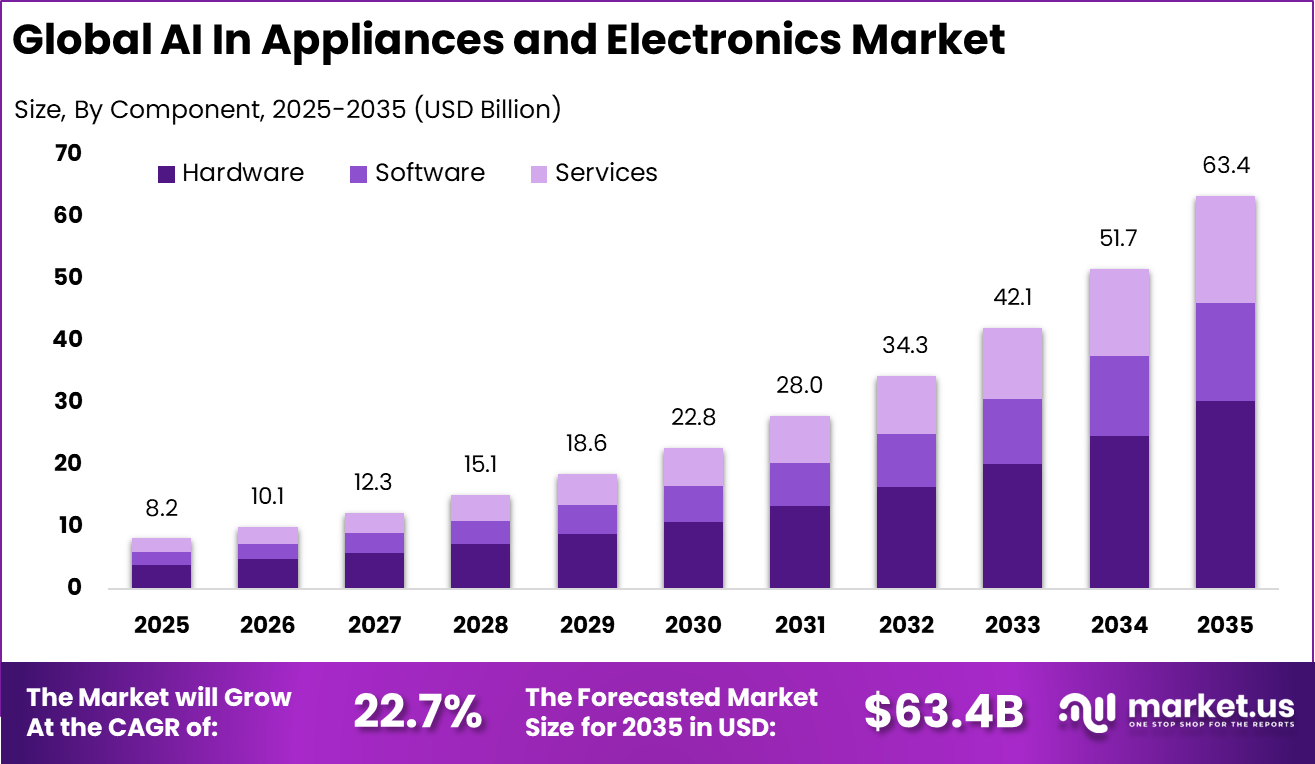
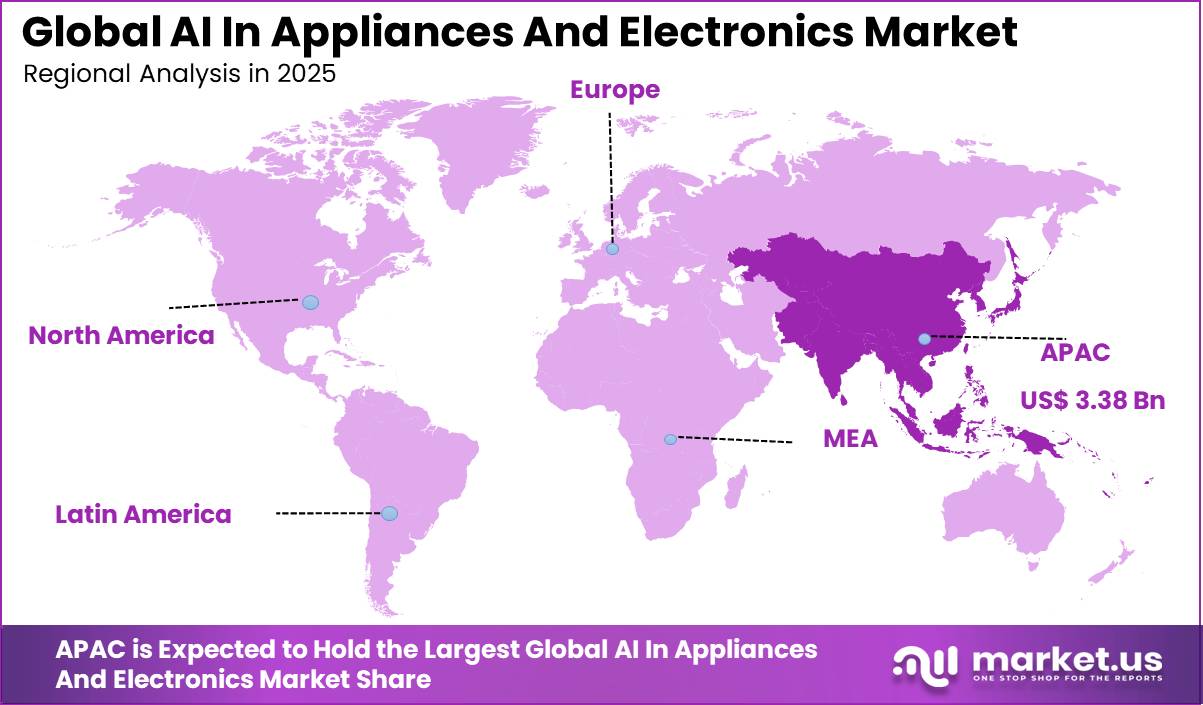
The Global AI in Appliances and Electronics Market size is expected to be worth around USD 63.4 billion by 2035, from USD 8.2 billion in 2025, growing at a CAGR of 22.7% during the forecast period from 2025 to 2035. Asia Pacific held a dominant market position, capturing more than a 41.26% share, holding USD 3.38 billion in revenue.
AI in Appliances and Electronics Market is the part of the consumer appliances and electronics industry where artificial intelligence is embedded into devices to sense, learn, decide, and act with limited user effort. It is typically delivered through a mix of sensors, connectivity, onboard processors, and software that enables functions such as voice control, adaptive settings, predictive maintenance alerts, and energy optimization. Interoperability standards also matter because they allow appliances to connect more reliably with broader smart home ecosystems.
In practical terms, AI is being used to make appliances and electronics more responsive to everyday routines. For example, voice and speech interfaces are used to reduce friction in device control, while on-device processing is increasingly used to keep key interactions fast and privacy-conscious. This shift is being reinforced by the broader industry move toward edge AI, where more intelligence is executed locally rather than only in the cloud.
Top driving factors are being shaped by three forces that are already visible in consumer behavior and regulation. First, voice interaction has become a mainstream habit, and frequent voice usage supports ongoing demand for speech-enabled device control. Second, privacy expectations are rising, and smart device makers are being pushed to reduce unnecessary data capture and improve user control, which increases the value of on-device AI approaches.
For instance, in September 2025, Midea’s SMART MASTER collection at IFA 2025 brought AI that learns user preferences across appliances, from contextual voice AC commands to predictive oven modes. Real-time data processing enables gentle, precise responses, turning everyday chores into seamless routines. Midea’s approach makes AI feel instinctive rather than gimmicky.
Demand analysis indicates that adoption is being pulled by clear household use cases rather than experimental features. The strongest demand tends to be concentrated where AI removes repeated effort, such as voice-led control, adaptive cooling and temperature management, and automated cycles that align with user preferences. A parallel layer of demand is being created by smart home reliability improvements, because buyers are more willing to expand into connected appliances when setup and cross-device control become easier.
Key Takeaway
- In 2025, the Hardware segment led the Global AI in Appliances and Electronics market, accounting for 47.9% share, supported by embedded processors, sensors, and edge computing modules.
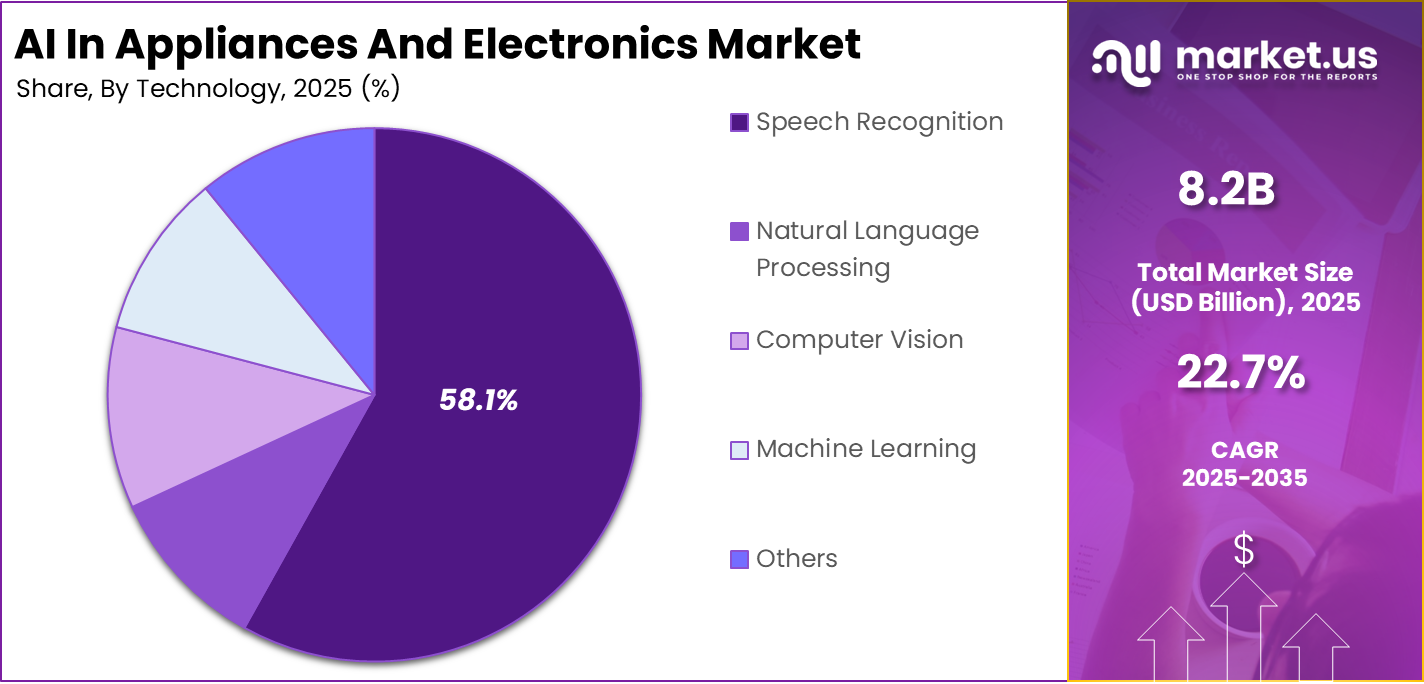
- In 2025, Speech Recognition held 58.1% of the market, driven by increasing consumer preference for voice-enabled control across smart home devices.
- In 2025, Smart Refrigerators captured 34.8% share, reflecting growing adoption of AI-enabled temperature management, inventory tracking, and energy optimization features.
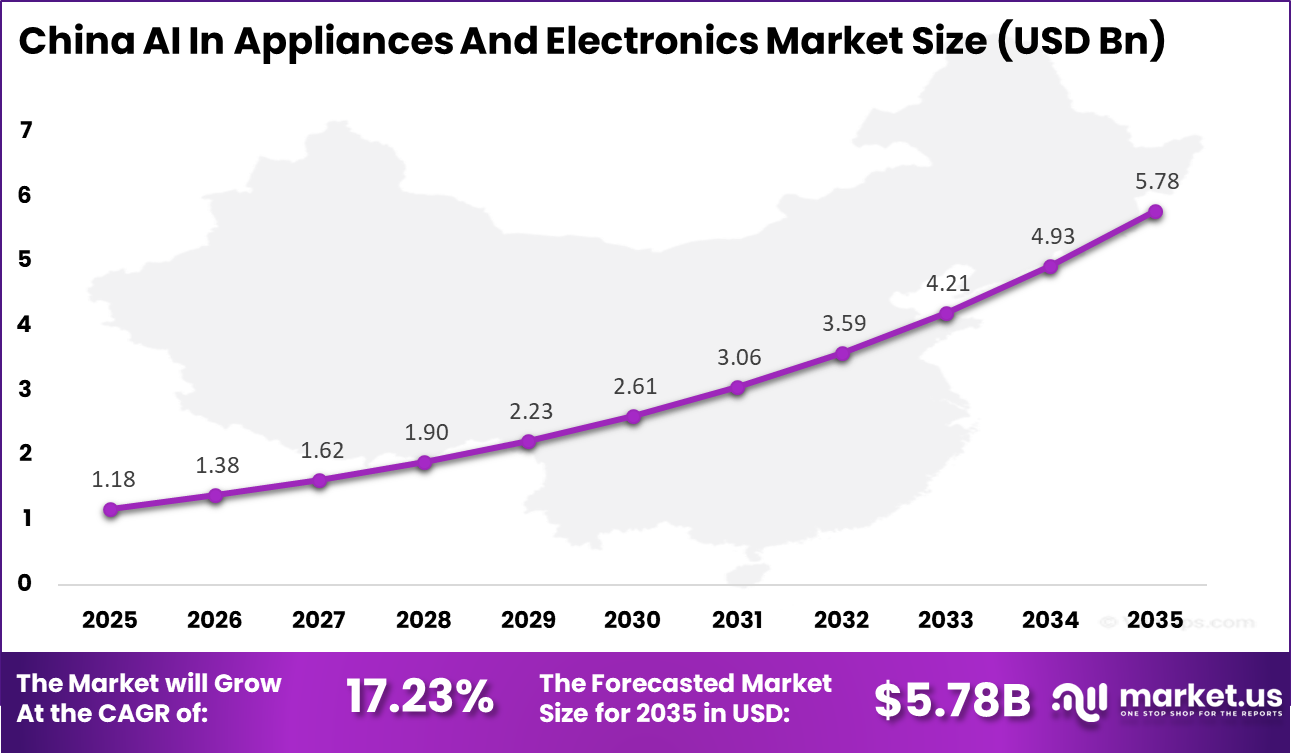
- The China AI in Appliances and Electronics market was valued at USD 1.18 billion in 2025 and is projected to expand at a 17.2% CAGR, supported by strong domestic manufacturing and smart home penetration.
- In 2025, Asia Pacific accounted for more than 41.26% of the global market, driven by rapid urbanization, rising disposable income, and large-scale adoption of connected consumer electronics.
Key Statistics
Key Efficiency and Usage Statistics
- AI-enabled smart appliances can reduce household energy consumption by up to 30%. Certain AI-powered washing machines report energy savings of up to 70%, reflecting optimized load detection and adaptive cycles.
- On-device AI processing reduces latency by 80% to 90% compared to cloud-based alternatives, improving real-time responsiveness and user experience.
- By 2025, nearly 75% of connected IoT devices are expected to integrate AI capabilities, indicating widespread embedded intelligence across consumer electronics.
- Samsung India projects that 70% of its appliance sales will come from AI-powered products by 2025, highlighting strong brand-level transition toward intelligent devices.
Consumer Sentiment and Challenges
- Around 64% of consumers express concern regarding the volume of personal data collected by AI-enabled devices, reflecting heightened awareness of privacy risks.
- Approximately 51% of consumers remain hesitant to adopt AI technologies due to data security concerns, limiting faster mass adoption.
- Rising AI infrastructure demand has intensified pressure on memory supply chains, with prices of consumer electronics such as laptops and televisions expected to increase by 40% to 50% in 2026.
Usage Statistics by Device Category
- As of late 2024, 73% of AI-aware users primarily interact with AI through smartphones. Additionally, 59% of consumers plan to shift to dedicated generative AI smartphones by late 2025.
- Voice assistants remain the dominant home AI interface. In the United States, usage is projected to reach 157.1 million users by 2026, reflecting continued integration into daily routines.
- Smart speakers held 18.49% share of the smart home market in 2025, maintaining the largest category position within connected home components.
- Security and surveillance solutions account for 36% of demand in emerging markets such as India, supported by AI-enabled monitoring and crime prevention features.
- By late 2025, 25% of consumers were regularly using generative AI tools for shopping assistance, indicating growing adoption of AI-driven retail engagement platforms.
By Component
In enterprise key management, the hardware share of 47.9% is commonly associated with stronger trust boundaries created by dedicated security devices such as HSM class infrastructure. The preference is being driven by the need to isolate key material from general compute environments and reduce exposure from malware and insider misuse.
This approach is often selected when auditability and tamper resistance are required in regulated workflows, especially where encryption keys underpin data protection. Demand for hardware anchored key management is also being shaped by the operational reality that modern environments are hybrid. Keys are needed across data centers, cloud services, and edge locations, and consistency of policy is expected across all of them.
From a risk perspective, the financial consequence of security failure is a clear motivator for stronger key governance. IBM reported that the average global cost of a data breach increased to $4.88 million in 2024 from $4.45 million in 2023, which keeps executive attention on preventive controls such as encryption and key lifecycle discipline.
For Instance, in January 2026, Samsung Electronics Co. Ltd. showcased AI hardware upgrades at CES 2026. Their Bespoke AI Refrigerator Family Hub integrates advanced processors with Google Gemini for seamless on-device processing. This boosts local AI tasks like vision analysis, cutting cloud dependency, and enhancing speed in smart kitchens.
By Technology
The technology share attributed to speech recognition at 58.1% can be interpreted as stronger use of voice signals in authentication and user experience flows, especially where hands free interaction is expected. In such setups, enterprise key management becomes the control plane that protects the cryptographic foundations behind identity, secure sessions, and encrypted data access.
The core requirement is that keys remain protected even when access channels expand beyond passwords into biometric assisted experiences. A practical driver is the shift to identity centric security, where insecure identities are repeatedly highlighted as a leading source of cloud incidents. When identity signals are exploited, keys and tokens can be abused to move laterally and decrypt protected data.
This is why key management programs are being tightened around least privilege access, separation of duties, and strong audit trails that can withstand internal and external scrutiny. Standards and guidance also reinforce this direction. NIST SP 800 57 is widely used as a reference for cryptographic key management best practices, including lifecycle handling, protection requirements, and governance expectations.
For instance, in September 2025, LG Electronics Inc. launched LG AI Home at IFA 2025. The solution features voice ID and natural language processing in appliances for personalized control. Users command fridges or ovens effortlessly, with AI learning habits for proactive adjustments, making home interactions smoother daily.
By Application
The smart refrigerator share of 34.8% suggests that connected appliances inside enterprise facilities are becoming a serious security scope, not just an operational convenience. Once a device is network connected, it can become an entry point, a data source, or a control surface, and encryption only works as intended when keys are managed correctly. This is pushing security teams to treat embedded and edge devices as first class citizens in key management strategy.
In many enterprises, the security objective is to ensure device identity, secure firmware updates, encrypted telemetry, and protected remote management. These outcomes rely on unique device keys, certificate based authentication, and a secure method for key provisioning and rotation at scale. As device fleets grow, manual handling becomes risky, and automation becomes more important to maintain consistency across sites and vendors.
The cloud connection is important because appliances often integrate with cloud dashboards and service platforms. Industry surveys have highlighted that cloud related breaches are widespread and sensitive data exposure is common once an incident occurs, which increases the emphasis on encryption and key discipline across both edge and cloud layers.
For Instance, in December 2025, Arcelik Marketing Inc. advanced AI refrigeration tech with Arm processors. Their smart fridges use reinforcement learning for self-tuning cooling, saving over 10% energy by limiting fluctuations. Cameras inside track food and predict issues, helping users manage freshness without extra hardware.
Regional Analysis
Asia Pacific at 41.26% can be attributed to high consumer electronics penetration, rapid adoption of connected home lifestyles in urban centers, and a strong manufacturing and product refresh environment. Product cycles tend to be faster, which helps new AI features move from premium ranges into wider price tiers. This regional structure supports quicker diffusion of AI functions across appliances and electronics.
Interoperability improvements also have regional relevance because consumers increasingly own multiple connected devices across brands. When pairing and day-to-day control are reliable, AI features are used more often and remain enabled after installation. This improves retention of smart features and supports broader household adoption.
For instance, in February 2025, LG Electronics Inc. launched AI-enhanced ThinQ appliances, including refrigerators with AI vision inventory tracking and washing machines with adaptive load sensing, strengthening its smart home ecosystem across Asia Pacific markets.
China’s provided values of USD 1.18 Bn and 17.23% CAGR indicate a high-velocity environment for AI-enabled appliances within the country context you supplied. Demand is typically supported by large installed bases of connected devices, strong retail presence for feature-led appliances, and faster replacement cycles in major cities. These conditions make it easier for new AI features to gain scale quickly.
China also tends to push rapid product iteration, which supports frequent upgrades in user experience, voice control quality, and device connectivity stability. In such environments, consumer expectations move quickly from novelty to baseline functionality. This drives ongoing competition around real-life reliability rather than only feature count.
For instance, in January 2026, Haier Smart Home Co. Ltd. unveiled its 2026 smart home lineup featuring AI-powered appliances like the UV Cool AI Voice air conditioner with hands-free voice control and AI ECO energy management. The integrated Haier Smart Home platform connects Wi-Fi appliances for adaptive smart living scenarios.
Key Market Segments
By Component
- Hardware
- Software
- Services
By Technology
- Machine Learning
- Natural Language Processing
- Computer Vision
- Speech Recognition
- Others
By Application
- Smart Refrigerators
- Smart Ovens
- Smart Washing Machine
- Smart TVS
- Smart Speakers
- Smartwatches
- Security Systems with Smart Cameras
- Others
Key Regions and Countries
North America
- US
- Canada
Europe
- Germany
- France
- The UK
- Spain
- Italy
- Russia
- Netherlands
- Rest of Europe
Asia Pacific
- China
- Japan
- South Korea
- India
- Australia
- Singapore
- Thailand
- Vietnam
- Rest of APAC
Latin America
- Brazil
- Mexico
- Rest of Latin America
Middle East & Africa
- South Africa
- Saudi Arabia
- UAE
- Rest of MEA
Drivers
Growing Consumer Demand for Smarter Living
The demand for smarter living is a key driver for AI in the appliances and electronics market. Consumers increasingly prefer devices that connect to the internet, respond to voice commands, and adapt to daily routines. Appliances like smart refrigerators, washing machines, and ovens provide convenience and energy efficiency, encouraging more households to adopt intelligent technologies.
Manufacturers are responding by adding features that improve automation and personalization. Devices that can monitor usage patterns, adjust settings, and communicate with other appliances make life easier. As people experience real benefits from these features, the adoption of AI-powered appliances continues to grow steadily.
For instance, in December 2025, LG unveiled AI-powered SIGNATURE refrigerators at CES 2026 with conversational AI that chats naturally to suggest recipes and pre-cools based on door-open patterns. A new screen shows freshness levels, drawing in folks wanting intuitive kitchen help.
Restraint
Higher Cost and Price Sensitivity
One significant restraint is the higher cost of AI-enabled appliances compared with traditional models. The advanced technology and sensors make these devices more expensive, which can deter consumers from upgrading. In regions with moderate incomes, the price difference is often a key factor in purchase decisions.
Price sensitivity limits adoption even when the long-term benefits are clear. Consumers may choose simpler appliances to stay within their budget, especially if the higher cost does not feel justified. This creates a barrier for the widespread acceptance of AI-driven products in some markets.
For instance, in September 2025, Beko, from Arcelik, rolled out AI-driven smart appliances like those with HomeWhiz and AdaptiveWash at a major show, stressing reliability amid premium pricing. Buyers pause as these advanced washers and dryers cost more than basics despite eco perks.
Opportunities
Better Integration with Home Networks
Integrating AI appliances with home networks presents a major opportunity for the market. Devices that communicate seamlessly with phones, voice assistants, and other smart products provide a smooth and unified home experience. This integration allows users to manage lighting, security, and kitchen appliances from a single system.
Enhanced connectivity also enables new services that simplify daily routines. Voice assistants and centralized control make smart appliances more intuitive and convenient. As technology advances and integration standards improve, consumer interest in connected homes is expected to rise, creating room for market expansion.
For instance, in January 2026, Robert Bosch GmbH debuted Cook AI at CES 2026, an app-based system that links kitchen appliances via sensors for real-time recipe guidance and multi-device orchestration. This fosters seamless smart home flows, coordinating cooking across ovens and tools effortlessly.
Challenges
Data Privacy and Compatibility Issues
Data privacy is a key concern for consumers using connected appliances. These devices often collect information about usage habits, and many people worry about how their data is stored and shared. This concern can slow adoption because trust is essential for the daily use of smart devices.
Compatibility is another challenge, as not all appliances work well with every platform or brand. Users may face issues when devices do not integrate smoothly with their existing home systems. Difficult setup and inconsistent performance can discourage people from purchasing AI-enabled appliances.
For instance, in March 2025, Haier Smart Home Co. Ltd. revealed AI Vision tech at its Ecosystem Conference, allowing appliances to interpret environments visually but sparking talks on data handling in connected fridges and washers. Users worry about privacy in shared networks lacking uniform standards.
Key Players Analysis
Competition is being shaped by ecosystem breadth and platform consistency across appliances and consumer electronics. Samsung Electronics Co. Ltd., LG Electronics Inc., Panasonic Holdings Corp., and Haier Smart Home Co. Ltd. benefit when multiple categories connect through unified control layers, which increases user lock-in through convenience rather than pricing pressure.
A second competitive dimension is category specialization and premium performance, where AI must improve outcomes, not only add interfaces. Dyson Group Co., Miele and Cie. KG, Breville Group Ltd., and Robert Bosch GmbH tend to compete where precision, durability, and user experience are closely scrutinized.
A third layer is scale and portfolio efficiency, where companies compete by pushing AI features into broader lineups while maintaining service networks and cost control. Whirlpool Corp., Electrolux Group, Arcelik Marketing Inc., and Midea Group Co. Ltd. operate across multiple price tiers and regions, so competitive advantage is often linked to product refresh speed, distribution reach, and ability to integrate AI features without raising complexity for end users.
Top Key Players in the Market
- Arcelik Marketing Inc.
- Breville Group Ltd.
- Dyson Group Co.
- Electrolux Group
- Glen Dimplex Group.
- Gorenje Group
- Haier Smart Home Co. Ltd.
- Hamilton Beach Brands Inc.
- Koninklijke Philips NV
- LG Electronics Inc.
- Midea Group Co. Ltd.
- Miele and Cie. KG
- Panasonic Holdings Corp.
- Robert Bosch GmbH
- Samsung Electronics Co. Ltd.
- SOCIETE SAS
- TEKA INDUSTRIAL SA
- Whirlpool Corp.
- Others
Recent Developments
- In January 2026, BSH Home Appliances announced at CES 2026 that Bosch would unveil personalized AI for the kitchen, showing continued momentum toward AI-led experiences in food preparation and kitchen management.
- In September 2025, Gorenje showcased its AI-powered refrigerators and smart ovens at IFA 2025, featuring AI cameras for real-time monitoring and adaptive cooking. These innovations highlight Gorenje’s push into intelligent appliances that learn user habits, maintaining energy efficiency while celebrating 75 years of appliance engineering.
- In December 2025, LG unveiled its evolved SIGNATURE lineup at the CES 2026 preview, featuring conversational AI refrigerators with LLM tech for natural interactions and AI Fresh pre-cooling. The 6.8-inch LCD tracks freshness while integrating with luxury interiors via Poliform partnership. LG’s decade of premium AI appliances reinforces its leadership in personalized home experiences.
Report Scope
Report Features Description Market Value (2025) USD 8.2 Bn Forecast Revenue (2035) USD 63.4 Bn CAGR(2026-2035) 22.7% Base Year for Estimation 2025 Historic Period 2020-2024 Forecast Period 2026-2035 Report Coverage Revenue forecast, AI impact on Market trends, Share Insights, Company ranking, competitive landscape, Recent Developments, Market Dynamics and Emerging Trends Segments Covered By Component (Hardware, Software, Services), By Technology (Machine Learning, Natural Language Processing, Computer Vision, Speech Recognition, Others), By Application (Smart Refrigerators, Smart Ovens, Smart Washing Machine, Smart TVS, Smart Speakers, Smartwatches, Security Systems with Smart Cameras, Others) Regional Analysis North America – US, Canada; Europe – Germany, France, The UK, Spain, Italy, Russia, Netherlands, Rest of Europe; Asia Pacific – China, Japan, South Korea, India, New Zealand, Singapore, Thailand, Vietnam, Rest of Latin America; Latin America – Brazil, Mexico, Rest of Latin America; Middle East & Africa – South Africa, Saudi Arabia, UAE, Rest of MEA Competitive Landscape Arcelik Marketing Inc., Breville Group Ltd., Dyson Group Co., Electrolux Group, Glen Dimplex Group, Gorenje Group, Haier Smart Home Co. Ltd., Hamilton Beach Brands Inc., Koninklijke Philips NV, LG Electronics Inc., Midea Group Co. Ltd., Miele and Cie. KG, Panasonic Holdings Corp., Robert Bosch GmbH, Samsung Electronics Co. Ltd., SOCIETE SAS, TEKA INDUSTRIAL SA, Whirlpool Corp., Others Customization Scope Customization for segments, region/country-level will be provided. Moreover, additional customization can be done based on the requirements. Purchase Options We have three license to opt for: Single User License, Multi-User License (Up to 5 Users), Corporate Use License (Unlimited User and Printable PDF)  AI In Appliances and Electronics MarketPublished date: Feb. 2026add_shopping_cartBuy Now get_appDownload Sample
 -
-
- Arcelik Marketing Inc.
- Breville Group Ltd.
- Dyson Group Co.
- Electrolux Group
- Glen Dimplex Group.
- Gorenje Group
- Haier Smart Home Co. Ltd.
- Hamilton Beach Brands Inc.
- Koninklijke Philips NV
- LG Electronics Inc.
- Midea Group Co. Ltd.
- Miele and Cie. KG
- Panasonic Holdings Corp.
- Robert Bosch GmbH
- Samsung Electronics Co. Ltd.
- SOCIETE SAS
- TEKA INDUSTRIAL SA
- Whirlpool Corp.
- Others
Our Clients

- 179062
- Feb. 2026