Report Overview
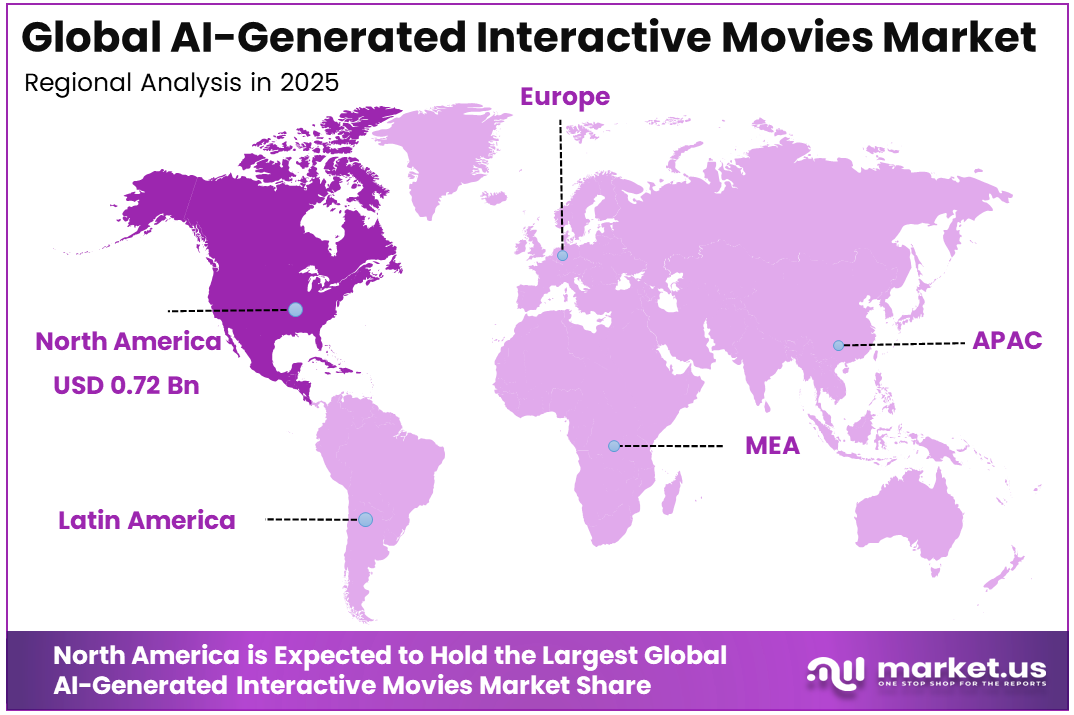
The Global AI-Generated Interactive Movies Market size is expected to be worth around USD 31.5 billion by 2035, from USD 1.6 billion in 2025, growing at a CAGR of 34.7% during the forecast period from 2026 to 2035. North America held a dominant market position, capturing more than a 45.2% share, holding USD 0.72 billion in revenue.
AI-Generated Interactive Movies refers to films created or supported by artificial intelligence, where viewers can influence story direction, character actions, scenes, or endings. These movies combine cinematic storytelling with real-time decision-making, allowing audiences to take a more active role while AI helps generate or adapt content during the experience.
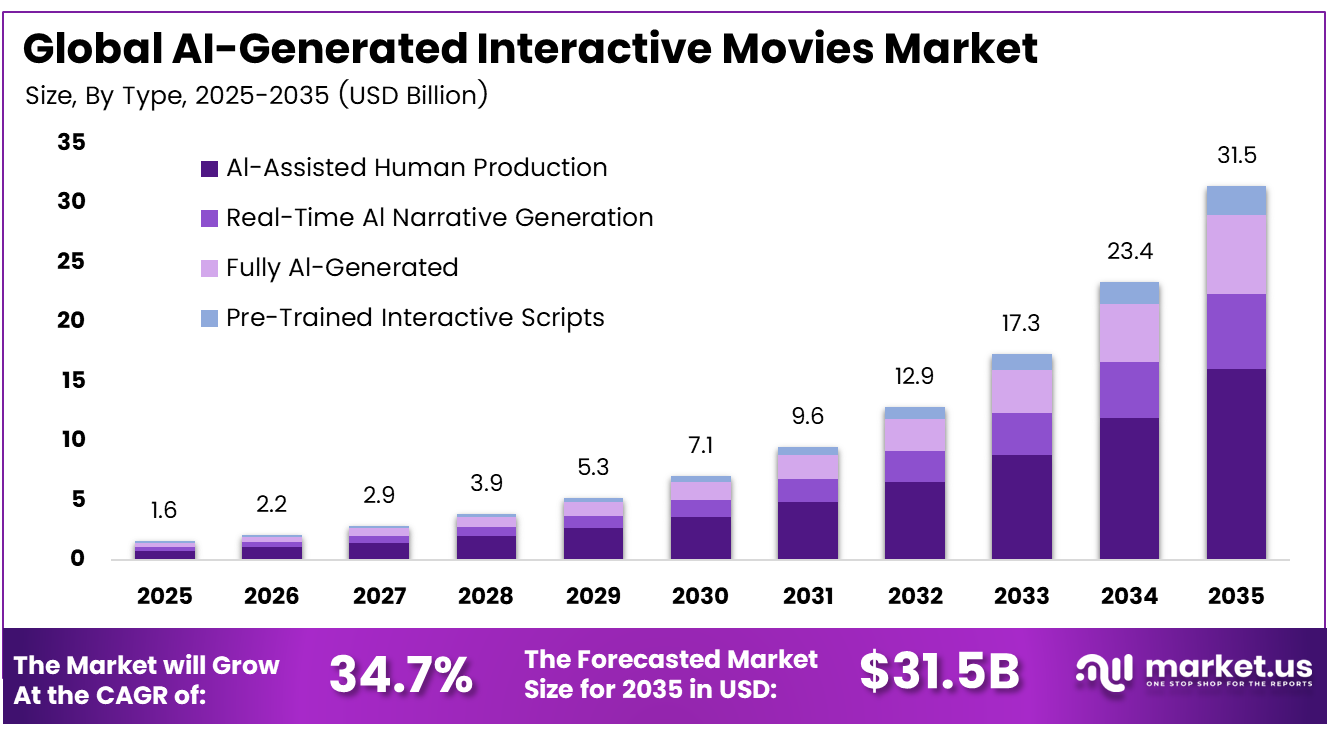
Top driving factors include always online streaming habits, stronger GPUs, and cheaper cloud computing, which make real-time rendering practical for large audiences. Studios are adopting these formats because interactive titles often deliver completion rates above 70%. Longer viewing sessions also support stronger audience retention, making choice-based entertainment more attractive for platforms and content producers.
The market for AI-Generated Interactive Movies is driven by rising viewer demand for personalized, choice-based entertainment that feels more immersive than traditional films. AI helps studios create adaptive storylines, dynamic dialogue, changing scenes, and multiple endings with greater flexibility. Growing use of streaming platforms, gaming-style engagement, and advanced creative tools is further supporting market adoption.
Demand is supported by younger viewers who are familiar with branching story games and expect content that allows personal choice. Multiple endings, live decisions, and viewer-controlled scenes make entertainment feel more active. Early vote-based live streams show participation rates can exceed 30% of concurrent viewers, which is much higher than typical social video engagement.
For instance, in May 2024, Sony Pictures’ leadership publicly committed to using AI “primarily” to cut film and TV production costs, from previs to post. By hard-wiring generative tools into studio workflows, Sony’s U.S. operation is building the capabilities needed to support semi-automated, choice-driven cuts and localized narrative variations across theatrical and streaming slates.
Key Takeaway
- In 2025, the AI-Assisted Human Production segment held a dominant market position, capturing a 51.2% share of the Global AI-Generated Interactive Movies Market.
- In 2025, the Streaming Services segment held a dominant market position, capturing a 34.5% share of the Global AI-Generated Interactive Movies Market.
- In 2025, the Natural Language Processing (NLP) segment held a dominant market position, capturing a 32.3% share of the Global AI-Generated Interactive Movies Market.
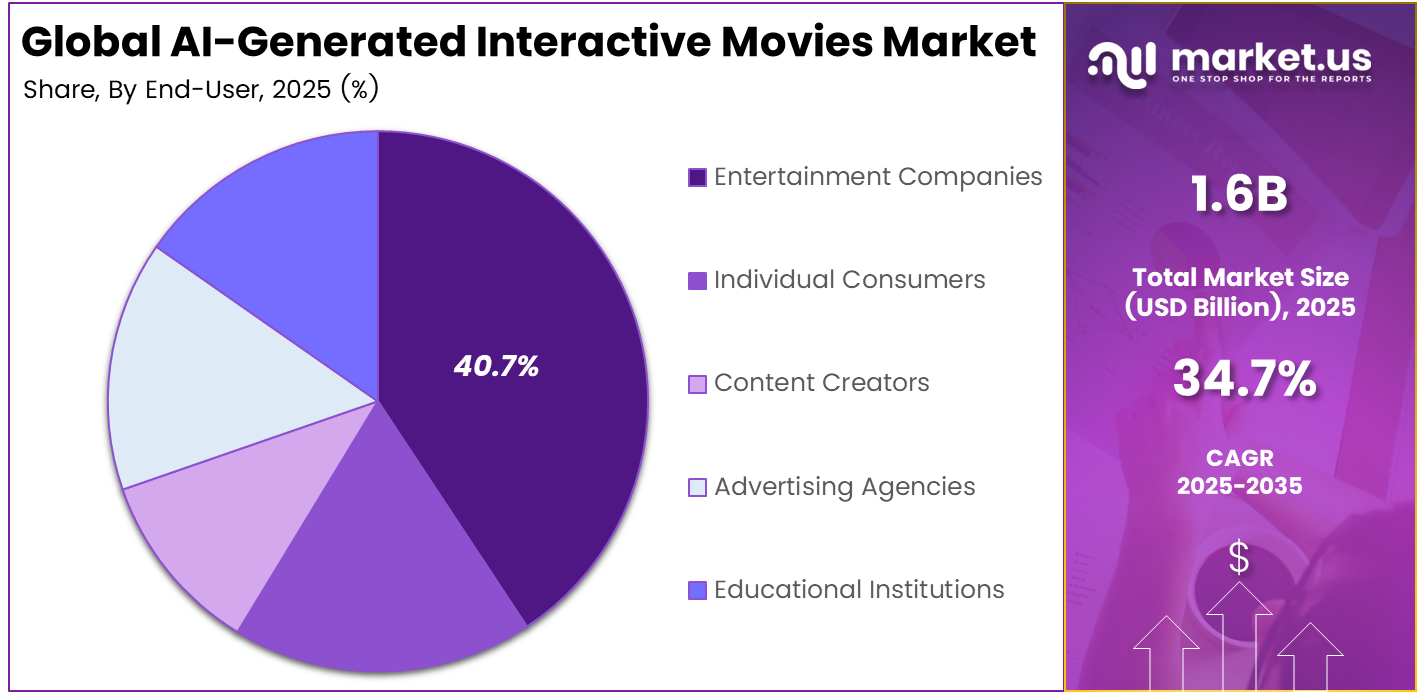
- In 2025, the Entertainment Companies (Studios, Streamers) segment held a dominant market position, capturing a 40.7% share of the Global AI-Generated Interactive Movies Market.
- In 2025, the OTT Platforms (Netflix, Hulu) segment held a dominant market position, capturing a 41.5% share of the Global AI-Generated Interactive Movies Market.
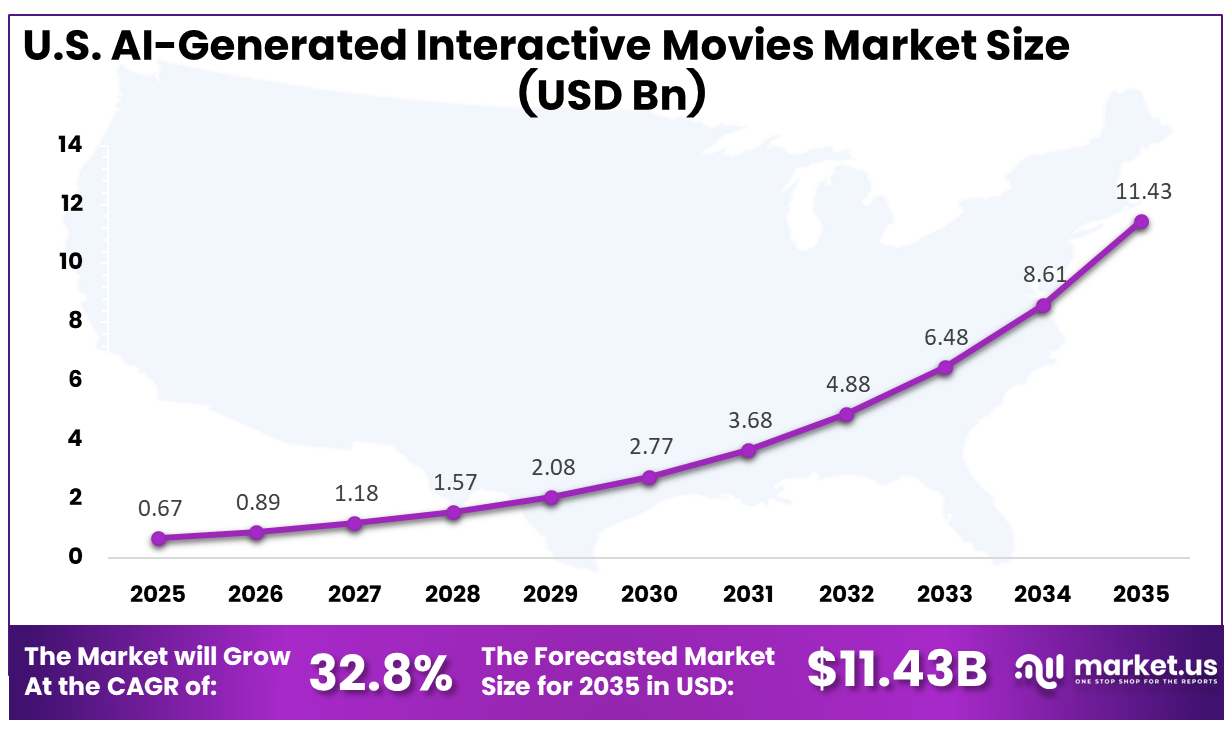
- The U.S. AI-Generated Interactive Movies Market was valued at USD 0.67 Billion in 2025, with a robust CAGR of 32.8%.
- In 2025, North America held a dominant market position in the Global AI-Generated Interactive Movies Market, capturing more than a 45.2% share.
Role of Generative AI
Generative AI is becoming a central part of interactive storytelling. It is being used for script branches, dialogue options, scene design, music, and character actions. Recent AI film workflow surveys show that more than 60% of experimental AI films use text-to-image or image-to-video diffusion models.
Generative AI is also changing how viewer choices appear on screen. Instead of filming every branch in advance, studios can use adaptive systems to create scenes more flexibly. Early lab projects show that adaptive narrative engines can cut manual storyboarding effort by roughly 30% while keeping character consistency and visual quality.
Investment and Business Benefits
Investment opportunities are rising across story engines, personalization platforms, creator tools, and large-scale interactive streaming infrastructure. Strong film markets in the Asia Pacific and Europe are gaining attention because they combine creative talent with fast broadband access. Funding is also moving toward AI-driven storytelling labs and accelerator programs that can support faster content development.
Business benefits include lower marginal content costs, stronger monetization options, and improved advertising performance. Studios can create premium branches, branded storylines, and outcome-based campaigns that keep viewers involved. Some studios report double-digit percentage savings in editing and VFX hours, while advertisers see measurable recall gains when users actively choose story outcomes.
Regional Analysis
In 2025, North America held a dominant market position in the Global AI-Generated Interactive Movies Market, capturing more than a 45.2% share, holding USD 0.72 billion in revenue. This dominance is due to the strong presence of film studios, streaming platforms, AI developers, and advanced production infrastructure across North America. The region has a mature digital entertainment ecosystem, high adoption of connected devices, and strong audience interest in personalized viewing. Content creators are also using AI tools to improve story development, visual effects, and interactive formats, which supports faster innovation in this market.
For instance, in March 2026, Autodesk expanded AI across its media tools, adding capabilities like MotionMaker for instant realistic character animation, Wonder 3D for text-to-3D assets, and AI-assisted generative texturing in Maya and 3ds Max. These U.S.-developed tools make it easier for studios to build branching, interactive movie worlds with rapid, AI-generated content variations.
U.S. AI-Generated Interactive Movies Market Size
The market for AI-Generated Interactive Movies within the U.S. is growing tremendously and is currently valued at USD 0.67 billion. The market has a projected CAGR of 32.8%. The market is growing due to strong demand for personalized entertainment, advanced streaming platforms, and wider use of AI in film production. U.S. studios and technology companies are testing interactive formats that allow viewers to influence stories, characters, and endings. Growth is also supported by high digital content consumption, strong broadband access, and rising interest in immersive viewing experiences among younger audiences.
For instance, in May 2025, Netflix unveiled generative AI-powered ad formats that dynamically blend brands into shows via interactive mid-roll and pause moments, with full rollout targeted for 2026. By turning video streams into personalized, clickable story layers, the U.S. streamer moves closer to AI-driven, interactive narrative and monetization models.
Key Regions and Countries
North America
- US
- Canada
Europe
- Germany
- France
- The UK
- Spain
- Italy
- Russia
- Netherlands
- Rest of Europe
Asia Pacific
- China
- Japan
- South Korea
- India
- Australia
- Singapore
- Thailand
- Vietnam
- Rest of APAC
Latin America
- Brazil
- Mexico
- Rest of Latin America
Middle East & Africa
- South Africa
- Saudi Arabia
- UAE
- Rest of MEA
Type Analysis
In 2025, the AI-Assisted Human Production segment held a dominant market position, capturing a 51.2% share of the Global AI-Generated Interactive Movies Market. This dominance is due to the balanced role of AI and human creativity in film production. Studios can use AI for story drafts, scene planning, editing support, and visual ideas, while creative teams still control the final direction, tone, and emotional quality of the movie.
AI-assisted human production is also preferred because it reduces repetitive work without removing professional judgment. Writers, directors, editors, and designers can test more ideas in less time. This approach supports faster production cycles, better creative flexibility, and safer adoption of AI in entertainment workflows.
For instance, in September 2025, OpenAI backed the AI-assisted animated film “Critterz,” using its models for script and visual generation while keeping human writers and actors in charge of the story and performances. The project shows how hybrid pipelines can shrink production timelines without removing human creative control, which directly strengthens the AI-assisted human production segment.
Platform Analysis
In 2025, the Streaming Services segment held a dominant market position, capturing a 34.5% share of the Global AI-Generated Interactive Movies Market. This dominance is due to the strong fit between interactive movies and streaming platforms. Viewers already use these services for on-demand content, personalized suggestions, and flexible viewing. Interactive films can be delivered smoothly through the same digital systems, making streaming a natural platform for this format.
Streaming services also give producers access to audience behavior data, which can improve story design and content placement. Viewer choices, watch time, and engagement patterns can help platforms refine interactive experiences. This makes streaming services important for testing, distributing, and scaling AI-generated movie formats.
For instance, in May 2025, Netflix announced plans to roll out generative AI-powered interactive ad formats, including mid-roll and pause ads that blend with show environments. While focused on advertising, the same infrastructure for interaction and real-time personalization supports richer interactive story experiences, reinforcing streaming services as the main platform for AI-driven interactive movies.
Technology Analysis
In 2025, the Natural Language Processing (NLP) segment held a dominant market position, capturing a 32.3% share of the Global AI-Generated Interactive Movies Market. This dominance is due to the important role of language understanding in interactive storytelling. Natural Language Processing helps systems read viewer choices, understand voice commands, and support dialogue-based interaction. This makes the story feel more responsive, personal, and closer to a real conversation.
NLP also supports smoother character interaction and better narrative control. It allows AI systems to generate suitable replies, adjust dialogue flow, and guide the viewer through different story paths. This makes the technology valuable for building interactive movies where audience input directly shapes the experience.
For instance, in January 2026, Microsoft highlighted conversational AI as a major trend, positioning its models as partners that help teams co-write and refine content across media. As such tools become easier to plug into creative software, producers can use NLP to generate and adapt dialogue paths in interactive films, which accelerates the growth of the NLP segment in this market.
End-User Analysis
In 2025, the Entertainment Companies (Studios, Streamers) segment held a dominant market position, capturing a 40.7% share of the Global AI-Generated Interactive Movies Market. This dominance is due to the strong production needs of studios, streamers, and entertainment firms. These companies are under pressure to create fresh content faster, improve viewer engagement, and manage production costs. AI-generated interactive movies help them test new formats while improving creative workflow efficiency.
Entertainment companies also have the resources, talent networks, and distribution reach needed to commercialize interactive movies. Their existing production teams can combine AI tools with professional storytelling methods. This makes them better positioned to adopt, refine, and release AI-supported interactive content for wider audiences.
For instance, in May 2026, Sony set out a strategy to deepen AI use in its entertainment businesses, from anime to broader film projects, while investing in supporting technologies like advanced image sensors. This indicates that a major studio group sees AI-enabled formats as central to future content, which drives more experimentation with AI-generated and interactive titles among entertainment companies.
Distribution Channel Analysis
In 2025, the OTT Platforms (Netflix, Hulu) segment held a dominant market position, capturing a 41.5% share of the Global AI-Generated Interactive Movies Market. This dominance is due to the ability of OTT platforms to deliver interactive content directly to viewers. These platforms support flexible viewing, personalized recommendations, and smooth content access across devices. AI-generated interactive movies benefit from this structure because viewer choices can be managed within digital delivery systems.
OTT platforms also allow faster content updates and easier audience testing. Producers can study how viewers respond to story branches, endings, and character choices. This helps improve future releases and supports better user engagement, making OTT platforms a strong channel for AI-driven interactive movie distribution.
For instance, in May 2025, Netflix’s plan to introduce AI-generated, interactive ad formats relies on its OTT app environment to deliver overlays, calls to action, and second-screen prompts. The same technical foundations support AI-powered interactive storytelling, helping OTT platforms become the preferred channel for deploying and updating AI-generated interactive movie experiences.
Key Market Segments
By Type
- Real-Time AI Narrative Generation
- Fully AI-Generated
- AI-Assisted Human Production
- Pre-Trained Interactive Scripts
By Platform
- Streaming Services
- Gaming Consoles
- VR/AR Platforms
- Mobile Devices
- Smart TVs
By Technology
- Deepfake/Generative Video
- Natural Language Processing (NLP)
- Machine Learning Algorithms
- Real-Time Rendering Engines
- Voice Synthesis
By End-User
- Entertainment Companies
- Individual Consumers
- Content Creators
- Advertising Agencies
- Educational Institutions
By Distribution Channel
- App Stores
- Direct-to-Consumer (D2C)
- Cinema Theaters
- OTT Platforms
- Web Platforms
Emerging Trends
A major trend is the move from pre-rendered branches to real-time generation. Visuals, dialogue, and character actions can now respond more directly to viewer input. Filmmaking research shows rising use of 3D generation, neural radiance fields, and hybrid pipelines that combine real footage with AI-generated elements.
Another trend is the growing link between interactive cinema, gaming, virtual reality, and social platforms. Demand is increasing for immersive screens and 3D venues as audiences seek deeper participation. Many new experiences now use algorithmic story branching and AI-driven characters that respond to voice and gesture in real time.
Growth Factors
Growth is being supported by fast improvements in generative models. Newer tools can produce high-resolution video, smoother motion, and longer story context. Technical reviews show better character consistency and scene continuity than earlier AI video tools, making feature-length interactive content more practical and less fragmented for audiences.
Lower production barriers are also helping the market expand. Small studios and independent creators can now use off-the-shelf generative tools for backgrounds, transitions, and visual effects. Some documented workflows show that asset production time can be reduced by 30–50%, making interactive content creation faster and more affordable.
Market Dynamics
Drivers - Rising Demand for Personalized and Immersive Viewing
Rising demand for personalized and immersive viewing is driving the AI-generated interactive movies market. Viewers increasingly prefer stories that allow them to choose paths, influence endings, and feel involved in the content. This shift is making interactive formats more attractive for studios and streaming platforms.
AI helps make these experiences more responsive by adjusting scenes, dialogue, and character actions based on viewer input. This creates a deeper connection between the audience and the story. As entertainment habits move toward active participation, AI-generated interactive movies are gaining stronger commercial relevance.
For instance, in December 2025, Microsoft introduced generative video in Microsoft 365 Copilot Create, allowing users to turn prompts and documents into short videos inside productivity apps, which shows how AI-assisted video generation is being normalised and can later support more personalised, story-driven formats.
Restraint - Rights and Consent Issues
Rights and consent issues remain a major restraint for the market. AI-generated movies may use voices, faces, scripts, music, or visual styles that need clear ownership and permission. This creates legal review pressure for studios, especially when human likenesses or copyrighted creative materials are involved.
These concerns can slow production and increase compliance costs. Creators must ensure that AI tools are trained and used responsibly. Without proper consent and rights management, interactive movie projects may face disputes, delays, or reputational risk, which can limit wider adoption across the entertainment industry.
For instance, in December 2025, Disney announced a plan for Disney+ users to create AI-assisted short-form content using its brands, while also stressing the need to protect its intellectual property and keep talent likenesses out of the licensing scope, reflecting how rights and consent questions must be managed carefully.
Opportunities - Convergence with Gaming, OTT
The convergence of gaming and OTT platforms creates a strong opportunity for AI-generated interactive movies. Gaming has already trained audiences to expect choice, control, and multiple outcomes. OTT platforms can bring these features into mainstream entertainment through accessible digital delivery and personalized viewing systems.
This opportunity can help studios build hybrid formats that combine cinematic storytelling with game-like decision-making. AI can support dynamic scenes, adaptive dialogue, and changing story paths. As streaming platforms look for fresh engagement models, interactive movies can become a valuable format for audience retention.
For instance, in June 2025, Meta rolled out generative AI video editing across its apps, letting people transform short videos with preset prompts, which supports more playful, interactive formats that resemble lightweight story experiences and can be integrated with social and gaming elements over time.
Challenges - Quality and Story Control
Quality and story control remain key challenges for AI-generated interactive movies. Each viewer’s choice must still lead to a clear, emotional, and meaningful story. If AI-generated scenes feel inconsistent or poorly connected, the viewing experience may become confusing and reduce audience trust.
Maintaining character behavior, visual style, tone, and plot logic across many story paths requires strong creative oversight. Studios need human review, clear story rules, and reliable AI systems. Without this balance, interactive films may struggle to deliver the same emotional quality as traditional cinema.
For instance, in May 2025, Netflix’s plan to use generative AI to blend ads into the worlds of its shows raises practical questions about tone and narrative consistency, since algorithmically driven overlays must fit the story context without distracting viewers or undermining the creative intent of the original scenes.
Key Players Analysis
One of the leading players in March 2026, Autodesk extended AI across its media portfolio, adding tools like MotionMaker for instant character animation and generative 3D and texturing features tied into Maya and 3ds Max. For studios, this materially lowers the cost of producing multiple scene variants, a key enabler for AI-generated interactive movies and personalized story paths.
Top Key Players in the Market
- OpenAI
- Netflix
- Sony Pictures
- Microsoft
- Amazon Studios
- Disney
- Meta
- Warner Bros.
- Apple
- Paramount
- Google DeepMind
- NVIDIA
- Unity Technologies
- Autodesk
- IBM Watson
- Adobe
- Tencent
- Baidu
- Alibaba Pictures
- Others
Recent Developments
- In May 2026, Meta introduced Incognito Chat with Meta AI on WhatsApp and the Meta AI app, allowing fully private, conversational interactions with its assistant. While framed as messaging, the same real-time dialogue and persona tools can underpin AI-driven, branching experiences inside future interactive films and social-video formats across Meta platforms.
- In May 2025, Netflix announced plans to roll out AI-driven, context-aware ads that blend dynamically with scenes in its shows and films, using generative technology to place products when viewers pause or during mid-roll breaks. This move lays the groundwork for personalized, interactive storytelling and monetization inside streaming titles, not just around them.
Report Scope
| Report Features | Description |
|---|---|
| Market Value (2025) | USD 1.6 Billion |
| Forecast Revenue (2035) | USD 31.5 Billion |
| CAGR (2026-2035) | 34.7% |
| Base Year for Estimation | 2025 |
| Historic Period | 2020-2024 |
| Forecast Period | 2026-2035 |
| Report Coverage | Revenue Forecast, Market Dynamics, Competitive Landscape, Recent Developments |
| Segments Covered | By Type (Real-Time AI Narrative Generation, Fully AI-Generated, AI-Assisted Human Production, Pre-Trained Interactive Scripts), By Platform (Streaming Services, Gaming Consoles, VR/AR Platforms, Mobile Devices, Smart TVs), By Technology (Deepfake/Generative Video, Natural Language Processing (NLP), Machine Learning Algorithms, Real-Time Rendering Engines, Voice Synthesis), By End-User (Entertainment Companies, Individual Consumers, Content Creators, Advertising Agencies, Educational Institutions), By Distribution Channel (App Stores, Direct-to-Consumer (D2C), Cinema Theaters, OTT Platforms, Web Platforms) |
| Regional Analysis | North America (US and Canada), Europe (Germany, France, The UK, Spain, Italy, and Rest of Europe), Asia Pacific (China, Japan, South Korea, India, Australia, and Rest of APAC), Latin America (Brazil, Mexico, and Rest of Latin America), Middle East & Africa (GCC, South Africa, and Rest of MEA) |
| Competitive Landscape | OpenAI, Netflix, Sony Pictures, Microsoft, Amazon Studios, Disney, Meta, Warner Bros., Apple, Paramount, Google DeepMind, NVIDIA, Unity Technologies, Autodesk, IBM Watson, Adobe, Tencent, Baidu, Alibaba Pictures, Others |
| Customization Scope | Customization for segments, region/country-level will be provided. Moreover, additional customization can be done based on the requirements. |
| Purchase Options | We have three licenses to opt for: Single User License, Multi-User License (Up to 5 Users), Corporate Use License (Unlimited Users and Printable PDF) |