Global AI Compliance Saas Market Size, Share, Industry Analysis Report By Component (Software/Platform, Services), By Compliance Type (Data Privacy & Security Compliance, Financial Services Compliance, AI Ethics & Governance Compliance, Industry-Specific Compliance), By Organization Size (Large Enterprises, Small and Medium-sized Enterprises (SMEs)), By End-User (Banking, Financial Services, and Insurance (BFSI), Healthcare & Life Sciences, IT & Telecommunications, Retail & E-commerce, Manufacturing & Industrial, Others), By Regional Analysis, Global Trends and Opportunity, Future Outlook By 2025-2034
- Published date: Dec. 2025
- Report ID: 168551
- Number of Pages: 305
- Format:
-
keyboard_arrow_up
Quick Navigation
- Report Overview
- Key Takeaway
- Key Statistics
- Role of Generative AI
- Investment and Business Benefits
- U.S. Market Size
- Component Analysis
- Compliance Type Analysis
- Organization Size Analysis
- End-User Analysis
- Emerging Trends
- Growth Factors
- Key Market Segments
- Drivers
- Restraint
- Opportunities
- Challenges
- Key Players Analysis
- Recent Developments
- Report Scope
Report Overview
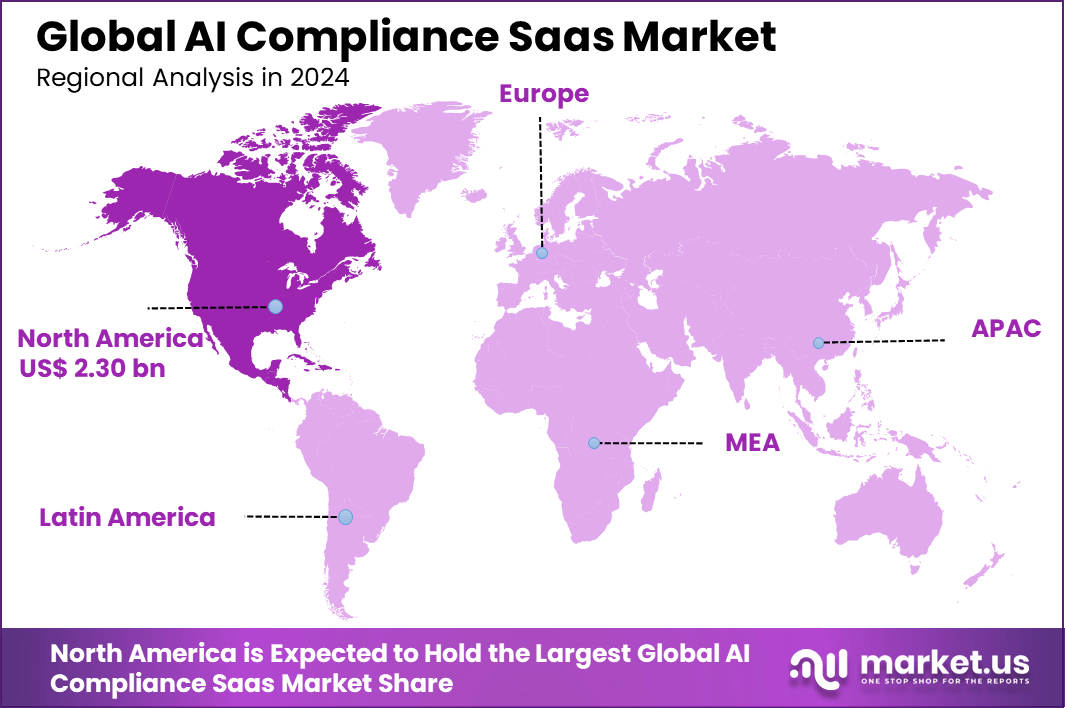
The Global AI Compliance Saas Market size is expected to be worth around USD 39.54 Billion by 2034, from USD 5.07 Billion in 2024, growing at a CAGR of 22.8% during the forecast period from 2025 to 2034. In 2024, North America held a dominant market position, capturing more than a 45.4% share, holding USD 2.30 billion in revenue.
AI Compliance SaaS refers to software-as-a-service platforms designed to help businesses ensure their artificial intelligence systems operate within legal, ethical, and regulatory boundaries. These platforms automate the management of AI compliance tasks, including data governance, bias detection, transparency reporting, and continuous monitoring. They play a crucial role in making sure AI algorithms maintain customer privacy, fairness, and meet evolving regulatory standards seamlessly.
The main drivers for AI Compliance SaaS adoption is accelerating as regulations tighten and AI usage expands across industries. Organizations need stronger controls to manage risks related to bias, transparency, and data privacy, while also maintaining customer trust. Rules such as GDPR and new AI governance mandates require transparency and human oversight, making compliance essential for SaaS companies integrating advanced AI systems.
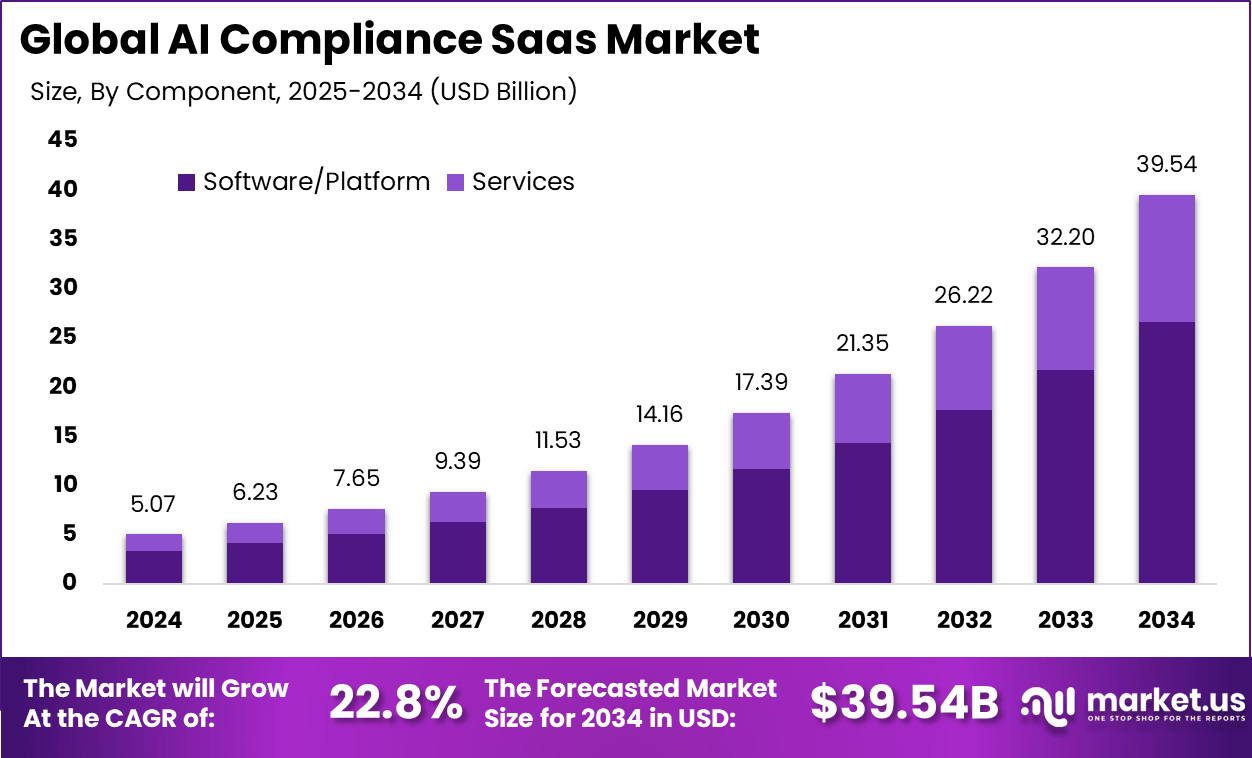
The market for AI Compliance SaaS is driven by increasing regulatory demands worldwide as governments implement stricter laws to govern AI use. Businesses adopting AI need efficient tools to ensure ongoing compliance with data privacy and ethical standards. Automated SaaS platforms help companies manage complex regulations, reduce manual effort, and quickly adapt to evolving rules. This growth is fueled by the rising use of AI across industries, which creates a vital need for scalable, real-time, and accurate compliance solutions.
Demand for AI Compliance SaaS is growing sharply as businesses face more complex regulatory environments combined with expanding AI use. Enterprises demand solutions that reduce manual compliance workloads, improve audit readiness, and automate risk management. SaaS platforms that embed AI compliance reduce response times to violations and enable real-time corrective actions, which enhances operational efficiency and lowers exposure to fines or reputational damage.
For instance, in July 2025, Workiva integrated AI governance features within its connected reporting platform to automate control testing and compliance documentation, reducing manual errors and accelerating audit cycles. Their platform improves transparency and ensures compliance with evolving AI regulations like the EU AI Act.
Key Takeaway
- In 2024, the Software and Platform segment accounted for 67.5% of the Global AI Compliance SaaS Market, reflecting its central role in managing automated oversight and policy controls.
- In 2024, the Data Privacy and Security Compliance segment captured 35.6%, showing strong demand for solutions that protect sensitive information within AI workflows.
- In 2024, the Large Enterprises segment reached 70.2%, indicating that bigger organizations drove most adoption due to extensive regulatory and governance requirements.
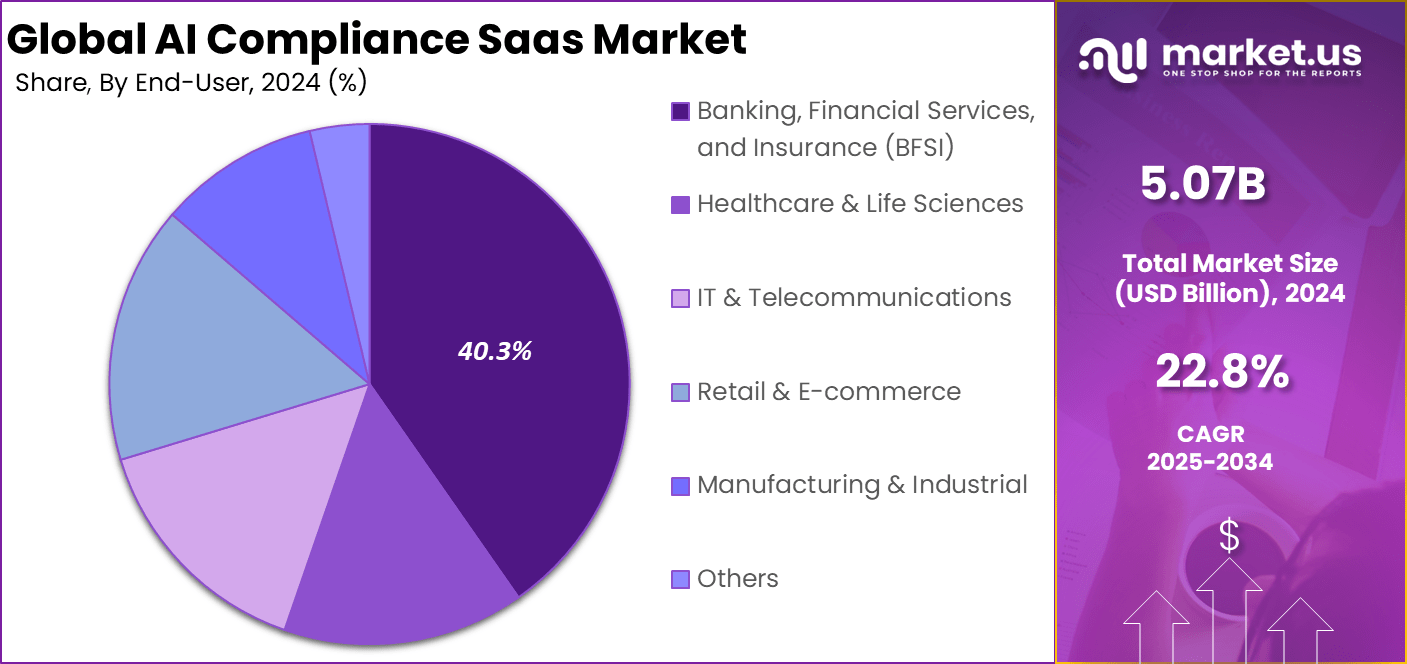
- In 2024, the BFSI segment held 40.3%, highlighting the sector’s focus on risk reduction and adherence to strict compliance frameworks.
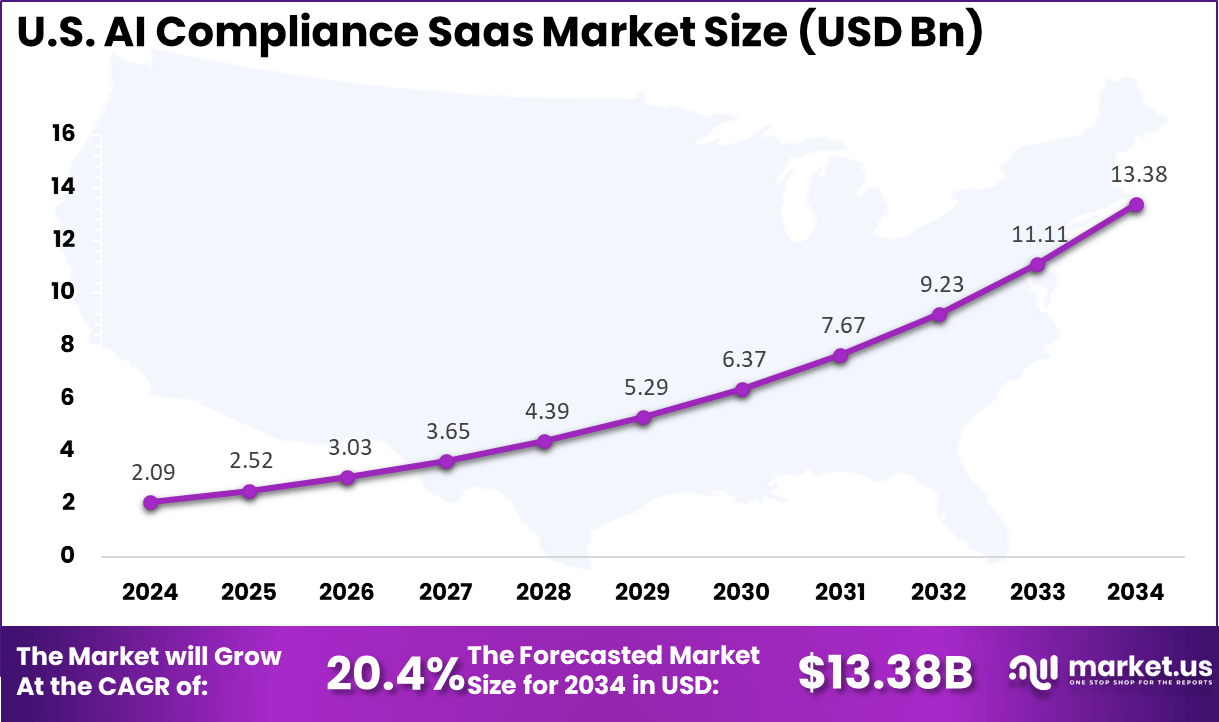
- The US market recorded USD 2.09 Billion in 2024 with a CAGR of 20.4%, signaling sustained investment in AI governance and regulatory assurance tools.
- In 2024, North America held 45.4%, confirming the region’s leadership in structured AI compliance adoption across regulated industries.
Key Statistics
Security and Liability
- AI-driven threat detection is reported to be 3.5 times faster than traditional security methods, improving real-time risk mitigation.
- AI liability clauses are now included in 42% of SaaS contracts, reflecting growing concern over accountability in AI-related security failures.
- Data residency regulations affect 89% of global SaaS providers, increasing the need for localized hosting and region-specific compliance strategies.
Adoption and Usage
- AI integration in SaaS has reached 7% of total SaaS applications in 2025, while more than 60% of enterprise SaaS products now include embedded AI features.
- SaaS adoption of AI continues to rise, with 76% of SaaS companies currently using or actively exploring AI for operational improvement.
- Future AI expansion remains strong, with 92% of SaaS companies planning to increase AI usage in their products in 2025.
Role of Generative AI
Generative AI plays a crucial role in AI compliance SaaS by automating complex tasks such as policy writing, control verification, and real-time risk monitoring. Over 70% of companies now regularly use generative AI in compliance-related functions, reflecting its growing importance in managing regulatory demands swiftly and accurately. This technology enhances the accuracy and speed of compliance processes by continuously adapting to new regulations and automatically generating audit reports.
In addition to automation, generative AI boosts productivity by helping developers generate and test code faster and providing users with AI-driven content creation for reports and dashboards. It supports better endpoint security by mapping device activity and enforcing access policies, which is essential for meeting compliance standards like GDPR and HIPAA. Such capabilities reduce human errors and help maintain regulatory adherence consistently across SaaS platforms.
Investment and Business Benefits
Investment opportunities exist in developing AI compliance platforms that serve mid-market enterprises and offer automated audit capabilities, integrated governance, and industry-specific compliance modules. There is strong investor interest in AI insurance solutions that manage AI risk exposure and underwriting processes using compliant AI workflows. Other growth areas include AI-driven ESG compliance SaaS and platforms combining cloud scalability with on-premise data security for sensitive data.
AI Compliance SaaS provides numerous business benefits, including streamlined regulatory reporting, reduced manual workloads by up to 50%, faster incident response with real-time issue correction, and improved governance confidence among customers and partners. Compliance fosters stronger customer loyalty and opens doors to enterprise deals that require certification or proof of adherence. Automated compliance further supports sustainable innovation by embedding ethical AI practices from development through deployment.
U.S. Market Size
The market for AI Compliance Saas within the U.S. is growing tremendously and is currently valued at USD 2.09 Billion, the market has a projected CAGR of 20.4%. The market is growing due to increasing regulatory demands and the rising adoption of cloud-based solutions.
Businesses across industries are embracing AI-powered SaaS to automate and streamline compliance processes, reduce manual risks, and enhance real-time data privacy and security monitoring. Digital transformation initiatives and the shift to remote work are also fueling demand for scalable, flexible SaaS platforms that enable better governance and regulatory adherence.
Additionally, the integration of AI technologies into SaaS solutions delivers predictive analytics and customized user experiences that improve efficiency and compliance accuracy. The need to address growing cybersecurity threats and evolving data privacy regulations drives companies to invest in advanced AI compliance tools.
For instance, in November 2025, Microsoft announced enhancements to its Azure Copilot with agentic AI capabilities, providing enterprise-grade safeguards for compliance and governance by respecting role-based access controls and compliance frameworks. This AI-powered platform supports secure, transparent operations and automated policy enforcement, reinforcing Microsoft’s dominance in AI compliance SaaS.
In 2024, North America held a dominant market position in the Global AI Compliance Saas Market, capturing more than a 45.4% share, holding USD 2.30 billion in revenue. This dominance is due to the region’s advanced technological infrastructure, high concentration of AI innovators, and extensive investments in AI research and development. The mature regulatory landscape, including frameworks like HIPAA and CCPA, pushes organizations to adopt AI-powered compliance tools for real-time monitoring and risk management.
Furthermore, strong demand from sectors such as BFSI and healthcare, which face stringent compliance requirements, fuels market growth. The priority on data security and regulatory adherence, combined with robust cloud adoption and digital transformation initiatives, makes North America a strategic hub for AI Compliance SaaS advancement and innovation.
For instance, in October 2025, IBM was recognized with the IDC 2025 SaaS Customer Satisfaction Award for its financial governance, risk, and compliance solutions, highlighting its leadership in AI-driven SaaS compliance platforms. IBM continues to accelerate SaaS innovation by integrating AI capabilities through acquisitions like Apptio and HashiCorp, advancing hybrid cloud ecosystems that enable enterprises to automate and secure complex compliance operations efficiently.
Component Analysis
In 2024, The Software/Platform segment held a dominant market position, capturing a 67.5% share of the Global AI Compliance Saas Market. This segment’s significance stems from its ability to offer comprehensive tools that automate regulatory compliance tasks, reducing manual efforts and enhancing accuracy. These platforms provide organizations with risk assessment, policy management, and real-time compliance monitoring functionalities that are essential for managing increasingly complex regulatory environments.
Companies rely on these software solutions to centralize compliance activities and ensure consistent adherence to ever-evolving regulations. The platforms also support seamless integration with existing enterprise systems, which boosts operational efficiency and improves visibility into compliance status across the organization. This widespread adoption underlines the growing importance of technology-enabled compliance management.
For Instance, in October 2025, IBM highlighted its acceleration in AI-driven SaaS platforms combining hybrid cloud and AI capabilities, integrating Watsonx and Red Hat to deliver scalable compliance and governance solutions across enterprises. This reflects IBM’s deep commitment to advancing software platforms tailored for complex compliance needs.
Compliance Type Analysis
In 2024, the Data Privacy & Security Compliance segment held a dominant market position, capturing a 35.6% share of the Global AI Compliance Saas Market. Organizations are prioritizing solutions that help manage stringent regulations around data protection, such as GDPR and HIPAA, which demand continuous oversight and mitigation of privacy risks. AI-powered compliance tools are effective at detecting anomalies, securing sensitive information, and facilitating audit readiness.
The rising incidence of data breaches and escalating regulatory penalties has driven businesses to adopt automated compliance monitoring to safeguard data assets. These solutions help maintain trust with customers and regulators by ensuring that privacy policies are consistently enforced and that security risks are promptly addressed.
For instance, in September 2025, MetricStream emphasized AI-powered automation and intelligence in regulatory compliance, enabling organizations to navigate evolving regulations while ensuring data privacy and risk transparency. Its agentic RCM agent automates key compliance steps to reduce manual effort.
Organization Size Analysis
In 2024, The Large Enterprises segment held a dominant market position, capturing a 70.2% share of the Global AI Compliance Saas Market. Their complex operational structures, wide geographic footprint, and extensive data handling requirements expose them to higher regulatory scrutiny. Consequently, these organizations invest significantly in sophisticated compliance solutions that allow for scalable, integrated management of diverse regulatory demands across multiple jurisdictions.
Such enterprises benefit from AI compliance platforms that provide automation, risk analytics, and comprehensive reporting features, which minimize compliance risks and reduce costs associated with manual oversight. Their sizable IT budgets and strategic focus on risk management enable the deployment of advanced AI tools that continuously adapt to regulatory changes.
For Instance, in November 2025, SAP SE revealed its EU AI Cloud, designed for European enterprises to securely deploy AI solutions that comply with regional sovereignty and regulatory standards. This offering caters to large organizations requiring strict governance control and compliance.
End-User Analysis
In 2024, The BFSI segment held a dominant market position, capturing a 40.3% share of the Global AI Compliance Saas Market. Financial institutions are subject to rigorous regulatory regimes aimed at preventing fraud, money laundering, and data breaches. AI-driven compliance tools help BFSI organizations automate transaction monitoring, detect anomalies, and ensure adherence to financial regulations effectively.
These solutions also facilitate vendor and third-party compliance management, which is critical in maintaining operational risk controls. The BFSI sector’s adoption of AI compliance SaaS reflects a broader commitment to leverage technology for improved governance and regulatory reporting.
For Instance, in June 2025, Salesforce.com showcased how its AI integration helps BFSI clients reduce manual work by automating compliance processes such as payment management and support requests, leading to better service and adherence to regulatory standards.
Emerging Trends
One emerging trend is the increasing integration of AI governance roles within organizations, with companies prioritizing fairness, transparency, and accountability as core compliance elements. Around 84% of government decision makers report accelerated AI adoption, highlighting the rising need for AI systems that comply with evolving laws.
Another trend involves shifting from qualitative to quantitative risk models, allowing for more precise measurement of AI-related risks and driving robust compliance frameworks across industries. Frameworks such as the EU AI Act and ISO 42001 are becoming critical for compliance with SaaS offerings, pushing companies to implement detailed documentation, continuous risk assessments, and human oversight protocols for high-risk AI applications.
Additional focus is on responsible AI, where ethical considerations are no longer optional but mandatory for market access and consumer trust. These trends shape the compliance SaaS landscape by demanding more dynamic and transparent AI governance structures.
Growth Factors
A significant growth factor is the rising complexity of AI regulations worldwide, which forces SaaS providers to develop adaptive compliance solutions that can handle diverse legal requirements. Over 60% of SaaS platforms are now embedding AI-powered features that assist in compliance, making such capabilities a competitive necessity.
Increased digitalization, cloud adoption, and use of AI-driven predictive analytics also fuel demand for sophisticated compliance tools that ensure continuous regulatory adherence. Furthermore, the sharp rise in cybersecurity threats and data privacy concerns drives enterprises to invest more in compliance SaaS that integrates AI for real-time monitoring and automated risk mitigation.
Key Market Segments
By Component
- Software/Platform
- Compliance Monitoring & Reporting
- Risk Assessment & Management
- Policy Management
- Data Privacy Management
- Audit Management
- Services
- Professional Services
- Managed Services
By Compliance Type
- Data Privacy & Security Compliance
- Financial Services Compliance
- AI Ethics & Governance Compliance
- Industry-Specific Compliance
By Organization Size
- Large Enterprises
- Small and Medium-sized Enterprises (SMEs)
By End-User
- Banking, Financial Services, and Insurance (BFSI)
- Healthcare & Life Sciences
- IT & Telecommunications
- Retail & E-commerce
- Manufacturing & Industrial
- Others
Regional Analysis and Coverage
- North America
- US
- Canada
- Europe
- Germany
- France
- The UK
- Spain
- Italy
- Russia
- Netherlands
- Rest of Europe
- Asia Pacific
- China
- Japan
- South Korea
- India
- Australia
- Singapore
- Thailand
- Vietnam
- Rest of Latin America
- Latin America
- Brazil
- Mexico
- Rest of Latin America
- Middle East & Africa
- South Africa
- Saudi Arabia
- UAE
- Rest of MEA
Drivers
Increasing Regulatory Pressure and AI Adoption
Growth in the AI Compliance SaaS market is being driven by increasing global regulatory demands. Organizations face strict laws such as GDPR and the EU AI Act, creating a strong need for automated tools that manage data privacy, audit readiness, and ethical AI use. As AI adoption accelerates across sectors, enterprises depend on SaaS platforms to reduce manual compliance workloads and lower operational risk.
Demand is also rising as industries integrate AI systems that require continuous monitoring rather than periodic checks. Tougher rules on transparency, fairness, and accountability push companies to rely on automated compliance solutions that can keep pace with evolving regulatory expectations. This shift reinforces the importance of real-time compliance for maintaining trust and avoiding penalties.
For instance, In November 2025, IBM introduced Guardium Data Protection 12.2 to support continuous AI compliance monitoring. The platform automates alignment with complex governance frameworks, helping enterprises meet regulatory obligations efficiently. This capability reflects a key driver behind market growth as organizations seek tools that ensure real-time adherence to expanding AI laws.
Restraint
Data Privacy and Security Concerns
Concerns over data privacy and security represent a significant restraint for the AI Compliance SaaS market. SaaS platforms require organizations to share sensitive data with the cloud provider, exposing risks of breaches or unauthorized access. For industries with strict regulations like healthcare and finance, maintaining robust data protection while using external AI services is challenging and costly. Fear of non-compliance adds hesitation for enterprises considering AI SaaS adoption.
Further complicating this is the need to meet requirements under standards such as HIPAA and GDPR, which can delay implementation and increase operational expenses. The complexity of safeguarding highly confidential and regulated data while using AI-powered SaaS solutions constrains market growth, as organizations weigh risks against benefits.
For instance, in April 2025, LogicGate introduced an automated control gap analysis solution that identifies compliance and regulatory overlaps with AI, yet also highlights the challenge of managing sensitive data securely within SaaS environments. Despite automation benefits, strict data privacy regulations and risk of breaches restrain faster SaaS adoption in compliance-sensitive sectors.
Opportunities
Automating Compliance in Regulated Industries
There is a substantial opportunity for AI Compliance SaaS in heavily regulated sectors such as aerospace, defense, finance, and insurance. These industries face rigorous ongoing compliance audits and documentation mandates that are labor-intensive and costly. AI-driven SaaS platforms can automate audit preparation, compliance tracking, and risk management, reducing reliance on manual processes and consultants.
This automation helps mid-market companies keep pace with regulatory demands and scale compliance efforts affordably. Specialized AI compliance SaaS tailored for vertical-specific regulations can save time and costs while improving accuracy and audit readiness. Market demand is high for AI-native compliance platforms that unify fragmented processes and offer continuous, real-time risk monitoring.
For instance, in October 2025, SAP received ISO 42001 certification for its AI governance, allowing it to offer AI-powered compliance features in SAP S/4HANA Cloud Public Edition. This enables customers to automate compliance data processing and reduce compliance costs by up to 90%, showcasing a strong opportunity for AI compliance SaaS in regulated industries seeking automation to cut expenses and improve accuracy.
Challenges
Integration Complexity and Skilled Workforce Shortage
The AI Compliance SaaS market faces challenges around the complexity of integrating new compliance tools with existing legacy systems. Many companies operate with varied technologies that create compatibility issues and slow the deployment of AI compliance solutions. This integration complexity hampers the ability to adopt SaaS platforms seamlessly for compliance.
Additionally, the shortage of skilled professionals who understand AI compliance and SaaS technologies limits market growth. Companies struggle to find experts who can manage AI systems while ensuring regulatory alignment and ethical considerations. The combined effect of technical integration hurdles and insufficient human resources creates a barrier for broad market penetration and scalability.
For instance, in September 2025, ServiceNow announced its AI-powered continuous compliance monitoring platform, which provides real-time oversight but also faced integration challenges with legacy systems used by many clients. This reflects the broader market challenge of deploying AI compliance SaaS smoothly amid complex IT environments and a shortage of skilled personnel to manage such integrations.
Key Players Analysis
IBM, Microsoft, SAP, Oracle, and Amazon lead the AI compliance SaaS market with strong cloud-based platforms designed to manage regulatory requirements, automate risk detection, and enforce data governance. Their solutions support policy monitoring, audit tracking, and real-time compliance insights across regulated industries. These companies focus on scalable architectures, AI-driven controls, and secure integrations.
ServiceNow, MetricStream, LogicGate, Workiva, OneTrust, RiskLens, NAVEX Global, and SAI Global strengthen the competitive landscape with specialized platforms for governance, risk, and compliance automation. Their tools centralize workflows, streamline reporting, and provide continuous monitoring of AI-related risks. These providers help organizations maintain operational transparency, meet regulatory expectations, and reduce manual compliance burdens.
Deloitte, PwC, Accenture, Cognizant, FICO, Fortinet, and other participants broaden the market with consulting-led compliance solutions and industry-specific AI oversight models. Their offerings combine risk assessments, data validation, cybersecurity protection, and ethical AI review. These companies support enterprises in meeting internal standards and emerging global regulations.
Top Key Players in the Market
- IBM Corporation
- Microsoft Corporation
- SAP SE
- Oracle Corporation
- com, Inc.
- ServiceNow, Inc.
- MetricStream
- LogicGate
- Workiva Inc.
- OneTrust
- RiskLens
- NAVEX Global
- SAI Global
- Deloitte
- PwC
- Accenture
- Cognizant
- FICO
- Fortinet
- Others
Recent Developments
- In November 2025, Microsoft unveiled advancements at Ignite 2025, including Windows 365 for Agents, enabling enterprise-grade AI agent creation under secure, compliant environments. This reflects Microsoft’s push to embed AI governance, data protection, and role-based compliance controls across its cloud and AI solutions, maintaining strong leadership in AI compliance SaaS.
- In October 2025, IBM Corporation received the IDC 2025 SaaS Customer Satisfaction Award for its Financial Governance, Risk and Compliance solutions. The recognition was linked to the company’s expanding SaaS portfolio, supported by acquisitions such as Apptio and HashiCorp, which strengthened its hybrid cloud and AI-driven compliance capabilities.
Report Scope
Report Features Description Market Value (2024) USD 5.07 Bn Forecast Revenue (2034) USD 39.5 Bn CAGR(2025-2034) 22.8% Base Year for Estimation 2024 Historic Period 2020-2023 Forecast Period 2025-2034 Report Coverage Revenue forecast, AI impact on Market trends, Share Insights, Company ranking, competitive landscape, Recent Developments, Market Dynamics and Emerging Trends Segments Covered By Component (Software/Platform, Services), By Compliance Type (Data Privacy & Security Compliance, Financial Services Compliance, AI Ethics & Governance Compliance, Industry-Specific Compliance), By Organization Size (Large Enterprises, Small and Medium-sized Enterprises (SMEs), By End-User (Banking, Financial Services, and Insurance (BFSI), Healthcare & Life Sciences, IT & Telecommunications, Retail & E-commerce, Manufacturing & Industrial, Others) Regional Analysis North America – US, Canada; Europe – Germany, France, The UK, Spain, Italy, Russia, Netherlands, Rest of Europe; Asia Pacific – China, Japan, South Korea, India, New Zealand, Singapore, Thailand, Vietnam, Rest of Latin America; Latin America – Brazil, Mexico, Rest of Latin America; Middle East & Africa – South Africa, Saudi Arabia, UAE, Rest of MEA Competitive Landscape IBM Corporation, Microsoft Corporation, SAP SE, Oracle Corporation, Salesforce.com, Inc., ServiceNow, Inc., MetricStream, LogicGate, Workiva Inc., OneTrust, RiskLens, NAVEX Global, SAI Global, Deloitte, PwC, Accenture, Cognizant, FICO, Fortinet, Others Customization Scope Customization for segments, region/country-level will be provided. Moreover, additional customization can be done based on the requirements. Purchase Options We have three license to opt for: Single User License, Multi-User License (Up to 5 Users), Corporate Use License (Unlimited User and Printable PDF) 
-
-
Our Clients

- 168551
- Dec. 2025