Report Overview
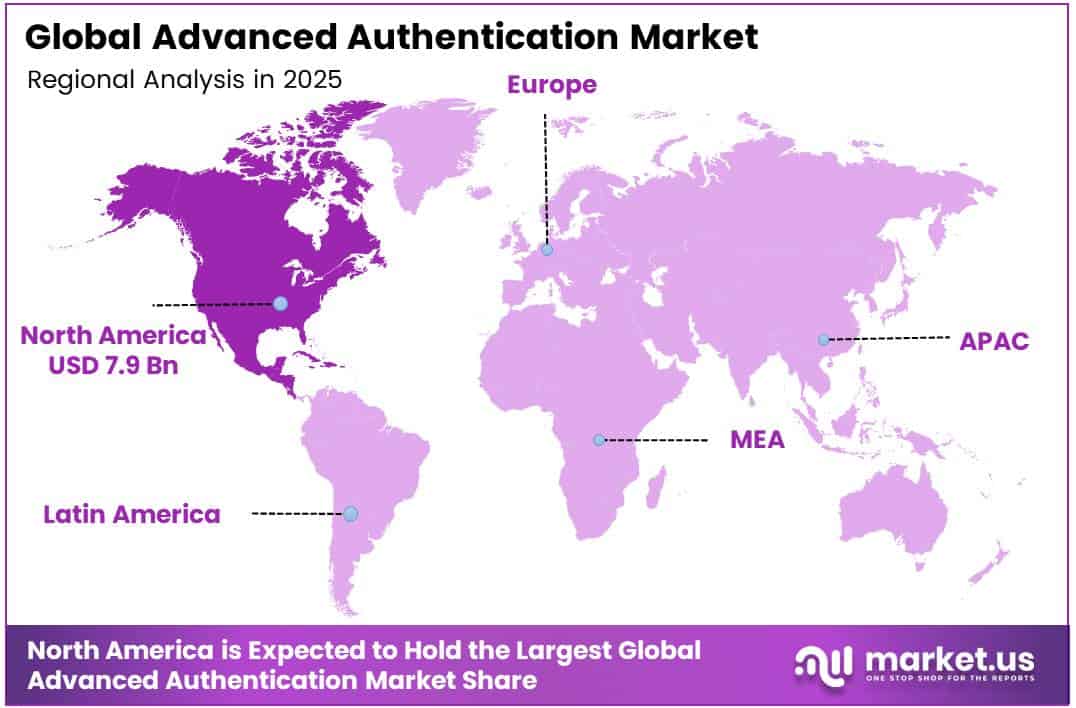
In 2025, the Global Advanced Authentication Market was valued at USD 23.2 billion. The market is projected to grow at a CAGR of 14.3% during 2026–2035, reaching approximately USD 88.2 billion by 2035. North America dominated the global market in 2025, accounting for more than 34.0% of the total market share and generating approximately USD 7.9 billion in revenue.
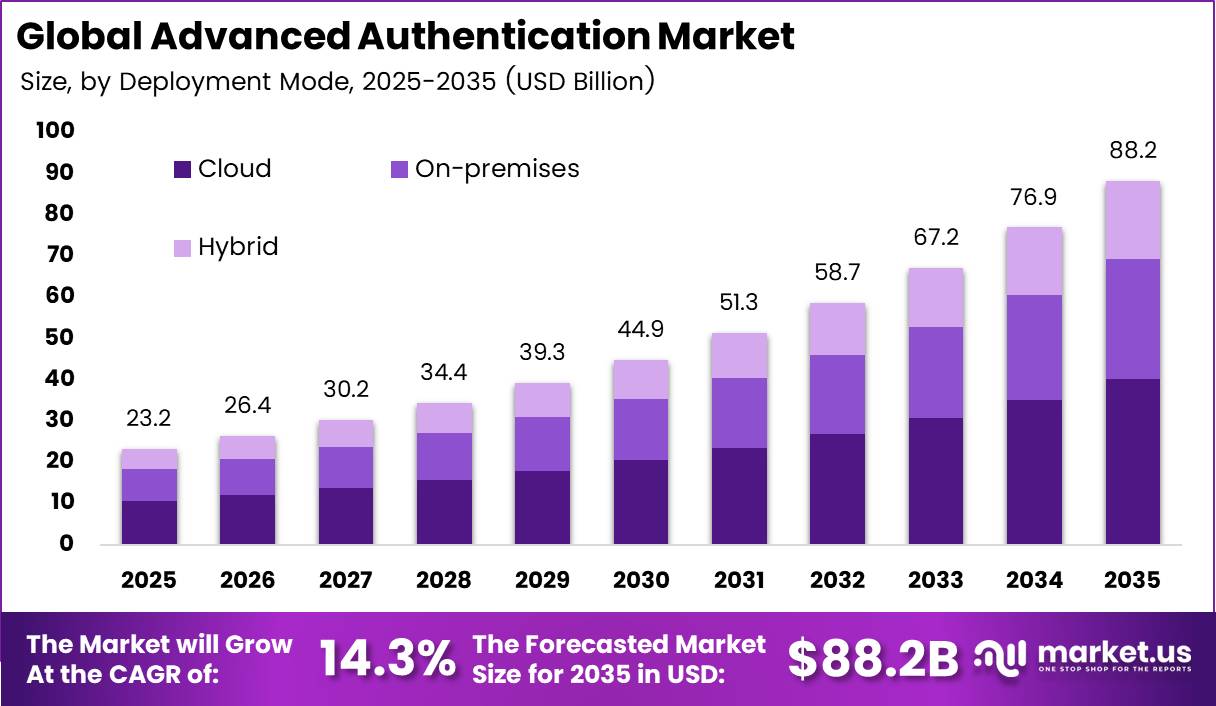
Rising cyber fraud drives this growth. The FBI Internet Crime Complaint Center reported 859,532 complaints in 2024, with losses of USD 16.6 billion. Losses rose 33% from 2023. Phishing, extortion, and personal data breaches were the top three crimes by complaint count.
Each one starts with a stolen or fake identity. Banks, telecom firms, and online retailers now replace simple passwords with stronger login checks. Investment fraud alone caused USD 6.5 billion in losses. Cisco reported that its Security revenue, which includes Identity and Access Management, grew 59% in fiscal 2025.
North America region faces the heaviest fraud pressure in the world. People over age 60 in the US lost nearly USD 5 billion to internet crime in 2024. That figure pushes banks and healthcare providers to adopt stronger identity checks. The region also hosts the largest identity security vendors.
Key Takeaways
- The Global Advanced Authentication Market reached USD 23.2 billion in 2025 and will reach USD 88.2 billion by 2035, at a CAGR of 14.3% from 2026 to 2035.
- By technology, Single-factor authentication leads with a 61.2% share.
- By deployment model, Cloud leads with a 57.9% share.
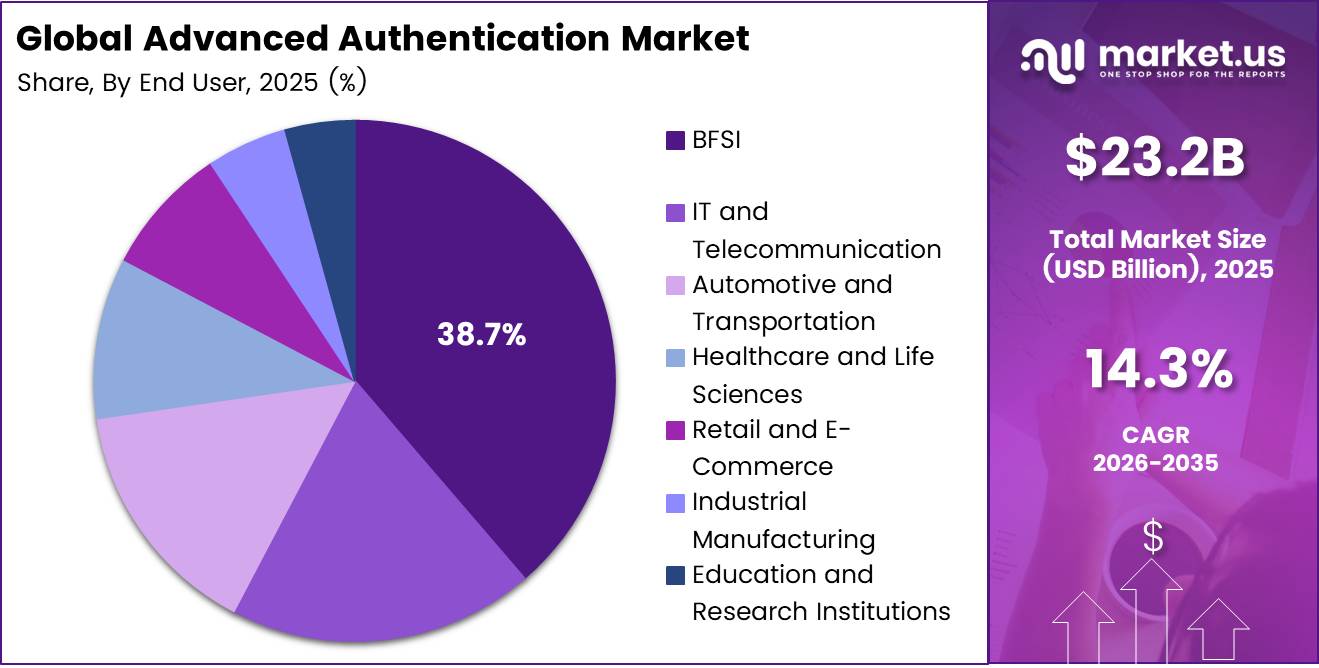
- By end user, BFSI leads with a 38.7% share.
- North America dominates with a 34.0% share and USD 7.9 billion in revenue.
By Technology
Single-factor authentication dominates with 61.2% due to simple password access across existing systems.
Single-factor authentication leads the supplied market split because businesses already use passwords across customer accounts, staff portals, and older software. This installed base supports continued spending on password management and account recovery.
Companies can maintain familiar login steps without adding security keys or extra checks. However, the supplied 61.2% share describes market size, not security strength. NIST warns that passwords alone cannot adequately protect sensitive business assets, which limits the long-term appeal of this approach.
By Deployment Model
Cloud dominates with 57.9% due to central access management across online applications.
Cloud leads the supplied deployment split with 57.9% because businesses need consistent login controls across online applications and distributed teams. A shared cloud service lets administrators manage access rules from a central point rather than maintain separate tools for each application.
Eurostat reported that 45.2% of EU enterprises purchased cloud computing services in 2023. This wider use of online business tools creates a clear setting for cloud authentication, although that figure measures general cloud adoption rather than authentication purchases.
Cloud demand also benefits from the move toward hosted email, file storage, and office software. Among EU enterprises buying cloud services, 82.7% purchased email services and 68.0% purchased file storage in 2023. Each service adds accounts that businesses must protect and manage. Central login controls can help teams apply common access rules as their application portfolios expand.
By End User
BFSI dominates with 38.7% due to high stakes in protecting financial accounts.
BFSI leads the supplied end-user split with 38.7% because banks, financial service providers, and insurers must protect accounts that hold money and sensitive customer records. They also need convenient access across mobile services, websites, and employee systems.
The FDIC found that 48.3% of banked US households used mobile banking as their main account-access method in 2023. This large digital customer base gives financial institutions a strong reason to invest in dependable authentication without making routine transactions harder.
Financial firms must also manage access beyond mobile applications. The same FDIC survey found that 70.5% of banked households mainly used remote channels, including mobile, online, or telephone banking. These findings describe US banking behavior rather than the whole global BFSI market.
IT and Telecommunications rank as the fastest-growing end-user group in the supplied input. ITU estimated 6 billion internet users worldwide in 2025. That scale expands the potential account base for connected services. Authentication demand follows as providers manage customer logins, workforce access, and service administration, while balancing stronger checks with convenient entry.
Key Market Segments
By Technology
- Single-factor authentication
- Multi-factor authentication
By Deployment Model
- Cloud
- Hybrid
- On-premises
By End User
- BFSI
- IT and Telecommunication
- Automotive and Transportation
- Healthcare and Life Sciences
- Retail and E-Commerce
- Industrial Manufacturing
- Education and Research Institutions
- Others
Geopolitical Impact Analysis
Geopolitical tension now affects the hardware side of advanced authentication. Security chips, smart cards, biometric sensors, and FIDO tokens depend on Asian chip supply. The US raised tariffs on Chinese semiconductors to 50% in January 2025. This change raises costs for token and card makers that source chips from China, so vendors move assembly to other countries.
Shipping risk adds more pressure. UNCTAD reports that rerouting ships around the Cape of Good Hope adds about 12 days to an Asia-to-Europe trip. This change raises transit times by about 30%. It also cuts effective global container capacity by about 9%. Container tonnage through the Suez Canal fell by 82% at the peak of the disruption.
Trade growth is also slowing. The WTO forecasts world merchandise trade volume growth of 1.9% in 2026, down from 4.6% in 2025. Conflict in the Middle East could cut 2026 growth to 1.4%. Weaker trade raises inventory costs for vendors that ship physical authenticators across borders.
These pressures push buyers toward cloud and software methods. Push alerts, passkeys, and app-based biometrics need no shipped hardware. Vendors avoid tariffs and port delays when they deliver authentication as a cloud service. This trend supports the cloud segment’s lead and speeds up multi-factor adoption on devices that people already own.
Regional Analysis
North America dominates the Advanced Authentication Market, holding a 34.0% share and generating USD 7.9 billion in revenue. The US drives most of this demand. Large banks, insurers, and healthcare groups face strict rules on data protection and access control. Federal agencies push zero trust security, which needs strong identity checks at every login.
The region also hosts the market’s largest vendors. Cisco grew its Americas revenue by 9% in the fourth quarter of fiscal 2025, faster than its other regions. Cisco also spent USD 9.3 billion on research and development in fiscal 2025, up 16% from the year before. This spending funds identity tools such as Duo multi-factor authentication. Deal activity confirms the region’s strength.
Infineon, based in Germany, earned EUR 1,418 million from its Connected Secure Systems segment in fiscal 2025. This segment supplies chips for authentication, ID documents, and payment cards. Cisco’s EMEA revenue grew 4% in the fourth quarter of fiscal 2025. Spain and Italy add growth through digital ID and e-government programs.
Asia Pacific is the fastest-growing region in the Advanced Authentication Market. China, Japan, South Korea, and India lead demand. Mobile banking, digital payments, and national ID programs drive quick growth in multi-factor use. Cisco’s APJC revenue grew 7% in the fourth quarter of fiscal 2025. Japan’s NEC and Fujitsu supply face and palm recognition systems across the region.
Key Regions and Countries
North America
- US
- Canada
Europe
- Germany
- France
- The UK
- Spain
- Italy
- Rest of Europe
Asia Pacific
- China
- Japan
- South Korea
- India
- Australia
- Rest of APAC
Latin America
- Brazil
- Mexico
- Rest of Latin America
Middle East and Africa
- GCC
- South Africa
- Rest of MEA
Market Dynamics
Drivers
| Driver | (~) % Impact on CAGR Forecast | Geographic Relevance | Impact Timeline |
|---|---|---|---|
| Password-based attacks accelerating phishing-resistant authentication | +0.9% | Global; North America and Europe strongest | Short term (2 years or less) |
| Cloud control-plane MFA enforcement | +0.5% | Global cloud-dependent enterprises | Short term (2 years or less) |
| Privileged-access authentication modernization | +0.4% | Global; regulated enterprises | Short term (2 years or less) |
| Consumer passkey enrollment momentum | +0.3% | North America, Europe and developed Asia-Pacific | Short term (2 years or less) |
| Federal workforce hardware-authenticator deployment | +0.2% | United States; public-sector spillovers | Medium term (2 to 4 years) |
Password-based attacks accelerating phishing-resistant authentication
Reusable credentials create a persistent attack surface that makes stronger authentication an operational security purchase rather than an optional convenience feature: Microsoft’s 2024 defense reporting identified more than 600 million daily identity attacks, with password-based attacks representing over 99% of that activity.
Microsoft’s May 2025 implementation update reported phishing-resistant protection for 92% of employee productivity accounts, demonstrating deployment at enterprise scale. Commercially, this shifts suppliers toward recurring orchestration, credential-lifecycle management and policy-enforcement revenue alongside authenticator sales.
The estimated +0.9 percentage-point contribution is an analyst sensitivity to the supplied 14.3% baseline, not an institution-published forecast; all table percentages use percentage-point adjustments, with the driver sensitivities totaling +2.3 percentage points, representing stronger-than-baseline realization rather than a second addition of demand already embedded in that baseline.
Restraints
| Restraint | (~) % Impact on CAGR Forecast | Geographic Relevance | Impact Timeline |
|---|---|---|---|
| Biometric processing without a valid legal condition | -0.7% | European Union and United Kingdom | Short term (2 years or less) |
| Native-platform substitution for standalone authentication licenses | -0.5% | Global; mature enterprise software markets | Short term (2 years or less) |
| Unavailable upfront funding for dedicated hardware rollouts | -0.3% | Budget-constrained enterprises and public agencies | Short term (2 years or less) |
| Unsupported endpoints excluding device-bound deployments | -0.2% | Global; legacy industrial and shared-device estates | Medium term (2 to 4 years) |
| Procurement exclusion of uncertified authenticators | -0.2% | United States; high-assurance government procurement | Short term (2 years or less) |
Biometric processing without a valid legal condition
Biometric authentication becomes a current-sales restraint when a proposed deployment lacks a lawful processing condition, rather than merely requiring additional engineering: the EDPB’s 2024 airport opinion examined 4 storage architectures and identified only individual-controlled storage or centrally stored templates with keys controlled solely by the individual as potentially compatible with the assessed security and privacy requirements, subject to safeguards.
The analyst-estimated -0.7 percentage-point sensitivity applies narrowly to this exposed deployment mix, not to all biometrics, while the combined restraint scenario of -1.9 percentage points reduces the supplied 14.3% baseline to 12.4% without implying market contraction.
Challenges
| Challenge | (~) % CAGR Friction Drag | Geographic Relevance | Mitigation Horizon |
|---|---|---|---|
| Secure Account Recovery Complexity | -0.6% | Global; consumer and workforce deployments | Medium term (2 to 4 years) |
| Heterogeneous Application Integration Burden | -0.4% | Global; hybrid enterprise environments | Medium term (2 to 4 years) |
| Specialist Deployment Skills Scarcity | -0.3% | Global; smaller implementation partners | Medium term (2 to 4 years) |
| Biometric Performance Across Populations | -0.2% | Global; diverse user populations | Long term (4 years or more) |
| Authentication Service Availability Engineering | -0.2% | Global; transaction-intensive services | Medium term (2 to 4 years) |
Secure Account Recovery Complexity
Loss of a device or authenticator exposes a structural weakness: a secure primary sign-in can still be undermined by a weaker recovery process, while overly restrictive recovery increases abandonment and support workload.
The analyst-estimated -0.6 percentage-point friction is distinct from endpoint eligibility or legal exclusion; combined challenge sensitivities total -1.7 percentage points, and applying both restraint and challenge downside totals to the supplied 14.3% baseline leaves a positive 10.7% scenario.
Opportunities
| Opportunity | (~) % Potential CAGR Upside | Geographic Relevance | Execution Window |
|---|---|---|---|
| Digital identity wallet relying-party authentication services | +0.7% | European Union; cross-border service providers | Medium term (2 to 4 years) |
| Managed authentication for underserved smaller businesses | +0.4% | Global; channel-led enterprise markets | Medium term (2 to 4 years) |
| Offline authentication for disconnected industrial operations | +0.3% | Global; manufacturing, mining and remote infrastructure | Long term (4 years or more) |
| Delegated authentication for autonomous software agents | +0.3% | North America, Europe and developed Asia-Pacific | Long term (4 years or more) |
| Accessible authentication for assisted-user workflows | +0.2% | Global; healthcare and public-service environments | Medium term (2 to 4 years) |
Digital identity wallet relying-party authentication services
The untapped opportunity is commercial authentication infrastructure connecting service providers to digital identity wallets, not wallet issuance itself: the European Commission identifies end-2026 availability as the EU rollout objective and defines common architecture, protocols and information-exchange formats, creating prospective demand for reusable acceptance connectors and verification orchestration.
In an illustrative analyst unit-economic scenario—not a reported institutional outcome reusable connectors could reduce implementation effort per additional relying party by 10–15%; assuming implementation delivery represents 30% of associated revenue and pricing remains unchanged, that translates mechanically into approximately 3–4.5 percentage points of delivery-margin improvement before certification, operations, and customer-acquisition costs.
The estimated +0.7 percentage-point CAGR upside requires deliberate execution; all opportunities total +1.9 percentage points, producing a 16.2% opportunity-only scenario against the supplied 14.3% baseline, while simultaneous full realization of driver and opportunity sensitivities would yield an illustrative upper scenario of 18.5%, not a central forecast.
Key Players Analysis
Tier 1 market leaders combine global reach with very large budgets. Microsoft spent USD 32.5 billion on research and development in fiscal 2025, equal to 12% of revenue, and grew Microsoft Cloud revenue 23% to USD 168.9 billion. Entra ID and Windows Hello reach users through this cloud base. Cisco reported total revenue of USD 56.7 billion in fiscal 2025. Its Security revenue rose 59% to USD 8.1 billion, helped by the Splunk acquisition.
Broadcom is also a Tier 1 player. It reported revenue of USD 63.9 billion in fiscal 2025. Its infrastructure software unit, which includes Symantec identity tools, earned USD 6.9 billion in the fourth quarter alone. IBM and Mastercard round out this tier. Both use their large enterprise and payment networks to sell identity and fraud tools.
Tier 2 challengers hold strong regional or niche positions. Infineon earned EUR 14,662 million in fiscal 2025 and spent about EUR 2.2 billion on research and development. Its Connected Secure Systems segment supplies authentication chips. NEC and Fujitsu lead in biometric systems in Asia. Entrust, Atos and FEITIAN lead in smart cards, keys and secure identity services.
Specialist players focus on new methods. ForgeRock now runs under Ping Identity, which manages over 8 billion accounts. Beyond Identity and FusionAuth focus on passwordless and developer-led login tools. These firms gain share as buyers move to multi-factor authentication.
Top Key Players in the Market
- Atos SE
- Beyond Identity Inc.
- Broadcom Inc.
- Cisco Systems Inc.
- Entrust Corp.
- FEITIAN Technologies Co. Ltd.
- ForgeRock Inc.
- Fujitsu Ltd.
- FusionAuth
- Infineon Technologies AG
- International Business Machines Corp.
- Mastercard Inc.
- Microsoft Corp.
- NEC Corp.
Recent Developments
- In February 2025, CyberArk acquired Zilla Security for USD 165 million in cash plus a USD 10 million earn-out, adding automated identity governance to its identity suite.
- In July 2025, Palo Alto Networks agreed to acquire CyberArk for about USD 25 billion, offering USD 45.00 in cash plus 2.2005 Palo Alto Networks shares for each CyberArk share.
- In September 2025, Okta completed its acquisition of Axiom Security for USD 54 million in cash, adding privileged access tools for cloud, SaaS, and database environments. Okta signed an agreement to acquire Permiso Security for about USD 200 million, adding identity threat detection for human, non-human, and AI agent identities.
Report Scope
| Report Features | Description |
|---|---|
| Market Value (2025) | USD 23.2 Billion |
| Forecast Revenue (2035) | USD 88.2 Billion |
| CAGR (2026-2035) | 14.3% |
| Base Year for Estimation | 2025 |
| Historic Period | 2020-2024 |
| Forecast Period | 2026-2035 |
| Report Coverage | Revenue Forecast, Market Dynamics, Competitive Landscape, Recent Developments |
| Segments Covered | By Technology (Single-factor authentication, Multi-factor authentication); By Deployment Model (Cloud, Hybrid, On-premises); By End User (BFSI, IT and Telecommunication, Automotive and Transportation, Healthcare and Life Sciences, Retail and E-Commerce, Industrial Manufacturing, Education and Research Institutions, Others) |
| Regional Analysis | North America – US, Canada; Europe – Germany, France, The UK, Spain, Italy, Rest of Europe; Asia Pacific – China, Japan, South Korea, India, Australia, Singapore, Rest of APAC; Latin America – Brazil, Mexico, Rest of Latin America; Middle East & Africa – GCC, South Africa, Rest of MEA |
| Competitive Landscape | Atos SE, Beyond Identity Inc., Broadcom Inc., Cisco Systems Inc., Entrust Corp., FEITIAN Technologies Co. Ltd., ForgeRock Inc., Fujitsu Ltd., FusionAuth, Infineon Technologies AG, International Business Machines Corp., Mastercard Inc., Microsoft Corp., NEC Corp. |
| Customization Scope | Customization for segments, region/country-level will be provided. Moreover, additional customization can be done based on the requirements. |
| Purchase Options | We have three licenses to opt for: Single User License, Multi-User License (Up to 5 Users), Corporate Use License (Unlimited Users and Printable PDF) |