Global Accounting Software Market Size, Share and Analysis Report By Type (Embedded Accounting Software Packages, Online Solutions Accounting Software, Desktop Non-Embedded Solutions Accounting Software and Others), By Deployment Mode (Cloud-based, On-premises), By Organization Size (Large Enterprises, Small and Medium-sized Enterprises), By Product (Small Business Accounting Software, Enterprise Accounting Software, Nonprofit Accounting Software and Others), By Application (Billing and Invoice, Payroll Management, Project Management and Others), By End-User Industry (Banking, Financial Services, and Insurance, Healthcare, Manufacturing, Retail and Others), By Technology (AI, Blockchain, Machine Learning, Internet of Things, Automation, Others), By Module (Core Accounting, Budgeting and Forecasting, Inventory Management, Order Management, Others), By Functionality (Multi-currency, Multi-language, Real-time Data, Customizable Dashboards, Integration Capabilities and Others), By Regional Analysis, Global Trends and Opportunity, Future Outlook By 2025-2035
- Published date: Feb. 2026
- Report ID: 179653
- Number of Pages: 376
- Format:
-
keyboard_arrow_up
Quick Navigation
- Report Overview
- Top Market Takeaways
- Key Insights Summary
- By Component
- By Type
- By Deployment Mode
- By Organization Size
- By Product
- By Application
- By End User Industry
- By Technology
- Regional Analysis
- Drivers Impact Analysis
- Restraint Impact Analysis
- Investor Type Impact Matrix
- Emerging Trends Analysis
- Growth Factors Analysis
- Key Market Segments
- Competitive Analysis
- Recent Developments
- Report Scope
Report Overview
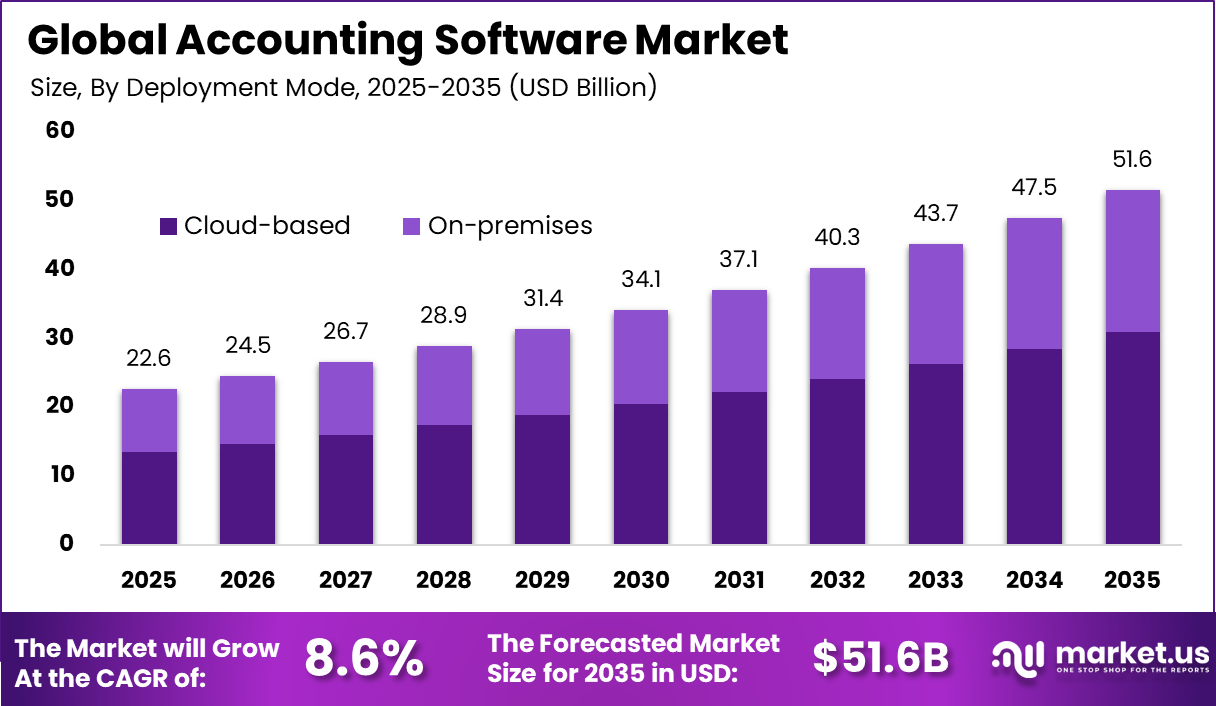
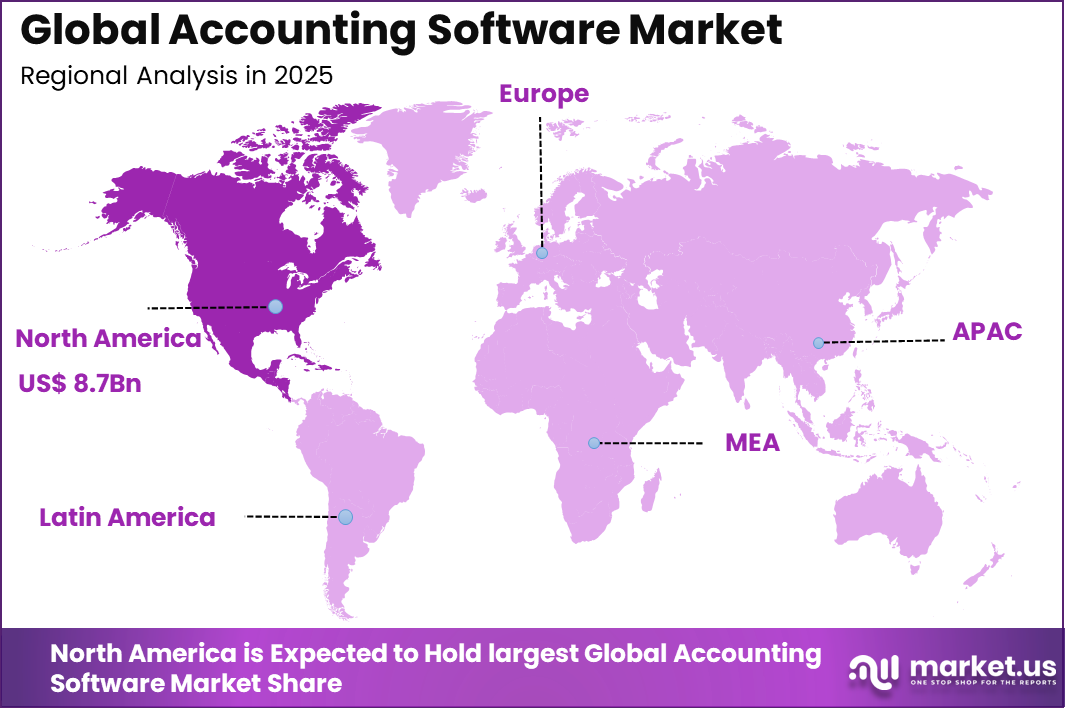
The Global Accounting Software Market size is expected to be worth around USD 51.6 Billion By 2035, from USD 22.6 billion in 2025, growing at a CAGR of 8.6% during the forecast period from 2026 to 2035. North America held a dominant Market position, capturing more than a 38.5% share, holding USD 8.7 Billion revenue.
The Accounting Software Market represents a critical segment within enterprise digital transformation, supporting financial record keeping, compliance reporting, payroll processing, billing, and real time financial visibility. Adoption has accelerated as businesses shift from manual bookkeeping and spreadsheet based processes to integrated digital accounting platforms. Regulatory complexity, tax compliance requirements, and audit transparency standards have strengthened the need for reliable accounting systems.
As organizations expand across regions and channels, centralized financial data management has become essential for operational stability and reporting accuracy. A major structural shift has been the transition toward online and cloud based accounting environments. Cloud deployment has enabled remote access, real time collaboration between finance teams and external auditors, and continuous system updates without large infrastructure investments.
One primary driver is the rising complexity of tax structures and financial regulations across industries. Businesses are required to maintain accurate digital records to comply with audit mandates and government filing standards. Errors in financial reporting can lead to penalties and reputational damage, increasing the value of automated accounting controls. This has led to consistent investment in accounting platforms that reduce manual errors and improve traceability.
For instance, In October 2025, the AI startup DualEntry secured USD 90 million in funding to strengthen its position in the enterprise resource planning segment. The investment is intended to accelerate the automation of financial workflows and support faster transitions from legacy accounting platforms to integrated ERP environments. This development reflects increasing enterprise demand for unified systems that seamlessly connect accounting functions with broader ERP data frameworks, improving operational visibility and financial control.
Demand is strongly linked to business digitization trends across retail, manufacturing, services, and e commerce sectors. As organizations adopt digital payment systems and online sales channels, financial transaction volumes increase significantly. This requires accounting systems that can automatically integrate with banking platforms, payroll tools, and tax filing systems. Integrated ecosystems have therefore become a key purchasing factor for buyers.
Top Market Takeaways
- By component, software accounted for 80.0%, reflecting strong preference for digital platforms over manual or hybrid financial systems.
- By type, online solutions accounting software accounted for 50.0%, showing increasing reliance on internet based financial management tools.
- By deployment mode, cloud based solutions accounted for 60.0%, highlighting the shift toward scalable and remote accessible systems.
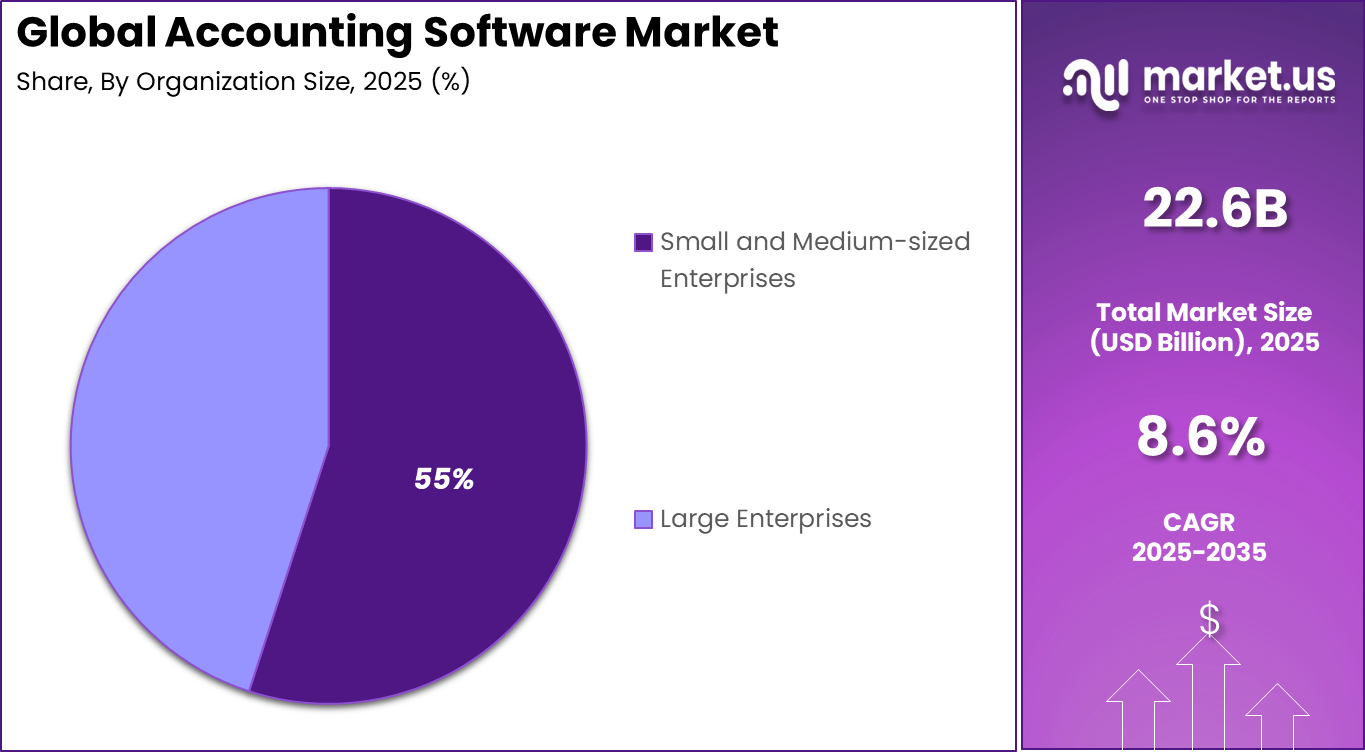
- By organization size, small and medium sized enterprises accounted for 55.0%, demonstrating SME led adoption momentum.
- By product, small business accounting software accounted for 45.0%, reinforcing demand for simplified financial tools.
- By application, billing and invoice accounted for 30.0%, indicating strong focus on revenue cycle management.
- By end user industry, manufacturing accounted for 25.0%, reflecting the need for inventory linked accounting controls.
- By technology, artificial intelligence accounted for 30.0%, showing growing integration of predictive and automated capabilities.
- North America accounted for 38.5%, supported by mature digital infrastructure and regulatory compliance standards.
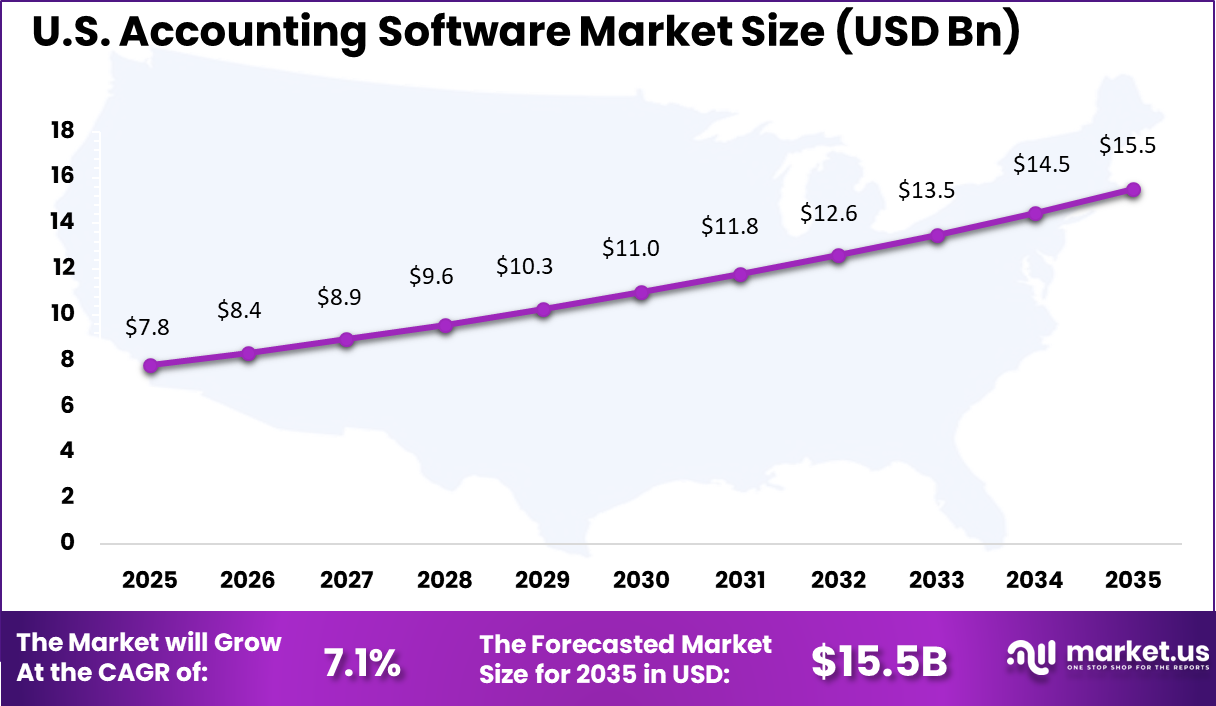
- The US market was valued at USD 7.84 Bn with a 7.15% CAGR as indicated in the provided figures.
Key Insights Summary
- Around 94% of accountants are using cloud services, and cloud based solutions accounted for 68.08% of total revenue share in 2025.
- More than 70% of small and medium enterprises worldwide have adopted some form of accounting software as of 2023.
- Advanced accounting platforms are capable of automating nearly 75% of routine accounting tasks.
- Businesses using cloud accounting solutions reported approximately 15% higher year over year revenue growth compared to traditional systems.
- About 60% of small business owners indicate limited accounting knowledge, increasing demand for simple and automated software tools.
By Component
Software accounted for 80.0% of the market, reflecting strong demand for automated financial management systems. Organizations prioritize applications that centralize bookkeeping, reporting, and compliance tracking within a unified platform. These systems reduce reliance on spreadsheets and manual data entry. Improved accuracy and audit readiness remain key drivers of adoption.
Accounting platforms integrate with payroll, inventory, and banking systems to ensure synchronized financial records. Automated reconciliation improves reporting efficiency and reduces operational risk. Real time dashboards provide visibility into cash flow and profitability. Businesses increasingly treat accounting software as a strategic operational tool.
Continuous updates also support evolving tax regulations and financial standards. Vendors provide regulatory adjustments within system updates, reducing compliance burden. This enhances trust in digital financial management systems. Software therefore dominates the accounting technology landscape.
By Type
Online solutions represented 50.0% of accounting software adoption. Web based platforms allow remote access to financial records from multiple locations. This supports distributed teams and external auditors. Accessibility improves collaboration between finance departments and management teams.
Online systems typically offer subscription models that reduce upfront investment. Automatic updates ensure users operate on the latest compliance frameworks. Data synchronization across devices prevents version inconsistencies. These operational benefits continue to encourage migration toward online accounting solutions.
Security protocols such as encryption and multi factor authentication strengthen confidence in digital platforms. Businesses gain secure access without maintaining internal servers. This improves scalability and operational flexibility. Online accounting systems therefore maintain strong demand.
By Deployment Mode
Cloud based deployment held 60.0% share due to scalability and maintenance efficiency. Cloud environments eliminate hardware management responsibilities for businesses. Automatic backups and disaster recovery mechanisms enhance financial data protection. Organizations benefit from predictable operational costs.
Cloud deployment also supports integration with digital payment platforms and enterprise systems. Financial data flows seamlessly across procurement, payroll, and customer management systems. This improves operational efficiency and reporting consistency. Real time access strengthens financial oversight.
System updates are managed centrally by service providers. Businesses focus on financial analysis rather than infrastructure maintenance. Reduced IT burden encourages adoption among growing enterprises. Cloud deployment remains a preferred operational model.
By Organization Size
Small and medium sized enterprises accounted for 55.0% of adoption. These businesses seek cost effective tools to manage accounting operations without extensive finance teams. Digital platforms automate bookkeeping and tax calculation tasks. This reduces administrative workload and improves accuracy.
Growing enterprises require scalable systems that expand with transaction volume. Accounting software provides structured reporting suitable for lenders and investors. Transparent financial records improve creditworthiness and strategic planning. SMEs therefore represent a significant user base.
Simplified user interfaces further support adoption among smaller firms. Training requirements remain manageable compared with complex enterprise resource systems. Operational clarity improves financial discipline. Digital accounting adoption strengthens SME financial management capabilities.
By Product
Small business accounting software represented 45.0% of product demand. These solutions are designed to address invoicing, expense tracking, and payroll within compact frameworks. Entrepreneurs and start ups prioritize ease of use and affordability. Digital systems reduce dependency on external bookkeeping services.
Automated invoice generation and payment tracking improve cash flow management. Real time profit and loss statements provide operational insight. Business owners monitor financial performance without advanced accounting expertise. This enhances decision making confidence.
Integration with digital payment gateways further improves operational efficiency. Transactions are recorded automatically, reducing reconciliation effort. Simplified reporting supports compliance with taxation authorities. Product demand remains strong within entrepreneurial ecosystems.
By Application
Billing and invoicing accounted for 30.0% of application focus. Accurate invoicing is essential for revenue management and cash flow stability. Digital platforms generate standardized invoices and automate reminders for outstanding payments. This reduces payment delays.
Automated billing improves customer communication and transaction transparency. Integration with accounting ledgers ensures revenue recognition accuracy. Businesses reduce manual entry errors through synchronized billing systems. Operational productivity therefore increases significantly.
Recurring billing capabilities support subscription based business models. Automated scheduling reduces administrative intervention. Payment tracking dashboards improve financial visibility. Billing functionality remains a core application area.
By End User Industry
Manufacturing represented 25.0% of end user adoption. Manufacturing firms manage complex cost structures including raw materials, labor, and overhead allocation. Accounting systems support inventory valuation and production cost analysis. Accurate financial tracking strengthens operational planning.
Integration with supply chain systems improves expense monitoring. Financial data aligns with procurement and production workflows. This ensures cost transparency across operations. Manufacturers rely on accounting platforms to maintain margin control.
Compliance with taxation and reporting standards also requires structured financial records. Automated audit trails simplify documentation. Operational accountability improves across manufacturing enterprises. Accounting software adoption remains strong in this sector.
By Technology
Artificial intelligence accounted for 30.0% of technological integration within accounting systems. AI algorithms automate transaction categorization and anomaly detection. This reduces manual review effort and enhances accuracy. Predictive analytics support forecasting and budgeting processes.
Machine learning models identify unusual spending patterns and potential fraud indicators. Automated suggestions assist accountants in decision making. Financial insights become more proactive rather than reactive. AI therefore enhances analytical capability within accounting platforms.
Natural language processing also enables simplified reporting interfaces. Users generate financial summaries through conversational queries. This improves accessibility for non finance professionals. Technology integration continues to transform accounting efficiency.
Regional Analysis
North America held 38.5% of the market due to advanced digital infrastructure and regulatory awareness. Businesses widely adopt automated financial management tools to maintain compliance and operational transparency. Strong adoption among SMEs and large enterprises supports regional leadership. Technology maturity strengthens software integration across industries.
The United States market reached USD 7.84 Bn and is expanding at a steady growth rate of 7.15% annually. Continued investment in digital transformation and financial automation drives adoption. Organizations prioritize efficient bookkeeping and compliance management systems. Sustained growth reflects ongoing modernization of financial operations.
Drivers Impact Analysis
Drivers Impact on CAGR Forecast (~%) Geographic Relevance Impact Timeline Strategic Importance Increasing Adoption of Cloud-based Accounting Solutions +2.4% North America, Europe Short to Medium Term Expands SaaS-based subscription revenue Rising SME Digitalization +2.1% APAC, North America Medium to Long Term Drives scalable financial management tools Regulatory Compliance and Tax Digitization +1.8% Europe, Asia Pacific Medium Term Encourages automated reporting systems Integration with Banking and Payment Platforms +1.3% Global Medium Term Enhances financial workflow automation Growth in Remote and Hybrid Work Models +1.0% Global Short to Medium Term Increases demand for cloud accessibility Restraint Impact Analysis
Restraints Impact on CAGR Forecast (~%) Geographic Relevance Impact Timeline Market Constraint Level Data Security and Privacy Concerns -1.6% Global Medium Term Slows cloud adoption in regulated sectors High Switching Costs from Legacy Systems -1.4% North America, Europe Medium Term Limits migration pace Limited Digital Literacy Among Small Businesses -1.1% Emerging Markets Short to Medium Term Slows onboarding rates Integration Complexity with Existing ERP Systems -0.9% Global Medium Term Extends deployment cycles Investor Type Impact Matrix
Investor Type Growth Sensitivity Risk Exposure Geographic Focus Investment Outlook Venture Capital Medium to High Medium North America Focus on AI-enabled fintech platforms Private Equity Medium Medium North America, Europe Stable recurring SaaS revenue streams Strategic Fintech Firms Medium to High Low to Medium Global Portfolio integration with payment ecosystems Institutional Investors Medium Medium Developed Markets Long-term digital finance allocation Banking and Financial Institutions Medium Low Global Strategic partnerships and platform integration Emerging Trends Analysis
One major trend is the integration of AI powered financial assistants within accounting platforms. These assistants can generate automated reports, answer financial queries, and highlight risk areas. The objective is to reduce manual data interpretation tasks for finance professionals.
Another emerging trend is deeper integration with banking APIs and digital payment ecosystems. Real time transaction feeds eliminate manual data entry and improve reconciliation speed. This integration strengthens the value of cloud accounting environments.
Growth Factors Analysis
Digital transformation across SMEs is a core growth factor. As small businesses adopt e commerce and digital payments, accounting digitization naturally follows. Financial visibility becomes essential for sustainable scaling.
Globalization of business operations is another growth factor. Cross border transactions require multi currency accounting and automated tax calculations. Modern accounting software supports these requirements efficiently.
Key Market Segments
By Type
- Embedded Accounting Software Packages
- Online Solutions Accounting Software
- Desktop Non-Embedded Solutions Accounting Software
- Spreadsheets
- ERP
- Custom Accounting Software
- Tax Management
- Others
By Deployment Mode
- Cloud-based
- On-premises
By Organization Size
- Large Enterprises
- Small and Medium-sized Enterprises
By Product
- Small Business Accounting Software
- Enterprise Accounting Software
- Nonprofit Accounting Software
- Project Accounting Software
- Fund Accounting Software
- Others
By Application
- Billing and Invoice
- Payroll Management
- Project Management
- Expense Management
- Tax Management
- Financial Reporting
- Fixed Asset Management
- Others
By End-User Industry
- Banking, Financial Services, and Insurance
- Healthcare
- Manufacturing
- Retail
- IT and Telecom
- Government and Public Sector
- Education
- Services
- Others
By Technology
- Artificial Intelligence
- Blockchain
- Machine Learning
- Internet of Things
- Automation
- Others
By Module
- Core Accounting
- Budgeting and Forecasting
- Inventory Management
- Order Management
- Others
By Functionality
- Multi-currency
- Multi-language
- Real-time Data
- Customizable Dashboards
- Integration Capabilities
- Others
Regional Analysis and Coverage
- North America
- US
- Canada
- Europe
- Germany
- France
- The UK
- Spain
- Italy
- Russia
- Netherlands
- Rest of Europe
- Asia Pacific
- China
- Japan
- South Korea
- India
- Australia
- Singapore
- Thailand
- Vietnam
- Rest of Latin America
- Latin America
- Brazil
- Mexico
- Rest of Latin America
- Middle East & Africa
- South Africa
- Saudi Arabia
- UAE
- Rest of MEA
Competitive Analysis
Competition is shaped by global software providers and financial service aligned platforms. Microsoft and Oracle compete through enterprise integration capabilities and cloud ecosystems that connect accounting with broader ERP solutions. Their strength lies in scalability and enterprise grade security frameworks.
SAP SE and IBM Corporation focus on integrated enterprise finance environments, particularly for large manufacturing and multinational organizations. Their offerings emphasize analytics, compliance management, and integration with supply chain systems. These vendors often compete in complex enterprise deployments.
Other players such as BlackBerry Limited, Infosys Limited, Capgemini, Accenture, HCL Technologies Limited, and Honeywell International Inc. participate through enterprise consulting, integration services, and digital transformation programs. Competitive differentiation is increasingly based on AI integration depth, cloud reliability, and industry specific customization rather than basic bookkeeping functionality.
Top Key Players in the Market
- Intuit Inc.
- The Sage Group plc
- SAP SE
- Oracle Corporation
- Microsoft Corporation
- Infor Inc.
- Epicor Software Corporation
- Workday, Inc.
- Unit4
- Xero Limited
- Yonyou Network Technology Co., Ltd.
- Kingdee International Software Group Co., Ltd.
- FreshBooks
- Zoho Corporation Pvt. Ltd.
- Tally Solutions Pvt. Ltd.
- Others
Recent Developments
- In February 2026, Intuit launched its AI-powered Construction Edition as part of the Enterprise Suite. This move sharpens their tools for construction firms handling complex jobs like project billing and compliance. It’s a practical step to make accounting smoother on job sites.
- In July 2025, Sage acquired Fyle to beef up expense management for small businesses. Fyle’s platform tracks receipts and approvals seamlessly, plugging right into Sage’s core system. SMBs dealing with messy reimbursements finally have a fix.
- In October 2025, SAP proposed buying BlackLine for $4.5 billion. BlackLine’s financial close tools integrate well with S/4HANA, speeding up period-ends. Finance teams get automation they can trust.
Report Scope
Report Features Description Market Value (2025) USD 22.6 Bn Forecast Revenue (2035) USD 51.6 Bn CAGR (2026-2035) 8.6% Base Year for Estimation 2025 Historic Period 2020-2024 Forecast Period 2026-2035 Report Coverage Revenue forecast, AI impact on Market trends, Share Insights, Company ranking, competitive landscape, Recent Developments, Market Dynamics and Emerging Trends Segments Covered By Type (Embedded Accounting Software Packages, Online Solutions Accounting Software, Desktop Non-Embedded Solutions Accounting Software and Others), By Deployment Mode (Cloud-based, On-premises), By Organization Size (Large Enterprises, Small and Medium-sized Enterprises), By Product (Small Business Accounting Software, Enterprise Accounting Software, Nonprofit Accounting Software and Others), By Application (Billing and Invoice, Payroll Management, Project Management and Others), By End-User Industry (Banking, Financial Services, and Insurance, Healthcare, Manufacturing, Retail and Others), By Technology (AI, Blockchain, Machine Learning, Internet of Things, Automation, Others), By Module (Core Accounting, Budgeting and Forecasting, Inventory Management, Order Management, Others), By Functionality (Multi-currency, Multi-language, Real-time Data, Customizable Dashboards, Integration Capabilities and Others) Regional Analysis North America – US, Canada; Europe – Germany, France, The UK, Spain, Italy, Russia, Netherlands, Rest of Europe; Asia Pacific – China, Japan, South Korea, India, New Zealand, Singapore, Thailand, Vietnam, Rest of Latin America; Latin America – Brazil, Mexico, Rest of Latin America; Middle East & Africa – South Africa, Saudi Arabia, UAE, Rest of MEA Competitive Landscape Intuit Inc., The Sage Group plc, SAP SE, Oracle Corporation, Microsoft Corporation, Infor Inc., Epicor Software Corporation, Workday, Inc., Unit4, Xero Limited, Yonyou Network Technology Co., Ltd., Kingdee International Software Group Co. Ltd., FreshBooks, Zoho Corporation Pvt. Ltd., Tally Solutions Pvt. Ltd., Others Customization Scope Customization for segments, region/country-level will be provided. Moreover, additional customization can be done based on the requirements. Purchase Options We have three license to opt for: Single User License, Multi-User License (Up to 5 Users), Corporate Use License (Unlimited User and Printable PDF)  Accounting Software MarketPublished date: Feb. 2026add_shopping_cartBuy Now get_appDownload Sample
 -
-
- Intuit Inc.
- The Sage Group plc
- SAP SE
- Oracle Corporation
- Microsoft Corporation
- Infor Inc.
- Epicor Software Corporation
- Workday, Inc.
- Unit4
- Xero Limited
- Yonyou Network Technology Co., Ltd.
- Kingdee International Software Group Co., Ltd.
- FreshBooks
- Zoho Corporation Pvt. Ltd.
- Tally Solutions Pvt. Ltd.
- Others
Our Clients

- 179653
- Feb. 2026