


Quick Navigation
Overview
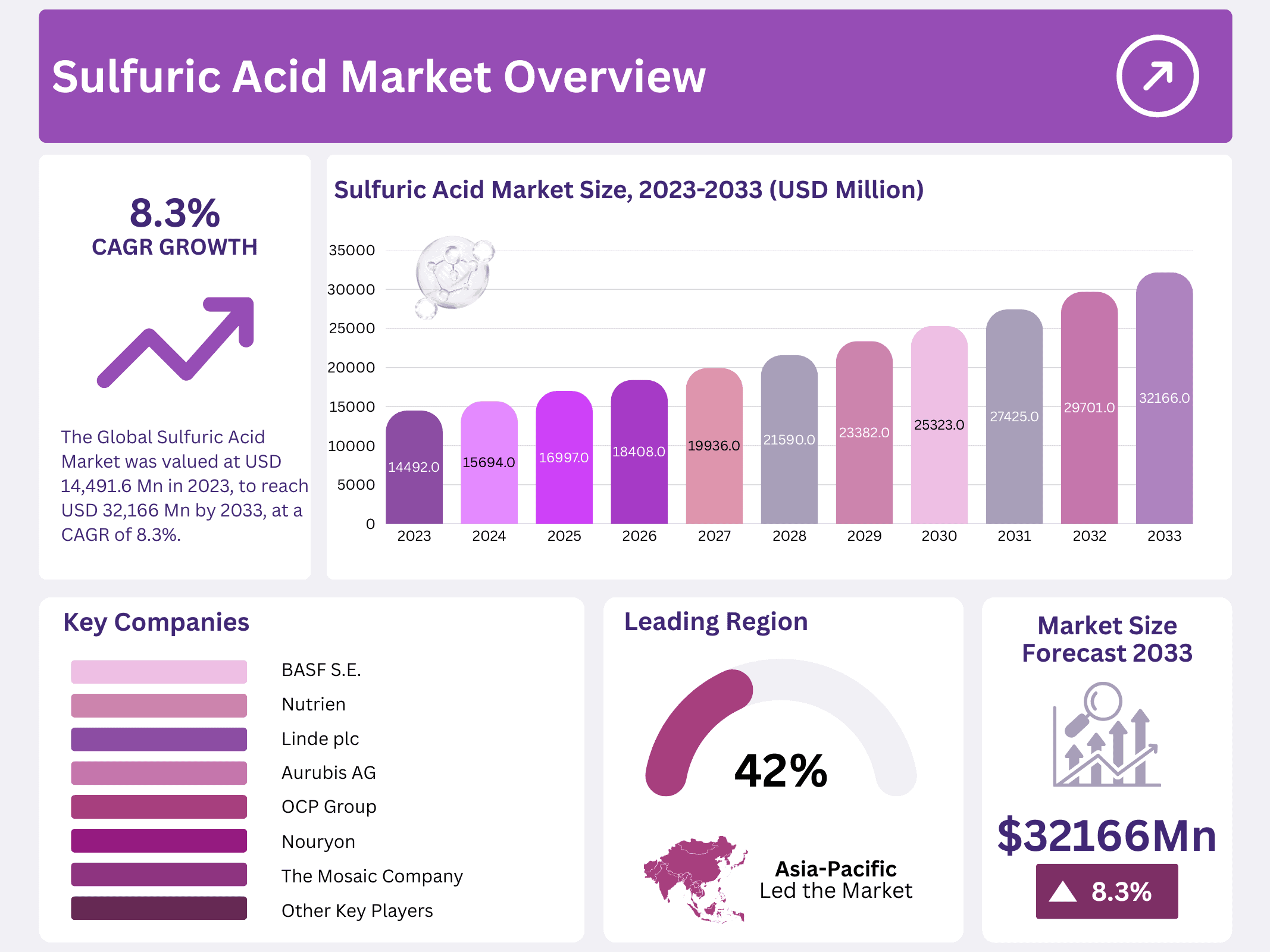
New York, NY – February 11, 2026 – The Sulfuric Acid Market, valued at USD 14,491.6 million in 2023, is projected to grow steadily at a CAGR of 8.3% through 2024–2033, reaching USD 32,166 million by 2033. Demand continues to rise mainly due to its widespread use in agriculture and the automotive sector. Often referred to as “the king of acids,” sulfuric acid plays a vital role in producing numerous chemicals, especially fertilizers, which remain its largest application area.
Sulfuric acid (H₂SO₄) is a mineral acid composed of sulfur, hydrogen, and oxygen. It is colorless, odorless, and highly reactive due to its strong acidic, dehydrating, and oxidizing properties. These characteristics make it indispensable across industries such as agriculture, transportation, paper & pulp, petroleum refining, and consumer goods. Industrial production primarily relies on two processes—the contact process and the lead chamber process—using raw materials like sulfur dioxide and ferrous sulfate wastewater.
Market growth is further supported by strict government regulations that encourage cleaner industrial operations and better emission control systems. Additionally, rising demand for sulfuric acid as a catalyst and dehydrating agent in chemical manufacturing, metal processing, and refinery operations continues to expand its industrial footprint. The increasing need for sulfate compounds, nitric and hydrochloric acids, synthetic detergents, dyes, and pharmaceuticals also contributes to the strong upward trajectory of the sulfuric acid market.
Key Takeaways
- The Global Sulfuric Acid Market was valued at USD 14,491.6 million in 2023, to reach USD 32,166 million by 2033, at a CAGR of 8.3%.
- Elemental sulfur led the raw material segment in 2023 with a 63.9% market share.
- The 93–99% sulfuric acid concentration segment dominated with a 48.9% share due to its high purity and industrial versatility.
- Fertilizers remained the leading application area in 2023, holding 65.7% of total market demand.
- Asia-Pacific was the largest regional market in 2022 with a 42% share, driven by strong industrial growth.
Report Scope
| Report Features | Description |
|---|---|
| Market Value (2023) | USD 14,491.6 Million |
| Forecast Revenue (2033) | USD 32,166 Million |
| CAGR (2024-2033) | 8.3% |
| Segments Covered | By Raw Material (Base Metal Smelters, Elemental Sulfur, Pyrite Ores, and Other Raw Materials), By Concentration (Below 50%, 50-70%, 70-93%, and 93-99%), By Application (Fertilizers, Metal Processing, Petroleum Refining, Textile, and Other Applications) |
| Competitive Landscape | BASF SE, The Mosaic Company, Nutrien, Honeywell International Inc., Linde plc (Asia Union Electronic Chemical Corporation), Aurubis AG, OCP Group, Nouryon, Solvay S.A., Boliden AB, Hubei Xingfa Chemicals Group Co. Ltd, Chemtrade Logistics Income Fund (Chemtrade Logistics Inc.), Trident Group, Other Key Players |
Key Market Segments
Raw Material Analysis
Elemental Sulfur Leads the Market Due to Its Wide Availability and Industrial Utility
Elemental sulfur dominated in 2023 with a 63.9% market share. It is the primary raw material used in sulfuric acid production and is abundantly obtained as a byproduct from petroleum refining and natural gas processing. Since sulfur is removed from fossil fuels to reduce sulfur dioxide emissions, its supply remains steady, making it both widely available and cost-efficient for manufacturers.
Sulfur is the 10th most abundant element in the universe and the 5th most common on Earth, occurring naturally in elemental form and as part of mineral compounds. It is also released into the atmosphere from volcanic activity in the form of sulfur dioxide.
Concentration Analysis
High-Purity Grades (93–99%) Dominate Owing to Their Effectiveness and Versatility
Among these categories, 93–99% sulfuric acid held the highest share at 48.9%. This concentration range is preferred in industries such as petroleum refining, phosphate fertilizers, metal processing, chemical synthesis, and wastewater treatment due to its high purity and consistent performance.
Although concentrations above 98% offer higher reactivity, they are also more corrosive and pose greater handling risks. The 93–99% range provides the ideal balance of efficiency, safety, and cost-effectiveness, which drives its strong market adoption.
Application Analysis
Rising Agricultural Needs Drive Fertilizer Applications to the Top
The sulfuric acid market includes fertilizers, metal processing, petroleum refining, textiles, and other uses. Fertilizers remained the dominant segment in 2023 with 65.7% of the total market share. This strong demand is tied to global population growth and the corresponding need to increase food production.
Sulfuric acid is vital in the production of phosphate fertilizers, which are essential for boosting crop yields. Intensive farming practices have depleted sulfur levels in soil, creating a greater need for sulfur-enriched fertilizers. As sulfur plays a key role in forming amino acids, proteins, enzymes, and vitamins in plants, the market continues to see increased consumption of sulfuric acid for fertilizer manufacturing.
Regional Analysis
Asia-Pacific dominated the sulfuric acid market in 2022, holding 42% of the total share. The region includes some of the world’s fastest-growing economies, such as China, India, and several Southeast Asian countries. Rapid industrial expansion across these nations increases the demand for sulfuric acid in manufacturing, metal processing, and chemical production.
Agriculture also plays a major role in APAC’s dominance. China and India rank among the largest global agricultural producers, driving strong demand for phosphate fertilizers, where sulfuric acid is an essential input. Growing populations in these countries further elevate the need for higher crop yields, thereby boosting fertilizer consumption and sulfuric acid usage.
APAC benefits from abundant raw materials like sulfur and base metals, with China being a leading supplier. This availability supports robust local production and reduces dependence on imports. Together, rapid industrialization, a strong agricultural base, plentiful raw materials, government support, and strategic market positioning make the Asia-Pacific one of the most lucrative regions for sulfuric acid growth.
Top Use Cases
- Fertilizer Production: Sulfuric acid is a key player in agriculture. It helps create phosphate fertilizers that boost crop yields worldwide. This use drives demand in farming regions, supporting food security and economic growth in rural areas. Industries rely on it to convert raw materials into effective soil enhancers, making it essential for sustainable farming practices.
- Metal Processing: Sulfuric acid shines in the metals industry for cleaning and preparing surfaces. It’s used to remove rust from steel and other metals before further processing. This application ensures high-quality products in manufacturing, from cars to construction materials. Market trends show steady demand as global infrastructure projects expand, highlighting its role in efficient production.
- Battery Manufacturing: Sulfuric acid is vital for lead-acid batteries found in vehicles and backup power systems. It acts as an electrolyte, enabling energy storage and release. This use supports the automotive and renewable energy sectors, where reliable power is crucial. As electric vehicles evolve, demand remains strong for traditional battery tech in various applications.
- Petroleum Refining: Sulfuric acid’s importance in oil refining processes. It catalyzes the production of high-quality fuels and removes impurities. This enhances efficiency in the energy sector, meeting global fuel needs. Market dynamics favor its use in upgrading crude oil, contributing to stable supply chains in transportation and industry.
- Chemical Synthesis: Sulfuric acid stands out for producing detergents, dyes, and pharmaceuticals. It facilitates reactions to create everyday products like cleaning agents and medicines. This broad application spans consumer goods and healthcare, driving innovation and market expansion. Its versatility ensures ongoing demand across diverse chemical manufacturing segments.
Recent Developments
1. BASF SE
- BASF is advancing sulfuric acid recycling and efficiency, notably in its new metal refinery in Harjavalta, Finland, which utilizes a closed-loop process. The company focuses on reducing environmental impact through optimized acid regeneration in chemical production, supporting circular economy goals in battery materials. Recent R&D emphasizes lowering emissions in sulfuric acid plants.
2. The Mosaic Company
- Mosaic’s sulfuric acid developments relate to phosphate fertilizer production, where acid is key for processing phosphate rock. The company recently enhanced acid plant reliability and environmental controls at its U.S. sites, investing in sulfur-burning contact process improvements to boost efficiency and meet stricter emissions standards while supporting crop nutrient output.
3. Nutrien
- Nutrien increased sulfuric acid capacity to support its potash and phosphate operations, including upgrades at key fertilizer complexes. Recent projects focus on acid plant modernization to improve energy recovery and sulfur utilization, aligning with sustainable input sourcing. This strengthens its integrated supply chain for crop nutrition amid growing global demand.
4. Honeywell International Inc.
- Honeywell offers advanced process technologies and catalysts for sulfuric acid production through its Performance Materials and Technologies segment. Recent developments include innovations in sulfur combustion and conversion catalysts that help plants increase yield, reduce energy use, and cut SO₂ emissions, supporting clients in meeting environmental regulations.
5. Linde plc
- Linde provides industrial gases, engineering, and technology for sulfuric acid plants, including oxygen-enrichment solutions that boost SO₂ conversion rates and plant capacity. Recent contracts involve integrating its proprietary oxidation and purification systems to enhance acid production efficiency and lower the carbon footprint for chemical and mining customers globally.
Conclusion
Sulfuric acid emerges as a cornerstone chemical with vast industrial relevance. Its applications span agriculture, manufacturing, energy, and consumer products, fueling economic sectors globally. Future market potential lies in sustainable practices and emerging technologies, positioning it as an indispensable resource for innovation and growth in various industries.







