


Quick Navigation
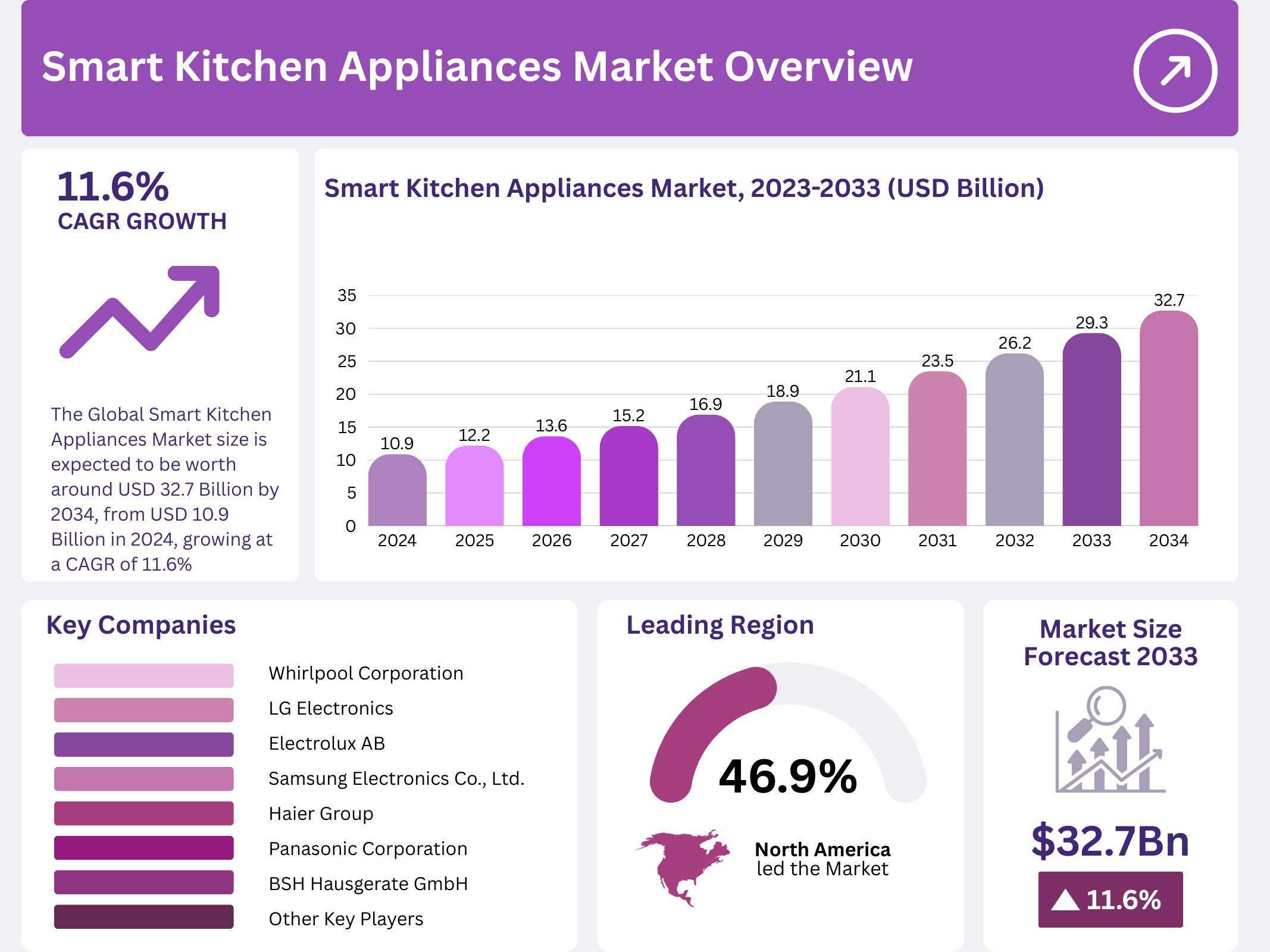
The global smart kitchen appliances market is undergoing a remarkable transformation. Valued at USD 10.9 billion in 2024, the market is projected to reach USD 32.7 billion by 2034, reflecting a CAGR of 11.6%. This surge signals a sweeping shift in how consumers interact with their kitchens.
Consequently, smart kitchen devices are no longer a luxury — they are becoming essential household tools. Integrated with IoT capabilities, these appliances offer voice control, AI personalization, and mobile connectivity. Together, these features are redefining everyday cooking and household management for millions worldwide.
Furthermore, the market encompasses a broad product spectrum, including smart refrigerators, ovens, dishwashers, and coffee makers. Both residential and commercial sectors are accelerating adoption. As a result, major players across technology, home appliances, and IoT sectors are investing heavily in continuous innovation to capture growing consumer demand.
Notably, the post-pandemic era has intensified consumer focus on efficiency and convenience. Smart appliances have responded by reducing cooking time by 20% and cutting food waste by 25%. Meanwhile, energy savings of up to 50% make these devices compelling for environmentally conscious buyers seeking smarter home solutions.
Additionally, 67% of global users now prefer smart kitchen appliances for advanced features such as remote control and automated cooking. This widespread preference underscores the technology’s mainstream appeal. Accordingly, the market outlook remains exceptionally strong as smart home ecosystems continue expanding across all global regions.
In parallel, emerging technologies like machine learning and AI are pushing product capabilities further. Companies are seizing opportunities to introduce next-generation appliances that learn user habits and optimize performance autonomously. Therefore, the smart kitchen appliances sector stands poised for sustained, robust growth throughout the forecast period.
Key Takeaways
- The global Smart Kitchen Appliances market is projected to grow from USD 10.9 billion in 2024 to USD 32.7 billion by 2034, reflecting a strong CAGR of 11.6% over the forecast period.
- Smart Refrigerators dominate the Smart Kitchen Appliances market with a market share of 38.7% in 2024, driven by advanced features like energy efficiency and smart connectivity.
- Wi-Fi leads the connectivity technology segment with a dominant market share of 63.3% in 2024, enabling seamless integration with other smart home devices and remote control.
- Full-Service Restaurants (FSRs) hold a dominant position in the market with a 37.5% share in 2024, driven by their demand for innovative kitchen solutions that enhance efficiency and food quality.
- North America leads the global Smart Kitchen Appliances market with a market share of 46.9% in 2024, fueled by strong consumer spending and the growing trend of smart home adoption.
Market Segmentation Overview
Smart Refrigerators captured the largest product share at 38.7% in 2024. Their dominance stems from features like inventory management, remote access, and energy efficiency. Moreover, touchscreen interfaces and smart home integration have made these appliances a cornerstone of the connected kitchen ecosystem for both residential and commercial users.
Meanwhile, Smart Cookware and Cooktops are gaining considerable momentum. Precision cooking capabilities and energy efficiency are driving their adoption. Similarly, Smart Dishwashers and Smart Ovens are expanding their presence through remote monitoring and recipe app integration, while smart coffee makers and air fryers are gradually increasing their market footprint.
Regarding connectivity, Wi-Fi dominates with a 63.3% share in 2024, enabling seamless device integration with platforms like Amazon Alexa and Google Assistant. In contrast, Bluetooth serves shorter-range applications, while NFC remains niche. Emerging technologies like Zigbee and Z-Wave are gaining traction as the market diversifies its connectivity requirements.
In terms of end-use, Full-Service Restaurants led with a 37.5% market share in 2024. Their demand for high-efficiency kitchen solutions drives this dominance. Beyond FSRs, Quick Service Restaurants, institutional canteens, and hotels are progressively adopting smart kitchen technologies to streamline large-scale food preparation and improve operational productivity.
Drivers
The primary driver is the surging consumer demand for convenience and time-saving solutions. As lifestyles accelerate, smart kitchen appliances offer remote monitoring, automated cooking, and voice control. IoT connectivity allows appliances to communicate seamlessly, reducing time spent on routine tasks and transforming kitchen management into a far more efficient, intuitive daily experience for modern households.
Additionally, the growing adoption of smart home ecosystems is propelling market expansion. Consumers integrating smart speakers, thermostats, and security systems naturally extend this connectivity to their kitchens. Therefore, appliances compatible with platforms like Apple HomeKit and Google Home are experiencing heightened demand, accelerating the overall penetration of smart kitchen devices across diverse consumer demographics globally.
Use Cases
Smart refrigerators offer powerful practical applications by tracking food inventory and alerting users when items expire. Consequently, food waste has been reduced by 25% among users. Furthermore, AI-powered recipe suggestions based on available ingredients make meal planning effortless, directly contributing to the reported 30% increase in fruit and vegetable consumption among smart appliance users.
Smart ovens represent another compelling use case, enabling users to preheat remotely and select pre-programmed cooking modes via mobile apps. As a result, cooking time is reduced by 20%. Integration with recipe applications further simplifies complex meals, making smart ovens particularly valuable for busy households and professional kitchens demanding consistent, high-quality food preparation at scale.
Major Challenges
The most significant challenge remains the high initial cost of smart kitchen appliances. Advanced features including AI algorithms, touchscreens, and home system integration push prices well above traditional alternatives. For budget-conscious consumers, particularly in emerging markets with lower disposable incomes, this premium pricing continues to act as a substantial barrier to widespread adoption and mainstream market penetration.
Moreover, concerns about long-term value persist. Maintenance costs, software update requirements, and the rapid pace of technological change cause hesitation among potential buyers. Additionally, in regions where smart home infrastructure remains underdeveloped, integrating these appliances into daily life proves challenging, limiting growth potential despite the clear operational and environmental benefits these technologies demonstrably offer.
Business Opportunities
Emerging markets present the most significant near-term growth opportunity. Rising urbanization, growing disposable incomes, and expanding e-commerce across Asia-Pacific, Latin America, and the Middle East are creating substantial new consumer bases. Manufacturers tailoring products to regional price sensitivities and lifestyle needs stand to capture enormous untapped demand as awareness of connected appliance benefits continues to grow.
Furthermore, AI and voice assistant integration offers compelling innovation opportunities. Companies developing appliances with deeper machine learning capabilities — ones that personalize settings, predict user preferences, and automate routines — are well-positioned to differentiate competitively. As voice-controlled ecosystems mature, building compatibility with Alexa, Google Assistant, and Siri will become increasingly essential for capturing the next wave of tech-savvy consumers.
Regional Analysis
North America commands the largest share at 46.9% of the global market in 2024, translating to a market size of USD 5.11 billion. High consumer spending, mature smart home infrastructure, and strong sustainability-driven demand for energy-efficient appliances collectively reinforce this region’s dominant position. The U.S. remains the primary growth engine, supported by tech-oriented consumer behavior and widespread smart home adoption.
Conversely, Asia-Pacific is the fastest-growing region, propelled by rapid urbanization and rising disposable incomes in China, India, and Japan. Although its current market share remains smaller, the region’s trajectory is sharply upward. Europe maintains steady growth through sustainability regulations and premium appliance demand, while the Middle East, Africa, and Latin America represent promising emerging opportunities with gradual but accelerating smart appliance adoption.
Recent Developments
- In 2023, Fresco launched KitchenOS, an all-in-one operating system enabling cross-brand IoT appliance control, smart recipe recommendations, and enhanced consumer convenience across connected kitchen ecosystems.
- On February 3, 2023, Samsung Electronics UK unveiled its Series 7 Bespoke AI™ Oven featuring AI Pro Cooking technology, delivering personalized, health-focused meal preparation with advanced smart functionality.
- On January 29, 2025, Whirlpool Corporation reported meeting its USD 300 million cost reduction target for 2024 and outlined plans for an additional USD 200 million in savings for 2025.
- On September 7, 2024, Midea Group showcased intelligent home appliances at IFA 2024, reinforcing its commitment to accessible, convenience-driven innovations under the “Friendly Innovations for Homes” initiative.
Conclusion
The global smart kitchen appliances market is firmly on an upward trajectory, supported by technological innovation, shifting consumer behavior, and expanding global connectivity. From USD 10.9 billion in 2024 to a projected USD 32.7 billion by 2034, the sector presents substantial opportunities for manufacturers, investors, and technology developers. As AI integration deepens and emerging markets mature, smart kitchen appliances are set to become indispensable components of the modern connected home.







