


Quick Navigation
Overview
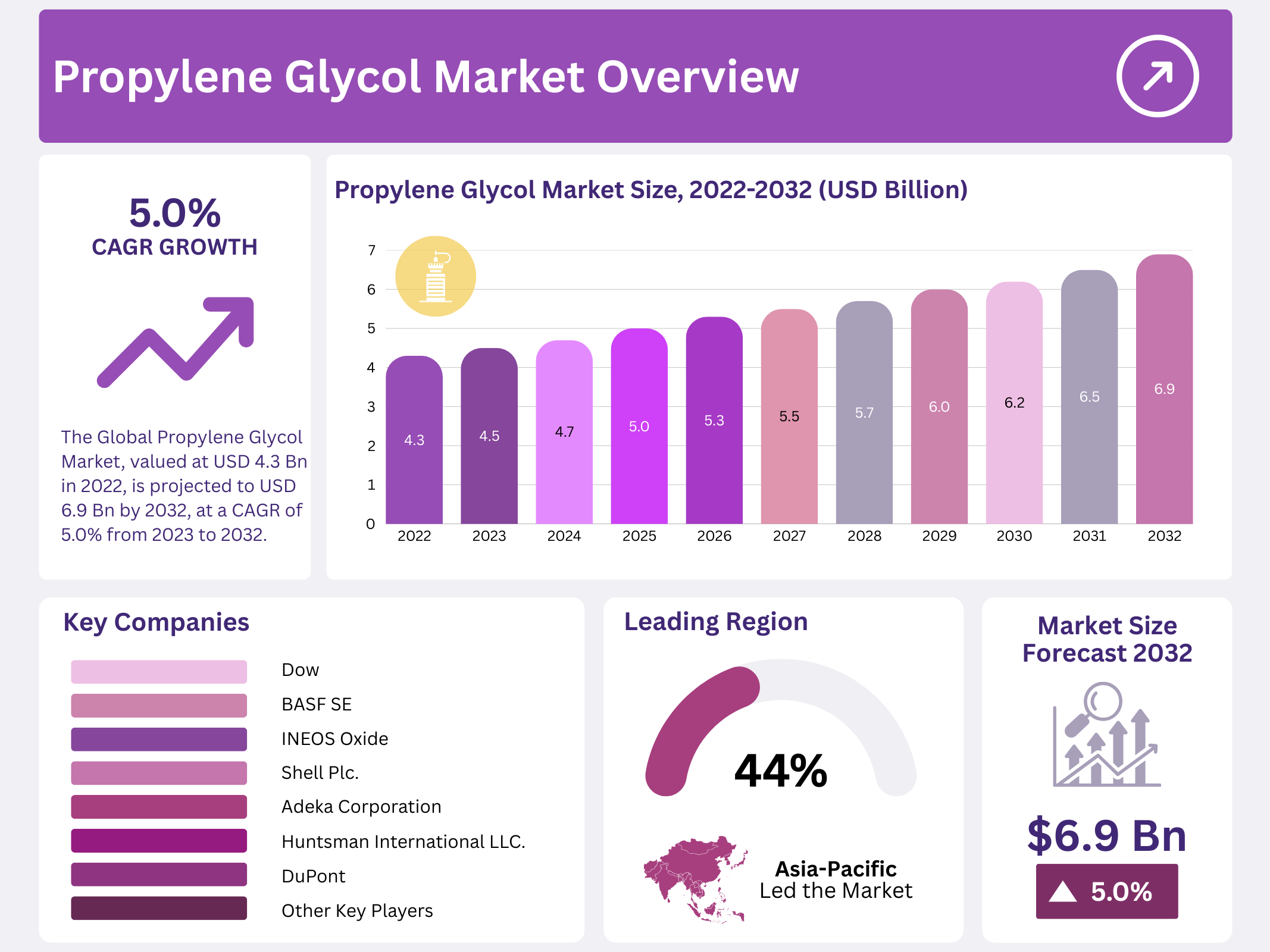
New York, NY – February 24, 2026 – The global Propylene Glycol Market, valued at USD 4.3 billion in 2022, is projected to climb to USD 6.9 billion by 2032, reflecting a steady 5.0% CAGR from 2023 to 2032. This growth is largely supported by its expanding use across key industries such as pharmaceuticals, cosmetics, automotive, and food & beverages. Among all regions, Asia-Pacific remains the largest consumer, driven by rapid industrial development and rising manufacturing activities.
Market players are consistently focusing on strategic partnerships, mergers, acquisitions, and collaborative initiatives to strengthen their global footprint and enhance production capabilities. Additionally, increasing awareness regarding the harmful effects of ethylene glycol has encouraged the shift toward propylene glycol as a safer substitute, especially in automotive applications like antifreeze and coolant formulations.
Despite its positive outlook, the market faces challenges such as fluctuating raw material prices and the presence of alternative substitutes that can influence buyer preference. Nevertheless, with its broad application scope and growing demand from end-user industries, the propylene glycol market is expected to witness strong and sustainable growth over the forecast period.
Key Takeaways
- The Global Propylene Glycol Market was valued at USD 4.3 billion in 2022 and is projected to reach USD 6.9 billion by 2032, at a steady CAGR of 5.0% from 2023 to 2032.
- The Petroleum-based segment dominated with 72.4% revenue share in 2022 due to lower costs and higher availability.
- Industrial-grade propylene glycol held the largest share at 62.4%, favored for its cost-effectiveness and suitability in broad industrial applications.
- The Construction sector accounted for the highest end-use share at 39.7%, driven by applications in insulation foams, adhesives, coatings, and geothermal systems.
- The Asia-Pacific (APAC) region led globally with 44.6% revenue share in 2022.
Report Scope
| Report Features | Description |
|---|---|
| Market Value (2022) | USD 4.3 Billion |
| Forecast Revenue (2032) | USD 6.9 Billion |
| CAGR (2023-2032) | 5.0% |
| Segments Covered | By Source (Petroleum-Based and Bio-Based), By Grade (Industrial Grade, Pharmaceutical Grade, and Other Grades), By End-User (Food & Beverages, Pharmaceuticals, Cosmetics & Personal Care, Construction, Transportation, Other End-Users) |
| Competitive Landscape | The Dow Chemical Company, BASF SE, INEOS Oxide, Shell Plc., Adeka Corporation, Huntsman International LLC., LyondellBasell Industries Industries N.V., Archer Danials Midland Company, Global Bio-Chem Technology Group Co., Ltd., DuPont Tate & Lyle Bio Products LLC, Temix International S.R.L., Other Key Players |
Key Market Segments
By Source Analysis
The Petroleum-based segment held the largest revenue share in the propylene glycol market in 2022, accounting for 72.4%. This dominance is primarily due to its lower cost and higher availability compared to bio-based alternatives. Since petroleum-based propylene glycol is derived from crude oil and natural gas—both widely accessible hydrocarbon sources—its production process is long-established, optimized, and highly efficient, making it a cost-effective solution for large-scale industrial use.
In comparison, the bio-based segment is projected to be the fastest-growing source category between 2022 and 2031. Bio-based propylene glycol is derived from renewable materials such as soybeans, sugarcane, and corn, offering a more sustainable and environmentally friendly alternative. Its safer profile for human health and the environment, coupled with advances that are making production more efficient and affordable, is pushing demand upward. As sustainability becomes a higher priority worldwide, this segment is set to expand rapidly in the coming years.
By Grade Analysis
The Industrial-grade segment holds the most significant share in the propylene glycol market, representing 62.4%. With a purity level of 99%, this grade is suitable for a wide range of industrial applications where ultra-high purity is not essential. Its cost-effectiveness and long-term stability make it an attractive option for manufacturers requiring large quantities for use in processes such as chemical production, de-icing solutions, and industrial formulations.
Meanwhile, the pharmaceutical-grade segment is identified as the fastest-growing category, expected to expand at a CAGR of 6.2%, holding a market share of 27.8%. With an enhanced purity level of approximately 99.5%, pharmaceutical-grade propylene glycol meets stringent regulatory standards such as those set by the United States Pharmacopeia (USP). Its high purity and safety profile make it suitable for sensitive applications, including drug formulations, medical products, and personal care items.
By End-User Analysis
The Construction sector holds the most significant share in the propylene glycol market, capturing 39.7%. Propylene glycol plays a crucial role in producing construction materials such as insulation foams, adhesives, and coatings. Its use as a heat transfer fluid in energy-efficient geothermal systems is also gaining traction, further driving demand.
Growth in this segment is strongly supported by rising infrastructure development, ongoing urbanization, and increasing adoption of environmentally friendly building solutions. As construction activities continue to expand globally, the demand for propylene glycol in this sector is expected to strengthen steadily.
Regional Analysis
The Asia-Pacific (APAC) region accounted for the largest share of the propylene glycol market in 2022, contributing 44.6% of global revenue. Rapid construction activity across major countries such as India, Indonesia, and China continues to be a major growth driver. China alone contributes 26.3% of global construction expansion, underscoring the region’s strong infrastructure momentum.
Meanwhile, North America is projected to be the fastest-growing region in the propylene glycol market during the forecast period. The region benefits from a well-established production and distribution infrastructure, supported by the presence of leading industry players ensuring efficient supply chain operations and consistent raw material availability.
Demand for propylene glycol remains strong across key industries such as food and beverages, pharmaceuticals, personal care, and cosmetics. Furthermore, North America’s robust emphasis on innovation, sustainability initiatives, and advanced manufacturing practices is expected to drive accelerated market growth throughout the projected period.
Top Use Cases
- Antifreeze Applications: Propylene glycol acts as a safe antifreeze for cars, planes, and plumbing. It stops water from freezing in cold conditions and is less harmful than other types. Market experts see strong demand here because it protects engines and surfaces without risking pets or kids if spilled. Its easy breakdown in nature adds to its appeal in everyday cooling needs.
- Food and Beverage Industry: In food production, propylene glycol helps keep items moist and fresh as a humectant and stabilizer. It mixes well with flavors and prevents separation in drinks and baked goods. Market researchers highlight its role in improving texture and shelf life for products like ice cream and soft drinks. Its safety approval makes it a trusted additive across global food markets.
- Pharmaceutical Applications: Propylene glycol works as a solvent and carrier in many medicines, helping dissolve drugs for better absorption in pills, creams, and injections. It keeps products stable and moist. From a market view, analysts note its importance in creating safe, effective treatments that doctors rely on daily. This versatility drives steady interest in health product development worldwide.
- Cosmetics and Personal Care: Propylene glycol acts as a moisturizer in lotions, shampoos, and makeup, drawing in water to soften skin and hair. It also extends product freshness by limiting bacteria. Market analysts point to its widespread use in beauty items for a better feel and longer shelf life. Consumers love how it makes daily care products gentle and effective.
- E-Cigarette and Vapor Products: In vaping products, propylene glycol serves as a key base liquid mixed with flavors and nicotine. It helps create smooth vapor and carries ingredients well in devices. As market researchers follow trends, its low viscosity improves device performance and user experience. This application has boosted demand in the growing personal vapor market for enjoyable, consistent use.
Recent Developments
1. The Dow Chemical Company
- Dow announced its Propylene Glycol (PG) facility in Map Ta Phut, Thailand, received the International Sustainability and Carbon Certification (ISCC) PLUS. This certification enables Dow to offer two new sustainable products in Asia Pacific: Propylene Glycol CIR featuring Renuva recycled material and Propylene Glycol REN featuring Ecolibrium bio-circular technology. This expansion allows Dow to provide verifiably circular and bio-circular solutions to customers in the personal care, pharmaceutical, and food industries, reinforcing its commitment to sustainable production globally.
2. BASF SE
- While no specific, standalone press release regarding Propylene Glycol was found in this search, BASF SE is identified as a key player in the global bio-based propylene glycol market. A July 2025 market report highlights BASF among the leaders capitalizing on the growing demand for sustainable and non-toxic alternatives to petrochemical glycols. The market is driven by increasing applications in pharmaceuticals and personal care, where BASF’s expertise is significant, and the company is expected to be leveraging advancements in bio-based production technologies to maintain its competitive position.
3. INEOS Oxide
- In a significant development, INEOS Oxide made the “painful decision” to cease production of propylene glycol (PG) and propylene oxide (PO) at its Cologne, Germany, site in September 2025. The decision was driven by high costs for raw materials, natural gas, and energy, coupled with an oversupply in the PO market and weak local demand. The company noted that its Cologne plant used the older, less efficient chlorohydrin process, which became a competitive disadvantage against regions with lower energy costs and more efficient technologies.
4. Shell Plc.
- In June 2025, Shell expanded its portfolio in the data center cooling market by launching Shell DLC Fluid S3. This new fluid is a propylene glycol-based direct liquid cooling solution designed to meet the thermal demands of high-performance computing and AI. It cools high-heat components like CPUs and GPUs directly, improving energy efficiency compared to air cooling. The fluid meets Open Compute Project (OCP) PG25 specifications, offering long-term corrosion protection, excellent heat transfer, and an expected life of over six years.
5. Adeka Corporation
- Adeka announced that its new high-performance clarifier, “TRANSPAREX,” was certified by Guinness World Records as the “Most effective clarifier for polypropylene transparency”. This additive grants polypropylene (PP) glass-like transparency, addressing PP’s key weakness and promoting its use as a replacement for other plastics. This supports mono-material initiatives and enhances the recyclability of products, contributing to sustainability goals in the plastics industry.
Conclusion
Propylene Glycol stands out as a versatile and safe ingredient that touches many parts of daily life. Its power to hold moisture, dissolve substances, and protect against cold makes it essential in food, health, beauty, and industrial products. With people seeking gentler and more reliable options, this compound will keep playing a key role in innovations and steady market growth ahead.







