


Quick Navigation
Overview
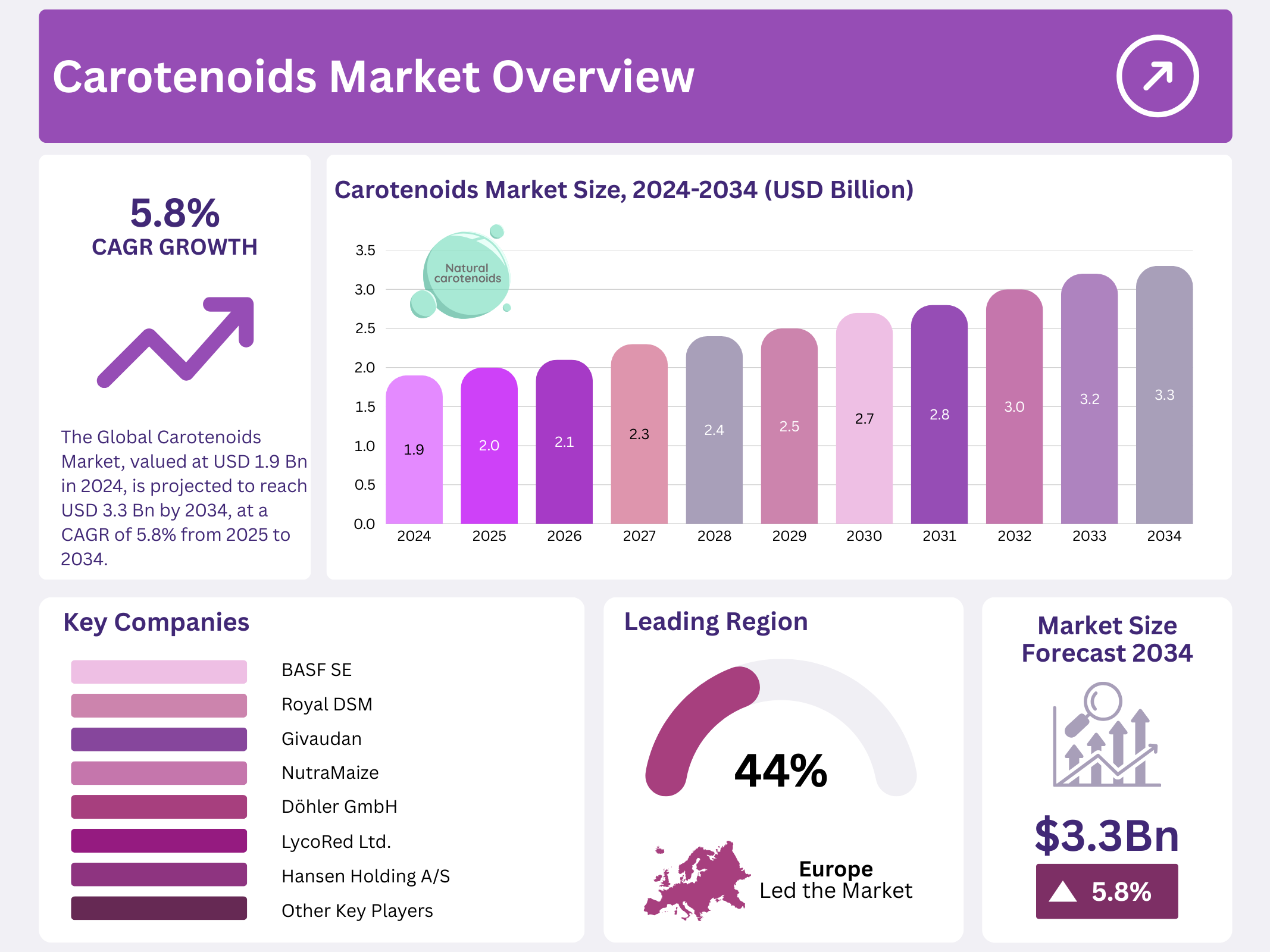
New York, NY – February 26, 2026 – The Global Carotenoids Market, valued at USD 1.9 Billion in 2024, is projected to reach USD 3.3 Billion by 2034, expanding at a CAGR of 5.8% from 2025 to 2034. Europe remains the dominant region, accounting for 44.2% of the total share and generating USD 0.8 billion in revenue, supported by strong adoption in food, cosmetics, and nutraceutical applications. The market continues to gain momentum as industries shift toward natural, plant-derived ingredients that offer both functionality and clean-label appeal.
Carotenoids, naturally occurring pigments found in colorful fruits, vegetables, and algae, play a crucial role in human health due to their potent antioxidant properties. Their molecular structure, characterized by conjugated double bonds, enables them to neutralize free radicals and reduce oxidative stress. These attributes contribute to multiple health benefits, including immune system enhancement, provitamin A activity, and protection from UV radiation. Their versatility and biological value make carotenoids increasingly relevant across various consumer-focused industries.
Growing demand from food and beverages, pharmaceuticals, cosmetics, and animal feed is shaping the rapid expansion of the carotenoids market. Beta-carotene and other key variants are widely used as natural colorants, stabilizers, and antioxidant agents in juices, dietary supplements, and processed foods. At the same time, the rising preference for natural, sustainable, and algae-based sources is accelerating product development. In cosmetics and pharmaceuticals, carotenoids are valued for skin protection, anti-aging benefits, and enhanced formulation stability—collectively driving consistent global market growth.
Key Takeaways
- The Global Carotenoids Market was valued at USD 1.9 billion in 2024, grew at a CAGR of 5.8%, and is estimated to reach USD 3.3 billion by 2034.
- The Synthetic accounted for the largest market share of 65.1%.
- Beta-carotene accounted for the majority of the market share at 34.1%.
- The Powder accounted for the largest market share of 46.1%.
- The Color accounted for the majority of the market share at 44.2%.
- Animal feed accounted for the majority of the market share at 38.1%.
- Europe is estimated as the largest market for Carotenoids with a share of 44.2% of the market share.
Report Scope
| Report Features | Description |
|---|---|
| Market Value (2024) | USD 1.9 Billion |
| Forecast Revenue (2034) | USD 3.3 Billion |
| CAGR (2025-2034) | 5.8% |
| Segments Covered | By Source (Synthetic, Natural, Plants, Microorganism, Algae), By Type (Beta-carotene, Lutein, Lycopene, Astaxanthin, Zeaxanthin, Canthaxanthin, Annatto Capsanthin, Apocarotenal, Others), By Form (Powder, Beadlet, Oil Suspension, Emulsion), By Application (Color, Flavor, Nutrition, Skin Condition), By End-use (Animal Feed (Poultry, Aquaculture, Ruminants, Others), Food & Beverages (Dairy, Bakery & Confectionary, Beverages, Meat Products, Others), Dietary Supplements (Capsules, Softgels, Gummies, Tablets, Others), Cosmetics (Skincare, Haircare, Others), Pharmaceuticals, Others) |
| Competitive Landscape | BASF SE, Royal DSM, Givaudan, Sensient Technologies, Allied Biotech Corporation, Döhler GmbH, Chr. Hansen Holding A/S, Kemin Industries, Inc., LycoRed Ltd., NutraMaize, Cyanotech Corporation, Fuji Chemical Industries Co., Ltd., Divi’s Laboratories Limited, Zhejiang NHU Co., Ltd, Solabia Group, Vidya Herbs Pvt. Ltd, Other Key Players |
Key Market Segments
Source Analysis
The Synthetic segment dominated the carotenoids market in 2024, holding a strong 65.1% share. This leadership stems from its cost efficiency, consistent quality, and suitability for large-scale production. Synthetic carotenoids are preferred across the food and beverage, animal feed, and cosmetics industries because they offer uniformity, stability, and dependable performance. Their controlled manufacturing environment ensures reliable supply availability and longer shelf life compared to natural alternatives, making them an attractive option for manufacturers aiming to optimize cost and maintain product consistency.
Type Analysis
Beta-carotenoids emerged as the leading type segment in 2024, capturing a notable 34.1% share. Their dominance is supported by superior chemical stability, affordability, and broad applicability across foods, beverages, supplements, and pharmaceuticals. Beta-carotenoids’ strong antioxidant properties and provitamin A activity boost their demand, given their role in eye health, immune support, and skin protection. High consumer awareness and easy formulation compatibility further strengthen their position as the most widely utilized carotenoid type in the global market.
Form Analysis
The Powder Form led the market with a 46.1% share due to its enhanced stability, longer shelf life, and ease of use. Powdered carotenoids dissolve well in varied formulations and are simpler to store and transport than other forms. Their versatility supports broad adoption across food, beverages, cosmetics, supplements, and animal feed applications. Manufacturers also favor powder due to its cost-effectiveness and precise dosing advantages, which improve production efficiency and product consistency.
Application Analysis
The color application segment dominated the carotenoids market in 2024, securing a 44.2% share. The growth of this segment is propelled by increasing demand for natural colorants in foods, beverages, and cosmetics, driven by global clean-label trends. Carotenoids offer vibrant natural hues without synthetic additives, making them highly desirable. Their antioxidant benefits also support wider use in cosmetic formulations. Rising consumer preference for safe, natural, and visually appealing products continues to boost the segment’s strong market presence.
End-Use Analysis
The Animal feed segment held a leading 38.1% market share in 2024 due to the expanding use of carotenoid-enriched feed in livestock, poultry, and aquaculture. Carotenoids help enhance pigmentation in eggs, meat, and fish while supporting immunity and growth performance. Their nutritional benefits directly improve animal health and overall product quality, making them a cost-effective additive in feed formulations. As demand grows for naturally enhanced and visually appealing animal products, the segment continues to maintain its dominance within the market.
Regional Analysis
Europe emerged as the leading region in the global carotenoids market, commanding 44.2% of the total share. This dominance is fueled by the region’s strong industrial base, rising health-conscious consumer preferences, and a favorable regulatory landscape. Countries such as Germany, the Netherlands, and Denmark host major carotenoid manufacturers known for advanced technological capabilities, especially in algae-based carotenoid production that aligns with the rising demand for natural and sustainable ingredients.
The region’s growing focus on health and wellness has significantly increased the consumption of functional foods and nutraceuticals, where carotenoids play a vital role due to their contributions to cancer prevention, immune support, and skin protection. European Union policies supporting clean-label and natural ingredient adoption—reinforced by initiatives from bodies like the European Algae Biomass Association (EABA)—further strengthen the market outlook. Europe’s ongoing commitment to sustainability, combined with a strong export ecosystem, positions it as a pivotal hub in the global carotenoids landscape.
Top Use Cases
- Animal Feed Carotenoids add natural colors to animal feed used for salmon, shrimp, and poultry products. They create appealing, bright hues in fish meat and egg yolks that attract buyers who value natural appearance. These pigments also enhance animal health and immunity. In the competitive market for premium foods, this application supports higher sales and meets growing consumer expectations for quality items.
- Food and Beverage Carotenoids work as natural colorants in the food and beverage industry, giving bright orange and red tones to juices, dairy products, and snacks. Shoppers favor these over synthetic options because of clean label preferences. They also provide extra nutritional benefits as antioxidants. This combination helps manufacturers create attractive, healthy products that stand out and drive sales in health-focused markets.
- Dietary Supplements Carotenoids feature prominently in dietary supplements to promote eye health, strengthen immunity, and combat aging effects. Modern consumers seek convenient plant-based options in capsule form for daily wellness. Preventive health trends fuel demand for these natural nutrients. Market analysts observe robust expansion in this segment as more people turn to supplements for proactive care and balanced nutrition.
- Cosmetics and Personal Care Carotenoids protect skin from sun damage and help reduce wrinkles through powerful antioxidant action in cosmetics and personal care products. Beauty enthusiasts prefer natural ingredients in creams and serums for safe daily use. Anti-aging demands create premium opportunities for brands. This application allows companies to differentiate products and capture loyal customers in the thriving personal care market.
- Pharmaceutical Applications Pharmaceutical companies explore carotenoids for their role in supporting heart health and other wellness areas via natural antioxidant properties. Developers integrate them into new drug formulas seeking gentler alternatives. Shift toward natural-based treatments boosts interest here. This emerging use case presents fresh avenues for growth and innovation in the health product marketplace.
Recent Developments
1. BASF SE
- In a joint effort with other industry players, BASF SE successfully participated in the European Food Safety Authority’s (EFSA) renewal assessment for beta-carotene as a feed additive. The July 2025 scientific opinion confirmed that its use remains safe for all animal species, consumers, and the environment, with no new efficacy data required for the authorization renewal. This ensures the continued regulatory compliance and market presence of their synthetic beta-carotene in the animal nutrition sector.
2. Royal DSM
- Leveraging precision fermentation, DSM-Firmenich is advancing the sustainability and functionality of carotenoids. In early 2025, the company highlighted its fermentation-derived carotenoids (like beta-carotene and lycopene), which lower carbon footprint compared to traditional methods. They are also developing next-generation carotenoids with superior stability for acidic beverages and using microcrystalline technology to create a broader spectrum of stable yellow-to-red shades from beta-carotene for the food and beverage industry.
3. Givaudan
- Givaudan is expanding its natural color palette through biotechnology, focusing on novel carotenoid-based pigments. The company has developed “Endure Red Beet,” a beetroot extract with enhanced thermal stability, and is exploring micronized anthocyanin technology for indigo shades to replace artificial colors. These innovations aim to provide stable, natural color solutions that meet consumer demand for clean labels and address technical challenges like heat stability in baked goods.
4. NutraMaize
- NutraMaize is researching the benefits of its high-xanthophyll Orange Corn to combat heat stress in laying hens. In October 2025, the company NIFA grant to study how these natural carotenoids can reduce oxidative stress in hens, a growing issue due to climate change. The project aims to offer egg producers a practical nutritional strategy that improves hen health and welfare while also enhancing yolk pigmentation.
5. Sensient Technologies
- Amidst the U.S. shift away from synthetic dyes, Sensient is actively developing natural carotenoid-based alternatives. The company is using ingredients like beta-carotene from algae to help food manufacturers match artificial shades, such as creating a custom red for raspberry vinaigrette. Facing a surge in demand, Sensient is working to scale up the supply chain for botanical colors, though the process is complex and can take years to fully convert products.
Conclusion
Carotenoids stand out as versatile natural compounds with broad appeal in today’s health-driven economy. Their roles in enhancing product appeal, delivering wellness benefits, and meeting clean-label demands position them for continued relevance across industries. Growing consumer interest in sustainable and functional ingredients ensures carotenoids remain a key focus for innovation and market development well into the future.







