


Quick Navigation
Introduction
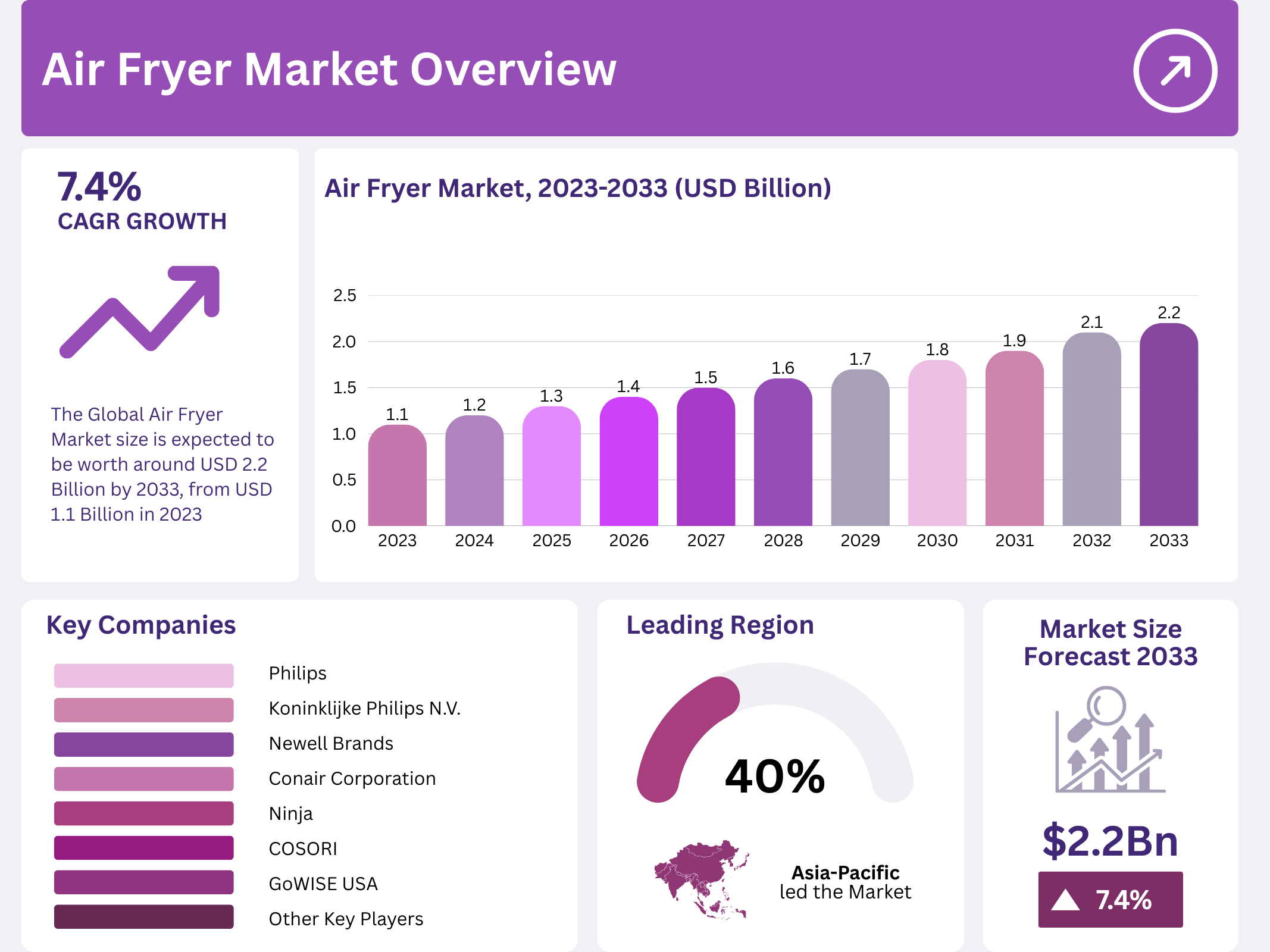
The global air fryer market is experiencing substantial growth, projected to reach USD 2.2 billion by 2033 from USD 1.1 billion in 2023. The market grows at a steady CAGR of 7.4%, reflecting rising health consciousness and the growing preference for low-fat cooking appliances.
Air fryers have become a popular household appliance, offering a healthier and more efficient cooking method. By circulating hot air and using minimal oil, they deliver crispy results similar to deep frying but with significantly fewer calories and fat.
In addition, social media trends have accelerated consumer awareness. Platforms like TikTok have over 2.5 billion views under #airfryer, demonstrating massive user engagement and global adoption of air fryers as a must-have kitchen gadget.
Manufacturers are leveraging innovation to meet evolving consumer needs. The focus on energy efficiency, compact designs, and smart technology integration continues to drive competition, particularly in markets emphasizing healthy and convenient lifestyles.
While developed regions such as North America lead the market with a 40% share, emerging markets in Asia-Pacific and Latin America are rapidly expanding due to urbanization and rising disposable incomes, signaling new opportunities for manufacturers.
As global demand grows, both established brands and new entrants are enhancing product diversity. Multi-functional models that can bake, grill, and dehydrate are reshaping the competitive landscape, appealing to health-conscious and time-sensitive consumers alike.
Key Takeaways
- The Air Fryer Market was valued at USD 1.1 Billion in 2023 and is projected to reach USD 2.2 Billion by 2033, with a CAGR of 7.4%.
- In 2023, Digital Air Fryer is the dominant product type, aligning with increasing user convenience.
- In 2023, 2L-5L capacity leads, supporting typical household cooking needs.
- In 2023, Residential use holds 69.7% of applications, reflecting popularity in home cooking.
- In 2023, North America leads with 40.0%, driven by rising health-conscious consumer preferences.
Market Segmentation Overview
Product Type: Digital air fryers dominate due to ease of use, preset cooking functions, and precision temperature control. They appeal to tech-savvy users seeking modern, efficient cooking solutions. Manual models retain a niche following among traditional users preferring simplicity and cost-effectiveness.
Application: Residential usage accounts for 69.7% of the market, driven by rising interest in healthy home cooking and convenience. Commercial adoption, though smaller, is growing among cafes and restaurants offering low-fat menu options.
Capacity: The 2L–5L segment leads the market, ideal for small to medium families. Compact models suit urban households, while larger units above 5L cater to families seeking high-capacity appliances for bulk cooking.
Distribution Channel: Offline channels dominate with 67.1% share, as consumers prefer testing products before purchase. However, online retail continues to expand rapidly due to convenience, product variety, and promotional pricing.
Drivers
1. Growing Health Awareness: Increasing consumer awareness about healthy eating habits fuels demand for low-oil cooking appliances. Air fryers reduce fat consumption by up to 90%, aligning perfectly with modern dietary preferences.
2. Convenience and Smart Features: Consumers favor easy-to-use devices with quick cooking times and digital control panels. Smart air fryers featuring programmable settings enhance user experience, driving household adoption globally.
Use Cases
1. Household Cooking: Families increasingly use air fryers to prepare everyday meals efficiently. The ability to cook fries, chicken, and pastries with less oil appeals to time-constrained and health-focused consumers.
2. Commercial Applications: Small cafes and health-centric restaurants utilize air fryers to prepare low-fat dishes quickly. Compact designs make them ideal for limited-space commercial kitchens offering healthier menus.
Major Challenges
1. High Initial Cost: Premium air fryers equipped with digital features and multi-functionality are expensive, limiting adoption in price-sensitive markets. Budget-conscious consumers often hesitate to invest despite long-term benefits.
2. Competition from Conventional Methods: Many consumers remain loyal to traditional frying, grilling, or baking methods. This resistance, coupled with limited awareness in developing regions, slows market penetration.
Business Opportunities
1. Emerging Market Expansion: Rising urbanization in Asia-Pacific and Latin America creates vast growth opportunities. Increasing disposable incomes and health awareness drive adoption of modern kitchen appliances.
2. Technological Integration: The rise of IoT-enabled air fryers opens opportunities for smart home connectivity. Integration with voice assistants and mobile apps enhances convenience, appealing to tech-oriented consumers.
Regional Analysis
1. North America: Holding a 40% market share, North America dominates due to health-focused lifestyles, high disposable incomes, and advanced retail networks. The U.S. remains the key contributor with continuous product innovation.
2. Asia-Pacific: Rapid growth in China and India stems from urbanization, middle-class expansion, and increasing adoption of energy-efficient kitchen appliances. Manufacturers target these regions through localized marketing and affordable product ranges.
Recent Developments
- SharkNinja (November 2024): Reported strong Q3 results with $1.43 billion in sales, driven by a 35% YoY increase due to air fryer popularity.
- Dreo (July 2024): Launched the ChefMaker Combi Fryer featuring water atomization technology to maintain food moisture during cooking.
- Cosori (October 2023): Introduced the 6-Quart TurboBlaze™ Air Fryer that cooks meals 46% faster using 95% less oil, appealing to health-conscious users.
Conclusion
The global air fryer market continues to thrive, driven by the intersection of health, convenience, and technology. With projected growth to USD 2.2 billion by 2033, innovation remains central to maintaining momentum. Manufacturers investing in smart features, compact designs, and energy efficiency are well-positioned to capitalize on this expanding market.
As digital transformation reshapes kitchen appliances, the demand for air fryers will surge across both developed and emerging economies. The shift toward healthier lifestyles, supported by e-commerce growth and continuous product innovation, ensures that air fryers remain a staple in modern homes worldwide.







