Report Overview
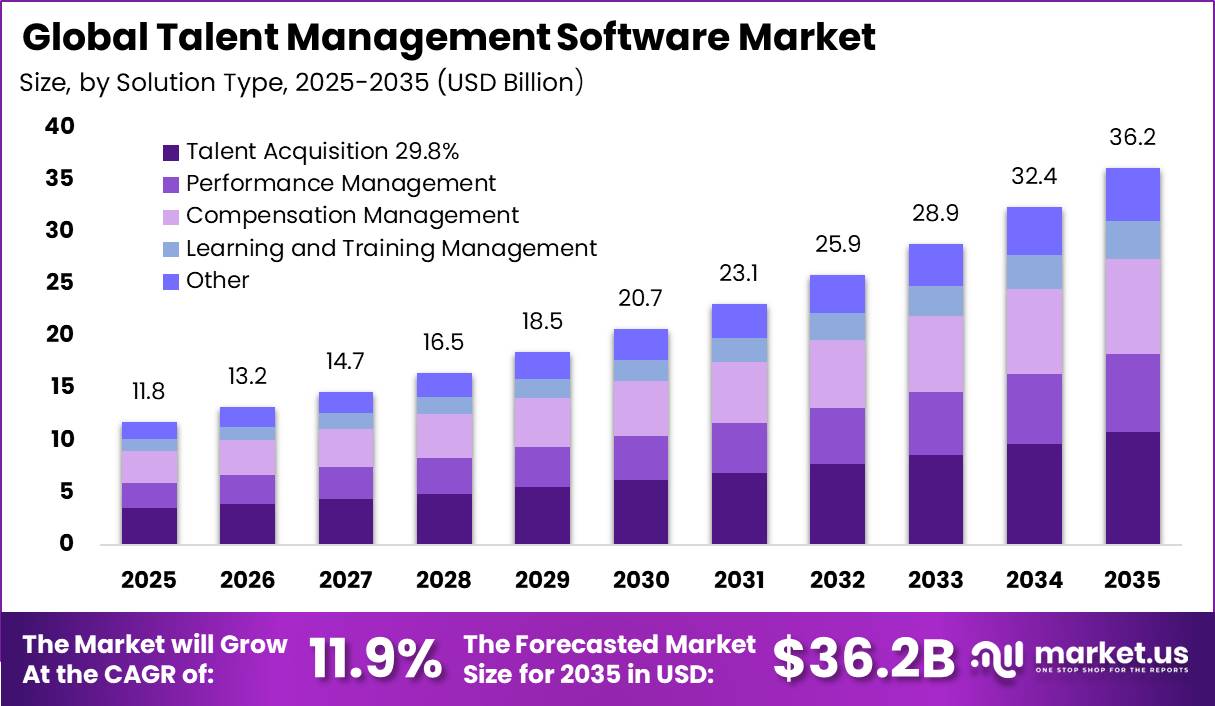
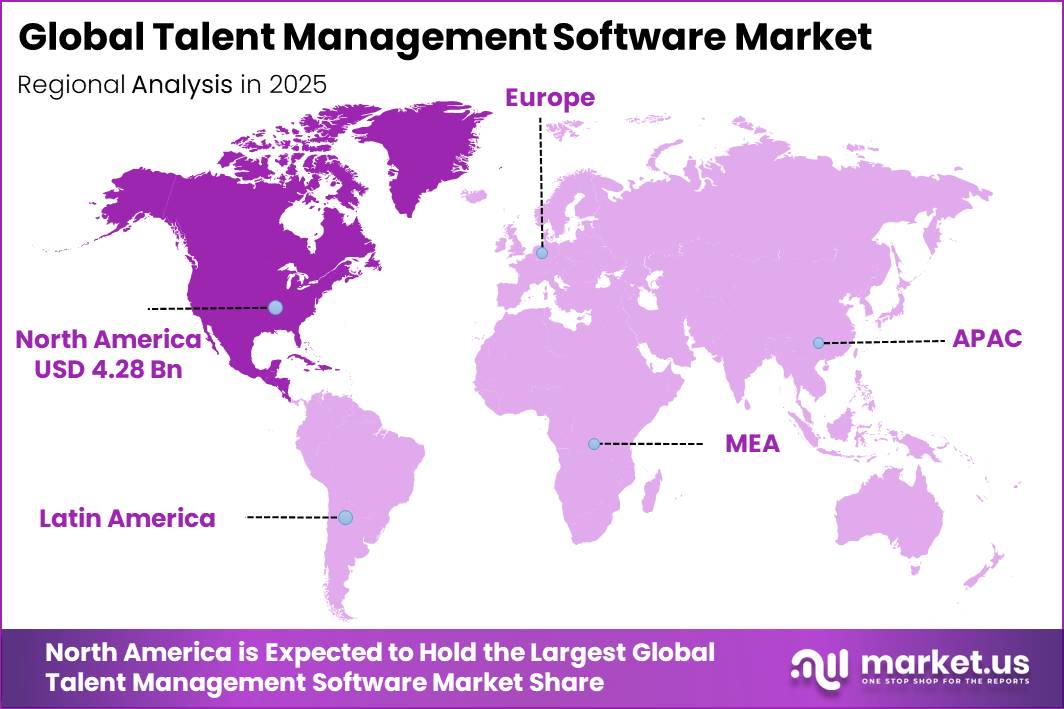
In 2025, the Global Talent Management Software Market was valued at USD 11.8 billion. The market is projected to grow at a CAGR of 11.9% during 2026–2035, reaching approximately USD 36.2 billion by 2035. North America dominated the global market in 2025, accounting for more than 36.3% of the total market share and generating approximately USD 4.28 billion in revenue.
Growth is supported by rising workforce complexity and the increasing difficulty of managing recruitment, performance reviews, employee learning, succession planning, and retention through manual processes. The World Economic Forum estimates that 22% of jobs could be disrupted by 2030, with 170 million new roles created and 92 million roles displaced, resulting in a net gain of 78 million jobs.
In addition, around 39% of workers’ core skills are expected to change by 2030. These changes are increasing demand for software that helps companies identify skill gaps, manage employee performance, support internal mobility, and organize workforce training. In the United States, the Bureau of Labor Statistics reported 7.3 million job openings in May 2025, highlighting continued hiring demand.
The U.S. Census Bureau recorded 446,993 seasonally adjusted business applications in May 2025, including 159,009 high-propensity applications. Growing employers require efficient systems for recruitment, onboarding, workforce planning, learning, performance tracking, and compliance, supporting continued adoption of cloud-based talent management platforms.
Key Takeaway
- The Talent Management Software Market was valued at USD 11.8 billion in 2025 and is projected to reach USD 36.2 billion by 2035, growing at a CAGR of 11.9%.
- Talent acquisition was the top solution type, holding a 29.8% share.
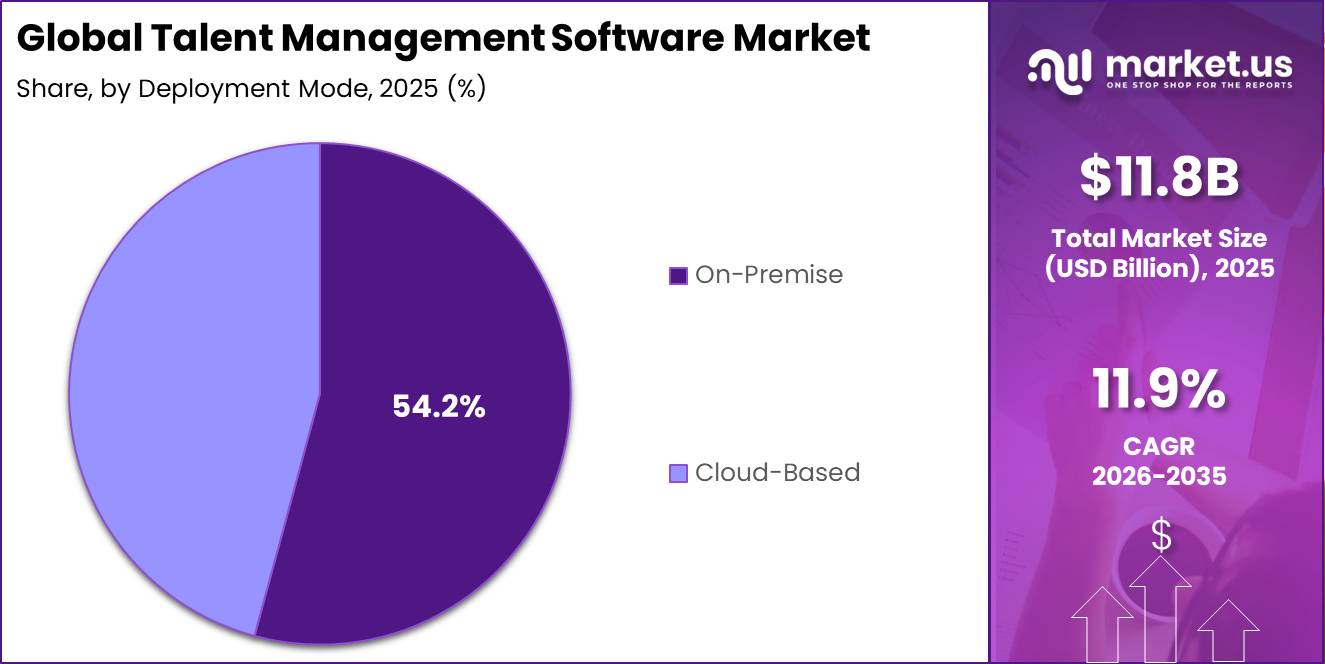
- On-premises deployment led with a 54.2% share, driven by large enterprises and security-sensitive organizations.
- Large enterprises dominated by organization size with a 64.5% share.
- IT and Telecommunication was the leading industry vertical, holding a 23.1% share.
- North America led the market in 2025 with a 36.3% share, worth approximately USD 4.28 billion.
Market Statistics and Data Insights
- The World Economic Forum found that 63% of employers identify skills gaps as a major barrier to business transformation. Out of every 100 workers, 59 are expected to require reskilling or upskilling by 2030, and 11 of those 59 may not receive it, leaving more than 120 million workers at medium-term redundancy risk. This directly supports skills-management, learning, and workforce-planning software.
- Around 77% of employers plan to upskill their existing workforce in response to AI, while 41% expect to reduce parts of their workforce as AI automates tasks. Almost half of employers also expect to move employees from AI-exposed roles into other areas of their organizations.
- Workday found that 51% of business leaders are concerned about future talent shortages, while only 32% strongly believe their current organizational skills will match future requirements. Only 54% said they have a clear view of skills already available within their organization.
- Workday reported that 55% of organizations worldwide have already started moving toward a skills-based workforce model, while another 23% plan to make the transition within the next 12 months.
- The U.S. Bureau of Labor Statistics projects approximately 73,700 HR specialist openings annually during 2025–2035, while training and development specialist employment is expected to increase 11%, with around 46,000 openings each year. This reflects continued investment in hiring, learning, and workforce-development functions.
- AI readiness remains strongly divided by enterprise size. OECD data show that 52.0% of large firms used AI in 2025, compared with only 17.4% of small firms. Overall adoption stood at 20.2%, up from 14.2% in 2024 and 8.7% in 2023. The gap indicates slower adoption potential among smaller talent-software buyers.
- SAP itself illustrates the scale of multinational recruitment that enterprise talent platforms can address. SAP reported hiring approximately 20,000–25,000 people annually across 160 countries, requiring scalable workflows, centralized candidate management, and recruitment automation.
- Generative AI adoption in recruiting is accelerating.
- LinkedIn found that 73% of talent acquisition professionals believe AI will change how organizations hire. Separately, 93% said accurately assessing candidate skills is important for improving quality of hire. Companies conducting the most skills-based searches were 12% more likely to achieve a quality hire.
- Microsoft’s 2025 Work Trend Index found that 28% of managers were considering hiring AI workforce managers and 32% were considering AI-agent specialists within the next 12–18 months. Another 35% were considering AI trainers, while 51% of managers expected AI training or upskilling to become a key team responsibility within 5 years.
- Candidate behavior is also shifting because of AI. In iCIMS’ 2026 survey, 78% of entry-level job seekers aged 18–24 said AI and automation are changing entry-level roles; 50% had changed or were reconsidering their career path, 30% were learning AI skills, and 29% were using AI during their job search.
By Solution Type
Talent Acquisition held a leading 29.8% share of the talent management software market, supported by the growing need for faster and more organized hiring processes. Recruitment is one of the most frequent workforce activities, especially as employers compete for skilled workers.
The OECD reported an unemployment rate of 4.9% across OECD countries in May 2025, while one in four euro-area service companies reported labour shortages as a factor limiting production in April 2025.
The U.S. Equal Employment Opportunity Commission received 88,531 workplace-discrimination charges in fiscal year 2024, representing an increase of more than 9% year on year. Standardized assessments, documented workflows, and record retention can help employers apply more consistent hiring practices.
By Deployment Mode
The On-premises segment held a leading 54.2% share of the talent management software market, supported by strong demand from large enterprises, public agencies, and security-sensitive organizations. These employers often prefer direct control over employee information, system access, and software settings.
The U.S. Office of Personnel Management reported 2.29 million federal civilian employees as of March 2025, while the U.S. Department of Defense employs nearly 900,000 civilian personnel. Managing recruitment records, performance reviews, training history, security clearances, and succession planning for such large workforces requires strict access controls and close integration with internal payroll, identity, and records systems.
By Organization Size
Large Enterprises held a dominant 64.5% share of the talent management software market, driven by their large workforces, multiple operating locations, and need for standardized HR processes. Eurostat reported that EU large enterprises with more than 249 employees represented only 0.2% of businesses, yet employed 59.7 million people, equal to 36.3% of the business-economy workforce, and generated €19.9 trillion in net turnover in 2023.
This scale gives large organizations both a strong operational need and sufficient budgets to adopt integrated talent platforms. In the United States, the Census Bureau reported that the health care and social assistance sector had 4,360 establishments with 500 or more employees in 2022, employing 7.16 million people and paying USD 518.4 billion annually.
By Industry Vertical
The IT and Telecommunication segment held a leading 23.1% share of the Talent Management Software Market, supported by its large technical workforce and continuous requirement for specialized digital skills. Eurostat reported that 76.24% of enterprises in the EU information and communication sector employed ICT specialists in 2024, the highest proportion among major industries.
Hiring activity in this sector also remains strong. Around 55.96% of information and communication companies recruited or attempted to recruit ICT specialists, showing the continued need for skilled employees. In addition, 56.27% of companies in this sector provided ICT-related training to their specialists in 2023, highlighting the importance of continuous workforce development.
The industry also operates at significant infrastructure scale. ITU recorded 9.2 billion mobile-cellular subscriptions in 2025, equal to 112 subscriptions per 100 inhabitants. This scale increases demand for professionals across software, networks, cybersecurity, cloud systems, and digital services. Talent management software helps telecom and IT companies manage recruitment, skills, training, performance, internal mobility, and workforce planning more efficiently.
Key Market Segments
By Solution Type
- Talent Acquisition
- Performance Management
- Compensation Management
- Learning and Training Management
- Other
By Deployment Mode
- On-Premise
- Cloud-Based
By Organization Size
- Small and Medium-Sized Enterprises
- Large Enterprises
By Industry Vertical
- IT and Telecommunication
- BFSI
- Retail
- Healthcare
- Education
- Manufacturing
- Government
- Other
Geopolitical Impact Analysis
Geopolitical disruption influences the Talent Management Software Market mainly through cloud infrastructure, data-center costs, enterprise IT budgets, and access to global technical talent. Software providers depend on servers, networking equipment, storage systems, semiconductors, electricity, and cross-border implementation teams to deliver their platforms.
The World Bank’s April 2026 outlook estimates that global energy prices could increase by 24% in 2026 because of Middle East supply disruptions. Brent crude is projected to average USD 86 per barrel, compared with USD 69 per barrel in 2025.
Higher energy and fuel costs can increase data-center operating expenses, hardware transportation costs, and regional deployment expenses. Under a more severe scenario, Brent crude could rise to USD 95–115 per barrel, adding further pressure on cloud-service margins and implementation costs.
Trade tensions and conflict-related shipping disruptions can also affect the physical infrastructure supporting talent management platforms. The World Bank expects overall commodity prices to rise by 16% in 2026, while metals and minerals could increase by 17%. These materials are widely used in servers, network hardware, power equipment, and data-center construction.
Higher costs may delay hardware upgrades, on-premises deployments, and cloud-capacity expansion. However, geopolitical uncertainty can also increase workforce restructuring, regional hiring, compliance monitoring, security screening, and skills planning, supporting continued demand for talent acquisition, workforce planning, and employee management software.
Regional Analysis
North America held the dominant position in the Talent Management Software Market in 2025, accounting for a 36.3% share and generating approximately USD 4.28 billion in revenue. The region benefits from a large digital workforce, strong enterprise technology spending, and widespread adoption of integrated HR systems.
STEM employment in the United States is also expected to grow by 8.1% between 2024 and 2034, compared with only 2.7% growth for non-STEM occupations. This widening demand for technical skills encourages employers to use talent platforms to identify skill gaps, improve retention, and manage workforce performance across multiple locations.
Asia Pacific is the fastest-growing regional market, supported by expanding digital access and technology-driven employment. Internet penetration in Asia and the Pacific reached 66% in 2024, while mobile-broadband subscriptions stood at 97 per 100 inhabitants, and 98% of the population had access to at least a 3G network.
The region’s online population grew at an average annual rate of 10.7% from 2005, compared with 8.0% globally. Between 2018 and 2022, automation displaced about 1.4 million lower-skilled workers but created 2 million skilled jobs in East Asia and the Pacific, increasing the need for reskilling, recruitment, and workforce redeployment software.
Key Regions and Countries
North America
- US
- Canada
Europe
- Germany
- France
- The UK
- Spain
- Italy
- Rest of Europe
Asia Pacific
- China
- Japan
- South Korea
- India
- Australia
- Rest of APAC
Latin America
- Brazil
- Mexico
- Rest of Latin America
Middle East & Africa
- GCC
- South Africa
- Rest of MEA
Market Dynamics
Drivers
| Driver | (~) % CAGR | Geographic Relevance | Impact Timeline |
|---|---|---|---|
| AI-led skills intelligence | +2.1% | Global | Short term (2 years or less) |
| High-volume hiring automation | +1.7% | North America, Europe, Asia Pacific | Short term (2 years or less) |
| Enterprise HCM consolidation | +1.4% | Global | Medium term (2 to 4 years) |
| Digital-workforce expansion | +1.2% | Asia Pacific, North America | Medium term (2 to 4 years) |
| Compliance workflow digitization | +0.9% | Europe, North America | Short term (2 years or less) |
AI-led skills intelligence
AI-led skills intelligence is a major growth driver as employers move talent software beyond basic HR recordkeeping toward continuous workforce decisions. The World Economic Forum estimates that 39% of workers’ existing skills could change or become outdated by 2030, increasing demand for real-time skills mapping and targeted employee development.
The U.S. Bureau of Labor Statistics projects around 280,000 annual openings in computer and information technology occupations during 2025–2035. This supports stronger demand for AI-based skills matching, internal mobility, talent marketplaces, workforce analytics, and personalized learning, helping employers fill critical roles faster while reducing dependence on costly external recruitment.
Restraints
| Restraint | (~) % CAGR | Geographic Relevance | Impact Timeline |
|---|---|---|---|
| Restricted HR-data transfers | -1.8% | Europe, China, Middle East | Short term (2 years or less) |
| Public-sector procurement limits | -1.2% | North America, Europe | Medium term (2 to 4 years) |
| Budget pressure in SMEs | -1.0% | Global | Short term (2 years or less) |
| Legacy-system lock-in | -0.8% | Global | Long term (4 years or more) |
| Cloud sovereignty mandates | -0.7% | Europe, Asia Pacific | Medium term (2 to 4 years) |
Restricted HR-data transfers
Cross-border restrictions on employee and applicant data remain a major sales restraint for talent management software. The European Commission classifies recruitment and worker-management AI as high risk, with key employment-related rules scheduled from 2 December 2027. Earlier AI Act requirements already applied from 2 February 2025 and 2 August 2025.
Compliance requirements can increase implementation time and operating costs. The U.S. Department of Labor’s 2024 inclusive-hiring framework also encourages employers to follow NIST AI Risk Management Framework practices.
Challenges
| Challenge | (~) % CAGR | Geographic Relevance | Mitigation Horizon |
|---|---|---|---|
| Fragmented HR data | -1.6% | Global | Long term (4 years or more) |
| Algorithmic bias controls | -1.3% | North America, Europe | Medium term (2 to 4 years) |
| Implementation skills shortage | -1.1% | Global | Medium term (2 to 4 years) |
| Cybersecurity assurance burden | -0.9% | Global | Long term (4 years or more) |
| Multi-country workflow complexity | -0.7% | Europe, Asia Pacific | Medium term (2 to 4 years) |
Fragmented HR data
Fragmented HR data remains a major growth challenge because talent management depends on connecting payroll, recruitment, learning, performance, workforce-planning, and identity systems. Eurostat reported that EU large enterprises employed 59.7 million people in 2023, highlighting the scale of workforce data that large organizations must manage across departments and locations.
Digital workforce expansion adds further complexity. The International Telecommunication Union recorded 5.5 billion internet users globally in 2024, increasing the number of connected and distributed employees. Data cleansing, API integration, local-language setup, and historical-record migration can increase deployment time and service costs.
Opportunities
| Opportunity | (~) % CAGR | Geographic Relevance | Execution Window |
|---|---|---|---|
| Frontline workforce penetration | +2.0% | Global | Medium term (2 to 4 years) |
| Skills-based internal mobility | +1.6% | Global | Medium term (2 to 4 years) |
| Emerging-market localization | +1.4% | Asia Pacific, Latin America, Africa | Long term (4 years or more) |
| Compliance-as-a-service modules | +1.1% | Europe, North America | Medium term (2 to 4 years) |
| HR service-provider channels | +0.9% | Global | Short term (2 years or less) |
Frontline workforce penetration
Frontline workforce adoption remains a major future opportunity because many retail, hospitality, logistics, manufacturing, and field-service employers still use separate systems for scheduling, payroll, recruitment, and training. The International Labour Organization estimated global employment at more than 3.6 billion people in 2024, showing the large potential user base for workforce technology.
Digital access is also improving this opportunity. The International Telecommunication Union reported that 68% of the global population used the internet in 2024, supporting mobile-first hiring, onboarding, microlearning, and career-management tools.
Key Players Analysis
The Talent Management Software Market is led by Tier-1 enterprise platform providers such as SAP, Oracle, Workday, ADP, IBM, and Dayforce. These companies benefit from large customer bases, global delivery networks, and the ability to combine talent management with HR, payroll, finance, cloud, and AI services.
SAP reported €21.0 billion in cloud revenue in fiscal 2025, while its Cloud ERP Suite generated €4.86 billion in fourth-quarter revenue, up 23% year on year. Oracle generated USD 44.03 billion from cloud services and license support in fiscal 2025, representing 77% of its USD 57.4 billion total revenue. Workday reported USD 8.8 billion in subscription revenue in fiscal 2026, up 14.5%, from total revenue of USD 9.5 billion.
Workday invested USD 2.6 billion in product development in fiscal 2026, equal to around 28% of revenue. Its AI products reached nearly USD 600 million in annual recurring revenue by the second quarter of fiscal 2027, rising more than 200% year on year. Oracle’s remaining performance obligations reached USD 138 billion at fiscal-2025year-end, up 41%. Tier-1 vendors are estimated to control around 55–65% of global spending.
Tier-2 challengers such as Cornerstone, iCIMS, Cegid, and Zoho compete through specialized, flexible, and lower-cost talent solutions. Cornerstone is strong in learning and skills management, while iCIMS focuses on recruitment. Cegid serves mid-sized enterprises with regional HR capabilities, and Zoho offers affordable integrated cloud tools. These providers are estimated to account for around 25–35% of the market.
Top Key Players in the Market
- IBM Corporation
- Oracle Corporation
- SAP SE
- Cornerstone
- ADP, Inc.
- Zoho Corporation
- iCIMS
- Workday, Inc.
- Dayforce, Inc.
- Cegid
Recent Developments
- In 2026, Thoma Bravo completed its acquisition of Dayforce for approximately USD 12.3 billion, taking the HCM provider private. Dayforce shareholders received USD 70.00 per share in cash. The transaction strengthens Dayforce’s financial backing for AI-powered HR, payroll, workforce management, talent, and analytics solutions while supporting further product development and international expansion.
- In 2025, Workday signed a definitive agreement to acquire AI knowledge and learning platform Sana for approximately USD 1.1 billion. Sana’s products had already served more than 1 million users across hundreds of enterprises.
Report Scope
| Report Features | Description |
|---|---|
| Market Value (2025) | USD 11.8 Billion |
| Forecast Revenue (2035) | USD 36.2 Billion |
| CAGR (2026-2035) | 11.9% |
| Base Year for Estimation | 2025 |
| Historic Period | 2020-2024 |
| Forecast Period | 2026-2035 |
| Report Coverage | Revenue Forecast, recruitmentMarket Dynamics, Competitive Landscape, Recent Developments |
| Segments Covered | By Solution Type (Talent Acquisition, Performance Management, Compensation Management, Learning and Training Management, Other); By Deployment Mode (On-Premise, Cloud-Based); By Organization Size (Small and Medium-Sized Enterprises, Large Enterprises); By Industry Vertical (IT and Telecommunication, BFSI, Retail, Healthcare, Education, Manufacturing, Government, Other) |
| Regional Analysis | North America – US, Canada; Europe – Germany, France, The UK, Spain, Italy, Rest of Europe; Asia Pacific – China, Japan, South Korea, India, Australia, Singapore, Rest of APAC; Latin America – Brazil, Mexico, Rest of Latin America; Middle East & Africa – GCC, South Africa, Rest of MEA |
| Competitive Landscape | IBM Corporation, Oracle Corporation, SAP SE, Cornerstone, ADP, Inc., Zoho Corporation, iCIMS, Workday, Inc., Dayforce, Inc., Cegid |
| Customization Scope | Customization for segments, region/country-level will be provided. Moreover, additional customization can be done based on the requirements. |
| Purchase Options | We have three licenses to opt for: Single User License, Multi-User License (Up to 5 Users), Corporate Use License (Unlimited Users and Printable PDF) |