


Quick Navigation
Report Overview
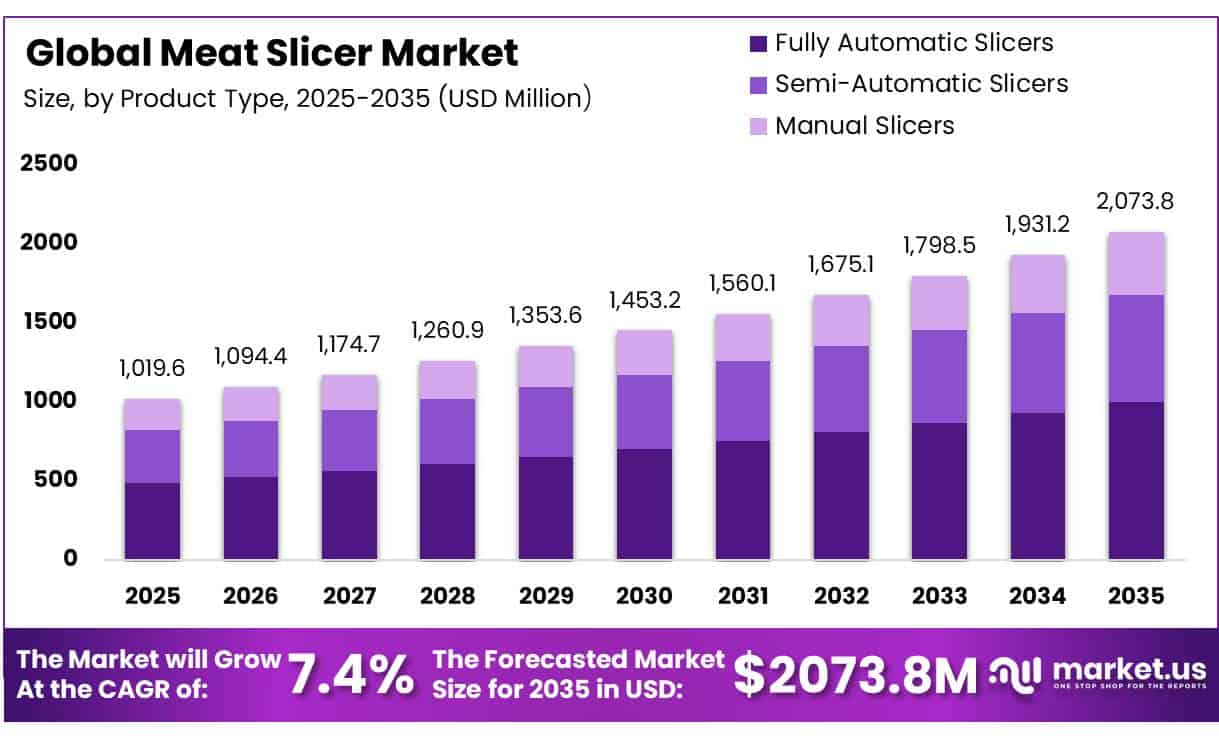
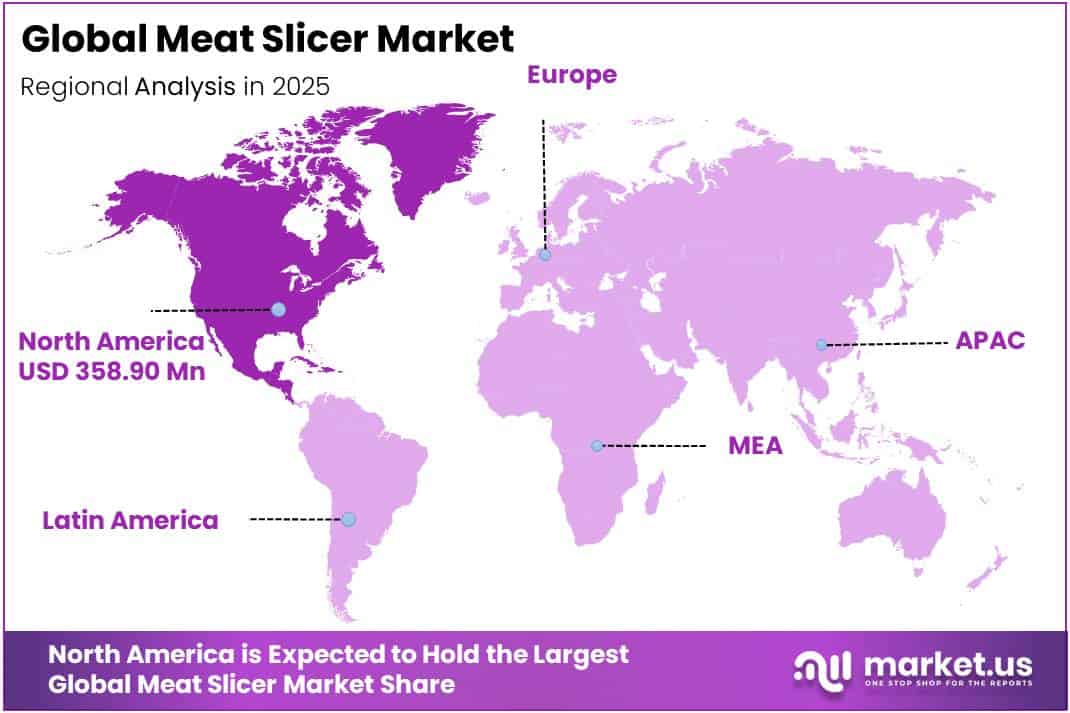
In 2025, the Global Meat Slicer Market was valued at USD 1019.6 million, and between 2026 and 2035, this market is estimated to register a CAGR of 7.4%, reaching about USD 2073.8 million by 2035. North America held a dominant market position, capturing more than a 35.2% share, holding USD 358.90 million in revenue.
The meat slicer industry operates as an indispensable pillar of the global food processing and foodservice ecosystem. Industrial meat slicers are precision-engineered machines deployed across commercial slaughterhouses, food processing plants, delicatessens, and retail chains to deliver uniform, high-speed slicing of beef, pork, poultry, and cured meats. The sector’s relevance is anchored in the upward trajectory of global meat production.
- According to the OECD-FAO Agricultural Outlook, global meat production in 2024 is estimated to have risen by 3%, reaching 365 million metric tonnes, led primarily by growth in poultry and beef output. This expanding production base directly amplifies the operational demand for efficient slicing equipment at the processing level.
Key Takeaways
- The global Meat Slicer market was valued at USD 1019.6 Million in 2025.
- The global Meat Slicer market is projected to grow at a CAGR of 7.4% and is estimated to reach USD 2073.8 Million by 2035.
- On the basis of product type, fully automatic slicers dominated the market, constituting 48.3% of the total market share.
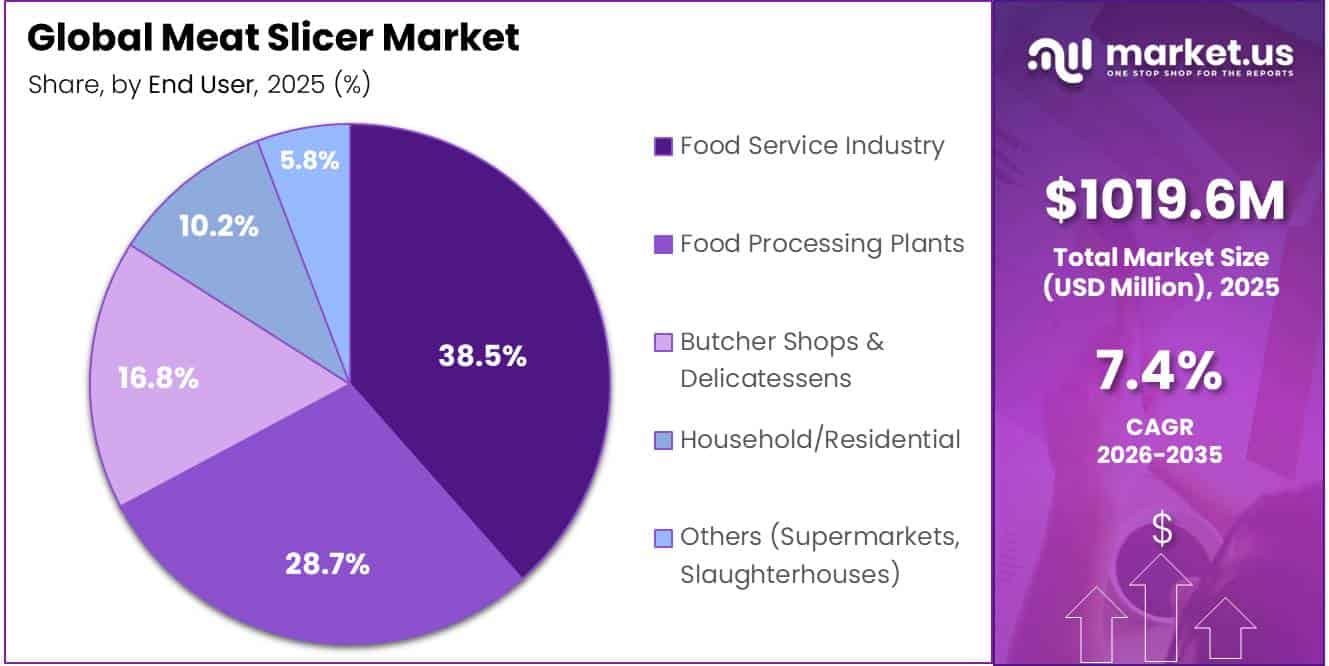
- Based on end-user, the food service industry held a major share in the meat slicer market, accounting for 38.5% of the total market.
- Based on distribution channel, direct sales (B2B) dominated the market with a substantial share of 45.6%.
- Based on blade size, 10–12 inches segment led the market, comprising 48.6% of the total market share.
- In 2025, North America was the most dominant region in the meat slicer market, accounting for 35.2% of the total market share.
The industrial scenario is further reinforced by strengthening trade volumes. Global meat exports recovered in 2024, rising by an estimated 2% to 40.2 million metric tonnes after two years of decline, fuelled by increasing import demand from the United States and Near East countries. Such trade momentum compels processing facilities to scale throughput capacity, making advanced slicing machinery a strategic necessity rather than an operational option.
Government mandates are among the most powerful driving factors shaping equipment adoption. Under USDA-FSIS regulations, federally inspected processing facilities must maintain validated Hazard Analysis and Critical Control Point (HACCP) plans and documented Sanitation Standard Operating Procedures (SSOPs), with FSIS conducting daily on-site verification of processing areas. These compliance obligations accelerate investment in hygienic, automated slicing equipment.
- Additionally, USDA’s FSIS in 2025 tested over 23,000 samples for Listeria a more than 200% increase from 2024 while enforcement actions rose 36% over the same period, underscoring the intensifying regulatory environment processors must navigate.
Future growth opportunities are underpinned by long-term consumption projections. The OECD-FAO projects global poultry, sheep meat, beef, and pig meat consumption to grow by approximately 21%, 16%, 13%, and 5%, respectively, by 2034, ensuring sustained pipeline demand for high-throughput slicing infrastructure across processing facilities globally.
By Product Type
Fully Automatic Slicers dominate with 48.3% because continuous output supports high-volume meat processing.
In 2025, Fully Automatic Slicers held a dominant market position, capturing more than a 48.3% share. Their leadership was supported by widespread use in meat-processing plants, central kitchens, supermarkets, and large foodservice operations requiring consistent slice thickness and rapid throughput. Automated feeding, portion control, stacking, and conveyor integration reduce manual handling and help processors maintain uniform presentation across packaged products. These systems are especially suitable for repetitive production runs, where dependable operation, hygiene-focused design, and lower labour involvement can improve workflow control and product consistency.
- For instance, in February 2025, according to JBT Marel, the company showcased its TREIF HAWK portion cutter at IPPE 2025, highlighting automated scanning and accurate slicing for fresh and crust-frozen meat products.
Semi-Automatic Slicers are expected to be the fastest-growing segment. Their growth is supported by demand from butcher shops, delicatessens, restaurants, and smaller processors seeking greater control without investing in fully integrated lines. These machines balance operator flexibility, manageable capacity, simpler maintenance, and lower space requirements for varied daily slicing tasks.
End User Analysis
Food Service Industry dominates with 38.5% because frequent preparation supports steady slicing demand.
In 2025, Food Service Industry held a dominant market position, capturing more than a 38.5% share. Its leadership was supported by regular use of meat slicers in restaurants, hotels, cafeterias, delicatessens, catering kitchens, and institutional dining facilities. Operators rely on these machines to prepare uniform portions for sandwiches, buffets, plated meals, and takeaway orders. Compact equipment, adjustable thickness settings, simple cleaning, and dependable daily operation help kitchens manage varied menus while controlling portion consistency and preparation time.
- For instance, in February 2026, according to the United States Department of Agriculture Rural Development, applications opened for Value-Added Producer Grants supporting agricultural producers in expanding processing and marketing activities.
Food Processing Plants are expected to be the fastest-growing segment. Their expansion is supported by rising demand for packaged meat, standardized portions, automated production lines, and stronger hygiene controls. Industrial processors increasingly require slicers that integrate with conveyors, inspection systems, packaging equipment, and digital controls to improve throughput, reduce manual handling, and maintain consistent product presentation across large production batches.
Distribution Channel Analysis
Direct Sales (B2B) dominates with 45.6% because tailored equipment support strengthens commercial purchasing.
In 2025, Direct Sales (B2B) held a dominant market position, capturing more than a 45.6% share. Its leadership was supported by the technical nature of meat slicers, which often require product demonstrations, capacity assessment, installation guidance, operator training, and maintenance planning before purchase. Food processors, supermarkets, hotels, restaurants, and central kitchens value direct contact with manufacturers because it helps them select suitable machines, negotiate orders, and receive faster technical support. This channel also enables suppliers to build long-term customer relationships and respond to changing production needs.
- For instance, in April 2025, according to Globe Food Equipment, the company expanded its sales team by appointing a regional sales manager and a director of national accounts to strengthen customer coverage.
Distributors and Wholesalers are expected to be the fastest-growing segment. Their expansion is supported by broad regional reach, local inventory, financing options, replacement-part availability, and access to multiple equipment brands. These partners help smaller businesses compare models, secure quicker delivery, and obtain nearby service without dealing directly with manufacturers.
Blade Size Analysis
10 to 12 inches dominates with 48.6% because its balanced capacity suits commercial slicing needs.
In 2025, 10-12 inches held a dominant market position, capturing more than a 48.6% share. Its leadership was supported by use across delicatessens, supermarkets, restaurants, butcher shops, and institutional kitchens. This blade range offers enough cutting width for meat portions while keeping the machine manageable for countertop installation. Operators value its ability to handle repeated slicing, maintain uniform thickness, and support varied products without requiring larger industrial equipment. Its balance of capacity, control, and usability strengthens demand across medium-volume food preparation settings.
- For instance, in February 2025, according to Bizerba, the company showcased professional meat and bread slicers at FoodEx 2025, including systems designed for precise cuts, improved presentation, hygiene, and reduced downtime.
Below 10 inches is expected to be the fastest-growing segment. Growth is supported by cafés, small restaurants, specialty stores, mobile caterers, and household users seeking compact equipment. These slicers require less counter space, are easier to move and clean, and suit lighter workloads where flexibility matters more than processing capacity.
Key Market Segments
By Product Type
- Fully Automatic Slicers
- Semi-Automatic Slicers
- Manual Slicers
By End-User
- Food Service Industry
- Food Processing Plants
- Butcher Shops & Delicatessens
- Household/Residential
- Others (Supermarkets, Slaughterhouses)
By Distribution Channel
- Direct Sales (B2B)
- Distributors and Wholesalers
- Online Retail
- Specialty Stores
- Others
By Blade Size
- 10-12 inches
- Below 10 inches
- Above 12 inches
Driver Analysis
Foodservice and deli-volume expansion
The expansion of restaurant, supermarket-deli, convenience-food, institutional-catering, and ready-to-eat protein formats directly increases the installed base requirement for manual, gravity-feed, automatic, and high-capacity meat slicers because slicing is a throughput-critical preparation step rather than a discretionary kitchen process. In the United States alone, restaurant and foodservice sales are projected at USD 1.55 trillion in 2026, with real sales growth of 1.3%, approximately 100,000 net jobs expected to be added, and total employment projected to reach 15.8 million; this enlarges the customer pool for counter-service, deli, sandwich, pizza, catering, and commissary equipment suppliers.
A modeled outlet opening requires one slicer for each 1–3 fresh-protein preparation stations, while multi-format grocery stores can require 2–6 units across deli, prepared-food, cheese, and back-of-house operations; therefore, even a 1% rise in relevant foodservice location density creates disproportionate replacement and greenfield equipment demand. This driver adds an estimated +1.6 percentage points to the baseline CAGR by lifting unit shipments in North America and Europe while accelerating mid-range commercial-slicer adoption across high-density APAC metropolitan corridors.
Drivers Impact Analysis
| Driver | (~) % Impact on CAGR | Geographic Relevance | Impact Timeline |
|---|---|---|---|
| Foodservice and deli-volume expansion | +1.6 pp | North America core, EU, APAC metros | Medium term (2-4 years) |
| Labor-saving slicing automation | +1.9 pp | North America, EU, Japan, South Korea | Short term (≤ 2 years) |
| Portion control and yield optimization | +1.3 pp | North America, EU, GCC, urban APAC | Short term (≤ 2 years) |
| Hygiene-led equipment replacement | +1.4 pp | North America, EU, Australia, Japan | Medium term (2-4 years) |
| Emerging-market protein consumption | +1.7 pp | India, Southeast Asia, Latin America, Africa | Long term (≥ 4 years) |
| Smart safety and connected equipment | +1.1 pp | EU, North America, advanced APAC | Medium term (2-4 years) |
Restraint Analysis
Stainless-steel and blade-cost volatility
Meat slicers are materially exposed to stainless-steel, aluminum, hardened-steel blade, motor, gearbox, and electronic-control costs; consequently, a 10–15% rise in the blended bill of materials can translate into a modeled 250–450 basis-point gross-margin compression for manufacturers unable to fully pass through price increases to distributors and foodservice buyers. Stainless steel is particularly consequential because it determines food-contact surfaces, structural rigidity, corrosion resistance, and cleanability; nickel, a major stainless-steel price input, traded broadly between roughly USD 14,000 and USD 15,500 per tonne during parts of 2025, illustrating the residual volatility embedded in alloy surcharges even after the acute post-pandemic spike eased.
In the 2026 downside scenario, a 12% rise in fabricated stainless and blade input costs, combined with only 60% pass-through within annual distributor contracts, raises average selling prices by approximately 4–6% while reducing unit demand by 2–4% among independent delis, butcher shops, and small restaurants; this is the basis for the modeled -1.4 percentage-point CAGR restraint. The effect is strongest in North America, Europe, and import-dependent APAC markets, where currency movements, freight, and distributor inventory buffers magnify raw-material inflation into higher landed-equipment prices.
Restraint Impact Analysis
| Restraint | (~) % Impact on CAGR | Geographic Relevance | Impact Timeline |
|---|---|---|---|
| Stainless-steel and blade-cost volatility | -1.4 pp | North America, EU, import-led APAC | Short term (≤ 2 years) |
| High SME acquisition and lifecycle cost | -1.8 pp | North America, EU, APAC urban markets | Medium term (2-4 years) |
| Safety liability and guard retrofits | -1.1 pp | North America core, EU, Australia | Medium term (2-4 years) |
| Sanitation complexity and downtime | -1.3 pp | North America, EU, Japan, South Korea | Short term (≤ 2 years) |
| Certification and regulatory fragmentation | -0.9 pp | EU, India, GCC, export-led APAC | Medium term (2-4 years) |
| Service-part shortages and maintenance burden | -1.0 pp | Latin America, MEA, secondary APAC | Long term (≥ 4 years) |
Opportunity Analysis
Slicing-as-a-Service
Slicing-as-a-service represents an untapped commercial-model opportunity rather than a baseline driver because most manufacturers still monetize the customer relationship through a one-time equipment sale, leaving financing, uptime assurance, blade replacement, maintenance, operator training, and end-of-life recovery largely unbundled. Under an analyst-modeled structure, a USD 3,500–8,000 commercial slicer can be converted into a 36–60-month contract priced at USD 110–240 per month, combining equipment access, two preventive-maintenance visits annually, blade sharpening or replacement, breakdown coverage, and optional upgrade rights; this can reduce the customer’s initial cash requirement by 70–90% while raising manufacturer lifetime revenue per installed unit by an estimated 25–45%.
The model is especially attractive for independent delis, franchisees, commissaries, and smaller chains that fail conventional capital-expenditure thresholds but can approve a monthly operating expense, while OEMs gain recurring revenue, lower channel churn, improved installed-base visibility, and a controlled trade-in inventory for certified refurbishment. As restaurant operators continue to face cost pressure despite an expected USD 1.55 trillion U.S. foodservice sales base in 2026, flexible acquisition models can capture customers who would otherwise defer replacement.
Opportunity Impact Analysis
| Opportunity | (~) % Potential CAGR | Geographic Relevance | Execution Window |
|---|---|---|---|
| Slicing-as-a-service | +1.5 pp | North America, EU, Japan, Australia | Short term (≤ 2 years) |
| Traceability-enabled slicers | +1.2 pp | North America core, EU, advanced APAC | Medium term (2-4 years) |
| Cheese and alt-protein platforms | +1.4 pp | EU, North America, APAC metros | Medium term (2-4 years) |
| Emerging-market local assembly | +1.8 pp | India, ASEAN, Latin America, Africa | Long term (≥ 4 years) |
| Central-kitchen line integration | +1.6 pp | North America, GCC, EU, urban APAC | Medium term (2-4 years) |
| Aftermarket roll-ups and blade plans | +1.0 pp | North America, EU, Latin America | Short term (≤ 2 years) |
Challenges Analysis
Multi-tier Component Volatility
The meat slicer supply chain remains operationally exposed to a multi-tier dependency structure in which stainless-steel fabricators, hardened-blade producers, electric-motor suppliers, control-switch manufacturers, bearing suppliers, guard-system vendors, and regional distributors each introduce lead-time variability without completely halting finished-machine sales. A modeled medium-capacity slicer contains 35–70 purchased components, and disruption in only one critical item—such as a motor, safety interlock, precision bearing, or electrical control—can delay final assembly by 10–30 days even when 90% or more of the bill of materials is available; manufacturers then carry 15–25% higher safety stock, incur expedited-freight premiums of 4–9% of unit cost, or redesign around substitute components that require retesting.
Broader food-manufacturing supply chains continue to report component procurement delays, capacity constraints, and order backlogs, demonstrating that supply reliability remains a managed risk rather than a resolved post-pandemic issue. The resulting challenge is a -1.1-percentage-point drag on maximum CAGR because OEMs must balance inventory carrying costs against missed delivery windows, requiring dual sourcing for the top 20–30% of critical parts, regional supplier qualification, 60–90-day demand visibility, and modular designs that permit replacement components without full machine re-certification.
Challenges Impact Analysis
| Challenge | (~) % CAGR Friction | Geographic Relevance | Mitigation Horizon |
|---|---|---|---|
| Multi-tier component volatility | -1.1 pp | EU, North America, import-led APAC | Medium term (2-4 years) |
| Technician capability shortage | -1.3 pp | North America, EU, Latin America, APAC | Long term (≥ 4 years) |
| Sanitation-throughput trade-off | -1.0 pp | North America, EU, Japan, Australia | Medium term (2-4 years) |
| Product variability control | -0.8 pp | Global processing hubs, APAC corridors | Medium term (2-4 years) |
| Regulatory lifecycle divergence | -0.9 pp | EU, India, GCC, export-led APAC | Long term (≥ 4 years) |
| Parts authenticity and uptime | -0.7 pp | Latin America, MEA, secondary APAC | Long term (≥ 4 years) |
Geopolitical Impact Analysis
Metal Tariffs and Meat Trade Restrictions Reshaping Meat Slicer Supply Chains.
Current geopolitical tensions are reshaping the meat slicer market through metal tariffs, trade disputes, and regional manufacturing policies. In June 2025, the United States increased Section 232 tariffs on imported steel and aluminium from 25% to 50%. Since slicers rely on stainless-steel blades, housings, tables, and protective components, higher import duties can raise production costs and encourage manufacturers to source metals or assemble equipment closer to major customers.
- In December 2025, China imposed final anti-dumping duties of 4.9% to 19.8% on pork and pig by-products imported from European Union companies for five years. Such measures can redirect meat-processing volumes, alter plant utilization, and affect investment decisions for slicing, portioning, packaging, and sanitation equipment across exporting and importing markets.
Shipping disruption creates further uncertainty for manufacturers that depend on imported motors, bearings, electronic controls, and replacement blades. In September 2025, United Nations Trade and Development projected maritime trade growth of only 0.5% for the year, while geopolitical rerouting increased ton-miles by 6% in 2024. Longer routes can increase freight costs, inventory requirements, and delivery times for machinery and spare parts.
These pressures are encouraging slicer manufacturers and distributors to diversify suppliers, maintain larger parts inventories, expand regional service networks, and localize assembly. However, fluctuating tariffs, meat-trade restrictions, shipping delays, and currency movements continue to affect equipment pricing and purchasing decisions among food processors, supermarkets, butcher shops, and foodservice operators.
Regional Analysis
North America dominated the Meat Slicer Market with a 35.2% share, reaching USD 358.90 Mn.
In 2025, North America held a dominant position in the Meat Slicer Market, accounting for more than 35.2% of the global market and reaching a value of USD 358.90 million. The region maintained leadership due to its well-established commercial food service sector, strong penetration of automated kitchen equipment, and high demand from restaurants, delicatessens, supermarkets, and meat processing facilities. Food operators across the region continued investing in equipment that improves slicing precision, labor efficiency, and food preparation speed.
Asia Pacific emerged as a growing regional market driven by expanding urban food consumption, rising commercial kitchen investments, and increasing development of organized food retail and processing infrastructure. Growing demand for processed and ready-to-eat meat products, along with the expansion of hospitality and food service businesses, continued to create favorable conditions for meat slicer adoption across the region.
Key Regions and Countries Covered
- North America
- The US
- Canada
- Europe
- Germany
- France
- The UK
- Spain
- Italy
- Russia & CIS
- Rest of Europe
- APAC
- China
- Japan
- South Korea
- India
- ASEAN
- Rest of APAC
- Latin America
- Brazil
- Mexico
- Rest of Latin America
- Middle East & Africa
- GCC
- South Africa
- Rest of MEA
Key Players Analysis
Meat slicer manufacturers focus on strengthening product differentiation, operational efficiency, and distribution capabilities to maintain competitiveness in the market. A major priority is continuous equipment innovation, including the development of precision slicing systems, energy-efficient motors, automatic feed mechanisms, and enhanced blade technologies that improve cutting consistency, reduce waste, and support food safety standards across commercial operations. Companies are also investing in compact and multifunctional equipment designs to meet the evolving requirements of restaurants, supermarkets, delicatessens, and food processing facilities.
Manufacturers further emphasize production optimization and supply chain resilience to manage material costs and maintain equipment availability. Strategic expansion of regional sales and service networks supports faster customer response and strengthens market presence across high-demand commercial food hubs. In addition, companies focus on automation integration, preventive maintenance solutions, and product standardization to improve long-term performance and operational reliability. Long-term partnerships with food service operators, distributors, and processing facilities continue to strengthen customer retention and reinforce positioning across premium and high-volume application segments.
Market Key Players
- Globe Food Equipment Company
- ITW Food Equipment Group (Hobart)
- BIRO Manufacturing Company
- Provisur Technologies, Inc.
- Grote Company
- Maja-Maschinenfabrik Hermann Schill GmbH
- NOCK Maschinenbau GmbH
- Food Technology Thielemann GmbH
- Sirman S.p.A.
- BIZERBA SE & Co. KG
- Weber Maschinenbau GmbH
- Dadaux SAS
- AGK Kronawitter GmbH
- C.R.M. s.r.l.
- Butcher Boy Machines International, Inc.
- Titan Slicer, Inc.
- Middleby Corporation
- Unitherm Food Systems, Inc.
- Grasselli S.p.A.
- MHS Schneidetechnik GmbH
- Others
Key Development
- In December 2025, Middleby Corporation entered into an agreement to sell a 51% stake in its Residential Kitchen business to 26North in a transaction valued at USD 885 million, supporting its transition toward a more focused commercial foodservice portfolio.
- In April 2025, ITW Food Equipment Group (Hobart) expanded its commercial food equipment strategy through continued investment in energy-efficient and productivity-focused food preparation solutions, supporting evolving operational requirements across professional kitchens.
Report Scope
| Report Features | Description |
|---|---|
| Market Value (2025) | USD 1019.6 Mn |
| Forecast Revenue (2035) | USD 2073.8 Mn |
| CAGR (2026-2035) | 7.4% |
| Base Year for Estimation | 2025 |
| Historic Period | 2020-2024 |
| Forecast Period | 2026-2035 |
| Report Coverage | Revenue Forecast, Market Dynamics, Competitive Landscape, Recent Developments |
| Segments Covered | By Product Type (Fully Automatic Slicers, Semi-Automatic Slicers, Manual Slicers), By End-User (Food Service Industry, Food Processing Plants, Butcher Shops & Delicatessens, Household/Residential, Others (Supermarkets, Slaughterhouses)), By Distribution Channel (Direct Sales (B2B), Distributors and Wholesalers, Online Retail, Specialty Stores, Others), By Blade Size (10–12 inches, Below 10 inches, Above 12 inches) |
| Regional Analysis | North America – The US & Canada; Europe – Germany, France, The UK, Spain, Italy, Russia & CIS, Rest of Europe; APAC– China, Japan, South Korea, India, ASEAN & Rest of APAC; Latin America– Brazil, Mexico & Rest of Latin America; Middle East & Africa– GCC, South Africa, & Rest of MEA |
| Competitive Landscape | Globe Food Equipment Company, ITW Food Equipment Group (Hobart), BIRO Manufacturing Company, Provisur Technologies, Inc., Grote Company, Maja-Maschinenfabrik Hermann Schill GmbH, NOCK Maschinenbau GmbH, Food Technology Thielemann GmbH, Sirman S.p.A., BIZERBA SE & Co. KG, Weber Maschinenbau GmbH, Dadaux SAS, AGK Kronawitter GmbH, C.R.M. s.r.l., Butcher Boy Machines International, Inc., Titan Slicer, Inc., Middleby Corporation, Unitherm Food Systems, Inc., Grasselli S.p.A., MHS Schneidetechnik GmbH, and Others |
| Customization Scope | Customization for segments, region/country-level will be provided. Moreover, additional customization can be done based on the requirements. |
| Purchase Options | We have three licenses to opt for: Single User License, Multi-User License (Up to 5 Users), Corporate Use License (Unlimited Users and Printable PDF) |





































