Quick Navigation
- Report Overview
- Key Takeaways
- Filter Type Analysis
- Filter Media Analysis
- Product Type Analysis
- Vehicle Type Analysis
- Sales Channel Analysis
- Key Market Segments
- Regional Analysis
- Key Regions and Countries
- Market Dynamics
- Drivers
- Restraints
- Challenges
- Opportunities
- Key Company Insights
- Recent Developments
- Geopolitical Impact Analysis
- Report Scope
Report Overview
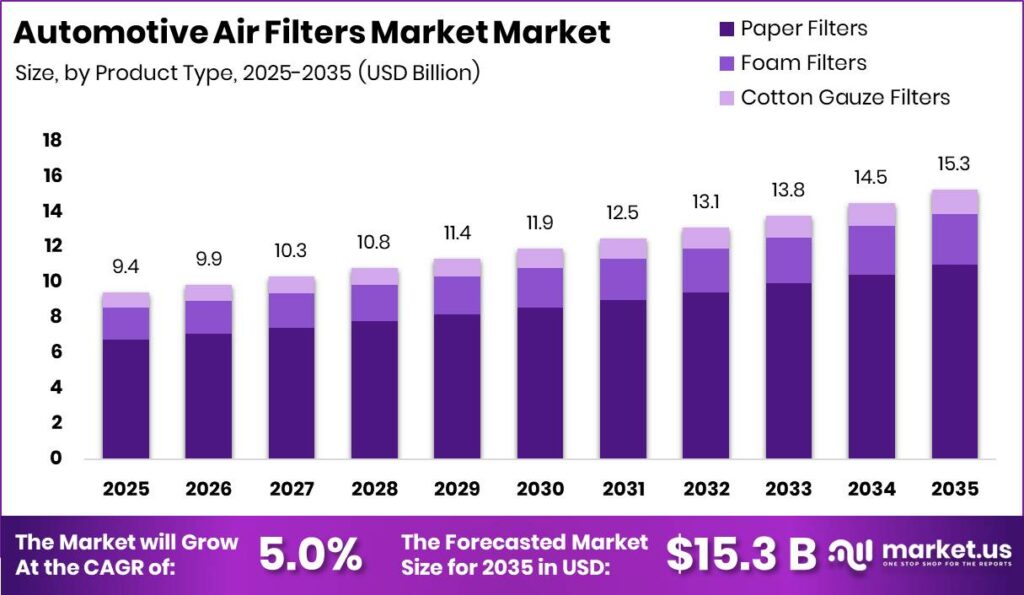
Global Automotive Air Filters Market size is expected to be worth around USD 15.3 Billion by 2035 from USD 9.4 Billion in 2025, growing at a CAGR of 5.0% during the forecast period 2026 to 2035.
The Automotive Filtration industry covers engineered components that trap dust, pollen, and combustion debris before particles reach an engine or a passenger cabin. This market spans intake elements, cabin elements, raw filter media, and finished products sold through OEM and aftermarket channels. This means passenger cars, light commercial vehicles, and heavy commercial vehicles each carry at least one intake filter and one cabin filter as standard fitment.
Key Takeaways
- Global Automotive Air Filters Market size was valued at USD 9.4 Billion in 2025 and is projected to reach USD 15.3 Billion by 2035.
- The market is set to grow at a CAGR of 5.0% between 2026 and 2035.
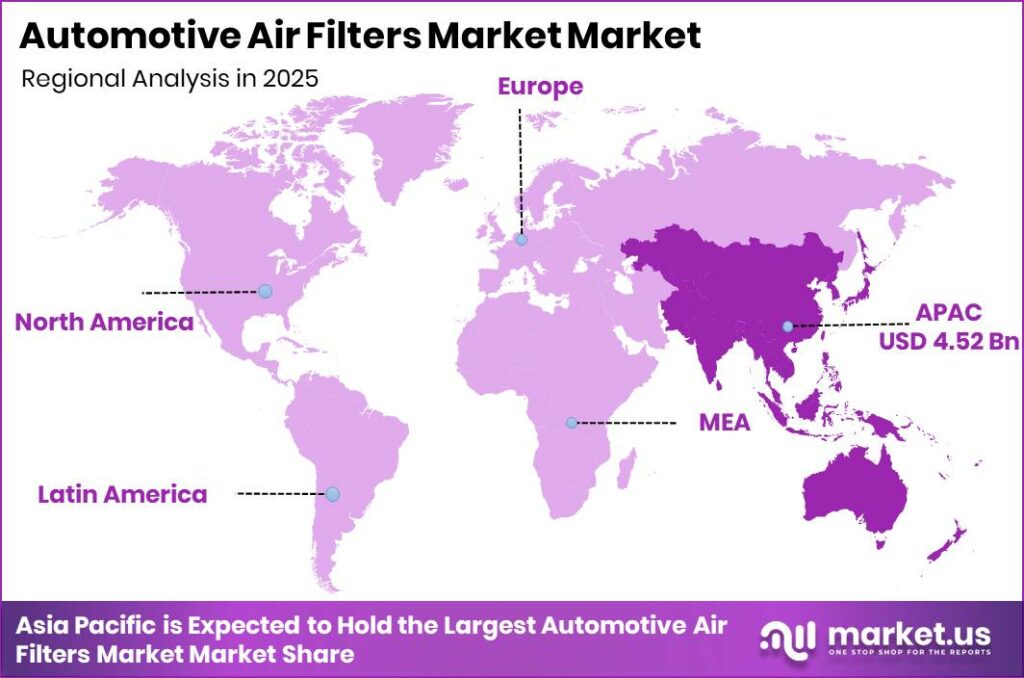
- Asia Pacific led the market with a share of 47.90%, valued at USD 4.52 Billion in 2025.
- Air Intake Filters dominated the By Filter Type segment with a share of 56.00%.
- Cellulose Fiber led the By Filter Media segment with a share of 48.00%.
- Paper Filters dominated the By Product Type segment with a share of 72.00%.
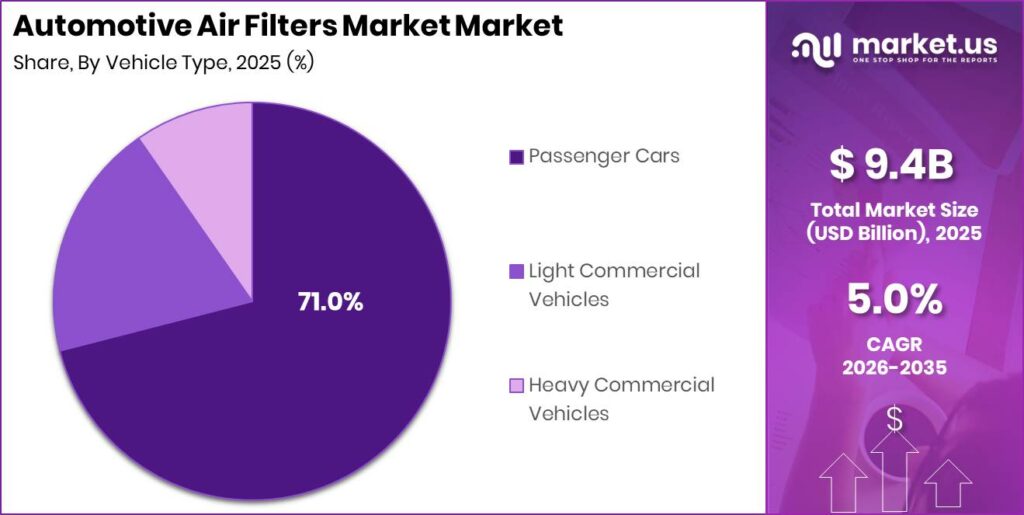
- Passenger Cars held the largest share in the By Vehicle Type segment at 71.00%.
- Aftermarket led the By Sales Channel segment with a share of 54.00%.
Camfil’s 2025 technical guidance confirms that HEPA grade automotive cabin media captures at least 99.97% of particles at 0.3 micrometers, a benchmark now referenced by premium cabin filter programs. This standard pushes suppliers toward finer, multi-layer media rather than basic single-ply paper. As a result, component cost per unit rises, but so does the price a buyer will pay for verified air quality performance.
Camfil also documents a typical new-filter pressure drop of 0.5 to 1.5 inches water gauge for HEPA grade media, rising to a replacement threshold of 2.0 to 3.0 inches water gauge. This range gives service networks a measurable trigger for scheduled replacement rather than a calendar guess. Consequently, workshops that adopt pressure based diagnostics can sell replacement service earlier and more consistently than mileage only programs.
Filter Type Analysis
Air Intake Filters dominates with 56.00% due to mandatory engine intake protection role.
In 2025, Air Intake Filters held a dominant market position in the By Filter Type segment of Automotive Air Filters Market, with a 56.00% share. Donaldson’s 2026 listed PowerCore 4×4 Air Intake System for the Toyota LandCruiser reports 99.99% filtration efficiency under ISO 5011 testing, against 99.87% for an OEM panel filter. This gap pushes fleet buyers toward branded replacement programs over generic parts.
Cabin Air Filters serve occupant health rather than engine protection, so buyer decisions follow comfort and air quality signals more than mileage alone. A 2025 SAE International passenger car study calibrated pressure drop clog thresholds rising from 83 Pa at blower speed 1 to 256 Pa at blower speed 5. The same study defined a clogged Cabin Air Filter as one causing a 10% reduction in airflow, giving service networks a precise diagnostic trigger. This creates a service upsell opportunity tied to measurable sensor data rather than a fixed calendar interval.
Filter Media Analysis
Cellulose Fiber dominates with 48.00% due to low cost balanced filtration performance.
In 2025, Cellulose Fiber held a dominant market position in the By Filter Media segment of Automotive Air Filters Market, with a 48.00% share. Donaldson’s standard cellulose type engine air filter media reaches a minimum overall efficiency above 99.90%, with efficiency rising further as dust accumulates on the media surface. This baseline keeps cellulose the default choice for cost sensitive OEM programs while still meeting core protection needs.
Synthetic Materials appeal to buyers who need consistent performance across humidity and temperature swings that cellulose handles less predictably. Car and Driver reporting confirms that HEPA rated automotive cabin filters must remove a minimum of 99.97% of particles as small as 0.3 microns, a specification synthetic media meets more consistently than cellulose blends. This reliability supports premium trim positioning and justifies a higher price point at the point of sale.
Activated Carbon serves buyers who prioritize odor and gas absorption alongside particulate capture, a distinct purchase driver from basic dust filtration. Under the MPPS based classification in Camfil’s 2025 technical article, true HEPA filtration requires at least 99.95% efficiency against particles measuring 0.1 to 0.2 micrometers. Manufacturers that pair carbon layers with this efficiency tier can market a combined air quality and odor control claim that plain media cannot support.
Others, covering blended and specialty media types, hold the remaining share collectively within this segment and serve niche vehicle platforms and regional filtration standards.
Product Type Analysis
Paper Filters dominates with 72.00% due to proven low cost high efficiency media.
In 2025, Paper Filters held a dominant market position in the By Product Type segment of Automotive Air Filters Market, with a 72.00% share. Donaldson Blue Ultra Web HD Engine Air Filter media achieves up to 99.999% filtration efficiency, equal to roughly 0.01 gram of test dust passing per kilogram fed under ISO style testing. This margin lets premium paper lines command a price gap over standard cellulose without losing fleet buyers focused on engine longevity.
Foam Filters suit buyers in dusty or off road operating conditions who value washable, reusable media over disposable elements. Donaldson’s standard Blue Ultra Web engine air filter media reaches up to 99.99% filtration efficiency, near 0.1 gram of dust passing per kilogram fed. Foam based programs positioned against this benchmark can target performance and off road buyers willing to pay for reusable convenience.
Cotton Gauze Filters attract performance oriented buyers seeking higher airflow, though this comes with a documented efficiency tradeoff. Donaldson’s testing shows will fit standard engine air filter media reaching only 99.0% efficiency, about 10 grams of dust passing per kilogram fed, up to 100 times more than Blue Ultra Web media under the same comparison. This tradeoff means gauze based products must be marketed on airflow gains, not on filtration purity claims.
Vehicle Type Analysis
Passenger Cars dominates with 71.00% due to largest global vehicle parc base.
In 2025, Passenger Cars held a dominant market position in the By Vehicle Type segment of Automotive Air Filters Market, with a 71.00% share. This vehicle class carries the broadest mix of intake and cabin filter fitments across every price tier, which keeps replacement volume steady regardless of new vehicle sales cycles. Suppliers that hold shelf space across this class secure the widest recurring aftermarket revenue base.
Light Commercial Vehicles operate on tighter duty cycles than passenger cars, so buyers weigh filter durability against uptime cost more heavily. Fleet operators managing these vehicles increasingly track service intervals through digital maintenance logs rather than paper records. This shift rewards suppliers who can document filter life with verifiable data instead of generic mileage guidance.
Heavy Commercial Vehicles demand the highest filtration durability given continuous long haul operating hours. Fleetguard filters paired with the FleetguardFIT monitoring system can extend service intervals to 1,000 hours or more under the operating conditions the manufacturer describes. This extension lowers total maintenance stops per truck each year, directly cutting fleet downtime cost for operators running dense delivery schedules.
Sales Channel Analysis
Aftermarket dominates with 54.00% due to recurring scheduled replacement demand cycle.
In 2025, Aftermarket held a dominant market position in the By Sales Channel segment of Automotive Air Filters Market, with a 54.00% share. Independent workshops and retail chains capture this recurring replacement cycle across every vehicle age group on the road today. This structure means aftermarket suppliers compete on distribution reach and shelf presence rather than one time vehicle assembly contracts.
OEM supply serves vehicle assemblers directly and is judged on consistency across production runs rather than retail visibility. Donaldson’s testing confirms that cellulose engine air filter media used in OEM fitment holds a minimum efficiency above 99.90%, with performance improving as dust accumulates on the media before scheduled replacement. This consistency requirement keeps OEM contracts concentrated among suppliers that can guarantee batch level quality control.
Key Market Segments
By Filter Type
- Air Intake Filters
- Cabin Air Filters
By Filter Media
- Cellulose Fiber
- Synthetic Materials
- Activated Carbon
- Others
By Product Type
- Paper Filters
- Foam Filters
- Cotton Gauze Filters
By Vehicle Type
- Passenger Cars
- Light Commercial Vehicles
- Heavy Commercial Vehicles
By Sales Channel
- OEM
- Aftermarket
Regional Analysis
Asia Pacific Dominates the Automotive Air Filters Market with a Market Share of 47.90%, Valued at USD 4.52 Billion
Asia Pacific leads the global market on the strength of its vehicle production base and dense aftermarket distribution network. This region held a 47.90% share in 2025, worth USD 4.52 Billion. High vehicle output across this region converts directly into filter demand at both the OEM assembly line and the replacement counter. Consequently, suppliers with regional manufacturing footprints hold a clear cost and logistics advantage over importers.
Growth momentum outside Asia Pacific tracks fleet aging and tightening emission linked filtration specifications in mature vehicle markets. Buyers in these regions increasingly favor verified high efficiency media over unbranded low cost alternatives. This shift signals rising willingness to pay for documented filtration performance rather than the lowest shelf price.
Key Regions and Countries
North America
- US
- Canada
Europe
- Germany
- France
- The UK
- Spain
- Italy
- Rest of Europe
Asia Pacific
- China
- Japan
- South Korea
- India
- Australia
- Rest of APAC
Latin America
- Brazil
- Mexico
- Rest of Latin America
Middle East and Africa
- GCC
- South Africa
- Rest of MEA
Market Dynamics
Market Opportunity Analysis - Underserved vehicle segments and sales channels leave clear entry points for challengers.
Cabin Air Filters trail Air Intake Filters with a smaller share of the By Filter Type segment despite serving occupant health rather than a purely mechanical function. This means suppliers who build a dedicated cabin air quality brand can grow share without competing directly against entrenched intake filter incumbents. Instead of matching intake filter pricing, a cabin specialist can compete on measurable air quality outcomes.
Heavy Commercial Vehicles remain the smallest vehicle type segment behind Passenger Cars, yet each unit demands the highest filtration durability and carries the strongest service contract value. This creates room for suppliers to build fleet specific monitoring and replacement programs rather than selling loose parts. As a result, a heavy duty specialist gains a defensible niche that mass market suppliers rarely prioritize.
OEM supply trails Aftermarket in overall channel share, yet OEM relationships anchor long term specification control that aftermarket sales alone cannot deliver. This signals an opening for suppliers who pair a modest OEM design win with a much larger aftermarket replacement tail. Therefore, a supplier entering through OEM qualification can convert that credibility into faster aftermarket trust building.
Middle East and Africa and Latin America carry smaller shares of the regional split than Asia Pacific, leaving distribution density in these regions comparatively thin. This reflects lower current vehicle parc concentration rather than any structural barrier to filtration demand. Consequently, early investment in regional distribution hubs across these markets can secure share before larger incumbents commit comparable resources.
Technology and Innovation Landscape - Nanofiber media and sensor based diagnostics redefine filtration performance benchmarks.
MANN FILTER nanofiber media for commercial vehicle engine air filters uses fibers up to 500 times finer than a human hair and up to 300 times finer than the cellulose base material. This construction lifts particle separation efficiency to 99.98%, against roughly 40% for the cellulose base alone. This means fleet buyers gain a measurable, testable reason to specify nanofiber upgrades over legacy cellulose media on new equipment orders.
Donaldson’s Blue Ultra Web platform demonstrates how layered media construction lifts engine filtration from a baseline 99.9% cellulose standard to as high as 99.999% in its HD variant. This creates a clear performance ladder that lets a single supplier serve budget, standard, and premium buyers from one core technology platform. Manufacturers that can document this ladder with test data convert technical superiority into tiered pricing power.
Automated clog detection research calibrated pressure drop thresholds across five blower speeds, rising from 83 Pa to 256 Pa, tied to a fixed 10% airflow loss definition of a clogged filter. This gives vehicle software a hard, testable trigger for dashboard replacement alerts instead of a generic mileage reminder. As a result, automakers integrating this logic can convert filter replacement into a connected service touchpoint rather than a missed maintenance item.
Drivers
The dominant active force is the compounding installed base of combustion and hybrid vehicles. Global motor vehicle output rose from roughly 92.7 million units in 2024 to about 96.4 million in 2025 per international manufacturers association tabulations. This sits alongside a US light vehicle fleet whose average age moved from about 12.6 years in 2024 toward roughly 13.0 years by 2026. Intake elements are consumed every 12,000 to 15,000 miles, so each added year of fleet age converts new build volume into 2 to 3 recurring replacement events annually.
This dynamic has shifted supplier business models away from transactional counter sales toward contracted service plan bundling. Aftermarket gross margins near 30% to 38% materially exceed OEM first fit margins closer to 12% to 18%, a mix effect visible in supplier disclosures since 2024. As a result, customer acquisition cost increasingly spreads across multi year replacement annuities, justifying regional stocking hubs that carry 60 to 90 days of inventory.
| Driver | (~) % Impact on CAGR Forecast | Geographic Relevance | Impact Timeline |
|---|---|---|---|
| Expanding vehicle parc and replacement cycle density | +1.4% | Global | Short term (2 years or less) |
| Euro 7 type-approval filtration specification uplift | +1.1% | EU, EEA, UN ECE adopters | Short term (2 years or less) |
| Urban particulate exposure driving multi-stage cabin filter adoption | +0.9% | Asia Pacific, Middle East, Southern Europe | Short term (2 years or less) |
| Heavy-duty model year 2027 intake air quality standards | +0.7% | North America | Medium term (2 to 4 years) |
| Aftermarket e-commerce and DIFM channel expansion | +0.6% | North America, Western Europe, China | Short term (2 years or less) |
| Light commercial and two-wheeler output growth in emerging economies | +0.5% | India, ASEAN, Latin America | Medium term (2 to 4 years) |
Restraints
The binding constraint originates in the 25% Section 232 duty structure applied to covered automobile parts entering the United States from May 2025, extended to medium and heavy duty vehicle parts from November 2025. Filter elements are low value, high volume consumables with landed costs often between 3 and 12 dollars per unit, so a duty at this level adds an 18% to 22% delivered cost increase that pack margins cannot absorb.
This creates a dual bottleneck for suppliers. Gross margin compression of roughly 200 to 350 basis points has appeared where price pass through lags by 2 to 3 quarters, based on 2025 and 2026 supplier earnings disclosures. Consequently, this freezes near term US volume for import reliant product lines and pushes reshoring decisions that require 18 to 30 month tooling qualification cycles before new capacity comes online.
| Restraint | (~) % Impact on CAGR Forecast | Geographic Relevance | Impact Timeline |
|---|---|---|---|
| Section 232 automotive parts tariffs on imported elements | -1.3% | United States, import-dependent suppliers | Short term (2 years or less) |
| Battery-electric powertrain removal of engine intake filtration | -0.9% | China, Western Europe, California | Medium term (2 to 4 years) |
| Counterfeit and non-certified replacement elements | -0.8% | Asia Pacific, Latin America, Africa | Short term (2 years or less) |
| Elevated policy rates constraining distributor inventory financing | -0.6% | Global, acute in emerging markets | Short term (2 years or less) |
| OEM extended service interval prescriptions | -0.5% | Western Europe, Japan, South Korea | Medium term (2 to 4 years) |
| Freight rate weakness deferring fleet maintenance | -0.4% | North America, Europe | Short term (2 years or less) |
Challenges
The structural vulnerability is bill of materials concentration. Cellulose, meltblown polypropylene, and glass fibre media typically represent 45% to 55% of a finished element’s manufacturing cost, leaving producers with minimal insulation against feedstock and energy swings. Polypropylene resin pricing tracks crude benchmarks that have moved in 15 to 25 dollar per barrel bands during recent disruption episodes, while spunbond and meltblown lines run at roughly 1.5 to 3.0 megawatt hours per tonne of media output.
This volatility produces a 120 to 180 basis point swing in gross margin for every 20% move in resin cost, amplified because OEM contracts commonly fix prices for 12 to 36 months with only partial index clauses. Media imports still cross multiple borders before conversion, adding 4 to 8 weeks of price exposed transit. Suppliers are responding through backward integration and index linked repricing clauses in new OEM awards.
| Challenge | (~) % CAGR Friction Drag | Geographic Relevance | Mitigation Horizon |
|---|---|---|---|
| Filter media input cost volatility | -0.7% | Global | Medium term (2 to 4 years) |
| Nonwoven capacity geographic concentration | -0.6% | East Asia sourcing, global exposure | Long term (4 years or more) |
| Filtration engineering talent deficit | -0.5% | Europe, North America, Japan | Long term (4 years or more) |
| Divergent cabin filter test standards | -0.4% | EU, China, India, North America | Medium term (2 to 4 years) |
| Aftermarket SKU proliferation complexity | -0.4% | Global distribution networks | Medium term (2 to 4 years) |
| Extended producer responsibility compliance | -0.3% | EU, United Kingdom, Canada | Long term (4 years or more) |
Opportunities
Replacement today is triggered mostly by odometer based service documentation rather than by measured restriction, leaving real time condition monitoring as white space. Differential pressure and particulate sensing is fitted on only a low single digit percentage of the circulating parc. A sensor and gateway module adds roughly 3 to 6 dollars of bill of materials cost per assembly, yet converts a commodity element sold at 30% to 38% gross margin into a data triggered replacement annuity.
Service and software attach rates in this model carry 55% to 65% contribution margins, implying 250 to 500 basis points of blended margin expansion for suppliers that own the alert layer. Fleet economics reinforce this case since unplanned workshop downtime carries a heavy per vehicle day utilization cost. Capturing this opportunity requires OEM data sharing agreements and a pivot from parts per order pricing toward per vehicle recurring contracts.
| Opportunity | (~) % Potential CAGR Upside | Geographic Relevance | Execution Window |
|---|---|---|---|
| Sensor-linked predictive replacement subscriptions | +1.2% | North America, Western Europe, China | Medium term (2 to 4 years) |
| Non-exhaust brake particulate capture adjacency | +0.9% | EU, United Kingdom, Japan | Long term (4 years or more) |
| Roll-up of fragmented regional element manufacturers | +0.8% | Asia Pacific, Latin America, Eastern Europe | Medium term (2 to 4 years) |
| Private-label OE-specification programmes for digital retailers | +0.6% | North America, Europe | Short term (2 years or less) |
| Antimicrobial media for humid tropical fleets | +0.5% | ASEAN, South Asia, Gulf states | Long term (4 years or more) |
| Off-highway and agricultural intake crossover platforms | +0.4% | Brazil, India, Sub-Saharan Africa | Medium term (2 to 4 years) |
Key Company Insights
MANN+HUMMEL holds a distinct engineering edge through its MANN FILTER nanofiber media for commercial vehicle applications, which reaches particle separation efficiency of up to 99.98%, against about 40% for the cellulose base material alone. In March 2025, the company launched the C 17 237 engine air filter, replacing conventional phenolic resin with lignin, a plant based material from paper production waste. This lowers the product’s carbon footprint and strengthens its position with sustainability minded fleet buyers.
MAHLE GmbH maintains a broad footprint across both OEM and aftermarket filtration lines, giving it direct access to vehicle assemblers and independent workshops at the same time. This dual channel structure lets the company absorb shifts in OEM order timing without losing aftermarket shelf presence. However, spreading engineering resources across such a wide product and channel base can slow the pace at which any single filtration innovation reaches full market rollout.
Key Players
- MANN+HUMMEL GmbH
- MAHLE GmbH
- Robert Bosch GmbH
- DENSO Corporation
- Donaldson Company, Inc.
- Cummins Inc. (Cummins Filtration/Fleetguard)
- Freudenberg Filtration Technologies
- Sogefi S.p.A.
- Parker-Hannifin Corporation
- Ahlstrom (Ahlstrom-Munksjö Oyj)
- Hengst SE
- K&N Engineering, Inc.
- Toyota Boshoku Corporation
- UFI Filters S.p.A.
- Champion Laboratories / FRAM Group
Recent Developments
- March 2025: MANN+HUMMEL launched the C 17 237 engine air filter, replacing conventional phenolic resin with lignin, a plant based raw material derived from paper production waste, reducing the product’s carbon footprint.
- June 2026: MANN+HUMMEL announced it would showcase new MANN FILTER automotive filtration products, including cabin and engine air filtration technologies, at Automechanika Frankfurt 2026, highlighting new aftermarket product introductions.
Geopolitical Impact Analysis
According to the World Trade Organization, global merchandise trade growth is forecast to slow to 1.9% in 2026 from 4.6% in 2025, as tariff effects and Middle East conflict risk weigh on shipping and input costs. Continued Cape of Good Hope routing adds 10 to 14 days of transit on Asia to Europe lanes that carry filter media and finished elements. This means suppliers sourcing nonwoven media from Asia face longer, less predictable lead times into European assembly plants.
As reported by the International Energy Agency, the Strait of Hormuz carries roughly 20% of global oil shipments, a chokepoint directly tied to polypropylene resin pricing used in meltblown filter media. This signals that any escalation around that route can push resin costs higher within weeks rather than months. Consequently, filter manufacturers with single region resin sourcing face sharper margin swings than competitors holding dual region supply contracts.
Report Scope
| Report Features | Description |
|---|---|
| Market Value (2025) | USD 9.4 Billion |
| Forecast Revenue (2035) | USD 15.3 Billion |
| CAGR (2026-2035) | 5.0% |
| Base Year for Estimation | 2025 |
| Historic Period | 2020-2024 |
| Forecast Period | 2026-2035 |
| Report Coverage | Revenue Forecast, Market Dynamics, Market Opportunity Analysis, Technology and Innovation Landscape, Competitive Landscape, Recent Developments |
| Segments Covered | By Filter Type (Air Intake Filters, Cabin Air Filters), By Filter Media (Cellulose Fiber, Synthetic Materials, Activated Carbon, Others), By Product Type (Paper Filters, Foam Filters, Cotton Gauze Filters), By Vehicle Type (Passenger Cars, Light Commercial Vehicles, Heavy Commercial Vehicles), By Sales Channel (OEM, Aftermarket) |
| Regional Analysis | North America (US and Canada), Europe (Germany, France, The UK, Spain, Italy, and Rest of Europe), Asia Pacific (China, Japan, South Korea, India, Australia, and Rest of APAC), Latin America (Brazil, Mexico, and Rest of Latin America), Middle East and Africa (GCC, South Africa, and Rest of MEA) |
| Competitive Landscape | MANN+HUMMEL GmbH, MAHLE GmbH, Robert Bosch GmbH, DENSO Corporation, Donaldson Company Inc., Cummins Inc. (Cummins Filtration/Fleetguard), Freudenberg Filtration Technologies, Sogefi S.p.A., Parker-Hannifin Corporation, Ahlstrom (Ahlstrom-Munksjö Oyj), Hengst SE, K&N Engineering Inc., Toyota Boshoku Corporation, UFI Filters S.p.A., Champion Laboratories / FRAM Group |
| Customization Scope | Customization for segments, region / country-level will be provided. Additional customization can be done based on requirements. |
| Purchase Options | We have three licenses to opt for: Single User License | Multi-User License (Up to 5 Users) | Corporate Use License (Unlimited User and Printable PDF) |