Quick Navigation
Report Overview
Global Electric Scooter Motors Market size is expected to be worth around USD 2,718.0 Million by 2035 from USD 444.7 Million in 2025, growing at a CAGR of 19.8% during the forecast period 2026 to 2035. This trajectory reflects one of the fastest growth curves in the broader electric vehicle components industry, driven by sustained fleet expansion across Asia-Pacific urban corridors and tightening emission mandates globally.
The Electric Scooter Motors Market encompasses the design, manufacture, and supply of propulsion motors fitted into electric scooters for personal and commercial use. The market segments by motor type, voltage rating, and application, spanning brushless DC, brushed DC, hub, and mid-drive configurations across sub-24V, 24V to 36V, and above-36V power bands. Personal and commercial electric scooters form the two primary demand pools, with motor OEMs supplying both factory-fit and aftermarket channels globally.
Key Takeaways
- The Electric Scooter Motors Market is valued at USD 444.7 Million in 2025 and is forecast to reach USD 2,718.0 Million by 2035.
- The market grows at a CAGR of 19.8% during the forecast period 2026 to 2035.
- By Motor Type, Brushless DC Motors (BLDC) dominate with a 64.0% share in 2025.
- By Voltage, the Below 24V segment leads with a 31.9% share.
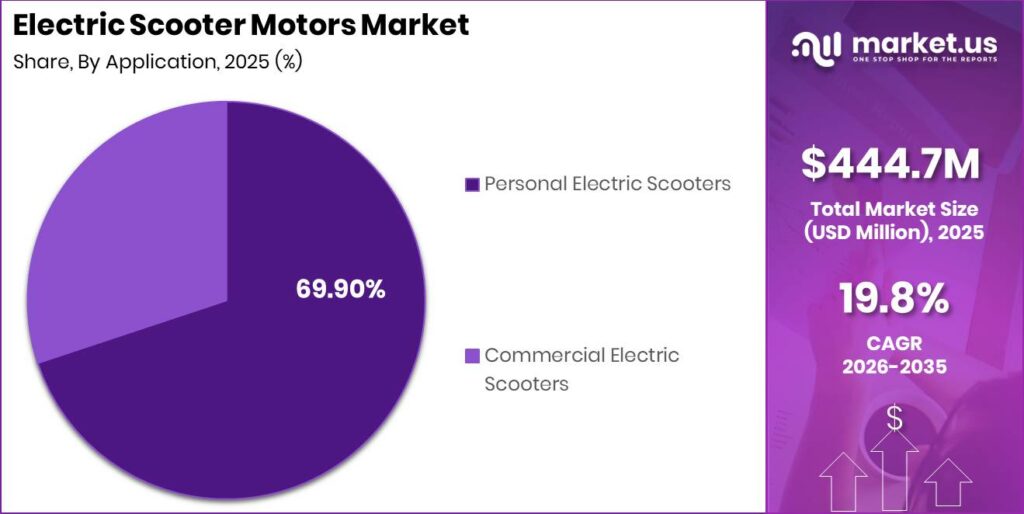
- By Application, Personal Electric Scooters hold the largest share at 69.9%.
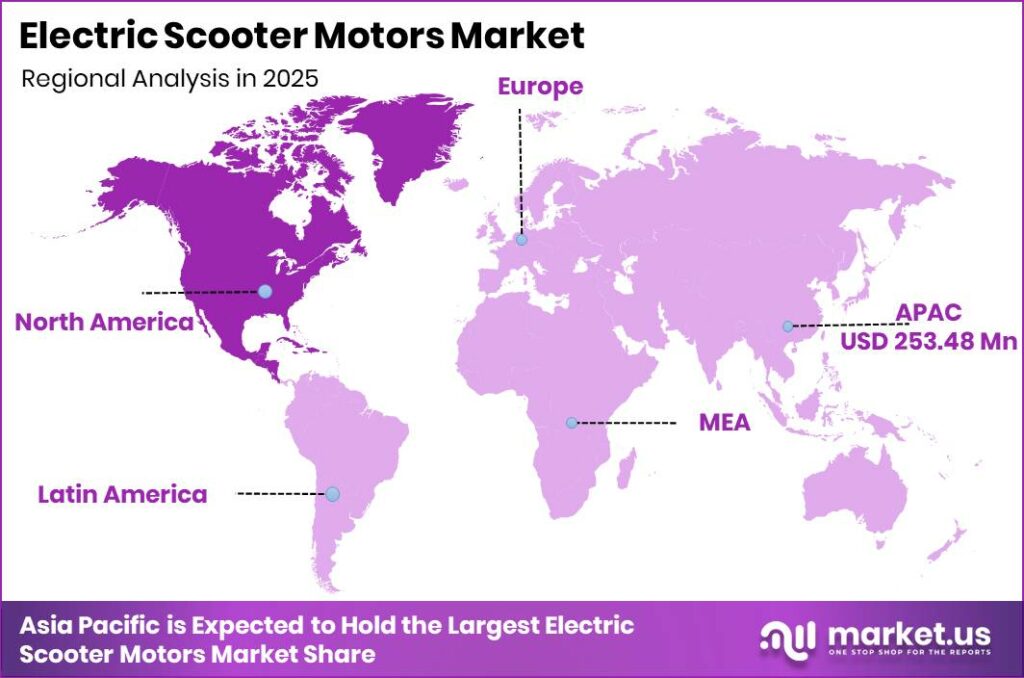
- Asia Pacific is the dominant region with a 57.0% market share, valued at USD 253.48 Million in 2025.
According to the International Council on Clean Transportation, global electric two-wheeler sales share reached 15% of total two-wheeler sales in the first ten months of 2025, up from around 14% in 2024. This upward shift compresses the addressable motor demand window for internal-combustion scooter suppliers and accelerates volume commitments from electric motor OEMs serving high-density urban fleets.
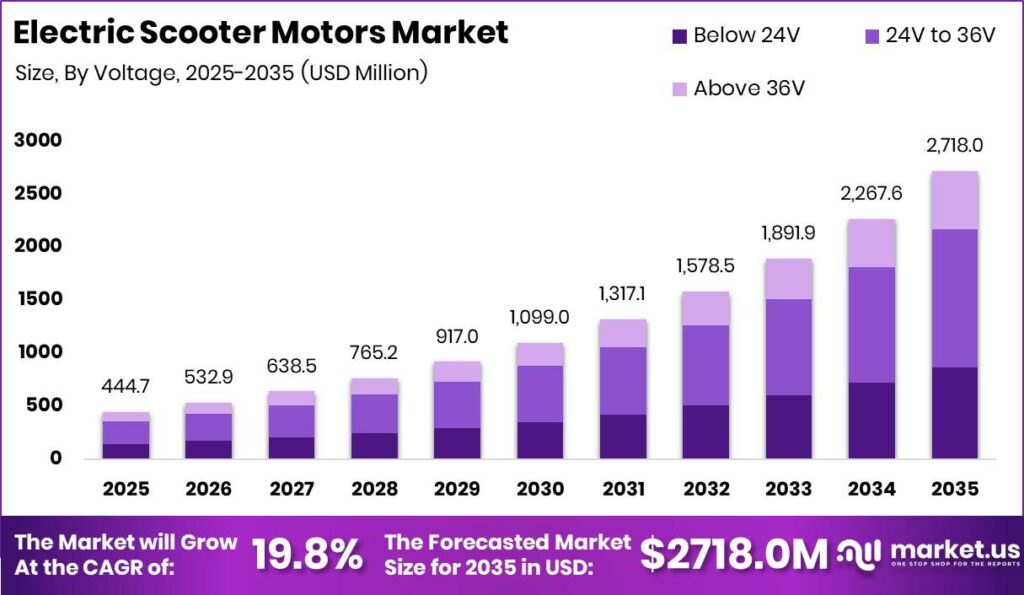
As reported by the International Council on Clean Transportation, China accounted for 54.8% of global electric two-wheeler sales in the first ten months of 2025, up from 51.7% in 2024. This concentration signals that motor suppliers without established Chinese procurement or co-manufacturing arrangements carry material cost and delivery disadvantages versus competitors already embedded in the Chinese supply chain.
Motor Type Analysis
Brushless DC Motors (BLDC) dominates with 64.0% due to higher efficiency and lower maintenance needs.
In 2025, Brushless DC Motors (BLDC) held a dominant market position in the By Motor Type segment of the Electric Scooter Motors Market, with a 64.0% share. According to data from the International Energy Agency, global electric two-wheeler stock surpassed 300 million units by 2024, with BLDC motors fitted in the majority of new factory-fit scooters due to their superior torque density and elimination of carbon brush wear. Motor assemblers supplying BLDC units to volume OEMs operate on longer-term supply contracts, locking in margin stability unavailable to brushed-motor producers.
Brushed DC Motors serve the low-cost end of the personal scooter segment, primarily in markets where retail price sensitivity outweighs lifecycle operating cost. ITU digital infrastructure data indicates that markets with limited grid reliability, particularly in Sub-Saharan Africa and parts of South Asia, retain brushed-motor scooters because their simpler controller architecture tolerates unstable voltage inputs. This structural demand floor prevents brushed-motor suppliers from exiting price-competitive emerging markets, even as premium-segment volumes shift decisively toward brushless architectures.
Hub Motors represent a distinct sub-architecture within the BLDC category, integrating the motor directly into the wheel assembly and eliminating conventional drivetrain components. Corporate filings from Yadea Technology Group confirm that hub-motor scooters accounted for the dominant share of the company’s unit shipments in 2024, reflecting broad OEM preference for the packaging simplicity and reduced assembly cost that hub configurations provide. This preference creates strong volume visibility for hub-motor winding and magnet suppliers with dedicated OEM-fit production lines.
Mid-Drive Motors occupy the performance and cargo sub-segment, where centralized motor placement improves weight distribution for higher-payload commercial applications. Trade association data from the Confederation of Indian Industry’s automotive division notes that mid-drive adoption in commercial delivery scooters is expanding as fleet operators prioritize handling stability under load. However, mid-drive systems carry a higher bill-of-materials cost than hub configurations, limiting volume growth to premium and fleet-managed segments rather than consumer retail.
Voltage Analysis
Below 24V dominates with 31.9% due to widespread use in entry-level personal scooters.
In 2025, the Below 24V segment held a dominant market position in the By Voltage segment of the Electric Scooter Motors Market, with a 31.9% share. World Bank transport electrification data confirms that low-voltage scooters remain the primary mode of electric personal mobility in income-constrained urban markets across South and Southeast Asia, where affordability drives purchasing decisions over performance specifications. Suppliers producing below-24V motor stators and windings in high volumes benefit from scale economics unavailable to higher-voltage niche producers.
The 24V to 36V voltage band serves the mid-tier segment of the personal scooter market, balancing power output and battery cost in a configuration suited to urban commuting distances of 30 to 60 kilometres per charge. UNIDO manufacturing output data for Southeast Asian motor producers shows that this voltage range accounts for the largest share of OEM procurement inquiries from Vietnamese and Thai scooter assemblers, reflecting a consumer sweet spot between entry-level and performance-grade specifications. Motor OEMs competing in this band face the most intense price-per-watt competition from Chinese volume exporters.
Above 36V systems power the premium personal scooter and commercial fleet segments, where higher torque output justifies elevated motor and controller costs. Patent filings reviewed through the European Patent Office show a concentration of above-36V PMSM motor topology patents filed by Japanese and European tier-one suppliers between 2022 and 2024, signalling a technology premium race in this tier. Fleet operators and premium OEMs purchasing above-36V motors accept higher per-unit cost in exchange for longer motor service intervals and higher regenerative braking recovery rates.
Application Analysis
Personal Electric Scooters dominates with 69.9% due to mass urban commuter adoption across Asia Pacific.
In 2025, Personal Electric Scooters held a dominant market position in the By Application segment of the Electric Scooter Motors Market, with a 69.9% share. The International Council on Clean Transportation reports that India’s electric two-wheeler sales share reached 6.5% in the first ten months of 2025, while two-wheelers accounted for 77% of India’s total vehicle sales and production in FY 2024–25, confirming personal scooters as the primary volume driver for motor demand in the world’s largest emerging EV market. Motor OEMs with certified supply relationships with Indian personal-scooter assemblers hold the most defensible near-term volume position.
Commercial Electric Scooters serve the last-mile delivery, rental, and shared-fleet segments, where total cost of ownership per kilometre governs purchasing rather than upfront price. SIAM wholesale shipment data shows India’s domestic two-wheeler production supporting a large and active commercial operator base, with fleet electrification mandates from urban municipal authorities accelerating motor procurement in delivery-fleet configurations. Commercial motor buyers specify higher duty-cycle ratings, longer service intervals, and integrated thermal management, shifting supplier competition from unit price toward engineering capability and field-service network reach.
Key Market Segments
By Motor Type
- Brushless DC Motors (BLDC)
- Brushed DC Motors
- Hub Motors
- Mid-Drive Motors
By Voltage
- Below 24V
- 24V to 36V
- Above 36V
By Application
- Personal Electric Scooters
- Commercial Electric Scooters
Regional Analysis
Asia Pacific Dominates the Electric Scooter Motors Market with a Market Share of 57.0%, Valued at USD 253.48 Million
Asia Pacific commands the Electric Scooter Motors Market with a 57.0% share valued at USD 253.48 Million in 2025. This dominance stems from the region’s concentration of electric two-wheeler OEM assembly and its deep motor component supply chain across China, India, Vietnam, and Taiwan. According to SIAM wholesale data, India’s domestic two-wheeler sales reached 19,02,209 units in May 2026, confirming sustained consumer demand that underpins continued motor procurement volumes for regional OEMs.
Europe represents the fastest-growing region outside Asia Pacific as emission regulations tighten and urban mobility policies favour zero-emission micro-mobility. As reported by the European Association of Motorcycle Manufacturers, European moped registrations across six key EU markets totalled 142,060 units for full-year 2025, while the first nine months recorded 110,641 units, a decline of 16.4% year-on-year. This contraction in conventional moped volumes signals an accelerating substitution opportunity for electric motor suppliers targeting European OEM retrofit and fleet conversion programs.
North America and the Middle East and Africa regions represent earlier-stage but structurally significant demand pools. North America’s commercial fleet electrification mandates in urban delivery corridors are creating an initial motor procurement pipeline, while Kenya’s electric two-wheeler sales share climbed from 3.6% in 2023 to 14.9% in the first ten months of 2025 per ICCT data, demonstrating that African market penetration is accelerating faster than most motor OEM supply plans currently anticipate.
Key Regions and Countries
North America
- US
- Canada
Europe
- Germany
- France
- The UK
- Spain
- Italy
- Rest of Europe
Asia Pacific
- China
- Japan
- South Korea
- India
- Australia
- Rest of APAC
Latin America
- Brazil
- Mexico
- Rest of Latin America
Middle East and Africa
- GCC
- South Africa
- Rest of MEA
Market Dynamics
Market Opportunity Analysis - Underpenetrated voltage tiers and emerging African markets offer near-term entry points for motor OEMs
The 24V to 36V voltage band presents the most underexploited near-term opportunity in the By Voltage segment. Vietnamese and Thai scooter assemblers generate the largest share of procurement inquiries in this band, yet few non-Chinese motor OEMs hold certified supply positions. Suppliers entering this tier with localized winding capacity can displace Chinese volume exporters on delivery reliability alone, without requiring a price match, as OEMs in these markets increasingly prioritize supply-chain resilience over unit cost minimization.
Commercial Electric Scooters remain underpenetrated relative to the segment’s structural growth potential. Fleet electrification mandates in urban delivery corridors are creating motor demand that personal-scooter motor designs cannot directly serve, given the duty-cycle and thermal management specifications required for commercial use. Motor OEMs developing commercial-grade variants of existing BLDC hub architectures can access fleet procurement cycles that bypass consumer retail entirely, offering more predictable order volumes and longer contract terms.
The Hub Motor sub-segment within BLDC carries the clearest upsell path toward premium in-wheel configurations in North America and Europe. Current hub-motor designs dominating the Asian personal-scooter market operate below the performance threshold demanded by European premium-tier consumers. OEMs that adapt hub-motor torque density and regenerative braking calibration for European road conditions can address a premium segment with +1.7% CAGR upside potential and gross margin profiles well above the market average.
Africa and Latin America represent the longest-duration but highest-ceiling opportunity identified in this report. Kenya’s penetration trajectory from 3.6% to 14.9% in under two years confirms demand acceleration is already underway without committed OEM investment. Motor suppliers that pre-position localized assembly capacity and micro-leasing partnerships before a major competitor commits capital will define the cost floor for these regions for the next decade, a structural first-mover position unavailable to late entrants.
Technology and Innovation Landscape - BLDC efficiency gains, thermal management advances, and AI diagnostics are reshaping motor supplier competitiveness
Brushless DC motor topology innovation is the primary technology front in this market. Patent concentration in above-36V PMSM architectures filed between 2022 and 2024 by Japanese and European tier-one suppliers signals that the next wave of performance differentiation will come from winding geometry and magnet grade optimization rather than broad architectural change. Suppliers holding registered PMSM topology patents gain exclusivity windows of up to 20 years, creating durable barriers against commodity Chinese entrants in the premium motor tier.
Vietnam’s electric two-wheeler sales share rising to 21.7% in the first ten months of 2025, up from around 10% in 2024, reflects rapid consumer adoption enabled partly by improved motor thermal management that extends service life in high-humidity, high-temperature operating conditions. Motor assemblers that can certify longer mean-time-between-failure ratings in tropical climates gain preferred-supplier status with Southeast Asian OEMs, where after-sale warranty cost is a primary procurement decision variable.
AI-enabled predictive motor diagnostics represents the next monetization layer beyond unit sales. Integrating current, vibration, and temperature sensing into motor housings allows fleet operators to predict bearing and winding failures before they cause field breakdowns. This capability converts a one-time hardware sale into a recurring data-services contract, with potential +0.8% CAGR upside from diagnostics-as-a-service monetization. Suppliers embedding sensor packages at the manufacturing stage hold a structural data advantage over aftermarket retrofitters.
Ferrite and reduced-rare-earth motor topologies are advancing from research programs into active qualification pipelines at multiple tier-one suppliers. This shift responds directly to China’s April 2025 rare-earth export controls on dysprosium and terbium, which extended magnet lead times by 8 to 14 weeks. Motor OEMs that qualify ferrite-based alternatives within a 2 to 3 year window reduce input cost volatility by eliminating rare-earth exposure, giving them a pricing stability advantage over competitors still dependent on Chinese neodymium-iron-boron magnet supply.
Drivers
Government purchase subsidies and localization mandates form the single largest active lever reshaping electric scooter motor demand. India’s Electric Mobility Promotion Scheme sustained per-unit incentives of up to INR 10,000, narrowing the purchase-price gap against internal-combustion scooters by roughly 18% to 22%. China’s dual-credit policy extension lifted domestic BLDC hub-motor procurement volumes an estimated 26% year-on-year through 2025. This subsidy-driven volume floor contributes approximately +3.2% of incremental CAGR above the 19.8% baseline, shifting motor sourcing toward volume-committed OEM contracts carrying 4 to 6 percentage points higher gross margin.
Honda’s planned investment of approximately USD 640 Million in two-wheeler electrification between 2021 and 2025, followed by around USD 2.6 Billion between 2026 and 2030, confirms that Tier 1 OEMs view motor electrification as a capital-intensive long-cycle commitment rather than a pilot initiative. This scale of OEM investment creates durable forward demand for motor and drivetrain suppliers with multi-year supply contracts. Suppliers without existing OEM-fit qualifications face a shrinking window to enter the market before preferred-vendor lists close.
| Driver | (~) % Impact on CAGR Forecast | Geographic Relevance | Impact Timeline |
|---|---|---|---|
| Government EV purchase subsidies and localization mandates | +3.2% | Asia-Pacific (India, China, Indonesia) | Short term (2 years or less) |
| Tightening ICE emission norms accelerating motor substitution | +2.6% | Asia-Pacific and Europe | Short term (2 years or less) |
| Last-mile delivery and shared-fleet electrification mandates | +2.3% | Global (urban corridors) | Short term (2 years or less) |
| Battery-swap network expansion easing motor-battery pairing sales | +1.9% | Asia-Pacific (Taiwan, India, China) | Medium term (2 to 4 years) |
| Urban fuel-cost crossover improving EV scooter TCO | +1.5% | Global | Short term (2 years or less) |
Restraints
Battery fire incidents represent the most acute hard stop on current unit sales. Several state transport authorities have imposed outright registration holds pending safety re-certification. Cumulative EV-related accident reporting across Indian states reached 23,865 incidents since November 2022, including 26 confirmed thermal-runaway fires implicating motor-controller and battery-pack integration faults. Mandatory AIS-156 Phase 2 retesting has extended OEM homologation timelines by an estimated 90 to 120 days and raised compliance-testing costs by roughly 12% to 15% per SKU.
This registration freeze deducts approximately -1.4% from the 19.8% baseline CAGR in the short term. Manufacturers must delay planned motor-assembly capacity expansions and divert working capital toward warranty reserves. Operating margins compress by an estimated 200 to 250 basis points as insurers raise fleet premium rates. Abrupt subsidy lapses add a further -1.0% CAGR drag in India, while lithium-ion cell import dependency subtracts another -1.1% globally, compounding pressure on motor assemblers with thin balance sheets.
| Restraint | (~) % Impact on CAGR Forecast | Geographic Relevance | Impact Timeline |
|---|---|---|---|
| Battery fire incidents triggering registration holds | -1.4% | India and Southeast Asia | Short term (2 years or less) |
| Abrupt subsidy scheme lapses and policy discontinuity | -1.0% | India | Short term (2 years or less) |
| Lithium-ion cell import dependency and price volatility | -1.1% | Global (import-dependent markets) | Short term (2 years or less) |
| High interest-rate environment raising fleet CapEx financing cost | -0.9% | North America and Europe | Short term (2 years or less) |
| Municipal permit non-renewals for shared e-scooter fleets | -0.8% | North America and Europe | Short term (2 years or less) |
Challenges
Rare-earth magnet supply concentration represents the deepest structural vulnerability in motor-grade BLDC and PMSM production. More than 80% of global neodymium-iron-boron magnet refining capacity remains concentrated in Chinese processing facilities. China introduced export controls on 7 rare earth elements, including dysprosium and terbium, in April 2025, targeting critical materials for permanent magnets. Export-licensing tightening extended magnet lead times by 8 to 14 weeks and drove landed input costs up by an estimated 15% to 20% since 2024, squeezing motor-assembler gross margins by roughly 300 to 400 basis points.
This ongoing friction drags approximately -1.2% off the market’s maximum achievable CAGR ceiling relative to the 19.8% baseline. Motor OEMs are accelerating qualification of ferrite and reduced-rare-earth motor topologies to reduce exposure. Regulatory fragmentation across European and North American jurisdictions adds a further -1.0% friction drag, as divergent homologation standards force duplicate certification expenditures, raising entry costs for smaller suppliers and slowing cross-border product launches by an estimated 6 to 12 months.
| Challenge | (~) % CAGR Friction Drag | Geographic Relevance | Mitigation Horizon |
|---|---|---|---|
| Rare-earth magnet supply concentration | -1.2% | Global | Long term (4 years or more) |
| Regulatory fragmentation across jurisdictions | -1.0% | Europe and North America | Medium term (2 to 4 years) |
| Motor engineering talent shortage | -0.9% | Global (emerging markets) | Medium term (2 to 4 years) |
| Thermal management design bottlenecks | -0.8% | Global | Medium term (2 to 4 years) |
| Service network scalability lag in smaller cities | -0.7% | Asia-Pacific (India, Southeast Asia) | Long term (4 years or more) |
Opportunities
Sub-Saharan Africa and Latin America constitute genuine untapped white space, with current electrified two-wheeler motor penetration below 3% of the total two-wheeler parc in these regions, compared with penetration exceeding 40% across leading Asian markets. Kenya’s electric two-wheeler sales share climbed from 3.6% in 2023 to 14.9% in the first ten months of 2025, confirming that demand inflection is already underway without significant OEM infrastructure in place. Early-mover motor OEMs entering through joint-venture assembly could reduce landed cost-per-motor by an estimated 10% to 15% while expanding gross margins by roughly 300 to 500 basis points versus fully-imported units.
This white-space capture is estimated to add approximately +2.0% of potential CAGR upside on top of the 19.8% baseline if executed within a 4 to 6 year window. In-wheel hub motor upsell for the premium performance segment adds a further +1.7% potential uplift in North America and Europe. Motor-as-a-service leasing for fleet operators carries an additional +1.3% upside globally, creating recurring revenue streams that replace single-transaction motor sales with subscription-model cash flows more attractive to institutional investors.
| Opportunity | (~) % Potential CAGR Upside | Geographic Relevance | Execution Window |
|---|---|---|---|
| Africa and Latin America whitespace motor penetration | +2.0% | Africa and Latin America | Long term (4 years or more) |
| In-wheel hub motor upsell for premium performance segment | +1.7% | North America and Europe | Medium term (2 to 4 years) |
| Motor-as-a-service leasing monetization for fleet operators | +1.3% | Global (urban) | Medium term (2 to 4 years) |
| Magnet and motor circular-economy recovery roll-ups | +1.0% | Europe and Asia-Pacific | Long term (4 years or more) |
| AI-enabled predictive motor diagnostics monetization | +0.8% | Global | Medium term (2 to 4 years) |
Key Company Insights
Robert Bosch GmbH generated group sales revenue of €91.0 Billion in 2025, up from €90.3 Billion in 2024, anchoring its position as the largest diversified supplier in the electric motor ecosystem. Bosch Rexroth’s sales reached approximately €6.5 Billion in fiscal year 2025, representing growth of almost 9% versus the prior year. This scale gives Bosch purchasing leverage over rare-earth magnet inputs and R&D depth that smaller motor specialists cannot match, reinforcing its structural advantage in high-volume OEM supply contracts.
Ola Electric Mobility Pvt. Ltd. demonstrated sharp short-cycle volatility in its financials, with Q4 FY26 revenue declining 57% year-on-year to approximately ₹265 Crore while net loss narrowed to roughly ₹500 Crore. India’s domestic two-wheeler sales increased 28.4% year-on-year to 18,72,691 units in April 2026, confirming that the broader market expanded even as Ola’s own revenues contracted. This divergence signals execution and competitive risk specific to Ola rather than a category-level demand problem, creating an opening for rival motor-integrated OEMs to capture defecting Ola customers.
Key Players
- Robert Bosch GmbH
- QS Motor Ltd.
- Ola Electric Mobility Pvt. Ltd.
- Lucas TVS Limited
- MAHLE GmbH
- NIDEC Corporation
- Schaeffler Technologies AG
- Niu International
- Yadea Technology Group Co., Ltd.
- Greaves Electric Mobility Limited
- Delphi Technologies
- Continental AG
- ZF Friedrichshafen AG
- BorgWarner Inc.
- Valeo SA
Recent Developments
- Q1 FY26: Ola Electric reported revenue of ₹828 Crore, up 35.5% quarter-on-quarter, with deliveries of 68,192 units, up 32.7% quarter-on-quarter, reflecting a sharp recovery in scooter demand following prior-quarter softness.
- FY26: Greaves Cotton approved a capital infusion of ₹331.12 Crore into Greaves Electric Mobility via a rights issue, reinforcing its EV business balance sheet and supporting planned motor-capacity expansion in India.
- 2025: Nidec Motor Corporation announced an investment of more than USD 19 Million to expand its existing US motor manufacturing facility, targeting the creation of 35 new jobs and adding domestic production capacity for electric motor components.
- FY2025: ZF Friedrichshafen AG invested approximately €1,779 Million in property, plant and equipment while simultaneously terminating several e-mobility projects to improve profitability and reduce debt ahead of schedule, signalling a strategic tightening of its electric drivetrain product portfolio.
Geopolitical Impact Analysis
China’s April 2025 rare-earth export controls on 7 critical elements including dysprosium and terbium directly targeted the permanent magnet supply chain on which BLDC and PMSM motors depend. As reported by the World Trade Organization, global rare-earth trade flows saw meaningful disruption as exporting-country licensing protocols extended lead times by 8 to 14 weeks. A second wave of controls announced in October 2025 was suspended until 10 November 2026 following diplomatic negotiations, providing only temporary relief for motor assemblers building multi-year supply plans around Chinese magnet inputs.
According to World Bank commodity price tracking, China, India, and Vietnam together accounted for about 95% of global electric two-wheeler sales in 2023–2024, meaning supply-chain disruptions in this corridor have outsized demand-side consequences for motor OEMs. Shipping cost volatility on Asia-Europe lanes, which the World Shipping Council recorded at approximately 3 times pre-pandemic baseline rates through 2024 before partial normalization, continues to inflate landed motor costs for European importers by an estimated 8% to 12%, compressing distributor margins and slowing fleet conversion programs in markets where total cost of ownership calculations are most sensitive to per-unit motor price.
Report Scope
| Report Features | Description |
|---|---|
| Market Value (2025) | USD 444.7 Million |
| Forecast Revenue (2035) | USD 2,718.0 Million |
| CAGR (2026-2035) | 19.8% |
| Base Year for Estimation | 2025 |
| Historic Period | 2020-2024 |
| Forecast Period | 2026-2035 |
| Report Coverage | Revenue Forecast, Market Dynamics, Market Opportunity Analysis, Technology and Innovation Landscape, Competitive Landscape, Recent Developments |
| Segments Covered | By Motor Type (Brushless DC Motors (BLDC), Brushed DC Motors, Hub Motors, Mid-Drive Motors), By Voltage (Below 24V, 24V to 36V, Above 36V), By Application (Personal Electric Scooters, Commercial Electric Scooters) |
| Regional Analysis | North America (US and Canada), Europe (Germany, France, The UK, Spain, Italy, and Rest of Europe), Asia Pacific (China, Japan, South Korea, India, Australia, and Rest of APAC), Latin America (Brazil, Mexico, and Rest of Latin America), Middle East and Africa (GCC, South Africa, and Rest of MEA) |
| Competitive Landscape | Robert Bosch GmbH, QS Motor Ltd., Ola Electric Mobility Pvt. Ltd., Lucas TVS Limited, MAHLE GmbH, NIDEC Corporation, Schaeffler Technologies AG, Niu International, Yadea Technology Group Co., Ltd., Greaves Electric Mobility Limited, Delphi Technologies, Continental AG, ZF Friedrichshafen AG, BorgWarner Inc., Valeo SA |
| Customization Scope | Customization for segments, region / country-level will be provided. Additional customization can be done based on requirements. |
| Purchase Options | We have three licenses to opt for: Single User License | Multi-User License (Up to 5 Users) | Corporate Use License (Unlimited User and Printable PDF) |