


Report Overview
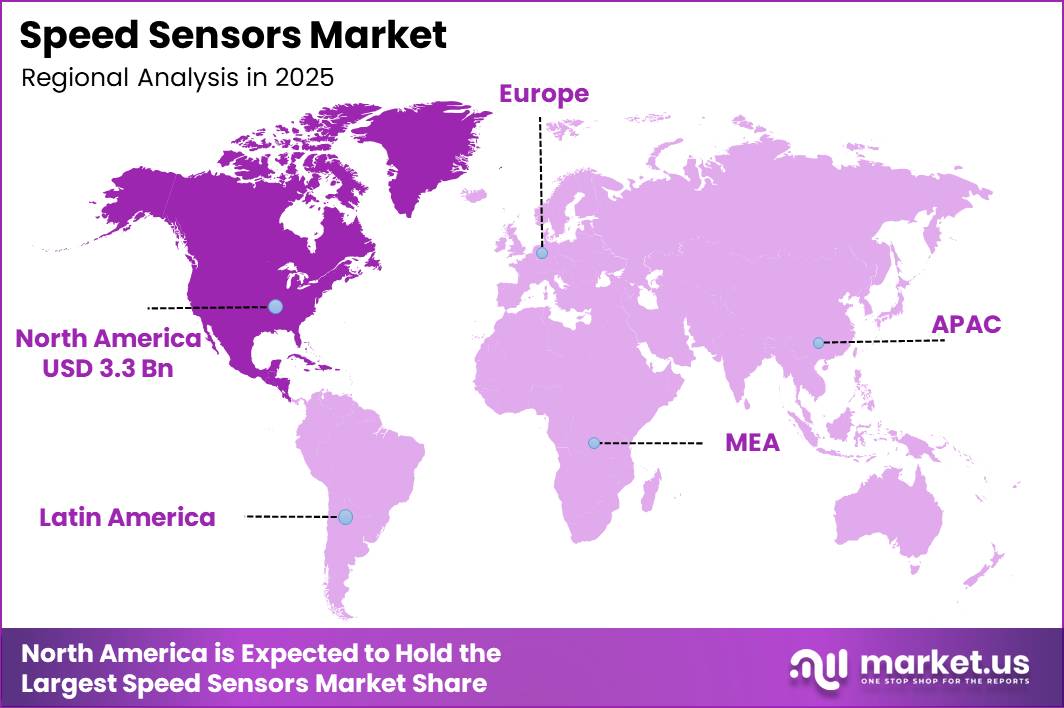
In 2025, the Global Speed Sensors Market was valued at USD 10.6 billion. The market is projected to grow at a CAGR of 4.4% during 2026–2035, reaching approximately USD 16.3 billion by 2035. North America dominated the global market in 2025, accounting for more than 31.4% of the total market share and generating approximately USD 3.3 billion in revenue.
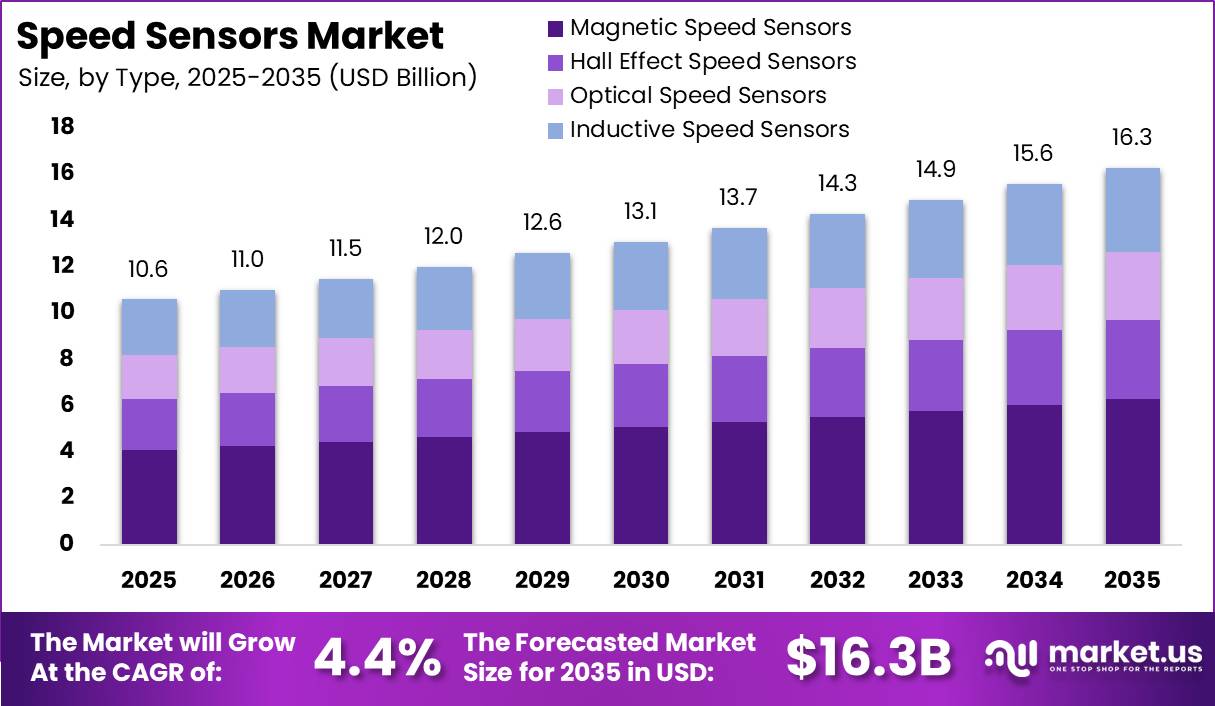
This growth is supported by rising automotive production, vehicle electrification, advanced safety systems, and stricter regulations. According to OICA, global vehicle production reached around 96.4 million units in 2025, increasing 3.9% from 92.7 million units in 2024. Global vehicle sales also rose 4.7% to nearly 99.8 million units.
Modern vehicles use several speed sensors across engines, transmissions, anti-lock braking systems, electronic stability control, ADAS, and electric drive systems. Therefore, higher vehicle production directly increases sensor demand. Asia represented more than 61% of global vehicle output in 2025, with China producing 34.5 million vehicles, up 10.4%, and India producing 6.4 million vehicles.
North America accounted for the largest share of market revenue, making it the leading regional market. The region benefits from high sensor use per vehicle and strict safety and emission standards. ABS and electronic stability control are standard in almost all new light vehicles and depend on accurate wheel and shaft speed measurements.
ACEA reported that global car production reached 78.7 million units in 2025, supported by investment in electric powertrains and ADAS. With approximately 80–100 million vehicles produced annually and around 10–20 speed sensors used in each modern car, the installed base could increase by more than 1 billion sensor units over a decade.
Key Takeaway
- The Speed Sensors Market was valued at USD 10.6 billion in 2025, projected to reach USD 16.3 billion by 2035 at a 4.4% CAGR.
- Magnetic speed sensors held the leading 38.7% type-segment share in 2025.
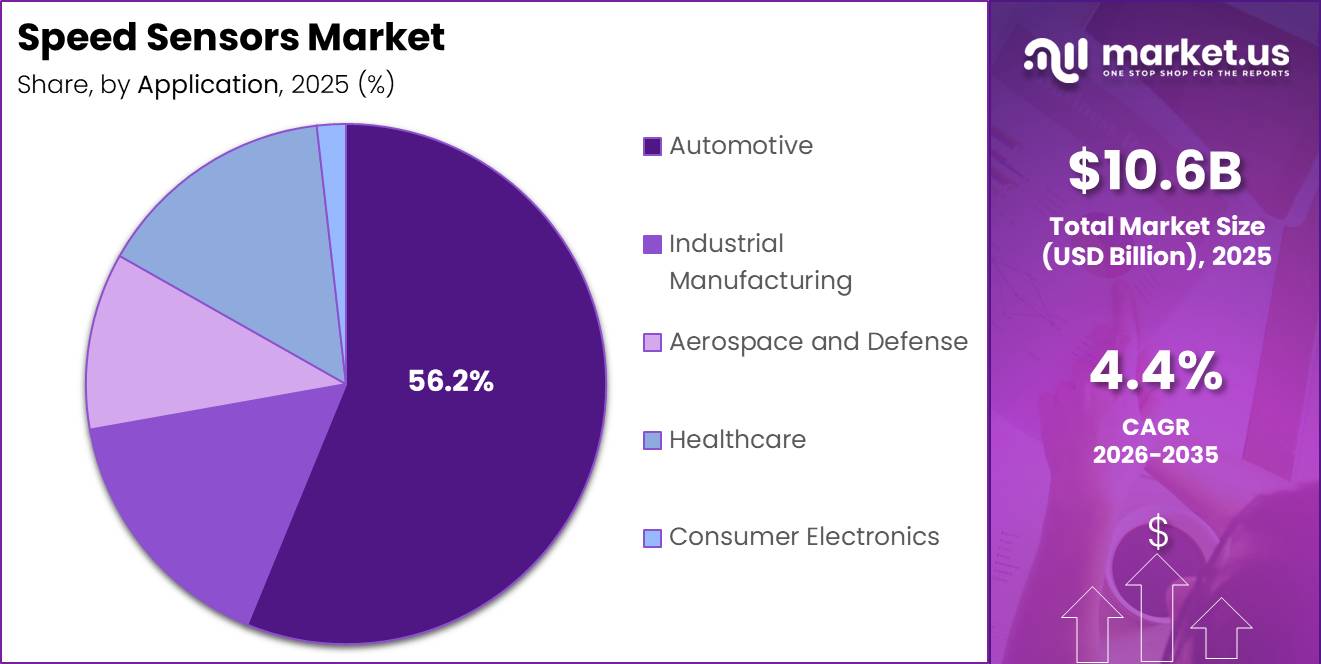
- The automotive application segment held a dominant 56.2% share of the market in 2025.
- North America led the market in 2025 with a 31.4% share and USD 3.3 billion in revenue.
By Type
Magnetic speed sensors held the leading 38.7% market share in 2025, supported by their reliable, contact-free operation, durability, and cost efficiency. These sensors are widely used in automotive and industrial systems because they can perform accurately in environments exposed to dust, oil, vibration, and high temperatures.
According to ACEA, global car production reached 78.7 million units in 2025, with Asia accounting for 62.1% of total output. North America and Europe together contributed more than 32% of global production. A significant portion of these vehicles use magnetic sensors to measure wheel, crankshaft, engine, and transmission speeds, as they connect easily with electronic control units and vehicle safety systems.
Demand is also increasing with the expansion of electric mobility. China produced more than 16 million new-energy vehicles, creating additional requirements for rotor, motor, and electric drivetrain speed monitoring.
By Application
The Automotive segment held a dominant 56.2% share of the speed sensors market in 2025, supported by high vehicle production and the growing number of sensors used in modern vehicles. Asia-Pacific produced approximately 59.2 million vehicles, representing more than 61% of global automotive output. Europe and the Americas together contributed around 35.9 million vehicles, based on data from OICA and regional automotive associations.
Every passenger car and commercial vehicle uses several speed sensors for wheel-speed measurement, engine control, transmission management, anti-lock braking systems, electronic stability control, and electric drive units. These sensors continuously provide rotational speed data to electronic control units, helping vehicles manage braking pressure, traction, gear changes, and power delivery.
Key Market Segments
By Type
- Magnetic Speed Sensors
- Hall Effect Speed Sensors
- Optical Speed Sensors
- Inductive Speed Sensors
By Application
- Automotive
- Industrial Manufacturing
- Aerospace and Defense
- Healthcare
- Consumer Electronics
Geopolitical Impact Analysis
Geopolitical risks have become an important cost factor for speed sensor manufacturers, as trade restrictions and shipping disruptions affect vehicles, electronic components, metals, and magnets used in sensor production. WTO tariff data indicate that the United States introduced a 25% import duty on vehicles from most trading partners in April 2025 and later applied a similar 25% tariff to a broad range of automotive components.
World Bank and UNCTAD tariff profiles show that the global weighted-average applied tariff across all products is around 4–5%. However, transport equipment and selected electronic products in several major economies face duties nearly three times higher than the national average. In some markets, maximum most-favoured-nation tariffs on transport equipment exceed 20%.
Shipping disruptions have created additional pressure. According to the WTO’s Global Trade Outlook, vessels redirected from the Red Sea through the Cape of Good Hope travel more than 55% farther on Asia–Europe routes. This diversion can add approximately 6–25 days to delivery schedules, with an average increase of nearly 17 days. During the disruption, Asian transport exports declined 25%, while China’s transport exports fell 40% year-on-year.
For speed sensor manufacturers relying on Asian semiconductor wafers, printed circuit boards, and magnets, 25% tariffs, double-digit component duties, and up to 17 additional transit days increase manufacturing, freight, and inventory costs. These pressures are encouraging regional production and creating stronger demand for locally manufactured speed sensors.
Regional Analysis
North America held the leading position in the global speed sensors market, accounting for 31.4% of total revenue and generating approximately USD 3.3 billion in 2025. The region benefits from high vehicle ownership, strict automotive safety regulations, and the widespread use of electronic control systems in passenger and commercial vehicles.
These systems require several wheel, engine, and transmission speed sensors, creating strong demand from both original equipment manufacturers and the replacement market. The United States remains the main regional contributor, with more than 15 million passenger vehicles sold annually and near-universal use of speed sensors in braking and drivetrain systems.
Asia Pacific is the fastest-growing regional market, supported by its large automotive manufacturing base and rapid adoption of electric and sensor-based vehicles. The region represents over 60% of global vehicle production and accounts for approximately 40–45% of advanced braking and wheel-speed sensor installations in selected product categories.
Key Regions and Countries
North America
- US
- Canada
Europe
- Germany
- France
- The UK
- Spain
- Italy
- Rest of Europe
Asia Pacific
- China
- Japan
- South Korea
- India
- Australia
- Rest of APAC
Latin America
- Brazil
- Mexico
- Rest of Latin America
Middle East & Africa
- GCC
- South Africa
- Rest of MEA
Market Dynamics
Drivers
| Driver | (~) % Impact on CAGR Forecast | Geographic Relevance | Impact Timeline |
|---|---|---|---|
| Mandatory vehicle safety systems | +2.0% | Global | Short term (≤ 2 years) |
| Electrification of vehicle fleets | +1.2% | North America, Europe, Asia Pacific | Medium term (2–4 years) |
| Industrial automation & motion control | +0.8% | Europe, Asia Pacific | Medium term (2–4 years) |
| Telematics & fleet monitoring adoption | +0.5% | North America, Latin America | Short term (≤ 2 years) |
| Rail & off-highway modernization | +0.4% | Asia Pacific, Middle East | Long term (> 4 years) |
Mandatory vehicle safety systems
Mandatory ABS and electronic stability control fitment is a major driver of speed sensor demand because these systems require accurate wheel and shaft speed data. More than 140 countries mandate ABS or similar braking technologies on new passenger vehicles, while UN vehicle regulations require multiple wheel-speed sensing points for ESC compliance.
Global road vehicle production exceeds 90 million units annually, and each light vehicle typically uses at least 4–6 wheel-speed sensors, with higher numbers in commercial vehicles. More than 95% of new cars in the EU include ESC and advanced braking electronics. This regulation-led demand supports standardized sensor platforms and long-term supply contracts, adding around 2.0% to the market’s baseline CAGR.
Restraints
| Restraint | (~) % Impact on CAGR Forecast | Geographic Relevance | Impact Timeline |
|---|---|---|---|
| High manufacturing cost for precision sensors | -1.5% | Global | Medium term (2–4 years) |
| Tariffs on vehicles & components | -0.9% | North America, Europe, Asia Pacific | Short term (≤ 2 years) |
| Capital expenditure tightening in OEMs | -0.7% | Global | Medium term (2–4 years) |
| Regulatory delays for new sensor types | -0.5% | Europe, North America | Long term (> 4 years) |
| Exposure to cyclical automotive demand | -0.4% | Global | Short term (≤ 2 years) |
High manufacturing cost for precision sensors
High manufacturing costs remain a major restraint for precision speed sensors, as they reduce supplier margins and slow the adoption of advanced designs. Semiconductor processing and packaging represent more than 60% of the cost of complex automotive-grade ICs.
Industrial electricity prices in several manufacturing economies have also increased by around 15–20% from pre-crisis levels, raising wafer fabrication, packaging, and testing expenses. Automotive and industrial sensor gross margins generally range from 35% to 45%, leaving limited scope to absorb higher compliance, traceability, and functional safety costs.
Rising borrowing costs since 2022 have also made investments in cleanrooms and automated production lines more expensive. Combined with strict qualification requirements under ISO 26262, these pressures delay the rollout of next-generation sensors. Some OEMs continue using older, lower-cost designs, creating an estimated 1.5% drag on the market’s attainable CAGR.
Challenges
| Challenge | (~) % CAGR Friction Drag | Geographic Relevance | Mitigation Horizon |
|---|---|---|---|
| Sensor integration complexity | -1.3% | Global | Medium term (2–4 years) |
| Harsh operating environments | -0.8% | Global | Long term (> 4 years) |
| Signal interference in dense electronics | -0.7% | North America, Europe | Medium term (2–4 years) |
| Skilled engineering talent gaps | -0.6% | Asia Pacific, Europe | Long term (> 4 years) |
| Extended qualification cycles | -0.5% | Global | Medium term (2–4 years) |
Sensor integration complexity
Sensor integration complexity remains a major market challenge, as modern vehicles and industrial systems require several speed sensors to operate within connected electronic architectures. New vehicles often contain more than 70 electronic control units and dozens of sensor nodes, making sensor placement, wiring, calibration, and electromagnetic compatibility more difficult.
Meeting functional safety requirements for drivetrain and chassis speed signals can extend development cycles by 12–24 months and raise validation spending by double-digit percentages. More than 50% of automotive and industrial OEMs identify sensor integration and calibration as a top-three technical challenge. As a result, new speed-sensing platforms must be introduced gradually across vehicle model cycles and factory upgrades, reducing the market’s maximum attainable CAGR by around 1.3%.
Opportunities
| Opportunity | (~) % Potential CAGR Upside | Geographic Relevance | Execution Window |
|---|---|---|---|
| Condition-based maintenance analytics | +1.6% | Global | Medium term (2–4 years) |
| Aftermarket sensor retrofits | +1.1% | North America, Europe | Short term (≤ 2 years) |
| Emerging markets vehicle safety upgrades | +1.0% | Asia Pacific, Latin America, Africa | Long term (> 4 years) |
| Non-automotive rotational monitoring | +0.7% | Global | Medium term (2–4 years) |
| Integrated sensor-service platforms | +0.6% | North America, Europe | Medium term (2–4 years) |
Condition-based maintenance analytics
Condition-based maintenance analytics using speed sensor data creates a strong growth opportunity by turning existing hardware into recurring software and service revenue. Rotating equipment, including motors, pumps, and compressors, accounts for more than 40% of manufacturing electricity use, while unexpected failures can reduce asset availability by 5–10 percentage points.
Predictive maintenance platforms using real-time speed data can lower unplanned downtime by 20–30% and extend equipment life. Service and software operations can also deliver margins 10–15 percentage points higher than hardware-only sales. However, fewer than 25% of mid-sized plants have fully integrated online monitoring for critical rotating equipment.
By offering standardized gateways, edge analytics, and subscription services, speed sensor suppliers can monetize installed sensor data and generate about 1.6% of additional CAGR growth through long-term, data-based service contracts.
Key Players Analysis
Tier-1 companies in the speed sensors market are large automotive and electronics suppliers with multi-billion-dollar sensing and motion-control businesses. Analog Devices generated approximately USD 11.7 billion in revenue in 2025, including USD 3.2 billion, or 29.8%, from automotive and USD 4.9 billion, or 44.7%, from industrial operations.
Continental reported sales guidance of EUR 38–41 billion and has supplied more than 277 million sensors and ECUs for assisted and automated driving, along with over 1 billion body control units. BorgWarner recorded USD 14.3 billion in net sales, including USD 2.6 billion, or 18%, from eProducts and USD 11.7 billion, or 82%, from combustion-related products. Major Tier-1 suppliers generally invest mid-single-digit to low-double-digit shares of revenue in R&D, equal to around USD 0.8–1.5 billion annually.
Tier-2 participants include Denso, Bosch, Infineon, Honeywell, Omron, Sensata Technologies, General Electric, and Ford. These companies usually hold low-single-digit market shares, while specialist and regional suppliers together account for approximately 20–30% of global revenue. Infineon operates within a group generating more than EUR 16 billion annually, while Bosch operates within a group with about EUR 91 billion in revenue.
Sensata generates nearly USD 4 billion annually and is estimated to invest 8–9%, or USD 320–360 million, in R&D. Overall, leading Tier-1 suppliers are estimated to control around 40–50% of the global speed sensors market.
Top Key Players in the Market
- Analog Devices Inc.
- BorgWarner Inc.
- Continental AG
- Denso Corporation
- Ford Corporation
- General Electric
- Honeywell Technology Solutions
- Infineon Technologies AG
- Omron
- Robert Bosch GmbH
- Sensata Technologies Inc.
- Other
Recent Developments
- In 2026, Infineon Technologies AG completed the acquisition of ams OSRAM’s non-optical analog and mixed-signal sensor portfolio on July 1. The transaction was valued at EUR 570 million on a debt-free and cash-free basis.
- The acquired business is expected to generate around EUR 230 million in 2026 revenue, while approximately 230 employees joined Infineon. The acquisition strengthens Infineon’s automotive and industrial sensor portfolio, including technologies used for position and motion monitoring.
- In 2026, Amphenol Corporation completed its USD 10.5 billion acquisition of CommScope’s Connectivity and Cable Solutions business on January 12. The transaction added approximately 20,000 employees and is expected to contribute nearly USD 4.1 billion in 2026 sales.
Report Scope
| Report Features | Description |
|---|---|
| Market Value (2025) | USD 10.6 Billion |
| Forecast Revenue (2035) | USD 16.3 Billion |
| CAGR (2026-2035) | 4.4% |
| Base Year for Estimation | 2025 |
| Historic Period | 2020-2024 |
| Forecast Period | 2026-2035 |
| Report Coverage | Revenue Forecast, Market Dynamics, Competitive Landscape, Recent Developments |
| Segments Covered | By Type – (Magnetic Speed Sensors, Hall Effect Speed Sensors, Optical Speed Sensors, Inductive Speed Sensors); By Application – (Automotive, Industrial Manufacturing, Aerospace and Defense, Healthcare, Consumer Electronics) |
| Regional Analysis | North America – US, Canada; Europe – Germany, France, The UK, Spain, Italy, Rest of Europe; Asia Pacific – China, Japan, South Korea, India, Australia, Singapore, Rest of APAC; Latin America – Brazil, Mexico, Rest of Latin America; Middle East & Africa – GCC, South Africa, Rest of MEA |
| Competitive Landscape | Analog Devices Inc., BorgWarner Inc., Continental AG, Denso Corporation, Ford Corporation, General Electric, Honeywell Technology Solutions, Infineon Technologies AG, Omron, Robert Bosch GmbH, Sensata Technologies Inc., Other |
| Customization Scope | Customization for segments, region/country-level will be provided. Moreover, additional customization can be done based on the requirements. |
| Purchase Options | We have three licenses to opt for: Single User License, Multi-User License (Up to 5 Users), Corporate Use License (Unlimited Users and Printable PDF) |





































