


Global Vertical Milling Machine Market Size, Share, Growth Analysis, Product Type (Gantry/Bridge-Type VMC, Turret VMC, Bed-Type VMC, Knee-Type VMC, Others), Automation Level (CNC Vertical Milling Machines, Conventional/Manual Vertical Milling Machines), Axis Configuration (3-Axis, 4-Axis, 5-Axis & Above), End-User Industry (Automotive, General Machinery, Precision Engineering, Transport Machinery, Others), Region and Companies - Industry Segment Outlook, Market Assessment, Competition Scenario, Statistics, Trends and Forecast 2026-2035
- Published date: Feb 2026
- Report ID: 178897
- Number of Pages: 359
- Format:
-
keyboard_arrow_up
Quick Navigation
Market Overview
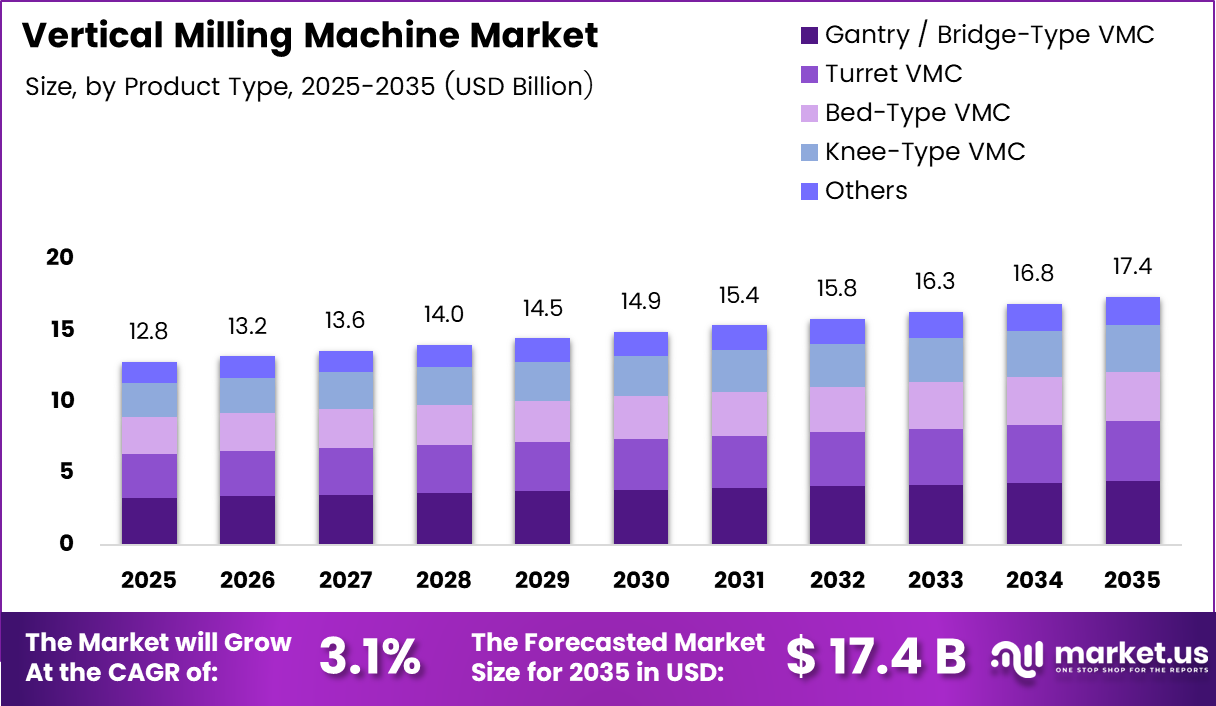
Global Vertical Milling Machine Market size is expected to be worth around USD 17.4 Billion by 2035 from USD 12.8 Billion in 2025, growing at a CAGR of 3.1% during the forecast period 2026 to 2035.
The vertical milling machine market refers to the global industry covering machines where the spindle axis is oriented vertically. These machines are widely used for cutting, drilling, and shaping metal and other materials. They serve as essential tools in precision manufacturing across multiple industrial sectors.
Vertical milling machines are a core component of modern machining operations. They support a broad range of applications, from simple flat surface milling to complex multi-axis component production. Consequently, demand remains steady across both large-scale manufacturers and small job shops worldwide.
The market is experiencing consistent growth driven by rising adoption of CNC automation in precision metalworking. Expanding manufacturing infrastructure in developing economies is further adding to market momentum. Additionally, the automotive and aerospace sectors continue to generate strong demand for high-accuracy milling equipment.
Government investments in industrial modernization are playing a key role in market expansion. Several national manufacturing programs, particularly in Asia and Europe, are encouraging upgrades to advanced CNC-based production systems. Moreover, policies supporting domestic manufacturing are accelerating procurement of vertical milling equipment.
Integration of Industry 4.0 technologies is reshaping the competitive landscape. Manufacturers are increasingly adopting IoT-enabled machine monitoring and digital twin simulation tools. Therefore, the market is evolving beyond traditional machining into smart, connected factory environments that improve efficiency and reduce downtime.
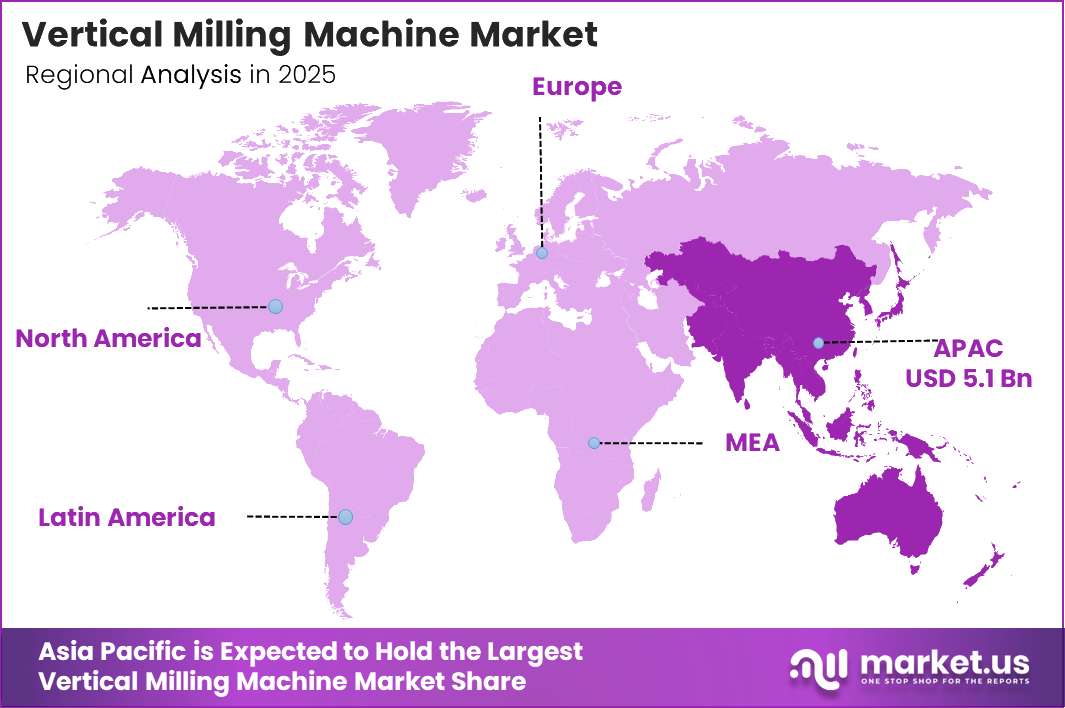
According to industry estimates, Asia Pacific holds approximately 40.1% of the global vertical milling machine market, valued at around USD 5.1 Billion. The region’s strong base in automotive, electronics, and precision engineering manufacturing supports this dominant position. Furthermore, continued infrastructure investment in China, India, and Southeast Asia ensures sustained regional growth through the forecast period.
Key Takeaways
- The global Vertical Milling Machine Market was valued at USD 12.8 Billion in 2025.
- The market is projected to grow at a CAGR of 3.1% during the forecast period 2026 to 2035.
- By Product Type, Gantry/Bridge-Type VMC holds the leading share of 25.8%.
- By Automation Level, CNC Vertical Milling Machines dominate with a 68.8% market share.
- By Axis Configuration, the 3-Axis segment leads with a share of 45.3%.
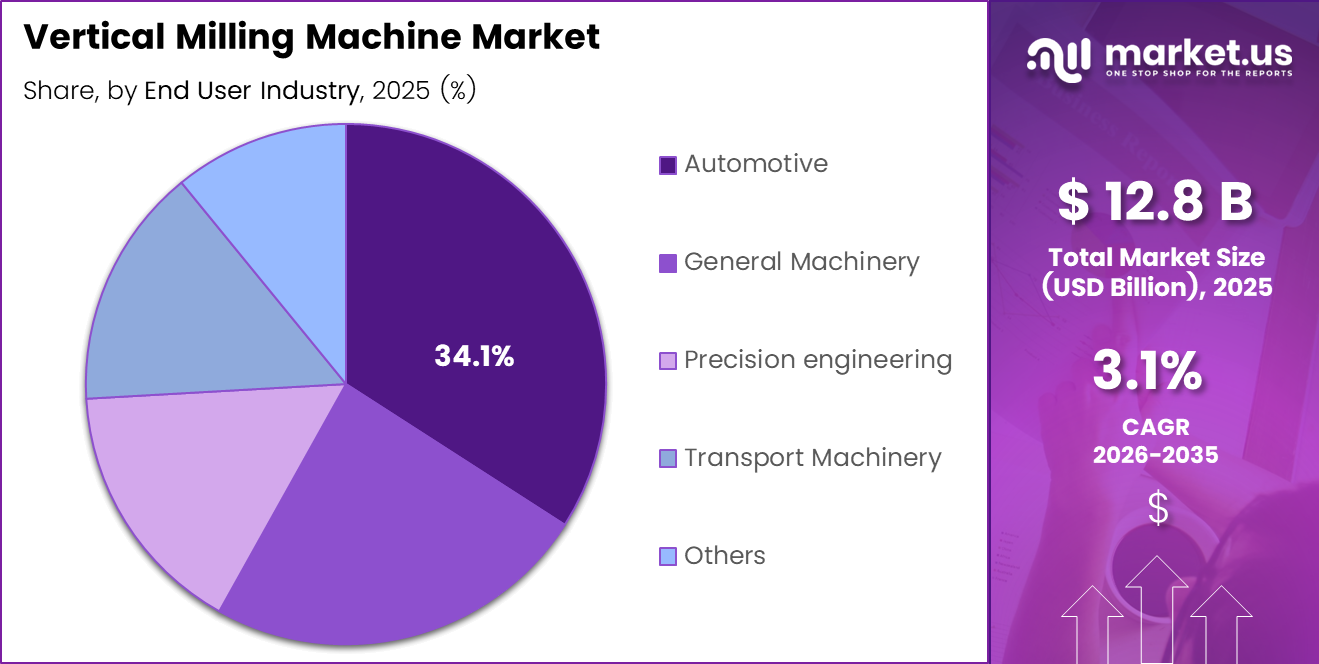
- By End-User Industry, the Automotive segment holds the top position with 34.1% share.
- Asia Pacific dominates the global market with a 40.1% share, valued at USD 5.1 Billion.
Product Type Analysis
Gantry/Bridge-Type VMC dominates with 25.8% due to its suitability for large and heavy workpiece machining.
In 2025, Gantry/Bridge-Type VMC held a dominant market position in the Product Type segment of the Vertical Milling Machine Market, with a 25.8% share. These machines are preferred for large-scale precision machining tasks. Their rigid structure supports high-load applications in aerospace and heavy equipment manufacturing. Consequently, adoption remains strong among large industrial manufacturers globally.
Turret VMC is widely used in general-purpose machining environments. These machines offer flexibility and cost-effectiveness for medium-volume production runs. Moreover, their compact design makes them suitable for job shops and small manufacturers seeking versatile milling solutions without significant capital investment.
Bed-Type VMC machines are preferred for heavy-duty applications that demand structural stability. They support larger workpieces and deliver high rigidity during cutting operations. Therefore, they are commonly found in automotive and industrial machinery production facilities requiring consistent, high-precision output.
Knee-Type VMC machines have long served traditional machining needs, particularly in toolrooms, workshops, and educational institutions where manual control and operator skill remain valued. They offer simplicity, ease of use, and lower cost compared to advanced CNC alternatives. Consequently, they continue to hold relevance in environments where flexibility and hands-on machining are prioritized over high-volume automation.
The Others category encompasses specialized vertical milling machine configurations designed to address niche and application-specific machining requirements. These include custom-built or hybrid machine designs used across sectors such as defense, research, and specialty fabrication. Moreover, as end-use industries diversify, demand for non-standard milling configurations within this category is gradually expanding across various industrial end-use applications globally.
Automation Level Analysis
CNC Vertical Milling Machines dominate with 68.8% due to high demand for automated precision machining.
In 2025, CNC Vertical Milling Machines held a dominant market position in the Automation Level segment of the Vertical Milling Machine Market, with a 68.8% share. CNC systems offer unmatched precision, repeatability, and production speed. Consequently, manufacturers across automotive, aerospace, and electronics sectors have rapidly replaced CNC Machine with manual alternatives to improve output quality.
Conventional/Manual Vertical Milling Machines continue to serve specific applications where automation is not required. These machines are preferred in toolrooms, educational settings, and low-volume custom jobs. However, their overall market share is declining as more facilities transition to CNC platforms to meet growing demands for accuracy and efficiency.
Axis Configuration Analysis
3-Axis machines dominate with 45.3% due to widespread use in standard milling operations.
In 2025, 3-Axis held a dominant market position in the Axis Configuration segment of the Vertical Milling Machine Market, with a 45.3% share. These machines are the most commonly deployed configuration globally. They offer a reliable balance between cost and capability, making them suitable for a wide range of standard machining tasks across general manufacturing industries.
4-Axis machines add rotational movement to standard 3-axis capability, enabling more complex part geometries. They are increasingly adopted in automotive and precision engineering sectors. Moreover, they provide improved efficiency for components requiring machining on multiple faces without manual repositioning during production runs.
5-Axis and Above machines represent the high-end segment, supporting complex contoured parts and simultaneous multi-surface machining. These are widely adopted in aerospace, medical device, and mold manufacturing. Additionally, growing demand for intricate component designs is accelerating the adoption of 5-axis systems in advanced manufacturing environments.
End-User Industry Analysis
Automotive dominates with 34.1% due to high-volume precision component manufacturing requirements.
In 2025, Automotive held a dominant market position in the End-User Industry segment of the Vertical Milling Machine Market, with a 34.1% share. The automotive sector requires continuous high-precision machining of engine parts, transmission components, and structural elements. Consequently, vertical milling machines remain critical assets across both OEM and Tier-1 automotive supplier facilities worldwide.
General Machinery is the second major end-user segment, using vertical milling machines for producing industrial components and equipment parts. These applications demand reliable, repeatable machining over extended production cycles. Moreover, growth in industrial equipment manufacturing in emerging markets is supporting steady demand from this segment.
Precision Engineering requires high-accuracy milling capabilities for tight-tolerance parts used in instruments, optics, and specialty hardware. This segment values advanced CNC multi-axis systems. Therefore, it is a key demand driver for higher-end vertical milling machine configurations, particularly 5-axis and above models in developed markets.
Transport Machinery covers applications including rail, marine, and energy equipment manufacturing. This segment requires large-format and heavy-duty vertical milling machines capable of handling oversized and complex components. Moreover, growing investments in rail infrastructure and shipbuilding across Asia and Europe are steadily increasing demand for high-capacity milling solutions.
The Others category encompasses a broad range of end-use applications beyond the primary industry segments. These include defense equipment, construction machinery, and specialty industrial components that require precise and reliable machining. Consequently, this segment contributes consistent demand for both standard and customized vertical milling machine configurations globally.
Key Market Segments
By Product Type
- Gantry / Bridge-Type VMC
- Turret VMC
- Bed-Type VMC
- Knee-Type VMC
- Others
By Automation Level
- CNC Vertical Milling Machines
- Conventional / Manual Vertical Milling Machines
By Axis Configuration
- 3-Axis
- 4-Axis
- 5-Axis & Above
By End-User Industry
- Automotive
- General Machinery
- Precision Engineering
- Transport Machinery
- Others
Drivers
Rising CNC Adoption and Expanding Industrial Demand Drive Vertical Milling Machine Market Growth
The rising adoption of CNC automation in precision metalworking is a primary driver for the vertical milling machine market. Manufacturers across sectors are replacing manual equipment with CNC systems to meet tighter tolerances and higher output requirements. Moreover, automotive and aerospace component production continues to generate strong, consistent demand for advanced milling solutions.
The increasing need for high-accuracy machining in tool and die production is further accelerating market growth. Toolmakers and mold manufacturers require machines capable of delivering micron-level precision consistently. Consequently, vertical CNC milling machines have become standard equipment in these specialized manufacturing environments globally.
Growth of industrial manufacturing infrastructure in emerging economies is also contributing significantly to market expansion. Countries across Southeast Asia, South Asia, and Latin America are investing in domestic production capabilities. Therefore, demand for reliable and cost-effective vertical milling machines continues to rise in these high-growth manufacturing regions.
Restraints
High Capital Costs and Skilled Labor Shortages Limit Broader Market Adoption
High initial capital investment and installation costs remain a significant restraint for the vertical milling machine market. Small and medium-sized manufacturers often face budget constraints when upgrading to advanced CNC systems. Consequently, many facilities in developing regions continue to rely on older, less efficient equipment rather than adopting modern vertical milling technology.
The requirement for skilled operators and advanced technical expertise presents another key challenge. CNC vertical milling machines demand trained professionals for programming, setup, and maintenance. Moreover, the global shortage of qualified machinists and CNC operators is slowing adoption in markets where technical training infrastructure remains underdeveloped.
Together, these factors create barriers particularly for smaller manufacturers and job shops. The combined burden of acquisition cost and workforce development investment can delay purchasing decisions. Therefore, market growth in cost-sensitive regions is more gradual compared to industrially advanced economies with established technical skill bases.
Growth Factors
Industry 4.0 Integration and Expanding Application Areas Accelerate Market Expansion
The integration of Industry 4.0 and smart factory capabilities is one of the most impactful growth factors for the vertical milling machine market. Connected machines, real-time monitoring, and automated production workflows are improving efficiency. Moreover, manufacturers are increasingly investing in smart machining systems to remain competitive in global supply chains.
Increasing use of vertical milling machines in medical device and electronics component fabrication is opening new growth avenues. These industries require precise, repeatable machining of complex small parts. Consequently, demand for high-precision, multi-axis CNC vertical milling machines is growing steadily within both the medical and electronics manufacturing sectors.
Expansion of contract manufacturing and job shops globally is also contributing to market growth. Additionally, demand from renewable energy equipment manufacturing, including wind turbine and solar infrastructure components, is creating new end-use opportunities. Therefore, the market is benefiting from diversification beyond traditional automotive and general machinery applications.
Emerging Trends
Multi-Axis Machining, IoT Integration, and Energy Efficiency Define the Next Phase of Market Evolution
A rapid shift toward multi-axis CNC vertical milling machines is among the most prominent trends in the market. Manufacturers increasingly require machines capable of producing complex components in fewer setups. Moreover, 5-axis and above systems are gaining traction across aerospace, automotive, and precision engineering as component designs grow more sophisticated.
Adoption of IoT-enabled predictive maintenance systems is transforming how manufacturers manage machine health and uptime. Real-time data from sensors allows early detection of wear and failure. Consequently, unplanned downtime is reduced significantly, improving overall equipment effectiveness and lowering long-term operational costs for milling machine users.
Growing preference for energy-efficient and compact machine designs reflects both cost pressures and sustainability goals. Additionally, increasing use of advanced software for simulation and digital twin machining is improving production planning accuracy. Therefore, manufacturers are investing in software-hardware integrated solutions that enhance output quality while minimizing waste and energy consumption.
Regional Analysis
Asia Pacific Dominates the Vertical Milling Machine Market with a Market Share of 40.1%, Valued at USD 5.1 Billion
Asia Pacific leads the global vertical milling machine market with a share of 40.1%, valued at USD 5.1 Billion in 2025. The region’s dominance is driven by large-scale manufacturing activity in China, Japan, South Korea, and India. Moreover, strong government support for industrial automation and domestic manufacturing investment continues to reinforce Asia Pacific’s leading market position.
North America Vertical Milling Machine Market Trends
North America represents a mature and technologically advanced market for vertical milling machines. The United States remains the primary contributor, with strong demand from aerospace, defense, and automotive sectors. Additionally, the growing adoption of smart manufacturing and reshoring of industrial production is sustaining steady demand for high-performance CNC milling systems.
Europe Vertical Milling Machine Market Trends
Europe holds a significant share of the global vertical milling machine market, supported by Germany, Italy, and France as key manufacturing hubs. The region benefits from a strong precision engineering and automotive supplier base. Furthermore, investments in digitalized manufacturing under European industrial policy frameworks are encouraging upgrades to advanced milling technology.
Latin America Vertical Milling Machine Market Trends
Latin America presents moderate growth potential, with Brazil and Mexico as the leading markets. Expansion of automotive assembly and general industrial manufacturing is generating demand for milling equipment. However, economic uncertainty and limited access to financing continue to slow the pace of technology adoption in the region’s smaller manufacturing facilities.
Middle East and Africa Vertical Milling Machine Market Trends
The Middle East and Africa market is at an early stage of development but shows promising long-term potential. Industrial diversification initiatives, particularly in the GCC countries, are driving investments in manufacturing infrastructure. Consequently, demand for vertical milling machines is gradually increasing as these economies work to reduce dependence on oil-based revenue streams.
Key Regions and Countries
North America
- US
- Canada
Europe
- Germany
- France
- The UK
- Spain
- Italy
- Rest of Europe
Asia Pacific
- China
- Japan
- South Korea
- India
- Australia
- Rest of APAC
Latin America
- Brazil
- Mexico
- Rest of Latin America
Middle East & Africa
- GCC
- South Africa
- Rest of MEA
Key Company Insights
Haas Automation is one of the largest machine tool manufacturers in the United States and holds a significant share of the global vertical milling machine market. The company is known for delivering reliable, cost-effective CNC vertical machining centers suited to a wide range of industrial applications. Its broad product lineup and strong dealer network support its global market reach.
DMG MORI is a globally recognized leader in precision machining tool manufacturing, offering a comprehensive portfolio of vertical milling machines. Its range spans entry-level 3-axis systems through to high-performance 5-axis simultaneous machining solutions. The company focuses on innovation, integrating digital manufacturing capabilities and advanced spindle technologies into its product lines to meet diverse industrial requirements.
Yamazaki Mazak is a leading Japanese manufacturer with a strong international presence in the vertical milling machine segment. The company emphasizes multi-tasking and multi-axis machining technology, enabling manufacturers to reduce setups and improve throughput. Moreover, Mazak’s investment in smart factory solutions and automation integration positions it well for evolving market demands.
Okuma Corporation is a well-established Japanese machine tool manufacturer recognized for its advanced CNC technology and thermal stability engineering. The company produces a wide range of vertical machining centers targeting aerospace, automotive, and precision engineering applications. Additionally, Okuma’s proprietary OSP control system enhances operational intelligence and supports predictive maintenance across its machine tool platforms.
Key Players
- Haas Automation
- DMG MORI
- Yamazaki Mazak
- Okuma Corporation
- Makino Milling Machine
- Hurco Companies
- DN Solutions (Doosan)
- FANUC Corporation
- Siemens AG
- GF Machining Solutions
- Fives Group
- JTEKT Corporation
- EMAG GmbH
- Brother Industries
- HELLER Group
- Other Key Players
Recent Developments
- September 2025 – Fives Group announced the acquisition of Pietro Carnaghi S.p.A., a leading manufacturer of machine tools specializing in large-scale machining solutions. This strategic move further strengthens Fives’ leadership position in the global machine tool sector and expands its portfolio of heavy-duty vertical milling capabilities.
- July 2024 – Grenville Engineering, a high-quality metal fabrication provider based in Stoke-on-Trent, announced the installation of a new Hurco VM20i vertical machining center. This investment reflects the company’s ongoing commitment to upgrading its precision machining capabilities and improving production efficiency for its industrial customer base.
Report Scope
Report Features Description Market Value (2025) USD 12.8 Billion Forecast Revenue (2035) USD 17.4 Billion CAGR (2026-2035) 3.1% Base Year for Estimation 2025 Historic Period 2020-2024 Forecast Period 2026-2035 Report Coverage Revenue Forecast, Market Dynamics, Competitive Landscape, Recent Developments Segments Covered Product Type (Gantry/Bridge-Type VMC, Turret VMC, Bed-Type VMC, Knee-Type VMC, Others), Automation Level (CNC Vertical Milling Machines, Conventional/Manual Vertical Milling Machines), Axis Configuration (3-Axis, 4-Axis, 5-Axis & Above), End-User Industry (Automotive, General Machinery, Precision Engineering, Transport Machinery, Others) Regional Analysis North America (US and Canada), Europe (Germany, France, The UK, Spain, Italy, and Rest of Europe), Asia Pacific (China, Japan, South Korea, India, Australia, and Rest of APAC), Latin America (Brazil, Mexico, and Rest of Latin America), Middle East & Africa (GCC, South Africa, and Rest of MEA) Competitive Landscape Haas Automation, DMG MORI, Yamazaki Mazak, Okuma Corporation, Makino Milling Machine, Hurco Companies, DN Solutions (Doosan), FANUC Corporation, Siemens AG, GF Machining Solutions, Fives Group, JTEKT Corporation, EMAG GmbH, Brother Industries, HELLER Group, Other Key Players Customization Scope Customization for segments, region/country-level will be provided. Moreover, additional customization can be done based on the requirements. Purchase Options We have three licenses to opt for: Single User License, Multi-User License (Up to 5 Users), Corporate Use License (Unlimited User and Printable PDF)  Vertical Milling Machine MarketPublished date: Feb 2026add_shopping_cartBuy Now get_appDownload Sample
 -
-
- Haas Automation
- DMG MORI
- Yamazaki Mazak
- Okuma Corporation
- Makino Milling Machine
- Hurco Companies
- DN Solutions (Doosan)
- FANUC Corporation
- Siemens AG
- GF Machining Solutions
- Fives Group
- JTEKT Corporation
- EMAG GmbH
- Brother Industries
- HELLER Group
- Other Key Players
Our Clients

- 178897
- Feb 2026






