


Global Vacuum Grease Market Size, Share and Report Analysis By Product (Silicone Based, Fluorocarbon Based, Hydrocarbon Based), By Application (Food Processing, Laboratory Equipment, Automotive/Aerospace, Pharmaceuticals, Others) , By Region and Companies - Industry Segment Outlook, Market Assessment, Competition Scenario, Trends and Forecast 2025-2034
- Published date: Feb 2026
- Report ID: 179665
- Number of Pages: 356
- Format:
-
keyboard_arrow_up
Quick Navigation
Report Overview
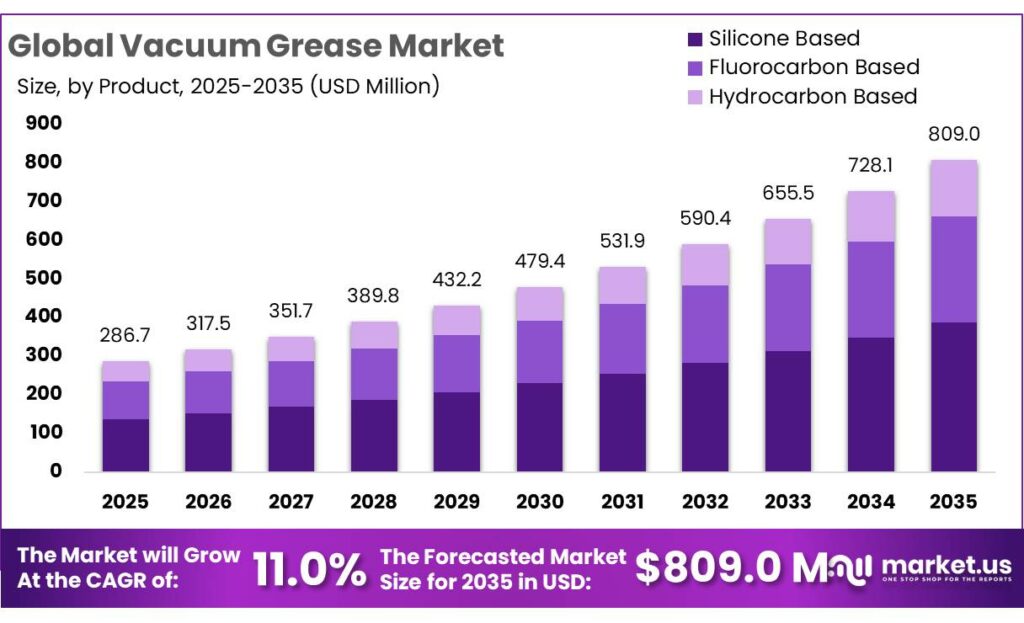
The Global Vacuum Grease Market is expected to be worth around USD 809.0 Million by 2035, up from USD 286.7 Million in 2025, at a CAGR of 11.0% from 2026 to 2035. The Asia Pacific segment maintained 42.7%, supporting a Vacuum Grease value of USD 122.4 Mn.
Vacuum grease is a specialised lubricant with very low vapour pressure, formulated to keep seals tight and equipment lubricated in high-vacuum and high-temperature conditions. Fluorinated products such as Apiezon PFPE 501, for example, operate up to about 250 °C and exhibit vapour pressure around 1.3 × 10⁻¹² Torr at 25 °C, while Apiezon L remains in the 10⁻¹¹ Torr range at 20 °C and still maintains useful performance near 300 °C.
The industrial context for vacuum grease is closely tied to the scale and complexity of the global food system. According to the Food and Agriculture Organization, the harvested area of major primary crops reached about 1.5 billion hectares in 2024, up roughly 197 million hectares from 2010, with oil-crop output alone rising 50 percent to around 1.2 billion tonnes over the same period. At the trade level, the FAO’s Food Outlook estimates the global food import bill in 2025 at about US$2.22 trillion, nearly 8 percent higher than in 2024, reflecting sustained flows of higher-value processed foods.
Several structural drivers support future demand. The OECD–FAO Agricultural Outlook projects that the share of calories in human diets supplied by livestock and fish products will rise by about 6 percent globally by 2034, pushing growth in chilled, frozen and ready-to-eat value chains that rely on vacuum packaging and leak-tight refrigeration components. Earlier projections by the same institutions suggest average per-capita food availability will increase about 4 percent to just over 3 025 kcal per day by 2030, reinforcing the need for more efficient processing and preservation capacity.
Public policy is also nudging processors toward modern equipment that typically incorporates vacuum-operated steps. India’s Pradhan Mantri Kisan SAMPADA Yojana is framed as a comprehensive programme to create modern, efficient food-processing infrastructure and supply chains, encouraging investment in contemporary plant and machinery.
- The Pradhan Mantri Formalisation of Micro Food Processing Enterprises scheme offers a 35 percent capital subsidy on project costs up to ₹10 lakh, seed capital of ₹40 000 per self-help-group member and 50 percent support for branding and marketing; Gujarat alone has onboarded 675 beneficiaries, signalling tangible uptake by small processors.
Key Takeaways
- Vacuum Grease Market is expected to be worth around USD 809.0 Million by 2035, up from USD 286.7 Million in 2025, at a CAGR of 11.0%.
- Silicone Based held a dominant market position, capturing more than a 48.3% share.
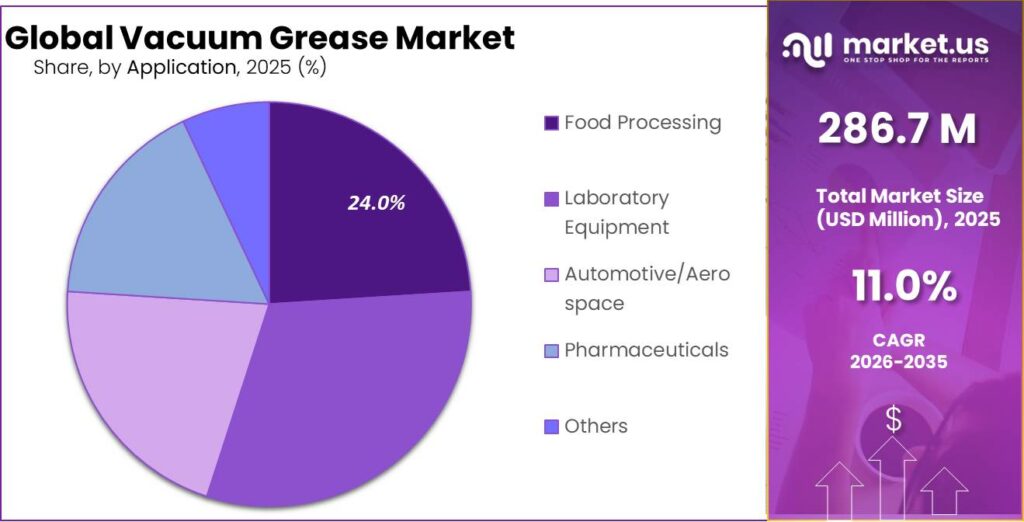
- Laboratory Equipment held a dominant market position, capturing more than a 31.6% share.
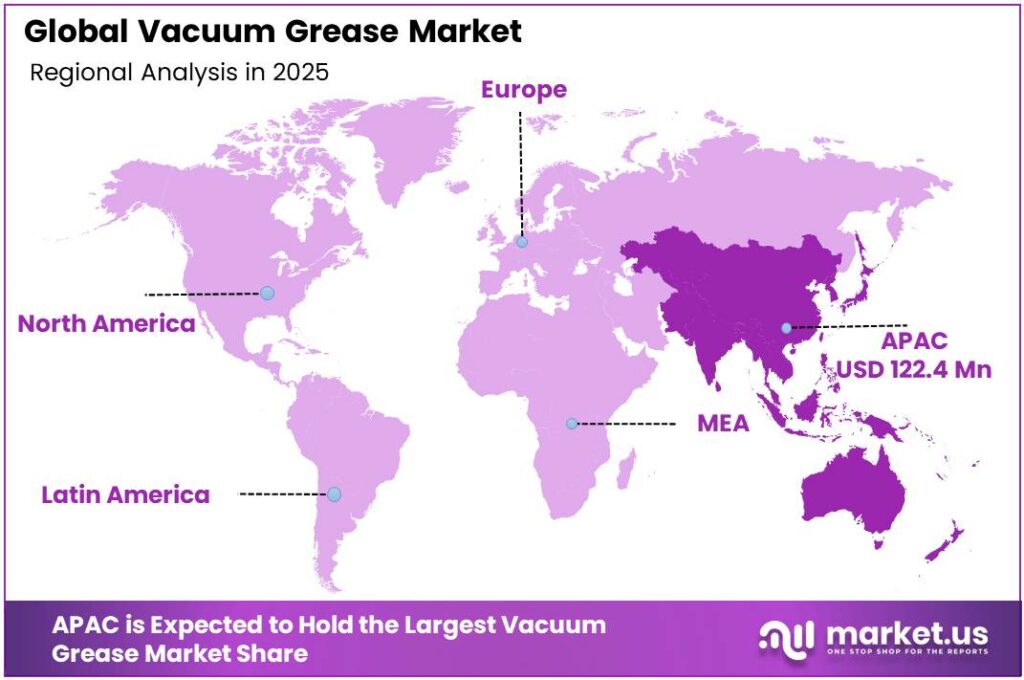
- Asia Pacific holds a decisive lead in the vacuum grease market, dominating with around 42.7% share and an estimated value of 122.4 Mn.
By Product Analysis
Silicone-Based Vacuum Grease leads with a strong 48.3% share in 2024
In 2024, Silicone Based held a dominant market position, capturing more than a 48.3% share, reflecting its strong acceptance across laboratories, electronics manufacturing units, and industrial vacuum systems. This category continues to stand out because of its clean composition, long-lasting stability, and safe interaction with rubber seals and gaskets.
Users across small and large facilities rely on it for routine sealing, system lubrication, and maintenance tasks that demand consistent low-vapour performance. Its ability to work smoothly across wide temperature ranges has played a big role in making silicone-based options the preferred choice for daily vacuum operations in both research and production settings.
By Application Analysis
Laboratory Equipment leads the market with a solid 31.6% share in 2024
In 2024, Laboratory Equipment held a dominant market position, capturing more than a 31.6% share, driven by the steady rise in academic research, chemical testing, and advanced analytical procedures. Vacuum grease remained essential for sealing joints, preventing leaks, and maintaining stable pressure levels in glassware assemblies, vacuum manifolds, and distillation setups.
Laboratories preferred reliable and temperature-resistant greases to support sensitive experiments, especially those involving high-vacuum or controlled-environment conditions. As research institutions expanded their testing capacities and upgraded equipment, the use of vacuum grease became even more routine in day-to-day laboratory operations.
Key Market Segments
By Product
- Silicone Based
- Fluorocarbon Based
- Hydrocarbon Based
By Application
- Food Processing
- Laboratory Equipment
- Automotive/Aerospace
- Pharmaceuticals
- Others
Emerging Trends
Vacuum Grease Is Quietly Going Greener In Food Processing
One of the clearest recent trends around vacuum grease is the shift toward cleaner, food-grade and more sustainable formulations in food plants. Food companies are under strong pressure to cut waste, shrink their carbon footprint and remove risky chemicals from anything that touches production. That pressure flows all the way down to seemingly small items like vacuum grease on O-rings and pump seals.
The global context explains why this trend is gathering speed. The UN Environment Programme estimates that food loss and waste account for 8–10% of annual global greenhouse-gas emissions, almost five times the emissions from aviation. At the same time, the Food Waste Index 2024 reports that in 2022 households alone wasted over 1 billion meals every day, while 783 million people still faced hunger. When so much food and so many resources are being thrown away, packaging, preservation and process reliability move to the centre of management attention.
Energy and climate policies are pushing in the same direction. A widely cited industrial study notes that the food industry uses around 30% of global energy and contributes about 20% of greenhouse-gas emissions across the value chain. In the United States alone, food and beverage manufacturing is responsible for about 6% of total industrial energy use, according to the Department of Energy.
Policy frameworks are making this shift more explicit. In Europe, the Farm to Fork Strategy under the Green Deal commits to revising food-contact materials law to cut hazardous chemicals, promote innovative and sustainable packaging solutions, and support food-waste reduction across the chain.
Drivers
Growing modern food processing and packaging steadily pulls up vacuum grease demand
A major driving factor for the vacuum grease market is the rapid expansion of modern food processing and packaging. The global food system keeps scaling up in both volume and complexity, and every new processing line that uses vacuum – for drying, concentration, freeze-drying, or modified-atmosphere packaging – adds more points where reliable sealing and lubrication are essential. According to the Food and Agriculture Organization (FAO), the global harvested area of major primary crops reached about 1.5 billion hectares in 2024, an increase of 197 million hectares compared with 2010, while oil-crop production rose roughly 50 percent to around 1.2 billion tonnes over the same period.
On the trade side, higher-value processed foods are moving in record volumes, further intensifying the need for safe, reliable vacuum operations. FAO’s Food Outlook estimates that the global food import bill in 2025 is about US$2.22 trillion, almost 8 percent higher than in 2024, with a particularly strong increase in value-added products such as coffee, cocoa, tea and other processed items. Such flows are only possible because large manufacturers operate sophisticated packaging and preservation lines, where vacuum grease plays a small but critical role in keeping chambers sealed and pumps running smoothly.
Employment and infrastructure data underline how central food processing has become in industrial economies. In the United States, the Department of Agriculture’s Economic Research Service reports that food and beverage manufacturing plants employed around 1.7 million workers in 2021, accounting for about 15.4 percent of all U.S. manufacturing employment and just over 1.1 percent of total non-farm employment. At the global level, FAO’s Statistical Yearbook 2024 notes that agriculture and agrifood systems together still employ roughly 26 percent of the world’s workforce, or about 892 million people, underscoring how large this value chain remains.
Government initiatives are reinforcing this trend by subsidising modern processing facilities that typically include vacuum stages. India’s Pradhan Mantri Kisan SAMPADA Yojana (PMKSY) is described by the Ministry of Food Processing Industries as a comprehensive package aimed at creating modern infrastructure with efficient supply chains from farm gate to retail. In 2025, the Union Cabinet approved a total outlay of about ₹6,520 crore for PMKSY during the 2021–2026 period, including an additional ₹1,920 crore, along with plans for 50 irradiation units and 100 food testing laboratories to strengthen preservation and safety capacity.
Restraints
High food loss and waste adds pressure on food processors and limits vacuum grease usage growth
One of the major restraining factors affecting the vacuum grease market, particularly in food-processing and related sectors, is the persistent problem of food loss and waste throughout the global food supply chain. When food is lost or wasted at different stages—from production and processing to retail and consumption—it creates pressure on processors to cut costs, shift priorities, and invest more in loss prevention strategies rather than equipment maintenance. This dynamic can indirectly restrain spending on auxiliary items such as vacuum grease, even though reliable sealing and lubrication are essential for vacuum-reliant machinery.
The scale of food loss and waste today is enormous. According to the Food and Agriculture Organization (FAO), approximately one-third of all food produced for human consumption is lost or wasted globally, which amounts to roughly 1.3 billion tonnes per year. This wastage spans the entire value chain, affecting not just farmers and suppliers but also processors and packaging facilities that invest in vacuum technologies to extend shelf life and reduce spoilage.
Breaking down these numbers, FAO and United Nations Environment Programme (UNEP) data indicate that about 13.2 percent of food is lost after harvest before retail, while a further 19 percent is wasted at retail, food service and household levels. These figures highlight inefficiencies early in processing and handling, where vacuum systems and packaging lines are supposed to preserve food quality.
In addition to direct volume losses, wasted food represents a significant economic burden. The inefficiencies tied to spoilage and contamination increase operating costs for processors, as they must cope with lost product value and tighter margins. Estimates suggest that an average food processing facility may lose close to US$890,000 annually due to inefficiencies, tool replacement, and contamination incidents.
Opportunity
Food-processing upgrades and safety infrastructure are creating more vacuum-system touchpoints for grease
A major growth opportunity for vacuum grease is the continued build-out and modernisation of food processing, preservation, and quality-assurance infrastructure. As food companies scale production and tighten hygiene standards, they increasingly rely on vacuum ovens, vacuum packaging chambers, degassing systems, and analytical lab instruments. Each of these systems needs dependable sealing and lubrication at joints, valves, and O-rings—exactly where vacuum grease is used.
This opportunity is supported by the strong momentum in global food trade and processing intensity. FAO’s Food Outlook update estimates the global food import bill in 2025 at about USD 2.22 trillion, nearly 8% higher than 2024. Higher cross-border movement of food—especially processed and value-added products—pushes manufacturers to invest in packaging performance, shelf-life stability, and contamination control.
At the same time, diet shifts are expected to raise demand for more processing steps and stricter handling conditions. The OECD–FAO Agricultural Outlook 2025–2034 projects that the share of calories in diets contributed by livestock and fish products will rise by 6% globally by 2034. Animal-source foods generally require tighter temperature control, more robust packaging, and higher standards of hygiene, which increases the use of vacuum sealing, vacuum cooling, and laboratory testing.
Government-led investment is an especially direct route to growth, because it creates new plants and testing capacity that need vacuum systems from day one. In India, the Government’s Press Information Bureau reported that the Union Cabinet approved a total outlay of ₹6,520 crore for PMKSY through the 15th Finance Commission cycle (2021–22 to 2025–26), including support such as ₹1,000 crore to set up 50 multi-product food irradiation units, and 100 NABL-accredited food testing laboratories.
Regional Insights
Asia Pacific anchors global demand with a 42.7% share, valued at 122.4 Mn
Asia Pacific holds a decisive lead in the vacuum grease market, dominating with around 42.7% share and an estimated value of 122.4 Mn in 2024, supported by its dense manufacturing and processing base. The region is the world’s industrial centre of gravity: Asia accounts for more than 50% of global manufacturing value added, with China alone contributing roughly 29–30% of world manufacturing output, followed by strong positions for Japan, South Korea and India.
This concentration of electronics, automotive, semiconductor, and chemical production translates into extensive use of vacuum systems for coating, degassing, drying and analytical testing—each relying on high-performance vacuum greases for sealing O-rings, valves and glass or metal joints. In food and agriculture, Asia remains the largest producer of key commodities; for example, the region contributes over 50% of global rice and wheat output, feeding an enormous domestic processing sector that increasingly uses vacuum packaging and freeze-drying to meet rising urban demand and export requirements.
At the policy level, governments across Asia Pacific are investing heavily in advanced manufacturing and food-processing infrastructure, from India’s schemes for mega food parks and cold chains to China’s continued push on high-tech fabrication capacity, further deepening the installed base of vacuum equipment. As plants upgrade toward higher reliability, cleaner lubricants and stricter hygiene standards, demand for silicone- and fluorinated-based vacuum greases is expected to grow in line with regional capital expenditure, allowing Asia Pacific to retain its dominant 42.7% share while shaping technical benchmarks for performance and compliance in the global vacuum grease market.
Key Regions and Countries Insights
- North America
- US
- Canada
- Europe
- Germany
- France
- The UK
- Spain
- Italy
- Rest of Europe
- Asia Pacific
- China
- Japan
- South Korea
- India
- Australia
- Rest of APAC
- Latin America
- Brazil
- Mexico
- Rest of Latin America
- Middle East & Africa
- GCC
- South Africa
- Rest of MEA
Key Players Analysis
Castrol participates in the vacuum grease space through its Braycote fluorinated greases, such as Micronic 803 and 1632, designed for long-term exposure to high temperature and high vacuum. Braycote Micronic 803 operates from about -63 to +260 °C and offers excellent outgassing characteristics with a coefficient of friction near 0.06 (ASTM D2266). These PFPE-based greases are used in cleanrooms, aerospace hardware, precision bearings and actuator systems where chemical resistance and low vapour pressure are essential.
Shin-Etsu Chemical, a major silicone producer, offers dedicated high-vacuum silicone greases such as HIVAC-G for seals operating down to around 10⁻⁶ Torr. These materials provide strong thermal-oxidative and chemical stability, with excellent sealing behaviour in vacuum valves, stopcocks and glassware joints. Retail listings position HIVAC-G as a specialised compound for dielectric and sealing applications, with high thermal stability for demanding scientific and industrial systems.
MPT Industries is a niche U.S. lubricant formulator offering silicone/PTFE high-performance lubricants and high-vacuum greases in jar packaging for industrial and scientific use. Its OC® Three oxygen-compatible PTFE paste operates from about -400 to +500 °F and is suitable for mid-vacuum service to 10⁻³ Torr, as well as pressures up to 3,500 psi. With chemically inert, non-flammable and low-outgassing characteristics, MPT products are used in vacuum systems, gas handling equipment and specialty sealing applications where cleanliness and safety margins are critical.
Top Key Players Outlook
- Dow
- M&I Materials Ltd.
- CASTROL LIMITED
- Maax Lubrication Pvt Ltd
- Shin-Etsu Chemical Co., Ltd.
- MPT Industries
- The Chemours Company
- Supervac Industries LLP
- Eastern Petroleum
- Kluber Lubrication
Recent Industry Developments
In 2024, Dow’s Performance Materials & Coatings segment generated about US$8.57 billion in net sales, up 1% from US$8.50 billion in 2023, signalling steady demand across silicone and specialty products that include high-vacuum lubricants used in lab and industrial equipment.
In 2024, Castrol India — a key regional arm of Castrol Limited — reported revenue from operations of ₹5,365 crore, reflecting its strength across automotive and industrial lubricant sales, with strong distribution networks supporting growth. By 2025, this climbed to a record ₹5,722 crore, up 7 % year-on-year, with volumes rising 8 % as the company expanded its industrial business and product offerings.
Report Scope
Report Features Description Market Value (2025) USD 286.7 Mn Forecast Revenue (2035) USD 809.0 Mn CAGR (2026-2035) 11.0% Base Year for Estimation 2025 Historic Period 2020-2024 Forecast Period 2026-2035 Report Coverage Revenue Forecast, Market Dynamics, Competitive Landscape, Recent Developments Segments Covered By Product (Silicone Based, Fluorocarbon Based, Hydrocarbon Based), By Application (Food Processing, Laboratory Equipment, Automotive/Aerospace, Pharmaceuticals, Others) Regional Analysis North America – US, Canada; Europe – Germany, France, The UK, Spain, Italy, Rest of Europe; Asia Pacific – China, Japan, South Korea, India, Australia, Singapore, Rest of APAC; Latin America – Brazil, Mexico, Rest of Latin America; Middle East & Africa – GCC, South Africa, Rest of MEA Competitive Landscape Dow, M&I Materials Ltd., CASTROL LIMITED, Maax Lubrication Pvt Ltd, Shin-Etsu Chemical Co., Ltd., MPT Industries, The Chemours Company, Supervac Industries LLP, Eastern Petroleum, Kluber Lubrication Customization Scope Customization for segments, region/country-level will be provided. Moreover, additional customization can be done based on the requirements. Purchase Options We have three licenses to opt for: Single User License, Multi-User License (Up to 5 Users), Corporate Use License (Unlimited User and Printable PDF) 
-
-
- Dow
- M&I Materials Ltd.
- CASTROL LIMITED
- Maax Lubrication Pvt Ltd
- Shin-Etsu Chemical Co., Ltd.
- MPT Industries
- The Chemours Company
- Supervac Industries LLP
- Eastern Petroleum
- Kluber Lubrication
Our Clients

- 179665
- Feb 2026






