


UK Personality Development Market Size, Share, Growth Analysis By Instrument (Books, e-Platforms, Personal Coaching/Training, Workshops & Seminars), By Focus Area (Mental Health, Motivation & Inspiration, Physical Health, Self-awareness, Skillset Enhancement), By Delivery Method (Online, In-Person, Hybrid, Mobile Applications, Written Materials), By Target Audience (Individuals, Professionals, Students, Executives, Retirees), By Region and Companies - Industry Segment Outlook, Market Assessment, Competition Scenario, Statistics, Trends and Forecast 2026-2035
- Published date: Feb 2026
- Report ID: 178030
- Number of Pages: 199
- Format:
-
keyboard_arrow_up
Quick Navigation
Report Overview
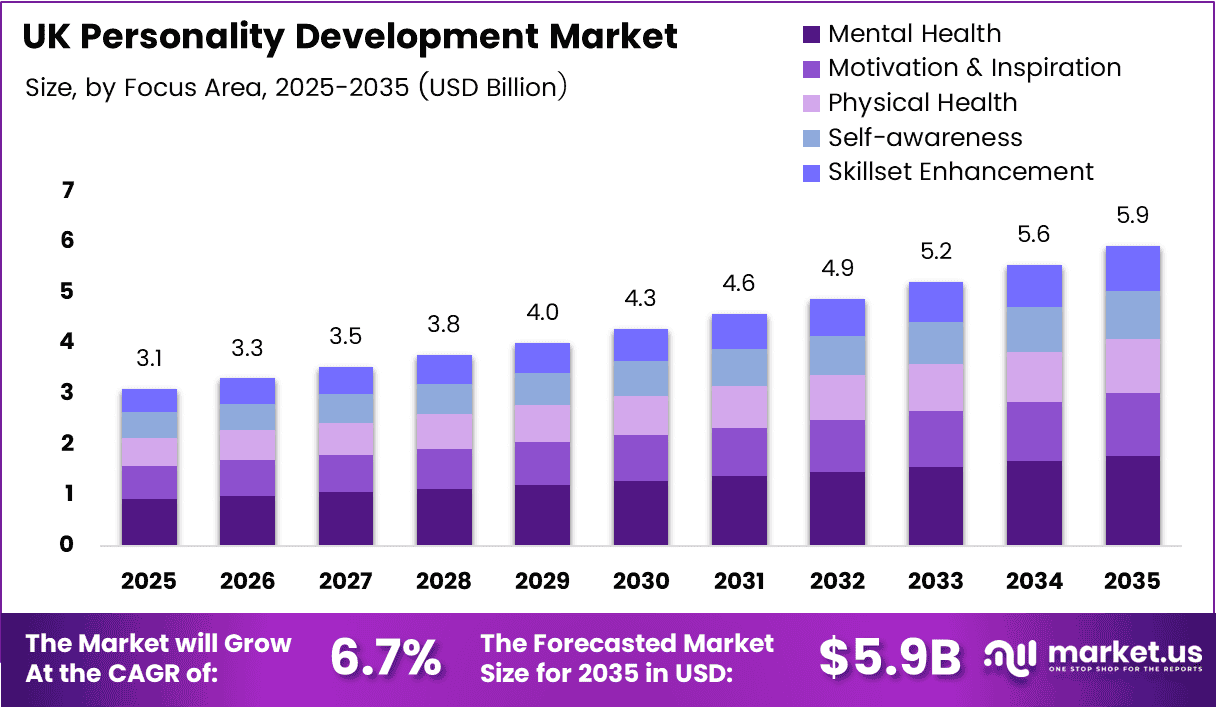
UK Personality Development Market size is expected to be worth around USD 5.9 Billion by 2035 from USD 3.1 Billion in 2025, growing at a CAGR of 6.7% during the forecast period 2026 to 2035.
The UK personality development market encompasses training programs, digital platforms, coaching services, and educational resources designed to enhance individual soft skills, emotional intelligence, leadership capabilities, and professional competencies. These solutions target individuals seeking career advancement, students building foundational skills, and organizations investing in workforce development.
Market growth accelerates as employers prioritize soft skills over formal qualifications in hiring decisions. Remote work culture drives demand for digital self-improvement platforms, while professionals seek confidence-building and communication training. Moreover, the integration of AI-powered assessment tools creates personalized learning pathways that increase engagement and outcomes.
Corporate investment expands across service-sector industries as companies recognize the link between employee personality development and organizational performance. Leadership coaching, emotional intelligence training, and executive development programs gain traction among mid-sized and large enterprises. Additionally, certification-based courses linked to employability outcomes attract working professionals seeking salary growth.
Government support for workforce upskilling initiatives strengthens market foundations. Educational institutions integrate personality development modules into curricula, preparing students for competitive job markets. Consequently, partnerships between training providers and universities create standardized quality benchmarks across the sector.
According to a survey of 500 employers and 1,000 workers, 67% of employers in the United Kingdom value soft skills more than educational qualifications when hiring. This preference shifts recruitment strategies and increases demand for structured personality development programs that demonstrate measurable skill improvements.
According to KPMG research, 66% of UK workers aged 18-34 want more soft skills training, reflecting generational demand for continuous professional development. Younger professionals actively seek training opportunities that enhance workplace adaptability, communication effectiveness, and leadership readiness, driving market expansion across digital and in-person delivery channels.
However, governance scrutiny emerged in January 2026 when the UK Charity Commission launched a statutory inquiry into major training organization transactions, examining decision-making processes and executive compensation structures. This development highlights increasing regulatory attention on the sector’s commercial operations and transparency standards.
Key Takeaways
- The UK Personality Development Market is projected to reach USD 5.9 Billion by 2035, growing at 6.7% CAGR from 2025 to 2035.
- e-Platforms segment dominates By Instrument with 45.4% market share in 2025.
- Mental Health segment leads By Focus Area with 29.7% market share in 2025.
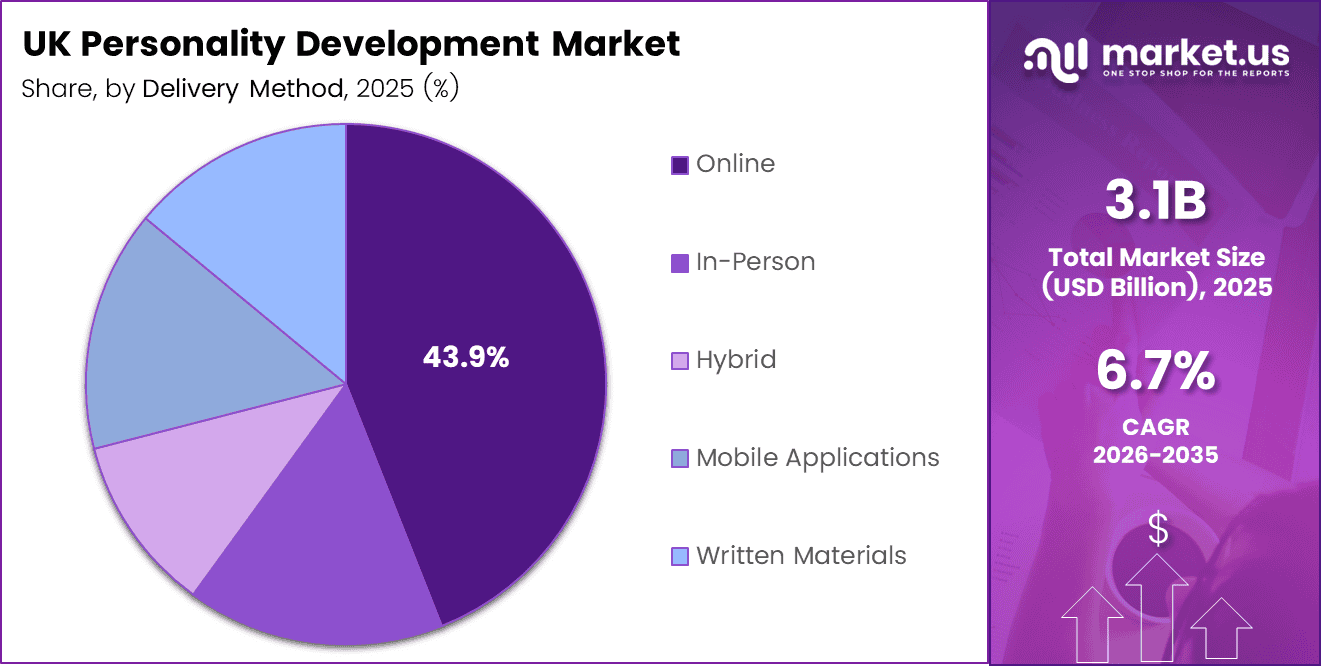
- Online delivery method holds 43.9% market share in 2025.
- Individuals segment accounts for 33.1% share in By Target Audience segment in 2025.
Instrument Analysis
e-Platforms dominates with 45.4% due to accessibility, scalability, and alignment with digital-first learning preferences.
In 2025, e-Platforms held a dominant market position in the By Instrument segment of the UK Personality Development Market, with a 45.4% share. Digital platforms offer mobile and web application-based learning solutions that provide flexibility for working professionals and students. These platforms deliver on-demand content, progress tracking, and interactive assessments that enhance engagement and completion rates.
Books maintain relevance as foundational learning resources for self-directed personality development journeys. Traditional print and digital book formats provide structured frameworks, theoretical knowledge, and expert insights that complement experiential learning. Publishers adapt content for modern audiences through multimedia integration and companion mobile applications that extend reading experiences.
Personal Coaching and Training services deliver customized one-to-one guidance across executive leadership, financial planning, career advancement, and specialized development areas. Professional coaches provide accountability, personalized feedback, and tailored strategies that address individual challenges and goals. Consequently, this instrument commands premium pricing while demonstrating measurable outcomes through behavioral assessments and performance metrics.
Workshops and Seminars create immersive learning environments where participants engage in group exercises, networking, and experiential activities. These in-person and virtual events facilitate peer learning, expert instruction, and practical skill application through scenario-based training. Additionally, corporate clients frequently invest in workshops for team-building and organization-wide skill standardization initiatives.
Focus Area Analysis
Mental Health dominates with 29.7% due to workplace stress management priorities and organizational wellness initiatives.
In 2025, Mental Health held a dominant market position in the By Focus Area segment of the UK Personality Development Market, with a 29.7% share. Organizations invest heavily in employee mental wellness programs that address stress management, resilience building, and emotional regulation. These initiatives reduce absenteeism, improve productivity, and demonstrate corporate commitment to employee wellbeing standards.
Motivation and Inspiration programs focus on goal-setting, positive psychology principles, and performance mindset development that drive achievement. Professionals seek these programs to overcome limiting beliefs, enhance self-confidence, and maintain sustained motivation through career challenges. Moreover, inspirational content formats including podcasts, videos, and live events attract diverse audience segments.
Physical Health integration recognizes the connection between physical fitness, energy management, and professional performance outcomes. Training programs incorporate exercise routines, nutrition guidance, and lifestyle optimization strategies that support cognitive function and stress resilience. Additionally, corporate wellness initiatives increasingly bundle physical health with personality development offerings.
Self-awareness development enhances emotional intelligence, personal values clarity, and behavioral pattern recognition that improve decision-making. Assessment tools, reflective exercises, and coaching methodologies help individuals understand their strengths, weaknesses, and interpersonal dynamics. Consequently, self-awareness training serves as a foundation for targeted skill development in other focus areas.
Skillset Enhancement addresses specific competencies including communication effectiveness, teamwork collaboration, analytical problem-solving, decision-making frameworks, and empowerment strategies. These practical skill modules deliver immediate workplace applicability and measurable performance improvements. Organizations prioritize skillset enhancement programs that align with business objectives and industry-specific requirements.
Delivery Method Analysis
Online dominates with 43.9% due to remote work adoption and preference for flexible learning schedules.
In 2025, Online held a dominant market position in the By Delivery Method segment of the UK Personality Development Market, with a 43.9% share. Digital delivery enables learners to access programs from any location, eliminating geographical barriers and commuting time. Live virtual sessions, recorded content libraries, and asynchronous learning modules accommodate diverse schedules and learning preferences.
In-Person delivery maintains strong demand for experiential learning, networking opportunities, and hands-on practice that requires physical presence. Face-to-face interactions facilitate deeper relationship building, immediate feedback, and immersive role-playing exercises that enhance skill retention. Moreover, executive coaching and leadership development programs frequently utilize in-person formats for intensive workshops.
Hybrid approaches combine online convenience with in-person engagement, offering flexibility while preserving high-impact experiential components. Organizations adopt hybrid models for long-term development programs that include virtual check-ins, online modules, and periodic in-person intensives. This delivery method optimizes cost efficiency while maintaining program effectiveness and participant engagement.
Mobile Applications provide on-the-go learning through bite-sized content, gamified exercises, and daily practice reminders that support habit formation. App-based platforms leverage push notifications, progress tracking, and social features that increase completion rates. Additionally, mobile delivery appeals particularly to younger professionals who prefer smartphone-based learning experiences.
Written Materials include workbooks, journals, and structured reading programs that support self-paced learning and reflective practice. These materials complement other delivery methods by providing reference resources, exercises, and documentation tools. Furthermore, written content remains valuable for learners who prefer text-based instruction and physical documentation.
Target Audience Analysis
Individuals dominates with 33.1% due to self-directed career development and personal growth investments.
In 2025, Individuals held a dominant market position in the By Target Audience segment of the UK Personality Development Market, with a 33.1% share. Self-funded consumers invest in personality development to advance careers, improve relationships, and achieve personal fulfillment goals. These learners demonstrate high motivation, selective program choices, and willingness to invest in premium offerings that deliver measurable outcomes.
Professionals seek targeted development programs that enhance job performance, leadership capabilities, and industry-specific competencies. Mid-career employees invest in skill upgrades to remain competitive, transition roles, or prepare for advancement opportunities. Organizations support professional development through training budgets, learning stipends, and performance-linked development requirements.
Students access personality development resources to build foundational soft skills, career readiness, and employability competencies before entering the workforce. Educational institutions integrate these programs into curricula, while students independently pursue additional training to differentiate themselves in competitive job markets. Moreover, career services departments frequently partner with personality development providers.
Executives engage in high-level coaching, strategic thinking development, and leadership transformation programs tailored for senior management roles. C-suite professionals invest in executive coaching to refine decision-making, stakeholder management, and organizational leadership capabilities. Consequently, this segment commands the highest per-participant spending levels while maintaining strong retention rates.
Retirees pursue personality development for life transition support, continued learning, and social engagement opportunities in post-career phases. Programs address purpose discovery, relationship building, and skill application in volunteer or consulting contexts. Additionally, retirees seek mental wellness, motivation, and self-awareness training that supports healthy aging.
Key Market Segments
By Instrument
- Books
- e-Platforms
- Mobile Application-Based
- Web Application-Based
- Personal Coaching/Training
- Executive and Leadership Coaching
- Financial Coaching
- Career Coaching
- Others
- Workshops & Seminars
By Focus Area
- Mental Health
- Motivation & Inspiration
- Physical Health
- Self-awareness
- Skillset Enhancement
- Communication
- Teamwork
- Decision Making
- Analytical and Problem Solving
- Empowerment
- Others
By Delivery Method
- Online
- In-Person
- Hybrid
- Mobile Applications
- Written Materials
By Target Audience
- Individuals
- Professionals
- Students
- Executives
- Retirees
Drivers
Rising Corporate Investment in Soft Skills and Digital Platform Adoption Drive Market Expansion
Corporate investment accelerates across service-sector industries as employers recognize soft skills as critical differentiators in hiring and promotion decisions. Companies allocate budgets for leadership coaching, emotional intelligence training, and workforce development programs that enhance organizational performance. Moreover, this investment creates sustained demand for specialized training providers and certification programs.
Digital platform adoption transforms market accessibility as remote work culture normalizes flexible learning schedules and location-independent training. According to KPMG research, 62% of UK workers have used social media or online platforms to learn workplace skills, demonstrating widespread acceptance of digital learning channels. Consequently, e-platform providers expand course libraries and enhance user experiences.
Consumer spending increases among young professionals seeking career advancement, confidence building, and communication effectiveness training. Individuals invest personal funds in development programs that deliver tangible employability outcomes and salary growth potential. Additionally, certification-based courses provide credible proof of skill acquisition that strengthens resumes and professional profiles.
Restraints
Market Saturation and Cost Barriers Limit Widespread Adoption
Market saturation emerges from unregulated online coaches and low-credibility training providers that reduce consumer trust and complicate purchasing decisions. Prospective buyers struggle to differentiate quality programs from ineffective offerings, leading to decision paralysis and market skepticism. Moreover, negative experiences with unqualified providers damage overall sector reputation.
Premium one-to-one coaching and executive personality development programs command high prices that limit accessibility to mass-market audiences. According to The Times, employer spending on workforce training in the UK has fallen nearly 20% per worker over the last decade, constraining corporate-funded development opportunities. This decline shifts training costs to individuals who may lack financial resources.
In December 2025, following a major acquisition, a prominent UK training organization initiated a £22 million cost-cutting program including workforce restructuring and international role relocation. Such restructuring reflects financial pressures within the sector that potentially reduce service quality, limit program innovation, and impact employee expertise retention.
Growth Factors
AI Integration and Educational Expansion Accelerate Market Development
AI-powered personal development assessment tools create customized learning pathways that adapt to individual progress, preferences, and performance data. These technologies enhance engagement through personalized recommendations, automated feedback, and predictive analytics that optimize outcomes. According to KPMG research, 61% of UK workers want generative AI training, indicating strong market readiness for AI-enhanced programs.
Demand for AI-skilled roles drives personality development investments as professionals seek competitive advantages in evolving job markets. According to research data, demand for AI-skilled roles in UK job postings grew about 21% between 2018-2023, creating urgency for continuous skill development. Consequently, training providers integrate AI literacy and technological adaptation modules into standard curricula.
Educational institutions expand personality development offerings in secondary schools and universities, preparing students for competitive employment landscapes. Early-career programs build foundational soft skills, emotional intelligence, and professional readiness that increase graduate employability. Moreover, multilingual and cross-cultural communication training supports workforce mobility in increasingly globalized employment markets.
Emerging Trends
Micro-Learning and Neuroscience-Based Training Transform Delivery Models
Micro-learning modules delivered through mobile-first applications gain popularity by offering bite-sized content that fits into busy schedules. These short-form lessons, typically lasting 5-15 minutes, increase completion rates and support habit formation through daily practice reminders. Additionally, gamification elements enhance engagement and motivation across diverse learner segments.
Neuroscience-based behavior training and cognitive performance enhancement workshops apply brain science principles to accelerate skill acquisition and behavior change. According to KPMG research, more than half of young UK workers, around 56%, already use generative AI tools to learn workplace skills. This technological adoption demonstrates market receptivity to innovative training methodologies.
Virtual reality simulations create immersive practice environments for public speaking, interview preparation, and leadership scenario training that traditional methods cannot replicate. VR technology enables learners to practice high-stakes situations repeatedly without real-world consequences, building confidence and competence. Furthermore, data analytics from VR sessions provide detailed performance insights for targeted improvement.
Subscription-based personal growth ecosystems emerge by combining coaching access, peer community engagement, and comprehensive skill tracking tools in unified platforms. According to KPMG research, only about 20% of workers regularly use workplace or external learning resources, suggesting significant untapped potential for integrated solutions that simplify access and increase utilization rates.
Key Company Insights
Franklin Covey Co operates as a global leadership development and organizational performance improvement provider offering training programs based on proven effectiveness principles. The company delivers solutions across leadership, execution, productivity, and trust-building that serve corporate clients worldwide. Additionally, Franklin Covey maintains strong brand recognition through bestselling publications and widely adopted planning systems that support individual and organizational effectiveness.
Dale Carnegie Training provides leadership training, corporate coaching, and professional development programs through a global franchise network spanning multiple decades. The organization focuses on communication skills, public speaking, interpersonal relations, and leadership development using time-tested methodologies. Moreover, Dale Carnegie leverages its established reputation and standardized curriculum to maintain consistent quality across international locations.
Hay House, Inc. specializes in self-help, personal transformation, and motivational content through publishing, live events, and online learning platforms. The company represents prominent authors and thought leaders in personal development, spirituality, and wellness categories. Consequently, Hay House reaches diverse audiences through books, audio programs, online courses, and global speaking events that inspire personal growth.
Landmark Worldwide delivers transformational education programs including intensive workshops and courses designed to produce breakthrough results in personal effectiveness. The organization operates globally with programs focused on leadership, communication, and personal development through experiential learning methodologies. Additionally, Landmark maintains a strong alumni community that supports ongoing participant engagement and program referrals.
Key players
- Franklin Covey Co
- Dale Carnegie Training
- Hay House, Inc.
- Landmark Worldwide
- Nutrisystem
- OpenSesame
- SkillPath
- Success Resources America
- Toastmasters International
Recent Developments
- October 2025 – International certification company PeopleCert completed the acquisition of City & Guilds’ commercial training, awarding and skills businesses, enabling major investment capabilities valued at approximately £180-£200 million. This transaction strengthens PeopleCert’s position in the UK training market while providing City & Guilds with funds for mission sustainability and long-term expansion initiatives.
- January 2026 – The UK Charity Commission launched a statutory inquiry into the City & Guilds sale to PeopleCert, examining governance structures and decision-making processes related to the transaction. This regulatory scrutiny reflects increasing oversight of commercial activities within charitable educational organizations and transparency requirements for major asset disposals.
- January 2026 – Executive compensation controversy and internal investigation emerged following the City & Guilds acquisition, highlighting governance challenges in UK training and certification organizations. These developments demonstrate the heightened regulatory environment surrounding leadership accountability, decision-making transparency, and stakeholder protection in the personality development and professional training sector.
Report Scope
Report Features Description Market Value (2025) USD 3.1 Billion Forecast Revenue (2035) USD 5.9 Billion CAGR (2026-2035) 6.7% Base Year for Estimation 2025 Historic Period 2020-2024 Forecast Period 2026-2035 Report Coverage Revenue Forecast, Market Dynamics, Competitive Landscape, Recent Developments Segments Covered By Instrument (Books, e-Platforms, Personal Coaching/Training, Workshops & Seminars), By Focus Area (Mental Health, Motivation & Inspiration, Physical Health, Self-awareness, Skillset Enhancement), By Delivery Method (Online, In-Person, Hybrid, Mobile Applications, Written Materials), By Target Audience (Individuals, Professionals, Students, Executives, Retirees) Competitive Landscape Franklin Covey Co, Dale Carnegie Training, Hay House, Inc., Landmark Worldwide, Nutrisystem, OpenSesame, SkillPath, Success Resources America, Toastmasters International Customization Scope Customization for segments will be provided. Moreover, additional customization can be done based on the requirements. Purchase Options We have three licenses to opt for: Single User License, Multi-User License (Up to 5 Users), Corporate Use License (Unlimited User and Printable PDF)  UK Personality Development MarketPublished date: Feb 2026add_shopping_cartBuy Now get_appDownload Sample
 -
-
- Franklin Covey Co
- Dale Carnegie Training
- Hay House, Inc.
- Landmark Worldwide
- Nutrisystem
- OpenSesame
- SkillPath
- Success Resources America
- Toastmasters International
Our Clients

- 178030
- Feb 2026






