


Global Two Piece Protective Clothing Market Size, Share, Growth Analysis By Material Type (Aramid, Polyolefin, Polyamide, PBI, Modacrylic), By Protection Type (Heat & Flame Resistant, Chemical Resistant, Electrical Arc Resistant, Cut Resistant, Others), By End-User (Manufacturing & Heavy Engineering, Chemical & Pharmaceutical Industry, Food Processing, Energy and Utilities, Railways & Transport, Construction, Oil & Gas, Others), By Distribution Channel (Online, Offline), By Region and Companies - Industry Segment Outlook, Market Assessment, Competition Scenario, Statistics, Trends and Forecast 2025-2034
- Published date: Dec 2025
- Report ID: 172209
- Number of Pages: 258
- Format:
-
keyboard_arrow_up
Quick Navigation
Report Overview
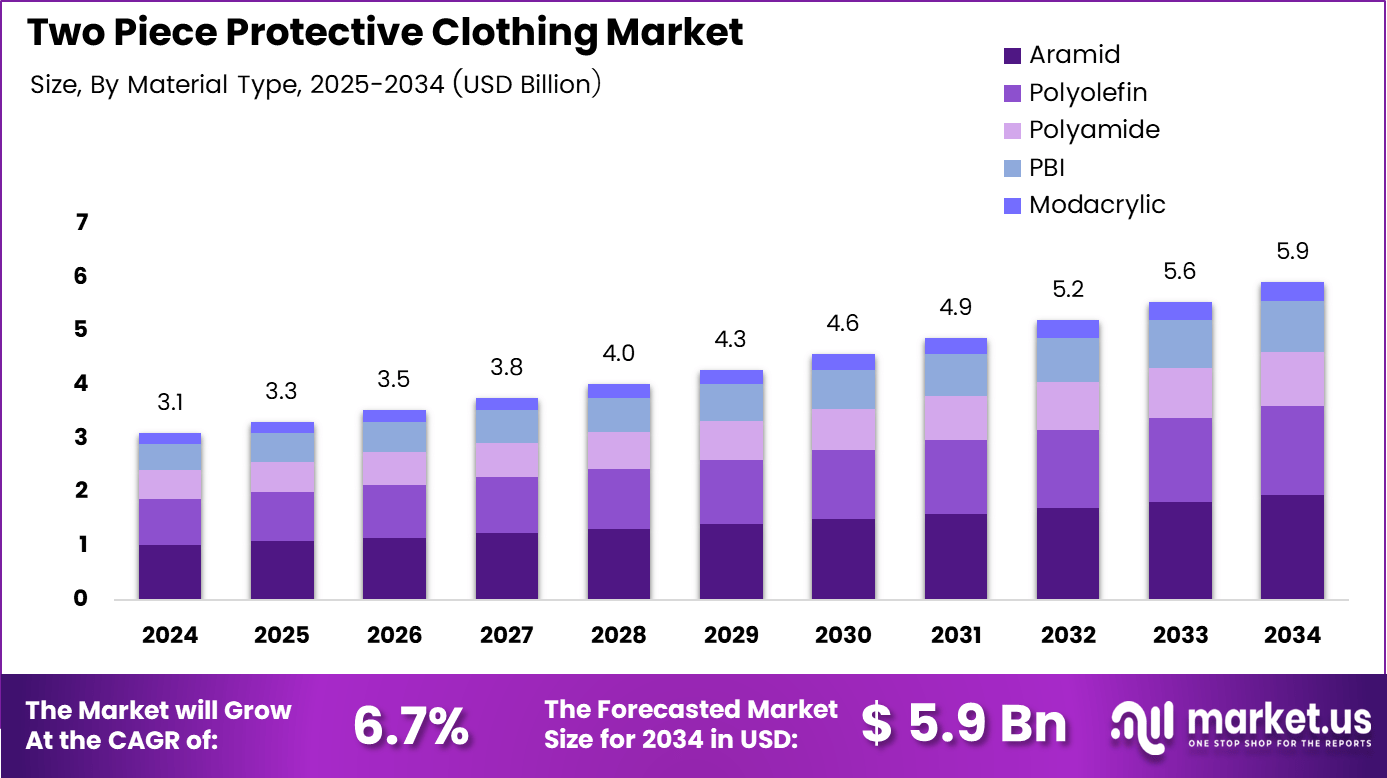
The Global Two Piece Protective Clothing Market size is expected to be worth around USD 5.9 billion by 2034, from USD 3.1 billion in 2024, growing at a CAGR of 6.7% during the forecast period from 2025 to 2034.
The Two Piece Protective Clothing Market refers to coordinated workwear sets consisting of separate upper and lower garments designed for occupational safety, durability, and comfort. These garments are widely adopted across manufacturing, utilities, oil and gas, and construction sectors. Importantly, two piece designs enable flexibility, easy replacement, and task specific protection while supporting operational efficiency.
The market is experiencing steady expansion due to stricter workplace safety norms and growing awareness of personal protection. Governments and regulators increasingly emphasize compliance with industrial safety standards, driving procurement across public infrastructure, energy, and heavy industry projects. As a result, demand for certified, reliable protective clothing continues to rise.
Growth momentum is further supported by product innovation focused on durability and usability. Conti suits made from 100% cotton high quality fabric are increasingly preferred due to breathability and wearer comfort during extended shifts. Functional enhancements such as eight utility pockets, reinforced stress points, and multi stitched seams improve garment longevity and reduce replacement frequency.
Safety performance remains a critical purchasing factor, particularly in electrically hazardous environments. According to the IEEE 1584 standard, incident energy calculation considers fault current, system voltage, and working distance to evaluate arc flash exposure. Consequently, protective clothing specifications increasingly align with quantified hazard assessment frameworks mandated by safety authorities.
Thermal comfort and physiological safety further influence buyer decisions. According to Study, microclimate measurements conducted at 21°C ambient temperature and 60% air humidity help assess heat buildup within layered protective clothing systems. These evaluations support better fabric selection for high activity industrial work environments.
On the supply side, scalable manufacturing capacity supports growing global demand. According to manufacturer disclosed data, factories employing more than 100 skilled workers can achieve monthly production of 100,000 clothing pieces. With over 10 years of workwear export experience, suppliers increasingly serve customers across more than 30 countries.
Overall, the Two Piece Protective Clothing Market demonstrates strong transactional potential supported by regulatory enforcement, expanding industrial employment, and continuous product optimization. Seed keywords such as industrial workwear, protective garments, cotton conti suits, arc flash safety clothing, and certified safety apparel reflect rising digital search intent and sustained market relevance.
Key Takeaways
- The global Two Piece Protective Clothing Market is projected to grow from USD 3.1 billion in 2024 to approximately USD 5.9 billion by 2034, registering a 6.7% CAGR during 2025–2034.
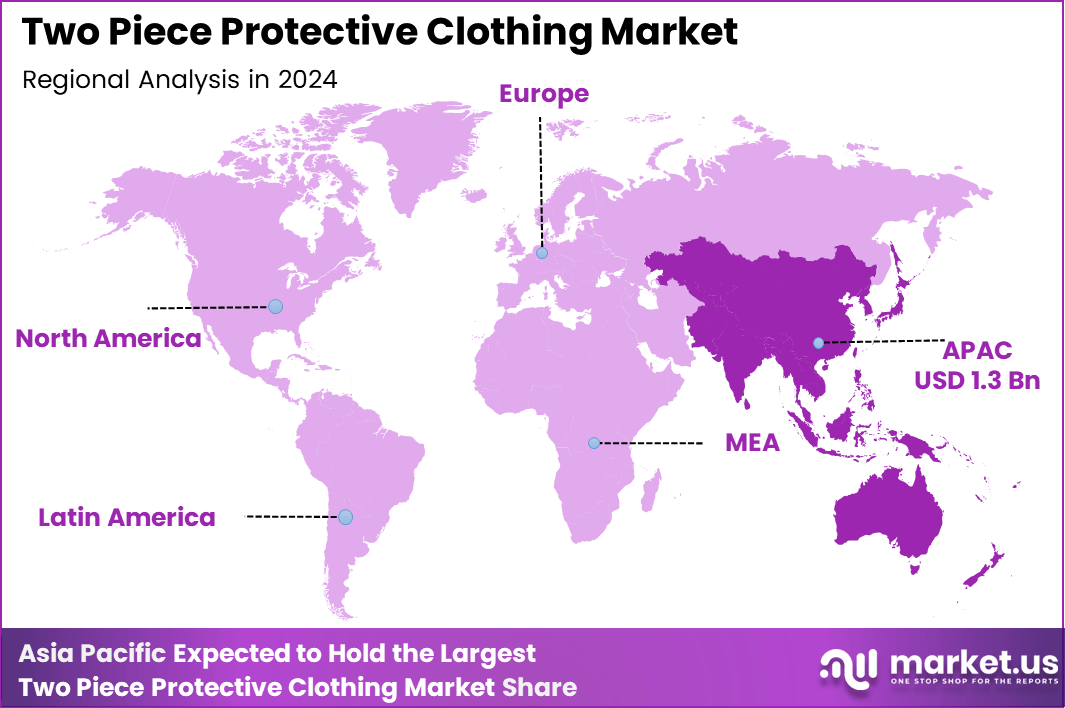
- Asia Pacific dominates the market with a 43.8% regional share, representing a market value of USD 1.3 billion, supported by large scale industrial activity.
- By material type, aramid leads the market with a 32.8% segment share, driven by demand for high thermal stability and durability.
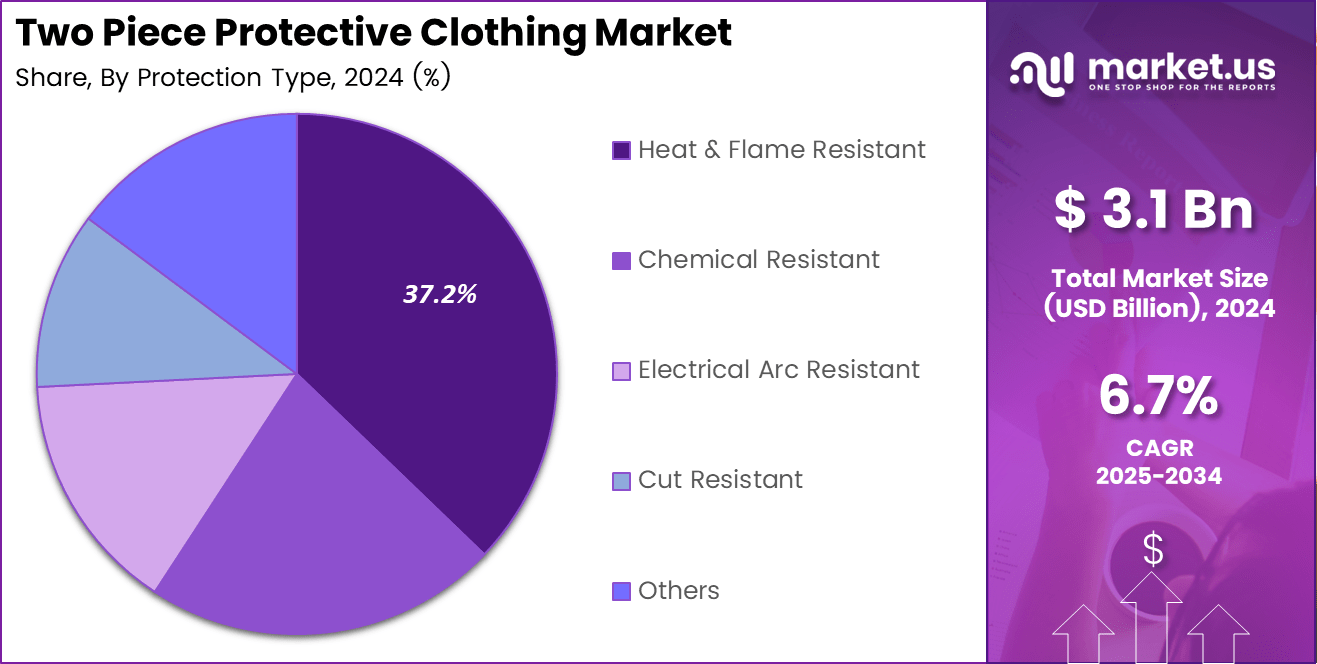
- Heat and flame resistant protection holds the largest protection type share at 37.2%, reflecting strict fire safety compliance requirements.
- Manufacturing and heavy engineering account for the largest end user share at 27.5%, due to high workforce exposure to occupational hazards.
- Offline distribution channels dominate with a 76.3% share, supported by bulk purchasing and physical product verification.
By Material Type Analysis
Aramid dominates with 32.8% due to its superior thermal stability and high tensile strength.
In 2024, Aramid held a dominant market position in the By Material Type Analysis segment of Two Piece Protective Clothing Market, with a 32.8% share. This dominance is supported by its excellent heat resistance, durability, and lightweight nature, making it suitable for high risk industrial and electrical environments.
Polyolefin based two piece protective clothing is increasingly used in applications requiring lightweight chemical splash protection. Moreover, its cost efficiency and ease of processing support adoption in disposable or limited reuse workwear across manufacturing and food handling environments.
Polyamide materials offer strong abrasion resistance and flexibility, supporting use in mechanically intensive work settings. Consequently, these fabrics are preferred where durability and wearer comfort must be balanced across long operational shifts.
PBI materials are primarily utilized in extreme heat exposure scenarios. Their inherent flame resistance supports compliance with stringent safety standards in specialized industrial and emergency response environments.
Modacrylic fabrics are adopted for their self extinguishing properties and softness. As a result, they are widely used where comfort and flame resistance are equally prioritized.
By Protection Type Analysis
Heat & Flame Resistant dominates with 37.2% driven by strict fire safety regulations.
In 2024, Heat & Flame Resistant held a dominant market position in the By Protection Type Analysis segment of Two Piece Protective Clothing Market, with a 37.2% share. This leadership reflects rising fire hazard awareness and regulatory mandates across energy, utilities, and heavy engineering sectors.
Chemical Resistant clothing is increasingly required in controlled processing environments. Consequently, demand remains stable across pharmaceuticals, laboratories, and specialty chemical handling operations.
Electrical Arc Resistant garments are selected based on quantified hazard assessments. As a result, adoption grows steadily in power generation, transmission, and electrical maintenance activities.
Cut Resistant two piece clothing supports worker safety in fabrication and metal handling. Therefore, it remains relevant in manufacturing units focused on mechanical safety compliance.
Other protection types address niche hazards such as biological or particulate exposure. These garments serve specialized operational needs across diverse industrial environments.
By End-User Analysis
Manufacturing & Heavy Engineering dominates with 27.5% due to high workforce exposure.
In 2024, Manufacturing & Heavy Engineering held a dominant market position in the By End-User Analysis segment of Two Piece Protective Clothing Market, with a 27.5% share. High machinery usage and occupational risk drive continuous demand for durable protective workwear.
Chemical & Pharmaceutical Industry adoption is driven by compliance with contamination and safety protocols. Consequently, protective clothing remains a standard operational requirement.
Food Processing applications emphasize hygiene and worker protection. Therefore, two piece protective clothing supports operational safety and regulatory adherence.
Energy and Utilities sectors rely on protective clothing to mitigate electrical and thermal risks. As a result, consistent procurement supports stable market demand.
Railways & Transport utilize protective apparel for maintenance and operational safety. Thus, adoption remains steady across infrastructure maintenance activities.
Construction industry demand is supported by worker safety regulations. Consequently, durable two piece clothing remains essential for on site operations.
Oil & Gas applications require specialized protection against heat and chemicals. Therefore, safety compliance sustains demand across upstream and downstream operations.
Other end users include logistics and municipal services. These segments collectively contribute to diversified market consumption.
By Distribution Channel Analysis
Offline dominates with 76.3% supported by bulk procurement and physical verification.
In 2024, Offline held a dominant market position in the By Distribution Channel Analysis segment of the Two Piece Protective Clothing Market, with a 76.3% share, reflecting the strong preference of industrial buyers for traditional procurement channels.
Large enterprises and contractors rely on offline sourcing to conduct physical inspection of fabric quality, stitching strength, and protective certifications before bulk purchases. Direct supplier engagement also enables customization of sizing, material specifications, and protection levels, which remains critical for workforce safety compliance.
Offline channels further benefit from long term supplier contracts, negotiated pricing, and reliable after sales support, making them the preferred choice for manufacturing, energy, and construction companies. On site trials and sample approvals help organizations reduce procurement risks and ensure regulatory adherence.
By Material Type
- Aramid
- Polyolefin
- Polyamide
- PBI
- Modacrylic
By Protection Type
- Heat & Flame Resistant
- Chemical Resistant
- Electrical Arc Resistant
- Cut Resistant
- Others
By End-User
- Manufacturing & Heavy Engineering
- Chemical & Pharmaceutical Industry
- Food Processing
- Energy and Utilities
- Railways & Transport
- Construction
- Oil & Gas
- Others
By Distribution Channel
- Online
- Offline
Drivers
Rising Adoption of Modular Protective Apparel for Task Specific Industrial Operations Drives Market Growth
The Two Piece Protective Clothing Market is benefiting from the growing use of modular workwear across industrial operations. Separate upper and lower garments allow workers to adapt clothing based on task intensity, weather, and hazard exposure. This flexibility improves usability and supports wider acceptance across diverse job roles.
At the same time, stricter enforcement of workplace safety regulations across manufacturing and utilities is reinforcing demand. Governments and safety authorities increasingly mandate certified protective clothing, pushing employers to invest in compliant two piece solutions that balance protection, comfort, and operational efficiency.
Cost sensitivity across industrial sectors is also influencing purchasing behavior. Reusable and washable two piece protective garments reduce long term replacement costs, making them attractive to budget conscious employers. This is especially relevant in sectors with large workforces and frequent garment usage.
Moreover, the expansion of oil gas, chemical processing, and metal fabrication activities globally continues to raise exposure to physical, thermal, and chemical risks. As industrial output grows, companies prioritize standardized protective clothing programs, strengthening sustained demand for two piece protective apparel.
Restraints
Higher Procurement and Maintenance Costs Compared to Single Piece Suits Limit Market Expansion
Despite steady demand, higher upfront procurement costs remain a restraint for the Two Piece Protective Clothing Market. Compared to single piece suits, two garment components increase material usage and stitching complexity, leading to higher unit prices that can limit adoption among small contractors.
Maintenance related costs further impact purchasing decisions. Frequent laundering, inspection, and replacement of individual garment components increase operational overhead. For organizations managing large workforces, these recurring expenses can create resistance to transitioning from simpler protective clothing alternatives.
Another limitation is reduced suitability for extreme hazard environments. Two piece protective clothing offers limited protection in fully encapsulated or high biohazard scenarios where seamless, sealed suits are required. This restricts use in specialized applications such as bio containment or hazardous waste handling.
Inconsistent sizing and fit issues also affect worker comfort and compliance. Poor fit can reduce mobility and discourage proper usage, weakening overall safety outcomes and slowing broader adoption across certain industries.
Growth Factors
Development of Lightweight and Breathable Fabrics Creates New Growth Opportunities
Innovation in lightweight and breathable protective fabrics presents a major opportunity for market growth. Advanced materials that improve airflow while maintaining barrier performance address heat stress concerns, encouraging wider use of two piece protective clothing in high activity environments.
Emerging economies investing in industrial safety infrastructure further strengthen growth potential. As manufacturing capacity expands in developing regions, governments and employers increasingly prioritize worker protection, creating new demand for affordable and scalable protective clothing solutions.
Integration of smart textiles also opens new commercial opportunities. Fabrics embedded with sensors for heat stress or fatigue monitoring support proactive safety management, positioning two piece protective clothing as part of connected workplace safety systems.
Together, these developments enhance product differentiation and support premium pricing strategies, allowing manufacturers to target both compliance driven buyers and safety focused enterprises.
Emerging Trends
Shift Toward Sustainable and Ergonomically Designed Protective Clothing Shapes Market Trends
Sustainability is emerging as a key trend in the Two Piece Protective Clothing Market. Manufacturers increasingly focus on recyclable and low impact fabrics to align with corporate sustainability goals and environmental regulations across industrial supply chains.
Ergonomic design is also gaining importance. Improved garment fit, flexible panels, and balanced weight distribution enhance worker comfort, increasing acceptance and consistent usage across long shifts and physically demanding tasks.
At the same time, the use of flame resistant and anti static fabric combinations is expanding. These multi hazard solutions address overlapping safety risks, reducing the need for multiple garment layers and simplifying compliance strategies.
Standardized color coding for role based and hazard specific protection is another growing trend. Clear visual identification improves workplace safety management and supports faster decision making in complex industrial environments.
Regional Analysis
Asia Pacific Dominates the Two Piece Protective Clothing Market with a Market Share of 43.8%, Valued at USD 1.3 Billion
Asia Pacific leads the Two Piece Protective Clothing market, supported by rapid industrialization and expanding manufacturing, construction, and energy activities across China, India, and Southeast Asia.
The region accounted for 43.8% of global demand, with the market valued at USD 1.3 billion, reflecting strong volume consumption across cost sensitive industries. High adoption of modular and reusable protective apparel in labor intensive sectors continues to strengthen regional dominance. Growing enforcement of occupational safety norms further sustains demand across both organized and semi organized industries.
North America Two Piece Protective Clothing Market Trends
North America represents a mature yet steady growth region, driven by stringent workplace safety regulations across manufacturing, utilities, and oil and gas operations. Demand remains consistent due to regular replacement cycles and a strong focus on compliance driven procurement. The region also benefits from higher awareness of worker safety and preference for durable, reusable protective garments. Industrial modernization and infrastructure maintenance activities support stable consumption patterns.
Europe Two Piece Protective Clothing Market Trends
Europe demonstrates stable demand supported by strict occupational health and safety directives across industrial workplaces. Manufacturing, chemical processing, and metal fabrication equipment industries continue to adopt two piece protective clothing for flexibility and comfort during extended work hours. Sustainability initiatives also encourage the use of washable and reusable protective apparel. Regulatory oversight and structured procurement systems contribute to predictable market expansion.
Middle East and Africa Two Piece Protective Clothing Market Trends
The Middle East and Africa market growth is closely linked to expanding oil and gas operations, mining activities, and infrastructure development projects. Demand is supported by increasing awareness of worker safety standards in industrial environments. Two piece protective clothing gains traction due to suitability for hot climates and task specific usage. Gradual regulatory strengthening is expected to improve long term adoption across the region.
Latin America Two Piece Protective Clothing Market Trends
Latin America shows moderate growth driven by industrial recovery and expanding manufacturing and construction activities in key economies. Adoption of two piece protective clothing increases as industries focus on cost efficient safety solutions that balance protection and comfort. Improving workplace safety enforcement supports demand across industrial and utility sectors. The region continues to evolve with gradual formalization of safety practices.
Key Regions and Countries
North America
- US
- Canada
Europe
- Germany
- France
- The UK
- Spain
- Italy
- Rest of Europe
Asia Pacific
- China
- Japan
- South Korea
- India
- Australia
- Rest of APAC
Latin America
- Brazil
- Mexico
- Rest of Latin America
Middle East & Africa
- GCC
- South Africa
- Rest of MEA
Key Two Piece Protective Clothing Company Insights
The competitive landscape of the global Two Piece Protective Clothing Market in 2024 reflects a mix of product innovation, functional design focus, and steady penetration across professional and hobbyist user bases. The leading players continue to emphasize durability, comfort, and task specific protection to maintain relevance in a market shaped by safety awareness and cost sensitivity.
Mann Lake maintains a strong market position through its consistent emphasis on functional protective apparel tailored for demanding field applications. The company’s focus on breathable materials, ergonomic two piece designs, and scalable product availability supports steady demand across professional users. Its ability to align protective performance with user comfort remains a key factor strengthening brand loyalty.
Dadant & Sons, Inc. leverages its long standing industry presence to offer reliable two piece protective clothing solutions designed for extended wear and operational flexibility. The company benefits from deep product expertise and a structured approach to quality, which supports sustained adoption among users prioritizing durability. Its portfolio reflects a balance between traditional protection standards and evolving user expectations.
Good Land Bee Supply differentiates itself by addressing practical usability and affordability within the two piece protective clothing segment. The company’s offerings emphasize ease of movement, lightweight construction, and cost efficiency, making them attractive to small scale and independent users. This positioning supports steady volume demand in value driven market segments.
BeeCastle continues to strengthen its market presence by focusing on modern design improvements and user friendly protective apparel configurations. The brand emphasizes improved fit, ventilation, and modular components, aligning well with evolving safety preferences. Its approach reflects a growing emphasis on comfort driven protection without compromising core safety requirements.
Overall, these players collectively shape a competitive market environment where product reliability, ergonomic design, and value alignment remain central to growth strategies in 2024.
Top Key Players in the Market
- Mann Lake
- Dadant & Sons, Inc.
- Good Land Bee Supply
- BeeCastle
- Beewise
- Humble Bee
- Thomas Apiculture Sas
- Others
Recent Developments
- In July 2, 2024, Ansell Limited successfully completed the acquisition of Kimberly-Clark’s Personal Protective Equipment (KCPPE) business in Iselin. This transaction strengthens Ansell’s global leadership in personal protection solutions while expanding its product portfolio and service capabilities across multiple industries and geographic markets.
- In December 2025, Gildan completed the acquisition of HanesBrands, bringing together two major apparel manufacturers with a shared focus on quality and innovation. The acquisition further strengthens leadership in responsibly made apparel and reinforces industry-leading environmental, social, and governance practices.
Report Scope
Report Features Description Market Value (2024) USD 3.1 billion Forecast Revenue (2034) USD 5.9 billion CAGR (2025-2034) 6.7% Base Year for Estimation 2024 Historic Period 2020-2023 Forecast Period 2025-2034 Report Coverage Revenue Forecast, Market Dynamics, Competitive Landscape, Recent Developments Segments Covered By Material Type (Aramid, Polyolefin, Polyamide, PBI, Modacrylic), By Protection Type (Heat & Flame Resistant, Chemical Resistant, Electrical Arc Resistant, Cut Resistant, Others), By End-User (Manufacturing & Heavy Engineering, Chemical & Pharmaceutical Industry, Food Processing, Energy and Utilities, Railways & Transport, Construction, Oil & Gas, Others), By Distribution Channel (Online, Offline) Regional Analysis North America (US and Canada), Europe (Germany, France, The UK, Spain, Italy, and Rest of Europe), Asia Pacific (China, Japan, South Korea, India, Australia, and Rest of APAC), Latin America (Brazil, Mexico, and Rest of Latin America), Middle East & Africa (GCC, South Africa, and Rest of MEA) Competitive Landscape Mann Lake, Dadant & Sons, Inc., Good Land Bee Supply, BeeCastle, Beewise, Humble Bee, Thomas Apiculture Sas, Others Customization Scope Customization for segments, region/country-level will be provided. Moreover, additional customization can be done based on the requirements. Purchase Options We have three licenses to opt for: Single User License, Multi-User License (Up to 5 Users), Corporate Use License (Unlimited User and Printable PDF)  Two Piece Protective Clothing MarketPublished date: Dec 2025add_shopping_cartBuy Now get_appDownload Sample
 -
-
- Mann Lake
- Dadant & Sons, Inc.
- Good Land Bee Supply
- BeeCastle
- Beewise
- Humble Bee
- Thomas Apiculture Sas
- Others
Our Clients

- 172209
- Dec 2025






