


Global Tokenization Market Size, Share and Analysis Report By Tokenization Technique (Vaulted Tokenization, Vaultless Tokenization), By Organization Size (Large Enterprises, Small and Medium-sized Enterprises), By Application (Payment Security, User Authentication, Compliance Management, Fraud Prevention and Risk Management, Data Protection, Others), By End-User Industry (Banking, Financial Services, and Insurance, Retail and E-commerce, IT and Telecommunications, Healthcare and Life Sciences, Government and Defense, Energy and Utilities, Media and Entertainment, Transportation and Logistics, Others.), By Regional Analysis, Global Trends and Opportunity, Future Outlook By 2025-2035
- Published date: Feb. 2026
- Report ID: 177756
- Number of Pages: 200
- Format:
-
keyboard_arrow_up
Quick Navigation
- Tokenization Market size
- Top Market Takeaways
- Report Overview
- Drivers Impact Analysis
- Restraint Impact Analysis
- By Tokenization Technique
- By Organization Size
- By Application
- By End User Industry
- Regional Analysis
- Emerging Trends Analysis
- Growth Factors Analysis
- Opportunity Analysis
- Challenge Analysis
- Investor Type Impact Matrix
- Technology Enablement Analysis
- Key Market Segments
- Competitive Analysis
- Recent Developments
- Report Scope
Tokenization Market size
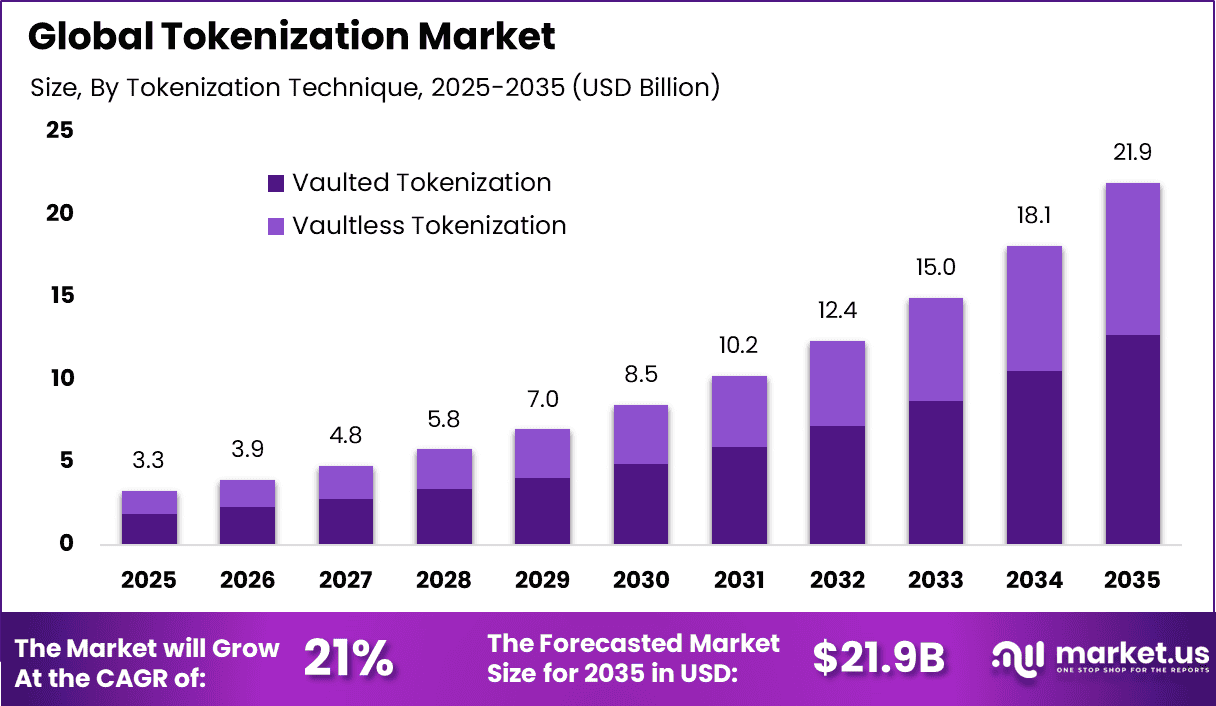
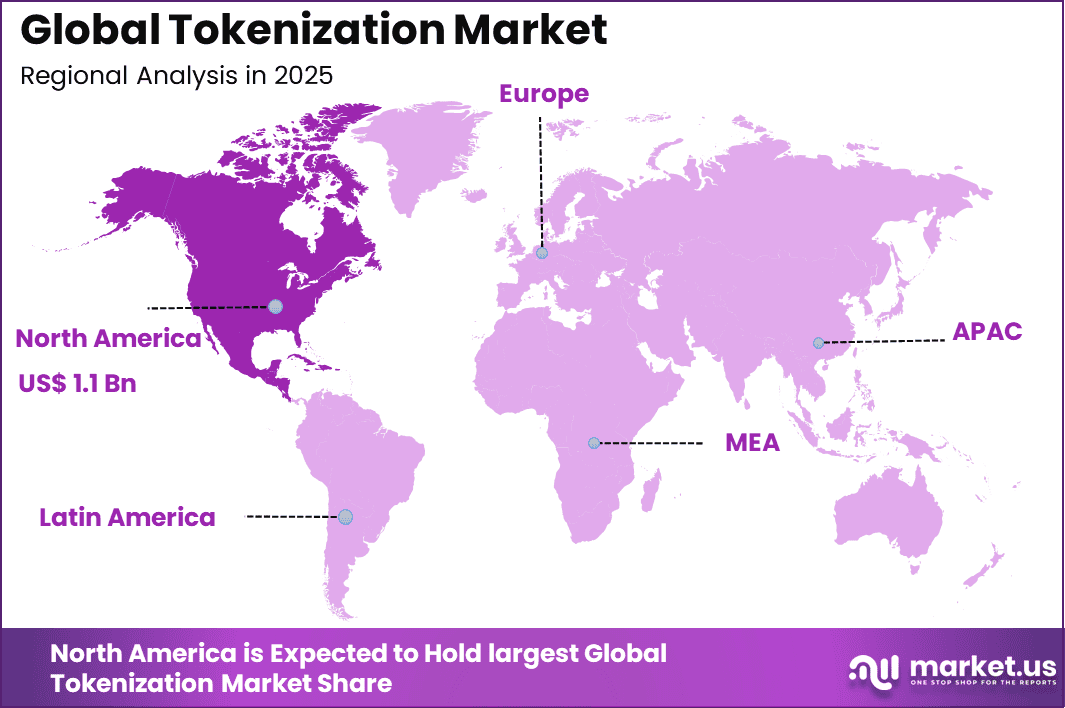
The Global Tokenization Market size is expected to be worth around USD 21.9 Billion By 2035, from USD 3.3 billion in 2025, growing at a CAGR of 21% during the forecast period from 2026 to 2035. North America held a dominant Market position, capturing more than a 33.6% share, holding USD 1.1 Billion revenue.
By 2026, tokenization has transitioned from early pilot programs to a mainstream financial standard, with an estimated 35% of all global transactions now tokenized. This shift reflects growing trust in token based security models and broader adoption across financial and digital commerce ecosystems. Adoption is clearly split across two major use cases. Payment tokenization is now nearly universal in digital commerce, driven by security and compliance requirements.
Top Market Takeaways
- By tokenization technique, vaulted tokenization led the Tokenization Market with a 58.0% share, supported by strong demand for centralized and secure token storage frameworks.
- By organization size, large enterprises accounted for 71.0% of total adoption, reflecting higher transaction volumes and stricter compliance requirements.
- By application, payment security represented 47.0% of the market, driven by the need to protect cardholder and transaction data.
- By end user industry, Banking, Financial Services, and Insurance held a 35.0% share, supported by regulatory mandates and digital payment expansion.
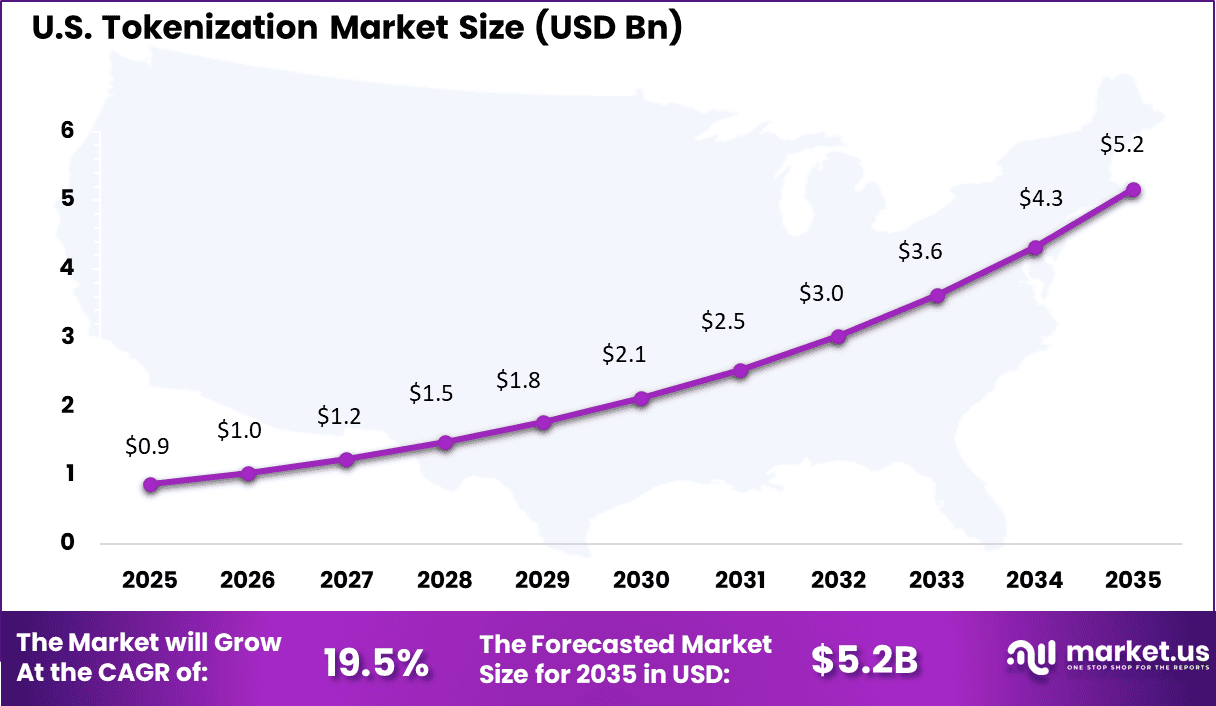
- Regionally, North America captured 33.6% of the market, with the US valued at USD 0.98 billion and recording a CAGR of 19.52%, reflecting steady growth in secure digital transactions.
Report Overview
The Tokenization Market refers to technologies and platforms that convert real world and digital assets into blockchain based tokens that can be securely stored, transferred, and managed. These assets may include financial instruments, real estate, commodities, intellectual property, digital identities, and data rights. Tokenization enables fractional ownership, faster settlement, and improved transparency by representing asset value digitally.
The market has gained strategic importance as organizations seek more efficient and programmable asset management models. Tokenization operates on distributed ledger infrastructure that ensures immutability, traceability, and verifiable ownership. Unlike traditional digitization, tokenization embeds rules and rights directly into the asset representation. This allows automated transfers, compliance checks, and lifecycle management.
One of the main driving factors is the need to improve asset liquidity and accessibility. Many traditional assets are illiquid, expensive to transact, or limited to a narrow investor base. Tokenization allows assets to be divided into smaller units and traded more easily. This structural change improves market participation and flexibility. Another key driver is operational inefficiency in traditional asset settlement and reconciliation processes. Legacy systems often rely on intermediaries and manual verification.
Drivers Impact Analysis
Key Driver Impact on CAGR Forecast (~%) Geographic Relevance Impact Timeline Rising digital payment transactions and card-not-present fraud +5.2% North America, Europe Short to medium term Expansion of e-commerce and mobile wallet ecosystems +4.6% Asia Pacific, North America Medium term Increasing regulatory focus on data protection and PCI compliance +4.1% Europe, North America Medium term Growth of embedded finance and API-based payment models +3.8% Global Medium term Adoption of network tokenization and real-time payment systems +3.3% Global Medium to long term Restraint Impact Analysis
Key Restraint Impact on CAGR Forecast (~%) Geographic Relevance Impact Timeline Integration complexity across legacy payment infrastructure -3.9% Global Short to medium term High compliance and certification costs -3.2% Emerging Markets Medium term Fragmented standards across regions and payment networks -2.8% Global Medium term Limited awareness among small merchants -2.4% Asia Pacific, Latin America Medium term Dependence on third-party service providers -2.0% Global Medium to long term By Tokenization Technique
Vaulted tokenization accounted for 58.0% of adoption, reflecting its strong security characteristics. In this approach, original sensitive data is stored securely in a centralized vault while tokens are used in operational systems. This separation significantly reduces breach impact. Enterprises prefer vaulted models for high risk data environments.
Vaulted tokenization supports strong access controls and auditability. Centralized storage allows tighter governance over sensitive data. This improves visibility and compliance management. As security expectations rise, vaulted techniques continue to dominate.
Scalability improvements have strengthened adoption. Modern vaulted systems handle high transaction volumes efficiently. This makes them suitable for large enterprises and financial institutions. Vaulted tokenization remains the most trusted technique.
By Organization Size
Large enterprises represented 71.0% of adoption due to their extensive data exposure and regulatory obligations. These organizations process large volumes of sensitive customer and transaction data. Tokenization helps reduce enterprise wide risk. Formal security frameworks often mandate its use. Large enterprises also operate across multiple systems and geographies.
Tokenization provides consistent protection across environments. Centralized policy enforcement simplifies governance. This supports widespread deployment. Higher investment capacity further accelerates adoption. Large organizations integrate tokenization into payment, analytics, and data platforms. This reinforces their dominant position.
By Application
Payment security accounted for 47.0% of usage, highlighting tokenization’s critical role in protecting transaction data. Payment systems are frequent targets for cyber attacks. Tokenization ensures that exposed data cannot be reused maliciously. This significantly reduces fraud risk. Tokenization also supports secure omnichannel payments.
Tokens can be reused safely across channels without exposing original credentials. This improves customer experience while maintaining security. Payment providers rely heavily on this capability. As digital and contactless payments grow, transaction volumes continue to rise. Tokenization scales effectively with this growth. Payment security remains the leading application area.
By End User Industry
Banking, financial services, and insurance accounted for 35.0% of adoption due to strict security and compliance requirements. These institutions handle highly sensitive financial and personal data. Breaches can result in severe financial and reputational damage. Tokenization helps mitigate these risks. Regulatory frameworks require strong data protection controls in BFSI.
Tokenization supports compliance by reducing sensitive data exposure. Audit and reporting processes are also simplified. This drives sustained adoption. Digital transformation in BFSI has increased data flow complexity. Tokenization provides consistent protection across systems. The sector remains a key end user.
Regional Analysis
North America accounted for 33.6% of market adoption, supported by advanced payment infrastructure and strong regulatory enforcement. Organizations in the region prioritize proactive data security. High digital payment usage has accelerated adoption.
The United States leads the region with market value of USD 0.98 Bn and a CAGR of 19.52%. Financial institutions and large enterprises drive demand. Investment in payment security remains strong. Ongoing innovation continues to reinforce regional leadership. Integration with digital wallets and cloud platforms has improved scalability. As digital payments expand, tokenization remains a critical security capability.
Emerging Trends Analysis
An emerging trend in the tokenization market is the convergence with data privacy and rights management frameworks. Organisations are implementing tokenisation alongside consent tracking, user-controlled data sharing, and privacy preserving analytics. This alignment supports stronger trust relationships between users and service providers. Privacy centric tokenisation is emerging as a differentiator.
Another trend is the adoption of context-aware tokenization. Instead of static token formats, dynamic tokens adjust based on user context, device profile, or transaction risk. Context-aware tokens increase security by making token use more restrictive and tailored. Adaptive tokenisation strengthens risk control.
Growth Factors Analysis
One of the key growth factors for the tokenization market is the global rise of digital payments and contactless transactions. As more consumers and businesses opt for online and mobile payments, securing sensitive payment data becomes a priority. Tokenisation reduces fraud risk and enhances trust in digital transaction ecosystems.
Another growth factor is increasing enterprise focus on zero trust security models. In zero trust frameworks, organisations minimise implicit trust and continuously validate access and data usage. Tokenisation aligns with zero trust principles by ensuring sensitive data is never exposed in clear text outside trusted boundaries. This strategic alignment supports sustained market adoption.
Opportunity Analysis
A significant opportunity in the tokenization market lies in expanding use cases beyond payment card data. Tokenisation can be applied to identity information, personally identifiable data, healthcare records, and proprietary business data. As digital ecosystems evolve, demand for flexible tokenisation frameworks that secure diverse data types increases. Solutions that support broad, enterprise-wide tokenisation strategies can capture growing demand.
Another opportunity is integration with emerging digital asset ecosystems and blockchain frameworks. Tokenisation is a foundational concept in asset digitisation, enabling representation of real-world or intangible assets on distributed ledgers. Platforms that support secure token generation, lifecycle management, and interoperability across systems are positioned to benefit from emerging digital finance use cases.
Challenge Analysis
A major challenge for the tokenization market is maintaining performance and scalability. Tokenisation systems must efficiently manage large volumes of token creation, lookup, and validation requests without introducing latency or bottlenecks. Organisations must design resilient systems that support high throughput and minimal disruption to operational workflows.
Another challenge is governance and token lifecycle management. Tracking token origins, usage policies, expiry, and revocation across systems requires robust governance frameworks. Without clear oversight, token sprawl and inconsistency can create security gaps. Effective token lifecycle controls are essential for sustained protection.
Investor Type Impact Matrix
Investor Type Growth Sensitivity Risk Exposure Geographic Focus Investment Outlook Payment security and tokenization platform providers Very High Medium North America, Europe Strong SaaS and transaction-based revenue Card networks and payment processors High Medium Global Embedded security expansion Fintech and digital wallet providers High Medium to High Asia Pacific, North America Core infrastructure investment Private equity firms Medium Medium North America, Europe Consolidation of payment security vendors Venture capital investors High High North America Innovation in blockchain and asset tokenization Technology Enablement Analysis
Technology Enabler Impact on CAGR Forecast (~%) Primary Function Geographic Relevance Adoption Timeline Network tokenization for card-on-file transactions +5.6% Reduced fraud and chargebacks Global Short to medium term API-based token vault and key management systems +4.8% Secure token lifecycle management Global Medium term AI-driven fraud detection integration +4.2% Enhanced transaction monitoring North America, Europe Medium term Cloud-native tokenization platforms +3.7% Scalability and low latency Global Medium to long term Blockchain-based asset tokenization frameworks +3.1% Digital asset security North America, Asia Pacific Long term Key Market Segments
By Tokenization Technique
- Vaulted Tokenization
- Vaultless Tokenization
By Organization Size
- Large Enterprises
- Small and Medium-sized Enterprises
By Application
- Payment Security
- User Authentication
- Compliance Management
- Fraud Prevention and Risk Management
- Data Protection
- Others
By End-User Industry
- Banking, Financial Services, and Insurance
- Retail and E-commerce
- IT and Telecommunications
- Healthcare and Life Sciences
- Government and Defense
- Energy and Utilities
- Media and Entertainment
- Transportation and Logistics
- Others
Regional Analysis and Coverage
- North America
- US
- Canada
- Europe
- Germany
- France
- The UK
- Spain
- Italy
- Russia
- Netherlands
- Rest of Europe
- Asia Pacific
- China
- Japan
- South Korea
- India
- Australia
- Singapore
- Thailand
- Vietnam
- Rest of Latin America
- Latin America
- Brazil
- Mexico
- Rest of Latin America
- Middle East & Africa
- South Africa
- Saudi Arabia
- UAE
- Rest of MEA
Competitive Analysis
Global payment networks such as Visa Inc., Mastercard Inc., and American Express Company play a foundational role in the tokenization market. Their network tokenization frameworks replace sensitive card data with secure tokens across digital and in-store transactions. These solutions reduce fraud risk and support regulatory compliance. Strong issuer and merchant relationships accelerate adoption. Demand is driven by growth in eCommerce, mobile wallets, and contactless payments.
Payment processors and financial technology providers such as Fiserv, Inc., Fidelity National Information Services, Inc., and Global Payments Inc. integrate tokenization within broader payment ecosystems. PayPal Holdings, Inc. extends token services through its Braintree division. These players benefit from large merchant bases and scalable processing infrastructure. Adoption is supported by rising transaction volumes and data security mandates.
Security and encryption specialists such as Thales Group, Entrust Corporation, Protegrity USA Inc., TokenEx, LLC, Futurex, LP, Bluefin Payment Systems, LLC, Broadcom Inc., and Lookout, Inc. focus on encryption, key management, and compliance-driven token services. Other vendors expand innovation and regional reach, supporting steady growth of tokenization solutions across industries.
Top Key Players in the Market
- Visa Inc.
- Mastercard Inc.
- American Express Company
- Thales Group
- Fiserv, Inc.
- Fidelity National Information Services, Inc. (FIS)
- Broadcom Inc. (Symantec Enterprise)
- PayPal Holdings, Inc. (Braintree)
- Protegrity USA Inc.
- TokenEx, LLC
- Entrust Corporation
- Global Payments Inc. (Worldpay)
- Lookout, Inc. (CipherCloud)
- Futurex, LP
- Bluefin Payment Systems, LLC
- Others
Recent Developments
- October, 2025 – Mastercard MDES API added token activation via Mastercard Identity Check for MCBP wallets, supporting multi‑PAN mapping and agent‑specific tokens for AI commerce (“Agent Pay”).
- July, 2025 – FIS partnered with Circle to embed USDC stablecoin payments into its Money Movement Hub, enabling banks to issue/redeem tokenized deposits and stablecoins via blockchain while leveraging FIS fraud detection and real-time rails.
- April, 2025 – Visa hit 13.7 billion total tokens issued, powering 50% of digital transactions and 90% fraud reduction in Tap to Add Card, with VTAP extending fiat tokenization to blockchains for banks.
Report Scope
Report Features Description Market Value (2025) USD 3.3 Bn Forecast Revenue (2035) USD 21.9 Bn CAGR(2026-2035) 21.0% Base Year for Estimation 2025 Historic Period 2020-2024 Forecast Period 2026-2035 Report Coverage Revenue forecast, AI impact on Market trends, Share Insights, Company ranking, competitive landscape, Recent Developments, Market Dynamics and Emerging Trends Segments Covered By Tokenization Technique (Vaulted Tokenization, Vaultless Tokenization), By Organization Size (Large Enterprises, Small and Medium-sized Enterprises), By Application (Payment Security, User Authentication, Compliance Management, Fraud Prevention and Risk Management, Data Protection, Others), By End-User Industry (Banking, Financial Services, and Insurance, Retail and E-commerce, IT and Telecommunications, Healthcare and Life Sciences, Government and Defense, Energy and Utilities, Media and Entertainment, Transportation and Logistics, Others.) Regional Analysis North America – US, Canada; Europe – Germany, France, The UK, Spain, Italy, Russia, Netherlands, Rest of Europe; Asia Pacific – China, Japan, South Korea, India, New Zealand, Singapore, Thailand, Vietnam, Rest of Latin America; Latin America – Brazil, Mexico, Rest of Latin America; Middle East & Africa – South Africa, Saudi Arabia, UAE, Rest of MEA Competitive Landscape Visa Inc., Mastercard Inc., American Express Company, Thales Group, Fiserv, Inc., Fidelity National Information Services, Inc. (FIS), Broadcom Inc. (Symantec Enterprise), PayPal Holdings, Inc. (Braintree), Protegrity USA Inc., TokenEx, LLC, Entrust Corporation, Global Payments Inc. (Worldpay), Lookout, Inc. (CipherCloud), Futurex, LP, Bluefin Payment Systems, LLC, Others. Customization Scope Customization for segments, region/country-level will be provided. Moreover, additional customization can be done based on the requirements. Purchase Options We have three license to opt for: Single User License, Multi-User License (Up to 5 Users), Corporate Use License (Unlimited User and Printable PDF) 
-
-
- Visa Inc.
- Mastercard Inc.
- American Express Company
- Thales Group
- Fiserv, Inc.
- Fidelity National Information Services, Inc. (FIS)
- Broadcom Inc. (Symantec Enterprise)
- PayPal Holdings, Inc. (Braintree)
- Protegrity USA Inc.
- TokenEx, LLC
- Entrust Corporation
- Global Payments Inc. (Worldpay)
- Lookout, Inc. (CipherCloud)
- Futurex, LP
- Bluefin Payment Systems, LLC
- Others
Our Clients

- 177756
- Feb. 2026






