


Global Termite Control Market Size, Share and Report Analysis By Type (Subterranean, Dry Wood, Damp Wood), By Control Method (Chemical, Physical and Mechanical, Biological, Others), By Service Type (Pre-Construction, Post-Construction), By Application (Commercial, Residential, Agriculture, Others) , By Region and Companies - Industry Segment Outlook, Market Assessment, Competition Scenario, Trends and Forecast 2025-2035
- Published date: Mar 2026
- Report ID: 180383
- Number of Pages: 298
- Format:
-
keyboard_arrow_up
Quick Navigation
Report Overview
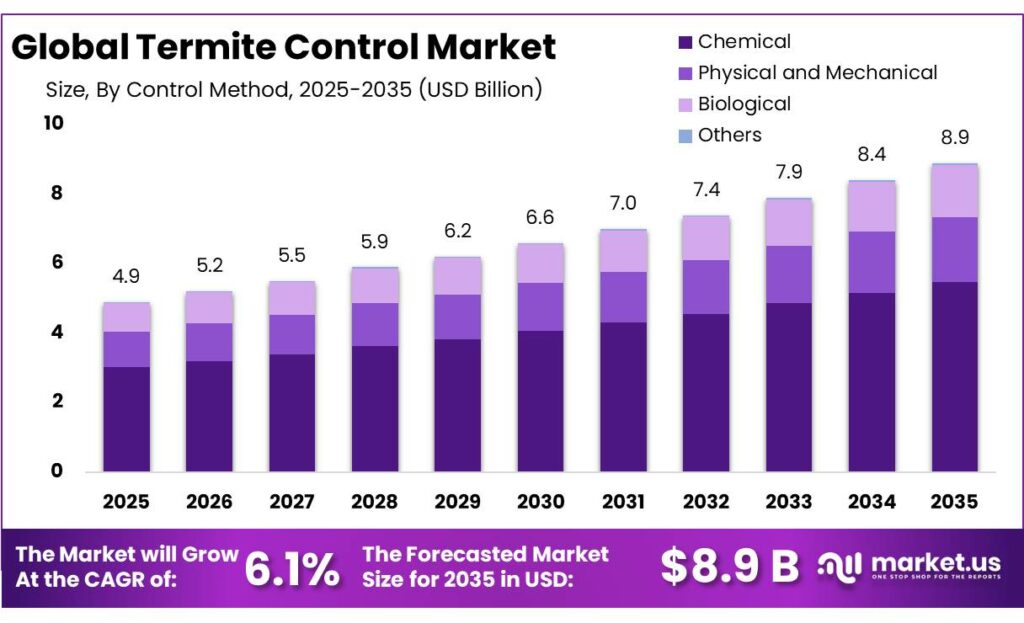
Global Termite Control Market is expected to be worth around USD 8.9 Million by 2035, up from USD 4.9 Billion in 2025, at a CAGR of 6.1% from 2026 to 2035. The Asia Pacific segment maintained 39.4%, supporting a Termite Control value of USD 1.9 Bn.
The termite control industry represents a crucial segment within the broader pest management ecosystem, driven by the increasing economic losses caused by termite infestations in residential, commercial, and agricultural environments. Termites are among the most destructive wood-damaging insects, particularly in tropical and subtropical climates, where they thrive in warm and humid conditions.
- According to the Food and Agriculture Organization (FAO), termites are present in approximately two-thirds of the world’s land areas, with nearly 4,000 species identified globally, many of which live in colonies that may contain over 1 million individuals per nest. These biological characteristics make termite infestations difficult to detect and control, necessitating specialized monitoring and treatment services across industries such as construction, forestry, and agriculture.
From an industrial scenario perspective, termite infestations result in substantial economic damage globally, thereby supporting sustained demand for termite control solutions and services. Research estimates indicate that termites cause approximately USD 40–50 billion in economic losses worldwide each year, including structural damage, crop losses, and preventive treatments. A significant portion of this damage is attributed to subterranean termite species, which are responsible for nearly 80% of termite-related destruction globally.
In the United States alone, termites affect around 600,000 homes annually, with property owners spending roughly USD 5 billion each year on termite control and repairs. These figures highlight the scale of financial risk associated with termite infestation and underscore the need for preventive measures in residential infrastructure and building construction.
Several macro-economic and environmental factors are driving the expansion of the termite control industry. Rapid urbanization and construction growth have increased the number of wooden and hybrid structural buildings, which are particularly vulnerable to termite attack. Additionally, climate change is influencing the distribution of pests and increasing infestation risks.
- According to the FAO, up to 40% of global crop production is lost to pests annually, while invasive insects alone cost the global economy at least USD 70 billion each year, demonstrating the broader significance of pest management solutions including termite control. Governments and international organizations have therefore been promoting integrated pest management (IPM) systems that combine monitoring, biological control, and chemical treatment methods to reduce pesticide dependency while improving agricultural productivity and infrastructure protection.
Government initiatives and regulatory frameworks are further strengthening the termite control industry by promoting safer and more effective pest management practices. For example, the U.S. Environmental Protection Agency (EPA) promotes termite prevention through public awareness programs and regulates the approval and safe application of termite control chemicals and treatments.
Additionally, the expansion of urban infrastructure, residential construction, and commercial real estate development is increasing the demand for pre-construction termite treatment and building protection measures. In 2023, approximately 1.6 million housing units were authorized for construction in the United States, illustrating the growing need for termite prevention systems integrated into building projects.
Key Takeaways
- Termite Control Market is expected to be worth around USD 8.9 Million by 2035, up from USD 4.9 Billion in 2025, at a CAGR of 6.1%.
- Subterranean held a dominant market position, capturing more than a 67.2% share in the termite control market.
- Chemical held a dominant market position, capturing more than a 61.5% share in the termite control market.
- Post-Construction held a dominant market position, capturing more than a 59.3% share in the termite control market.
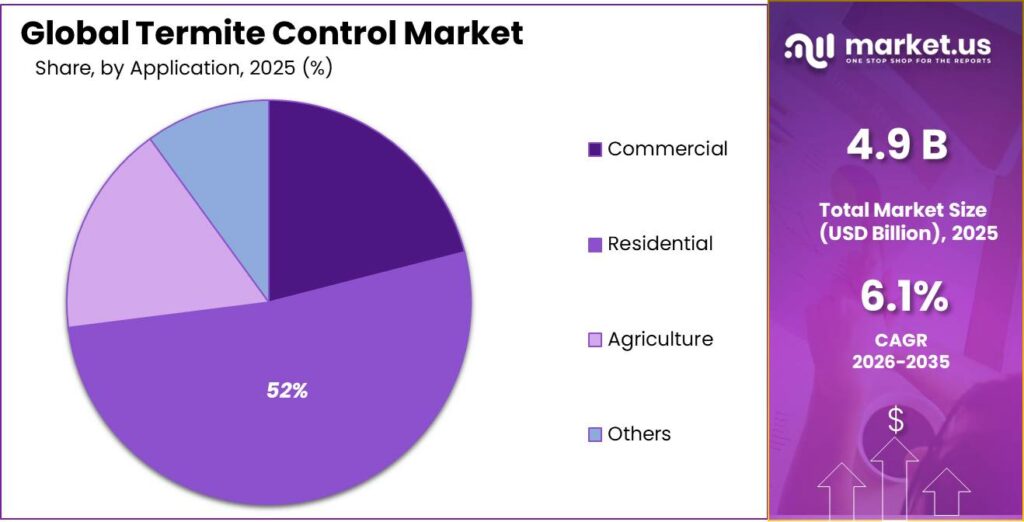
- Residential held a dominant market position, capturing more than a 52.7% share in the termite control market.
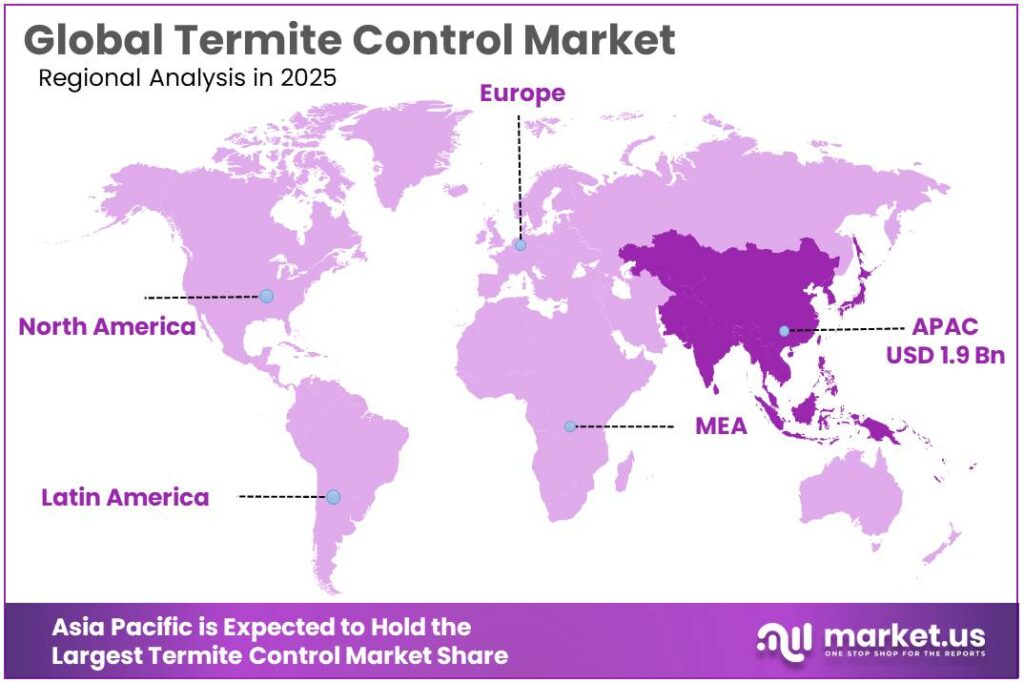
- Asia Pacific emerged as the dominating region in the termite control market, accounting for nearly 39.4% of the global share and reaching a market value of about USD 1.9 billion.
By Type Analysis
Subterranean dominates with 67.2% due to its widespread structural damage and global prevalence
In 2024, Subterranean held a dominant market position, capturing more than a 67.2% share in the termite control market by type. This strong position is mainly attributed to the widespread presence of subterranean termite species and their ability to cause extensive damage to wooden structures, building foundations, and agricultural crops. These termites live in underground colonies and build mud tubes to reach food sources, allowing them to infest buildings without being easily detected. Because of this hidden behavior, they are responsible for a large portion of termite-related structural damage across residential and commercial properties.
By Control Method Analysis
Chemical control dominates with 61.5% due to its fast action and reliable protection
In 2024, Chemical held a dominant market position, capturing more than a 61.5% share in the termite control market by control method. This dominance is mainly linked to the effectiveness and quick action of chemical treatments in eliminating termite colonies and protecting structures from further infestation. Chemical methods, including liquid termiticides, soil treatments, and wood treatments, are widely used in residential, commercial, and construction projects. These treatments create protective barriers around buildings, preventing termites from entering structures and damaging wooden components.
By Service Type Analysis
Post-Construction services dominate with 59.3% as most termite issues appear after buildings are occupied
In 2024, Post-Construction held a dominant market position, capturing more than a 59.3% share in the termite control market by service type. This leading position is mainly because a large number of termite infestations are detected after buildings are already constructed and occupied. Many homeowners and commercial property owners only become aware of termite problems once visible damage appears in wooden structures, furniture, doors, or flooring. As a result, pest control services that deal with existing infestations are in constant demand across residential, commercial, and industrial properties.
By Application Analysis
Residential leads with 52.7% as homeowners increasingly invest in termite protection
In 2024, Residential held a dominant market position, capturing more than a 52.7% share in the termite control market by application. This strong presence is largely due to the growing number of termite infestations reported in houses and residential buildings. Termites are known to damage wooden structures such as doors, window frames, flooring, furniture, and roof supports, making homes highly vulnerable to long-term structural problems. Because of this risk, homeowners increasingly rely on professional termite control services to protect their properties and prevent costly repairs.
Key Market Segments
By Type
- Subterranean
- Dry Wood
- Damp Wood
By Control Method
- Chemical
- Physical and Mechanical
- Biological
- Others
By Service Type
- Pre-Construction
- Post-Construction
By Application
- Commercial
- Residential
- Agriculture
- Others
Emerging Trends
Shift Toward Integrated and Eco-Friendly Pest Management in Termite Control
One of the most noticeable trends shaping the termite control industry today is the growing shift toward integrated and environmentally friendly pest management solutions. In the past, termite control relied heavily on chemical pesticides and termiticides. While these chemicals were effective in killing termite colonies, long-term environmental concerns and increasing pesticide resistance have encouraged governments, researchers, and farmers to adopt more sustainable approaches.
- According to the Food and Agriculture Organization (FAO), up to 40% of global crop production is lost every year due to plant pests and diseases, making pest control essential for food security and agricultural sustainability. These losses not only affect farmers’ incomes but also put pressure on global food supplies as the world population continues to grow. Because termites attack roots, stems, and woody plant materials, they are among the pests that contribute to agricultural damage in many tropical and subtropical regions.
Another factor driving this trend is the growing awareness of biodiversity and soil health. Termites themselves are part of natural ecosystems, and there are around 4,000 known termite species worldwide, many of which play beneficial roles in soil formation and organic matter decomposition. However, some species become destructive pests when they attack crops or wooden structures. Modern termite control strategies therefore focus on targeting harmful species while minimizing damage to beneficial organisms in the ecosystem.
Government initiatives and international agricultural programs are also supporting this transition toward sustainable pest control. Organizations such as the FAO and the International Plant Protection Convention (IPPC) actively promote environmentally responsible pest management practices. Many countries now encourage farmers to adopt integrated pest management through training programs, agricultural extension services, and national plant health campaigns.
Drivers
Rising Crop Losses Due to Termite Infestations Driving Demand for Termite Control
One of the major driving factors for the termite control industry is the increasing damage caused by termites to agricultural crops, food supply chains, and rural infrastructure. Termites are among the most destructive pests affecting plant materials because they feed mainly on cellulose found in wood, plant roots, stems, and crop residues. According to the Food and Agriculture Organization (FAO), termites feed almost entirely on plant-derived materials such as wood and crop residues, which makes them capable of causing significant economic damage to agriculture and natural ecosystems.
The impact of pest attacks on global agriculture is already very high, and termites are a key contributor to this problem in many tropical and subtropical regions. The FAO reports that up to 40% of global crop production is lost every year due to plant pests and diseases, creating serious pressure on food systems and farmer incomes. These losses also cost the global economy over USD 220 billion annually, highlighting how pest management has become essential for protecting food security.
Termites are particularly harmful to staple crops such as maize, wheat, sugarcane, cotton, coffee, and fruit trees. Studies in agricultural regions show that termite infestations can reduce crop productivity significantly. In rain-fed agricultural systems, termite attacks have been observed to affect around 20–25% of crops, while irrigated farming systems report approximately 10% crop damage due to termite activity. These losses directly impact farmer income and food availability, especially in developing countries where agriculture supports large populations.
In several regions, termites have also been reported to cause extremely high damage to specific crops. Research on wheat farming has shown that termite infestation can damage 18% to nearly 28% of plants at crop maturity, while some field observations have recorded 20–40% yield losses in vulnerable farming areas. Such losses push farmers to adopt chemical soil treatments, baiting systems, and biological pest control methods to protect their fields and maintain stable production levels.
Restraints
Strict Environmental Regulations on Chemical Termiticides Limiting Market Expansion
One of the major restraining factors affecting the termite control industry is the growing concern about the environmental and health impacts of chemical pesticides used in termite treatments. Most traditional termite control solutions rely heavily on chemical termiticides that are applied to soil, wood, or building foundations to eliminate termite colonies.
According to the Food and Agriculture Organization (FAO), total pesticide use in agriculture reached 3.70 million tonnes of active ingredients in 2022, marking a 4% increase from 2021 and a 13% increase over the previous decade. The same data also shows that pesticide use has more than doubled since 1990, reflecting the growing dependence on chemical pest control solutions worldwide. However, this rising usage has triggered stricter regulatory frameworks in many countries, particularly for chemicals that may affect ecosystems or human health.
As a result, several governments now require extensive testing and approval procedures before a new pesticide or termiticide can be introduced to the market. International guidelines such as the FAO and World Health Organization (WHO) International Code of Conduct on Pesticide Management encourage governments to regulate pesticides throughout their lifecycle—from manufacturing to disposal—to reduce environmental risks and ensure safe use.
The rising global focus on sustainable agriculture and environmental protection is further influencing how termite control solutions are developed and applied. The FAO Statistical Yearbook 2024 highlights that pesticide use worldwide increased by around 70% between 2000 and 2022, a trend that has prompted governments and environmental organizations to push for safer pest management approaches.
Opportunity
Growing Need for Sustainable Pest Management in Agriculture Creating New Opportunities
One major growth opportunity for the termite control industry comes from the increasing global focus on protecting crops and improving agricultural productivity. Agriculture remains the backbone of food supply systems, and protecting crops from pests—including termites—has become a priority for farmers, governments, and international organizations. Termites can damage plant roots, stems, and stored organic materials, making them a serious threat to crops such as maize, cotton, coffee, sugarcane, and fruit trees.
A major concern driving this opportunity is the high level of crop losses caused by pests globally. According to the Food and Agriculture Organization (FAO), up to 40% of global crop production is lost every year due to plant pests and diseases, which significantly affects food security and farmer incomes. These losses are not only agricultural problems but also major economic challenges. The same FAO data indicates that plant diseases alone cost the global economy more than USD 220 billion annually, while invasive insects cause an additional USD 70 billion in economic damage each year.
Another reason this creates strong growth potential for termite control is the rising global demand for food. FAO estimates that global food production will need to increase by about 50% by 2050 to meet the needs of the growing population. A large portion of this additional demand is expected to come from plant-based food products such as grains, vegetables, fruits, and oilseeds. Protecting crops from pest damage is therefore a key requirement to maintain stable food production and prevent supply shortages.
Government initiatives and global programs focused on plant health are also supporting this opportunity. The United Nations and FAO introduced global plant health initiatives, including the celebration of the International Day of Plant Health, to encourage countries to strengthen pest monitoring and control systems. These initiatives highlight that protecting plants from pests is critical for ensuring global food security and maintaining healthy agricultural ecosystems.
Regional Insights
Asia Pacific dominates the termite control market with 39.4% share valued at around USD 1.9 Billion
Asia Pacific emerged as the dominating region in the termite control market, accounting for nearly 39.4% of the global share and reaching a market value of about USD 1.9 billion. The region’s strong position is mainly supported by its large population base, rapid urbanization, and extensive agricultural activities. Countries such as China, India, Indonesia, Japan, and Australia are major contributors to regional demand, as both residential infrastructure and farming activities are highly vulnerable to termite infestations.
Termites are known to damage wooden structures, crop roots, stored grains, and plantation crops, making pest control services essential across many industries. Globally, termites are estimated to cause more than USD 40 billion in economic damage each year, including losses to buildings, forests, and agricultural production.
The region’s growing urban construction sector is another important factor supporting termite control demand. Asia Pacific contains some of the world’s fastest-growing cities, which has resulted in a continuous rise in residential housing projects, commercial infrastructure, and industrial development. Termite prevention treatments are commonly used in pre-construction and post-construction building protection to safeguard structures made of wood and cellulose materials.
Another supporting factor is the strong growth of crop protection industries in the region. The Asia Pacific crop protection chemicals sector was valued at around USD 24.18 billion in 2024 and expected to reach USD 25.22 billion in 2025, highlighting the rising adoption of pest management technologies in farming and horticulture. These developments indirectly support termite control solutions because farmers and agricultural authorities increasingly invest in pest monitoring, chemical treatments, and biological control technologies.
Key Regions and Countries Insights
- North America
- US
- Canada
- Europe
- Germany
- France
- The UK
- Spain
- Italy
- Rest of Europe
- Asia Pacific
- China
- Japan
- South Korea
- India
- Australia
- Rest of APAC
- Latin America
- Brazil
- Mexico
- Rest of Latin America
- Middle East & Africa
- GCC
- South Africa
- Rest of MEA
Key Players Analysis
BASF SE is a major participant in the termite control ecosystem through its crop protection and pest management solutions. The company operates in more than 90 countries and generated around €68.9 billion in total revenue in 2023. BASF invests heavily in innovation, allocating nearly €2.1 billion annually to research and development, supporting new pest control technologies. Its agricultural solutions segment contributed roughly €10.1 billion in sales in 2023, including insecticides and soil treatment products used in termite management.
Bayer AG is a global leader in crop science and pest management products that support termite control in agriculture and structural protection. The company reported approximately €47.6 billion in total revenue in 2023 and operates in over 80 countries worldwide. Bayer’s Crop Science division generated around €22.3 billion in sales in 2023, offering insecticides and pest management technologies used to control soil-dwelling pests such as termites. Bayer also invested about €5.8 billion in research and development in 2023 to strengthen agricultural innovation.
Syngenta Group is one of the largest agricultural technology companies supporting pest management solutions worldwide. The company operates in over 100 countries and reported around USD 32.2 billion in total sales in 2023. Syngenta’s Crop Protection division generated approximately USD 13.5 billion in revenue, including insecticides used for soil pest and termite control in farming systems. The company invests strongly in innovation, spending about USD 1.4 billion annually on research and development to improve crop protection technologies.
Top Key Players Outlook
- BASF SE
- Bayer AG
- Syngenta Group
- Corteva Agriscience
- FMC Corporation
- UPL Ltd.
- Nufarm Ltd.
- Sumitomo Chemical Co., Ltd.
- Terra Agro Biotech Pvt Ltd
- Sinon Corporation
Recent Industry Developments
BASF reported €65.3 billion in total global sales in 2024, reflecting its strong presence in the global chemical and agricultural technology industry.
In 2025, FMC also reported USD 1.22 billion in revenue in the fourth quarter of 2024, showing a 7% increase compared with the same period in 2023, driven by stronger sales of new crop protection products.
Report Scope
Report Features Description Market Value (2025) USD 4.9 Bn Forecast Revenue (2035) USD 8.9 Bn CAGR (2026-2035) 6.1% Base Year for Estimation 2025 Historic Period 2020-2024 Forecast Period 2026-2035 Report Coverage Revenue Forecast, Market Dynamics, Competitive Landscape, Recent Developments Segments Covered By Type (Subterranean, Dry Wood, Damp Wood), By Control Method (Chemical, Physical and Mechanical, Biological, Others), By Service Type (Pre-Construction, Post-Construction), By Application (Commercial, Residential, Agriculture, Others) Regional Analysis North America – US, Canada; Europe – Germany, France, The UK, Spain, Italy, Rest of Europe; Asia Pacific – China, Japan, South Korea, India, Australia, Singapore, Rest of APAC; Latin America – Brazil, Mexico, Rest of Latin America; Middle East & Africa – GCC, South Africa, Rest of MEA Competitive Landscape BASF SE, Bayer AG, Syngenta Group, Corteva Agriscience, FMC Corporation, UPL Ltd., Nufarm Ltd., Sumitomo Chemical Co., Ltd., Terra Agro Biotech Pvt Ltd, Sinon Corporation Customization Scope Customization for segments, region/country-level will be provided. Moreover, additional customization can be done based on the requirements. Purchase Options We have three licenses to opt for: Single User License, Multi-User License (Up to 5 Users), Corporate Use License (Unlimited User and Printable PDF) 
-
-
- BASF SE
- Bayer AG
- Syngenta Group
- Corteva Agriscience
- FMC Corporation
- UPL Ltd.
- Nufarm Ltd.
- Sumitomo Chemical Co., Ltd.
- Terra Agro Biotech Pvt Ltd
- Sinon Corporation
Our Clients

- 180383
- Mar 2026






