Global Synthetic Email Monitoring Market By Component (Solution (API Monitoring, SaaS Application Monitoring), Services (Managed Services, Professional Services)), By Deployment Mode (On-Premises, Cloud), By Organization Size (Large Enterprises, Small and Medium Enterprises (SMEs)), By Application (Security Monitoring, Performance Monitoring, Others), By End-User (BFSI, Healthcare, IT and Telecommunications, Others),By Regional Analysis, Global Trends and Opportunity, Future Outlook By 2025-2035
- Published date: Mar. 2026
- Report ID: 180429
- Number of Pages: 220
- Format:
-
keyboard_arrow_up
Quick Navigation
- Report Overview
- Top Market Takeaways
- Drivers Impact Analysis
- Restraints Impact Analysis
- By Component
- By Deployment Mode
- By Organization Size
- By Application
- By End-User
- Investor Type Impact Matrix
- Technology Enablement Analysis
- Key Challenges
- Emerging Trends
- Growth Factors
- Key Market Segments
- Regional Analysis
- Competitive Analysis
- Future Outlook
- Recent Developments
- Report Scope
Report Overview
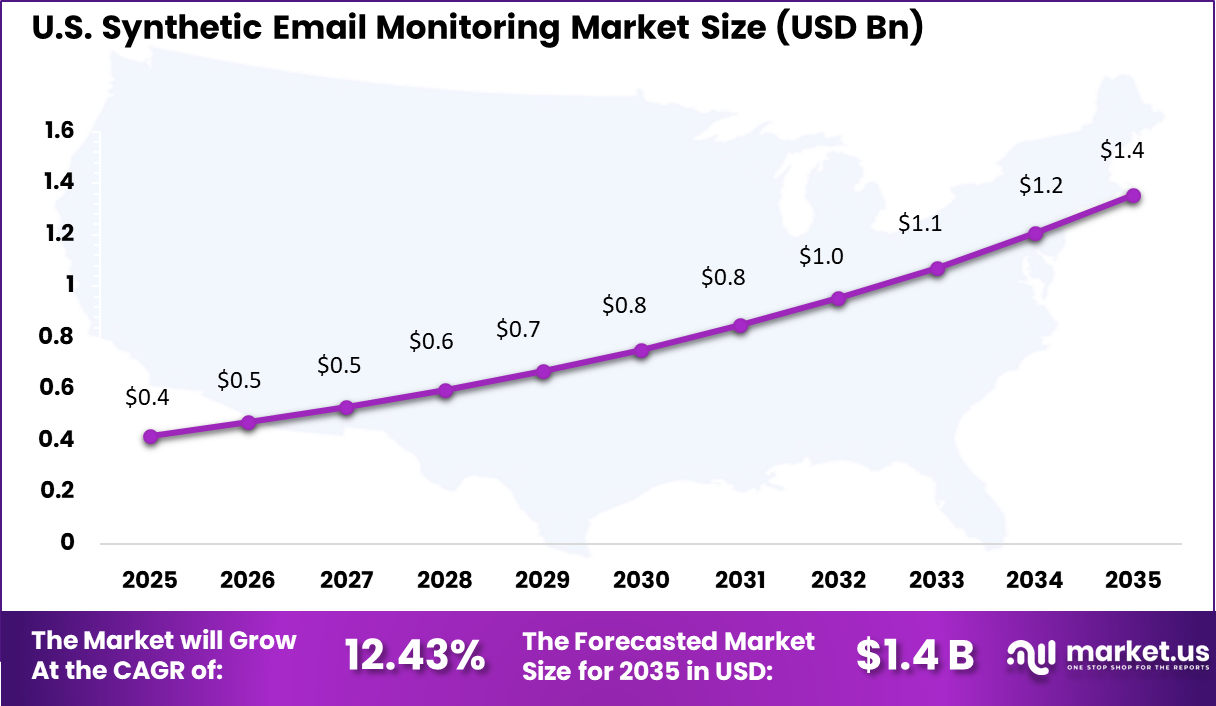
The Global Synthetic Email Monitoring Market generated USD 1.3 billion in 2025 and is predicted to register growth from USD 1.5 billion in 2026 to about USD 4.9 billion by 2035, recording a CAGR of 14.50% throughout the forecast span. In 2025, North America held a dominan market position, capturing more than a 37.53% share, holding USD 0.47 Billion revenue.
The synthetic email monitoring market refers to digital monitoring solutions designed to test and evaluate the performance, reliability, and deliverability of email systems using automated simulated email transactions. These platforms generate synthetic email messages that replicate real user interactions in order to monitor mail server performance, delivery time, spam filtering behavior, and system availability.
Email communication remains a critical component of business operations, customer engagement, and digital service delivery. Organizations depend on reliable email systems for transactional messages, customer notifications, and internal communication. Synthetic email monitoring tools allow IT teams to proactively track system performance, detect delays or failures in message delivery, and maintain consistent service quality across email platforms.
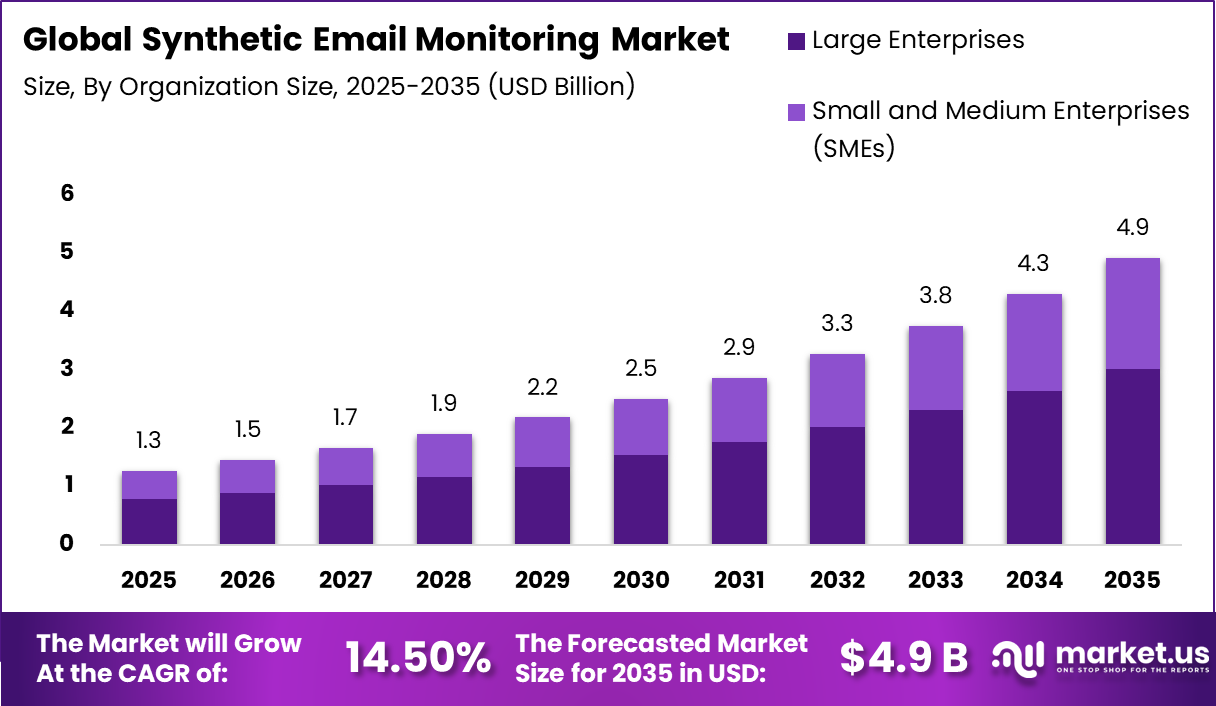
One of the key growth factors driving the synthetic email monitoring market is the increasing reliance on email communication for business operations and customer interactions. Companies use email for transactional notifications, security alerts, marketing communications, and customer service responses. Ensuring the reliability and deliverability of these messages has become essential for maintaining operational continuity and customer satisfaction.
Another growth factor is the growing adoption of cloud-based email services and enterprise communication platforms. As organizations migrate email infrastructure to cloud environments, monitoring tools are required to verify system availability and ensure that messages are delivered without delays or disruptions. Synthetic monitoring provides continuous visibility into the performance of these distributed systems.
Top Market Takeaways
- By Component, solutions dominate with 67.8% share, generating synthetic attack simulations, behavioral baselines, and automated deception networks to harden email ecosystems.
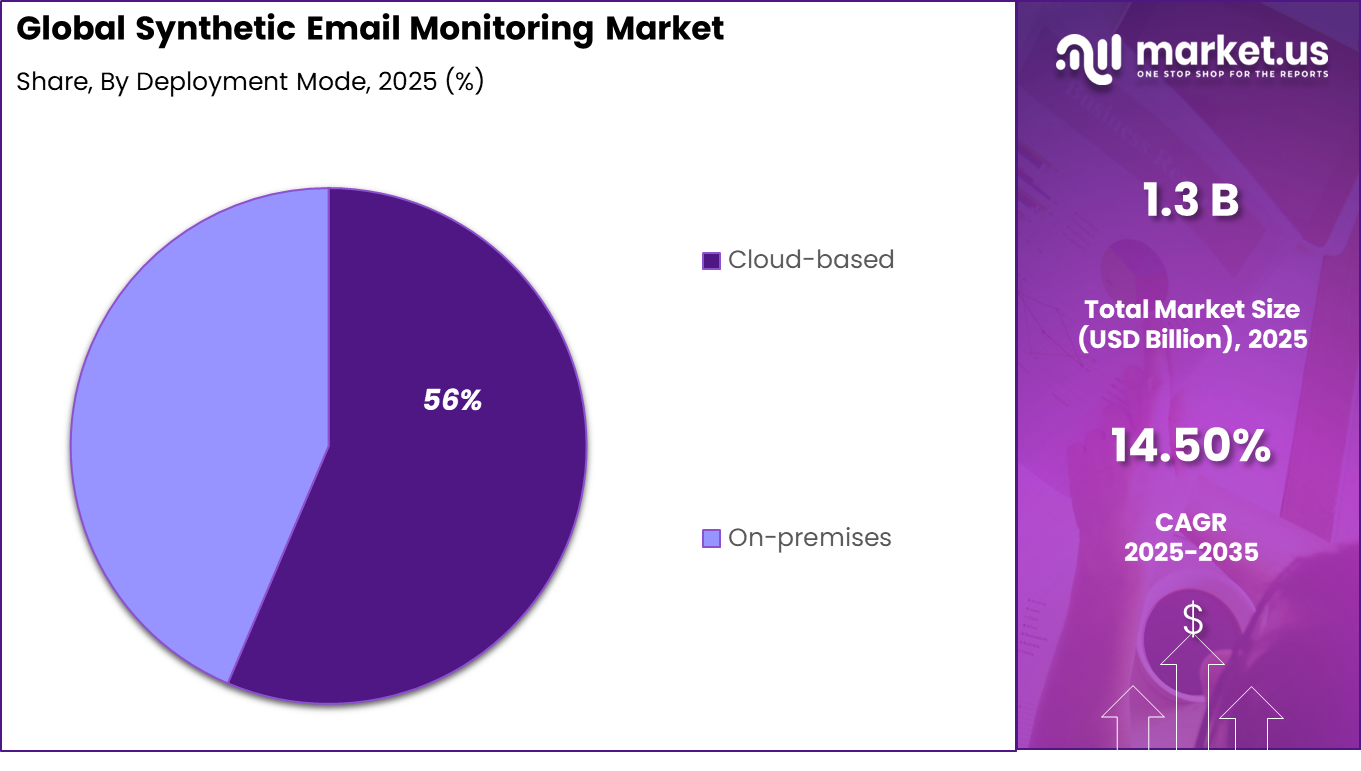
- By Deployment Mode, cloud-based captures 56.4%, enabling scalable canary deployments, real-time threat feeds, and cross-domain email telemetry aggregation.
- By Organization Size, large enterprises hold 61.35%, orchestrating enterprise-grade honeypots across Office 365, Gmail, and on-prem servers with unified alerting.
- By Application, security monitoring leads at 42.3%, providing continuous synthetic payload testing, click analytics, and credential harvesting detection.
- By End-User, BFSI commands 24.61%, protecting wire transfer approvals, executive impersonations, and regulatory-compliant email audit trails.
- Regionally, North America accounts for 37.53% global share, with the U.S. market valued at USD 0.42 billion and a CAGR of 12.43%, driven by SEC email security mandates and AI-powered social engineering defenses.
Drivers Impact Analysis
Key Drivers Impact on CAGR Forecast (~%) Geographic Relevance Impact Timeline Strategic Importance Rising Sophistication of Phishing and Email-based Fraud +4.1% Global Short to Long Term Increases the need for advanced monitoring systems Increasing Regulatory Requirements for Email Security +3.3% North America, Europe Medium Term Drives demand for compliance-driven email monitoring High Adoption of Cloud-based Email Platforms +2.7% North America, APAC Medium to Long Term Expands email monitoring opportunities across cloud environments Growing Use of Synthetic Email Campaigns for Fraud +2.4% Global Medium Term Encourages organizations to adopt synthetic email detection solutions Demand for Real-time Threat Detection and Prevention +1.9% Global Short to Medium Term Improves proactive defense mechanisms Restraints Impact Analysis
Key Restraints Impact on CAGR Forecast (~%) Geographic Relevance Impact Timeline Market Constraint Level High Implementation and Maintenance Costs -2.1% Emerging Markets Short to Medium Term Limits adoption, particularly for SMEs Complexity in Integrating with Existing IT Systems -1.8% Global Medium Term Slows deployment in legacy environments Limited Awareness of Synthetic Email Threats -1.5% Emerging Markets Short to Medium Term Reduces the pace of early adoption False Positives in Synthetic Email Detection -1.2% Global Medium Term Affects user trust and system efficiency By Component
Solutions account for 67.8% of the market, reflecting the growing adoption of specialized platforms designed to simulate and monitor email system performance. These solutions perform automated tests that replicate real email interactions, enabling organizations to identify issues related to delivery delays, server performance, or authentication failures. By detecting potential problems early, enterprises can maintain stable communication networks.
The dominance of solution platforms is also supported by their ability to integrate with enterprise IT monitoring environments. Automated reporting and alert mechanisms help IT teams respond quickly to disruptions. As organizations prioritize system uptime and operational continuity, synthetic monitoring solutions remain central to email infrastructure management.
By Deployment Mode
Cloud based deployment represents 56.4% of the market, indicating strong demand for scalable monitoring systems that can operate across distributed infrastructure environments. Cloud platforms allow organizations to simulate email transactions from multiple geographic locations, providing a broader view of system performance. This approach improves visibility into service reliability across global operations.
Cloud based monitoring also reduces infrastructure management complexity and enables faster deployment of monitoring tools. Enterprises benefit from centralized dashboards and real time performance analytics accessible through web based interfaces. As organizations expand cloud based communication platforms, cloud deployment continues to gain strong adoption.
By Organization Size
Large enterprises account for 61.35% of market adoption due to their extensive communication infrastructure and large employee networks. These organizations rely heavily on email systems for internal coordination, customer communication, and business operations. Continuous monitoring helps ensure reliable service availability and protects against communication disruptions.
Large enterprises also face higher risks related to system outages and security breaches. Synthetic monitoring tools allow IT teams to proactively test system performance and identify weaknesses. As enterprise communication environments become more complex, large organizations remain the primary adopters of synthetic email monitoring platforms.
By Application
Security monitoring represents 42.3% of the market application due to the increasing number of cyber threats targeting email systems. Email platforms are frequently used as entry points for phishing attacks, malware distribution, and unauthorized access attempts. Synthetic monitoring tools help detect abnormal system behavior and identify potential security vulnerabilities.
Organizations also use monitoring platforms to evaluate authentication protocols and encryption systems. Continuous testing ensures that security controls function correctly across email infrastructure. As cybersecurity concerns continue to rise, security monitoring remains a key application within the market.
By End-User
The BFSI sector accounts for 24.61% of market adoption due to strict regulatory requirements and heavy reliance on secure communication systems. Financial institutions handle sensitive transactional information and customer data through email channels. Synthetic monitoring platforms help ensure that these communication systems remain reliable and secure.
Financial organizations also require continuous monitoring to maintain compliance with security standards and regulatory frameworks. Automated monitoring tools provide detailed insights into system performance and potential vulnerabilities. As financial services increasingly depend on digital communication channels, the BFSI sector continues to adopt advanced monitoring technologies.
Investor Type Impact Matrix
Investor Type Growth Sensitivity Risk Exposure Geographic Focus Investment Outlook Venture Capital High Medium to High North America, Europe Focus on cybersecurity and email threat detection startups Private Equity Medium to High Medium North America, Europe Attractive recurring revenue SaaS models for email security solutions Strategic Cybersecurity Firms High Medium Global Integration with broader enterprise security suites Institutional Investors Medium Medium Developed Markets Long-term investments in cybersecurity infrastructure Government-backed Cybersecurity Funds Medium Low North America, Europe Focus on email security and fraud prevention initiatives Technology Enablement Analysis
Technology Enabler Impact on CAGR Forecast (~%) Geographic Relevance Impact Timeline Adoption Momentum AI-powered Email Filtering and Detection Systems +4.3% North America, Europe Medium to Long Term Enhances detection accuracy and reduces false positives Cloud-based Email Security Platforms +3.5% Global Medium Term Supports scalable, cost-effective solutions Machine Learning for Synthetic Email Recognition +2.8% North America, Europe Medium to Long Term Improves detection of evolving email threats Blockchain for Email Authentication and Verification +2.2% Global Long Term Strengthens email trust and authenticity Multi-layered Email Security Solutions +1.9% Global Medium Term Provides comprehensive defense against synthetic emails Key Challenges
- Difficulty in accurately detecting and filtering out synthetic or fake email addresses
- High volume of false positives leading to important emails being blocked or flagged
- Integration challenges with existing email systems and security platforms
- Evolving tactics used by malicious actors to bypass monitoring systems
- Privacy concerns when monitoring and analyzing email content for synthetic activity
Emerging Trends
In the Synthetic Email Monitoring market, a key trend is the increasing focus on detecting and preventing synthetic email attacks, where cybercriminals create fake email addresses that mimic real ones to deceive users. Organisations are implementing advanced monitoring systems that analyse email behaviour patterns, looking for signs of irregularities or anomalies in the sender’s domain, frequency of interactions, and content structure.
This trend reflects the need for more proactive measures to combat phishing, spoofing, and other fraudulent activities. Another emerging pattern is the integration of machine learning algorithms that continually learn from new threats, helping to improve detection accuracy and reduce false positives over time.
Growth Factors
A major growth factor in this market is the increasing frequency of email-based attacks such as phishing and impersonation. As email remains one of the primary communication tools for businesses, the risk of these threats continues to grow. Organisations are recognising the need for more robust systems to detect and prevent synthetic emails, which can lead to significant security breaches.
Additionally, as businesses expand their digital operations and communication channels, there is a greater reliance on automated systems to ensure ongoing email security, pushing the demand for synthetic email monitoring tools.
Key Market Segments
By Component
- Solution
- API Monitoring
- SaaS Application Monitoring
- Mobile Application Monitoring
- Web Application Monitoring
- Services
- Managed Services
- Professional Services
By Deployment Mode
- On-Premises
- Cloud
By Organization Size
- Large Enterprises
- Small and Medium Enterprises (SMEs)
By Application
- Security Monitoring
- Performance Monitoring
- Compliance Management
- Others
By End-User
- BFSI
- Healthcare
- IT and Telecommunications
- Retail and E-commerce
- Government and Defense
- Automotive
- Media & Entertainment
- Others
Regional Analysis
North America holds 37.53% of the synthetic email monitoring market, supported by increasing concerns over email fraud, phishing attacks, and the need for more robust email security systems. Organizations across industries, including finance, healthcare, and retail, are adopting synthetic email monitoring solutions to detect and block fraudulent email activity and ensure secure communication. Demand is driven by the rising volume of synthetic identity fraud and the growing reliance on email for sensitive business transactions.
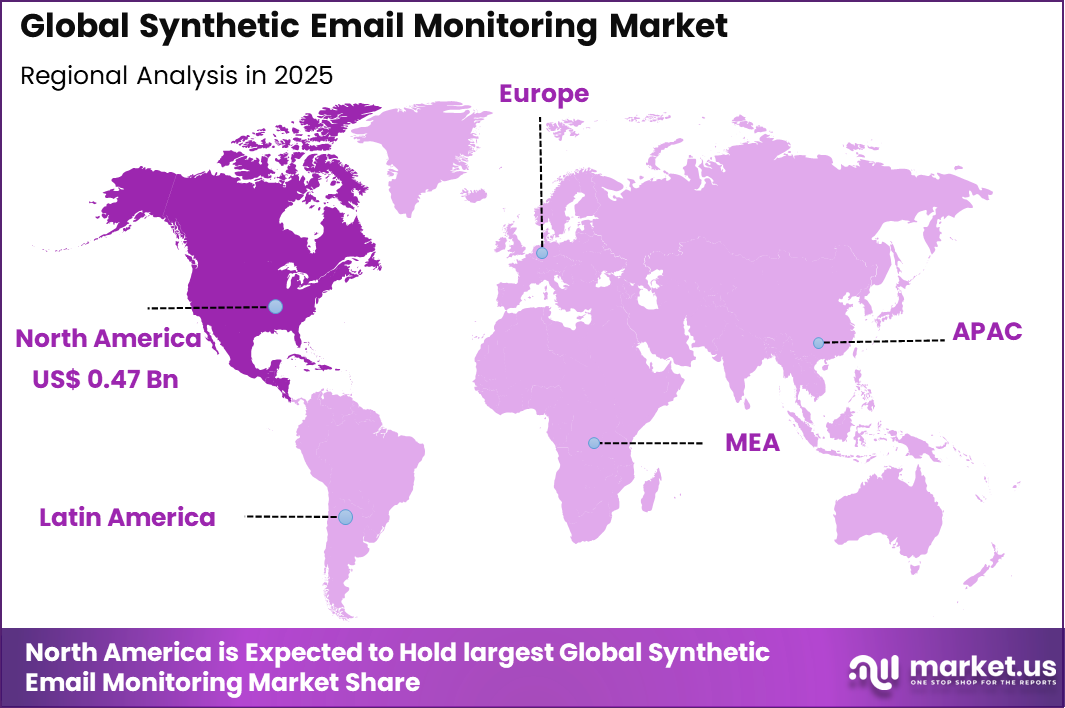
The U.S. market is valued at USD 0.42 Billion and is expanding at a CAGR of 12.43%, reflecting the increasing need for automated email security systems to protect businesses from impersonation, phishing, and spam. Adoption is influenced by the widespread use of email in corporate communication, the complexity of fraudulent tactics, and the regulatory pressure to safeguard consumer and organizational data. Growth is further supported by advancements in AI and machine learning technologies, which enhance the detection and prevention of synthetic email threats.
Key Regions and Countries
- North America
- US
- Canada
- Europe
- Germany
- France
- The UK
- Spain
- Italy
- Russia
- Netherlands
- Rest of Europe
- Asia Pacific
- China
- Japan
- South Korea
- India
- Australia
- Singapore
- Thailand
- Vietnam
- Rest of APAC
- Latin America
- Brazil
- Mexico
- Rest of Latin America
- Middle East & Africa
- South Africa
- Saudi Arabia
- UAE
- Rest of MEA
Competitive Analysis
The Synthetic Email Monitoring Market is supported by enterprise monitoring and observability platform providers that deliver performance tracking tools for business communication systems. SolarWinds, Cisco, Broadcom, and OpenText provide infrastructure monitoring platforms that include email service performance testing and uptime tracking features. These systems allow organizations to simulate user interactions with email services to detect latency, delivery failures, and authentication issues.
Application performance monitoring vendors contribute advanced analytics and automated testing capabilities. Dynatrace, Splunk, New Relic, and Datadog provide real time monitoring tools supported by AI driven analytics. Their platforms track email server availability, response time, and service performance across distributed networks. Continuous improvements in observability technologies have strengthened their ability to support complex enterprise communication infrastructures.
Specialized monitoring and testing platforms further enhance the competitive landscape. Nagios Enterprises, Paessler AG, LogicMonitor, ManageEngine, Uptrends, Pingdom, Catchpoint, SmartBear, Site24x7, Dotcom-Monitor, and Riverbed Technology deliver synthetic testing and performance diagnostics tools designed to monitor email workflows and infrastructure stability.
Top Key Players in the Market
- SolarWinds
- Paessler AG (PRTG Network Monitor)
- Nagios Enterprises
- Dynatrace
- Broadcom
- Cisco
- Micro Focus (OpenText)
- Splunk
- LogicMonitor
- ManageEngine
- New Relic
- Datadog
- Uptrends
- Pingdom
- Catchpoint
- SmartBear
- Site24x7
- Dotcom-Monitor
- Riverbed Technology
- Others
Future Outlook
The future outlook for the Synthetic Email Monitoring Market is positive as businesses increasingly focus on detecting and preventing fraud and security threats in email communications. Synthetic email monitoring solutions help identify fake or fraudulent email accounts and protect organizations from phishing, spam, and other email-based attacks. As cyber threats continue to evolve and email remains a primary communication channel, the demand for these monitoring tools is expected to grow. Overall, the market is likely to expand as businesses prioritize email security and proactive threat detection.
Recent Developments
- October, 2025 – SolarWinds added synthetic email testing to Pingdom. Teams now simulate inbox placement across 80 providers. False delivery rates dropped 25% for marketing campaigns. The feature runs automated checks every 15 minutes. It flags spam traps before launch. Users integrate with ServiceNow for instant alerts on deliverability issues.
- November, 2025 – Dynatrace launched OneAgent for email synthetic monitoring. It tracks render times and link performance from 50 global locations. Enterprises cut troubleshooting from hours to minutes. Davis AI correlates email failures with server events. Real user monitoring blends with synthetics for complete visibility. Finance teams report 40 percent faster campaign fixes.
Report Scope
Report Features Description Market Value (2025) USD 1.3 Billion Forecast Revenue (2035) USD 4.9 Billion CAGR(2025-2035) 14.50% Base Year for Estimation 2024 Historic Period 2020-2024 Forecast Period 2025-2035 Report Coverage Revenue forecast, AI impact on Market trends, Share Insights, Company ranking, competitive landscape, Recent Developments, Market Dynamics and Emerging Trends Segments Covered By Component (Solution (API Monitoring, SaaS Application Monitoring), Services (Managed Services, Professional Services)), By Deployment Mode (On-Premises, Cloud), By Organization Size (Large Enterprises, Small and Medium Enterprises (SMEs)), By Application (Security Monitoring, Performance Monitoring, Others) Regional Analysis North America – US, Canada; Europe – Germany, France, The UK, Spain, Italy, Russia, Netherlands, Rest of Europe; Asia Pacific – China, Japan, South Korea, India, New Zealand, Singapore, Thailand, Vietnam, Rest of Latin America; Latin America – Brazil, Mexico, Rest of Latin America; Middle East & Africa – South Africa, Saudi Arabia, UAE, Rest of MEA Competitive Landscape SolarWinds, Paessler AG (PRTG Network Monitor), Nagios Enterprises, Dynatrace, Broadcom, Cisco, Micro Focus (OpenText), Splunk, LogicMonitor, ManageEngine, New Relic, Datadog, Uptrends, Pingdom, Catchpoint, SmartBear, Site24x7, Dotcom-Monitor, Riverbed Technology, Others Customization Scope Customization for segments, region/country-level will be provided. Moreover, additional customization can be done based on the requirements. Purchase Options We have three license to opt for: Single User License, Multi-User License (Up to 5 Users), Corporate Use License (Unlimited User and Printable PDF)  Synthetic Email Monitoring MarketPublished date: Mar. 2026add_shopping_cartBuy Now get_appDownload Sample
 -
-
- SolarWinds
- Paessler AG (PRTG Network Monitor)
- Nagios Enterprises
- Dynatrace
- Broadcom
- Cisco
- Micro Focus (OpenText)
- Splunk
- LogicMonitor
- ManageEngine
- New Relic
- Datadog
- Uptrends
- Pingdom
- Catchpoint
- SmartBear
- Site24x7
- Dotcom-Monitor
- Riverbed Technology
- Others
Our Clients

- 180429
- Mar. 2026