


Global Swimming Pool Heaters Market Size, Share, Growth Analysis By Product Type (Electric Pool Heaters, Gas Pool Heaters, Solar Pool Heaters, Heat Pumps), By Pool Type (In-ground Pools, Above-ground Pools), By Fuel Type (Electric, Natural Gas, Solar, Propane), By Application (Residential, Commercial), By Region and Companies - Industry Segment Outlook, Market Assessment, Competition Scenario, Statistics, Trends and Forecast 2026-2035
- Published date: Feb 2026
- Report ID: 177974
- Number of Pages: 294
- Format:
-
keyboard_arrow_up
Quick Navigation
Report Overview
The Global Swimming Pool Heaters Market size is expected to be worth around USD 5.1 Billion by 2035 from USD 3.2 Billion in 2025, growing at a CAGR of 4.7% during the forecast period 2026 to 2035.
Swimming pool heaters are specialized systems designed to maintain optimal water temperatures for residential and commercial pools. These devices utilize various heating mechanisms including electric resistance, gas combustion, solar energy absorption, and heat pump technology to extend swimming seasons beyond natural climate limitations.
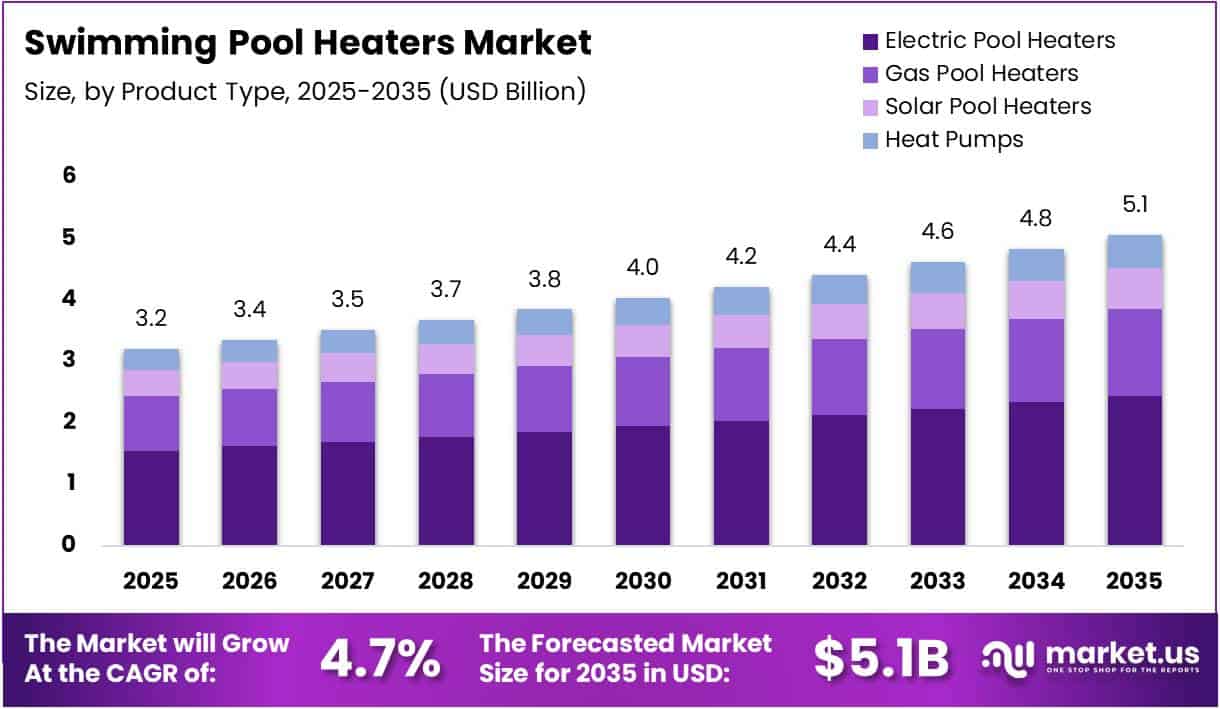
The market encompasses diverse product categories tailored to different pool configurations and consumer preferences. Electric heaters offer precise temperature control, while gas heaters provide rapid heating capabilities. Solar systems deliver sustainable heating solutions, and heat pumps combine efficiency with environmental benefits for modern pool owners.
Market growth is driven by rising residential pool construction in urban developments and increasing demand for year-round swimming access. Moreover, technological advancements in energy-efficient heating systems are reshaping consumer purchasing decisions. The integration of smart controls and renewable energy sources further accelerates market expansion across developed economies.
Government initiatives promoting energy efficiency standards are influencing product development strategies. Additionally, stringent environmental regulations on refrigerants push manufacturers toward eco-friendly alternatives. These regulatory frameworks create both opportunities and challenges for industry stakeholders seeking competitive advantages in sustainable pool heating solutions.
Investment in research and development continues to fuel innovation in pool heating technologies. Consequently, manufacturers are introducing inverter-based heat pumps and IoT-enabled control systems to meet evolving consumer expectations. The retrofitting demand from aging pool installations presents substantial growth opportunities for replacement equipment across mature markets.
According to Pool Magazine, only 55% of American pool owners reported being aware of eco-friendly solar heating options that increase pool temperature, suggesting potential consumer education gaps. Furthermore, according to Fluidra, a typical pool heater lasts around 10 to 15 years with proper maintenance, indicating consistent replacement cycles.
According to Local Energy Codes, approximately 53% of residential swimming pools in California have some form of pool heating installed. According to ZNFU, solar pool heating systems can reduce pool heating costs by up to 70% compared to conventional heating methods, making them appealing for energy-conscious homeowners seeking long-term operational savings.
Key Takeaways
- The Global Swimming Pool Heaters Market is projected to reach USD 5.1 Billion by 2035 from USD 3.2 Billion in 2025, growing at a CAGR of 4.7% during the forecast period 2025 to 2035.
- Electric Pool Heaters dominate the By Product Type segment with 48.2% market share in 2025.
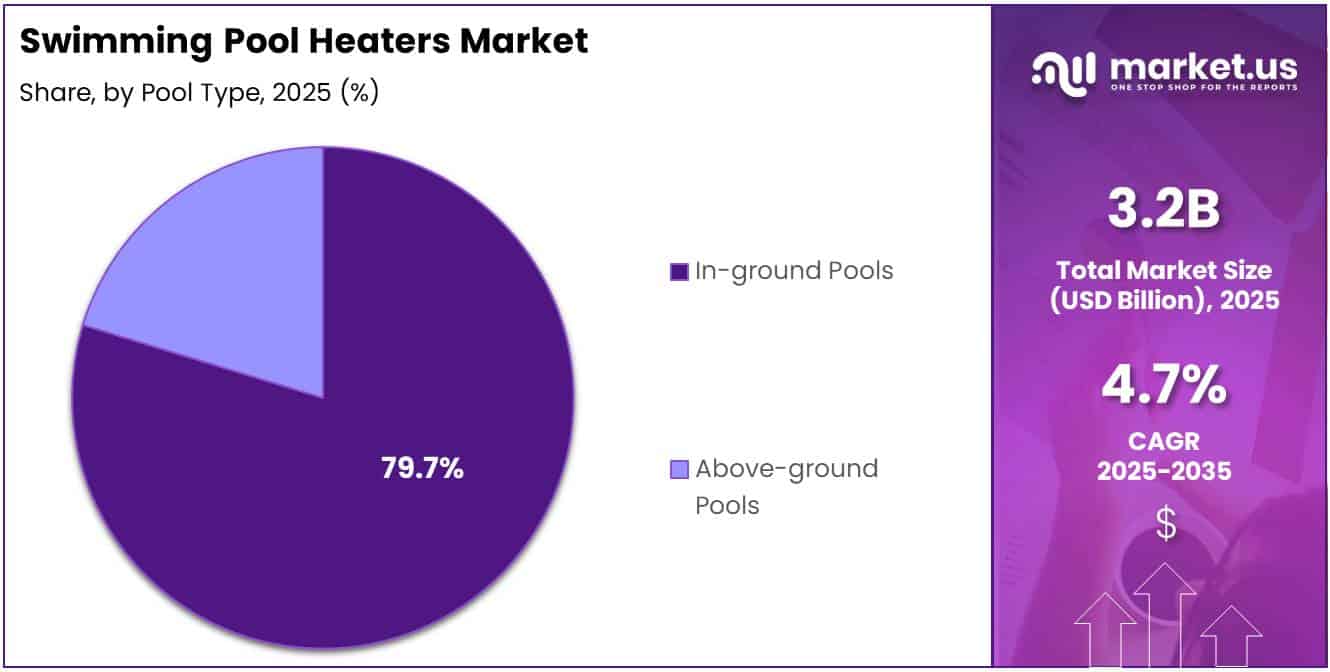
- In-ground Pools hold 79.7% share in the By Pool Type segment during 2025.
- Electric fuel type leads with 49.1% market share in the By Fuel Type segment in 2025.
- Residential applications command 65.6% share in the By Application segment for 2025.
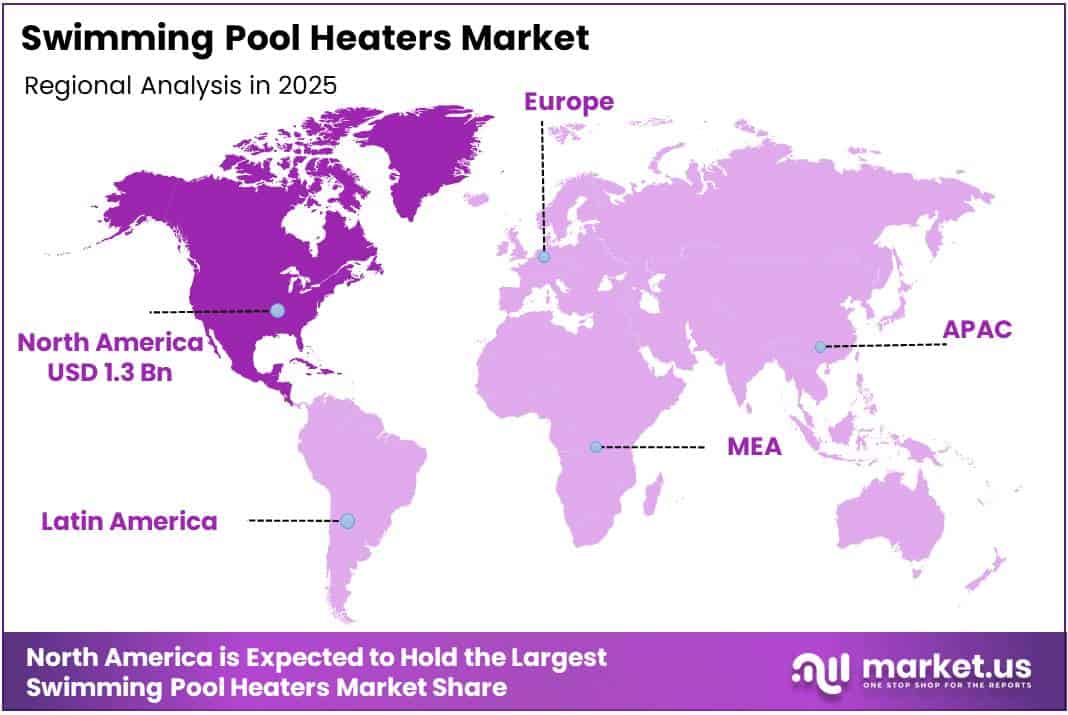
- North America dominates the regional market with 42.80% share, valued at USD 1.3 Billion in 2025.
Product Type Analysis
Electric Pool Heaters dominates with 48.2% due to precise temperature control and operational reliability.
In 2025, Electric Pool Heaters held a dominant market position in the By Product Type segment of Swimming Pool Heaters Market, with a 48.2% share. These systems deliver consistent heating performance regardless of weather conditions, making them preferred choices for residential and commercial pool owners. Their ease of installation and minimal maintenance requirements contribute significantly to widespread market adoption.
Gas Pool Heaters offer rapid heating capabilities that appeal to commercial facilities requiring quick temperature adjustments. These units utilize natural gas or propane combustion to generate heat efficiently. However, operating costs and environmental concerns influence purchasing decisions, particularly in regions with stringent emissions regulations affecting long-term market penetration strategies.
Solar Pool Heaters represent sustainable heating alternatives leveraging renewable energy sources to reduce operational expenses. These systems require significant initial investment but deliver substantial cost savings over extended operational periods. Growing environmental awareness among consumers drives increasing adoption rates, especially in sunny climates where solar efficiency maximizes heating performance and return on investment.
Heat Pumps combine energy efficiency with environmental benefits by extracting ambient heat from surrounding air. These systems offer lower operating costs compared to traditional electric heaters while maintaining effective heating performance. Advanced inverter technology and eco-friendly refrigerants enhance their market appeal among environmentally conscious consumers seeking sustainable pool heating solutions with reduced carbon footprints.
Pool Type Analysis
In-ground Pools dominates with 79.7% due to permanent installation and higher investment in heating infrastructure.
In 2025, In-ground Pools held a dominant market position in the By Pool Type segment of Swimming Pool Heaters Market, with a 79.7% share. These permanent installations represent substantial homeowner investments requiring consistent temperature maintenance for optimal user experience. The integration of heating systems during construction phases ensures seamless functionality and long-term performance reliability across residential and commercial applications.
Above-ground Pools constitute a smaller market segment typically associated with temporary or seasonal installations. These pools generally require less sophisticated heating solutions due to smaller water volumes and shorter usage periods. Nevertheless, portable heating options and compact heat pumps cater to this segment, particularly in regions where above-ground pools serve as cost-effective alternatives to permanent installations.
Fuel Type Analysis
Electric dominates with 49.1% due to widespread electrical infrastructure and consistent heating performance.
In 2025, Electric held a dominant market position in the By Fuel Type segment of Swimming Pool Heaters Market, with a 49.1% share. Electric heating systems benefit from established electrical infrastructure in residential and commercial properties, eliminating fuel storage requirements. Their precise temperature control mechanisms and automated operation features enhance user convenience, driving sustained market preference across diverse geographic regions and climate zones.
Natural Gas provides cost-effective heating solutions in regions with established gas distribution networks. These systems deliver rapid heating capabilities suitable for large commercial pools requiring quick temperature adjustments. However, fluctuating fuel prices and environmental regulations concerning emissions impact long-term adoption rates, particularly in markets transitioning toward cleaner energy alternatives for pool heating applications.
Solar energy represents the most sustainable fuel option, harnessing renewable resources to minimize environmental impact and operational costs. These systems require adequate sun exposure and initial capital investment but offer significant long-term savings. Growing environmental consciousness and government incentives supporting renewable energy adoption accelerate market penetration in sunny regions where solar efficiency optimizes heating performance.
Propane serves as an alternative fuel source particularly in rural areas lacking natural gas infrastructure. These systems offer portable heating solutions with reliable performance characteristics. Storage requirements and fuel delivery logistics present operational considerations, yet propane heaters maintain steady demand in specific market segments where alternative fuel options remain limited or economically disadvantageous for pool owners.
Application Analysis
Residential dominates with 65.6% due to extensive private pool ownership and year-round usage demand.
In 2025, Residential held a dominant market position in the By Application segment of Swimming Pool Heaters Market, with a 65.6% share. Private homeowners invest substantially in pool heating systems to maximize usage throughout extended seasons and enhance property values. The growing trend of backyard pool installations in suburban developments fuels consistent demand for efficient residential heating solutions across temperate and cold climate regions.
Commercial applications encompass hotels, resorts, fitness centers, and public aquatic facilities requiring reliable heating systems for continuous operation. These installations demand robust equipment capable of handling larger water volumes and higher usage frequencies. Energy efficiency considerations and operational cost management drive purchasing decisions, with commercial operators prioritizing systems offering durability, performance consistency, and minimal maintenance requirements for optimal operational efficiency.
Key Market Segments
By Product Type
- Electric Pool Heaters
- Gas Pool Heaters
- Solar Pool Heaters
- Heat Pumps
By Pool Type
- In-ground Pools
- Above-ground Pools
By Fuel Type
- Electric
- Natural Gas
- Solar
- Propane
By Application
- Residential
- Commercial
Drivers
Rising Residential Pool Construction Drives Market Expansion Across Urban and Suburban Housing Developments
Increasing residential pool construction in urban and suburban areas creates substantial demand for heating systems. Homeowners prioritize extended swimming seasons and year-round pool accessibility, driving investment in efficient heating solutions. Moreover, rising disposable incomes and lifestyle preferences favoring outdoor recreation accelerate pool installation rates, subsequently expanding the market for associated heating equipment across developed economies.
Climate variations in temperate and cold regions necessitate reliable heating systems for comfortable swimming conditions. Consumers increasingly seek solutions enabling pool usage beyond traditional summer months, creating sustained demand for advanced heating technologies. Additionally, the integration of pool heating during new construction phases ensures seamless installation and optimal system performance, encouraging widespread adoption among residential developers and homeowners.
Technological advancements in energy-efficient heat pumps and solar pool heating systems enhance market appeal through reduced operational costs. These innovations address consumer concerns regarding energy consumption while maintaining effective heating performance. Consequently, manufacturers focusing on eco-friendly and cost-effective heating solutions gain competitive advantages, driving market growth through product differentiation and enhanced value propositions for environmentally conscious pool owners.
Restraints
Stringent Environmental Regulations Limit Market Growth Through Compliance Requirements and Operational Restrictions
Stringent environmental regulations on refrigerants and emissions standards impose significant compliance challenges for manufacturers. Governments worldwide implement strict guidelines limiting harmful refrigerant usage and requiring eco-friendly alternatives in heating equipment. These regulatory frameworks increase production costs and necessitate substantial research investments, potentially constraining market growth and limiting product availability in heavily regulated regions with strict environmental enforcement mechanisms.
Complex installation requirements and technical compatibility issues with existing pool systems create barriers to market adoption. Pool heating systems require professional installation ensuring proper integration with filtration, circulation, and control equipment. Moreover, retrofitting older pools presents technical challenges related to space constraints and infrastructure limitations, discouraging some consumers from investing in heating upgrades despite potential benefits from extended usage seasons.
High initial investment costs associated with advanced heating technologies deter price-sensitive consumers from market entry. Although energy-efficient systems offer long-term operational savings, substantial upfront expenses create financial barriers for residential pool owners. Therefore, market penetration remains constrained in price-conscious segments where immediate cost considerations outweigh long-term efficiency benefits, limiting overall market expansion potential in economically diverse consumer demographics.
Growth Factors
Smart Pool Heating Systems and Renewable Energy Integration Accelerate Market Expansion Opportunities
Expansion of smart and IoT-enabled pool heating control systems transforms consumer experiences through enhanced convenience and energy management. These intelligent systems enable remote monitoring, automated temperature adjustments, and predictive maintenance capabilities via smartphone applications. Consequently, tech-savvy consumers increasingly adopt connected heating solutions, creating substantial growth opportunities for manufacturers integrating digital technologies into traditional pool heating equipment portfolios.
Integration of renewable energy sources in residential and commercial pool infrastructure drives sustainable market development. Solar thermal systems and heat pumps powered by renewable electricity reduce environmental impact while lowering operational costs. Additionally, government incentives supporting clean energy adoption encourage consumers to invest in eco-friendly heating alternatives, accelerating market growth through favorable regulatory environments and financial subsidies promoting sustainable pool heating solutions.
Retrofitting and replacement demand in aging pool installations across developed markets presents significant growth opportunities. Existing pool heaters approaching end-of-life cycles require replacement with modern, energy-efficient alternatives meeting current performance standards. Moreover, upgrading outdated heating systems improves energy efficiency and reduces operational costs, motivating pool owners to invest in advanced technologies. Therefore, replacement cycles generate consistent demand supporting sustained market growth throughout mature economies.
Emerging Trends
Advanced Heat Pump Technology and Eco-Friendly Innovations Reshape Pool Heating Market Landscape
Growing preference for inverter-based heat pump pool heaters represents a significant market trend driven by superior energy efficiency and performance consistency. These advanced systems adjust compressor speeds dynamically based on heating requirements, reducing energy consumption substantially compared to traditional fixed-speed models. Consequently, environmentally conscious consumers and commercial operators increasingly adopt inverter technology, establishing new performance benchmarks for pool heating equipment across residential and commercial applications.
Rising adoption of eco-friendly refrigerants in pool heating equipment reflects industry response to environmental regulations and consumer sustainability preferences. Manufacturers transition from traditional refrigerants to low-global-warming-potential alternatives complying with international environmental standards. Additionally, these environmentally responsible refrigerants maintain heating efficiency while minimizing ecological impact, positioning manufacturers favorably in markets prioritizing environmental stewardship and regulatory compliance for sustainable pool heating solutions.
Bundled pool automation systems integrating heating, filtration, and lighting functionalities streamline pool management while enhancing user convenience. These comprehensive solutions enable centralized control through unified interfaces, simplifying operation and maintenance requirements. Moreover, integrated systems optimize energy consumption across multiple pool functions, delivering operational cost savings and improved performance efficiency. Therefore, bundled automation platforms gain market traction among consumers seeking comprehensive, user-friendly solutions for complete pool management and control.
Regional Analysis
North America Dominates the Swimming Pool Heaters Market with a Market Share of 42.80%, Valued at USD 1.3 Billion
North America maintains dominant market position with 42.80% share, valued at USD 1.3 Billion in 2025, driven by extensive residential pool ownership and established heating infrastructure. The region benefits from high disposable incomes, strong consumer awareness regarding pool maintenance, and favorable climate conditions necessitating heating solutions. Additionally, technological innovation and stringent energy efficiency standards accelerate adoption of advanced heating systems throughout residential and commercial applications.
Europe Swimming Pool Heaters Market Trends
Europe demonstrates steady market growth supported by increasing wellness tourism and residential pool installations across Western European nations. Environmental regulations promoting energy-efficient and eco-friendly heating solutions drive product innovation and market development. Moreover, government incentives supporting renewable energy adoption encourage consumers to invest in solar and heat pump technologies, positioning Europe as a significant market for sustainable pool heating alternatives.
Asia Pacific Swimming Pool Heaters Market Trends
Asia Pacific represents the fastest-growing regional market fueled by rising disposable incomes, urbanization, and expanding hospitality infrastructure across emerging economies. Growing middle-class populations in countries like China and India drive residential pool construction and heating equipment demand. Furthermore, increasing awareness regarding pool maintenance and year-round accessibility accelerates market penetration, creating substantial growth opportunities for manufacturers targeting this dynamic regional market.
Middle East and Africa Swimming Pool Heaters Market Trends
Middle East and Africa exhibit moderate market growth driven by luxury residential developments and expanding hospitality sectors across Gulf nations. Hot climate conditions necessitate pool cooling capabilities alongside heating functions for optimal water temperature management. Additionally, increasing investments in tourism infrastructure and high-end residential projects create demand for premium pool heating systems offering advanced features and reliable performance in challenging environmental conditions.
Latin America Swimming Pool Heaters Market Trends
Latin America shows emerging market potential supported by growing residential construction and increasing pool ownership in Brazil and Mexico. Economic development and rising consumer spending power drive demand for pool heating equipment across middle-income segments. However, price sensitivity and economic fluctuations influence market growth rates, with consumers prioritizing cost-effective heating solutions offering long-term operational efficiency and minimal maintenance requirements for sustained market development.
Key Regions and Countries
North America
- US
- Canada
Europe
- Germany
- France
- The UK
- Spain
- Italy
- Rest of Europe
Asia Pacific
- China
- Japan
- South Korea
- India
- Australia
- Rest of APAC
Latin America
- Brazil
- Mexico
- Rest of Latin America
Middle East & Africa
- GCC
- South Africa
- Rest of MEA
Key Company Insights
Hayward Industries Inc. maintains a leading market position through comprehensive product portfolios encompassing electric heat pumps, gas heaters, and automated control systems. The company leverages advanced microchannel heat exchanger technology to enhance energy efficiency and heating performance. Moreover, Hayward’s strategic focus on innovation and customer-centric solutions strengthens its competitive advantages, enabling sustained market leadership across residential and commercial pool heating segments with extensive distribution networks supporting global market presence.
Pentair plc demonstrates strong market presence through diversified pool equipment offerings and strategic acquisitions expanding technological capabilities and market reach. The company emphasizes energy-efficient heating solutions integrating smart controls and connectivity features appealing to modern consumers. Additionally, Pentair’s commitment to sustainability and operational excellence positions the company favorably in markets prioritizing environmental responsibility, supporting long-term growth objectives through continuous product innovation and strategic market expansion initiatives.
Rheem Manufacturing Company operates as a prominent player offering comprehensive heating solutions across residential and commercial applications. The company’s extensive experience in water heating technologies translates effectively to pool heating equipment development and manufacturing. Furthermore, Rheem’s established distribution channels and brand recognition facilitate market penetration, while ongoing investments in energy-efficient technologies and eco-friendly refrigerants align with evolving regulatory requirements and consumer preferences for sustainable pool heating solutions.
Jandy specializes in premium pool equipment including advanced heating systems featuring intelligent controls and automation capabilities. The company targets high-end residential and commercial markets seeking sophisticated heating solutions with superior performance characteristics. Moreover, Jandy’s focus on integrated pool management systems combining heating, filtration, and sanitization functionalities creates comprehensive value propositions appealing to consumers prioritizing convenience, efficiency, and seamless operation in complete pool automation environments supporting enhanced user experiences.
Key players
- Hayward Industries Inc.
- Pentair plc
- Rheem Manufacturing Company
- Jandy
- Raypak Inc.
- AquaCal AutoPilot Inc.
- Lochinvar LLC
- FibroPool
- Coates Heater Company Inc.
- EvoHeat
Recent Developments
- September 2025 – Hayward launched the HeatPro® 5T MCHX Series electric heat pumps featuring industry-first microchannel heat exchanger technology designed for efficient heating and cooling of pools, demonstrating significant advancements in thermal transfer efficiency and environmental performance standards.
- March 2025 – Merino Capital acquires HeatPumps4Pools, expanding strategic market presence in specialized pool heating equipment distribution and strengthening capabilities in heat pump technologies across residential and commercial market segments through enhanced operational scale and market reach.
- May 2025 – Dantherm Group acquires SET Energietechnik GmbH in Germany, broadening technological expertise and manufacturing capabilities in energy-efficient heating solutions while establishing stronger presence in European markets supporting regional expansion strategies and product portfolio diversification initiatives.
- December 2024 – Pentair acquired Florida-based G&F Manufacturing, LLC for approximately USD $108 million in cash, enhancing manufacturing capacity and expanding product offerings in pool equipment sector while strengthening supply chain capabilities and distribution networks supporting North American market leadership.
Report Scope
Report Features Description Market Value (2025) USD 3.2 Billion Forecast Revenue (2035) USD 5.1 Billion CAGR (2026-2035) 4.7% Base Year for Estimation 2025 Historic Period 2020-2024 Forecast Period 2026-2035 Report Coverage Revenue Forecast, Market Dynamics, Competitive Landscape, Recent Developments Segments Covered By Product Type (Electric Pool Heaters, Gas Pool Heaters, Solar Pool Heaters, Heat Pumps), By Pool Type (In-ground Pools, Above-ground Pools), By Fuel Type (Electric, Natural Gas, Solar, Propane), By Application (Residential, Commercial) Regional Analysis North America (US and Canada), Europe (Germany, France, The UK, Spain, Italy, and Rest of Europe), Asia Pacific (China, Japan, South Korea, India, Australia, and Rest of APAC), Latin America (Brazil, Mexico, and Rest of Latin America), Middle East & Africa (GCC, South Africa, and Rest of MEA) Competitive Landscape Hayward Industries Inc., Pentair plc, Rheem Manufacturing Company, Jandy, Raypak Inc., AquaCal AutoPilot Inc., Lochinvar LLC, FibroPool, Coates Heater Company Inc., EvoHeat Customization Scope Customization for segments, region/country-level will be provided. Moreover, additional customization can be done based on the requirements. Purchase Options We have three licenses to opt for: Single User License, Multi-User License (Up to 5 Users), Corporate Use License (Unlimited User and Printable PDF)  Swimming Pool Heaters MarketPublished date: Feb 2026add_shopping_cartBuy Now get_appDownload Sample
 -
-
- Hayward Industries Inc.
- Pentair plc
- Rheem Manufacturing Company
- Jandy
- Raypak Inc.
- AquaCal AutoPilot Inc.
- Lochinvar LLC
- FibroPool
- Coates Heater Company Inc.
- EvoHeat
Our Clients

- 177974
- Feb 2026






