


Global Stereo Microscopes Market By Type (Greenough Stereo Microscope, Common Main Objective (CMO) Microscope, Zoom Stereo Microscope, Digital Stereo Microscope, Trinocular Models and Others), By Mounting (Stand/Tabletop, Boom Stand, Articulating Arm and Others), By Application (Biological Sciences, Precision Tasks, Field and Forensic Work and Others), By End User (Electronics & Semiconductor, Manufacturing & Quality Control, Jewelry & Watchmaking, Medical & Life Sciences, Forensics & Security and Others), Region and Companies – Industry Segment Outlook, Market Assessment, Competition Scenario, Trends and Forecast 2026-2035
- Published date: March 2026
- Report ID: 180629
- Number of Pages: 263
- Format:
-
keyboard_arrow_up
Quick Navigation
Report Overview
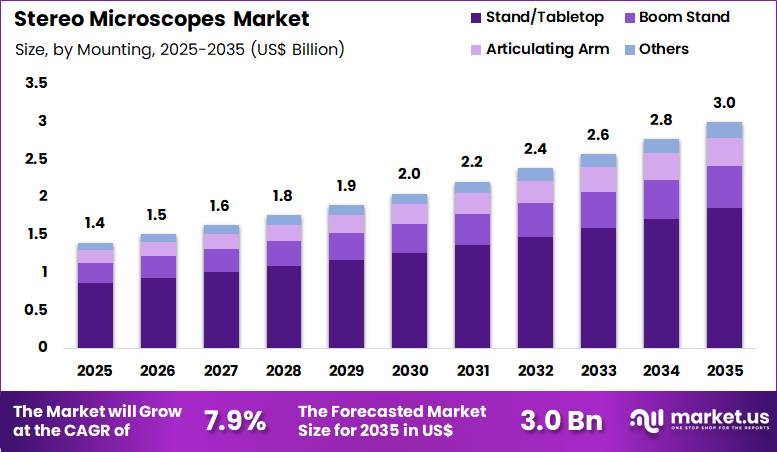
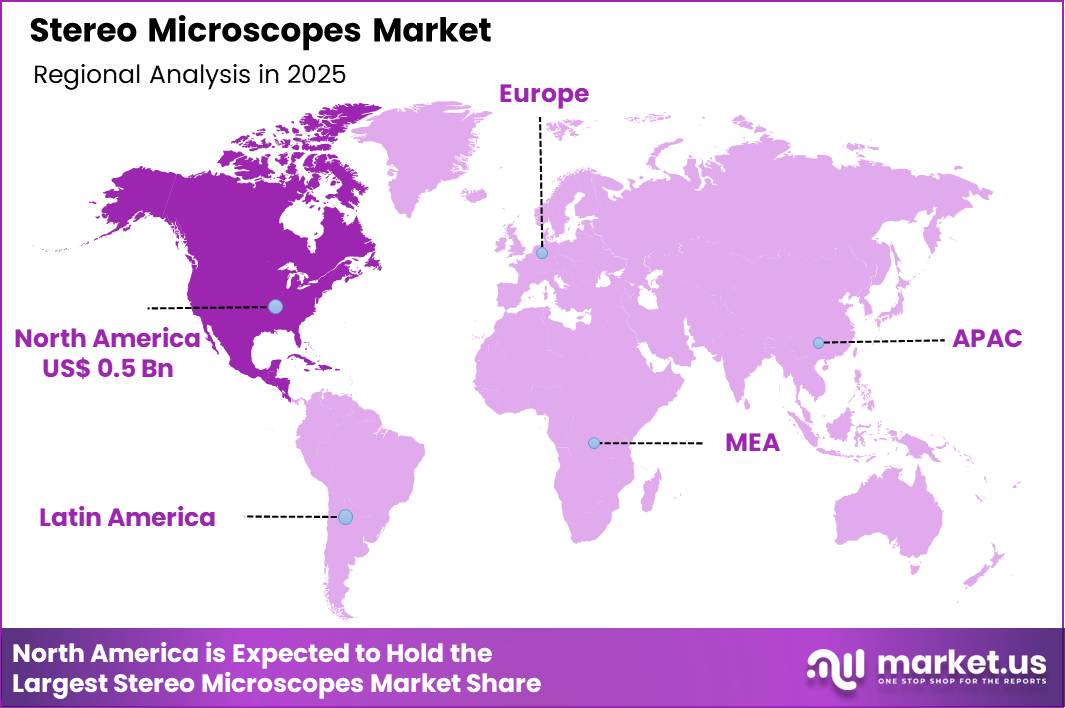
The Global Stereo Microscopes Market size is expected to be worth around US$ 3.0 Billion by 2035 from US$ 1.4 Billion in 2025, growing at a CAGR of 7.9% during the forecast period 2026-2035. In 2025, North America led the market, achieving over 38.6% share with a revenue of US$ 0.5 Billion.
Increasing demand for precise, three-dimensional visualization in research and industrial applications propels the stereo microscopes market as laboratories and manufacturers require tools that deliver high-resolution, ergonomic observation of complex samples.
Biologists increasingly utilize stereo microscopes for specimen dissection and microsurgery in developmental biology, enabling detailed examination of embryonic structures, plant tissues, and small invertebrates under low-to-medium magnification. These instruments support entomology and forensic entomology by allowing clear inspection of insect morphology, wing venation, and larval features for species identification and postmortem interval estimation.
In materials science and electronics quality control, engineers apply stereo microscopes to inspect solder joints, circuit board defects, and micro-components, ensuring reliable assembly and failure analysis in semiconductor and consumer electronics production.
Jewelry appraisers and gemologists employ these microscopes to evaluate inclusions, cuts, and authenticity of gemstones and precious metals with enhanced depth perception. Industrial metrology teams use them for precise measurement and assembly verification of small mechanical parts and watch components.
Manufacturers pursue opportunities to integrate digital imaging and hybrid optical-digital systems that combine traditional stereoscopic views with high-resolution CMOS sensors, expanding applications in automated inspection and documentation workflows.
Developers advance ergonomic designs with modular accessories, broadening utility in prolonged observation tasks such as entomological taxonomy and paleontological fossil preparation. These innovations facilitate seamless connectivity with imaging software for real-time annotation and measurement in educational and research settings.
Opportunities emerge in portable, battery-operated models for field-based applications in ecology and archaeology. Companies invest in enhanced illumination options and anti-glare optics to improve contrast in challenging samples. In February 2026, Leica Microsystems announced a strategic technical update for its high-end stereo microscope portfolios to enhance integration with digital pathology workflows.
This development focuses on improving the optical resolution and ergonomic modularity of systems used in complex biological research and industrial quality control. The update aligns with the recent shift toward hybrid imaging solutions that combine traditional optical performance with advanced CMOS sensor technology for real-time data analysis.
Recent trends emphasize sustainability through durable, repairable designs and software-driven enhancements, positioning stereo microscopes as versatile tools in precision-driven scientific and industrial environments.
Key Takeaways
- In 2025, the market generated a revenue of US$ 1.4 Billion, with a CAGR of 7.9%, and is expected to reach US$ 3.0 Billion by the year 2035.
- The type segment is divided into greenough stereo microscope, common main objective (CMO) microscope, zoom stereo microscope, digital stereo microscope, trinocular models and others, with zoom stereo microscope taking the lead with a market share of 46.3%.
- Considering mounting, the market is divided into stand/tabletop, boom stand, articulating arm and others. Among these, stand/tabletop held a significant share of 61.9%.
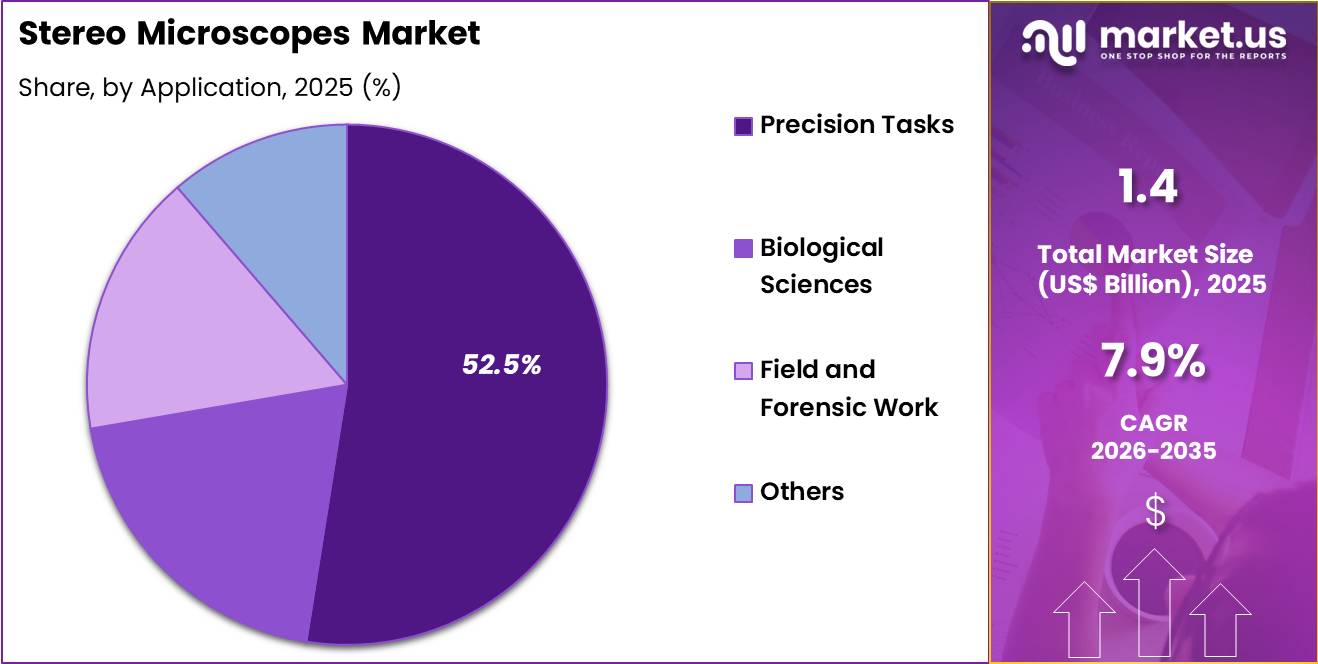
- Furthermore, concerning the application segment, the market is segregated into biological sciences, precision tasks, field and forensic work and others. The precision tasks sector stands out as the dominant player, holding the largest revenue share of 52.5% in the market.
- The end user segment is segregated into electronics & semiconductor, manufacturing & quality control, jewelry & watchmaking, medical & life sciences, forensics & security and others, with the electronics & semiconductor segment leading the market, holding a revenue share of 41.6%.
- North America led the market by securing a market share of 38.6%.
Type Analysis
Zoom stereo microscopes accounted for 46.3% of growth within type and dominate the stereo microscopes market due to their ability to deliver variable magnification and high image clarity during inspection tasks. Laboratories and industrial facilities increasingly rely on zoom optics because they allow users to examine objects at multiple magnification levels without repositioning the sample.
Segment growth is expected to strengthen as electronics manufacturing and precision engineering sectors expand globally. Semiconductor fabrication and circuit board assembly require detailed inspection of miniature components. Zoom stereo microscopes support accurate defect detection and quality verification during production processes.
Manufacturers also integrate advanced optical coatings and digital imaging capabilities to improve visual analysis. Demand is anticipated to increase as industries prioritize microscopic inspection for product reliability and performance.
Research laboratories and academic institutions also adopt zoom models for teaching and experimental observation. Continuous technological improvements in optics and imaging systems further support the expansion of this segment.
Mounting Analysis
Stand or tabletop mounting accounted for 61.9% of growth within mounting and dominate the stereo microscopes market because they provide stable platforms for laboratory and industrial observation tasks. Users prefer tabletop configurations due to their ergonomic design and ease of integration with laboratory workstations.
Segment growth is projected to expand as research laboratories, quality control departments, and training centers increase equipment installations. Tabletop microscopes provide steady viewing conditions that improve accuracy during delicate inspections. Electronics manufacturers frequently install these systems along assembly lines to support consistent component analysis.
Educational institutions also favor stand-mounted microscopes for student training and laboratory demonstrations. Demand is likely to rise as scientific research and manufacturing quality programs expand globally. Stable mounting solutions support extended observation periods and reduce operator fatigue. Continued growth in laboratory infrastructure strengthens the adoption of tabletop microscope systems.
Application Analysis
Precision tasks accounted for 52.5% of growth within application and dominate the stereo microscopes market due to their extensive use in fine mechanical work and micro-level inspection activities. Industries including electronics assembly, microelectronics fabrication, and watchmaking rely on stereo microscopes to perform delicate tasks that require high magnification and depth perception.
Segment growth is expected to accelerate as miniaturization of electronic devices increases the need for precise inspection tools. Engineers and technicians use stereo microscopes to identify manufacturing defects, soldering issues, and component misalignment.
The rapid growth of consumer electronics manufacturing strengthens demand for precision inspection systems. Research laboratories also utilize these microscopes to handle delicate biological samples and microstructures. Adoption is anticipated to increase as industries pursue higher production quality standards and stricter quality control protocols.
End-User Analysis
Electronics and semiconductor companies accounted for 41.6% of growth within end users and dominate the stereo microscopes market due to their dependence on microscopic inspection during chip fabrication and circuit board assembly. Semiconductor manufacturing processes involve extremely small components that require detailed visual analysis during production.
Stereo microscopes enable technicians to examine solder joints, microchips, and connectors with high accuracy. Segment growth is projected to strengthen as global demand for semiconductor devices continues to expand across computing, automotive electronics, and telecommunications industries.
Semiconductor fabrication facilities invest heavily in optical inspection tools to maintain production quality. Electronics manufacturers also use stereo microscopes for prototype development and failure analysis. Demand is expected to increase as miniaturized electronic components require increasingly precise inspection technologies. Continued expansion of global electronics manufacturing supports the sustained growth of this segment.
Key Market Segments
By Type
- Greenough Stereo Microscope
- Common Main Objective (CMO) Microscope
- Zoom Stereo Microscope
- Digital Stereo Microscope
- Trinocular Models
- Others
By Mounting
- Stand/Tabletop
- Boom Stand
- Articulating Arm
- Others
By Application
- Biological Sciences
- Precision Tasks
- Field and Forensic Work
- Others
By End User
- Electronics & Semiconductor
- Manufacturing & Quality Control
- Jewelry & Watchmaking
- Medical & Life Sciences
- Forensics & Security
- Others
Drivers
Sustained revenue growth in the ZEISS Group is driving the market.
The stereo microscopes market derives considerable impetus from the overarching expansion within major manufacturers’ portfolios that encompass microscopy solutions. ZEISS Group achieved revenue of EUR 10.108 billion in fiscal year 2022/23. This advanced to EUR 10.894 billion in fiscal year 2023/24, marking an increase of 7.8%.
Fiscal year 2024/25 revenue reached EUR 11.896 billion, reflecting a further 9.2 percent rise. Such progression highlights robust demand across industrial and research applications integral to stereo microscopy. The growth supports enhanced production capacities for high-resolution imaging systems used in quality assurance.
Manufacturers leverage this momentum to refine ergonomic designs and optical precision in stereo models. End-users in electronics and biotechnology sectors benefit from reliable access to advanced tools. The trajectory encourages investment in complementary software for digital enhancement. Overall, this financial strength underpins innovation and market accessibility for stereo microscope technologies.
Restraints
Marginal decline in Industrial Quality & Research segment revenue is restraining the market.
ZEISS Industrial Quality & Research segment recorded revenue of EUR 2,369 million in fiscal year 2022/23. The figure remained at EUR 2,369 million in fiscal year 2023/24. Fiscal year 2024/25 revenue fell to EUR 2,334 million, a 1.5% contraction. This softening tempers enthusiasm for segment-specific expansions in stereo microscopy offerings.
Facilities delay upgrades amid perceived stabilization in core demand drivers. Suppliers adjust inventory levels to align with moderated procurement forecasts. The restraint influences pricing strategies for entry-level stereo systems.
Practitioners in research labs encounter fewer incentives for adopting premium configurations. Operational budgets in quality control departments face scrutiny under flat growth signals. This dynamic curtails the velocity of technological diffusion across the stereo microscope ecosystem.
Opportunities
Strategic expansion targets for biological microscopes are creating growth opportunities.
Nikon outlined ambitions to elevate biological microscope sales to over 50% of total microscopy revenue by fiscal year 2025. This initiative targets private sector penetration, representing 70% of the biological market. Opportunities emerge for hybrid stereo systems bridging biological and industrial inspections. Developers can integrate modular optics to address diverse specimen handling needs.
The focus fosters collaborations with academic institutions for customized configurations. Enhanced market share in high-priced system microscopes promises elevated margins. Practitioners gain versatile tools for dissecting and three-dimensional analysis.
The strategy enables scalability through service contracts and upgrades. Such positioning attracts investment in automated alignment features. This opportunity cultivates long-term diversification and competitive differentiation in stereo microscopy.
Impact of Macroeconomic / Geopolitical Factors
Macroeconomic conditions influence the stereo microscopes market through research budgets, academic funding, and industrial inspection spending. Inflation raises costs for precision optics, illumination systems, mechanical components, and assembly labor, which increases manufacturing expenses. Higher interest rates reduce capital flexibility for universities, laboratories, and manufacturing facilities that plan equipment upgrades.
Geopolitical tensions affect global supply of optical glass, electronic modules, and precision parts, creating procurement delays and cost volatility. Current US tariffs on imported optical components and microscope assemblies increase acquisition costs for distributors and end users. These pressures can slow replacement cycles and limit purchases in cost-sensitive research institutions.
At the same time, manufacturers strengthen regional supply networks and invest in domestic assembly capabilities to reduce external dependency. Expanding demand from life science research, electronics inspection, and education continues to support stable and confident long-term market growth.
Latest Trends
Announcement of the Nikon LV100N microscope series is driving the market.
Nikon introduced the LV100N series of upright microscopes in March 2025. The lineup incorporates advanced LED illumination for superior color fidelity in stereo applications. This development addresses demands for maintainable systems in prolonged laboratory sessions. The series supports seamless integration with digital cameras for enhanced documentation.
Researchers appreciate the modular design facilitating future-proof expansions. The 2025 launch aligns with trends toward energy-efficient imaging solutions. Facilities upgrade to these models for consistent performance in material sciences.
The innovation stimulates cross-segment adoption in quality inspection workflows. Stakeholders observe heightened interest in compatible accessories. Overall, the introduction reinforces technological leadership and accelerates adoption rates in stereo microscopy practices.
Regional Analysis
North America is leading the Stereo Microscopes Market
North America accounted for 38.6% of the stereo microscopes market in 2025 as research laboratories, electronics manufacturers, and life science institutions expanded demand for precision optical inspection tools. Universities and biomedical laboratories across the United States increased investments in advanced imaging equipment to support research in cell biology, microelectronics, and material science.
The National Science Foundation reported that U.S. research and development expenditure reached about USD 886 billion in 2022, reflecting strong funding momentum that continued into subsequent years and supported procurement of laboratory instruments used for detailed specimen observation.
Semiconductor and electronics industries in the region also rely heavily on magnification systems to examine circuit boards, micro components, and device assemblies during quality control processes. Medical device manufacturers have increasingly integrated advanced optical inspection systems into production workflows to maintain strict regulatory compliance and product reliability.
Academic laboratories and teaching institutions expanded use of optical microscopy platforms for training and experimental analysis in biological sciences. Technological advances in LED illumination, ergonomic optics, and digital imaging compatibility have improved usability and accuracy in modern laboratory environments.
Collaborations between instrument manufacturers and research institutions have accelerated adoption of upgraded microscopy systems across laboratories. These factors collectively supported sustained market expansion throughout North America in 2025.
The Asia Pacific region is expected to experience the highest CAGR during the forecast period
Asia Pacific is expected to experience significant growth during the forecast period as governments strengthen scientific research infrastructure and manufacturing capabilities across the region. Countries such as China, Japan, South Korea, and India continue to expand investments in laboratory facilities, electronics manufacturing, and biotechnology research.
China alone allocated approximately 3.09 trillion yuan to research and development spending in 2022, according to official national statistics, reflecting strong national commitment to scientific advancement and technology innovation. Expanding semiconductor production and electronics assembly operations across East Asia require high precision optical inspection tools for component analysis and defect detection.
Universities and technical institutes across the region are strengthening laboratory capabilities to support education in life sciences, materials engineering, and nanotechnology. Biotechnology startups and pharmaceutical research centers are also increasing demand for advanced laboratory imaging equipment to support experimental workflows.
Governments are promoting domestic manufacturing of scientific instruments while encouraging partnerships with global optical technology firms. Industrial quality assurance programs in electronics, automotive components, and medical devices are increasing reliance on magnification systems for inspection tasks. These developments are expected to support steady expansion of optical laboratory imaging equipment across Asia Pacific in the coming years.
Key Regions and Countries
North America
- US
- Canada
Europe
- Germany
- France
- The UK
- Spain
- Italy
- Russia
- Netherland
- Rest of Europe
Asia Pacific
- China
- Japan
- South Korea
- India
- Australia
- New Zealand
- Singapore
- Thailand
- Vietnam
- Rest of APAC
Latin America
- Brazil
- Mexico
- Rest of Latin America
Middle East & Africa
- South Africa
- Saudi Arabia
- UAE
- Rest of MEA
Key Players Analysis
Key companies in the Stereo Microscopes market pursue growth by advancing optical precision, integrating digital imaging capabilities, and expanding product applications across life sciences, electronics inspection, and academic research. They strengthen global distribution networks and collaborate with universities, laboratories, and industrial manufacturers to widen adoption of advanced microscopy tools.
Leica Microsystems represents a notable participant in the Stereo Microscopes market and operates as a German manufacturer headquartered in Wetzlar that develops optical microscopes and scientific imaging instruments used in research, medicine, and industrial analysis. The company maintains development and production sites across several countries and supplies microscopy technologies to customers in more than one hundred markets worldwide.
Industry competitors including Nikon, Carl Zeiss, and Olympus focus on continuous innovation, digital integration, and specialized optical systems to enhance imaging accuracy and workflow efficiency. These strategies strengthen technological leadership and expand commercial opportunities within the Stereo Microscopes market.
Top Key Players
- Olympus Corporation (Evident)
- Leica Microsystems
- Zeiss AG
- Nikon Corporation
- Motic Instruments
- Meiji Techno
- Keyence Corporation
- Vision Engineering Ltd.
- Euromex Microscopen
- Labomed Inc.
Recent Developments
- In late 2024, Nikon Corporation introduced new epi-fluorescence modules designed for direct integration with stereo microscopes. The system connects LED illumination directly to the microscope body, removing the need for fiber-optic light guides and enabling brighter, more consistent lighting for research, industrial inspection, and teaching laboratories.
- In September 2024, Vision Engineering Ltd. launched OPTA, a cost-efficient stereo microscope priced below USD 1,200. The model features ergonomic viewing, flexible stand configurations, and durable optical components, making it suitable for laboratories, manufacturing inspection tasks, and educational institutions seeking reliable microscopy tools at an accessible price point.
Report Scope
Report Features Description Market Value (2025) US$ 1.4 Billion Forecast Revenue (2035) US$ 3.0 Billion CAGR (2026-2035) 7.9% Base Year for Estimation 2025 Historic Period 2020-2024 Forecast Period 2026-2035 Report Coverage Revenue Forecast, Market Dynamics, COVID-19 Impact, Competitive Landscape, Recent Developments Segments Covered By Type (Greenough Stereo Microscope, Common Main Objective (CMO) Microscope, Zoom Stereo Microscope, Digital Stereo Microscope, Trinocular Models and Others), By Mounting (Stand/Tabletop, Boom Stand, Articulating Arm and Others), By Application (Biological Sciences, Precision Tasks, Field and Forensic Work and Others), By End User (Electronics & Semiconductor, Manufacturing & Quality Control, Jewelry & Watchmaking, Medical & Life Sciences, Forensics & Security and Others) Regional Analysis North America – US, Canada; Europe – Germany, France, The UK, Spain, Italy, Russia, Netherlands, Rest of Europe; Asia Pacific – China, Japan, South Korea, India, Australia, New Zealand, Singapore, Thailand, Vietnam, Rest of APAC; Latin America – Brazil, Mexico, Rest of Latin America; Middle East & Africa – South Africa, Saudi Arabia, UAE, Rest of MEA Competitive Landscape Olympus (Evident), Leica Microsystems, Zeiss, Nikon, Motic, Meiji Techno, Keyence, Vision Engineering, Euromex, Labomed. Customization Scope Customization for segments, region/country-level will be provided. Moreover, additional customization can be done based on the requirements. Purchase Options We have three licenses to opt for: Single User License, Multi-User License (Up to 5 Users), Corporate Use License (Unlimited User and Printable PDF)  Stereo Microscopes MarketPublished date: March 2026add_shopping_cartBuy Now get_appDownload Sample
 -
-
- Olympus Corporation (Evident)
- Leica Microsystems
- Zeiss AG
- Nikon Corporation
- Motic Instruments
- Meiji Techno
- Keyence Corporation
- Vision Engineering Ltd.
- Euromex Microscopen
- Labomed Inc.
Our Clients

- 180629
- March 2026






