


Global Snail Beauty Products Market Size, Share, Growth Analysis By Product (Creams, Masks & Cleansers, Serum & Essence, Shampoo, Moisturizers, Others), By Gender (Female, Male), By Application (Skin, Hair), By Distribution Channel (Supermarkets & Hypermarkets, Online, Medical Stores, Convenience Stores, Others), By Region and Companies - Industry Segment Outlook, Market Assessment, Competition Scenario, Statistics, Trends and Forecast 2026-2035
- Published date: Mar 2026
- Report ID: 182133
- Number of Pages: 390
- Format:
-
keyboard_arrow_up
Quick Navigation
Report Overview
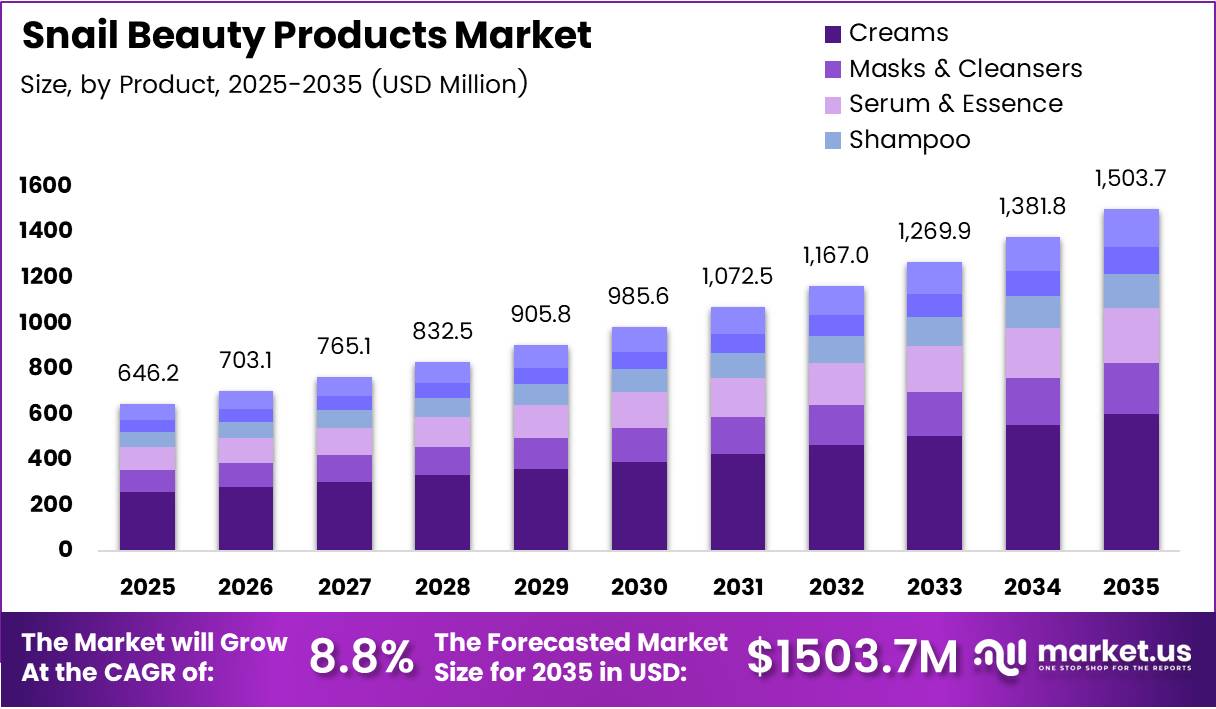
Global Snail Beauty Products Market size is expected to be worth around USD 1,503.7 Million by 2035 from USD 646.2 Million in 2025, growing at a CAGR of 8.8% during the forecast period 2026 to 2035.
The snail beauty products market covers cosmetics and personal care formulations that use snail secretion filtrate as a primary active ingredient. These products range from facial creams and serums to sheet masks, essences, and shampoos. Buyers seek them for skin repair, hydration, and anti-aging benefits backed by measurable biological activity.
Snail mucin is not a novelty ingredient — it carries a documented biochemical profile. It contains proteins, glycosaminoglycans, glycolic acid, and allantoin, each targeting a distinct skin function. This multi-compound composition allows one ingredient to address several skin concerns simultaneously, which matters to consumers choosing fewer, higher-efficacy products.
The K-Beauty wave has been the single most important commercial force behind this market. South Korean brands built snail mucin into mainstream skincare routines and exported that framework globally. This created product familiarity across markets that previously had no cultural connection to snail-derived ingredients, lowering the adoption barrier significantly.
Anti-aging remains the dominant use case. Urban consumers aged 30 and above — particularly women — drive most category purchases. Demographic aging in North America, Europe, and East Asia sustains this demand structurally, not cyclically. Brands that anchor positioning in clinical skin regeneration rather than trend aesthetics hold more durable pricing power.
E-commerce platforms have changed how this market distributes. Online channels allow niche snail-based SKUs to reach buyers in markets where shelf placement in physical retail would be cost-prohibitive. This is particularly significant for brands entering Southeast Asia, Latin America, and the Middle East, where digital beauty retail outpaces traditional channel growth.
According to a study published in PMC (National Center for Biotechnology Information), a hydrogel containing 10% snail mucin accelerates wound closure in a rat model by 23% compared to standard treatment. This type of clinical evidence shifts snail beauty products from trend-driven purchases to performance-justified buys, supporting premium pricing and repeat purchase behavior.
According to research published in the International Journal of Creative Research Thoughts (IJCRT), snail mucin use results in an 11% increase in skin elasticity. For investors, this quantified efficacy is the mechanism that sustains category premiumization — it gives brands a defensible claims platform that generic moisturizers cannot replicate.
Key Takeaways
- The global Snail Beauty Products Market was valued at USD 646.2 Million in 2025 and is forecast to reach USD 1,503.7 Million by 2035.
- The market grows at a CAGR of 8.8% during the forecast period 2026 to 2035.
- By Product, Creams hold the dominant share at 39.2%, reflecting strong consumer preference for daily-use hydrating formats.
- By Gender, Female consumers lead with 78.8% share, underscoring the category’s concentrated buyer profile.
- By Application, Skin care accounts for 89.3% of market demand, with hair applications representing a smaller but emerging segment.
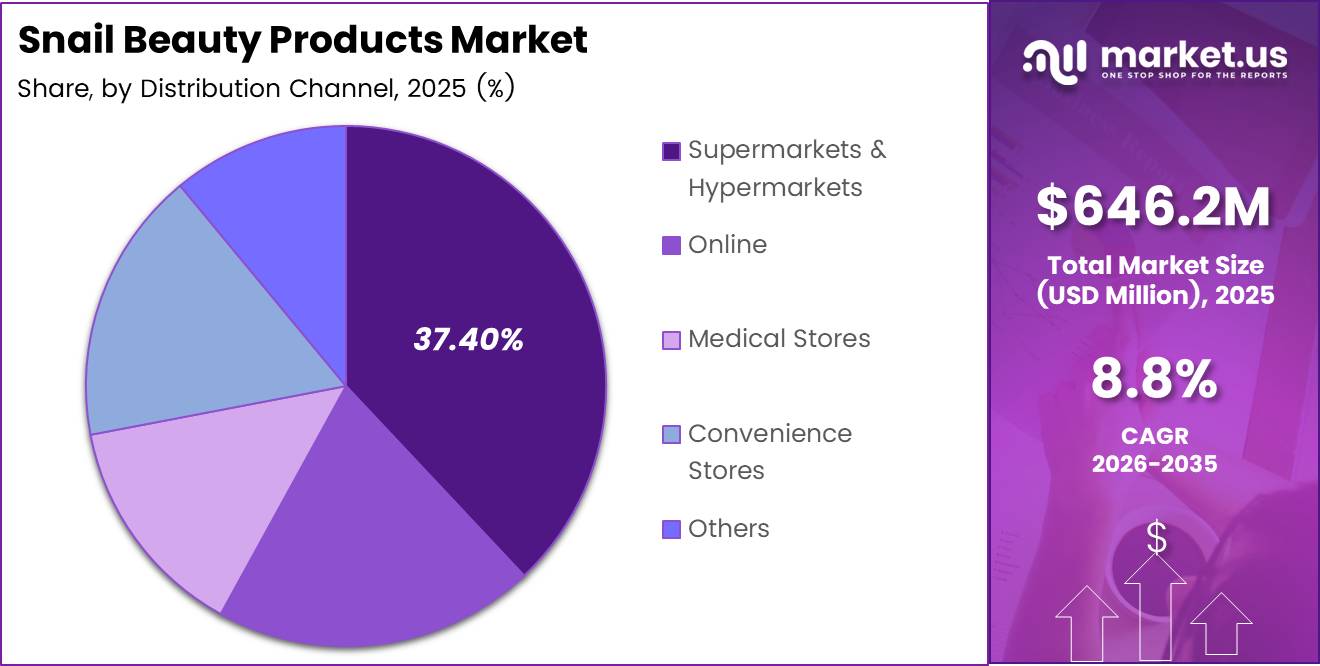
- By Distribution Channel, Supermarkets and Hypermarkets hold 37.4% share, though online channels are closing the gap.
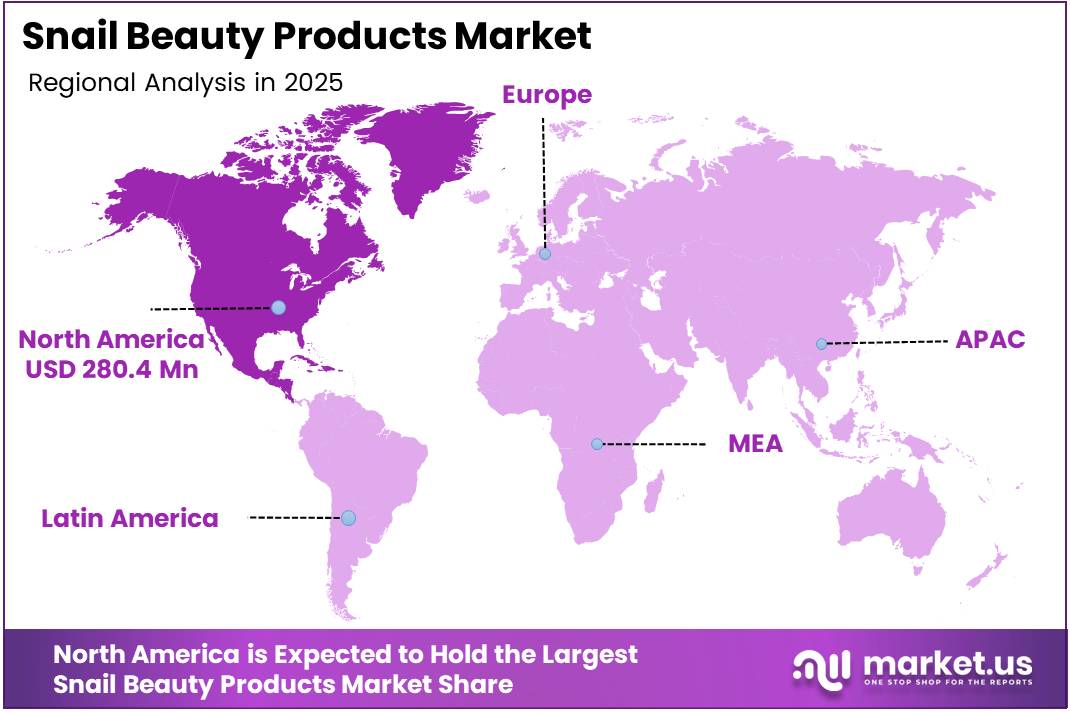
- North America dominates regionally with a 43.4% market share, valued at USD 280.4 Million.
Product Analysis
Creams dominate with 39.2% due to daily-use habituation and broad retail availability.
In 2025, Creams held a dominant market position in the By Product segment of the Snail Beauty Products Market, with a 39.2% share. Creams fit naturally into existing morning and evening skincare routines, requiring no behavioral change from the buyer. This habitual compatibility, combined with wide placement across supermarkets, pharmacies, and online stores, makes creams the default entry point for first-time snail mucin users.
Masks and Cleansers serve as the trial and exploration layer of the snail beauty portfolio. Consumers purchase masks as a low-commitment, single-use format before committing to daily-use products. This positions the sub-segment as a pipeline feeder — strong mask sales typically precede cream and serum adoption, making it strategically valuable for brand acquisition spend.
Serums and Essences carry the highest per-unit value within the snail beauty product range. Consumers who choose serums already understand active ingredients and expect measurable results. This buyer profile supports a premium price point and strong repeat purchase rates, making the sub-segment disproportionately important to revenue margin despite its smaller volume share.
Shampoo represents the crossover between snail mucin’s skin repair properties and haircare science. Consumer uptake remains early-stage, but the protein and glycoprotein composition of snail secretion filtrate offers a credible functional story for scalp health and hair strength. Brands entering this space now face low competition and high differentiation potential.
Moisturizers overlap functionally with creams but compete on texture and positioning rather than ingredients. Lightweight moisturizer formats appeal to consumers in humid climates or those preferring gel-type finishes. This creates a regional differentiation opportunity — moisturizer SKUs with snail mucin show stronger traction in Southeast Asian markets where cream textures are less preferred.
Others in the product segment include eye creams, toners, and sunscreen formulations incorporating snail secretion filtrate. These formats serve high-engagement consumers building multi-step routines. As the core snail beauty buyer matures in brand familiarity, ancillary product formats gain adoption and expand the per-customer revenue base for established players.
Gender Analysis
Female consumers dominate with 78.8% due to higher skincare routine complexity and anti-aging focus.
In 2025, Female consumers held a dominant market position in the By Gender segment of the Snail Beauty Products Market, with a 78.8% share. Female buyers invest more consistently in multi-step skincare regimens and respond strongly to clinical efficacy claims. The anti-aging and skin regeneration benefits of snail mucin align directly with this buyer profile, sustaining purchase frequency across age groups from 25 to 55.
Male consumers represent the market’s fastest-expanding buyer cohort from a low base. Male grooming norms are shifting — particularly in East Asia and urban Western markets — toward active-ingredient skincare rather than basic cleansing. Snail mucin’s non-greasy texture and multi-benefit profile suits the male preference for simplified, high-return products. Brands that repackage and reposition existing formulations for male buyers can capture this segment without significant reformulation cost.
Application Analysis
Skin application dominates with 89.3% due to snail mucin’s proven dermal repair properties.
In 2025, Skin application held a dominant market position in the By Application segment of the Snail Beauty Products Market, with an 89.3% share. The biochemical composition of snail secretion filtrate — including allantoin, glycolic acid, and hyaluronic acid — directly targets skin regeneration, hydration, and elasticity. This functional alignment with skin-focused outcomes concentrates buyer demand on facial and body skincare applications rather than other categories.
Hair application occupies a small but structurally interesting share of the market. Snail mucin’s protein content and moisture-binding capacity provide a credible basis for scalp conditioning and hair fiber repair. Market penetration in this sub-segment remains limited by low consumer awareness of snail mucin’s haircare benefits. Brands investing early in hair application communication and clinical validation can establish a defensible position before the sub-segment reaches mainstream awareness.
Distribution Channel Analysis
Supermarkets and Hypermarkets dominate with 37.4% due to physical accessibility and impulse purchase behavior.
In 2025, Supermarkets and Hypermarkets held a dominant market position in the By Distribution Channel segment of the Snail Beauty Products Market, with a 37.4% share. Large-format retail provides consumer goods exposure to buyers who have not yet intentionally sought snail beauty products, generating trial purchases that convert to online replenishment. This dual-channel behavior — discover in-store, repurchase online — makes supermarket placement a category awareness engine, not just a sales channel.
Online channels are the structural growth engine for snail beauty distribution. Digital platforms remove geographic and shelf-space constraints, enabling specialist brands to reach niche buyers across multiple countries from a single logistics hub. In December 2024, COSRX launched the Advanced Snail Mucin Glass Glow Hydrogel Mask via digital-first channels, demonstrating how online launches generate global awareness for premium snail beauty products without dependence on physical retail rollouts.
Medical Stores serve the dermocosmetic segment of snail beauty buyers — consumers seeking products with clinical framing rather than beauty positioning. Placement in pharmacy and dermatology retail environments elevates perceived product credibility and justifies higher price points. This channel is particularly relevant in Europe, where cosmeceutical positioning carries stronger consumer trust than mass-market beauty branding.
Convenience Stores serve impulse and travel-sized purchase occasions within the snail beauty category. While average transaction value is lower, convenience channel placement builds brand visibility in transit and urban locations. This matters particularly for sheet masks and single-use formats, where purchase decisions are often spontaneous rather than planned.
Others in distribution include specialty beauty boutiques, department stores, and direct-to-consumer brand websites. These channels serve high-engagement buyers who research purchases in advance and seek curated product selections. For premium snail beauty brands, specialty and direct channels deliver stronger brand storytelling control and higher margin per unit than mass retail.
Key Market Segments
By Product
- Creams
- Masks & Cleansers
- Serum & Essence
- Shampoo
- Moisturizers
- Others
By Gender
- Female
- Male
By Application
- Skin
- Hair
By Distribution Channel
- Supermarkets & Hypermarkets
- Online
- Medical Stores
- Convenience Stores
- Others
Drivers
Proven Bioactive Efficacy and Anti-Aging Demand Accelerate Snail Mucin Adoption Across Global Skincare Markets
Consumers worldwide are shifting away from synthetic ingredient-heavy formulas toward bio-active alternatives with documented skin benefits. Snail mucin fits this demand precisely — its composition of glycolic acid, allantoin, and glycosaminoglycans targets cell regeneration, hydration, and elasticity through distinct biological mechanisms. This is not a trend narrative; it is a formulation advantage with clinical backing.
According to research published in biorxiv, all snail slime-treated groups achieve complete wound closure (100%) within the 24-hour experimental period. This level of measurable performance gives brands a concrete efficacy claim that supports premium pricing and differentiates snail-based products from conventional moisturizers competing on texture and fragrance alone.
The K-Beauty distribution model has carried snail mucin from a South Korean specialty ingredient into mass global awareness. Urban consumers aged 30 and above — the core anti-aging buyer — now encounter snail mucin across multiple product formats and price tiers. This category breadth creates multiple entry points for new buyers while sustaining repurchase among established ones, compressing the time between trial and habitual use.
Restraints
Ethical Concerns Over Snail Mucin Extraction and Low Awareness in Traditional Markets Constrain Category Expansion
A segment of consumers — particularly in Western markets with organized animal welfare communities — actively avoids snail mucin products due to ethical objections to extraction methods. This objection is not marginal. It affects purchasing decisions among eco-conscious buyers who represent a premium-price-willing demographic that brands cannot easily afford to exclude.
The restraint is structural: snail mucin extraction involves live animals, and no standardized cruelty-free certification framework currently covers this ingredient. Without an industry-recognized welfare standard, brands cannot credibly neutralize the objection. This leaves ethical positioning to individual brand claims rather than third-party verification, which sophisticated consumers discount.
In emerging markets — including parts of South Asia, Latin America, and Sub-Saharan Africa — cultural familiarity with snail-derived cosmetics remains low. Distribution investment without parallel education spending yields poor conversion. Brands entering these markets must allocate resources to ingredient awareness before category pull develops, making market entry more capital-intensive than standard beauty launches.
Growth Factors
Formulation Innovation and Cosmeceutical Expansion Open High-Value Revenue Streams for Snail Mucin Producers
Product developers are combining snail mucin with peptides, hyaluronic acid, and probiotic ingredients to create multi-mechanism formulations. These combinations target specific consumer concerns — barrier repair, deep hydration, and microbiome balance — within a single SKU. The result is a higher-complexity product that commands stronger margins and creates sharper differentiation from single-ingredient competitors.
According to research published in the International Journal of Creative Research Thoughts (IJCRT), metformin-loaded PEGylated snail mucin achieves a drug release rate of 92%, improved from 81% in conventional formulations. This pharmaceutical application signals that snail mucin’s utility extends into cosmeceutical and dermatological product categories — markets that operate at significantly higher price points than standard consumer beauty retail.
Emerging economies with rising disposable incomes — particularly in Southeast Asia, the Middle East, and Latin America — represent the next geographic expansion wave for snail beauty brands. Consumers in these markets are adopting structured skincare routines and showing appetite for Korean beauty references. Brands that build distribution infrastructure and localized digital presence now will benefit from category pull as awareness builds over the next three to five years.
Emerging Trends
Social Media Influence and Multi-Functional Format Demand Reshape Product Development Priorities in Snail Beauty
Beauty influencers on platforms including TikTok, Instagram, and YouTube have made snail mucin one of the most discussed active ingredients in skincare content globally. Influencer-generated content functions as a low-cost education channel that builds ingredient familiarity ahead of purchase intent. Brands that activate influencer partnerships at the ingredient awareness stage — before category competition intensifies — gain first-mover advantage in new geographies.
According to research published in biorxiv, snail slime is well tolerated for up to 72 hours in normal human dermal fibroblasts. This biocompatibility data supports the minimalist skincare trend — consumers building routines around fewer, more potent actives select ingredients with strong safety profiles. Snail mucin’s tolerability positions it as a suitable base ingredient for sensitive skin formulations targeting a clinically risk-averse buyer segment.
Consumer appetite for sheet masks, serums, and essences infused with snail secretion filtrate confirms a structural shift toward intensive but time-efficient skincare formats. In December 2024, COSRX launched the Advanced Snail Mucin Glass Glow Hydrogel Mask, combining high-concentration snail secretion filtrate with hydrogel delivery technology. This launch signals that even established snail beauty players are investing in format innovation to maintain product relevance among buyers with rapidly evolving performance expectations.
Regional Analysis
North America Dominates the Snail Beauty Products Market with a Market Share of 43.4%, Valued at USD 280.4 Million
North America holds a 43.4% share of the global Snail Beauty Products Market, valued at USD 280.4 Million. The region’s position reflects mature consumer awareness of active-ingredient skincare, strong K-Beauty retail penetration, and a well-developed e-commerce infrastructure that supports premium beauty discovery. American buyers — particularly women in the 25–45 age cohort — drive consistent demand for snail mucin serums, creams, and masks across both digital and physical channels.
Europe Snail Beauty Products Market Trends
Europe represents a structurally important market for snail beauty products due to its large cosmeceutical retail sector and regulatory emphasis on ingredient transparency. German, French, and UK consumers exhibit strong preference for clinically validated skincare, creating alignment with snail mucin’s documented efficacy profile. Medical store and pharmacy distribution channels perform above global average in the region, supporting premium price positioning for snail-based formulations.
Asia Pacific Snail Beauty Products Market Trends
Asia Pacific is the origin market for snail mucin cosmetics and remains a center of product development and brand innovation. South Korea continues to define formulation standards, while China, Japan, and emerging Southeast Asian markets expand the consumer base. The region’s dense social media beauty culture accelerates product launches and drives trial purchases, making it the primary testing ground for new snail beauty formats before global rollout.
Middle East and Africa Snail Beauty Products Market Trends
The Middle East and Africa market for snail beauty products is in an early but active development stage. Rising disposable incomes in Gulf Cooperation Council countries and a young, beauty-engaged urban population create conditions for category growth. Consumer awareness of snail mucin remains lower than in North America or Asia, but Korean beauty content on social platforms is building familiarity faster than traditional retail education programs.
Latin America Snail Beauty Products Market Trends
Latin America shows rising interest in premium and functional skincare as the middle class expands across Brazil, Mexico, and Colombia. K-Beauty influence has reached the region through social media and specialty beauty retail, introducing snail mucin to a new buyer cohort. Distribution remains concentrated in urban centers, which limits total addressable market size in the near term but signals strong potential as online retail infrastructure continues to develop.
Key Regions and Countries
North America
- US
- Canada
Europe
- Germany
- France
- The UK
- Spain
- Italy
- Rest of Europe
Asia Pacific
- China
- Japan
- South Korea
- India
- Australia
- Rest of APAC
Latin America
- Brazil
- Mexico
- Rest of Latin America
Middle East & Africa
- GCC
- South Africa
- Rest of MEA
Key Company Insights
Amorepacific anchors its snail beauty positioning within a broader portfolio of clinically backed Korean skincare. The company’s advantage lies in its integrated R&D model — it develops proprietary ingredient supply chains alongside product formulation, giving it tighter control over mucin quality and concentration than brands sourcing from third-party suppliers. This vertical integration supports both premium pricing and consistent product performance across global markets.
BENTON has built its market credibility on a clean beauty and sensitive skin positioning, making snail mucin central to its product philosophy rather than a trend addition. This approach attracts a buyer segment that researches ingredients before purchasing and maintains high brand loyalty once trust is established. BENTON’s strong performance in online-first markets reflects the alignment between its ingredient-transparency positioning and the research habits of digital beauty consumers.
PFD Co., Ltd. operates at the formulation innovation end of the snail beauty supply chain. The company’s strategic value lies in its technical capability to standardize mucin extraction quality — a supply-side challenge that limits scalability for many brands. Reliable ingredient supply at consistent bioactive concentration levels is a competitive constraint across the industry, and companies solving this problem upstream hold structural leverage over brands dependent on variable external supply.
KENRA PROFESSIONAL represents the haircare application of snail mucin ingredients, extending the category beyond its dominant skin-focused use case. Its professional salon distribution model reaches a buyer segment — licensed cosmetologists and salon-educated consumers — that places higher trust in performance claims and accepts premium price points. This channel creates a credibility pathway for snail mucin haircare that mass retail cannot replicate through packaging or marketing alone.
Key Players
- Amorepacific
- BENTON
- PFD Co., Ltd.
- KENRA PROFESSIONAL
- Missha
- Eveline Cosmetics USA
- TONYMOLY
- tianDe Rheinland Halabis GmbH
- DRAN Co., Ltd
- YEOUTH
Recent Developments
- December 2024 — COSRX launched the Advanced Snail Mucin Glass Glow Hydrogel Mask, the latest addition to its award-winning Advanced Snail line. The product features high-concentration snail secretion filtrate paired with hydrogel technology that turns transparent upon absorption, delivering deep hydration, brightening, soothing, and firming benefits suitable for overnight use.
Report Scope
Report Features Description Market Value (2025) USD 646.2 Million Forecast Revenue (2035) USD 1,503.7 Million CAGR (2026-2035) 8.8% Base Year for Estimation 2025 Historic Period 2020-2024 Forecast Period 2026-2035 Report Coverage Revenue Forecast, Market Dynamics, Competitive Landscape, Recent Developments Segments Covered By Product (Creams, Masks & Cleansers, Serum & Essence, Shampoo, Moisturizers, Others), By Gender (Female, Male), By Application (Skin, Hair), By Distribution Channel (Supermarkets & Hypermarkets, Online, Medical Stores, Convenience Stores, Others) Regional Analysis North America (US and Canada), Europe (Germany, France, The UK, Spain, Italy, and Rest of Europe), Asia Pacific (China, Japan, South Korea, India, Australia, and Rest of APAC), Latin America (Brazil, Mexico, and Rest of Latin America), Middle East & Africa (GCC, South Africa, and Rest of MEA) Competitive Landscape Amorepacific, BENTON, PFD Co., Ltd., KENRA PROFESSIONAL, Missha, Eveline Cosmetics USA, TONYMOLY, tianDe Rheinland Halabis GmbH, DRAN Co., Ltd, YEOUTH Customization Scope Customization for segments, region/country-level will be provided. Moreover, additional customization can be done based on the requirements. Purchase Options We have three licenses to opt for: Single User License, Multi-User License (Up to 5 Users), Corporate Use License (Unlimited User and Printable PDF)  Snail Beauty Products MarketPublished date: Mar 2026add_shopping_cartBuy Now get_appDownload Sample
 -
-
- Amorepacific
- BENTON
- PFD Co., Ltd.
- KENRA PROFESSIONAL
- Missha
- Eveline Cosmetics USA
- TONYMOLY
- tianDe Rheinland Halabis GmbH
- DRAN Co., Ltd
- YEOUTH
Our Clients

- 182133
- Mar 2026






