


Global Service Account Governance Market Size, Share and Analysis Report By Component (Software (On-Premises, Cloud), Services (Managed Services, Professional Services)), By Organization Size (Small and Medium Enterprises, Large Enterprises), By Application (Identity Management, Access Management, Compliance Management, Risk Management, Others), By Vertical (BFSI, Healthcare, IT and Telecommunications, Government, Retail, Manufacturing, Others), By Regional Analysis, Global Trends and Opportunity, Future Outlook By 2025-2035
- Published date: Feb. 2026
- Report ID: 179263
- Number of Pages: 334
- Format:
-
keyboard_arrow_up
Quick Navigation
Report Overview
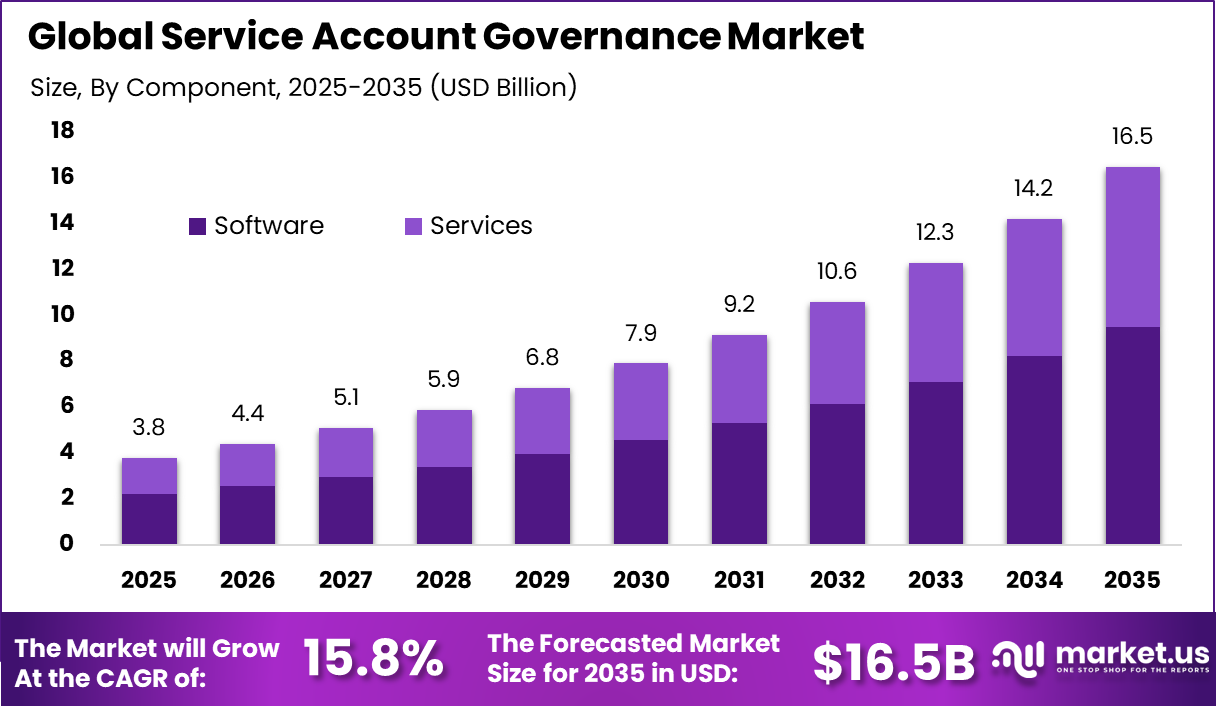
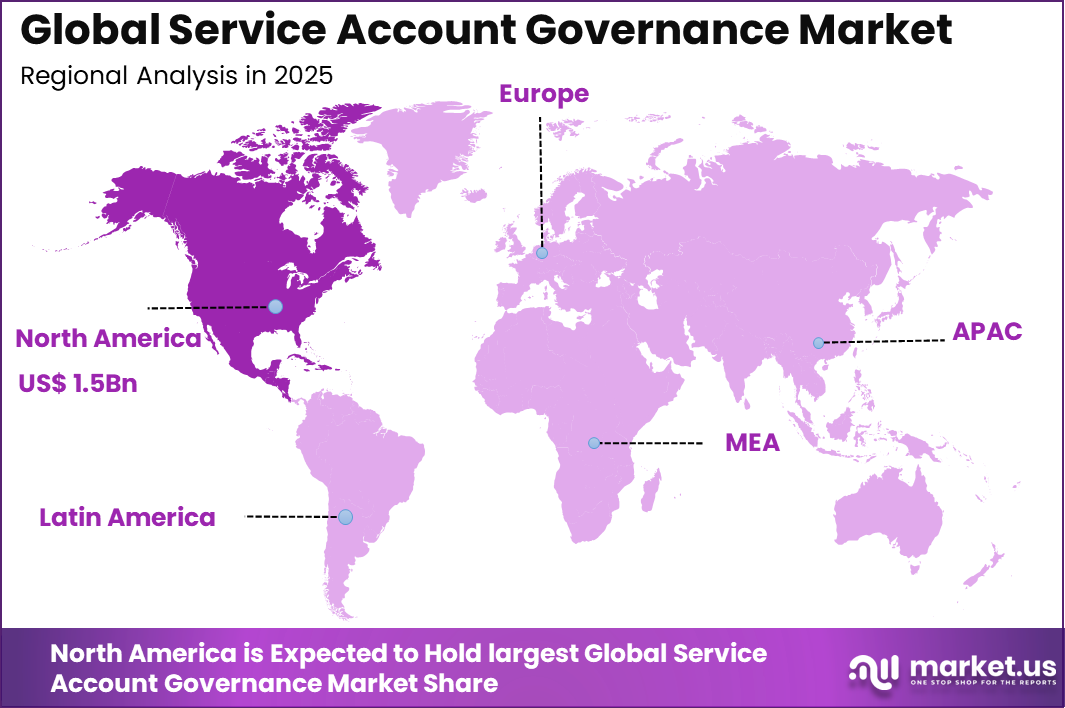
The Global Service Account Governance Market size is expected to be worth around USD 16.5 Billion By 2035, from USD 3.8 billion in 2025, growing at a CAGR of 15.8% during the forecast period from 2026 to 2035. North America held a dominant Market position, capturing more than a 40.3% share, holding USD 1.5 Billion revenue.
The service account governance market is expanding as enterprises strengthen control over non human identities across digital environments. Service accounts are widely used by applications, automated scripts, cloud workloads, and machine to machine processes. These accounts often possess elevated privileges, making them attractive targets for cyberattacks. As organizations increase automation and cloud adoption, structured governance of service accounts has become a core cybersecurity requirement.
The market has expanded due to increasing reliance on automated systems, script-based processes, and integrations between enterprise applications. Traditional identity and access management controls are often designed primarily for human users, leaving gaps in visibility and control over service accounts. Governance solutions for service accounts provide automated discovery, access entitlement reviews, credential lifecycle management, and auditing capabilities.
One primary driver of the Service Account Governance Market is the growing volume of automated and non-human identities within enterprise IT ecosystems. Cloud services, DevOps pipelines, containerised applications, and distributed microservices require numerous service accounts for authentication and operations. Without structured governance, these accounts often accumulate excessive privileges, stale credentials, and unmanaged access paths.
Service account governance has emerged as a major security priority, as nearly 85% of identity related breaches in 2024 were linked to compromised service accounts. These accounts are often overlooked in routine monitoring and are frequently assigned broad access rights, which increases organizational risk exposure.
Demand for service account governance solutions is strongest among organisations with large and complex IT infrastructures, particularly those operating in regulated industries. Financial services, healthcare, energy, and government sectors often maintain extensive automation and integration across legacy and modern platforms. These environments generate significant numbers of service accounts that require oversight to reduce risk and maintain compliance.
Top Market Takeaways
- Software accounts for 57.8% of total component adoption in the Service Account Governance market, driven by rising demand for automated credential management and monitoring tools.
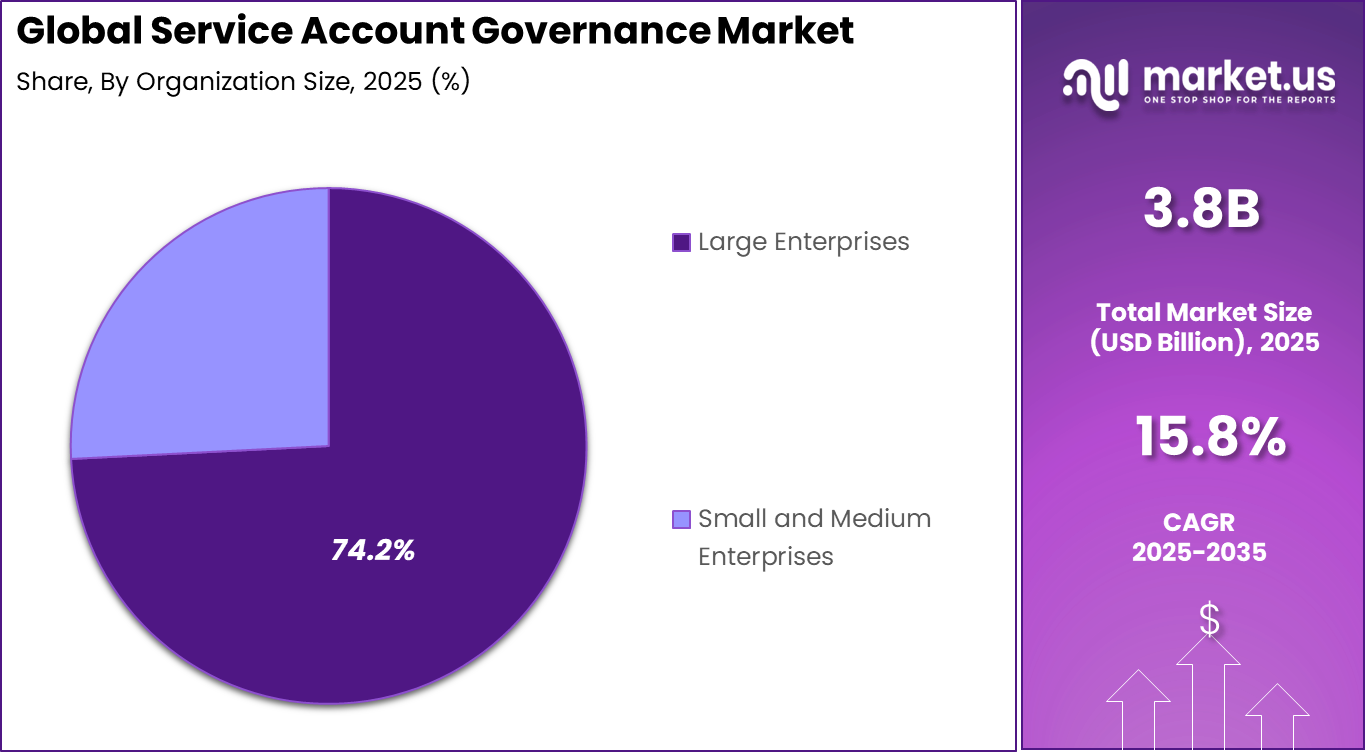
- Large enterprises represent 74.2% of overall demand, reflecting complex IT environments and stricter regulatory compliance requirements.
- Access management contributes 33.26% of total application usage, supported by increasing focus on privilege control and identity lifecycle governance.
- The BFSI sector holds 23.6% share by vertical, primarily due to high regulatory scrutiny and strong data protection mandates.
- North America commands 40.3% of the market, supported by advanced cloud adoption and identity security frameworks.
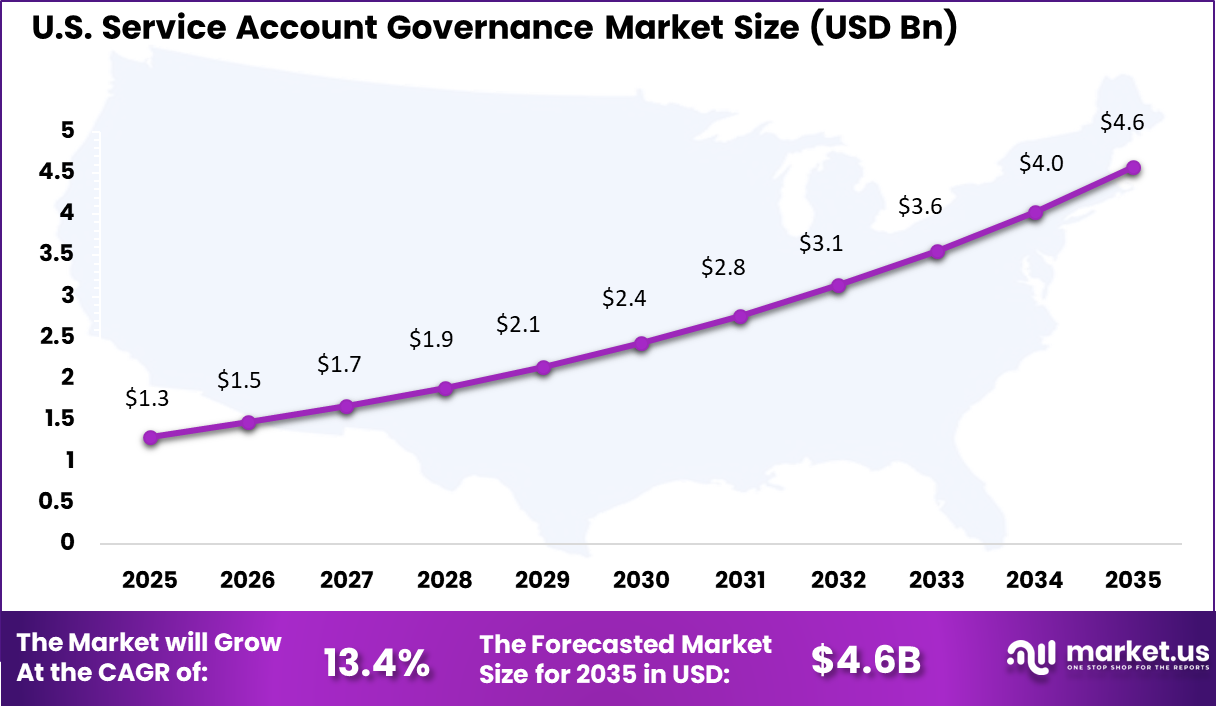
- The United States market is expanding at a 13.42% CAGR, reflecting sustained investments in cybersecurity governance and non-human identity management.
Key Insights Summary
- In 2024, 85% of identity-related breaches involved compromised service accounts, highlighting elevated exposure from non-human identities.
- Around 83% of containerized applications contain hardcoded service account credentials, increasing the likelihood of unauthorized access if repositories are exposed.
- In Google Cloud environments, 23% of virtual machines operate with overly permissive project access. Similarly, 19.4% of AWS EC2 instances are identified as overprivileged, expanding potential attack surfaces.
- Only 45% of organizations rotate service account passwords annually or more frequently, indicating gaps in credential lifecycle management.
- Approximately 94% of organizations lack full visibility and oversight of non-human identities, limiting centralized control and audit readiness.
- Regulatory frameworks such as PCI DSS 4.0, NIST SP 800-63B, and DORA now require structured service account governance, including credential rotation policies and periodic access reviews.
- Despite rising regulatory pressure, 67.9% of organizations prioritize other cybersecurity initiatives over service account protection, reflecting misaligned security investment focus.
- Breaches involving cloud or SaaS environments cost an average of USD 5.17 million in 2025, often linked to compromised service accounts and identity mismanagement.
- Organizations implementing AI-powered security automation for governance report average breach cost reductions of USD 2.22 million, demonstrating measurable financial benefits from proactive identity controls.
By Component
Software dominates with 57.8% because enterprises require centralized platforms to manage service account discovery, monitoring, and lifecycle control. Governance software automates credential rotation, permission reviews, and access approvals. This reduces manual oversight and improves consistency across systems. Integration with identity and access management frameworks strengthens control mechanisms.
These platforms also provide real time visibility into privileged activities. Security teams can detect anomalous behavior linked to automated accounts. Audit trails and compliance reporting features support regulatory requirements. The scalability of software solutions makes them suitable for complex enterprise environments.
By Organization Size
Large enterprises account for 74.2% of market adoption due to extensive automation and distributed IT infrastructures. These organizations manage thousands of applications and cloud services, each requiring service accounts. Centralized governance becomes essential to avoid unmanaged privileges. Complex environments increase exposure to identity related security risks.
Large corporations also operate across multiple geographic regions with diverse compliance standards. Governance platforms help standardize identity controls and enforce consistent policies. Investment capacity allows these enterprises to deploy advanced identity security systems. As digital transformation accelerates, governance demand remains strong among large organizations.
By Application
Access management represents 33.26% because controlling privileges of service accounts is a critical cybersecurity function. Governance platforms ensure that automated identities follow the principle of least privilege. Access approvals, periodic reviews, and credential rotation processes reduce attack surface. This structured oversight prevents unauthorized system access.
Integration with privileged access management systems further enhances security posture. Service accounts are monitored alongside human users within unified frameworks. Automated alerts and policy enforcement mechanisms strengthen defense against misuse. As identity based attacks increase, access management remains a central application area.
By Vertical
BFSI accounts for 23.6% due to high sensitivity of financial data and strict regulatory oversight. Banks and financial institutions operate complex digital systems with extensive automation. Service accounts are widely used in transaction processing, reporting, and analytics workflows. Governance ensures that these accounts do not introduce security vulnerabilities.
Compliance obligations within BFSI require detailed access documentation and audit readiness. Governance platforms provide transparent records of credential usage and privilege changes. This supports regulatory inspections and internal risk management programs. The emphasis on operational resilience strengthens adoption within this vertical.
Regional Analysis
North America represents 40.3% of the service account governance market due to advanced cybersecurity infrastructure and regulatory enforcement. Enterprises in the region prioritize identity centric security frameworks. Adoption of cloud computing and automation technologies further increases demand for service account oversight. Strong awareness of cyber threats supports investment in governance platforms.
The United States remains the leading contributor within the region, with a CAGR of 13.42% reflecting steady enterprise deployment. Financial services, technology firms, and healthcare organizations actively enhance identity security controls. Mature cybersecurity ecosystems continue to drive market expansion.
Emerging Trends Analysis
One significant trend is the integration of artificial intelligence within identity governance platforms. AI driven analytics can detect abnormal service account behavior and flag potential misuse. Predictive risk scoring improves response time to emerging threats. This enhances proactive security management.
Another emerging trend is the adoption of zero trust architecture. Service accounts are increasingly evaluated under continuous verification models. Access decisions are based on contextual signals rather than static permissions. This shift strengthens overall identity security frameworks.
Key Market Segments
By Component
- Software
- On-Premises
- Cloud
- Services
- Managed Services
- Professional Services
By Organization Size
- Small and Medium Enterprises
- Large Enterprises
By Application
- Identity Management
- Access Management
- Compliance Management
- Risk Management
- Others
By Vertical
- BFSI
- Healthcare
- IT and Telecommunications
- Government
- Retail
- Manufacturing
- Others
Regional Analysis and Coverage
- North America
- US
- Canada
- Europe
- Germany
- France
- The UK
- Spain
- Italy
- Russia
- Netherlands
- Rest of Europe
- Asia Pacific
- China
- Japan
- South Korea
- India
- Australia
- Singapore
- Thailand
- Vietnam
- Rest of Latin America
- Latin America
- Brazil
- Mexico
- Rest of Latin America
- Middle East & Africa
- South Africa
- Saudi Arabia
- UAE
- Rest of MEA
Driver Analysis
A primary driver is the rising frequency of identity based cyberattacks. Compromised service accounts often provide attackers with elevated system access. Governance solutions reduce this risk by enforcing strict credential controls. Organizations view identity security as a foundational defense layer.
Another driver is rapid cloud and DevOps adoption. Automated deployments and machine based processes rely heavily on service accounts. As automation scales, governance becomes essential to maintain control. Structured oversight ensures secure digital transformation.
Restraint Analysis
Implementation complexity can slow adoption, particularly in organizations with legacy systems. Integrating governance platforms across diverse infrastructure requires technical planning. Migration and configuration processes may demand specialized expertise. Smaller enterprises may face resource constraints.
Cost considerations also influence deployment decisions. Comprehensive governance platforms require investment in software and operational management. Budget limitations can delay adoption cycles. Organizations must evaluate return on security investment.
Opportunity Analysis
A key opportunity lies in expanding governance to machine identities beyond traditional service accounts. As IoT devices and automated workloads increase, identity management scope broadens. Governance platforms can extend coverage to these emerging identity categories. This expansion strengthens long term market potential.
Another opportunity exists in managed security services. Enterprises seeking external expertise may adopt governance through service based models. This approach reduces internal workload while maintaining strong security oversight. Growing demand for outsourced cybersecurity supports this opportunity.
Challenge Analysis
A major challenge is maintaining visibility across hybrid and multi cloud environments. Service accounts operate across diverse platforms with varying permission models. Achieving unified governance requires continuous integration efforts. Inconsistent policy enforcement may weaken security posture.
Ensuring continuous compliance monitoring also presents difficulty. Regulatory standards evolve and require periodic policy adjustments. Governance systems must remain adaptable to changing requirements. Sustained operational diligence is necessary for effective implementation.
Competitive Analysis
The Service Account Governance market is supported by leading privileged access management providers. CyberArk Software Ltd., Delinea, BeyondTrust Corporation, and One Identity LLC focus on securing non human identities across enterprise systems. Centrify Corporation and Thycotic Software strengthen credential vaulting and session monitoring capabilities. These vendors help organizations reduce risks associated with unmanaged service accounts in hybrid IT environments.
Large enterprise technology companies integrate governance within broader identity frameworks. IBM Corporation, Microsoft Corporation, and Oracle Corporation provide centralized control across cloud and on premises systems. SailPoint Technologies Holdings, Inc. and Saviynt Inc. emphasize automated identity lifecycle management and compliance reporting. Their platforms improve visibility into machine identities and reduce credential sprawl.
Competition in this market is driven by automation, analytics, and regulatory alignment. Vendors are enhancing AI based monitoring to detect abnormal service account behavior. Demand is increasing as organizations adopt zero trust security models and stricter audit requirements. Strategic integration with cloud and DevOps environments remains a key growth factor across industries.
Top Key Players in the Market
- Delinea
- CyberArk Software Ltd.
- BeyondTrust Corporation
- One Identity LLC
- IBM Corporation
- Microsoft Corporation
- SailPoint Technologies Holdings, Inc.
- Oracle Corporation
- Centrify Corporation
- Thycotic Software
- Saviynt Inc.
- Others
Recent Developments
- In January 2026 (Acquisition): Delinea signed an agreement to acquire StrongDM, positioning the combined offer around privileged access plus just-in-time runtime authorization. For service account governance, this direction typically reduces standing privileges by tightening how non-human access is approved and time-bounded.
- In July 2025 (M&A): Palo Alto Networks announced an agreement to acquire CyberArk for about $25 billion. This was one of the biggest identity-focused deals and signals that privileged access and service account controls are being treated as core security platform capabilities, not add-ons.
Report Scope
Report Features Description Market Value (2025) USD 3.8 Bn Forecast Revenue (2035) USD 16.5 Bn CAGR (2026-2035) 15.8% Base Year for Estimation 2025 Historic Period 2020-2024 Forecast Period 2026-2035 Report Coverage Revenue forecast, AI impact on Market trends, Share Insights, Company ranking, competitive landscape, Recent Developments, Market Dynamics and Emerging Trends Segments Covered By Component (Software (On-Premises, Cloud), Services (Managed Services, Professional Services)), By Organization Size (Small and Medium Enterprises, Large Enterprises), By Application (Identity Management, Access Management, Compliance Management, Risk Management, Others), By Vertical (BFSI, Healthcare, IT and Telecommunications, Government, Retail, Manufacturing, Others) Regional Analysis North America – US, Canada; Europe – Germany, France, The UK, Spain, Italy, Russia, Netherlands, Rest of Europe; Asia Pacific – China, Japan, South Korea, India, New Zealand, Singapore, Thailand, Vietnam, Rest of Latin America; Latin America – Brazil, Mexico, Rest of Latin America; Middle East & Africa – South Africa, Saudi Arabia, UAE, Rest of MEA Competitive Landscape Delinea, CyberArk Software Ltd., BeyondTrust Corporation, One Identity LLC, IBM Corporation, Microsoft Corporation, SailPoint Technologies Holdings, Inc., Oracle Corporation, Centrify Corporation, Thycotic Software, Saviynt Inc., Others Customization Scope Customization for segments, region/country-level will be provided. Moreover, additional customization can be done based on the requirements. Purchase Options We have three license to opt for: Single User License, Multi-User License (Up to 5 Users), Corporate Use License (Unlimited User and Printable PDF)  Service Account Governance MarketPublished date: Feb. 2026add_shopping_cartBuy Now get_appDownload Sample
 -
-
- Delinea
- CyberArk Software Ltd.
- BeyondTrust Corporation
- One Identity LLC
- IBM Corporation
- Microsoft Corporation
- SailPoint Technologies Holdings, Inc.
- Oracle Corporation
- Centrify Corporation
- Thycotic Software
- Saviynt Inc.
- Others
Our Clients

- 179263
- Feb. 2026






