Report Overview
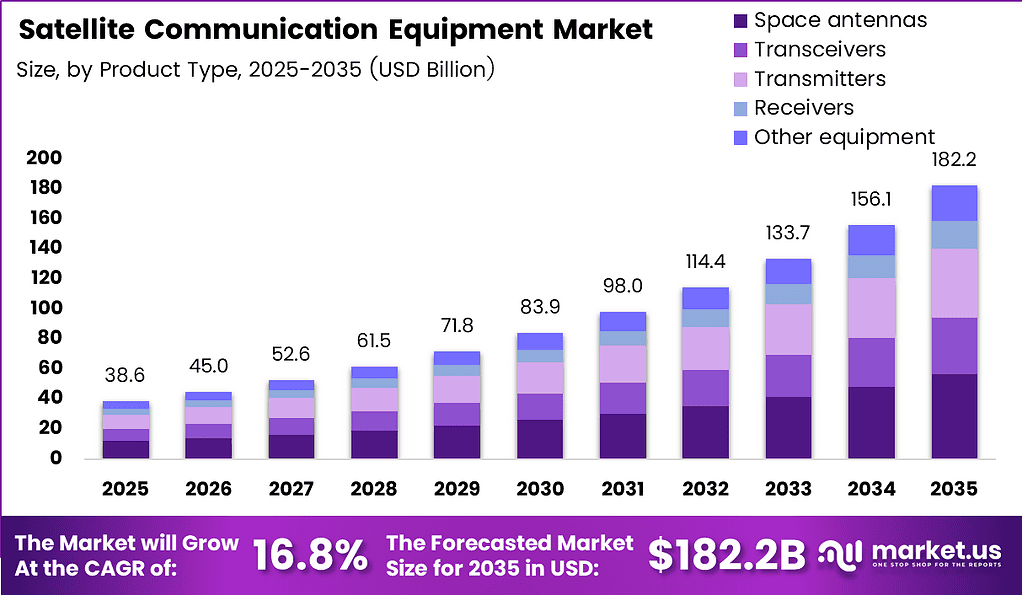
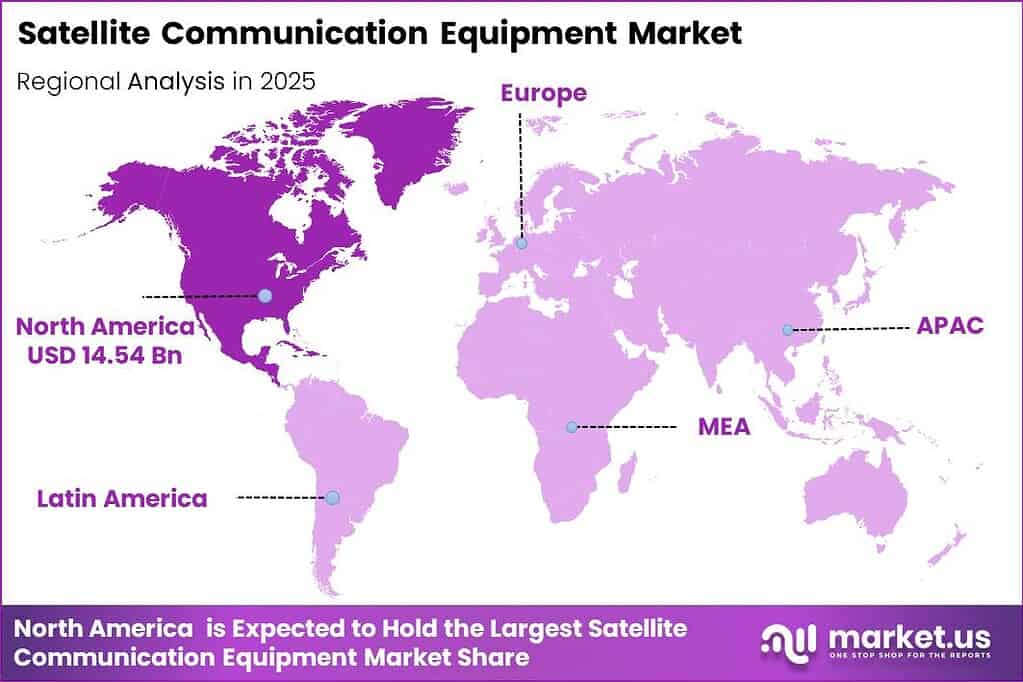
In 2025, the Global Satellite Communication (SATCOM) Equipment Market was valued at US$38.6 billion, and between 2026 and 2035, this market is estimated to register a CAGR of 16.8%, reaching about US$181.2 billion by 2035. North America held a dominant market position, capturing more than a 37.70% share, holding USD 14.54 billion in revenue.
SATCOM equipment refers to the physical hardware including antennas, terminals, modems, transceivers, and gateways that makes satellite-based communication possible across voice, broadband, video, navigation, defense, aviation, maritime, and remote connectivity services around the world.
The global Satellite Communication (SATCOM) Equipment market is growing due to rising demand for reliable connectivity across remote areas, defense operations, aviation, maritime, and emergency communication systems. Growth is also supported by increasing satellite launches, wider use of high-speed broadband services, and the need for secure communication networks where traditional ground-based infrastructure is limited or unavailable.
- In December 2025, Cobham Satcom merged its Network Division with Gatehouse Satcom, creating a focused entity dedicated to 5G NTN satellite communication solutions aimed at serving commercial, defense, and enterprise users. On the national level, India made a significant statement in November 2025 when ISRO launched CMS-03, its heaviest communication satellite to date, signaling serious ambitions across the Asia-Pacific region.
Meanwhile, North America continued to hold its position at the front of the global market in 2025, largely on the back of strong defense procurement, sustained R&D investment, and the steady build-out of secure government communication networks. Across all regions, next-generation technologies like phased-array antennas, high-throughput satellites, and software-defined payloads are fundamentally changing how equipment is deployed — particularly in aviation, maritime operations, and military communications.
Key Takeaways
- The global SATCOM equipment market was valued at US$38.6 billion in 2025.
- The global SATCOM equipment market is projected to grow at a CAGR of 16.8% and is estimated to reach US$181.2 billion by 2035.
- On the basis of component, space antennas dominated the market, constituting 30.10% of the total market share.
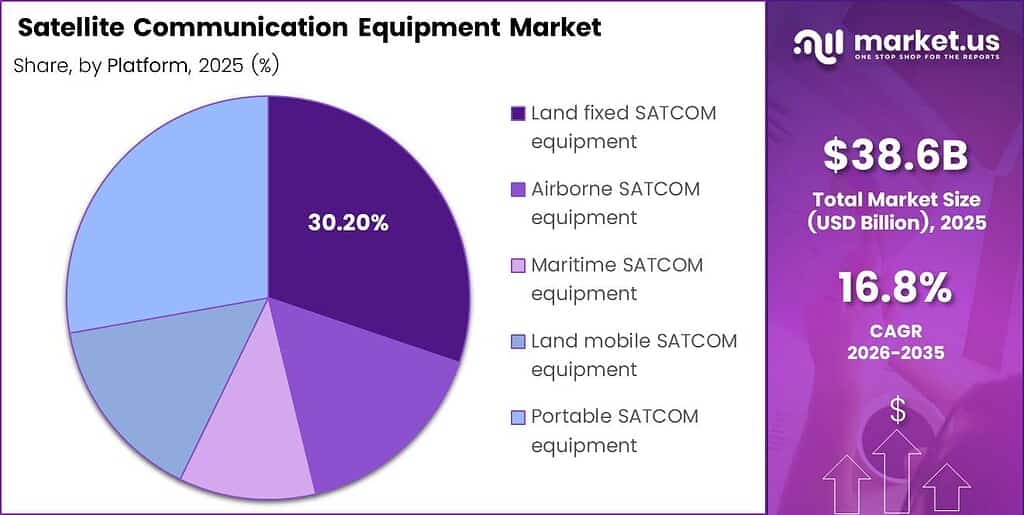
- Based on the platform, land fixed SATCOM equipment (teleports, gateways, ground stations) dominated the SATCOM equipment market, with a substantial market share of around 30.20%.
- Based on the connectivity, GEO / MEO-based connectivity led the market, comprising 61.20% of the total market.
- Among the technologies, SATCOM-on-the-move (SOTM) / communications-on-the-move (COTM) is the most considerable within the market, accounting for around 65.40% of the revenue.
- Among the end-uses, the commercial industry held a major share in the SATCOM equipment market, 55.60% of the market share.
- In 2025, North America was the most dominant region in the SATCOM equipment market, accounting for 37.70% of the total global consumption.
Component Analysis
Space antennas dominate the global SATCOM equipment market
Space antennas dominate the global SATCOM equipment market with a 30.10% share, as they are essential across all parts of the satellite communication chain, including user terminals, gateways, and satellite payloads. Demand is being strongly driven by the rapid expansion of LEO mega-constellations, which require electronically steered phased-array antennas to maintain continuous connectivity with fast-moving satellites.
The industry shift away from static, mechanical copper dishes to Active Electronically Scanned Antennas (AESAs) has drastically raised the monetary value of the antenna assembly. A modern phased-array antenna is no longer just shaped metal; it is a complex grid embedded with thousands of Radio Frequency Integrated Circuits (RFICs), silicon-germanium (SiGe) beamformers, and advanced printed circuit boards (PCBs). This dense integration makes the antenna the most expensive component in a standard satellite terminal.
For instance, SpaceX’s Starlink, with over 6,000 active satellites by early 2026, relies heavily on flat-panel phased-array terminals, and global LEO terminal shipments are expected to reach 18.5 million units annually by 2030. The defense sector is also contributing significantly, with the U.S. Space Force allocating over $3.8 billion toward satellite communications programs in FY2025 and major contractors such as Northrop Grumman, RTX, and L3Harris Technologies investing in phased-array antenna production.
Platform Analysis
Land-fixed SATCOM is the most significant type
Land-fixed SATCOM equipment holds the largest share at 30.20%, as teleports, gateways, and ground stations form the core infrastructure that supports all satellite networks. The expansion of LEO constellations is increasing the need for dense gateway networks, since each system requires more terrestrial nodes for traffic routing and inter-satellite link management compared to traditional GEO systems. Investments such as SES’s next-generation meoSphere network, designed for compatibility with EU IRIS² and 5G NTN standards, are further driving upgrades in fixed ground infrastructure.
Airborne SATCOM is the fastest-growing segment, supported by rising demand for in-flight connectivity across commercial and business aviation. Operators such as Viasat already serve thousands of aircraft, while competitors like Hughes Network Systems and Eutelsat OneWeb continue expanding aviation broadband services. Maritime SATCOM also represents a significant segment, driven by naval modernization and commercial shipping needs. For example, NATO has contracted Orbit Communication Systems to supply OceanTRx4 MIL systems for naval vessels, with multi-band capability across Ku-, X-, and Ka-bands.
Connectivity Analysis
GEO and MEO connectivity dominates the connectivity segment
GEO and MEO connectivity dominate with a 61.20% share, supported by long-established infrastructure, spectrum rights, and long-term contracts. GEO remains widely used for broadcasting, enterprise VSAT, and aviation due to its fixed-position advantage, while MEO systems, led by SES’s O3b mPOWER, are preferred for low-latency applications such as maritime connectivity and government networks. Operators are increasingly adopting multi-orbit strategies to stay competitive, with Viasat integrating GEO and LEO capabilities to enhance service flexibility.
LEO connectivity holds 38.80% and is the fastest-growing segment, driven by mega-constellations delivering low-latency broadband. SpaceX is expanding next-generation satellite capacity, while Amazon is scaling its LEO constellation toward global coverage. This growth is sharply increasing demand for phased-array terminals, gateways, and LEO-compatible infrastructure across industries like aviation, maritime, and direct-to-device services.
Technology Analysis
SATCOM-on-the-Move (SOTM) and Communications-on-the-Move (COTM) Held a Major Share of the global SATCOM equipment market
SATCOM-on-the-Move (SOTM) and Communications-on-the-Move (COTM) dominate the market with a 65.40% share, reflecting the shift toward uninterrupted satellite connectivity across defense, aviation, maritime, and commercial mobility applications. These systems enable real-time communication for moving platforms such as vehicles, aircraft, and naval vessels, making them essential in modern military operations and high-mobility commercial use cases. Growing electronic warfare threats have further increased demand for secure, ruggedized mobile terminals and electronically steered antennas that can maintain connectivity in dynamic environments.
SATCOM-on-the-Pause (SOTP) accounts for 34.60% of the market and is used in scenarios where brief stops for connectivity are acceptable, such as remote enterprise sites, disaster recovery operations, military logistics hubs, and news gathering. However, the gap between SOTM and SOTP is narrowing as phased-array antenna technology becomes more affordable and widely adopted, gradually shifting more applications toward continuous, on-the-move connectivity.
End Use Analysis
Commercial segment is Mostly Utilized in the End Use segment
The commercial segment leads the SATCOM equipment market with a 55.60% share, driven by strong demand from aviation, maritime, enterprise networks, telecom operators, and broadband connectivity services. It includes applications such as VSAT networks, in-flight connectivity, maritime broadband, rural internet access, and industrial IoT. Growth is increasingly supported by multi-orbit and hybrid systems. For example, Hughes Network Systems has deployed Fusion technology with Delta Air Lines to integrate GEO, LEO, and 5G networks for in-flight connectivity. Expansion of direct-to-device services, with 34 operators across 25 markets by August 2025, is further strengthening this segment.
Government and defense account for 44.40% of the market, driven by demand for secure, high-value SATCOM systems, encrypted terminals, and sovereign communication infrastructure. Procurement is steady due to long-term defense contracts and national security needs. For instance, Gilat Satellite Networks supplied transportable SATCOM terminals to a European Ministry of Defense in a contract exceeding $16 million in February 2026, highlighting ongoing investment in resilient military communication systems.
Key Market Segments
By Component
- Space antennas
- Transceivers
- Transmitters
- Receivers
- Other equipment
By Platform
- Land fixed SATCOM equipment (teleports, gateways, ground stations)
- Airborne SATCOM equipment
- Maritime SATCOM equipment
- Land mobile SATCOM equipment
- Portable SATCOM equipment (man-portable / transportable)
By Connectivity
- GEO / MEO-based connectivity
- LEO-based connectivity
By Technology
- SATCOM-on-the-move (SOTM) / communications-on-the-move (COTM)
- SATCOM-on-the-pause (SOTP)
By End Use
- Commercial
- Government and defense
Drivers
LEO Satellite Constellations Driving Global SATCOM Equipment Demand
The rapid expansion of Low Earth Orbit (LEO) satellite constellations is becoming a major growth driver for the global SATCOM equipment market. Unlike traditional geostationary satellites, LEO satellites move continuously, requiring advanced electronically steered phased-array antennas instead of conventional dish systems. This shift is increasing demand for higher-value SATCOM hardware across aviation, maritime, and defense sectors.
Each new LEO satellite also drives additional demand for supporting ground infrastructure, including gateways, modems, broadband terminals, and tracking systems. At the same time, LEO networks are expanding internet access to remote regions, aircraft, ships, and military operations, creating demand for specialized communication terminals tailored to these environments.
- Amazon’s Project Kuiper significantly accelerated this trend when it began large-scale deployment in April 2025. The company plans more than 80 launches and a total constellation of 3,236 satellites, supported by customer terminals offering speeds between 100 Mbps and 1 Gbps.
Partnerships with airlines and aerospace companies are already increasing demand for airborne SATCOM equipment. In February 2026, FCC approval for an additional 4,500 satellites further strengthened expectations for global growth in phased-array antennas, user terminals, and gateway infrastructure.
Restraints
Spectrum Constraints, Cybersecurity Risks, and High Costs Restraining SATCOM Market Growth
The SATCOM equipment market is growing, but it faces key challenges including spectrum limitations, cybersecurity risks, and high infrastructure costs. The rapid expansion of LEO satellite constellations is increasing pressure on available spectrum. Existing FCC regulations, originally designed for smaller networks, are struggling to manage dense LEO systems operating in the 10.7–30.0 GHz range alongside geostationary satellites. This is raising interference concerns and forcing operators to invest in costly equipment upgrades, which is slowing terminal deployment in some regions.
Cybersecurity and signal jamming threats are also rising. In July 2025, the U.S. Space Force awarded Boeing, Northrop Grumman, Intelsat, Viasat, and Astranis a combined $37 million under the Protected Tactical SATCOM-Global program, which has a total contract ceiling of $4 billion. These investments reflect growing concerns about cyberattacks and electronic interference targeting satellite communications.
Although launch costs have decreased, building and maintaining global LEO defense communication networks still requires 30 to 40% more investment than comparable geostationary systems due to frequent satellite replenishment needs. Supply chain constraints, especially shortages of radiation-hardened chipsets, are also delaying equipment delivery. As a result, these factors are limiting SATCOM adoption, particularly in smaller countries and emerging economies with limited budgets for large-scale satellite infrastructure.
Opportunity
Defense Modernization and Direct-to-Device Connectivity Creating New SATCOM Equipment Opportunities
The SATCOM equipment market is expanding rapidly, driven by defense modernization, rural broadband growth, and direct-to-device (D2D) connectivity.
The major growth area is direct-to-device connectivity. In January 2025, AST SpaceMobile secured access to up to 45 MHz of lower mid-band spectrum in the United States, enabling smartphone connectivity at speeds of up to 120 Mbps. The company also signed a 10-year agreement in October 2025 with stc group to provide satellite broadband across Saudi Arabia and parts of the Middle East. AST SpaceMobile now works with more than 50 mobile network operators globally, covering nearly 3 billion subscribers, and has demonstrated tactical NTN connectivity for multiple branches of the U.S. armed forces, driving additional demand for both commercial and defense equipment.
- In August 2025, the GSA reported 170 publicly announced operator-satellite partnerships across 80 countries and territories, with 34 operators in 25 markets already offering commercial services. Nearly half of these partnerships focused on rural and enterprise broadband, increasing demand for ground terminals, electronically steered antennas, and gateway infrastructure.
Integration of satellite communications with 5G NTN infrastructure is also creating new opportunities. In France, Eutelsat signed a military communications agreement worth up to 1 billion euros with the French armed forces, increasing demand for secure SATCOM terminals and software-defined ground systems. SES completed its 2.8-billion-euro acquisition of Intelsat in July 2025, strengthening multi-orbit capabilities and expanding opportunities for modem and gateway suppliers. In February 2025, Qualcomm partnered with Iridium Communications to improve satellite-enabled messaging and emergency services using NTN-compatible chipsets, further accelerating adoption across consumer and enterprise devices.
Trends
Emerging Technology Trends Transforming the SATCOM Equipment Market
The SATCOM equipment market is undergoing significant transformation driven by AI adoption, software-defined satellite systems, maritime expansion, and geopolitical pressures.
AI is increasingly being used to improve signal processing, network optimization, predictive maintenance, and interference mitigation. Companies such as Eutelsat, Space42, SKY Perfect JSAT, and Spire Global are integrating AI into satellite operations, boosting demand for AI-enabled ground infrastructure, intelligent modems, and adaptive terminals.
Software-defined satellite architectures are another key trend. SES announced its next-generation meoSphere MEO network, combining software-defined payloads built in Luxembourg with 28 high-power satellites from K2 Space. The system aims to expand broadband capacity, reduce terminal costs, and support compatibility with the EU IRIS² constellation and 5G NTN standards. In September 2025, ST Engineering iDirect launched a software-defined ground system with AI-driven network management.
Additionally, satellites planned for 2026 in Telesat’s Lightspeed constellation will use MDA Space’s Aurora platform, marking a shift toward integrated space and ground software systems. These developments are driving demand for reconfigurable terminals, adaptive modems, and flexible gateway infrastructure.
Geopolitical Impact Analysis
Geopolitical Tensions and Sovereign Defense Investments Reshaping SATCOM Equipment Demand
Geopolitical tensions are accelerating SATCOM investments. NATO warned that reliance on commercial SATCOM systems creates vulnerabilities and that attacks on space assets could trigger Article 5 collective defense provisions. NATO also launched its first Commercial Space Strategy in 2025 and is strengthening partnerships with industry through NCIA workshops. In December 2025, Ovzon secured a 240 million Swedish krona contract from a NATO member nation, with about 60% tied to mobile SATCOM terminals.
Globally, countries in Asia Pacific and the Middle East are investing in sovereign satellite systems to reduce dependence on foreign networks, increasing demand for secure terminals, encrypted modems, and portable SATCOM solutions. Europe is also expanding sovereign initiatives through the IRIS² constellation with 2.4 billion euros in funding, along with programs like France’s Syracuse system and the UK’s Skynet 6A initiative, creating sustained long-term demand for SATCOM ground equipment and secure communications infrastructure.
Regional Analysis
North America Held the Largest Share of the Global Satellite Communication (SATCOM) Equipment Market
North America leads the global SATCOM equipment market with a 37.70% share, supported by strong defense spending, advanced satellite constellation operators, and a highly developed ecosystem of manufacturers and technology providers. The United States drives most demand through large-scale procurement programs across the U.S. Space Force, Army, Navy, and Air Force, covering secure terminals, anti-jamming systems, and multi-orbit infrastructure. Programs such as General Dynamics’ MUOS satellite communications contract (up to $2.2 billion) highlight the scale of ongoing investment, while Canada continues expanding LEO-compatible ground infrastructure for rural broadband connectivity.
Europe is the second-largest market, driven by NATO-aligned defense modernization and the EU’s IRIS² sovereign satellite initiative, which is boosting demand for secure terminals, gateways, and electronically steered antennas. For example, Ovzon secured a $25.2 million contract from a European NATO member, with a significant portion allocated to mobile SATCOM terminals.
Asia-Pacific is the fastest-growing region, supported by rising defense budgets, expanding satellite broadband ecosystems, and increasing maritime connectivity needs across countries like India, Japan, China, and Southeast Asia. Meanwhile, the Middle East and Africa are witnessing growth through sovereign satellite programs and direct-to-device partnerships, while Latin America is steadily expanding adoption through rural broadband initiatives and maritime connectivity demand along major shipping routes.
Key Regions and Countries Covered in this Report
North America
- The US
- Canada
Europe
- Germany
- France
- The UK
- Spain
- Italy
- Russia & CIS
- Rest of Europe
APAC
- China
- Japan
- South Korea
- India
- ASEAN
- Rest of APAC
Latin America
- Brazil
- Mexico
- Rest of Latin America
Middle East & Africa
- GCC
- South Africa
- Rest of MEA
The global SATCOM equipment market is driven by defense primes, commercial broadband operators, and disruptive innovators supplying terminals, antennas, modems, and ground infrastructure for military, aviation, maritime, and remote connectivity applications. Competition is increasing as LEO constellation growth, direct-to-device services, defense modernization, and 5G NTN integration reshape traditional market segments.
Defense primes continue to anchor major institutional procurement. General Dynamics secured a U.S. Space Force contract worth up to $2.2 billion to sustain the Mobile User Objective System (MUOS). L3Harris received an $843 million Space Development Agency contract for Tracking Layer satellites, with 34 additional satellites in development.
On the commercial side, Hughes Network Systems secured a follow-on deal with Delta Air Lines for its Fusion technology, which integrates GEO and LEO satellite capacity with terrestrial 5G networks to enhance in-flight connectivity. Among disruptive players, SpaceX acquired 50 MHz of wireless spectrum from EchoStar for $17 billion in 2025 and is preparing Gen 3 satellite launches in 2026. Iridium also secured a U.S. Space Force infrastructure transformation contract worth up to $85.8 million to support global Department of Defense connectivity.
The following are some of the major players in the industry:
- Viasat, Inc.
- SES S.A.
- Intelsat S.A.
- Telesat Corporation
- EchoStar Corporation / Hughes Network Systems
- L3Harris Technologies, Inc.
- Thales Group (Thales Alenia Space, Thales Defense & Security)
- RTX Corporation (Raytheon)
- General Dynamics Corporation
- Cobham Satcom (Cobham Limited)
- Honeywell International Inc. (Honeywell Aerospace)
- Gilat Satellite Networks Ltd.
- Iridium Communications Inc.
- Aselsan A.S.
- Intellian Technologies Inc.
- ST Engineering iDirect
- SpaceX (Starlink ground terminals and antennas)
- Elbit Systems Ltd.
- ACORDE Technologies S.A.
- CPI SATCOM & Antenna Technologies (Communications & Power Industries)
- Other Key Players
Key Development
- In May 2026, Viasat and Intelsat General Communications secured a combined $437.7 million contract from the U.S. Space Force to design, develop, and deliver space vehicles under the Protected Tactical Satellite Communications-Global (PTS-G) program, with work expected to be completed by March 2029.
- In March 2026, RTX secured a $2.01 billion increase for its AEHF SATCOM terminal program, raising total value to $2.97 billion through 2031. It covers production and sustainment of secure military communication terminals. Work is based at U.S. Air Force facilities in Massachusetts and Florida. It reinforces long-term defense demand for encrypted SATCOM systems.
Report Scope
| Report Features | Description |
|---|---|
| Market Value (2025) | US$38.6 Bn |
| Forecast Revenue (2035) | US$181.2 Bn |
| CAGR (2026–2035) | 16.8% |
| Base Year for Estimation | 2025 |
| Historic Period | 2020–2024 |
| Forecast Period | 2026–2035 |
| Report Coverage | Revenue Forecast, Market Dynamics, Competitive Landscape, Recent Developments |
| Segments Covered | By Component (Space antennas, Transceivers, Transmitters, Receivers, and Other equipment), By Platform (Land fixed SATCOM equipment, Airborne SATCOM equipment, Maritime SATCOM equipment, Land mobile SATCOM equipment, and Portable SATCOM equipment), By Connectivity (GEO / MEO-based connectivity and LEO-based connectivity), By Technology (SATCOM-on-the-move (SOTM) / communications-on-the-move (COTM) and SATCOM-on-the-pause (SOTP)), By End Use (Commercial and Government and defense) |
| Regional Analysis | North America – The US & Canada; Europe – Germany, France, The UK, Spain, Italy, Russia & CIS, Rest of Europe; APAC – China, Japan, South Korea, India, ASEAN & Rest of APAC; Latin America – Brazil, Mexico & Rest of Latin America; Middle East & Africa – GCC, South Africa, & Rest of MEA |
| Competitive Landscape | Viasat, Inc., SES S.A., Intelsat S.A., Telesat Corporation, EchoStar Corporation / Hughes Network Systems, L3Harris Technologies, Inc., Thales Group (Thales Alenia Space), RTX Corporation (Raytheon), General Dynamics Corporation, Cobham Satcom (Cobham Limited), Honeywell International Inc., Gilat Satellite Networks Ltd., Iridium Communications Inc., Aselsan A.S., Intellian Technologies Inc., ST Engineering iDirect, SpaceX (Starlink ground terminals), Elbit Systems Ltd., ACORDE Technologies S.A., CPI SATCOM & Antenna Technologies, and Others |
| Customization Scope | Customization for segments, region/country-level will be provided. Moreover, additional customization can be done based on the requirements. |
| Purchase Options | We have three licenses to opt for: Single User License, Multi-User License (Up to 5 Users), Corporate Use License (Unlimited Users and Printable PDF) |