


Global Robotic Total Stations Market Size, Share, Growth Analysis By Technology (Reflector-Based Robotic Total Stations, Reflectorless Robotic Total Stations), By Application (Construction Layout, Land Surveying, Mining Surveying, Infrastructure Development, Topographic Surveying, Monitoring & Inspection, Others), By End User (Construction, Utilities, Mining, Others), By Region and Companies - Industry Segment Outlook, Market Assessment, Competition Scenario, Statistics, Trends and Forecast 2026-2035
- Published date: Mar 2026
- Report ID: 181456
- Number of Pages: 370
- Format:
-
keyboard_arrow_up
Quick Navigation
Report Overview
Global Robotic Total Stations Market size is expected to be worth around USD 3.2 Billion by 2035 from USD 2.0 Billion in 2025, growing at a CAGR of 4.8% during the forecast period 2026 to 2035.
Robotic total stations are precision survey instruments that automate angle and distance measurements without requiring a second operator at the instrument. They combine motorized servo drives, automatic target recognition, and onboard computing to deliver real-time positioning data across construction, mining, and infrastructure projects. This automation reduces crew size requirements while lifting output accuracy.
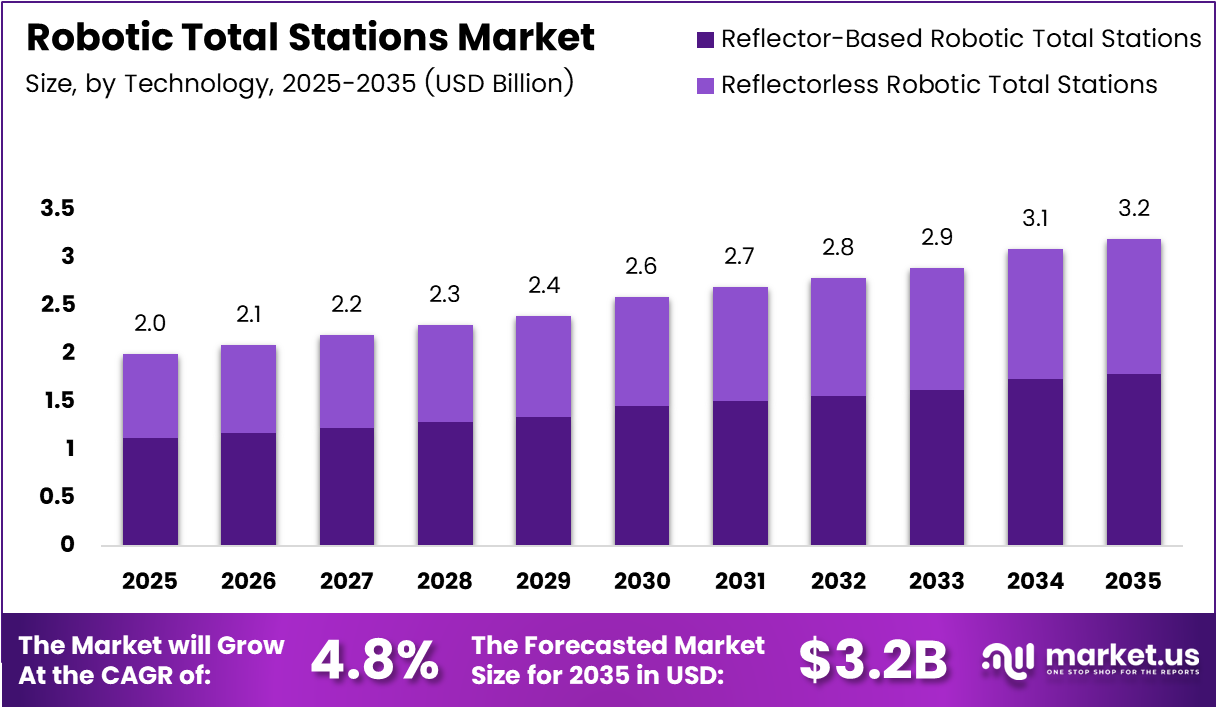
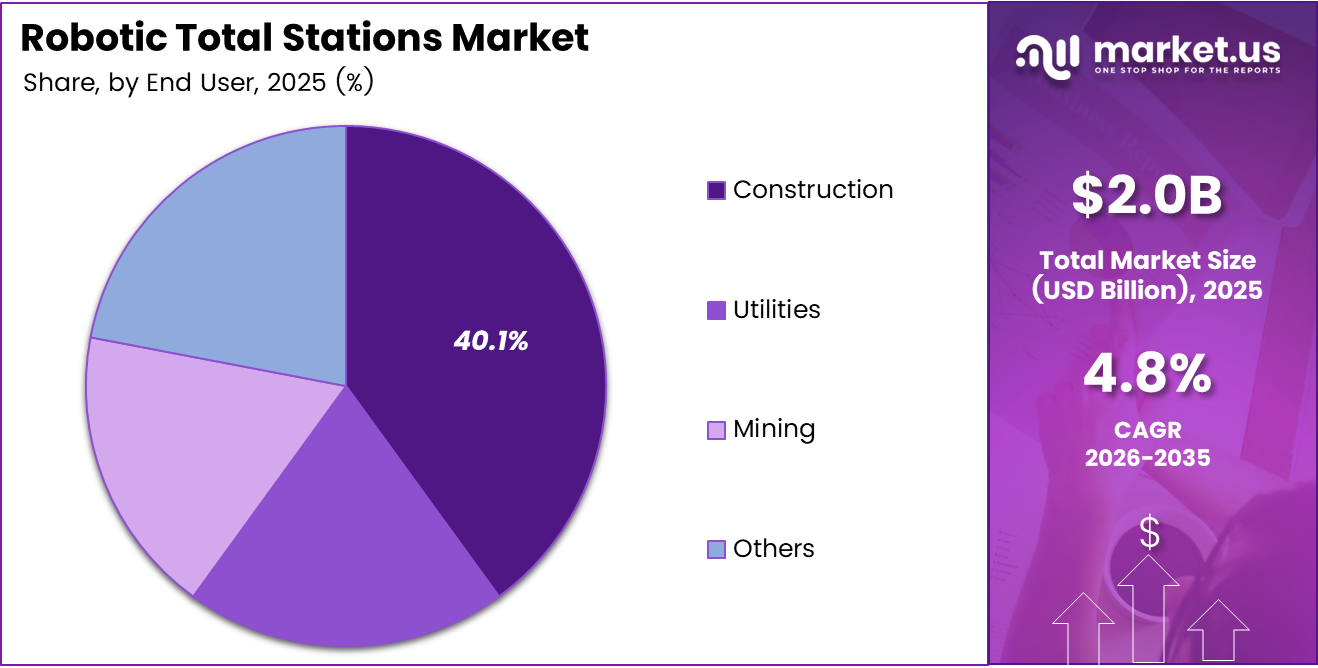
The market spans two core technology categories — reflector-based and reflectorless systems — serving end users across construction, utilities, and mining. Construction alone accounts for 40.1% of end-user demand, reflecting how deeply these instruments have embedded into large-scale project workflows. That concentration signals both the sector’s maturity and its sensitivity to construction cycle fluctuations.
Large-scale infrastructure expansion across Asia Pacific, North America, and Europe continues to place pressure on project timelines and accuracy standards. Contractors now face regulatory requirements that mandate as-built documentation and real-time deviation tracking. Robotic total stations directly address both requirements, making them a non-discretionary procurement item on major civil projects rather than an optional upgrade.
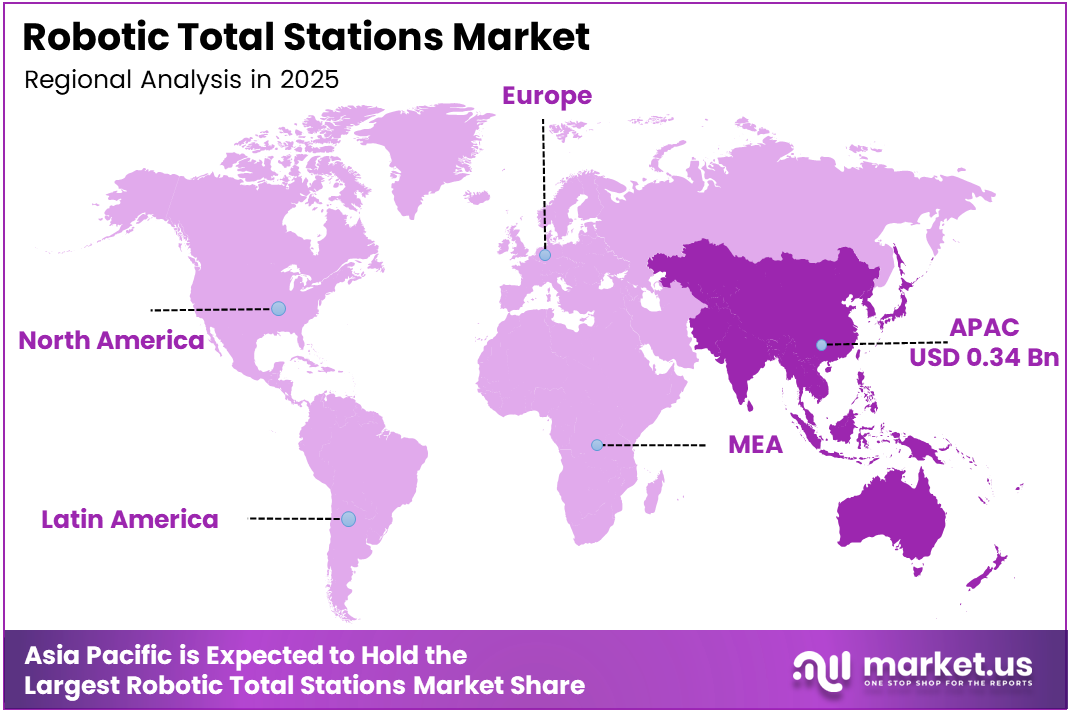
Government investment in public infrastructure — roads, bridges, rail, and smart city development — further reinforces procurement volumes. Asia Pacific leads this investment wave, holding 37.8% of global market share valued at USD 0.7 Billion, driven by national infrastructure programs in China, India, and Southeast Asia. This regional concentration means vendors with strong Asia Pacific channel presence hold a structural revenue advantage.
In June 2025, Advent International partnered with LayerZero Power Systems to support portfolio and growth initiatives in power distribution and precision infrastructure solutions, signaling continued institutional investment in the broader precision measurement and infrastructure technology segment. This type of capital deployment reflects sustained investor confidence in hardware-adjacent infrastructure tools.
According to a 2025 academic study published by THS-UKI, robotic total stations achieve accuracy of less than 1 cm for ranges under 400 m in high-precision bathymetry applications. This sub-centimeter performance benchmark reinforces why engineering-grade projects cannot substitute RTS with lower-cost GNSS alternatives — the accuracy gap is measurable and contractually significant.
Additionally, a 2025 UAS geo-referencing field test published in ISPRS Annals found that robotic total stations produce an average 3D trajectory difference of less than 13 mm versus reference datasets. For buyers evaluating RTS against drone-only survey workflows, this precision differential justifies the cost premium and underscores the instrument’s role as the ground-truth reference standard.
Key Takeaways
- The Global Robotic Total Stations Market was valued at USD 2.0 Billion in 2025 and is forecast to reach USD 3.2 Billion by 2035.
- The market advances at a CAGR of 4.8% over the forecast period 2026 to 2035.
- By Technology, Reflector-Based Robotic Total Stations lead with 55.4% market share in 2025.
- By Application, Construction Layout holds the largest share at 30.2% among all application segments.
- By End User, Construction dominates with 40.1% share of the global market.
- Asia Pacific is the leading region, holding 37.8% market share valued at USD 0.7 Billion in 2025.
Technology Analysis
Reflector-Based Robotic Total Stations dominate with 55.4% due to superior long-range accuracy and prism reliability.
In 2025, Reflector-Based Robotic Total Stations held a dominant market position in the By Technology segment of the Robotic Total Stations Market, with a 55.4% share. Prism-based measurement delivers verified, high-confidence readings at extended distances — a requirement that safety-critical infrastructure and tunneling projects will not compromise on. This structural dependency on certified accuracy keeps reflector-based systems entrenched despite higher setup requirements.
Reflectorless Robotic Total Stations serve as the preferred solution for inaccessible or hazardous measurement targets where placing a prism is impractical. Applications including bridge inspection, cliff face surveying, and live traffic zones drive adoption of reflectorless configurations. However, these systems carry trade-offs in absolute accuracy at longer ranges, which limits their share in precision-critical segments where reflector-based tools remain the default choice.
Application Analysis
Construction Layout dominates with 30.2% due to mandatory real-time positioning in large-scale builds.
In 2025, Construction Layout held a dominant market position in the By Application segment of the Robotic Total Stations Market, with a 30.2% share. Site layout demands sub-centimeter stakeout accuracy across grids, columns, and structural reference points — precision that manual methods cannot reliably deliver at scale. As project timelines compress and labor costs rise, automated layout becomes the productivity multiplier that justifies the capital cost.
Land Surveying represents one of the broadest and most consistent application bases for robotic total stations. Cadastral mapping, boundary determination, and topographic base mapping all require the combination of portability and measurement repeatability that these instruments provide. The continued expansion of land title registration programs in developing economies sustains baseline demand for land survey-grade instruments across the Asia Pacific and African markets.
Mining Surveying differentiates through its requirement for continuous deformation and convergence monitoring in underground environments. Open-pit and tunnel projects use robotic stations as fixed monitoring nodes that track wall movement without operator intervention. This autonomous monitoring use case commands premium pricing, as undetected deformation events carry both safety and financial consequences that far exceed instrument costs.
Infrastructure Development applications span road alignment, bridge construction, dam monitoring, and rail trackwork — all requiring high-frequency, high-accuracy position verification at multiple project phases. The multi-phase nature of infrastructure projects creates long-duration rental and service revenue streams, making this segment attractive to equipment finance and leasing providers entering the precision survey market.
Topographic Surveying carries strong demand from environmental assessment, master planning, and natural resource management projects where terrain modeling drives downstream design decisions. Robotic total stations in topographic workflows increasingly interface with drone-collected point cloud data, creating a hybrid ground-control ecosystem that elevates the instrument’s role from standalone tool to data anchor.
Monitoring and Inspection applications leverage robotic total stations as automated, long-duration observation platforms for structural health, landslide risk, and construction settlement monitoring. These deployments often run unmanned for weeks or months, generating time-series datasets that feed geotechnical analysis platforms. The shift toward sensor-as-a-service models in infrastructure monitoring creates recurring revenue opportunities beyond traditional instrument sales.
Others within the application segment include forensic investigation, archaeological site documentation, and precision agriculture field mapping. While individually smaller in volume, these niche applications often command above-average pricing for specialty configurations. Their expansion signals that robotic total station technology is migrating beyond its traditional civil engineering base into adjacent technical fields.
End-User Analysis
Construction dominates with 40.1% due to mandatory precision stakeout across all project phases.
In 2025, Construction held a dominant market position in the By End User segment of the Robotic Total Stations Market, with a 40.1% share. Large commercial, residential, and civil construction projects embed robotic total stations across layout, as-built verification, and quality control checkpoints. The instrument’s ability to reduce two-person survey teams to single-operator operation directly addresses the construction industry’s persistent skilled labor shortage.
Utilities operators use robotic total stations for pipeline alignment, tower positioning, and network infrastructure placement where positional accuracy determines long-term operational safety and maintenance access. Smart grid expansion and renewable energy installation programs — particularly solar farm and wind turbine foundation work — are adding new procurement volume within the utilities end-user segment that was previously served by lower-accuracy GNSS tools.
Mining end users deploy robotic total stations across both surface and underground operations to manage drill pattern accuracy, blast hole positioning, and ongoing stability monitoring. The cost of misaligned drilling in hard-rock mining — measured in wasted explosive charges and diluted ore grades — means the accuracy premium of robotic total stations delivers direct financial returns that justify procurement over cheaper alternatives.
Others in the end-user base include government survey agencies, environmental consultancies, academic research institutions, and forensic engineering firms. These buyers tend to specify instruments at the higher-performance end of the product range because accuracy certification requirements in their work cannot be met by entry-level survey tools. Their procurement patterns are project-driven rather than continuous, but they contribute to after-sales calibration and service revenue.
Key Market Segments
By Technology
- Reflector-Based Robotic Total Stations
- Reflectorless Robotic Total Stations
By Application
- Construction Layout
- Land Surveying
- Mining Surveying
- Infrastructure Development
- Topographic Surveying
- Monitoring & Inspection
- Others
By End User
- Construction
- Utilities
- Mining
- Others
Drivers
Global Infrastructure Expansion and Engineering Automation Mandates Accelerate Robotic Total Station Adoption
Large-scale construction and infrastructure programs across Asia, Europe, and North America require contractors to meet precision tolerances that manual survey methods cannot achieve consistently. Robotic total stations resolve this gap by delivering automated, repeatable measurements across high-volume stakeout tasks. The result is faster project delivery with fewer rework cycles — a direct bottom-line benefit for contractors operating on fixed-price contracts.
The integration of GPS and robotics into construction workflows has fundamentally changed site planning. Real-time position updates allow project managers to track progress against design models continuously rather than in periodic survey windows. According to Frontier Precision, the Trimble SPS620/SPS720 averages over 2,000 angle observations per measurement cycle by returning angles at 1,000 Hz — a technical capability that eliminates the rework costs caused by single-observation error on large sites.
Precision agriculture is adding a new and previously underrepresented demand base for robotic field mapping. High-accuracy positioning of drainage systems, irrigation infrastructure, and field boundary markers now requires sub-centimeter survey tools rather than consumer-grade GNSS. In August 2025, Socomec participated in Elecrama 2025 with advanced infrastructure technology showcases, reflecting how precision measurement tools are being positioned across multiple infrastructure verticals simultaneously.
Restraints
High Procurement Costs and Competitive Pressure from Alternative Technologies Constrain Market Penetration
Robotic total stations carry procurement costs that place them out of reach for small and mid-sized surveying firms operating on project-based cash flows. Annual maintenance, calibration, and software licensing add recurring costs that compound the initial investment. For firms managing three to five concurrent projects, the capital case for ownership — versus renting — is not always clear, suppressing addressable market size among smaller operators.
According to a 2025 THS-UKI study, conventional analogue GNSS processing delivers an interquartile range of 12 cm for height differences compared to 8 cm with robotic total stations. While this 4 cm improvement is significant for precision work, GNSS systems cost a fraction of a full robotic total station setup. For buyers whose project specifications do not require sub-centimeter accuracy, that cost differential makes GNSS a commercially rational substitute.
LiDAR scanning technology is compressing the price premium further. Mobile and static LiDAR systems can capture dense point clouds of complex environments in a fraction of the time required by traditional total station workflows. As LiDAR hardware prices fall and processing software matures, contractors increasingly evaluate LiDAR as a primary capture method — positioning robotic total stations in a defensive role limited to stakeout and control network verification tasks.
Growth Factors
BIM Integration, Asia-Pacific Infrastructure Demand, and Flexible Access Models Open New Revenue Channels
Building Information Modeling adoption across major construction markets creates a direct demand signal for instruments that produce BIM-compatible positional data in real time. Robotic total stations that integrate natively with cloud platforms and digital twin environments eliminate the post-processing step that previously delayed design-to-field feedback loops. This workflow efficiency argument is converting BIM mandates into instrument upgrade cycles on active projects.
Asia Pacific’s 37.8% market share — valued at USD 0.7 Billion — reflects the region’s role as the primary growth engine for precision survey hardware. National infrastructure programs in China, India, and Indonesia are generating sustained procurement volume that Western markets cannot replicate at equivalent rates. According to Topcon’s 2025 GT-Series datasheet, the GT-Series achieves a 40-hour battery life and a turning speed of 200° per second — performance specifications that match the continuous, high-throughput deployment conditions that large Asia Pacific construction sites demand.
Rental and leasing model development removes the capital barrier that limits small enterprise access to robotic total station technology. Equipment finance providers entering the precision survey segment allow project-level procurement decisions rather than corporate capital allocation approvals. In June 2024, Nature’s Generator released a 125-amp universal automatic transfer switch for solar and battery backup integration, illustrating how modular, accessible hardware models are expanding the customer base for technical infrastructure equipment across multiple segments.
Emerging Trends
AI Automation, Remote Operation, and Drone-RTS Hybrid Workflows Redefine Field Survey Productivity
AI-powered automation is shifting robotic total stations from passive measurement tools into active decision-support systems. Onboard imaging sensors with machine learning classification can now distinguish between survey targets, obstacles, and environmental noise without operator input. This processing capability reduces field time on complex sites and moves the instrument toward semi-autonomous operation that one technician can supervise across multiple concurrent measurement tasks.
Remote operation and cloud-connected workflows allow project managers to review measurement outputs from off-site locations in real time. This architectural shift is particularly consequential for infrastructure monitoring applications where the instrument operates unattended for extended periods. According to a 2025 Stonex case study on the TMB traverse update, the Stonex R180 offers a reflectorless range of up to 1,000 m and EDM accuracy of 1 mm + 1 ppm in prism mode — specifications that make remote, long-range monitoring operationally viable without field personnel on-site.
Drone-assisted topographical mapping paired with ground-control RTS networks is becoming the standard workflow for large area surveys. UAVs capture terrain data at speed while robotic total stations provide the verified ground control points that tie aerial data to absolute coordinate systems. Smart city planning initiatives amplify this trend by requiring both high-resolution spatial models and survey-grade control accuracy across urban environments — a requirement that neither technology can satisfy independently.
Regional Analysis
Asia Pacific Dominates the Robotic Total Stations Market with a Market Share of 37.8%, Valued at USD 0.7 Billion
Asia Pacific holds 37.8% of the global Robotic Total Stations Market, valued at USD 0.7 Billion in 2025. National-scale infrastructure investment programs in China, India, and Southeast Asia generate consistent demand for precision survey equipment across road, rail, and urban development projects. The region’s construction cost sensitivity also makes operator-reduction arguments for robotic systems commercially compelling in a way that high-labor-cost Western markets do not fully capture.
North America Robotic Total Stations Market Trends
North America benefits from mature construction technology procurement frameworks and well-established BIM adoption mandates across public infrastructure contracts. Federal highway and transit investment programs sustain multi-year equipment replacement cycles. The region’s concentration of established survey technology distributors and trained operators provides a reliable channel infrastructure that supports consistent robotic total station utilization rates across project types.
Europe Robotic Total Stations Market Trends
Europe’s robotic total station demand is anchored by large civil engineering contractors operating under EU infrastructure funding programs and stringent as-built documentation requirements. Germany, France, and the UK lead procurement volumes, supported by active adoption of digital construction mandates. The region’s focus on sustainable construction and lifecycle asset management creates a secondary demand stream for monitoring and inspection applications beyond initial project survey work.
Middle East and Africa Robotic Total Stations Market Trends
The Middle East drives demand through large-scale urban development, transport megaprojects, and smart city initiatives across GCC nations. Saudi Arabia’s Vision 2030 program and UAE infrastructure expansion create concentrated procurement windows for precision survey equipment. Africa’s market remains smaller but is advancing through mining sector investment and international development project funding that specifies survey-grade instrumentation as a contract requirement.
Latin America Robotic Total Stations Market Trends
Latin America presents a developing demand base anchored by Brazil and Mexico, where mining, oil and gas infrastructure, and urban construction projects create recurring survey equipment needs. Procurement is constrained by import cost structures and currency volatility that elevate effective acquisition prices for imported precision instruments. Rental model expansion and local distribution partnerships are the primary mechanisms through which vendors are building addressable market depth in this region.
Key Regions and Countries
North America
- US
- Canada
Europe
- Germany
- France
- The UK
- Spain
- Italy
- Rest of Europe
Asia Pacific
- China
- Japan
- South Korea
- India
- Australia
- Rest of APAC
Latin America
- Brazil
- Mexico
- Rest of Latin America
Middle East & Africa
- GCC
- South Africa
- Rest of MEA
Key Company Insights
Carlson Software positions itself as the software-hardware integration specialist within the robotic total station ecosystem, offering field-to-office data workflows that tie RTS measurement outputs directly into CAD and civil design platforms. This integration strategy reduces the post-processing burden for contractors, creating switching costs that are software-dependency based rather than hardware-performance based — a durable competitive moat in an otherwise hardware-commoditizing segment.
Changzhou Dadi Surveying Science & Technology Co. Ltd. competes on price-performance positioning in the mid-market tier, targeting construction contractors and surveying firms in emerging markets that require capable instrumentation without the premium associated with Western-brand systems. Their manufacturing base in China provides a structural cost advantage that enables competitive pricing in Asia Pacific markets where total cost of ownership is the primary procurement criterion.
Guangdong Kolida Instrument Co. Ltd. has built its market position around accessible precision instruments for professional and semi-professional survey applications in price-sensitive markets. Kolida’s distribution reach across Asia, Africa, and the Middle East gives it coverage in geographies where established premium brands have weaker channel presence. This geographic positioning allows Kolida to capture first-time buyers entering the robotic total station category from conventional optical instruments.
Hexagon AB operates at the premium end of the robotic total station market through its Leica Geosystems division, offering instruments that integrate with Hexagon’s broader spatial intelligence platform. The strategic value of this approach lies in creating enterprise-level recurring revenue through software subscriptions, cloud services, and sensor integration — shifting the business model beyond one-time hardware transactions toward long-duration data services relationships with major engineering and construction clients.
Key Players
- Carlson Software
- Changzhou Dadi Surveying Science & Technology Co. Ltd.
- Guangdong Kolida Instrument Co. Ltd.
- Hexagon AB
- Hilti Corporation
- Hi-Target Global
- South Surveying & Mapping Technology CO., LTD.
- STONEX Srl
- Suzhou FOIF Co. Ltd. (Singoo)
- Topcon Corporation
- Trimble Inc.
- Topcon Sokkia India Pvt. Ltd.
- Vertex Group
- Vp ESS
- SatLab
- Other Key Players
Recent Developments
- May 2025 – Schneider Electric unveiled new transfer switch capabilities, including automatic transfer switch offerings in its Acti9 range and ASCO bypass switches, enhancing power resilience and continuity for critical infrastructure facilities. These additions strengthen Schneider’s portfolio for data centers and industrial clients requiring uninterrupted power systems.
- November 2025 – Schneider Electric and Switch expanded a USD 1.9 billion supply capacity partnership focused on AI data center infrastructure, implying broader deployment of resilient power systems including transfer switches across hyperscale facilities. This deal reflects the scale of capital now flowing into AI-driven infrastructure buildout.
- September 2024 – Socomec India officially launched the ATyS a M pre-programmed automatic transfer switching equipment, targeting commercial builds and fire-safety circuits. The product’s pre-programmed design reduces installation complexity, lowering the barrier for mid-tier contractors to specify automatic transfer switching in standard commercial projects.
Report Scope
Report Features Description Market Value (2025) USD 2.0 Billion Forecast Revenue (2035) USD 3.2 Billion CAGR (2026-2035) 4.8% Base Year for Estimation 2025 Historic Period 2020-2024 Forecast Period 2026-2035 Report Coverage Revenue Forecast, Market Dynamics, Competitive Landscape, Recent Developments Segments Covered By Technology (Reflector-Based Robotic Total Stations, Reflectorless Robotic Total Stations), By Application (Construction Layout, Land Surveying, Mining Surveying, Infrastructure Development, Topographic Surveying, Monitoring & Inspection, Others), By End User (Construction, Utilities, Mining, Others) Regional Analysis North America (US and Canada), Europe (Germany, France, The UK, Spain, Italy, and Rest of Europe), Asia Pacific (China, Japan, South Korea, India, Australia, and Rest of APAC), Latin America (Brazil, Mexico, and Rest of Latin America), Middle East & Africa (GCC, South Africa, and Rest of MEA) Competitive Landscape Carlson Software, Changzhou Dadi Surveying Science & Technology Co. Ltd., Guangdong Kolida Instrument Co. Ltd., Hexagon AB, Hilti Corporation, Hi-Target Global, South Surveying & Mapping Technology CO., LTD., STONEX Srl, Suzhou FOIF Co. Ltd. (Singoo), Topcon Corporation, Trimble Inc., Topcon Sokkia India Pvt. Ltd., Vertex Group, Vp ESS, SatLab, Other Key Players Customization Scope Customization for segments, region/country-level will be provided. Moreover, additional customization can be done based on the requirements. Purchase Options We have three licenses to opt for: Single User License, Multi-User License (Up to 5 Users), Corporate Use License (Unlimited User and Printable PDF)  Robotic Total Stations MarketPublished date: Mar 2026add_shopping_cartBuy Now get_appDownload Sample
 -
-
- Carlson Software
- Changzhou Dadi Surveying Science & Technology Co. Ltd.
- Guangdong Kolida Instrument Co. Ltd.
- Hexagon AB
- Hilti Corporation
- Hi-Target Global
- South Surveying & Mapping Technology CO., LTD.
- STONEX Srl
- Suzhou FOIF Co. Ltd. (Singoo)
- Topcon Corporation
- Trimble Inc.
- Topcon Sokkia India Pvt. Ltd.
- Vertex Group
- Vp ESS
- SatLab
- Other Key Players
Our Clients

- 181456
- Mar 2026






