


Global Rice Water Haircare Products Market Size, Share, Growth Analysis By Product (Shampoo, Conditioner, Hair Masks, Serums, Hair Oil, Others), By End-use (Women, Men), By Distribution Channel (Hypermarkets & Supermarkets, Convenience Stores, Specialty Stores, Online, Others), By Region and Companies - Industry Segment Outlook, Market Assessment, Competition Scenario, Statistics, Trends and Forecast 2026-2035
- Published date: Feb 2026
- Report ID: 180116
- Number of Pages: 249
- Format:
-
keyboard_arrow_up
Quick Navigation
Report Overview
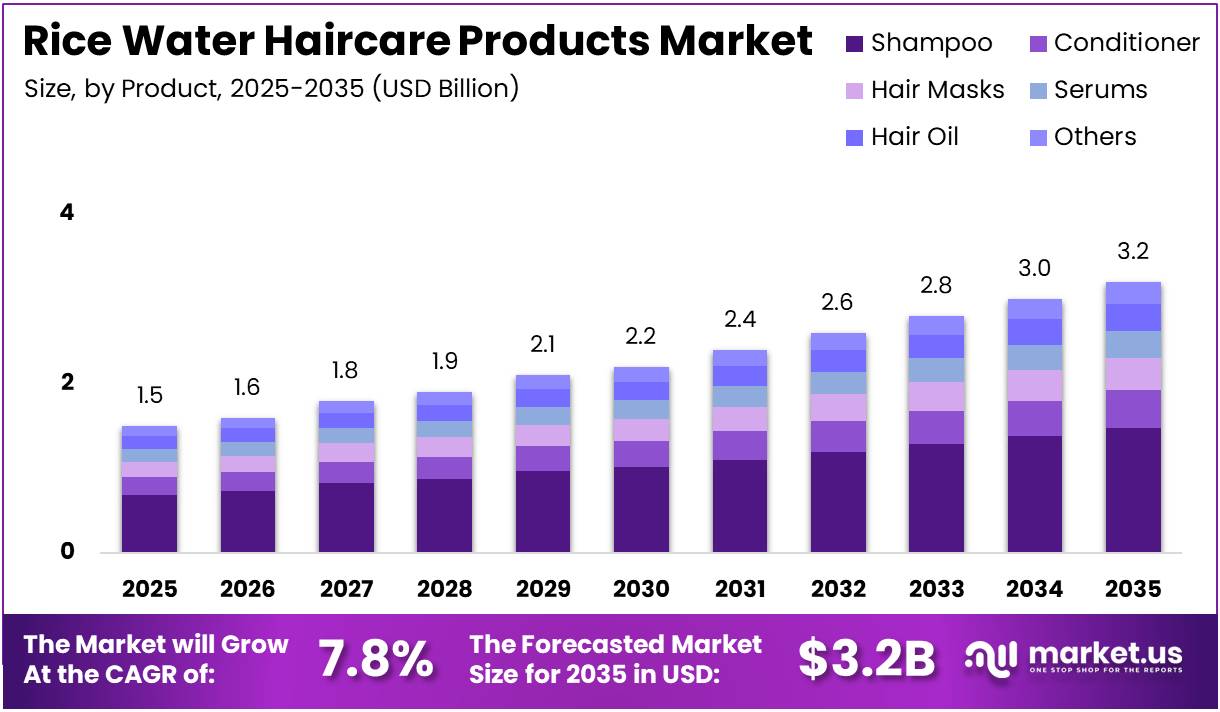
The Global Rice Water Haircare Products Market size is expected to be worth around USD 3.2 Billion by 2035 from USD 1.5 Billion in 2025, growing at a CAGR of 7.8% during the forecast period 2026 to 2035.
The rice water haircare products market encompasses a broad range of personal care items formulated with rice water as a primary or key active ingredient. These products include shampoos, conditioners, hair masks, serums, and hair oils. Moreover, they are marketed for benefits such as hair strengthening, improved elasticity, and reduced breakage.
Rice water is derived from the soaking or fermentation of rice grains and is naturally rich in amino acids, vitamins B and E, and inositol. Historically used in East and Southeast Asian beauty rituals, it has transitioned from a traditional DIY practice to a commercially recognized haircare ingredient globally.
Consumer demand for clean-label and sulfate-free haircare is a primary driver of market expansion. Urban consumers across North America, Europe, and Asia Pacific are actively seeking alternatives to chemical-laden hair products. Additionally, the influence of social media beauty communities has significantly accelerated awareness and adoption of rice water-based haircare.
Government agencies in several Asia Pacific nations are actively promoting the use of traditional and herbal ingredients in personal care formulations. These regulatory supportive environments are creating favorable conditions for product development and market entry. Consequently, brands are increasingly investing in organic, cold-fermented, and clean-certified rice water products.
According to Attest, 52% of haircare shoppers globally say they are more likely to purchase products featuring chemical-free or natural ingredients. This finding strongly validates demand growth within the rice water haircare market. Therefore, brands that position themselves around ingredient transparency and natural formulations are well positioned for sustained long-term growth.
According to ResearchGate, a formulation containing 96% rice water demonstrated excellent biocompatibility, indicating its meaningful potential for broader cosmetic applications. This scientific evidence supports growing interest from product developers seeking clinically supported claims. Moreover, it encourages investment in high-concentration rice water products positioned as premium and therapeutically effective haircare solutions.
Key Takeaways
- The global Rice Water Haircare Products Market was valued at USD 1.5 Billion in 2025 and is projected to reach USD 3.2 Billion by 2035.
- The market is expected to grow at a CAGR of 7.8% during the forecast period 2026 to 2035.
- By Product, Shampoo dominates the market with a share of 42.6% in 2025.
- By End-use, the Women segment holds the largest share at 76.3%.
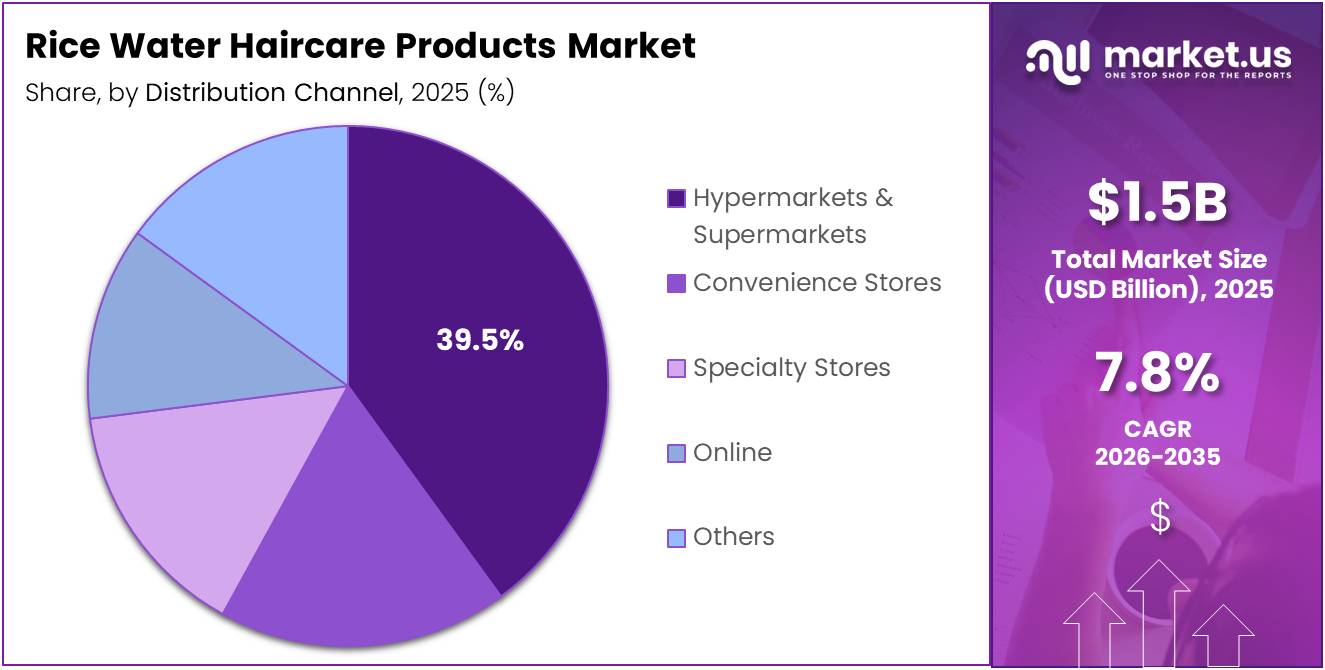
- By Distribution Channel, Hypermarkets and Supermarkets account for the leading share of 39.5%.
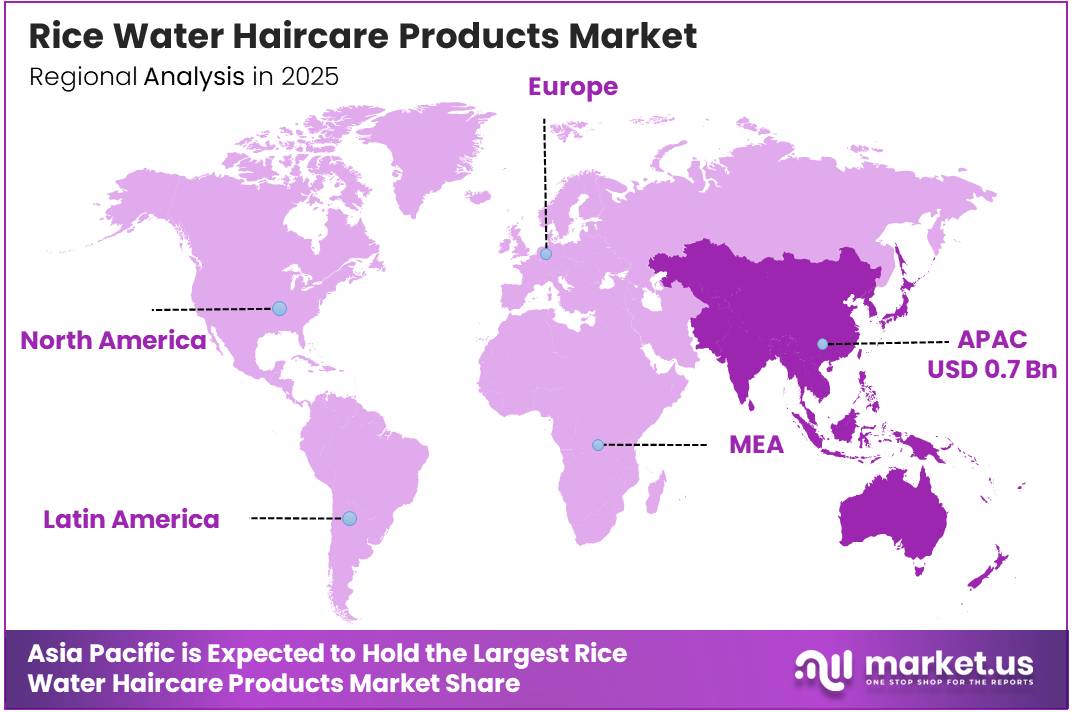
- By Region, Asia Pacific leads the market with a share of 48.60%, valued at USD 0.7 Billion in 2025.
By Product Analysis
Shampoo dominates with 42.6% due to its widespread daily use and strong consumer recognition of rice water haircare benefits.
In 2025, Shampoo held a dominant market position in the By Product segment of the Rice Water Haircare Products Market, with a 42.6% share. Shampoos remain the most frequently purchased haircare format globally, driven by daily use habits and broad retail availability. Additionally, rice water shampoos are widely recognized for their cleansing and strengthening properties.
Conditioner holds a notable share in the market, supported by growing consumer interest in post-wash smoothening and detangling solutions. Rice water conditioners are gaining popularity as sulfate-free and nourishing alternatives to conventional products. Moreover, the segment benefits from bundled product launches that pair rice water shampoos and conditioners for a complete care routine.
Hair Masks are seeing steady growth as consumers seek intensive treatment options for damaged or chemically treated hair. Rice water-based masks are positioned as premium repair products within the natural haircare space. Consequently, this sub-segment is gaining traction among urban consumers who prioritize deep conditioning and targeted hair recovery treatments.
Serums represent a high-value and fast-growing product category within the rice water haircare segment. These lightweight formulations target specific hair concerns including frizz, breakage, and scalp health. Additionally, serums are performing well through e-commerce channels, where targeted claims and premium positioning support stronger consumer engagement and revenue growth.
Hair Oil retains strong consumer demand, particularly in South and Southeast Asian markets where oil-based haircare is a culturally embedded practice. Rice water-infused oils blend traditional ingredient appeal with modern clean-label branding. Therefore, this sub-segment continues to grow alongside increasing interest in scalp nourishment and holistic hair wellness routines.
Others category includes leave-in treatments, scalp tonics, and hair sprays that are gradually expanding the rice water haircare product range. These formats cater to consumers seeking personalized, multi-step haircare regimens. Moreover, brands are actively exploring innovative formats in this category to capture additional consumer interest and broaden their product portfolios.
By End-use Analysis
Women dominate with 76.3% due to higher frequency of haircare product use and greater brand engagement in daily beauty routines.
In 2025, Women held a dominant market position in the By End-use segment of the Rice Water Haircare Products Market, with a 76.3% share. Women represent the primary consumer base, driven by consistent demand for hair strengthening, conditioning, and scalp health solutions. Additionally, targeted marketing campaigns focused on female consumers reinforce this strong segment dominance.
Men segment is experiencing growing interest as male consumers increasingly prioritize personal grooming and scalp health. Rice water-based products for men are being introduced in gender-neutral and male-targeted formats. Consequently, this sub-segment offers significant untapped growth potential, particularly as brands develop dedicated rice water haircare lines for the male consumer audience.
By Distribution Channel Analysis
Hypermarkets and Supermarkets dominate with 39.5% due to wide product availability, strong footfall, and consumer preference for in-store haircare purchasing.
In 2025, Hypermarkets and Supermarkets held a dominant market position in the By Distribution Channel segment of the Rice Water Haircare Products Market, with a 39.5% share. These large-format retail outlets offer extensive product visibility and easy consumer access. Moreover, promotional displays and in-store trial opportunities significantly drive impulse purchases across the haircare category.
Convenience Stores serve as an important secondary channel, particularly for urban consumers seeking quick access to everyday haircare products. Their wide geographic reach and extended operating hours make them an accessible touchpoint for smaller-sized rice water haircare formats. Therefore, this channel maintains a steady and consistent share within the overall distribution landscape.
Specialty Stores cater to informed and beauty-focused consumers who seek curated selections and expert guidance on haircare products. These outlets provide a strong environment for premium and niche rice water haircare brands to build consumer loyalty. Additionally, specialty stores are particularly effective for launching new and innovative product formats to targeted and engaged audiences.
Online channel is the fastest-growing distribution segment, driven by increasing e-commerce penetration and shifting consumer purchasing habits. Digital platforms enable brands to reach a global audience and offer personalized product recommendations. Consequently, many rice water haircare brands are prioritizing direct-to-consumer online strategies to drive growth and expand brand awareness.
Others category includes salon and professional channels, drug stores, and direct selling formats that complement mainstream retail distribution. These channels are important for introducing premium rice water haircare products to professional consumer segments. Moreover, they support brand credibility through recommendation-driven purchase behaviors across specialized and expert-focused consumer touchpoints.
Key Market Segments
By Product
- Shampoo
- Conditioner
- Hair Masks
- Serums
- Hair Oil
- Others
By End-use
- Women
- Men
By Distribution Channel
- Hypermarkets and Supermarkets
- Convenience Stores
- Specialty Stores
- Online
- Others
Drivers
Rising Consumer Demand for Natural and Fermented Haircare Ingredients Drives Rice Water Market Growth
Consumer preference for fermented and nutrient-rich traditional haircare ingredients is one of the most significant growth drivers in this market. Rice water, particularly in its fermented form, is highly valued for its protein content and hair-nourishing properties. Moreover, growing awareness of ancient Asian beauty rituals is converting more global consumers toward rice water-based haircare products.
Increasing demand for sulfate-free and silicone-free formulations in daily hair routines is accelerating adoption of rice water haircare products. Consumers are actively seeking gentle alternatives that support scalp health without compromising hair quality. Therefore, brands offering rice water formulations with clean-label credentials are capturing strong consumer interest across all major markets globally.
Growing popularity of hair strengthening and breakage-reduction claims is driving consumer purchase decisions in the rice water haircare segment. Urban consumers, particularly women, are prioritizing products that address hair thinning and damage concerns. Additionally, brands that highlight clinically validated hair strengthening benefits are gaining competitive advantages and stronger consumer trust within this expanding market.
Restraints
Limited Scientific Standardization and Scalp Sensitivity Concerns Restrain Wider Market Adoption
Limited scientific standardization in rice water formulations creates inconsistent efficacy perceptions among consumers and dermatologists. Without universally accepted concentration benchmarks or clinical testing protocols, product quality varies significantly across brands and price segments. Consequently, consumer skepticism about actual product benefits remains a barrier to converting new users into consistent repeat buyers.
Risk of product build-up and scalp sensitivity with frequent use is another restraining factor for the rice water haircare market. Some consumers report adverse reactions such as scalp irritation or excessive protein build-up after prolonged use. Therefore, these concerns limit adoption among sensitive scalp users and require brands to invest in dermatologically tested, carefully balanced formulations.
These restraints collectively highlight the need for greater industry-wide investment in research, clinical validation, and consumer education. Brands that proactively address formulation safety and ingredient transparency are better positioned to overcome adoption barriers. Moreover, establishing regulatory quality standards for rice water concentrations could help strengthen long-term market credibility and build sustained consumer confidence.
Growth Factors
Product Innovation and Premiumization Drive Sustained Growth in the Rice Water Haircare Market
Development of scalp-focused rice water serums and leave-in treatments is creating new product opportunities and expanding the overall category. These targeted formulations address specific hair repair needs that traditional rinse-off products cannot fully deliver. Additionally, consumer interest in multi-step haircare routines is supporting growing demand for specialized, leave-in rice water formats across all key markets.
Premiumization through organic, cold-fermented, and clean-label certifications is enabling brands to command higher price points and attract quality-conscious consumers. Certified products resonate particularly well with millennial and Gen Z consumers who value ingredient integrity and sustainable sourcing. Therefore, investment in premium positioning is becoming a key growth lever for rice water haircare brands globally.
Expansion into men’s grooming and gender-neutral haircare segments represents a substantial untapped growth opportunity for the market. Male consumers are increasingly spending on premium hair and scalp products, creating space for rice water formulations within this segment. Consequently, brands that develop gender-inclusive product lines stand to benefit from this emerging and rapidly growing consumer base.
Emerging Trends
Traditional Asian Haircare Rituals and Clean Formulations Shape the Future of the Rice Water Haircare Market
A significant trend in the market is the surge in DIY-to-commercial transition of traditional Asian haircare rituals. Consumers who previously prepared homemade rice water treatments are increasingly turning to commercially produced alternatives for convenience and consistency. Moreover, brands are capitalizing on this shift by offering authenticity-focused products that replicate traditional formulation methods at commercial scale.
Integration of rice water with adaptogens and botanical extract complexes is an emerging formulation trend gaining significant traction. Brands are combining rice water with ingredients such as ashwagandha, ginseng, and green tea to create multi-benefit haircare solutions. Therefore, these advanced hybrid formulations are attracting premium-segment consumers seeking comprehensive scalp and hair health benefits from a single product.
Eco-conscious packaging adoption is rapidly becoming a standard expectation among natural haircare consumers. Brands in the rice water haircare space are transitioning toward biodegradable, recyclable, and refillable packaging formats to align with growing sustainability demands. Additionally, transparent packaging that showcases natural ingredients reinforces brand authenticity and appeals to environmentally aware shoppers across global markets.
Regional Analysis
Asia Pacific Dominates the Rice Water Haircare Products Market with a Market Share of 48.60%, Valued at USD 0.7 Billion
Asia Pacific leads the global rice water haircare products market with a dominant share of 48.60%, valued at USD 0.7 Billion in 2025. The region’s leadership stems from deep-rooted cultural traditions of rice water use, particularly in India, China, Japan, and South Korea. Moreover, a rapidly growing middle-class consumer base continues to fuel demand for traditional and natural haircare products.
North America Rice Water Haircare Products Market Trends
North America represents a significant and fast-growing market for rice water haircare products. Consumer demand for clean-label, chemical-free haircare is rising steadily across the United States and Canada. Additionally, the growing influence of K-beauty and J-beauty trends is driving mainstream adoption of rice water formulations in North American retail channels.
Europe Rice Water Haircare Products Market Trends
Europe is an emerging market for rice water haircare products, led by growing consumer preference for natural, sustainable, and ethically sourced personal care items. Germany, France, and the UK are the leading markets within the region. Moreover, stringent EU cosmetic regulations are encouraging broader adoption of clean, ingredient-transparent haircare formulations across European retail channels.
Latin America Rice Water Haircare Products Market Trends
Latin America is showing growing potential for rice water haircare adoption, particularly in Brazil and Mexico where natural ingredient-based products are gaining consumer traction. Rising disposable incomes and increased beauty spending are supporting market growth in the region. Additionally, local brand development and international product launches are expanding product availability across Latin American markets.
Middle East and Africa Rice Water Haircare Products Market Trends
The Middle East and Africa region represents an emerging opportunity for the rice water haircare products market. Growing urbanization, rising beauty awareness, and expanding modern retail infrastructure are supporting category development. Moreover, demand for natural and chemical-free haircare solutions is rising across GCC countries and South Africa, creating a favorable long-term growth environment.
Key Regions and Countries
North America
- US
- Canada
Europe
- Germany
- France
- The UK
- Spain
- Italy
- Rest of Europe
Asia Pacific
- China
- Japan
- South Korea
- India
- Australia
- Rest of APAC
Latin America
- Brazil
- Mexico
- Rest of Latin America
Middle East & Africa
- GCC
- South Africa
- Rest of MEA
Key Company Insights
Mamaearth is a prominent player in the rice water haircare products market, widely recognized for its toxin-free and natural formulation philosophy. The brand has established a strong consumer following across India and other emerging markets through its affordable premium positioning. Additionally, Mamaearth’s extensive digital presence and influencer-driven marketing strategy have accelerated its penetration within the natural haircare category.
WOW Skin Science is a key player in the rice water haircare space, known for its science-backed approach to natural beauty formulations. The brand has developed a strong portfolio of rice water-based shampoos, conditioners, and serums. Moreover, WOW Skin Science has effectively leveraged e-commerce platforms to build a global consumer base, particularly in North America and Asia Pacific markets.
The Body Shop brings its globally recognized commitment to ethical sourcing and natural ingredients to the rice water haircare segment. The brand appeals to environmentally conscious consumers who prioritize cruelty-free and sustainably produced personal care products. Therefore, its rice water formulations strengthen the category’s premium positioning and expand its reach across European and North American retail markets.
NatureLab Tokyo is a Japan-inspired haircare brand that integrates traditional Japanese beauty principles with modern salon-grade formulations. The brand positions its rice water-infused products as premium haircare solutions focused on shine enhancement and damage repair. Additionally, NatureLab Tokyo’s retail presence across specialty beauty stores and online platforms gives it strong visibility among haircare enthusiasts globally.
Key Players
- Mamaearth
- WOW Skin Science
- The Body Shop
- NatureLab Tokyo
- Yao Secret
- Briogeo
- Hairfinity
- Buds&Berries
- Kiehl’s
- Ouai Haircare
Recent Developments
- July 2025 – CavinKare’s Meera brand launched a rice kanji shampoo designed to keep hair smooth and shiny. This product introduction reflects growing consumer demand for heritage-inspired, rice-based haircare formulations in the Indian personal care market.
- February 2025 – Nykaa entered India’s rice water haircare category with a dedicated Rice Water and Hyaluronic Acid Range. This launch marks a significant expansion of the brand’s natural haircare portfolio, targeting consumers seeking hydration-focused and ingredient-transparent haircare solutions.
Report Scope
Report Features Description Market Value (2025) USD 1.5 Billion Forecast Revenue (2035) USD 3.2 Billion CAGR (2026-2035) 7.8% Base Year for Estimation 2025 Historic Period 2020-2024 Forecast Period 2026-2035 Report Coverage Revenue Forecast, Market Dynamics, Competitive Landscape, Recent Developments Segments Covered By Product (Shampoo, Conditioner, Hair Masks, Serums, Hair Oil, Others), By End-use (Women, Men), By Distribution Channel (Hypermarkets & Supermarkets, Convenience Stores, Specialty Stores, Online, Others) Regional Analysis North America (US and Canada), Europe (Germany, France, The UK, Spain, Italy, and Rest of Europe), Asia Pacific (China, Japan, South Korea, India, Australia, and Rest of APAC), Latin America (Brazil, Mexico, and Rest of Latin America), Middle East & Africa (GCC, South Africa, and Rest of MEA) Competitive Landscape Mamaearth, WOW Skin Science, The Body Shop, NatureLab Tokyo, Yao Secret, Briogeo, Hairfinity, Buds&Berries, Kiehl’s, Ouai Haircare Customization Scope Customization for segments, region/country-level will be provided. Moreover, additional customization can be done based on the requirements. Purchase Options We have three licenses to opt for: Single User License, Multi-User License (Up to 5 Users), Corporate Use License (Unlimited User and Printable PDF)  Rice Water Haircare Products MarketPublished date: Feb 2026add_shopping_cartBuy Now get_appDownload Sample
 -
-
- Mamaearth
- WOW Skin Science
- The Body Shop
- NatureLab Tokyo
- Yao Secret
- Briogeo
- Hairfinity
- Buds&Berries
- Kiehl's
- Ouai Haircare
Our Clients

- 180116
- Feb 2026






