


Global Reclaimed Butyl Rubber Market By Material Type (Reclaimed Butyl Rubber (RBR), Blended Reclaimed Butyl Rubber, and Others), By Application (Automotive And Aircraft Tyres, Retreading, Belts And Hoses, Footwear, Molded Rubber Goods, and Others), By Region and Companies - Industry Segment Outlook, Market Assessment, Competition Scenario, Trends and Forecast 2025-2034
- Published date: Feb 2026
- Report ID: 178985
- Number of Pages: 208
- Format:
-
keyboard_arrow_up
Quick Navigation
Report Overview
The Global Reclaimed Butyl Rubber Market is expected to be worth around USD 3.2 Billion by 2034, up from USD 1.6 Billion in 2024, and is projected to grow at a CAGR of 7.2% from 2025 to 2034. The Asia Pacific segment maintained 40.2%, supporting a Reclaimed Butyl Rubber value of USD 4.6 Bn.
Reclaimed butyl rubber (RBR) is a recycled form of butyl rubber produced by reprocessing discarded rubber products, primarily scrap inner tubes and bladders from tires, through a process called devulcanization. It is significantly cheaper than virgin butyl rubber, allowing manufacturers to lower production costs without sacrificing essential properties.
- According to the Recycled Rubber Coalition, recycling saves impressive amounts of energy, which ultimately reduces greenhouse gas emissions. For instance, recycling four tires reduces CO2 by about 323 pounds, which is equivalent to 18 gallons of gasoline.
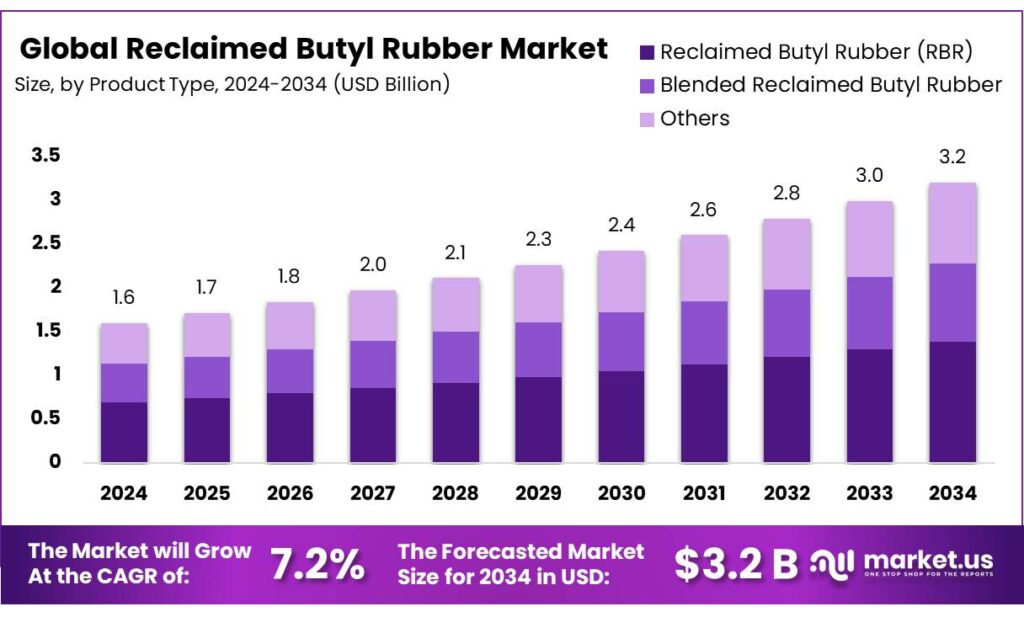
The market is primarily driven by a shift towards a circular economy, environmental concerns, stringent waste management regulations, and the growing demand for sustainable materials in industries such as automotive and aerospace. RBR is particularly valuable due to its excellent gas impermeability and durability, making it ideal for use in tire manufacturing and airtight seals.
- According to the U.S. Tire Manufacturers Association (USTMA), the total tire shipments in the United States reached 338.9 million units in 2024, an increase from 331.9 million units in 2023 and 332.7 million units in 2019. This figure exceeded the prior record of 335.2 million units set in 2021.
- The USTMA 2024 report revealed a positive momentum in tire recycling, with 79% of end-of-life tires being consumed by end-use markets, reflecting a 10.5% increase in overall utilization, reinforcing that end-of-life tires remain one of the most recycled and reclaimed consumer products, outpacing materials such as metal, glass, aluminum, plastic, and paper.
The Asia Pacific region leads the market, driven by high tire waste volumes and significant recycling initiatives in countries such as China, Japan, and India. In addition, technological advancements in recycling methods, such as improved pyrolysis and devulcanization, have enhanced the quality and consistency of reclaimed butyl rubber, boosting its applicability.
While most RBR is used in automotive and aircraft tires, diversification into construction, adhesives, and other sectors is increasing. However, challenges such as inconsistent quality and contamination remain. Moreover, the geopolitical tensions and supply chain disruptions can impact material availability and processing, influencing the overall market dynamics.
Key Takeaways:
- The global reclaimed butyl rubber market was valued at USD 1.6 billion in 2024.
- The global reclaimed butyl rubber market is projected to grow at a CAGR of 7.2% and is estimated to reach USD 3.2 billion by 2034.
- Based on the product type, reclaimed butyl rubber (RBR) dominated the market, with a market share of around 43.4%.
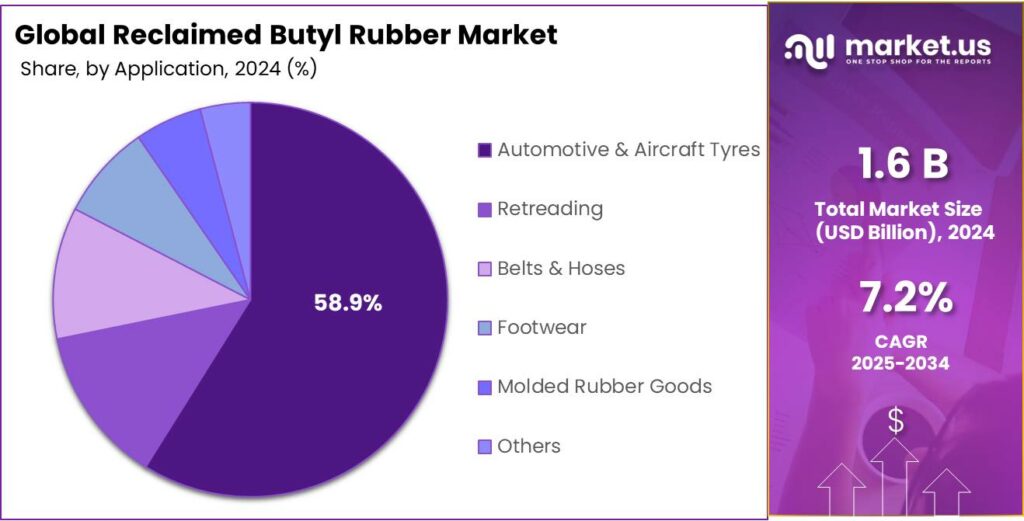
- Among the applications of reclaimed butyl rubber, the automotive & aircraft tyres held a major share in the market, 58.9% of the market share.
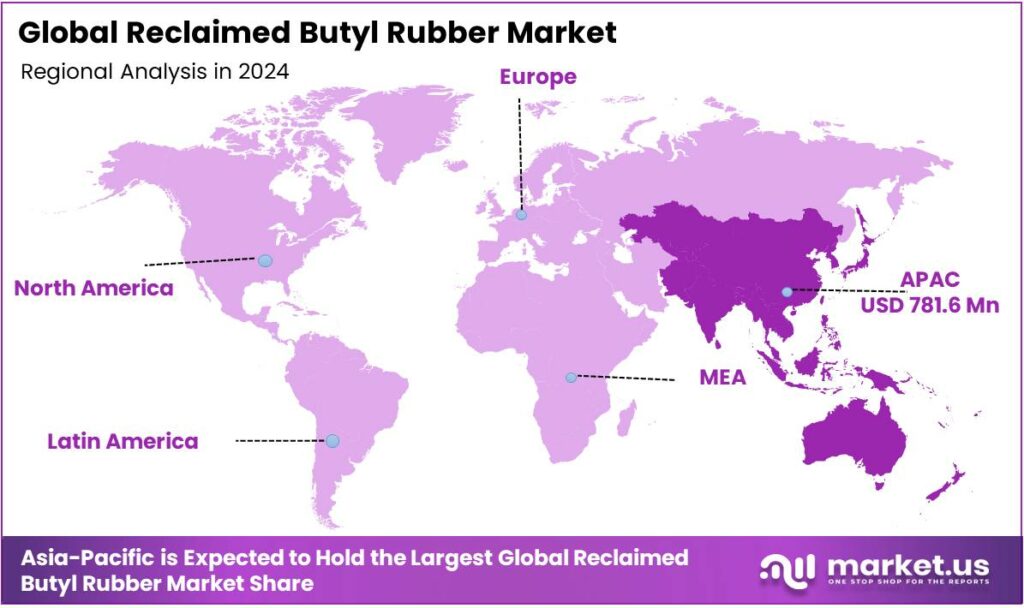
- In 2024, the Asia Pacific was the most dominant region in the reclaimed butyl rubber market, accounting for around 50.1% of the total global consumption.
Product Type Analysis
Reclaimed Butyl Rubber (RBR) Held the Largest Share in the Market.
The reclaimed butyl rubber market is segmented based on product type into reclaimed butyl rubber (RBR), blended reclaimed butyl rubber, and others. The reclaimed butyl rubber (RBR) dominated the market, comprising around 43.4% of the market share, due to its superior performance characteristics, such as better impermeability to gases and enhanced durability. RBR retains much of the original butyl rubber’s physical properties, making it ideal for high-performance applications such as sealing and insulation in automotive and manufacturing industries.
In contrast, blended reclaimed butyl rubber, which mixes RBR with other types of recycled materials, often experiences variability in quality, leading to less consistency and performance reliability. Additionally, RBR has a more established processing and recycling infrastructure, making it more readily available and cost-effective for large-scale industrial use. These factors contribute to its preference over other reclaimed rubber types, where performance consistency is critical.
Application Analysis
The Reclaimed Butyl Rubbers Are Mostly Utilized for Automotive & Aircraft Tyres.
Based on the applications of reclaimed butyl rubber, the market is divided into automotive & aircraft tires, retreading, belts & hoses, footwear, molded rubber goods, and others. The automotive & aircraft tires dominated the market, with a market share of 58.9%, due to their unique properties that align with the demanding requirements of tire manufacturing.
RBR’s low permeability to gases and excellent durability make it ideal for maintaining the integrity of tires, particularly in automotive and aviation industries, where high performance and longevity are crucial. These properties are less critical for applications such as belts and hoses, where other types of rubber, such as natural or synthetic rubbers, may be more suitable.
Additionally, tires, particularly those for vehicles and aircraft, are the largest source of scrap rubber, creating a natural recycling loop that feeds into the tire manufacturing process, making it the most efficient and logical application for reclaimed butyl rubber.
Key Market Segments:
By Product Type
- Reclaimed Butyl Rubber (RBR)
- Blended Reclaimed Butyl Rubber
- Others
By Application
- Automotive & Aircraft Tyres
- Retreading
- Belts & Hoses
- Footwear
- Molded Rubber Goods
- Others
Drivers
Environmental Sustainability and Regulations Drive the Reclaimed Butyl Rubbers Market.
Growing environmental concerns and stringent government regulations are significantly influencing the reclaimed butyl rubber market. The accumulation of waste rubber, particularly from tire disposal, has emerged as a pressing issue, with approximately 1 billion tires discarded each year globally. Governments have responded with regulations aimed at reducing landfill waste and encouraging recycling.
For instance, the European Union’s End-of-Life Vehicles (ELV) Directive mandates high recovery and recycling targets, forcing manufacturers to integrate secondary raw materials into production cycles. Similarly, the U.S. Environmental Protection Agency’s (EPA) tire recycling initiatives have focused on increasing recycling rates of end-of-life tires, which directly impacts the demand for reclaimed butyl rubber.
The reclaimed butyl rubber, derived mostly from used tires, offers environmental benefits by diverting waste from landfills and reducing the need for virgin rubber, which is energy-intensive to produce. These regulations align with global sustainability goals, pushing industries to adopt more circular economy practices, particularly in the automotive and manufacturing sectors.
Restraints
Inconsistent Quality and Potential Contamination Might Pose Challenges to the Reclaimed Butyl Rubber Market.
The reclaimed butyl rubber market faces significant technical barriers centered on variable material output and chemical purity. Unlike virgin synthetic rubber, which adheres to precise petrochemical specifications, reclaimed butyl is derived from heterogeneous waste streams. A key issue lies in the variability of the material’s properties due to diverse recycling methods and the contamination of scrap tires with non-rubber components.
The U.S. Environmental Protection Agency (EPA) and the National Toxicology Program (NTP) have identified various metals, polycyclic aromatic hydrocarbons (PAHs), and plasticizers, such as phthalates, in recycled tire crumb and rubber derivatives, which can impact the final product’s performance and safety.
Similarly, thermogravimetric analysis (TGA) of waste butyl rubber reveals that unburned mineral residues can account for up to 23% of mass loss, introducing non-elastomeric fillers that compromise final product uniformity. These issues can limit the application of reclaimed butyl rubber in high-performance sectors, where material reliability is critical. Effective contamination management and standardization of recycling processes are essential to mitigating these challenges.
Opportunity
Technological Advancements in Processing Create Opportunities in the Reclaimed Butyl Rubber Market.
Technological innovations in rubber devulcanization are transforming reclaimed butyl rubber from a low-grade filler into a high-performance substitute for virgin polymers. Advanced processing methods address the historical challenge of non-selective bond scission, which previously degraded the backbone of the rubber molecule. For instance, modern techniques, including ultrasonic, microwave, and bio-devulcanization, target sulfur cross-links (C-S and S-S bonds) while preserving the C-C polymer chains.
The U.S. Department of Energy (DOE) highlights the development of advanced pyrolysis processes, which can efficiently break down tire-derived materials into reusable components, including high-quality butyl rubber. Additionally, recent advancements in devulcanization processes, such as solvent-based methods, have enabled better recovery of butyl rubber’s original properties, addressing issues of inconsistency in reclaimed materials.
Similarly, the European Union’s Horizon project on sustainable tire recycling focuses on improving the recyclability of rubber, aiming to enhance processing technologies to reduce contamination and increase material recovery rates. These technological improvements not only improve the environmental benefits of recycling but also expand the potential applications of reclaimed butyl rubber in industries demanding higher-quality materials.
Trends
Diversification in Applications of the Reclaimed Butyl Rubbers.
Diversification in the applications of reclaimed butyl rubber beyond the automotive industry is a growing trend. This shift is driven by the material’s inherent properties, such as air impermeability, chemical stability, and aging resistance. While traditionally used in tires, reclaimed butyl rubber is now being explored in industries such as construction, adhesives, and consumer goods.
The European Commission’s research on sustainable materials highlights the potential of reclaimed rubber in manufacturing sealing products and coatings, where its water-resistant and elastic properties are valued. In the construction sector, reclaimed butyl rubber is being utilized in soundproofing and vibration-damping materials.
Additionally, the increasing focus on circular economy principles has led to innovations in using reclaimed rubber in flooring materials and insulation, sectors where material durability and environmental benefits are crucial. Furthermore, industrial goods applications include anti-corrosive rubber linings for pools, printing rubber rollers, and high-heat resistant hoses for air conditioning and steam systems.
Geopolitical Impact Analysis
Geopolitical Tensions Are Impacting the Reclaimed Butyl Rubber Market Due to Disrupted Petroleum Markets.
The geopolitical tensions are impacting the reclaimed butyl rubber market by disrupting global supply chains, inflating the costs of virgin alternatives, and influencing regulatory frameworks. The ongoing trade disputes and sanctions, particularly between major economies such as the U.S. and China, have affected the availability of raw materials for tire recycling and reclaimed rubber production. For instance, the U.S. Trade Representative’s Section 301 tariffs have targeted Chinese imports of synthetic rubber, which might affect the supply of butyl rubber used in tire manufacturing.
Further, geopolitical instability in regions such as Eastern Europe, notably the Russia-Ukraine conflict, has exacerbated raw material shortages and disrupted logistics, increasing the cost and reducing the reliability of the supply chain for waste tire management and recycling. Additionally, tensions may lead to stricter environmental regulations, as seen in the European Union’s response to concerns over rubber waste management in light of the conflict.
These regulatory changes could either spur innovation in local recycling industries or constrain market access, depending on the geopolitical landscape. Consequently, while geopolitical tensions may provide opportunities for localized recycling initiatives, they might pose significant challenges in terms of supply chain stability and international market access for reclaimed butyl rubber.
Regional Analysis
Asia Pacific Held the Largest Share of the Global Reclaimed Butyl Rubber Market.
In 2024, the Asia Pacific dominated the global reclaimed butyl rubber market, holding about 50.1% of the total global consumption, driven by high production volumes of end-of-life tires and significant recycling capabilities. The region generates significant waste tires annually, with countries such as China and India accounting for the majority of this waste. Consequently, regional governments have implemented policies to promote tire recycling and the use of reclaimed materials, which encourage the reuse of waste tires for environmental and economic sustainability.
Additionally, Japan has been a leader in tire recycling, with initiatives such as the Japan Rubber Recycling Council promoting technology to reclaim high-quality rubber for industrial applications. The increasing emphasis on sustainable practices and stricter regulations on waste management in the region is further boosting demand for reclaimed butyl rubber, particularly in automotive, construction, and manufacturing sectors.
Key Regions and Countries
- North America
- The US
- Canada
- Europe
- Germany
- France
- The UK
- Spain
- Italy
- Russia & CIS
- Rest of Europe
- APAC
- China
- Japan
- South Korea
- India
- ASEAN
- Rest of APAC
- Latin America
- Brazil
- Mexico
- Rest of Latin America
- Middle East & Africa
- GCC
- South Africa
- Rest of MEA
Key Players Analysis
Manufacturers of reclaimed butyl rubber invest in advanced recycling technologies, such as improved pyrolysis and devulcanization processes, to increase the efficiency and quality of reclaimed rubber. Additionally, they form strategic partnerships with tire manufacturers and waste management companies to secure a steady supply of raw material, used tires, which helps mitigate supply chain disruptions.
Similarly, manufacturers are expanding their applications beyond the automotive sector, incorporating reclaimed butyl rubber into construction materials, adhesives, and consumer goods. Moreover, adherence to stricter environmental regulations, such as those in the EU and China, positions companies as leaders in sustainability, strengthening brand reputation and attracting eco-conscious customers.
The Major players in the industry
- GRP Ltd
- Allcock & Sons Ltd
- Rolex Reclaim Pvt. Ltd.
- Fishfa Rubbers Ltd.
- HUXAR
- Tianyu (Shandong) Rubber & Plastic Products Co., Ltd.
- Swani Rubber Industries
- Minar Reclaimation Private Limited
- SRI Impex Pvt. Ltd.
- SNR Reclamations Pvt. Ltd.
- High Tech Reclaim Pvt. Ltd.
- Balaji Rubber Industries (P) Ltd.
- Star Polymers Inc.
- Other Key Players
Key Development
- In February 2025, Virdis Chemicals Ltd. acquired the rubber curatives and additives division from J. Allcock and Sons, a rubber recycling company based in Manchester, the United Kingdom.
- In February 2025, GRP Ltd. expanded its facility by adding 3,600 metric tons of capacity to its reclaim rubber segment.
Report Scope
Report Features Description Market Value (2024) US$1.6 Bn Forecast Revenue (2034) US$3.2 Bn CAGR (2025-2034) 7.2% Base Year for Estimation 2024 Historic Period 2020-2023 Forecast Period 2025-2034 Report Coverage Revenue Forecast, Market Dynamics, Competitive Landscape, Recent Developments Segments Covered By Material Type (Reclaimed Butyl Rubber (RBR), Blended Reclaimed Butyl Rubber, and Others), By Application (Automotive & Aircraft Tyres, Retreading, Belts & Hoses, Footwear, Molded Rubber Goods, and Others) Regional Analysis North America – The US & Canada; Europe – Germany, France, The UK, Spain, Italy, Russia & CIS, Rest of Europe; APAC– China, Japan, South Korea, India, ASEAN & Rest of APAC; Latin America– Brazil, Mexico & Rest of Latin America; Middle East & Africa– GCC, South Africa, & Rest of MEA Competitive Landscape GRP Ltd., J. Allcock & Sons Ltd., Rolex Reclaim Pvt. Ltd., Fishfa Rubbers Ltd., HUXAR, Tianyu (Shandong) Rubber & Plastic Products Co., Ltd., Swani Rubber Industries, Minar Reclaimation Private Limited, SRI Impex Pvt. Ltd., SNR Reclamations Pvt. Ltd., High Tech Reclaim Pvt. Ltd., Balaji Rubber Industries (P) Ltd., Star Polymers Inc., and Other Players. Customization Scope Customization for segments, region/country-level will be provided. Moreover, additional customization can be done based on the requirements. Purchase Options We have three licenses to opt for: Single User License, Multi-User License (Up to 5 Users), Corporate Use License (Unlimited Users and Printable PDF)  Reclaimed Butyl Rubber MarketPublished date: Feb 2026add_shopping_cartBuy Now get_appDownload Sample
 -
-
- GRP Ltd
- Allcock & Sons Ltd
- Rolex Reclaim Pvt. Ltd.
- Fishfa Rubbers Ltd.
- HUXAR
- Tianyu (Shandong) Rubber & Plastic Products Co., Ltd.
- Swani Rubber Industries
- Minar Reclaimation Private Limited
- SRI Impex Pvt. Ltd.
- SNR Reclamations Pvt. Ltd.
- High Tech Reclaim Pvt. Ltd.
- Balaji Rubber Industries (P) Ltd.
- Star Polymers Inc.
- Other Key Players
Our Clients

- 178985
- Feb 2026






