


Report Overview
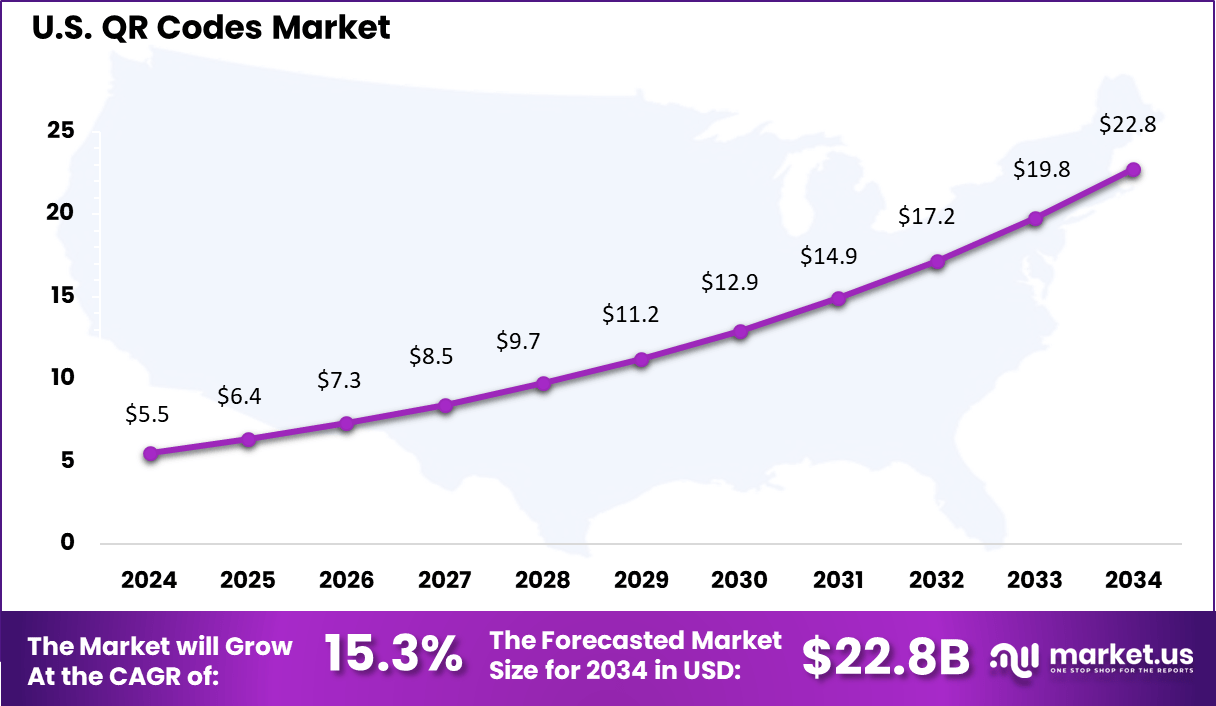
The Global QR Codes Market generated USD 15.6 billion in 2024 and is predicted to register growth from USD 18.6 billion in 2025 to about USD 89 billion by 2034, recording a CAGR of 19% throughout the forecast span. In 2024, North America held a dominan market position, capturing more than a 40.7% share, holding USD 6.35 Billion revenue.
The QR Codes market refers to the global ecosystem of QR code generation, deployment, and end-user scanning across diverse commercial applications. QR codes serve as two-dimensional barcodes that link physical environments with digital content, including payments, marketing, ticketing, and information retrieval. In recent years, the use of QR codes has expanded from basic inventory tracking to a vital interface in retail, payments, and digital engagement.
The market is projected to grow rapidly as mobile device usage, contactless transactions, and digital interaction preferences rise worldwide. A primary driver of the QR Codes market is the increasing adoption of contactless technologies, especially for payments and consumer interactions. Consumers and merchants are seeking seamless digital experiences, and QR codes provide a simple, low-cost medium to bridge physical and digital touchpoints without additional hardware.
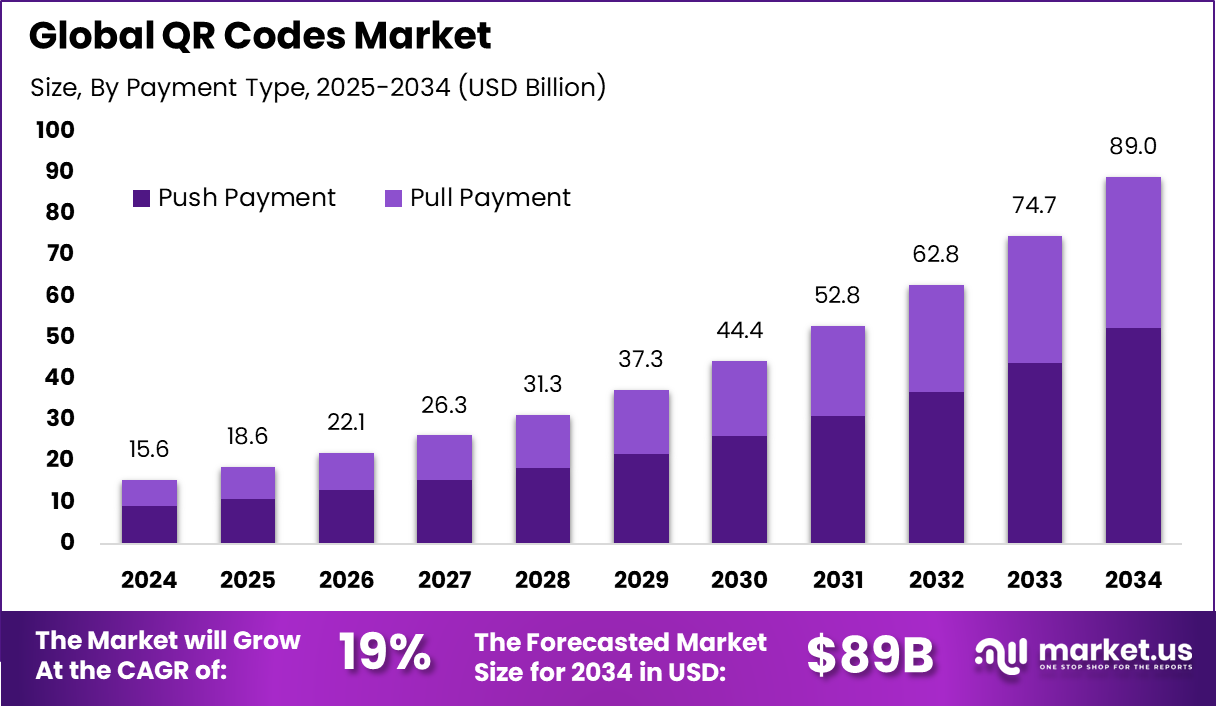
One primary factor driving the QR codes market is the rising demand for contactless and mobile-first interactions. Consumers increasingly prefer touch-free experiences for payments, check-ins, and product engagement, which has led businesses to integrate QR codes into customer touchpoints. Growth in smartphone ownership and mobile app usage further fuels this trend.
Another driving influence is the integration of QR codes into digital marketing and customer analytics strategies. Companies use QR codes to track engagement, direct users to websites or promotions, and bridge physical advertising with online experiences. This capability has encouraged broader deployment across industries seeking measurable interaction metrics.
According to QRCodeChimp, QR code usage continues to rise globally, with scan activity across 50 countries increasing by 57% and expected to grow another 22% by 2025. Adoption is supported by high creation rates, with up to 8 QR codes generated every minute, while usage remains strong in Europe and China, where a large share of consumers scan codes weekly.
Data from Bitly shows that QR codes are now widely used in marketing, with over 90% of marketers adopting them in 2025 and 94% increasing usage over the past year. Consumer engagement is high, as more than two thirds of users scanned a QR code in the last year, and about 50% of Gen Z and Millennials scan at least once a week, reflecting increasingly positive sentiment toward QR based interactions.
Top Market Takeaways
- By type, website QR codes took 38.9% of the QR codes market, as they link scans directly to web pages for easy access.
- By payment type, push payments held 58.8% share, letting users send money fast by scanning a fixed code.
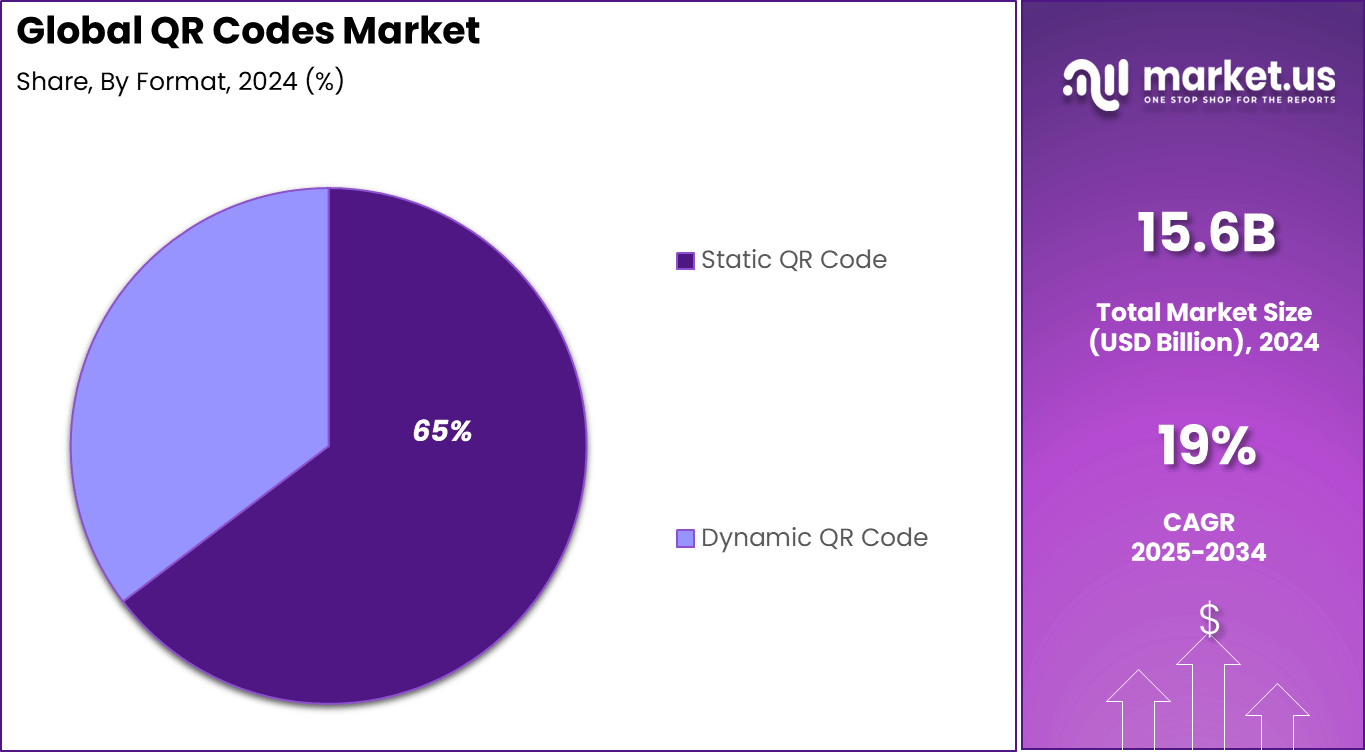
- By format, static QR codes captured 65%, preferred for simple, low-cost uses like one-time links or payments.
- By end-user application, payments and transactions led with 40.2%, driving contactless shopping and quick transfers.
- North America had 40.7% of the global market, with the U.S. at USD 5.53 billion in 2025 and growing at a CAGR of 15.2%.
Quick Market Facts
Usage and Adoption Insights
- Global QR code usage is expanding rapidly, with more than 2.9 billion users expected by 2025.
- Around 44.6% of global internet users scanned a QR code at least once per month in 2023, indicating routine usage behavior.
- Adoption is strongest among younger demographics, with 83% of Gen Z and 81% of Millennials using QR codes, and nearly half scanning on a weekly basis.
- QR codes are effective traffic drivers, with the potential to increase landing page visits by up to 80% when integrated into campaigns.
Payments and Commerce Insights
- QR-based payments are expanding quickly and are expected to reach $35 billion in value by 2025, supported by a user base of 2.2 billion.
- China leads global adoption, with over 87% of mobile payment transactions relying on QR code technology.
Marketing and Performance Insights
- Dynamic QR codes outperform static versions, achieving 48% higher scan rates and holding around 65% market share in 2024.
- Marketers place the highest value on unique user tracking (54%), conversion rates (52%), and total scan volume (50%).
- Personalized QR codes, including time-based and location-based formats, consistently deliver higher engagement and stronger campaign performance.
Type Analysis
Website QR codes account for 38.9%, showing their strong use in directing users to online content. These codes are widely used in advertising, packaging, and print media to provide quick access to websites. They help bridge offline and online engagement. Ease of use supports high adoption.
The growth of website QR codes is driven by mobile browsing behavior. Businesses use them to increase website traffic and customer interaction. QR codes also allow easy tracking of user engagement. This supports marketing and information sharing activities.
Payment Type Analysis
Push payment represents 58.8%, making it the leading payment type within the QR codes market. This payment method allows users to initiate transactions directly from their mobile devices. It reduces dependency on cards and cash. Transactions are completed quickly and securely.
Adoption of push payments is supported by growth in digital wallets and mobile banking. Consumers prefer contactless and fast payment options. Merchants benefit from lower transaction friction. These factors continue to support strong usage.
Format Analysis
Static QR codes hold 65%, reflecting their simplicity and low deployment cost. These codes contain fixed information and do not require backend management systems. They are easy to generate and distribute. Static QR codes are commonly used in retail and promotions.
The dominance of static formats is driven by ease of implementation. Businesses use them for simple redirection and payment purposes. They require minimal technical setup. This supports widespread adoption among small and large users.
End-User Application Analysis
Payments and transactions account for 40.2%, making them the largest application segment. QR codes are widely used for in-store and peer-to-peer payments. They enable fast and contactless transactions. This improves customer convenience.
Growth in this segment is driven by rising digital payment adoption. QR-based payments reduce checkout time and handling of physical cash. Businesses use them to improve transaction efficiency. This supports continued market expansion.
How They Work?
- Data Storage: Black squares placed on a white background store information both across and up and down.
- Scanning: A smartphone camera scans the pattern, and the software reads the information instantly.
- Content Access: The code can open websites, download apps, support payments, share contact details, or connect to Wi-Fi.
- Error Correction: The code can still be read even if part of it is damaged or covered.
Key Features and Uses
- High Data Capacity: These codes can store much more information than traditional barcodes.
- Wide Usage: They are commonly used in marketing, contactless payments, event entry, digital menus, and supply chain tracking.
- Static and Dynamic Codes: Static codes contain fixed information, while dynamic codes allow updates and tracking, making them suitable for campaigns.
- Easy to Use: Most smartphones can scan them using the built-in camera, without needing an extra app.
Key reasons for adoption
- Contactless interactions are preferred across retail, payments, and public services.
- Smartphones with built in scanners have made QR codes easy to access for users.
- Businesses are seeking low cost tools to connect offline and digital channels.
- Real time information sharing supports faster customer decision making.
- Marketing campaigns benefit from quick and measurable user engagement.
Benefits
- Customer access to information becomes faster and more convenient.
- Printing and distribution costs are reduced compared to traditional materials.
- Engagement can be tracked to understand customer behavior and interest.
- Brand interaction improves through instant links to digital content.
- Operational efficiency increases as manual processes are minimized.
Emerging Trends
| Key Trend | Description |
|---|---|
| Dynamic QR Codes Grow | QR codes allow link updates and scan tracking without the need for new prints. |
| AI Smart QR Codes | Artificial intelligence enables personalized links and automatic user tracking. |
| Payments Take Over | Cashless purchases through QR codes are rising across retail stores and apps. |
| Green Eco QR Use | Digital menus and ads reduce paper usage and support sustainability goals. |
| NFC QR Mix | QR codes integrate with NFC technology for faster taps and improved security. |
Growth Factors
| Key Factors | Description |
|---|---|
| Smartphones Everywhere | Widespread smartphone adoption enables billions of QR scans every day. |
| No Touch After Virus | Consumers prefer contactless menus, tickets, and payment options. |
| Cashless Push in Asia | Strong growth in QR payments across India and China supports adoption. |
| Biz Track Customer Data | QR scans provide data insights that help businesses improve sales decisions. |
| Cheap Easy to Make | Free and low cost tools make QR code adoption simple for small businesses. |
Key Market Segments
By Type
- Website QR Code
- Menu QR Code
- File-Download QR Code
- Social-Media QR Code
- App-Store QR Code
- Other Types
By Payment Type
- Push Payment
- Pull Payment
By Format
- Static QR Code
- Dynamic QR Code
By End-User Application
- Payments and Transactions
- Marketing and Advertising
- Information Sharing
- Customer Engagement and Loyalty
- Other End-User Applications
Regional Analysis
North America accounted for 40.7% share, driven by widespread smartphone usage and strong acceptance of contactless digital interactions across retail, payments, healthcare, and transportation. QR codes have become a standard tool for quick access to product information, digital menus, ticketing, and promotional content.
Adoption has been supported by the region’s advanced digital payment infrastructure, where QR based transactions are used to simplify checkout and reduce physical contact. Enterprises have increasingly integrated QR codes into marketing and customer engagement strategies to track user behavior and improve interaction efficiency.
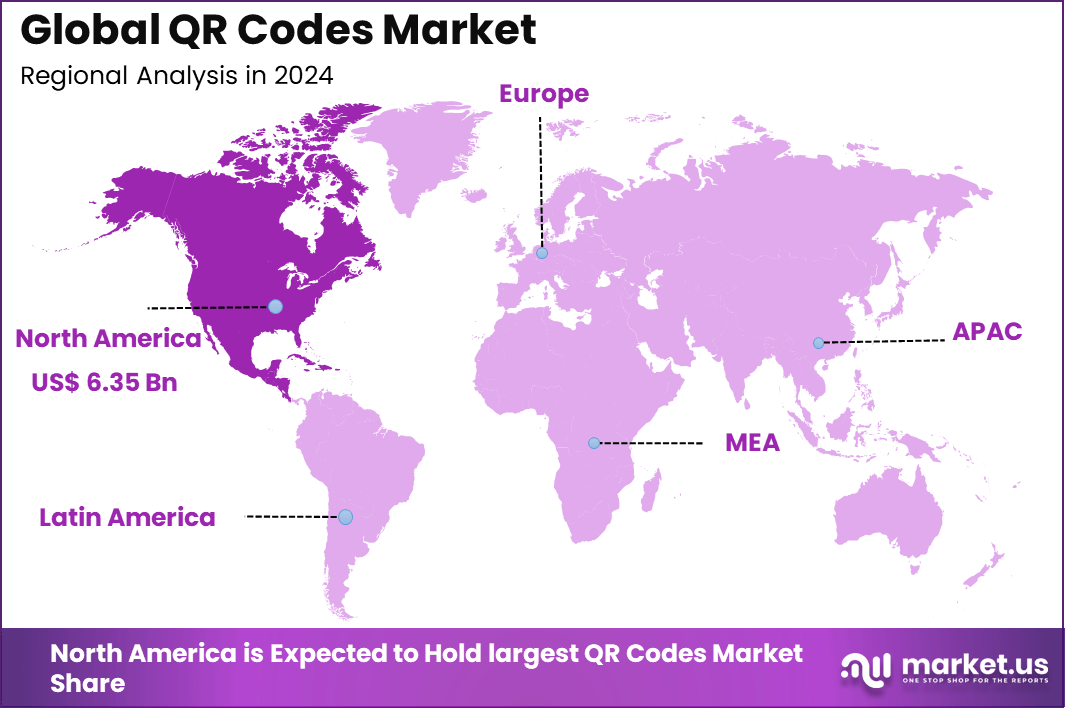
The U.S. market reached USD 5.53 Bn and is projected to grow at a 15.2% CAGR, reflecting strong demand across consumer facing and enterprise applications. Retailers and brands have widely adopted QR codes to bridge offline and online experiences, enabling instant access to offers, reviews, and mobile payments. In the food service and hospitality sectors, QR codes have become common for menus, ordering, and loyalty programs, improving operational efficiency and customer convenience.
Key Regions and Countries
- North America
- US
- Canada
- Europe
- Germany
- France
- The UK
- Spain
- Italy
- Russia
- Netherlands
- Rest of Europe
- Asia Pacific
- China
- Japan
- South Korea
- India
- Australia
- Singapore
- Thailand
- Vietnam
- Rest of APAC
- Latin America
- Brazil
- Mexico
- Rest of Latin America
- Middle East & Africa
- South Africa
- Saudi Arabia
- UAE
- Rest of MEA
Opportunities & Threats
The QR Codes market offers strong opportunities as contactless interaction becomes a standard practice across retail, payments, marketing, and public services. QR codes provide a simple way to connect physical spaces with digital content using smartphones. Businesses use them for payments, menus, product information, and promotions, which improves customer convenience and reduces the need for printed materials.
Growing smartphone penetration and mobile internet access continue to support widespread usage across both developed and emerging markets. The market faces threats related to security and misuse. Fake or tampered QR codes can redirect users to malicious websites or fraudulent payment pages, which reduces trust among consumers. Lack of awareness about safe scanning practices increases this risk.
Another threat is the low barrier to entry. QR code generation is widely available at minimal or no cost, which creates strong price competition and limits revenue growth for solution providers. Overuse of QR codes without clear value can also lead to user fatigue. Changes in consumer behavior or the emergence of alternative contactless technologies may further reduce long term reliance on QR codes in some use cases.
Competitive Analysis
The competitive landscape of the QR codes market is shaped by a mix of global payment networks, software providers, and specialized QR solution companies. PayPal Holdings, Inc. and UnionPay International Co., Ltd. hold strong positions due to their wide merchant acceptance, trusted payment infrastructure, and integration of QR codes into everyday digital payment and transaction flows.
Adobe Inc. competes from a design and document perspective by enabling QR code creation and management within its creative and document tools, which supports marketing, publishing, and enterprise use cases. At the same time, providers such as Nearex Pte Ltd. and QR Code Kit Inc. focus on flexible QR generation, campaign management, and tracking features that appeal to businesses seeking quick deployment and measurable engagement.
Competitive intensity is driven by ease of use, security, analytics, and compatibility with mobile devices and payment platforms. Differentiation increasingly depends on dynamic QR capabilities, customization options, data insights, and integration with broader digital ecosystems such as wallets, CRM systems, and marketing tools.
Top Key Players in the Market
- PayPal Holdings, Inc.
- UnionPay International Co., Ltd.
- Nearex Pte Ltd.
- QR Code Kit Inc.
- Adobe Inc.
- Others
Future Outlook
The future outlook for the QR Codes market is expected to stay strong as contactless and mobile first interactions become part of daily consumer behavior. QR codes are widely used across payments, retail, packaging, transport, and marketing because they are easy to create and simple to scan.
Growing smartphone penetration and improved camera capabilities are supporting regular usage without the need for separate apps. In the coming years, more secure and dynamic QR codes are likely to be adopted, allowing businesses to update content in real time, track engagement, and connect physical touchpoints with digital services.
Opportunities lie in
- Digital payments and ticketing: QR based access and payment solutions can reduce physical handling and speed up transactions.
- Smart packaging and product traceability: Brands can use QR codes to share product details, authenticity information, and sustainability data.
- Omnichannel marketing and engagement: QR codes can link offline campaigns directly to online content, offers, and customer support channels.
Recent Developments
- September, 2025 – PayPal announced at the China Cross-border E-commerce Fair (CCEF) in Shenzhen that it will enable QR code payments with WeChat Pay via PayPal World starting Q4 2025, allowing users to scan WeChat QR codes for instant cross-border transactions.
- December, 2025 – UnionPay International piloted cross-border QR payments between China and Vietnam under a four-party model with NAPAS, RAJA, ICBC and Vietcombank, targeting over 30,000 merchants by end-2025 and expanding to all Vietnamese payment networks in 2026.
Report Scope
| Report Features | Description |
|---|---|
| Market Value (2024) | USD 15.6 Bn |
| Forecast Revenue (2034) | USD 89 Bn |
| CAGR(2025-2034) | 19% |
| Base Year for Estimation | 2024 |
| Historic Period | 2020-2023 |
| Forecast Period | 2025-2034 |
| Report Coverage | Revenue forecast, AI impact on Market trends, Share Insights, Company ranking, competitive landscape, Recent Developments, Market Dynamics and Emerging Trends |
| Segments Covered | Global QR Codes Market By Type (Website QR Code, Menu QR Code, File-Download QR Code, Other Types), By Payment Type (Push Payment, Pull Payment), By Format (Static QR Code, Dynamic QR Code), By End-User Application (Payments and Transactions, Marketing and Advertising, Other End-User Applications) |
| Regional Analysis | North America – US, Canada; Europe – Germany, France, The UK, Spain, Italy, Russia, Netherlands, Rest of Europe; Asia Pacific – China, Japan, South Korea, India, New Zealand, Singapore, Thailand, Vietnam, Rest of Latin America; Latin America – Brazil, Mexico, Rest of Latin America; Middle East & Africa – South Africa, Saudi Arabia, UAE, Rest of MEA |
| Competitive Landscape | PayPal Holdings, Inc., UnionPay International Co., Ltd., Nearex Pte Ltd., QR Code Kit Inc., Adobe Inc. |
| Customization Scope | Customization for segments, region/country-level will be provided. Moreover, additional customization can be done based on the requirements. |
| Purchase Options | We have three license to opt for: Single User License, Multi-User License (Up to 5 Users), Corporate Use License (Unlimited User and Printable PDF) |





































