


Global Protective Footwear Market Size, Share, Growth Analysis By Product (S1, S1P, S2, S3, S4, S5, Others), By End-Use Industry (Construction & Manufacturing, Oil & Gas, Chemicals, Firefighting, Military & Defense, Mining, Others) , By Region and Companies - Industry Segment Outlook, Market Assessment, Competition Scenario, Statistics, Trends and Forecast 2025-2034
- Published date: Aug 2025
- Report ID: 155039
- Number of Pages: 235
- Format:
-
keyboard_arrow_up
Quick Navigation
Report Overview
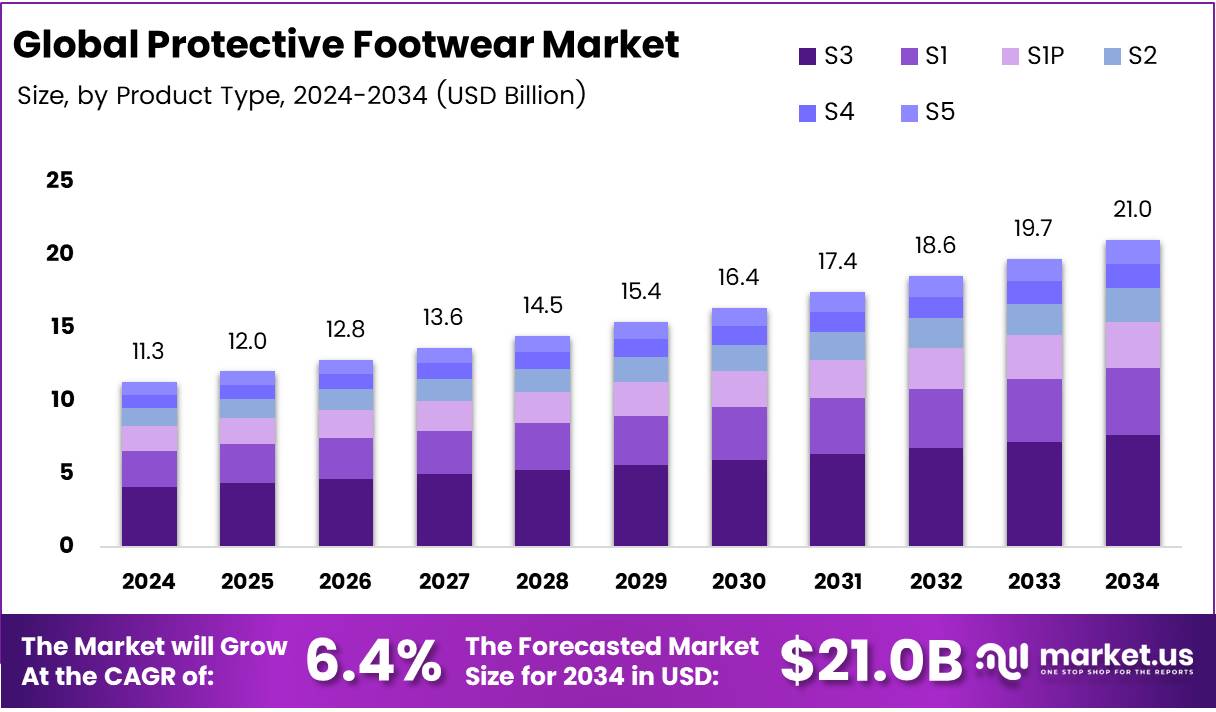
The Global Protective Footwear Market size is expected to be worth around USD 21.0 Billion by 2034, from USD 11.3 Billion in 2024, growing at a CAGR of 6.4% during the forecast period from 2025 to 2034.
Protective footwear, also known as safety or work footwear, is designed to safeguard feet from workplace hazards. This includes protection against impacts, compression, punctures, electrical hazards, slips, and chemical exposure. These specialized shoes and boots are considered a form of personal protective equipment (PPE) and are crucial in various industries to prevent injuries and ensure workplace safety.
As this concerns the wellness of many workers, there are specific regulatory bodies in specific regions, such as the Occupational Safety and Health Administration (OSHA) in the United States and the European Union (EU) for 32 European countries, that monitor the design, production, as well as consumption of the products.
The laws and directives by these bodies are the major drivers of the protective footwear market. According to the Bureau of Labor Statistics (BLS), proper use of PPE, including footwear, can reduce workplace injuries by up to 60%. However, discomfort to the workers due to the heavy weight of shoes or a loose fit might be a challenge to the industry. As industries expand, there is a gap in the market, allowing emerging players to develop products.
- The Occupational Safety and Health Administration (OSHA) reports that companies can face fines ranging from US$ 7,000 for each serious violation to US$ 70,000 for each willful or repeated violation.
Key Takeaways
- The global protective footwear market was valued at US$ 11.3 billion in 2024.
- The global protective footwear market is projected to grow at a CAGR of 6.4% and is estimated to reach US$ 21.0 billion by 2034.
- Among the product types, S3 protective footwear comprised the largest market with around 36.4% of the total market share.
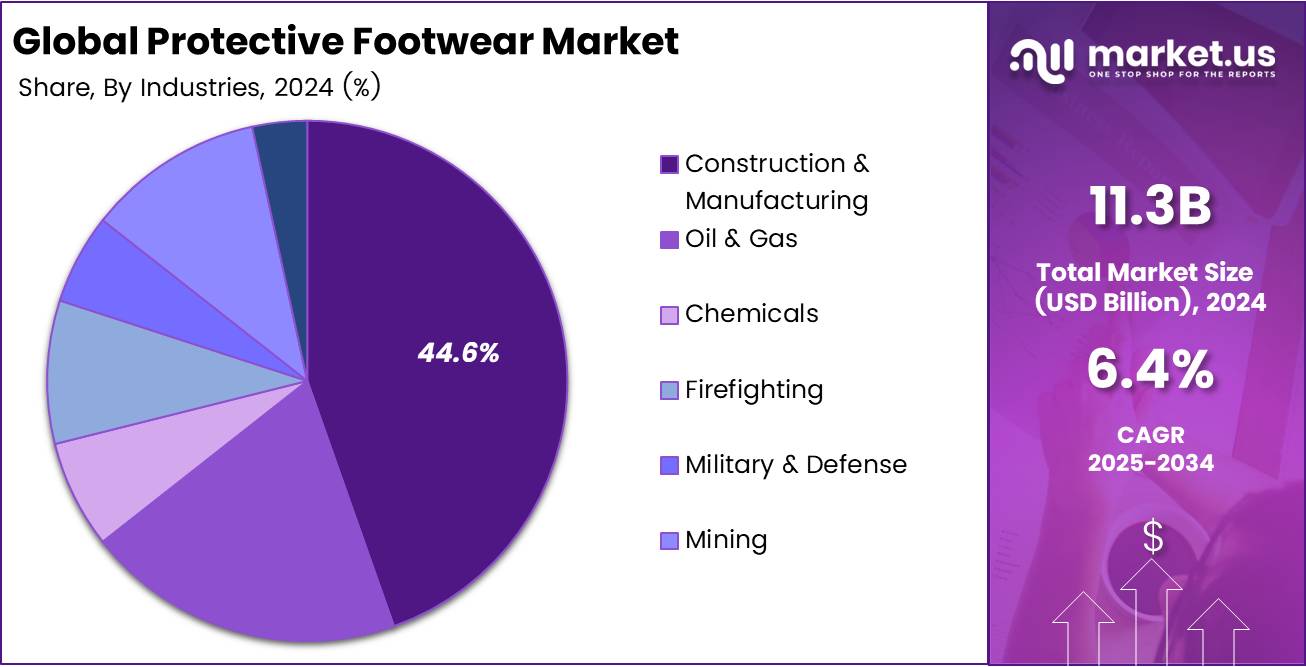
- Based on end-use industry, the protective footwear market was led by the construction and manufacturing industry in 2024, valued at around US$ 5 billion.
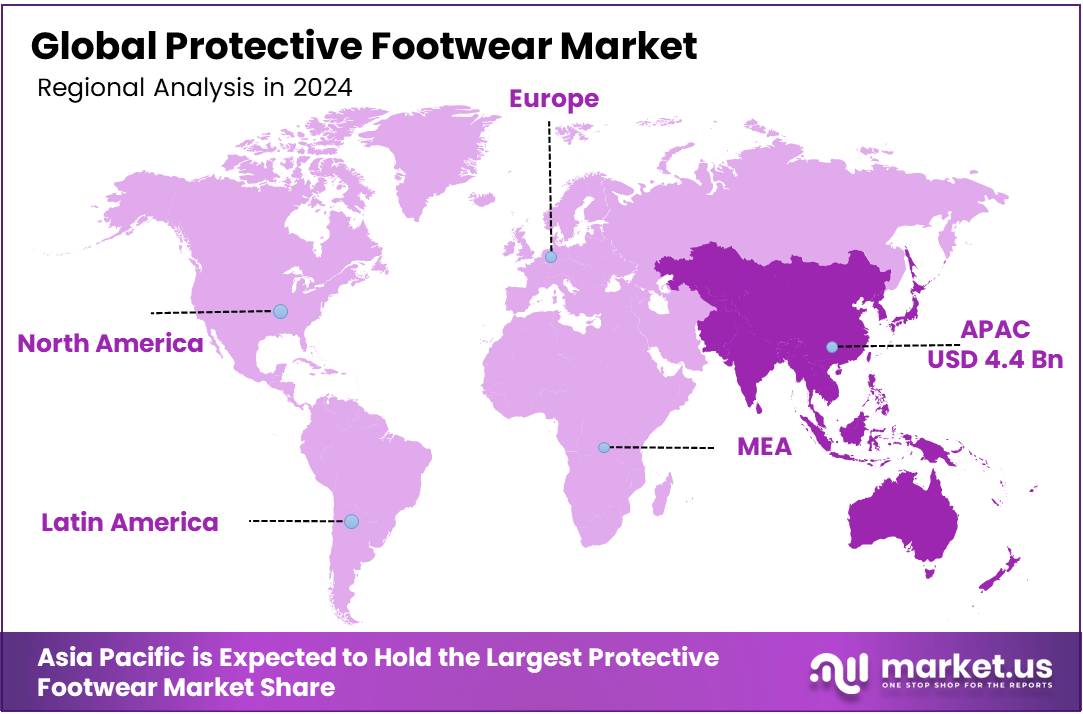
- Asia Pacific became the largest market for protective footwear and saw the fastest growth in 2024, valuing around US$ 4.4 billion, which is approximately 38.6% of the total market share.
Product Type Analysis
S3 Class of Protective Footwear Dominates the Market with About 36.4%.
On the basis of the product type, the market is divided into S1, S1P, S2, S3, S4, S5, and others. S3 protective footwear held a dominant market position in the market in 2024, seizing around 36% share of the global market. According to the International Organization for Standardization, there are two classes of safety wear.
Among those, class 1 is comparatively cheaper due to the material used; however, the protection for the feet is reliable. S1, S1P, S2, and S3 fall under the category of class 1. The protective footwears in class S1 provide basic toe protection and slip-resistant soles, as well as antistatic protection, oil resistance, and offers energy absorption in the heel.
S1P is similar to S1 except includes penetration resistance. S2 features an additional waterproof exterior to the S1 protective shoes. S3 is an upgraded version of S2 with added midsole penetration resistance. As S3 offers all-around protection, while being relatively cheaper, it is the most sought-after product in the market.
End-Use Industry Analysis
Construction and Manufacturing Industry Dominate the Protective Footwear Market
Among the end-use industries, the market can be segmented into construction & manufacturing, oil & gas, chemicals, firefighting, military & defense, mining, and others. The construction and manufacturing industry dominated the global protective footwear market, comprising around 44.6% of the total market share.
Safety footwear is crucial for protecting workers’ feet from various hazards present in construction and manufacturing environments. Due to urbanization and industrialization, the construction and manufacturing industry is expanding exponentially.
According to the World Bank Group, in 2024, the manufacturing industry added value of around US$ 16.8 trillion and industries (including construction) of about US$28.91 trillion to the global economy. As the construction and manufacturing industry rises, there is a constant demand for protective footwear in the industry.
Key Market Segments
By Product
- S1
- S1P
- S2
- S3
- S4
- S5
- Others
By End-Use Industry
- Construction & Manufacturing
- Oil & Gas
- Chemicals
- Firefighting
- Military & Defense
- Mining
- Others
Drivers
Government Regulations Drive the Protective Footwear Market
Government regulations that ensure personal protective equipment in several industries are the major drivers of the protective footwear market. Stringent safety standards and regulations set by bodies such as the Occupational Safety and Health Administration (OSHA) and the European Union mandate the use of personal protective equipment in various industries, boosting market growth.
For instance, in the U.S., federal law mandates that employers provide and pay for required PPE to protect employees from workplace hazards. The OSHA standards outline specific requirements for PPE, including eye, face, head, feet, and extremity protection, protective clothing, safety shoes, respiratory devices, and protective shields.
Similarly, the European Union’s regulation (EU) 2016/425 governs the design, manufacture, and marketing of personal protection equipment to ensure the safety of users. Compliance with these regulations directly increases the demand for personal protective equipment, including safety footwear.
Restraints
Potential Discomfort Might Pose a Significant Challenge to the Protective Footwear Market
Safety shoes, while essential for workplace safety, can present some disadvantages, such as potential discomfort due to weight and stiffness, especially with steel-toe boots, and the risk of cold conduction in low temperatures. Steel-toe boots, a common type of safety shoe, can be significantly heavier than regular shoes, which can lead to fatigue, especially during long shifts or periods of intense physical activity.
Similarly, ill-fitting safety shoes, whether too tight or too loose, can cause bunions, corns and calluses, blisters, ingrown nails, hammertoes, and even more painful conditions such as plantar fasciitis. The rigidity of safety shoes can make it harder to perform certain tasks, especially those requiring fine motor skills or quick movements. These disadvantages might pose a challenge to the market, leaving room for advancements in the products.
Growth Factors
Advancements in Protective Footwear Are Expected to Create Opportunities for Emerging Players
Personal protective equipment is mandatory for industries related to physical shock, contamination, heat, chemicals, and radioactive materials. But the footwear available in the market does not suffice in several settings.
For instance, when a worker, for some reason, falls and cannot request help. To solve the crisis, companies are adding sensors and smart features to track user health metrics, such as footsteps and geolocation, as well as monitor risks like toxic gases and radiation.
The smart work boots are manufactured that connect to mobile apps via Bluetooth, enabling data analytics and reporting, where they can detect falls, provide advanced remote safety monitoring, and track incidents in workplaces.
For instance, in May 2025, Swedish personal protective equipment provider Båstadgruppen announced that it had manufactured safety shoes, under its Monitor brand in collaboration with safety technology company Quin, that detect falls and automatically alert emergency contacts. The shoes are scheduled to be launched in Autumn 2025.
Emerging Trends
Increased Demand for Lightweight and Athletic Fit Products
Advancements in technology and design are transforming safety footwear. One of the key trends in safety footwear is the use of long-life and lightweight materials to manufacture the footwear. The traditional safety shoes that are largely available in the market are heavy, causing strain and fatigue to the muscles.
However, the use of materials such as carbon fiber, thermoplastics, and composites allows manufacturers to create lightweight shoes that offer protection while reducing the weight on the wearer. Additionally, another trend that is gaining by is the athletic styling of the safety footwear inspired by sports footwear.
The athletic fit style is getting popular, particularly among millennials, who represent the largest working population in the world. The manufacturers are producing safety footwear with stronger meshes, anti-fatigue footbeds, moisture-wicking linings, shock absorption, and flexible soles. These features in the shoes enable more natural foot movement and enhance comfort for the workers.
Geopolitical Impact Analysis
Geopolitical Tensions Disrupt the Supply Chains of Protective Footwear and Affect the Prices of the Product
Geopolitical factors such as trade wars, regulatory changes, and conflicts between countries heavily affect the global trade routes and sourcing of raw materials for protective footwear.
For instance, 99% of all shoes sold in the U.S. are imported, with 2.147 billion pairs of shoes imported in 2023. That amounts to an average of 6.3 pairs of imports per person across the country. In volume terms, China accounts for 57.7% of all imports, followed by Vietnam at 24.3% and Indonesia at 7.7%.
However, as tariffs in the U.S. had increased during early 2025, the sourcing of footwear has become increasingly complex for retailers. Similarly, due to tensions in the South China Sea, some leading footwear brands have already shifted production from China to countries like Vietnam and Indonesia, reducing their dependence on a single region.
Additionally, the majority of oil imports for the Asia Pacific from the Middle East and Africa occur through this sea, affecting the oil and gas industry as well. As the industry is affected negatively, it may affect the number of protective footwear items bought by the industry.
Regional Analysis
Asia Pacific Held the Largest Share of the Global Protective Footwear Market.
In 2024, the Asia Pacific dominated the global protective footwear market, holding about 38.6%, valued at approximately US$ 4.4 billion. As urbanization and industrialization increase exponentially in the region, the sectors, such as construction and manufacturing, oil and gas, and chemicals, rise.
According to the International Trade Administration, the Asia Pacific is the world’s largest construction market, particularly China. In June 2025, China’s GDP from construction was approximately 3.8 trillion CNY, Chinese yuan. Additionally, the Asia Pacific is a large and significant market for mining. For instance, China and India are major producers and consumers of coal, while China produces over half of the world’s coal.
Similarly, 80% of antimony reserves are found in China. Also, Southeast Asia is a significant producer of base metals such as nickel and copper, with Indonesia being a major hub for downstream processing. As mining activities in the region are consistent, there is a growing demand for high-quality protective footwear in the region.
Key Regions and Countries
North America
- US
- Canada
Europe
- Germany
- France
- The UK
- Spain
- Italy
- Rest of Europe
Asia Pacific
- China
- Japan
- South Korea
- India
- Australia
- Rest of APAC
Latin America
- Brazil
- Mexico
- Rest of Latin America
Middle East & Africa
- GCC
- South Africa
- Rest of MEA
Key Protective Footwear Company Insights
Honeywell International, Wolverine World Wide, Protective Industrial Products (Puma), VF Corporation (Timberland), Bata Corporation, Dunlop Protective Footwear, Uvex Group, Elten GmbH, and Oftenrich Holdings are the major global players in the protective footwear market. In the niche market of protective footwear, many players engage in strategic activities, such as product development, partnerships and collaborations, and mergers and acquisitions.
For instance, in September 2024, Timberland released a collection of work boots in collaboration with BOA Technology, creators of the BOA Fit System. The collaboration aimed to enhance the fit and performance of Timberland’s workwear by incorporating three different BOA dials for micro-adjustable, precision fit and improved ankle stability.
Wolverine World Wide is a major player in the industrial protective footwear market. The company is actively innovating in the protective footwear space by focusing on domestic manufacturing, diversifying its sourcing, and incorporating advanced technologies to enhance safety, comfort, and performance.
Protective Industrial Products is a global leader in Personal Protective Equipment, including a wide range of safety footwear designed to protect workers’ feet from various hazards. With its robust supply chain and wide resources, the company aims to offer comfort and protection to consumers.
VF Corporation is a global apparel, footwear, and accessories company with a diverse portfolio of brands. While known for its outdoor, active, and workwear brands, VF also has a significant presence in the protective footwear market, primarily through Timberland PRO. The company has expanded its workwear and protective footwear presence through acquisitions, such as Williamson-Dickie (Dickies).
Top Key Players in the Market
- Honeywell International Inc.
- Wolverine World Wide Inc.
- Protective Industrial Products, Inc. (Puma)
- VF Corporation (Timberland)
- Bata Corporation
- Dunlop Protective Footwear
- Hilson Footwear Pvt. Ltd
- U-power Group Spa
- Cofra SRL
- Uvex Group
- Elten GmbH
- Oftenrich Holdings Co., Ltd.
- Rahman Group
- Other Key Players
Recent Developments
- In June 2025, Wolverine launched a program focusing on manufacturing work boots in the U.S., which included the release of the Workshop Wedge, the first in a multi-year line of boots designed and built in America.
- In May 2023, Protective Industrial Products, a global leader in personal protective equipment, including hand protection, above-the-neck protection, workwear, and footwear, announced a definitive agreement to acquire ISM Heinrich Krämer GmbH & Co. KG, headquartered in Lippstadt, Germany. Ism was one of the world’s leading and fastest-growing providers of athletic-inspired safety footwear.
Report Scope
Report Features Description Market Value (2024) USD 11.3 Billion Forecast Revenue (2034) USD 21.0 Billion CAGR (2025-2034) 6.4% Base Year for Estimation 2024 Historic Period 2020-2023 Forecast Period 2025-2034 Report Coverage Revenue Forecast, Market Dynamics, Competitive Landscape, Recent Developments Segments Covered By Product (S1, S1P, S2, S3, S4, S5, Others), By End-Use Industry (Construction & Manufacturing, Oil & Gas, Chemicals, Firefighting, Military & Defense, Mining, Others) Regional Analysis North America (US and Canada), Europe (Germany, France, The UK, Spain, Italy, and Rest of Europe), Asia Pacific (China, Japan, South Korea, India, Australia, and Rest of APAC), Latin America (Brazil, Mexico, and Rest of Latin America), Middle East & Africa (GCC, South Africa, and Rest of MEA) Competitive Landscape Honeywell International Inc., Wolverine World Wide Inc., Protective Industrial Products, Inc. (Puma), VF Corporation (Timberland), Bata Corporation, Dunlop Protective Footwear, Hilson Footwear Pvt. Ltd, U-power Group Spa, Cofra SRL, Uvex Group, Elten GmbH, Oftenrich Holdings Co., Ltd., Rahman Group, Other Key Players Customization Scope Customization for segments, region/country-level will be provided. Moreover, additional customization can be done based on the requirements. Purchase Options We have three licenses to opt for: Single User License, Multi-User License (Up to 5 Users), Corporate Use License (Unlimited User and Printable PDF) 
-
-
- Honeywell International Inc.
- Wolverine World Wide Inc.
- Protective Industrial Products, Inc. (Puma)
- VF Corporation (Timberland)
- Bata Corporation
- Dunlop Protective Footwear
- Hilson Footwear Pvt. Ltd
- U-power Group Spa
- Cofra SRL
- Uvex Group
- Elten GmbH
- Oftenrich Holdings Co., Ltd.
- Rahman Group
- Other Key Players
Our Clients

- 155039
- Aug 2025






