


Global Pearlescent Pigment Market By Product Type (Natural Pearl Essence, Titanium Dioxide Mica, Iron/Ferric Oxide Mica, Combination Mica, and Others), By Application (Paints And Coatings, Plastics / Polymer, Printing Inks, Personal Care And Cosmetics, and Others), By Region and Companies - Industry Segment Outlook, Market Assessment, Competition Scenario, Trends and Forecast 2025-2034
- Published date: Jan 2026
- Report ID: 175551
- Number of Pages: 341
- Format:
-
keyboard_arrow_up
Quick Navigation
Report Overview
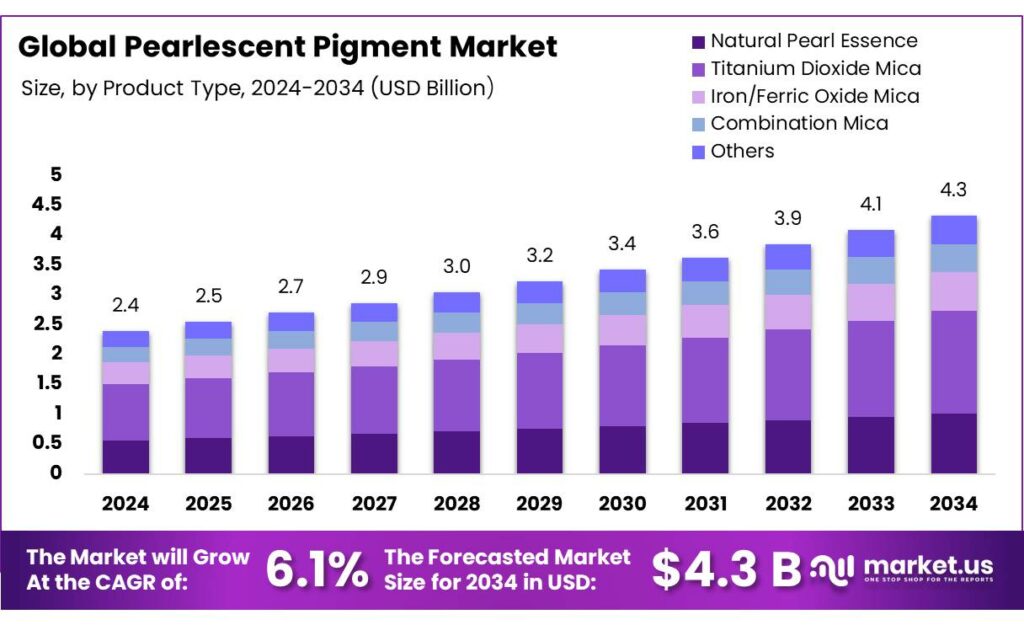
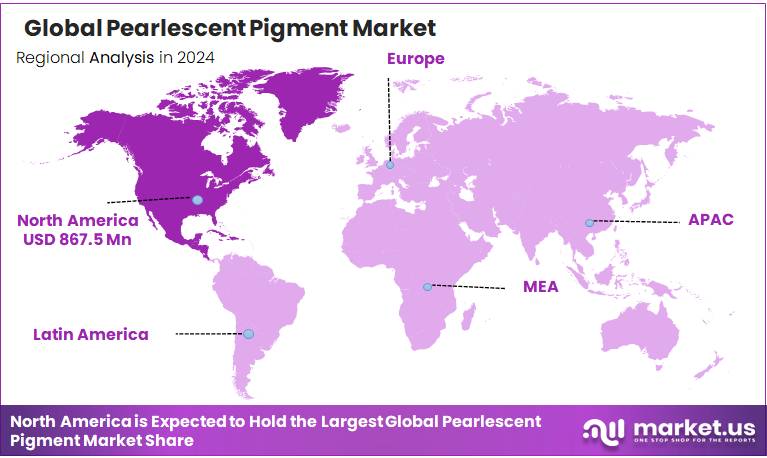
Global Pearlescent Pigment Market size is expected to be worth around USD 4.3 Billion by 2034, from USD 2.4 Billion in 2024, growing at a CAGR of 6.1% during the forecast period from 2025 to 2034. In 2024 North America held a dominant market position, capturing more than a 35.7% share, holding USD 867.5 Million in revenue.
Pearlescent pigments are specialized effect pigments that produce a lustrous, shimmering finish similar to natural pearls. Unlike standard pigments that create color by absorbing specific light wavelengths, pearlescent pigments function through light interference, reflecting and refracting light across multiple semi-transparent layers to create depth and a shifting color effect. Most modern pearlescent pigments use thin, transparent flakes of mica, natural or synthetic, as a base.
- According to the United States Geological Survey (USGS), the world mine production of mica reached around 380,000 metric tons in 2024, with Madagascar, China, and Finland dominating the production with 85,000, 80,000, and 50,000 metric tons of production, respectively.
The pearlescent pigment market is primarily driven by its widespread use in automotive paints, coatings, personal care products, and specialty applications such as food and beverages. Titanium dioxide mica-based pigments dominate the market due to their exceptional optical properties, offering vibrant, color-shifting effects and superior durability, particularly in paints and coatings.
These pigments enhance the aesthetic appeal of vehicles, architectural coatings, and cosmetics, where visual impact is paramount. Regulatory bodies, including the FDA and EPA, ensure the safety and stability of these pigments, further bolstering their adoption.
- According to a report by the National Institutes of Health, 90% of individuals worldwide use some form of personal care product daily. As there is a significant growth in the cosmetics and personal care industry, the application of pearlescent pigment is estimated to grow with shifting consumer preference towards visually appealing products.
Despite their versatility, pearlescent pigments face challenges such as environmental concerns regarding production and recycling, as well as geopolitical tensions affecting supply chains. North America remains the largest market, benefiting from strong demand in the automotive and personal care industries, where high-quality finishes and innovative formulations are in demand. However, the growth of sustainable and non-toxic alternatives is influencing future product development in the industry.
Key Takeaways
- The global pearlescent pigment market was valued at USD 2.4 billion in 2024.
- The global pearlescent pigment market is projected to grow at a CAGR of 6.1% and is estimated to reach USD 4.3 billion by 2034.
- Based on the pearlescent pigment type, titanium dioxide mica pearlescent pigment dominated the market, with 39.4% of the total global market.
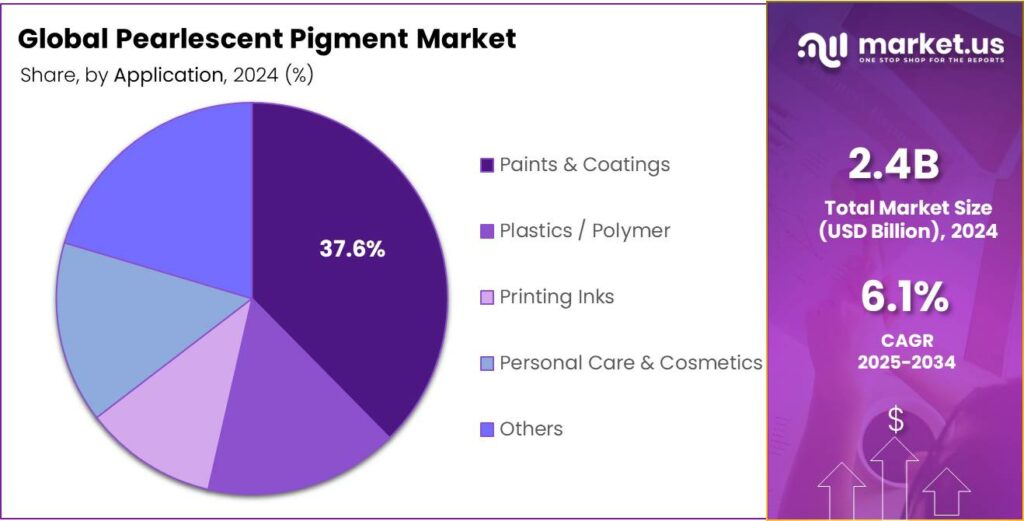
- Among the applications, the paints & coatings sector emerged as a major segment in the pearlescent pigment market, with a market share of 37.6%.
- In 2024, North America was the most dominant region in the Pearlescent Pigment market, accounting for 35.7% of the total global consumption.
Product Type Analysis
Titanium Dioxide Mica Pearlescent Pigment Held a Major Share in the Market.
The pearlescent pigment market is segmented based on the pearlescent pigment types into natural pearl essence, titanium dioxide mica, iron/ferric oxide mica, combination mica, and others. The titanium dioxide mica pearlescent pigment dominated the market, comprising 39.4% of the market share, primarily due to its superior optical properties and versatility. Titanium dioxide-coated mica offers a high degree of brightness and a wide range of color-shifting effects, making it ideal for industries requiring vibrant and durable finishes, such as automotive paints and cosmetics.
Additionally, its stability under UV exposure and resistance to fading contribute to its widespread adoption. In contrast, natural pearl essence, while aesthetically appealing, tends to have a more limited and softer effect. Similarly, iron oxide mica, though cost-effective, lacks the same level of brilliance and durability. Furthermore, combination mica pigments are often more complex to produce compared to titanium dioxide-coated variants.
Application Analysis
Paints & Coatings Sector Emerged as a Leading Segment in the Market.
On the basis of application, the pearlescent pigment market is segmented into paints & coatings, plastics/polymers, printing inks, personal care & cosmetics, and others. Approximately 37.6% of the pearlescent pigment market revenue is generated from the paints & coatings sector. Most pearlescent pigments are used in paints and coatings as these applications fully capitalize on their aesthetic properties, such as brightness, color-shifting, and shimmer. Paints and coatings allow for more visible exposure of the pigment, enabling its unique visual effects to be showcased, particularly in automotive and architectural finishes where visual appeal is crucial.
Additionally, paints and coatings can better accommodate the pigment’s stability and durability, ensuring long-term performance. In contrast, plastics and polymers often require specific formulations that may not highlight the pigment’s iridescence as effectively, while in personal care or printing inks, the demand for more precise, often translucent effects limits the scope of pearlescent pigment use. Furthermore, the production volume of paints and coatings is higher compared to other applications.
Key Market Segments
By Product Type
- Natural Pearl Essence
- Titanium Dioxide Mica
- Iron/Ferric Oxide Mica
- Combination Mica
- Others
By Application
- Paints & Coatings
- Plastics / Polymer
- Printing Inks
- Personal Care & Cosmetics
- Others
Drivers
Industrial Application Fields Drive the Pearlescent Pigment Market.
The industrial application of pearlescent pigments spans several sectors, including automotive paints, inks, architectural coatings, metal coatings, and aromatherapy candles, each serving as a significant driver for market demand. Automotive coatings remain a primary driver, with 2025 global color reports by Atlanta indicating that while neutrals such as white (29%) and black (23%) dominate, pearlescent effects are critical for premium aesthetics and multi-dimensional finishes in OEM and aftermarket segments. For instance, BMW reported using these pigments for pearl effect tones in their vehicles.
Similarly, for the inks, pearlescent pigments are integral to packaging and labeling, where their iridescence boosts consumer attraction. Architectural decorative coatings benefit from the pearlescent pigments’ ability to enhance exterior and interior surfaces. Their durability and visual effects make them a popular choice for high-end real estate projects. The South Coast Air Quality Management District (SCAQMD) Rule 1113 defines decorative coatings as those containing at least 48 grams of pearlescent mica per liter.
Furthermore, in aromatherapy candles, pearlescent pigments improve the visual appeal of the candles, supporting the growth of the niche market for luxury home decor. Similarly, metal coatings, applied to machinery and industrial products, use pearlescent pigments to offer protective and aesthetic functions. These applications contribute significantly to the steady demand for pearlescent pigments in multiple industries, driven by both consumer preference and regulatory advancements in quality standards.
Restraints
Environmental Hurdles Pose a Significant Challenge to the Pearlescent Pigment Market.
The production and recycling of pearlescent pigments face several environmental challenges, stemming from their manufacturing processes and post-consumer disposal. A key challenge is the use of heavy metals, such as titanium dioxide and bismuth oxychloride, in pearlescent pigments. According to the International Agency for Research on Cancer (IARC), titanium dioxide has been classified as a potential carcinogen when inhaled in large quantities during production, raising concerns about worker safety. Furthermore, the extraction and processing of raw materials for these pigments often involve energy-intensive methods, contributing to carbon emissions.
In recycling, the environmental impact is compounded by the difficulty of separating pearlescent pigments from other components in products such as coatings and plastics. The European Union’s Circular Economy Action Plan highlights the challenges of recycling mixed-material products, where combination mica pearlescent pigments are often embedded in complex formulations, making them non-recyclable or difficult to treat in standard recycling streams.
Moreover, according to a report by the Environmental Protection Agency, the pigments embedded in paints and coatings can enter waterways, where they persist for long periods, which raises concerns over their impact on aquatic ecosystems and human health. These environmental hurdles have prompted calls for the development of more sustainable production methods and improved recycling technologies in the pearlescent pigment industry.
Opportunity
Demand for Personal Care and Cosmetics Products Creates Opportunities in the Pearlescent Pigment Market.
The demand for pearlescent pigments in personal care and cosmetics products presents a significant opportunity for the market, driven by consumer preferences for visually appealing and luxurious products. Pearlescent pigments are commonly used in cosmetics such as nail polishes, lipsticks, eyeshadows, and highlighters, due to their ability to provide a shimmering or iridescent finish. The U.S. Food and Drug Administration (FDA) approves certain pearlescent pigments for use in cosmetics, underscoring their safety and market acceptance.
Similarly, in the European Union, regulations under the European Chemicals Agency support the use of specific pearlescent pigments, ensuring compliance with stringent safety standards. This regulatory backing has contributed to their widespread use in premium and mass-market cosmetics products. Furthermore, the International Nomenclature of Cosmetic Ingredients (INCI) system allows for standardized labeling of pearlescent pigments, ensuring transparency in product formulations.
The growing trend for cosmetic formulations with added visual appeal, as seen in the rise of high-glamour and high-visibility cosmetic products, directly correlates with increased demand for pearlescent pigments. Leveraging the trend, many players in the market have invested in product development. For instance, in July 2025, Sun Chemical launched Chione Electric Amber SB90D, a third addition to its Chione Electric product line, which is a highly chromatic synthetic mica-based pearlescent pigment in a shimmering amber hue.
Trends
Adoption of Pearlescent Pigment in Food and Beverages.
The adoption of pearlescent pigments in food and beverage products is a growing trend, driven by consumer demand for visually appealing items and regulatory advancements that ensure safety. Pearlescent pigments, particularly those based on natural mica, are increasingly used in confectionery, beverages, and desserts to create shimmering effects. The European Union, through the European Food Safety Authority (EFSA), has authorized the use of mica-based pearlescent pigments in food, particularly in decorations and coatings for sweets and beverages.
Similarly, according to the U.S. Food and Drug Administration (FDA), certain pearlescent pigments, such as mica-based pigments, are approved for use in food products under specific conditions regarding purity and the absence of toxic elements. The lead content must not exceed 4 parts per million, arsenic content must not exceed 3 parts per million, and mercury content must not exceed 1 part per million.
Additionally, these pigments may be safely used as a color additive in amounts up to 1.25% by weight in cereals, confections and frostings, gelatin desserts, hard and soft candies, including lozenges, nutritional supplement tablets and gelatin capsules, and chewing gum. These innovations have been embraced by various brands, supported by regulatory clarity and consumer preference for novel, aesthetic food products.
Geopolitical Impact Analysis
Geopolitical Tensions Cause Price Volatility in the Pearlescent Pigment Market.
The ongoing geopolitical tensions, particularly in regions such as Asia and Eastern Europe, have notable implications for the pearlescent pigment market, influencing supply chains, trade, and raw material availability. Pearlescent pigments are primarily derived from raw materials such as mica, titanium dioxide, and bismuth oxychloride, which are often sourced from regions with geopolitical instability. For instance, mica is predominantly exported by China and India, which have seen fluctuations in export conditions due to regulatory changes and political instability.
Restrictions or disruptions in mica exports can lead to supply shortages, thereby affecting the production of pearlescent pigments globally. In addition, geopolitical tensions can impact transportation and logistics, with sanctions or border closures disrupting the movement of key raw materials. For instance, the conflict in Ukraine has affected trade routes and energy supplies, which are crucial for pigment manufacturing processes.
The imposition of tariffs and trade barriers in response to political tensions can further increase production costs for pearlescent pigments, as seen in the trade disputes between China and the United States. These factors create uncertainties for manufacturers, potentially leading to delays and price volatility in the market. These disruptions in supply and cost escalation can influence the pricing and availability of pearlescent pigments in various industries.
Consequently, the EU Critical Raw Materials Act aims to strengthen domestic processing capacities, setting benchmarks of 40% of annual consumption for processing strategic raw materials within the EU by 2030, reducing reliance on a single third country.
Regional Analysis
North America Held the Largest Share of the Global Pearlescent Pigment Market.
In 2024, North America dominated the global pearlescent pigment market, holding about 35.7% of the total global consumption, driven by the region’s robust demand across various industries, including automotive, cosmetics, and coatings. According to the U.S. Food and Drug Administration (FDA), pearlescent pigments are widely used in personal care products, with mica-based pigments being approved for use in cosmetics such as eyeshadows, lipsticks, and nail polishes. This regulatory support ensures the widespread adoption of pearlescent pigments in the personal care sector.
Additionally, in the automotive industry, North America leads in the application of pearlescent coatings. Car manufacturers, particularly in the luxury vehicle segment, increasingly incorporate these coatings to enhance aesthetic appeal and vehicle differentiation. Furthermore, the region’s emphasis on high-quality architectural coatings has fostered demand for pearlescent pigments in interior and exterior paints. The combination of regulatory alignment and consumer demand positions North America as the dominant market for pearlescent pigments.
- According to a report by the USGS, in 2024, the United States produced around 23,000 metric tons of mica, and Canada around 12,000 metric tons. Similarly, it is estimated that the apparent consumption of mica in the United States rose by 9% compared to 2023.
Key Regions and Countries
- North America
- The US
- Canada
- Europe
- Germany
- France
- The UK
- Spain
- Italy
- Russia & CIS
- Rest of Europe
- APAC
- China
- Japan
- South Korea
- India
- ASEAN
- Rest of APAC
- Latin America
- Brazil
- Mexico
- Rest of Latin America
- Middle East & Africa
- GCC
- South Africa
- Rest of MEA
Key Players Analysis
Manufacturers of pearlescent pigments focus on several strategic activities, including continuous innovation in product formulations to improve color vibrancy, durability, and environmental sustainability. Additionally, research into alternative, non-toxic raw materials is a key focus, as consumer demand for eco-friendly solutions rises. Similarly, manufacturers invest in enhancing production efficiency and reducing costs through advanced manufacturing technologies, improving the consistency and quality of pigments.
Furthermore, they focus on expanding into emerging applications, such as food, beverages, and eco-friendly paints, to diversify their product portfolios. Similarly, strategic partnerships with industries like automotive, cosmetics, and packaging further strengthen market presence. Moreover, players emphasize maintaining compliance with regulatory standards in key regions to ensure product safety, reinforcing customer trust and marketability in regions with stringent regulations.
The Major Players in The Industry
- BASF SE
- Sun Chemical Performance Pigments
- Lansco Colors
- L’Arca Srl (Arca Colours)
- Fujian Kuncai Fine Chemicals Co., Ltd.
- Geotech International B.V.
- RIKA Technology Co. Ltd.
- Smarol Technology
- Nanyang Lingbao Pearl Pigment Co., Ltd.
- Pritty Pearlescent Pigments
- Huaian Concord Cosmetics Product Co., Ltd. (Kolortek)
- Global New Material International
- Other Key Players
Key Development
- In October 2025, BASF Coatings revealed an expanded partnership with Xiaomi, aimed at co-developing 100 car paint colors. This initiative seeks to foster innovation and enhance personalization in automotive color design, ultimately reshaping the visual identity of smart mobility.
- In July 2024, Merck KGaA of Germany announced the sale of its pigments division, Surface Solutions, to China’s Global New Material International (GNMI) for EUR 665 million (approximately US$721.46 million). Surface Solutions specializes in pigments that produce pearlescent and metallic effects in coatings, plastics, and cosmetics.
Report Scope
Report Features Description Market Value (2024) US$2.4 Bn Forecast Revenue (2034) US$4.3 Bn CAGR (2025-2034) 6.1% Base Year for Estimation 2024 Historic Period 2020-2023 Forecast Period 2025-2034 Report Coverage Revenue Forecast, Market Dynamics, Competitive Landscape, Recent Developments Segments Covered By Product Type (Natural Pearl Essence, Titanium Dioxide Mica, Iron/Ferric Oxide Mica, Combination Mica, and Others), By Application (Paints & Coatings, Plastics / Polymer, Printing Inks, Personal Care & Cosmetics, and Others) Regional Analysis North America – The US & Canada; Europe – Germany, France, The UK, Spain, Italy, Russia & CIS, Rest of Europe; APAC– China, Japan, South Korea, India, ASEAN & Rest of APAC; Latin America– Brazil, Mexico & Rest of Latin America; Middle East & Africa– GCC, South Africa, & Rest of MEA Competitive Landscape BASF SE, Sun Chemical Performance Pigments, Lansco Colors, L’Arca Srl (Arca Colours), Fujian Kuncai Fine Chemicals Co., Ltd., Geotech International B.V., RIKA Technology Co. Ltd., Smarol Technology, Nanyang Lingbao Pearl Pigment Co., Ltd., Pritty Pearlescent Pigments, Huaian Concord Cosmetics Product Co., Ltd. (Kolortek), Global New Material International, and Other Players. Customization Scope Customization for segments, region/country-level will be provided. Moreover, additional customization can be done based on the requirements. Purchase Options We have three licenses to opt for: Single User License, Multi-User License (Up to 5 Users), Corporate Use License (Unlimited Users and Printable PDF) 
-
-
- BASF SE
- Sun Chemical Performance Pigments
- Lansco Colors
- L’Arca Srl (Arca Colours)
- Fujian Kuncai Fine Chemicals Co., Ltd.
- Geotech International B.V.
- RIKA Technology Co. Ltd.
- Smarol Technology
- Nanyang Lingbao Pearl Pigment Co., Ltd.
- Pritty Pearlescent Pigments
- Huaian Concord Cosmetics Product Co., Ltd. (Kolortek)
- Global New Material International
- Other Key Players
Our Clients

- 175551
- Jan 2026






