


Global Passive Hydroponics Market By Type (Wick-Based Systems, Kratky/Non-Circulating Systems, Sub-Irrigated And Semi-Hydroponic Systems, and Passive Grow Kits), By Application (Residential, Small Urban And Community Farms, Nurseries And Ornamental Plant Cultivation, Educational And Institutional Use, Specialty Application, and Others), By Region and Companies - Industry Segment Outlook, Market Assessment, Competition Scenario, Trends and Forecast 2025-2035
- Published date: Mar 2026
- Report ID: 181231
- Number of Pages: 351
- Format:
-
keyboard_arrow_up
Quick Navigation
Report Overview
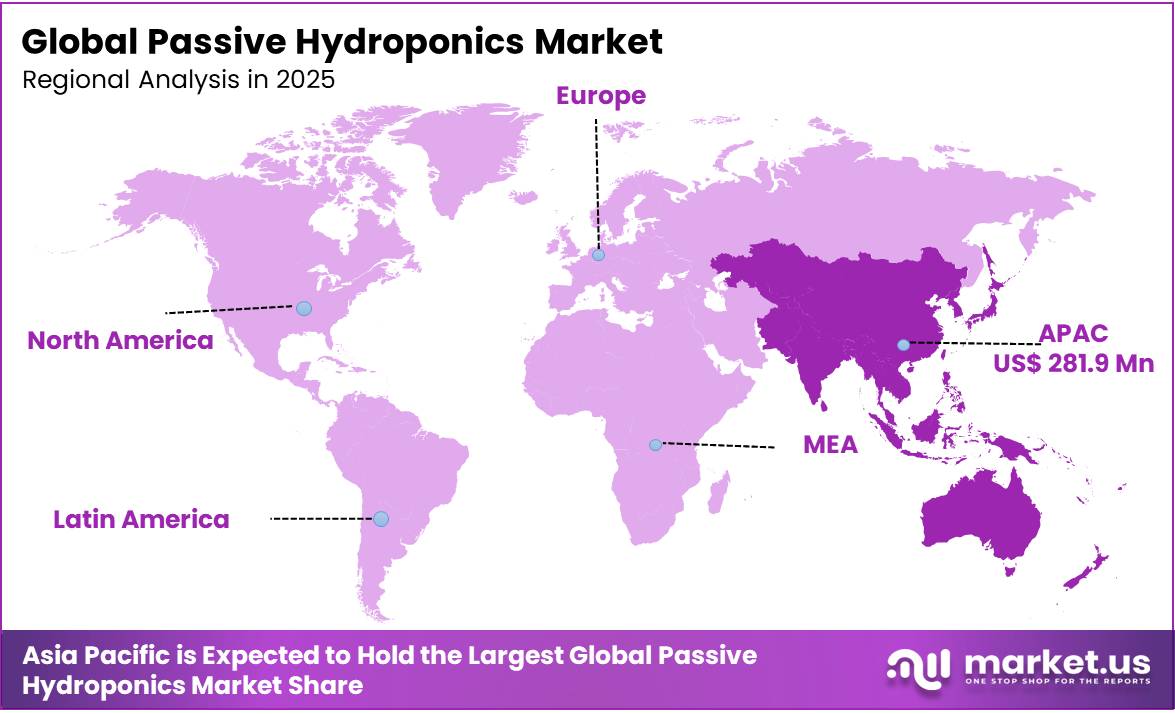
The Global Passive Hydroponics Market size is expected to be worth around USD 3139.3 Million by 2035, from USD 789.6 Million in 2025, growing at a CAGR of 14.8% during the forecast period from 2026 to 2035. In 2025, Asia Pacific held a dominant market position, capturing more than a 34.4% share, holding USD 0.9 billion revenue.
Passive hydroponics is a method of growing plants without soil that relies on natural forces such as capillary action and evaporation rather than electric pumps or moving parts. It is one of the simplest and most cost-effective ways to maintain plants, making it a popular choice for beginners and indoor gardeners. The market is driven by the growing demand for sustainable, low-maintenance agricultural solutions, particularly in urban areas with limited space and resources.
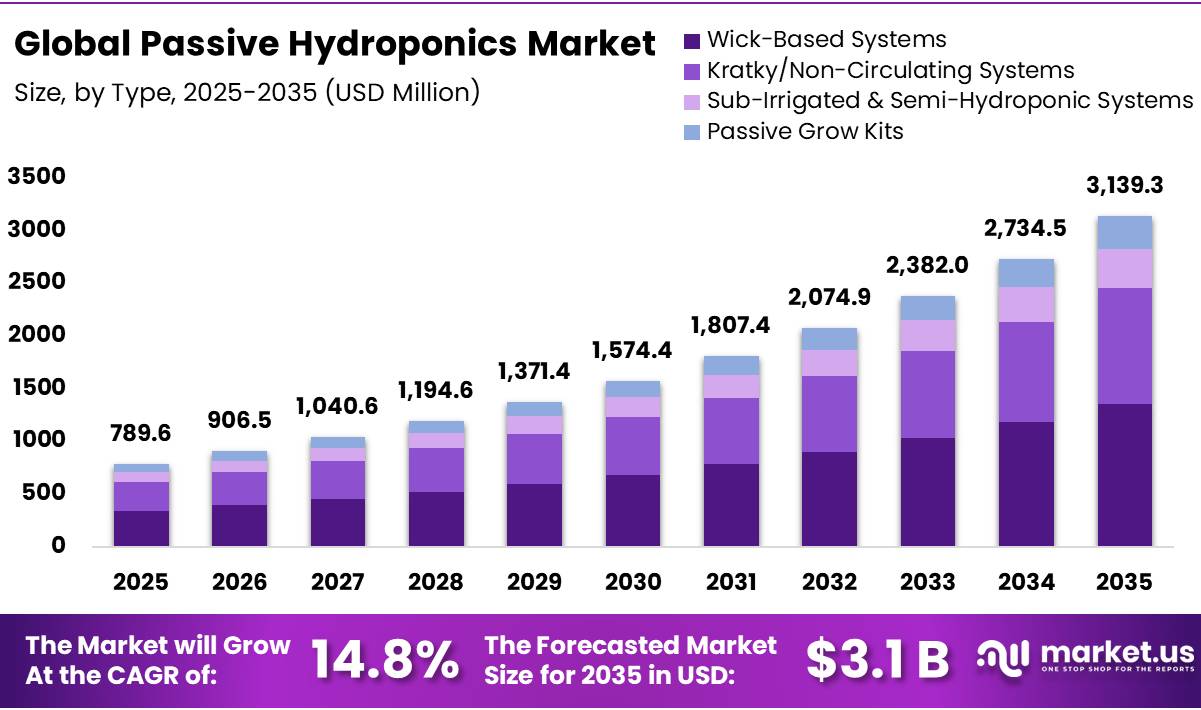
Wick-based systems are the most commonly used due to their simplicity, cost-effectiveness, and minimal need for technical expertise. These systems rely on capillary action to deliver water and nutrients to plants, making them ideal for residential applications where space constraints are prevalent. Urbanization and an intensified interest in DIY gardening have further fueled adoption, especially in residential settings. However, challenges such as system vulnerabilities, including nutrient imbalances and clogging, can hinder performance and crop yields.
Despite these issues, the commercial potential of passive hydroponics remains significant, with governments in regions such as the Asia Pacific investing in urban agriculture initiatives. Furthermore, the market is seeing increasing adoption in educational institutions and sustainability-driven projects, although large-scale applications in community farms and nurseries are less common due to the more complex needs of these sectors.
Key Takeaways:
- The global passive hydroponics market was valued at USD 789.6 million in 2025.
- The global passive hydroponics market is projected to grow at a CAGR of 14.8% and is estimated to reach USD 3139.3 Million by 2035.
- Based on the types, wick-based systems dominated the passive hydroponics market, with a market share of around 29.7%.
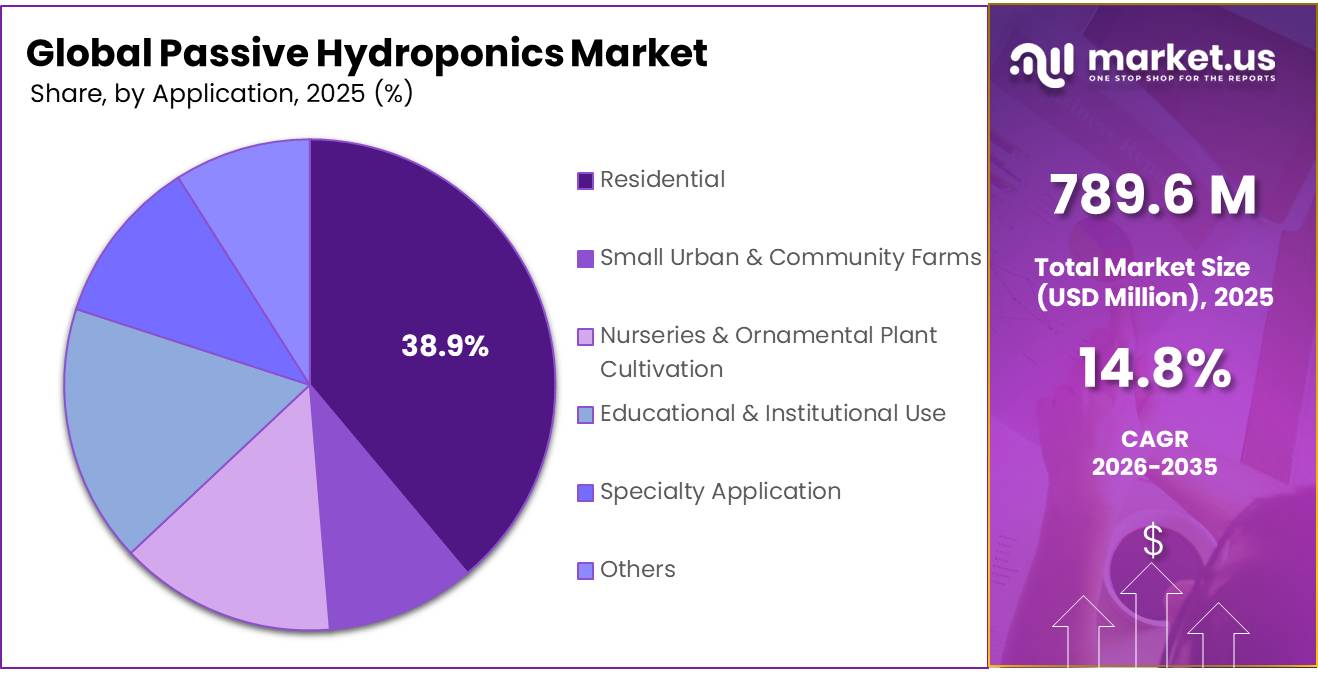
- Among the applications of passive hydroponics, residential applications held a major share in the market, 38.1% of the market share.
- In 2025, the Asia Pacific was the most dominant region in the passive hydroponics market, accounting for around 35.7% of the total global consumption.
Type Analysis
Wick-Based Systems Held the Largest Share in the Passive Hydroponics Market.
The passive hydroponics market is segmented based on type into wick-based systems, kratky/non-circulating systems, sub-irrigated & semi-hydroponic systems, and passive grow kits. The wick-based systems dominated the passive hydroponics market, comprising around 29.7% of the market share, due to their simplicity, cost-effectiveness, and versatility. They require minimal infrastructure, relying on capillary action to transport water and nutrients from a reservoir to the plants, making them easy to set up and maintain. This low-tech approach appeals to both beginners and experienced growers, as it eliminates the need for pumps or complex water circulation mechanisms.
Additionally, wick-based systems are ideal for smaller-scale, space-constrained environments, such as urban apartments or small gardens, providing an efficient way to grow plants with minimal space and water usage. In contrast, kratky and non-circulating systems may require more frequent monitoring, while sub-irrigated or semi-hydroponic systems can be more complex to maintain, making wick-based systems a more attractive option for widespread adoption.
Application Analysis
Passive Hydroponics is Mostly Utilized for Residential Applications.
Based on the applications of passive hydroponics, the market is divided into residential, small urban & community farms, nurseries & ornamental plant cultivation, educational & institutional use, specialty application, and others. The residential applications dominated the passive hydroponics market, with a market share of 38.9%, as passive hydroponics are ideal for small-scale and space-constrained environments. Residential users, particularly urban dwellers, seek easy-to-manage solutions for growing food at home, and passive hydroponics fits well in limited spaces such as apartments or balconies. The low setup cost and minimal maintenance make these systems appealing for individual use.
In contrast, small urban and community farms, nurseries, and educational institutions often require larger, more specialized systems with higher scalability and automation. These sectors typically prioritize systems that can handle more complex needs, such as nutrient control or larger volumes of crops, which passive systems may not provide as efficiently. Consequently, passive hydroponics is more suitable for residential settings where simplicity and space-saving features are paramount.
Key Market Segments:
By Type
- Wick-Based Systems
- Kratky/Non-Circulating Systems
- Sub-Irrigated & Semi-Hydroponic Systems
- Passive Grow Kits
By Application
- Residential
- Small Urban & Community Farms
- Nurseries & Ornamental Plant Cultivation
- Educational & Institutional Use
- Specialty Application
- Others
Drivers
Cost-Effectiveness and Limited Space Drive the Passive Hydroponics Market.
The rise of passive hydroponics is increasingly driven by cost-effectiveness and limited space due to urbanization, allowing for up to 90% less water usage than soil-based methods. Cost-effectiveness stems from the reduced need for energy-intensive equipment, such as pumps and aerators, which passive systems, including wick and kratky methods, minimize.
For instance, passive hydroponic systems often require minimal infrastructure, reducing both setup and operational costs. These systems eliminate the need for electricity for nutrient delivery, while enabling vertical farming techniques that can produce up to 10 times higher yields per square foot, addressing severe land constraints in cities. This makes them accessible for small-scale urban agriculture initiatives.
Similarly, urbanization significantly exacerbates space constraints, particularly in densely populated areas. According to the United Nations, over 60% of the global population lives in urban areas, a trend expected to increase. In cities, available land is scarce and expensive, pushing the adoption of efficient, space-saving farming methods like passive hydroponics. For instance, urban farmers in Singapore have turned to passive hydroponics to grow crops in rooftop gardens and vertical farms, optimizing small spaces for high yields. These systems allow urban dwellers to cultivate food in confined environments, aligning with both economic and spatial constraints.
Restraints
System Vulnerabilities & Operational Issues Might Hamper the Demand for Passive Hydroponics.
System vulnerabilities and operational issues present significant challenges for the passive hydroponics market. One key vulnerability is the potential for nutrient imbalances, as passive systems rely heavily on capillary action and gravity for nutrient delivery. In the absence of active monitoring systems, uneven distribution of nutrients can result in plant stress or poor yields. A study by the United States Department of Agriculture (USDA) has highlighted that inconsistent nutrient flow in passive systems can affect crop health, particularly in high-density plantings.
Apart from this, operational issues arise from system maintenance. Passive hydroponic setups are susceptible to clogging, particularly in systems that rely on wick mechanisms. Additionally, these systems face significant operational constraints rooted in their lack of active circulation and aeration. This can lead to reduced water and nutrient flow, hindering plant growth. In addition, improper maintenance could lead to increased operational costs and crop failures in some passive hydroponics setups.
Opportunity
Commercial Potential of Passive Hydroponics Systems Creates Opportunities in the Market.
The commercial potential of passive hydroponics lies in its ability to offer cost-effective and scalable solutions in space-constrained environments, particularly through its integration into urban residential agriculture and the retail gardening sector. The United Nations Food and Agriculture Organization (FAO) has emphasized the growing importance of urban farming as a means to address food security in rapidly urbanizing regions.
Passive hydroponic systems enable high-density crop production in small spaces without the need for complex infrastructure or continuous energy inputs, making them attractive for commercial use. The system’s commercial utility is most pronounced for leafy greens and herbs, where the lack of mechanical aeration is less of a physiological constraint compared to high-biomass crops. For instance, in Singapore, government initiatives such as the 30 by 30 goal aim to produce 30% of its nutritional needs locally by 2030. This has spurred interest in passive hydroponics for urban commercial farming. Additionally, vertical farming projects in cities such as New York and Tokyo have demonstrated the viability of passive hydroponic systems to maximize space and yield, offering commercial opportunities in urban food production and sustainability.
Trends
Growing Interest in DIY Gardening.
The trend of DIY (do-it-yourself) gardening in the passive hydroponics market is characterized by a shift toward residential self-sufficiency and low-barrier entry systems. A key driver of this trend is the increasing popularity of home gardening, which has seen a surge in urban gardening and indoor plant cultivation. According to a study published in the National Institutes of Health (NIH), approximately 30% of survey respondents reported growing edible plants in a home garden, with many opting for low-maintenance, water-efficient methods such as passive hydroponics.
DIY gardening enthusiasts are drawn to passive hydroponics for its simplicity and resource efficiency. The lack of complex equipment, such as pumps and aerators, appeals to those seeking affordable and beginner-friendly options. In addition, the proliferation of online tutorials and digital education has significantly lowered the technical threshold for first-time users, accelerating global adoption. DIY gardening is increasingly viewed as a means to ensure food security and access to pesticide-free, nutrient-dense produce within limited living spaces.
Geopolitical Impact Analysis
Geopolitical Tensions Are Impacting Global Food Supply Chains.
The geopolitical tensions, particularly the disruptions to global trade and supply chains, have heightened interest in alternative agricultural solutions, including passive hydroponics. The United Nations Food and Agriculture Organization (FAO) has reported that conflicts, such as the ongoing Russia-Ukraine war, have severely impacted global food supply chains, especially in countries dependent on imports of grains and fertilizers. This has triggered governments to explore self-sufficiency in food production, especially in urban and semi-urban settings.
Consequently, passive hydroponics is increasingly seen as a viable solution to enhance local food production in countries facing supply chain vulnerabilities. For instance, the U.S. Department of Agriculture (USDA) emphasized the role of urban agriculture in mitigating food insecurity exacerbated by international trade disruptions. Cities are adopting space-efficient methods such as passive hydroponics to grow food within controlled environments, reducing reliance on imports and minimizing the impact of global trade instability.
Additionally, countries with strained international relations are focusing on resilient farming techniques. For instance, in Israel, a nation with long-standing geopolitical tensions, innovations in hydroponics have led to greater food production independence. These trends indicate that geopolitical instability is pushing governments and individuals toward sustainable, localized agricultural systems.
Regional Analysis
Asia Pacific Held the Largest Share of the Global Passive Hydroponics Market.
In 2025, the Asia Pacific dominated the global passive hydroponics market, holding about 35.7% of the total global consumption, driven by rapid urbanization, limited arable land, and the need for sustainable agricultural practices. The United Nations estimates that by 2050, over 60% of the region’s population will live in urban areas, intensifying the demand for innovative farming methods. Countries such as Singapore and Japan have actively promoted urban agriculture to ensure food security. Similarly, Japan’s Ministry of Agriculture has supported vertical farming initiatives, often utilizing passive hydroponic techniques for urban food production.
Additionally, China’s National Development and Reform Commission has recognized the potential of hydroponics to improve agricultural efficiency in both urban and rural areas. These regional policy pushes underscore the Asia Pacific’s growing adoption of passive hydroponics as a strategic solution to address space limitations and food security challenges.
Key Regions and Countries
- North America
- The US
- Canada
- Europe
- Germany
- France
- The UK
- Spain
- Italy
- Russia & CIS
- Rest of Europe
- APAC
- China
- Japan
- South Korea
- India
- ASEAN
- Rest of APAC
- Latin America
- Brazil
- Mexico
- Rest of Latin America
- Middle East & Africa
- GCC
- South Africa
- Rest of MEA
Key Players Analysis
Players in the passive hydroponics market invest in R&D to innovate and optimize passive hydroponic systems, improving efficiency, yield, and ease of use. Many companies have developed new materials and design improvements to reduce maintenance and increase system longevity. In addition, collaboration with governments and urban farming initiatives is a key strategy.
Many companies align with sustainability goals, such as food security and local production, to gain support from public sector funding and incentives. Similarly, they expand product offerings to cater to both commercial and DIY markets, targeting urban farmers, educational institutions, and hobbyists. These strategies are complemented by enhancing customer service and offering educational resources to facilitate adoption.
The Major Players in The Industry
- AUTOPOT
- Gardyn
- KratkyHydroponics
- WeHydroponics
- Casa De Amor
- Coco and Seed- EcoPlanter
- Ponics Life- Candlestick Hydroponic Wicking Kit
- GroTech Garden Products
- EarthBox
- LetPot
- Other Key Players
Report Scope:
Report Features Description Market Value (2025) US$789.6 Mn Forecast Revenue (2035) US$ 3139.3 Mn CAGR (2025-2035) 14.8% Base Year for Estimation 2025 Historic Period 2021-2024 Forecast Period 2025-2035 Report Coverage Revenue Forecast, Market Dynamics, Competitive Landscape, Recent Developments Segments Covered By Type (Wick-Based Systems, Kratky/Non-Circulating Systems, Sub-Irrigated & Semi-Hydroponic Systems, and Passive Grow Kits), By Application (Residential, Small Urban & Community Farms, Nurseries & Ornamental Plant Cultivation, Educational & Institutional Use, Specialty Application, and Others) Regional Analysis North America – The US & Canada; Europe – Germany, France, The UK, Spain, Italy, Russia & CIS, Rest of Europe; APAC– China, Japan, South Korea, India, ASEAN & Rest of APAC; Latin America– Brazil, Mexico & Rest of Latin America; Middle East & Africa– GCC, South Africa, & Rest of MEA Competitive Landscape AUTOPOT, Gardyn, KratkyHydroponics, WeHydroponics, Casa De Amor, Coco and Seed- EcoPlanter, Ponics Life- Candlestick Hydroponic Wicking Kit, GroTech Garden Products, EarthBox, LetPot, and Other Players. Customization Scope Customization for segments, region/country-level will be provided. Moreover, additional customization can be done based on the requirements. Purchase Options We have three licenses to opt for: Single User License, Multi-User License (Up to 5 Users), Corporate Use License (Unlimited Users and Printable PDF) 
-
-
- AUTOPOT
- Gardyn
- KratkyHydroponics
- WeHydroponics
- Casa De Amor
- Coco and Seed- EcoPlanter
- Ponics Life- Candlestick Hydroponic Wicking Kit
- GroTech Garden Products
- EarthBox
- LetPot
- Other Key Players
Our Clients

- 181231
- Mar 2026






