


Global Oxygen Scavengers Market By Product (Organic Scavengers and Inorganic Scavengers), By End-Use (Food and Beverage, Pharmaceutical, Oil and Gas, Energy And Power, Chemical, Pulp and Paper, and Others), By Region and Companies - Industry Segment Outlook, Market Assessment, Competition Scenario, Trends and Forecast 2025-2034
- Published date: Feb 2026
- Report ID: 179014
- Number of Pages: 299
- Format:
-
keyboard_arrow_up
Quick Navigation
Report Overviews
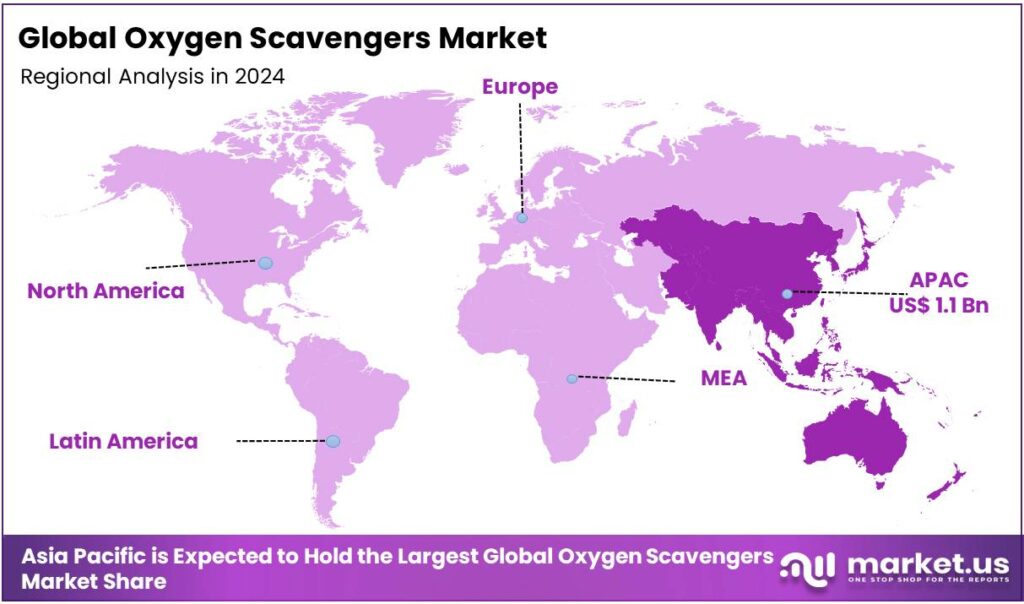
The Global Oxygen Scavengers Market is expected to be worth around USD 6.4 Billion by 2034, up from USD 3.2 Billion in 2024, and is projected to grow at a CAGR of 7.2% from 2025 to 2034. The Asia Pacific segment maintained 40.2%, supporting a Oxygen Scavengers value of USD 4.6 Bn.
Oxygen scavengers are substances or systems that actively remove oxygen from a sealed environment or fluid through chemical or enzymatic reactions. By eliminating oxygen, they prevent oxidation, which can cause spoilage, degradation, and corrosion. The market is primarily driven by the need to preserve product quality and extend shelf life, with widespread application in the food and beverage industry, which dominates usage due to the direct impact of oxygen on spoilage, nutrient degradation, and sensory changes.
- According to the FDA’s FY2024 Report on the State of Pharmaceutical Quality, the organization issued 105 warning letters for quality issues, the highest in five years. These incidents highlight persistent stability and quality control challenges that oxygen scavengers can address.
Asia Pacific emerges as the largest regional market, supported by high packaged food consumption, large-scale manufacturing infrastructure, and regulatory frameworks promoting active packaging. Technological trends in the market include the integration of scavengers directly into packaging structures, enhancing safety, recyclability, and convenience compared with sachet-based systems.
Furthermore, organic scavengers are favored over inorganic alternatives for their food-safety compatibility, biodegradability, and suitability for direct contact applications. Meanwhile, the market faces challenges related to by-product toxicity and supply chain vulnerabilities amplified by geopolitical tensions, which influence raw material availability, logistics, and compliance with food-contact standards. These dynamics collectively shape adoption, innovation, and operational strategies within the sector.
Key Takeaways:
- The global oxygen scavengers market was valued at US$3.2 billion in 2024.
- The global oxygen scavengers market is projected to grow at a CAGR of 7.2% and is estimated to reach US$6.4 billion by 2034.
- Based on types of oxygen scavengers, organic scavengers dominated the market in 2024, comprising about 59.7% share of the total global market.
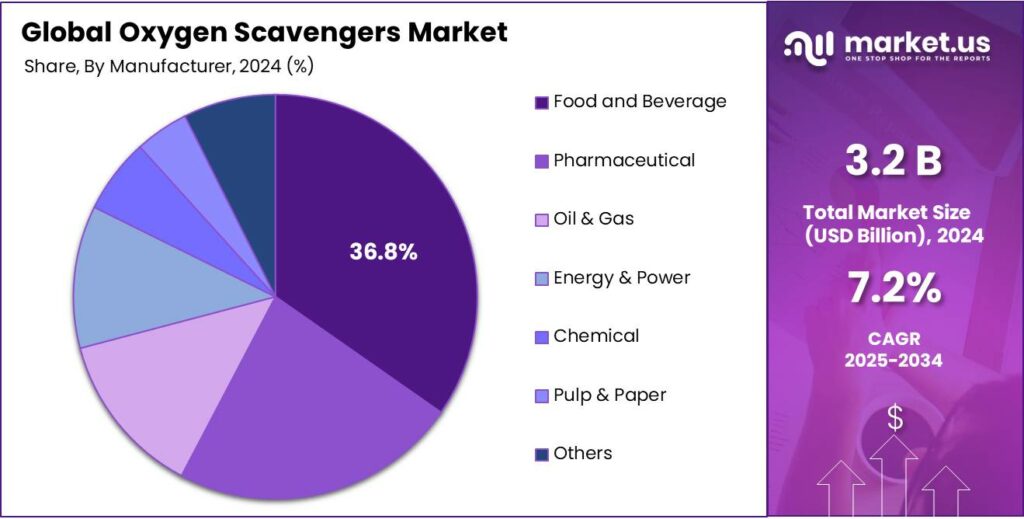
- Among the end-uses of oxygen scavengers, the food and beverage industry dominated the market in 2024, accounting for around 36.8% of the market share.
- The Asia Pacific was the largest market for oxygen scavengers in 2024, comprising 35.7% of the market share.
Product Analysis
Organic Scavengers Held the Largest Share in the Market.
On the basis of product type, the oxygen scavengers market is segmented into organic scavengers and inorganic scavengers. The organic scavengers dominated the market in 2024 with a market share of 59.7%, primarily due to safety and regulatory compatibility with food and sensitive products. Organic scavengers such as ascorbic acid, tocopherols, unsaturated hydrocarbons, and enzyme-based systems can be inherently non-metallic and biodegradable, reducing risks associated with metal contamination or metal detector interference in food lines.
Additionally, they are considered more food-safe and aligned with sustainability objectives as they derive from natural or bioactive molecules, making them attractive where direct or close contact with consumables occurs. Similarly, organic scavengers have been explored in active packaging films and coatings that integrate with polymer structures without introducing metallic residues. By contrast, inorganic scavengers often rely on iron or other metals that, while efficient, raise concerns about ingestion, regulatory scrutiny, and recyclability in food contact contexts.
End-Use Analysis
In 2024, the Food and Beverage Industry Dominated the Oxygen Scavengers Market.
In 2024, the food and beverage industry emerged as the largest end-use sector for oxygen scavengers, accounting for nearly 36.8% of the product’s global consumption, outperforming sectors such as pharmaceutical, oil and gas, energy & power, chemical, pulp and paper, and others. The food and beverage industry’s predominance in oxygen scavenger usage is grounded in the ubiquity and severity of oxygen-related quality degradation in foods, which directly affects safety, sensory attributes, and spoilage rates.
In contrast, other sectors such as pharmaceuticals or industrial applications face narrower, more specialized oxygen challenges tied to specific formulations, requiring tailored protective measures within highly regulated container-closure systems rather than broad packaging solutions. Due to the sheer volume of packaged food products and the direct link between oxygen control and food safety/quality outcomes, the food and beverage packaging accounts for the most extensive deployment of oxygen scavenging technology.
Key Market Segments:
By Product
- Organic Scavengers
- Inorganic Scavengers
By End-Use
- Food and Beverage
- Pharmaceutical
- Oil and Gas
- Energy & Power
- Chemical
- Pulp and Paper
- Others
Drivers
Food and Beverage Industry Growth Drives the Demand for Oxygen Scavengers.
The structural expansion of the global food and beverage industry underpins growth in demand for oxygen scavengers, active packaging components that retard oxidative spoilage in packaged foods and beverages. The increased penetration of packaged and processed products corresponds with growth in packaging volumes that require improved shelf life and quality retention.
Oxygen promotes aerobic microbial growth, oxidative rancidity, nutrient loss, off-odors, and color changes in perishable and processed foods. Controlling residual oxygen is central to maintaining product quality during distribution and storage. In food packaging, oxygen scavengers are routinely employed in sachets or integrated films to reduce headspace oxygen to very low levels, significantly slowing these spoilage pathways and extending shelf life without altering taste or aroma.
Additionally, global initiatives, such as the FAO’s goal to halve food waste by 2030 (SDG 12.3), prioritize technologies that maintain product integrity during complex supply chain transits. Similarly, the FDA’s Human Foods Program 2026 deliverables and the EU Packaging and Packaging Waste Regulation (PPWR), mandatory from August 2026, are driving a transition toward non-metallic scavengers to minimize metal-ion migration and comply with stricter chemical limits.
Restraints
By-product Toxicity Might Hamper the Growth of the Oxygen Scavengers Market.
By-product toxicity represents a critical regulatory and technical challenge for the oxygen scavenger market, as chemical migration from active components can compromise the safety of the contents. During scavenging, reactions involving polyunsaturated molecules can generate volatile organic by-products such as organic acids, aldehydes, and ketones. These compounds may affect sensory attributes such as off-odors and off-flavors and raise regulatory concerns about migration into food matrices. Regulatory frameworks in the EU, such as Directive 89/109/EEC, require that active packaging materials neither pose a health risk nor adversely alter food sensory qualities. This includes controlling the toxicity and migration characteristics of any oxidation by-products.
Furthermore, sachet-type systems containing iron oxides or other reactive compounds carry risks if leakage occurs, with iron oxide exposure linked to respiratory symptoms such as chest tightness and pneumoconiosis in occupational settings. In industrial water treatment, the use of hydrazine, a common oxygen scavenger, is strictly controlled due to its classification as a carcinogen and mutagen. These material and by-product safety considerations necessitate stringent material selection, barrier design, and compliance testing to ensure that oxygen scavenger systems do not introduce harmful substances into packaged foods or beverages.
Opportunity
Expansion in Healthcare & Pharmaceuticals Creates Opportunities in the Oxygen Scavengers Market.
The expansion of the healthcare and pharmaceutical industries presents a significant opportunity for the oxygen scavenger market, driven by the need to protect sensitive and high-value medical products from oxidative degradation. Oxidation is the second most common degradation pathway for pharmaceuticals after hydrolysis, leading to a loss of efficacy or the formation of harmful substances. Additionally, modern therapeutics, such as monoclonal antibodies (mAbs), are particularly susceptible to oxidation, which can alter their binding affinity, half-life, and overall efficacy.
Incorporating oxygen scavengers in primary packaging can reduce headspace oxygen to extremely low levels in hours and achieve near-zero oxygen conditions, mitigating oxidative degradation pathways that compromise drug potency and safety. For instance, the use of scavengers in solid dosage form packaging has been observed to attain very low oxygen concentrations within 24 hours, aiding in stability control with permeable containers commonly used in the industry.
In addition, global health initiatives, such as the CDC’s recommendations for the 2025-2026 vaccine season, underscore a massive global supply chain for oxygen-sensitive biologicals that require robust protective packaging to ensure stability and efficacy during transport and storage.
Trends
Integration of Scavenging Technology Directly into the Packaging Structure.
Integration of oxygen scavenging functionality directly into packaging structures is an established technological trend that enhances active packaging performance by embedding reactive components within polymer layers rather than using separate sachets. Embedding scavengers addresses several limitations of sachets, such as the risk of accidental ingestion and the need for additional packaging operations, while offering consumer-friendly and safer packaging formats.
The developments include multilayer structures with catalysts or reactive polymers co-extruded into film and rigid container walls, enabling the scavenger to be an intrinsic part of the packaging material. These integrated systems may reduce residual headspace oxygen to levels comparable with sachet-based solutions and can be tailored via co-extrusion and lamination processes to balance scavenging activity with barrier integrity.
Geopolitical Impact Analysis
Geopolitical Tensions Leading to Supply Chain Disruptions in the Oxygen Scavengers Market.
The geopolitical tensions exert measurable effects on the oxygen scavengers market through chemical supply chain disruption, trade policy shifts, and logistical volatility, given that oxygen scavengers are derived from intermediates and polymers embedded within the broader chemicals and packaging ecosystem. The US imposition of broad tariffs, including a 10% baseline in early 2025 and rates up to 50% on specific countries, has reshaped global trade flows.
For instance, prices for raw materials such as iron powder and specialty polymers have increased by 18%-22% annually due to unpredictable lead times and import dependencies. Additionally, tariff regimes and trade barriers alter input cost structures and sourcing strategies for packaging raw materials essential to oxygen scavenger incorporation. For instance, tariffs on imported packaging materials such as plastics and metals have added billions in landed costs and complexity to supply chains.
Furthermore, to mitigate future disruptions, the EU is launching a coordinated stockpiling scheme for critical raw materials in early 2026. Additionally, broader geopolitical instability has been linked by the United Nations Conference on Trade and Development (UNCTAD) to increased volatility in maritime logistics, including route deviations and rising freight distances, further stressing delivery reliability.
Regional Analysis
Asia Pacific is at the Forefront of the Global Oxygen Scavengers Market.
The Asia Pacific held the major share of the global oxygen scavengers market, led by the United States, commanding an estimated 35.7% of total revenue share. This predominance reflects high consumption of packaged foods and beverages in China, India, Japan, and Southeast Asia, where extended shelf life and quality preservation are critical for both domestic sales and export compliance. Governments in several Asia Pacific countries have implemented food safety and packaging regulations that encourage the use of active packaging technologies, including oxygen scavengers, to maintain product integrity and reduce spoilage.
- According to the Indian IBEF, the Indian food processing sector is one of the country’s largest industries, representing 1.5% of GDP and ranking fifth in terms of production, consumption, and exports.
Industrial development and large-scale manufacturing capacity for packaging materials such as flexible films and PET containers support oxygen scavenger integration into polymer structures widely used in the region’s packaging value chain. In China, strong chemical and packaging sectors improve access to reactive additives and processing infrastructure, reinforcing regional leadership in active packaging adoption. Asia Pacific’s position as the leading oxygen scavenger market is anchored in quantifiable regional demand and supply capacities, supported by extensive packaging activity across food, pharmaceuticals, and related sectors.
Key Regions and Countries
- North America
- The US
- Canada
- Europe
- Germany
- France
- The UK
- Spain
- Italy
- Russia & CIS
- Rest of Europe
- APAC
- China
- Japan
- South Korea
- India
- ASEAN
- Rest of APAC
- Latin America
- Brazil
- Mexico
- Rest of Latin America
- Middle East & Africa
- GCC
- South Africa
- Rest of MEA
Key Players Analysis
Manufacturers of oxygen scavengers increasingly prioritize product innovation and sustainability-oriented development to differentiate offerings. Additionally, firms collaborate with converters and technology partners to co-develop next-generation materials and integrate scavenging functions into broader packaging systems.
Similarly, strategic emphasis is placed on regulatory compliance and technical validation, ensuring new formulations meet direct food-contact standards in key jurisdictions. These activities, targeted innovation, sustainability integration, technical collaboration, and regulatory alignment, establish differentiated value propositions in competitive procurement processes and reinforce long-term supplier relationships within packaging and end-use sectors.
The Major Players in The Industry
- BASF SE
- Mitsubishi Gas Chemical Company, Inc.
- Avient Corporation
- Ecolab Inc.
- Arkema Group
- Eastman Chemical Company
- Solenis USA
- Kemira Oyj
- Henkel AG & Co. KGaA
- Veolia Water Technologies
- Other Key Players
Key Developments
- In July 2025, Avient Corp. introduced an oxygen-scavenging additive aimed at improving the recyclability of PET packaging while helping products last longer on the shelf. The product, ColorMatrix Amosorb Oxyloop-1, is the first offering in Avient’s Oxyloop line of oxygen scavengers.
Report Scope:
Report Features Description Market Value (2024) US$3.2 Bn Forecast Revenue (2034) US$6.4 Bn CAGR (2025-2034) 7.2% Base Year for Estimation 2024 Historic Period 2020-2023 Forecast Period 2025-2034 Report Coverage Revenue Forecast, Market Dynamics, Competitive Landscape, Recent Developments Segments Covered By Product (Organic Scavengers and Inorganic Scavengers), By End-Use (Food & Beverage, Pharmaceutical, Oil and Gas, Energy & Power, Chemical, Pulp & Paper, and Others) Regional Analysis North America – The US & Canada; Europe – Germany, France, The UK, Spain, Italy, Russia & CIS, Rest of Europe; APAC– China, Japan, South Korea, India, ASEAN & Rest of APAC; Latin America– Brazil, Mexico & Rest of Latin America; Middle East & Africa– GCC, South Africa, & Rest of MEA Competitive Landscape BASF SE, Mitsubishi Gas Chemical Company, Inc., Avient Corporation, Ecolab Inc., Arkema Group, Eastman Chemical Company, Solenis USA, Kemira Oyj, Henkel AG & Co. KGaA, Veolia Water Technologies, Other Key Players. Customization Scope Customization for segments, region/country-level will be provided. Moreover, additional customization can be done based on the requirements. Purchase Options We have three licenses to opt for: Single User License, Multi-User License (Up to 5 Users), Corporate Use License (Unlimited Users and Printable PDF) 
-
-
- BASF SE
- Mitsubishi Gas Chemical Company, Inc.
- Avient Corporation
- Ecolab Inc.
- Arkema Group
- Eastman Chemical Company
- Solenis USA
- Kemira Oyj
- Henkel AG & Co. KGaA
- Veolia Water Technologies
- Other Key Players
Our Clients

- 179014
- Feb 2026






