Market Overview
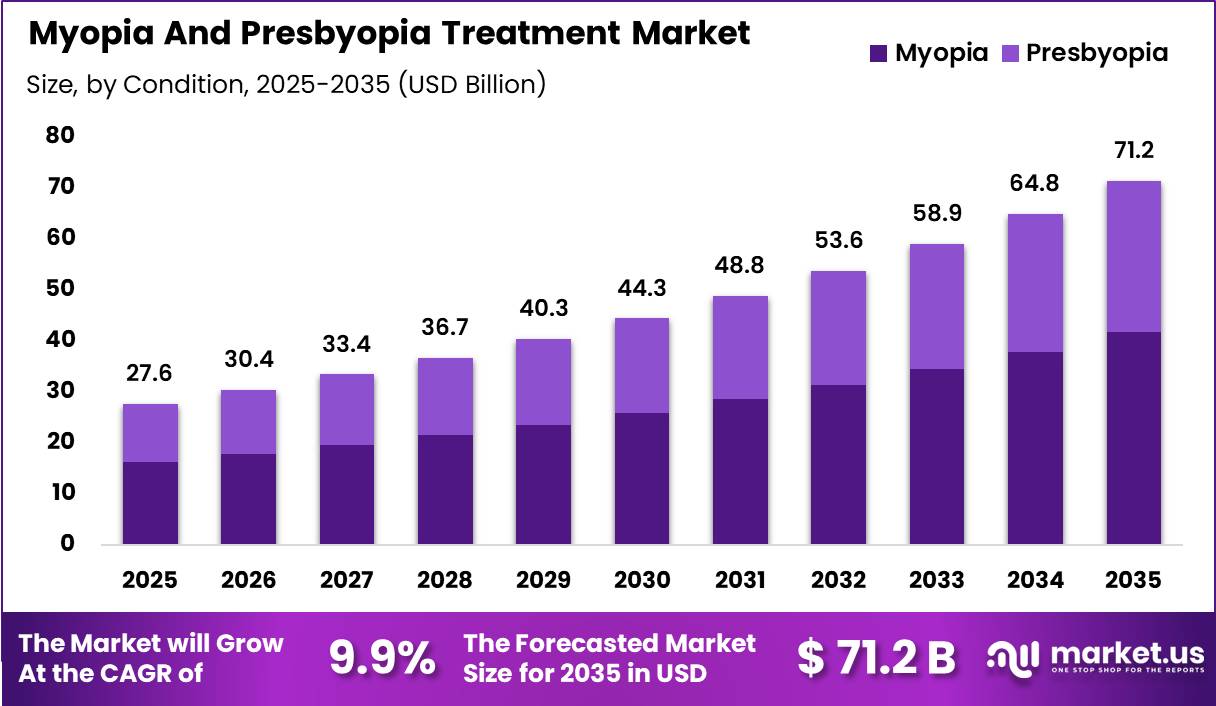
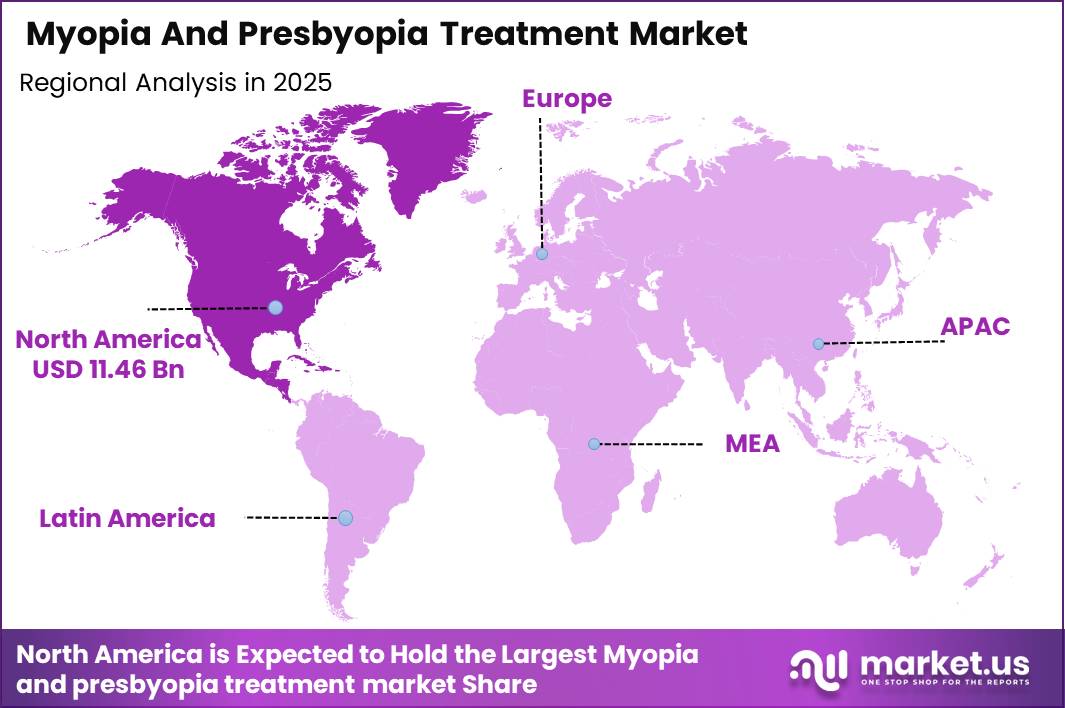
The Global Myopia and Presbyopia Treatment Market size is expected to be worth around US$ 71.2 Billion by 2035 from US$ 27.61 Billion in 2025, growing at a CAGR of 9.9% during the forecast period from 2026 to 2035. In 2025, North America led the market, achieving over a 41.5% share with a revenue of US$ 11.46 Billion.
The Myopia and Presbyopia Treatment Market is expanding steadily due to the rising prevalence of refractive errors, increasing aging populations, greater digital device use, and improved access to advanced eye care. Myopia and presbyopia are among the most common vision disorders globally, creating sustained demand for corrective lenses, pharmaceuticals, laser vision correction, and premium intraocular lenses.
According to the World Health Organization (WHO), at least 2.2 billion people worldwide live with near or distance vision impairment, and 88.4 million cases of distance vision impairment are caused by uncorrected refractive errors, while approximately 826 million people have unaddressed presbyopia. WHO also estimates that 2 out of every 3 people in low-income countries who need eyeglasses do not have access to them, highlighting a major unmet healthcare need.
The National Eye Institute (NEI) states that presbyopia usually begins after age 40 and continues to progress until around age 65, supporting long-term demand for reading glasses, multifocal contact lenses, and surgical vision correction. Meanwhile, the National Academies of Sciences, Engineering, and Medicine projects that nearly 5 billion people around half of the global population could have myopia by 2050 if current trends continue.
Technological innovations such as AI-assisted eye screening, optical coherence tomography (OCT), wavefront-guided LASIK, SMILE surgery, orthokeratology lenses, and low-dose atropine therapy are improving treatment outcomes.
According to WHO, presbyopia is expected to affect approximately 2.1 billion people by 2030, while global myopia cases are projected to reach 3.36 billion by 2030. In addition, annual productivity losses from uncorrected myopia are estimated at US$ 244 billion, while presbyopia contributes an additional US$25.4 billion in global productivity losses, emphasizing the economic importance of timely diagnosis and treatment.
Key Takeaways
- Market Size: The Global Myopia and Presbyopia Treatment Market size was US$ 27.61 Billion in 2025. The market is estimated to grow to US$ 71.2 Billion by 2035.
- Market Share: The Compound Annual Growth Rate (CAGR) of the market from 2026 to 2035 will be 9.9%.
- Condition: Myopia has the largest market share, accounting for 58.4% of total sales.
- Treatment Type: Corrective Lenses dominate the segment, accounting for 42.7% of total revenue.
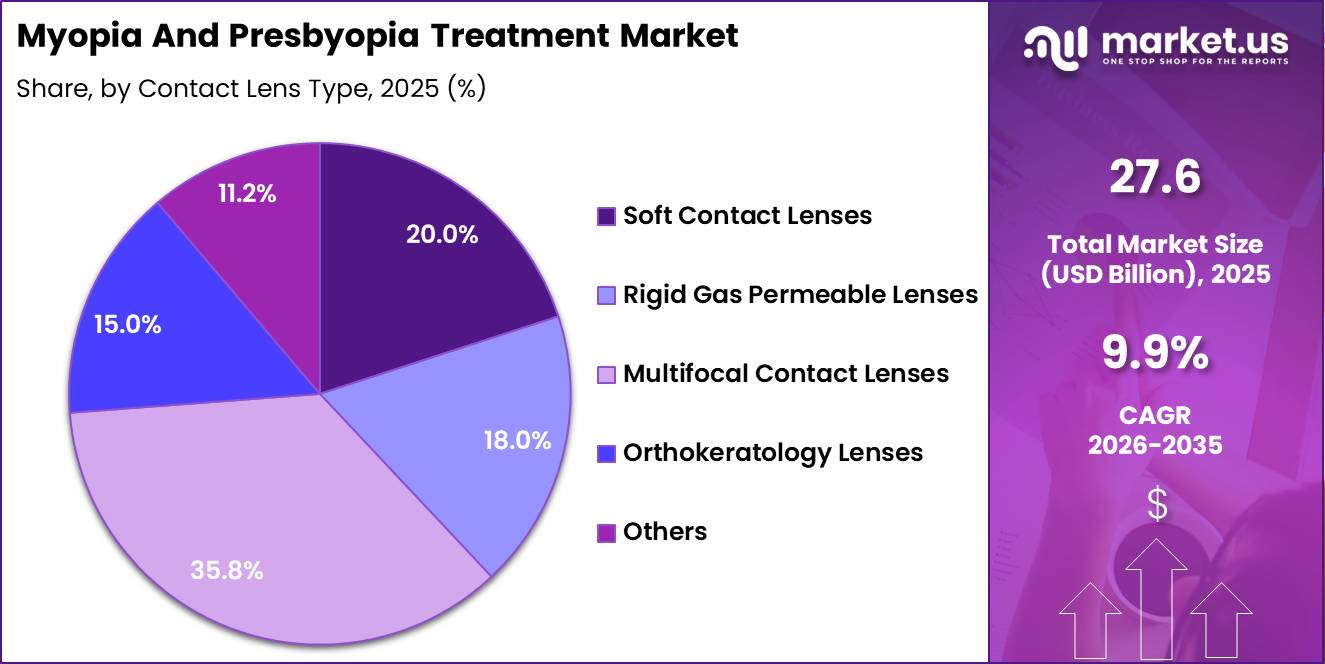
- Contact Lens Type: Multifocal Contact Lenses lead the segment, accounting for 35.8% of total revenue.
- End User: Ophthalmic Clinics dominate the segment, accounting for 38.5% of total revenue.
- Age Group: Adults dominate the segment, accounting for 44.6% of total revenue.
- Regional: North America is the dominant regional market, accounting for 41.5% of global sales, holding US$ 11.46 billion in revenue.
Condition Analysis
The condition segment of the Myopia and Presbyopia Treatment Market is divided into Myopia and Presbyopia. Myopia dominates the market, accounting for 58.4% of the global market share in 2025. The segment leads because of the rapidly increasing prevalence of nearsightedness among children, adolescents, and young adults, driven by prolonged screen exposure, intensive educational activities, and reduced outdoor time.
Rising awareness of early vision correction and increasing adoption of corrective lenses, pharmaceutical eye drops, orthokeratology, and refractive surgery further strengthen market demand. Continuous advancements in diagnostic technologies and personalized treatment options also contribute to the dominance of this segment. Healthcare providers are increasingly focusing on slowing myopia progression rather than only correcting vision, creating additional treatment opportunities.
The Presbyopia segment holds 41.6% of the market share in 2025 and continues to expand due to the growing aging population worldwide. Presbyopia commonly affects adults over the age of 40, creating sustained demand for reading glasses, multifocal contact lenses, intraocular lenses, and surgical correction procedures.
Improvements in premium lens technologies and minimally invasive treatments are encouraging more patients to seek long-term vision correction, supporting consistent growth across developed and emerging healthcare markets.
Treatment Type Analysis
Based on treatment type, the Myopia and Presbyopia Treatment Market is segmented into Corrective Lenses, Contact Lenses, Intraocular Lenses, Refractive Surgery, Pharmaceutical Eye Drops, Orthokeratology, and Others.
Corrective Lenses account for the largest 42.7% market share in 2025, making them the leading treatment category. Their affordability, easy availability, non-invasive nature, and suitability for patients of all age groups continue to support widespread adoption.
Prescription eyeglasses remain the preferred first-line treatment for both myopia and presbyopia because they provide immediate visual correction while requiring minimal clinical intervention. Ongoing innovations in lightweight materials, blue-light filtering coatings, and progressive lenses further enhance consumer acceptance.
Contact Lenses represent a significant portion of the market, supported by increasing preference for convenience and cosmetic benefits. Intraocular Lenses continue to gain demand, particularly among cataract and presbyopia patients seeking permanent vision correction.
Refractive Surgery is expanding with improvements in laser technologies that offer faster recovery and greater precision. Pharmaceutical Eye Drops are emerging as an innovative treatment option for managing myopia progression and presbyopia symptoms.
Orthokeratology is witnessing growing adoption among pediatric patients for overnight vision correction and myopia control, while the Others segment includes combination therapies and evolving vision care solutions contributing to overall market growth.
Contact Lens Type Analysis
Based on contact lens type, the Myopia and Presbyopia Treatment Market is segmented into Multifocal Contact Lenses, Soft Contact Lenses, Rigid Gas Permeable Lenses, Orthokeratology Lenses, and Others. Multifocal Contact Lenses dominate the segment with 35.8% market share in 2025.
Their leadership is supported by increasing demand from presbyopia patients who require clear vision at multiple distances without relying on reading glasses. Continuous advancements in lens design, enhanced comfort, improved oxygen permeability, and customized fitting options have increased patient satisfaction and adoption.
Eye care professionals increasingly recommend multifocal lenses because they provide effective daily vision correction while maintaining convenience and lifestyle flexibility. Soft Contact Lenses account for 20.0% of the market, benefiting from their high comfort level, affordability, and suitability for daily wear among myopia patients. Rigid Gas Permeable Lenses hold 18.0%, offering superior optical clarity and durability for individuals with complex vision needs.
Orthokeratology Lenses represent 15.0%, supported by growing use in pediatric myopia management through overnight corneal reshaping. The Others category contributes 11.2%, including specialty hybrid and customized contact lenses designed for unique ocular conditions. Collectively, these product categories support expanding patient preferences for personalized, non-surgical vision correction.
End User Analysis
Based on end users, the Myopia and Presbyopia Treatment Market is segmented into Ophthalmic Clinics, Hospitals, Ambulatory Surgical Centers, and Others. Ophthalmic Clinics dominate the market with a 38.5% share in 2025. These specialized centers provide comprehensive eye examinations, accurate diagnosis, personalized treatment planning, contact lens fitting, refractive surgery consultations, and long-term vision management.
Patients increasingly prefer ophthalmic clinics because of shorter waiting times, specialized expertise, advanced diagnostic equipment, and continuity of care. The growing availability of technologically advanced imaging systems and customized treatment approaches further strengthens the position of these facilities.
Hospitals account for a substantial portion of the market due to their capability to manage complex ophthalmic conditions and perform advanced surgical procedures, including cataract surgery with premium intraocular lens implantation.
Ambulatory Surgical Centers continue to gain popularity because they offer cost-effective, minimally invasive eye procedures with faster patient recovery and reduced hospital stays. Their efficiency and convenience are attracting increasing patient volumes for refractive surgeries and other outpatient vision correction procedures.
The Others segment includes optical centers, academic institutions, and community eye care facilities that contribute to preventive vision screening, follow-up care, and expanding access to eye health services across diverse populations.
Age Group Analysis
Based on age group, the Myopia and Presbyopia Treatment Market is segmented into Pediatric, Adults, and Geriatric populations. Adults hold the largest 44.6% market share in 2025. The segment dominates because adults experience high rates of both myopia and presbyopia while maintaining active professional and personal lifestyles that require effective vision correction.
Increased digital device usage, prolonged screen exposure, and greater awareness of advanced treatment options continue to drive demand for eyeglasses, contact lenses, pharmaceutical eye drops, refractive surgery, and premium intraocular lenses.
Higher healthcare spending and improved access to specialized eye care also contribute to the segment’s leadership. The Pediatric segment is expanding steadily due to the rising prevalence of childhood myopia and increasing emphasis on early intervention strategies.
Parents and healthcare providers are adopting orthokeratology, specialized contact lenses, and pharmaceutical therapies to slow myopia progression and reduce long-term complications. The Geriatric segment remains an important contributor as age-related presbyopia becomes increasingly common among older adults.
Growing life expectancy, regular eye examinations, and advancements in multifocal intraocular lenses and minimally invasive surgical procedures continue to support demand for comprehensive vision correction solutions in the aging population.
Key Market Segments
By Condition
- Myopia
- Presbyopia
By Treatment Type
- Corrective Lenses
- Contact Lenses
- Intraocular Lenses
- Refractive Surgery
- Pharmaceutical Eye Drops
- Orthokeratology
- Others
By Contact Lens Type
- Soft Contact Lenses
- Rigid Gas Permeable Lenses
- Multifocal Contact Lenses
- Orthokeratology Lenses
- Others
By End User
- Hospitals
- Ophthalmic Clinics
- Ambulatory Surgical Centers
- Others
By Age Group
- Pediatric
- Adults
- Geriatric
Driver
Aging and Myopia Trends Expanding Vision Care Treatment Demand
Presbyopia is an age-linked condition, so demographic aging directly enlarges the treatable pool across drops, lenses, and surgery-adjacent solutions. WHO states presbyopia is the main cause of near vision impairment, affecting 826 million people, while the World Report on Vision notes at least 2.2 billion people live with vision impairment globally; the Lancet Global Health Commission further estimated 1.1 billion people had distance vision impairment or uncorrected presbyopia in 2020 and projected that figure to 1.8 billion by 2050.
Strategically, this expands demand across multiple price tiers: low-cost readers remain the entry point, but the growth profit pool shifts toward prescription presbyopia drops, premium intraocular lenses, and combined cataract-refractive pathways as older patients increasingly purchase convenience, extended working-life productivity, and reduced dependence on spectacles, especially in North America, Europe, Japan, and wealthier urban China.
The strongest structural driver is the sheer expansion of the addressable myopia pool, especially in children and adolescents where treatment duration is longest and lifetime revenue per patient is materially higher.
A widely cited global projection estimated myopia at 4.758 billion people, or 49.8% of the world population, by 2050, with high myopia reaching 938 million; a newer meta-analysis also found childhood myopia prevalence rose from 24.32% to 35.81% between 1990 and 2023 and is projected to approach 39.80% by 2050, with East Asia at 35.22%, adolescents at 47.00%, and high-school students at 45.71%.
For market mechanics, this shifts value capture away from one-time refractive correction and toward multi-year disease-management models including repeated exams, axial-length monitoring, optical interventions, and pharmaceutical follow-up, with APAC remaining the core volume engine while North America and Europe contribute higher revenue intensity per treated child.
| Driver | (~) % Impact on CAGR Forecast | Geographic Relevance | Impact Timeline |
|---|---|---|---|
| Rising myopia prevalence and earlier-age onset | +2.4% | APAC core, North America, EU, urban LATAM spill-over | Medium term |
| Clinical validation of higher-efficacy myopia control therapies | +1.7% | North America core, EU, developed APAC | Short term |
| Aging population expanding presbyopia and lens-replacement demand | +2.1% | North America, EU, Japan, China urban clusters | Medium term |
| Reimbursement-supported cataract and post-IOL vision pathways | +1.3% | North America core, EU major markets | Short term |
| Consumer shift toward premium refractive correction and spectacle independence | +1.5% | North America, South Korea, Japan, China tier-1 cities, Gulf markets | Medium term |
| Diabetes-linked eye care utilization lifting detection and intervention volumes | +1.0% | North America, Middle East, India, China, Latin America | Long term |
Challenge
Care Fragmentation Limiting Vision Correction Market Expansion
Care fragmentation and access gaps generate persistent operational friction because the pathways from symptom onset to advanced myopia management or presbyopia correction remain disjointed, with patients oscillating between general practitioners, optometrists, ophthalmologists, and retail channels without coordinated escalation or continuity.
In many LMICs and rural corridors, provider density for eye care can be as low as 1–2 ophthalmologists per 1 million inhabitants, compared with 40–60 per million in some high-income urban regions, and primary care facilities often lack basic refraction equipment, driving referral delays that stretch from an optimal 30–60 days to 12–24 months.
Operationally, this fragmentation creates high no-show rates, and elevates patient drop-out between initial screening and definitive corrective intervention by 15–25 % points, which materially depresses conversion into revenue-generating modalities such as multifocal intraocular lenses, advanced contact lenses, or presbyopia-correcting pharmacologic therapies.
While tele-ophthalmology and mobile screening units can cut average travel time by 30–50% and improve continuity, deploying such infrastructure at scale requires multi-year capital programs, cross-sector partnerships, and standardized electronic referral protocols, all of which tend to roll out over 4–6 years and add coordination overhead that tempers near-term growth.
As a result, companies must design multi-channel engagement architectures linking retail optical, primary care clinics, and specialist centers combined with case management and automated recall systems ideally targeting a reduction in referral-to-treatment time by at least 90–120 days and a 10–15 % point improvement in completion rates across the care continuum, but these gains accrue gradually, embedding a structural drag on CAGR until care pathways become genuinely integrated.
| Challenge | (~) % CAGR Friction Drag | Geographic Relevance | Mitigation Horizon |
|---|---|---|---|
| Underdiagnosis & late detection | -1.2% | Asia urban belts, LMICs, US seniors | Long term (≥ 4 years) |
| Fragmented care & access gaps | -0.9% | LMIC primary care, rural corridors | Long term (≥ 4 years) |
| Talent & capacity bottlenecks | -0.7% | EU aging systems, US specialty hubs, APAC tier-2 | Medium term (2-4 years) |
| Technology adoption friction | -0.8% | North America core, EU surgical centers | Medium term (2-4 years) |
| Reimbursement & affordability drag | -1.0% | US, EU public payers, emerging private plans | Long term (≥ 4 years) |
| Data, outcomes & regulatory complexity | -0.6% | Global multi-center trials, innovation hubs | Medium term (2-4 years) |
Restraints
Uncorrected Vision Burden Restricting Refractive Treatment Adoption
The first and most structurally persistent restraint is the sheer volume of uncorrected refractive error and presbyopia that remains outside the formal treatment ecosystem, creating a paradox where a very large theoretical patient pool does not fully translate into realized demand, particularly in Africa and Asia.
Estimates indicate that near vision impairment due to presbyopia affects between 510 million and 826 million people globally, with up to 1 billion individuals either blind or visually impaired because they lack basic spectacles, yet much of this demand is concentrated in low‑income settings where per‑capita health spending often remains below 150–200 USD, and out‑of‑pocket shares exceed 40–50 %.
Structurally depresses uptake of premium contact lenses, orthokeratology, and pharmacological drops, which can cost the equivalent of 10–20 USD per month in many markets, effectively capping penetration at 5–15 % of eligible patients in rural corridors even where urban adoption grows.
At an industry level, this dampens volume growth that would otherwise support double‑digit global CAGR; instead, the sector loses an estimated 1.3 % points off baseline CAGR because a disproportionate share of incremental innovation targets middle‑ and high‑income segments while the largest volume resides in underserved, low‑margin geographies where basic refractive correction remains under‑delivered.
Strategically, this forces manufacturers and providers to reconcile margin optimization and ESG commitments; capital is allocated toward high‑value surgery and advanced lenses in OECD markets, while large‑scale deployment of low‑cost spectacles and simpler solutions in LMICs remains dependent on cross‑subsidies and donor programs, delaying economies of scale and slowing the ramp of more advanced treatments for myopia and presbyopia worldwide.
| Restraint | (~) % Impact on CAGR Forecast | Geographic Relevance | Impact Timeline |
|---|---|---|---|
| High burden of uncorrected refractive error | -1.3% | Africa, South Asia, LatAm | Long term (≥ 4 years) |
| Regulatory latency for novel therapies | -0.9% | US, EU, East Asia | Medium term (2-4 years) |
| Safety concerns and product recalls (drops & devices) | -0.8% | US, EU, global urban | Short term (≤ 2 years) |
| Affordability and reimbursement gaps | -1.0% | Low- and middle-income regions | Long term (≥ 4 years) |
| Limited specialty care and diagnostics capacity | -0.7% | Sub-Saharan Africa, rural Asia | Medium to long term (≥ 4 years) |
| Competitive cannibalization between modalities | -0.6% | North America, EU, developed APAC | Medium term (2-4 years) |
Opportunity
Workplace Vision Programs Creating Presbyopia Growth Opportunities
Rather than simply selling reading glasses to aging workers, this opportunity focuses on enterprise-level programs that treat presbyopia management as a productivity and occupational health lever, leveraging the documented annual global productivity losses associated with presbyopia of about 25 billion USD as a corporate ROI case rather than a clinical burden alone.
In practice, employers with more than 500 employees could implement annual near-vision screening, subsidized presbyopia correction packages, and ergonomic interventions and tie these to measurable KPIs such as error rates in digital workflows, average task completion times, and absenteeism, which evidence suggests can be reduced by 5–10% when near-vision impairment is adequately corrected.
If just 5% of the global working presbyopic population, estimated at around 600–700 million people today and growing with demographic ageing, were covered under such corporate programs with a per-employee spend of 40–80 USD per year on bundled services and devices, the incremental B2B TAM could reach 12–25 billion USD by 2030, distinct from existing retail channels.
Margins in B2B contracts can be 5–8 % points higher than retail due to lower per-user acquisition costs and multi-year renewal structures, and integrating outcome-based pricing, where vendors share savings from reduced error rates or improved throughput, can further differentiate these programs from baseline drivers that simply respond to individual symptom presentation.
Because occupational-health regulation is expanding and employers are increasingly pressured to quantify productivity risk, structured workplace presbyopia programs can credibly deliver an additional 1.9 % points of CAGR upside to 2035 by converting productivity loss currently treated as an externality into a monetized service line with repeatable, data-backed value propositions.
| Opportunity | (~) % Potential CAGR Upside | Geographic Relevance | Execution Window |
|---|---|---|---|
| Digital myopia–presbyopia care platforms | +2.3% | East Asia, North America, EU | Short–medium term |
| Workplace presbyopia productivity programs | +1.9% | North America, EU, Latin America | Short term |
| Low-income refractive access franchises | +2.1% | Sub-Saharan Africa, South Asia, LATAM | Medium–long term |
| Premium myopia-control & presbyopia bundles | +1.7% | East Asia, GCC, EU, North America | Medium term |
| AI-driven screening embedded in primary care | +1.5% | APAC, EU, North America | Medium term |
| Pharma-grade myopia & presbyopia disease-modification | +2.8% | Global urban markets | Long term |
Regional Analysis
In 2025, North America led the market, achieving over 41.5% share with a revenue of US$ 11.46 billion. North America dominates the Myopia and Presbyopia Treatment Market, accounting for the largest share in 2025. The region benefits from advanced healthcare infrastructure, high awareness of vision disorders, widespread access to ophthalmologists and optometrists, and strong adoption of innovative treatment options.
Europe represents the second-largest regional market due to its aging population, increasing prevalence of presbyopia, and well-established public healthcare systems. Countries such as Germany, the United Kingdom, France, and Italy are witnessing rising demand for advanced vision correction technologies, including premium contact lenses and minimally invasive refractive procedures. Government-supported eye care programs and regular vision screening initiatives also contribute to steady market growth.
Asia-Pacific is expected to register the fastest growth during the forecast period. Rapid urbanization, increasing digital screen usage, rising incidence of childhood myopia, improving healthcare infrastructure, and expanding access to specialized eye care services are driving demand across China, Japan, South Korea, and India. Growing disposable incomes and greater awareness of early vision correction further accelerate market development.
Latin America and the Middle East & Africa are experiencing gradual market expansion due to improving healthcare accessibility, increasing investment in ophthalmic services, rising awareness of eye health, and expanding availability of corrective lenses and surgical treatments.
Although these regions currently hold smaller market shares, ongoing healthcare modernization and expanding vision care programs are expected to create significant long-term growth opportunities.
Key Regions and Countries
North America
- The US
- Canada
Europe
- Germany
- France
- The U.K.
- Italy
- Spain
- Russia & CIS
- Rest of Europe
Asia Pacific
- China
- India
- Japan
- South Korea
- ASEAN
- Australia & New Zealand
- Rest of Asia Pacific
Middle East & Africa
- GCC
- South Africa
- Rest of Middle East & Africa
Latin America
- Brazil
- Mexico
- Rest of Latin America
Key Player Analysis
Competitive advantage in the global myopia and presbyopia treatment market is achieved through broad treatment portfolio coverage spanning corrective lenses, contact lenses, intraocular lenses, refractive surgery platforms, pharmaceutical eye drops, and orthokeratology systems, established relationships with ophthalmic clinic and ambulatory surgical center institutional buyers, and continued investment in pharmaceutical myopia control and presbyopia-correcting eye drop development addressing growing demand for non-surgical vision correction alternatives.
Major strategic priorities for leading manufacturers include expansion of multifocal contact lens product lines addressing the dominant contact lens type segment, development of novel pharmaceutical eye drop formulations targeting myopia progression control in pediatric populations and presbyopia correction in adults, and growing investment in ophthalmic clinic and ambulatory surgical center distribution channels supporting the dominant institutional end-user segment.
Strong ophthalmic clinic procurement relationships, combined with expanding e-commerce and direct-to-consumer contact lens distribution channels, represent a critical competitive differentiator for manufacturers serving the dominant myopia treatment and corrective lens segments globally.
Top Key Players
- Novartis AG
- Johnson & Johnson
- Bausch Health Companies Inc.
- CooperCompanies
- EssilorLuxottica SA
- Alcon Inc.
- Carl Zeiss Meditec AG
- Hoya Corporation
- Abbott Medical Optics Inc.
- Menicon Co., Ltd.
- Staar Surgical Company
- Orasis Pharmaceuticals Ltd.
- Eyenovia Inc.
- LENZ Therapeutics Inc.
- Visus Therapeutics Inc.
- Other Key Players
Recent Developments
- In January 2026, Alcon Inc. launched an expanded multifocal contact lens portfolio with enhanced near vision clarity technology, targeting ophthalmic clinic and ambulatory surgical center institutional buyers seeking improved presbyopia correction options for adult patients seeking alternatives to reading glasses and refractive surgery.
- In February 2026, Johnson & Johnson Vision introduced a new daily disposable myopia management contact lens incorporating peripheral defocus technology, targeting pediatric ophthalmic clinic buyers seeking clinically validated contact lens-based myopia progression control solutions for school-age children.
- In March 2026, LENZ Therapeutics Inc. received FDA approval for its LNZ100 pharmaceutical eye drop for presbyopia treatment, targeting ophthalmic clinic and retail pharmacy institutional buyers seeking non-surgical pharmacological presbyopia correction options for adult patients across North American markets.
- In April 2026, CooperCompanies secured a multi-year supply agreement with a leading Asian ophthalmic clinic network covering its myopia management and multifocal contact lens portfolio, expanding its institutional presence across pediatric myopia control and adult presbyopia treatment procurement channels in the Asia Pacific region.
Report Scope
| Report Features | Description |
|---|---|
| Market Value (2025) | US$ 27.61 Billion |
| Forecast Revenue (2035) | US$ 71.2 Billion |
| CAGR (2026-2035) | 9.9% |
| Base Year for Estimation | 2025 |
| Historic Period | 2020-2024 |
| Forecast Period | 2026-2035 |
| Report Coverage | Revenue Forecast, Market Dynamics, Competitive Landscape, Recent Developments |
| Segments Covered | By Condition (Myopia, Presbyopia), By Treatment Type (Corrective Lenses, Contact Lenses, Intraocular Lenses, Refractive Surgery, Pharmaceutical Eye Drops, Orthokeratology, Others), By Contact Lens Type (Soft Contact Lenses, Rigid Gas Permeable Lenses, Multifocal Contact Lenses, Orthokeratology Lenses, Others), By End User (Hospitals, Ophthalmic Clinics, Ambulatory Surgical Centers, Others), By Age Group (Pediatric, Adults, Geriatric) |
| Regional Analysis | North America – The US, Canada; Europe – Germany, France, U.K., Italy, Spain, Russia & CIS, Rest of Europe; Asia Pacific – China, India, Japan, South Korea, ASEAN, Australia & New Zealand, Rest of Asia Pacific; Middle East & Africa – GCC, South Africa, Rest of Middle East & Africa; Latin America – Brazil, Mexico, Rest of Latin America |
| Competitive Landscape | Novartis AG, Johnson & Johnson, Bausch Health Companies Inc., CooperCompanies, EssilorLuxottica SA, Alcon Inc., Carl Zeiss Meditec AG, Hoya Corporation, Abbott Medical Optics Inc., Menicon Co., Ltd., Staar Surgical Company, Orasis Pharmaceuticals Ltd., Eyenovia Inc., LENZ Therapeutics Inc., Visus Therapeutics Inc., Other Key Players |
| Customization Scope | Customization for segments, region/country-level will be provided. Moreover, additional customization can be done based on the requirements. |
| Purchase Options | We have three licenses to opt for: Single User License, Multi-User License (Up to 5 Users), Corporate Use License (Unlimited User and Printable PDF) |