


Global Mushroom Cosmetics Market Size, Share, Growth Analysis By Product (Skin Care, Hair Care), By Ingredient Source (Organic Mushrooms, Conventional Mushrooms), By Product Formulation (Creams and Lotions, Serums, Masks, Others), By Packaging Type (Glass Packaging, Plastic Packaging, Eco-friendly Packaging, Others), By End-User (Women, Men, Unisex, Others), By Distribution Channel (Hypermarkets & Supermarkets, Specialty Stores, Online, Others), By Region and Companies - Industry Segment Outlook, Market Assessment, Competition Scenario, Statistics, Trends and Forecast 2026-2035
- Published date: Mar 2026
- Report ID: 183134
- Number of Pages: 320
- Format:
-
keyboard_arrow_up
Quick Navigation
- Report Overview
- Key Takeaways
- Product Analysis
- Ingredient Source Analysis
- Product Formulation Analysis
- Packaging Type Analysis
- End-User Analysis
- Distribution Channel Analysis
- Key Market Segments
- Drivers
- Restraints
- Growth Factors
- Emerging Trends
- Regional Analysis
- Key Regions and Countries
- Key Company Insights
- Recent Developments
- Report Scope
Report Overview
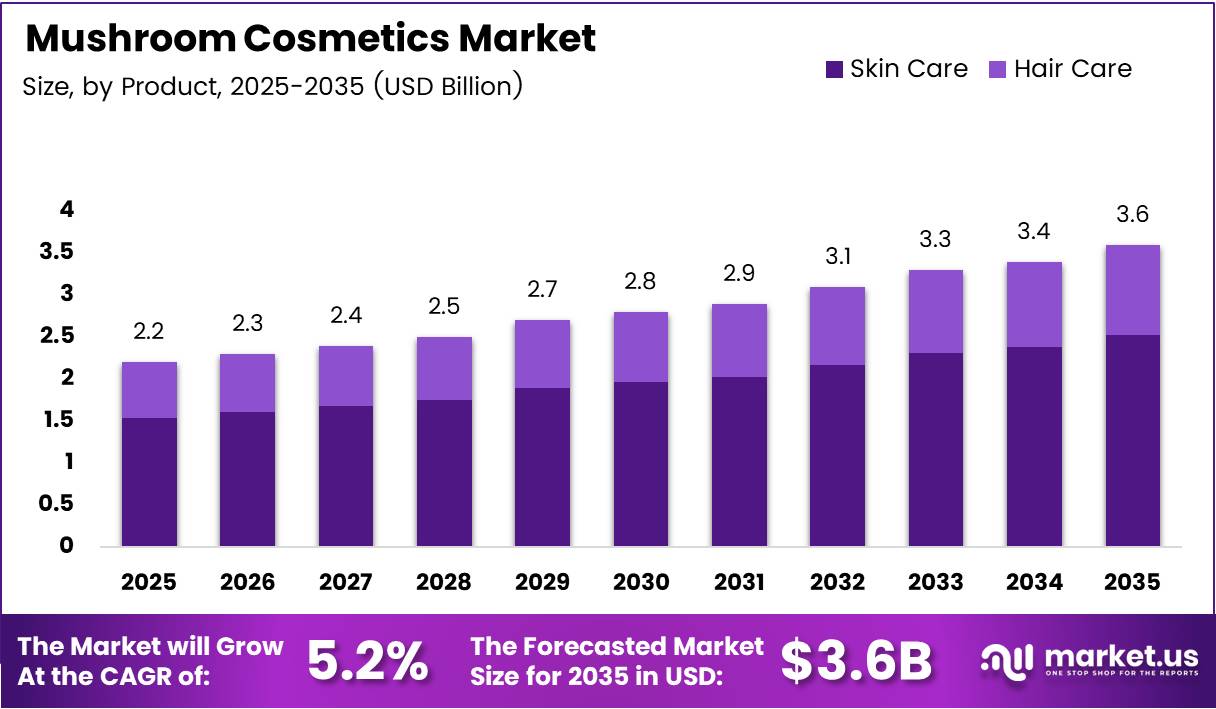
Global Mushroom Cosmetics Market size is expected to be worth around USD 3.6 Billion by 2035 from USD 2.2 Billion in 2025, growing at a CAGR of 5.2% during the forecast period 2026 to 2035.
Mushroom cosmetics integrate bioactive compounds from fungi — including reishi, chaga, shiitake, and tremella — into skincare and hair care formulations. These extracts deliver antioxidant, anti-aging, and hydration benefits that synthetic alternatives struggle to replicate. This biological advantage positions mushroom-based beauty products as a distinct, science-backed category within the premium cosmetics space.
Consumers today read ingredient labels and reject synthetic actives at a measurably higher rate than a decade ago. Functional mushrooms answer that shift directly — they are plant-derived, clinically studied, and culturally familiar. This alignment with clean beauty values is not a coincidence; it is the structural reason this market holds pricing power above mass-market alternatives.
The 5.2% CAGR signals that demand is not speculative — buyers are already repurchasing mushroom-based products at rates that support consistent revenue expansion. For brands, this means the category rewards early formulation investment. For investors, it signals a window before mid-market consolidation narrows entry points.
Skin care commands the largest share of this market, with face serums and moisturizers leading adoption. Organic mushroom sourcing drives premiumization, as brands use certified ingredient origin to justify price positioning above conventional cosmetics. This pattern mirrors the trajectory of organic botanicals before they became mainstream personal care staples.
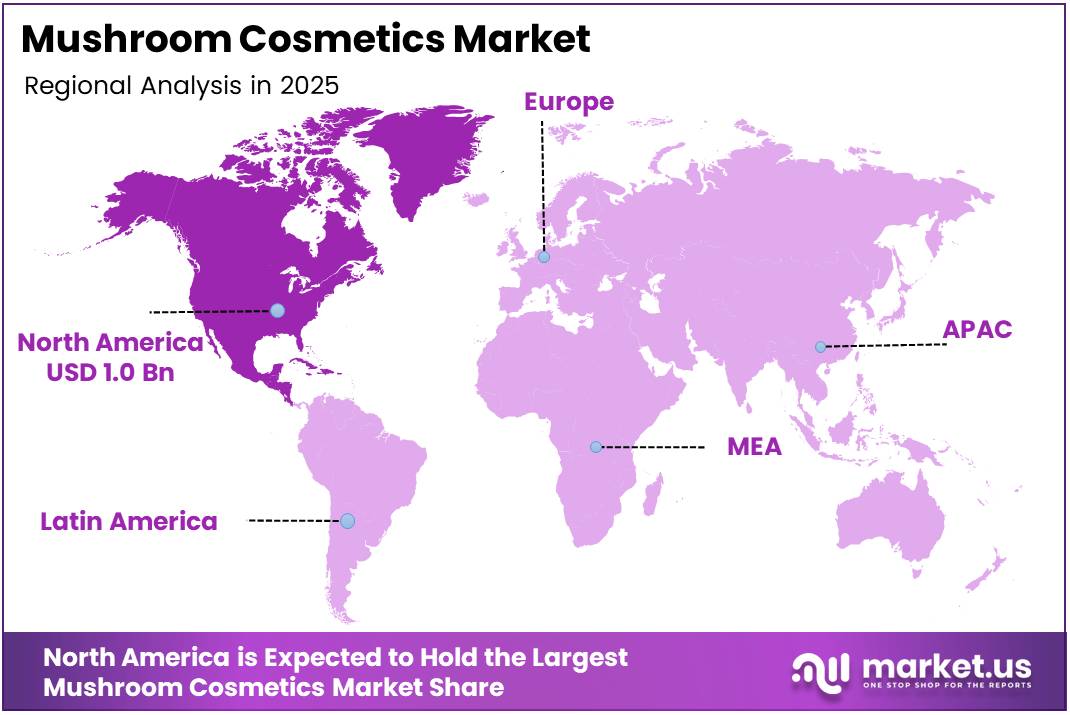
North America leads with 45.70% of global market share, valued at approximately USD 1.0 Billion. This concentration reflects established clean beauty retail infrastructure, high consumer willingness to pay for functional ingredients, and active brand innovation pipelines across both indie and prestige segments.
Research validation is accelerating commercial confidence in this category. According to a study published in PMC (February 2026), shiitake mushroom extract demonstrated an antioxidant capacity of 107 μM Trolox equivalent — a figure that places it among high-performing botanical actives. This positions shiitake extract as credible competition to established antioxidant ingredients like vitamin C.
The same study reported that shiitake extract inhibited elastase activity by 51.99%, according to PMC research. Elastase degrades skin elasticity — so this inhibition level directly translates to measurable anti-aging performance. Clinical evidence at this specificity gives formulators a defensible efficacy claim, which is increasingly required for premium placement at retail.
Key Takeaways
- The Global Mushroom Cosmetics Market was valued at USD 2.2 Billion in 2025 and is forecast to reach USD 3.6 Billion by 2035.
- The market grows at a CAGR of 5.2% during the forecast period 2026 to 2035.
- By Product, Skin Care dominates with a 69.4% share in 2025.
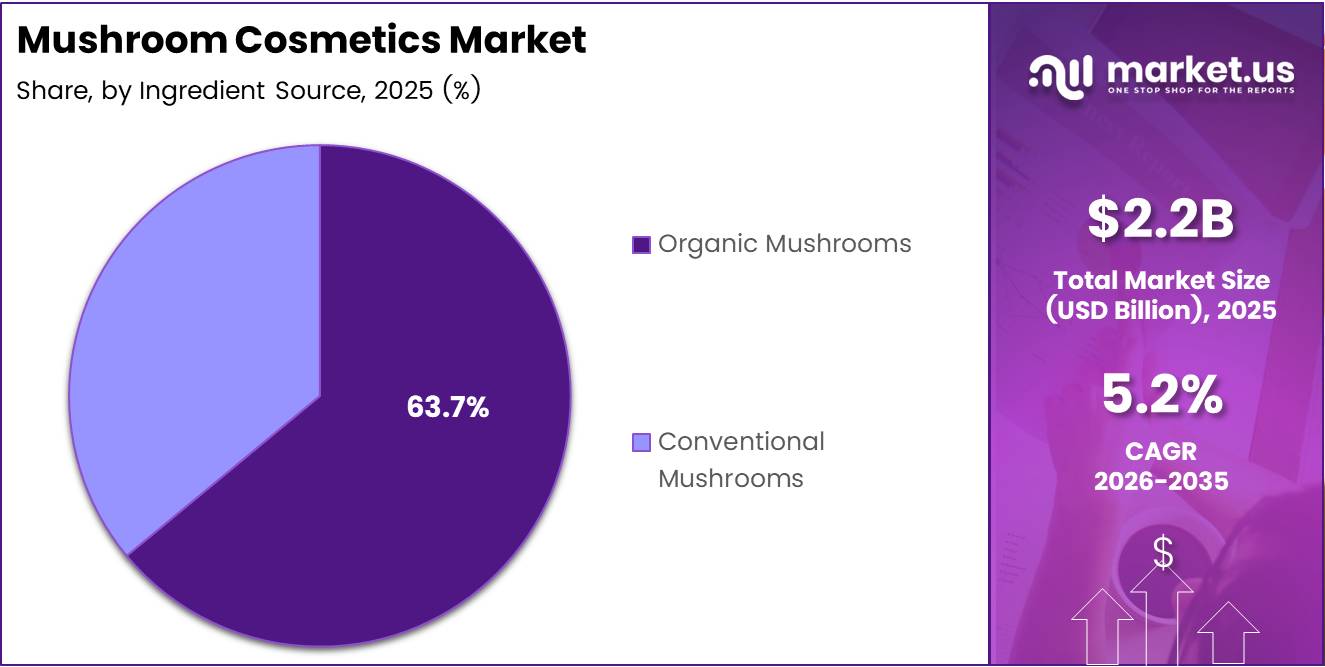
- By Ingredient Source, Organic Mushrooms lead with a 63.7% share.
- By Product Formulation, Creams and Lotions hold the largest share at 43.9%.
- By Packaging Type, Plastic Packaging leads with 45.1% share.
- By End-User, Women represent the largest segment at 51.6%.
- By Distribution Channel, Hypermarkets and Supermarkets lead with 34.2% share.
- North America dominates regional markets with a 45.70% share, valued at USD 1.0 Billion.
Product Analysis
Skin Care dominates with 69.4% due to broad consumer demand for functional botanical actives.
In 2025, Skin Care held a dominant market position in the By Product segment of the Mushroom Cosmetics Market, with a 69.4% share. Mushroom-derived actives address multiple skin concerns — hydration, anti-aging, and brightening — within a single ingredient profile, giving formulators a compelling efficiency advantage over single-function synthetics.
Hair Care serves as the fastest-developing adjacent segment in mushroom cosmetics, with scalp health and hair loss driving new formulation interest. Clinical studies on Polyporus umbellatus extract reported a 9.6% reduction in hairless areas, according to CosmeticsDesign (April 2025). Additionally, in April 2025, Presperse launched Inawave Polyporus, a patented extract targeting stress-related hair loss — confirming commercial momentum in this sub-segment.
Face Serums carry the highest margin within the skin care sub-category. Consumers accept premium pricing for serums when ingredient efficacy is clinically supported, and mushroom extracts — particularly reishi and tremella — deliver documented hydration and antioxidant performance that supports that premium positioning.
Face Creams and Moisturizers represent the highest-volume entry point for mushroom actives in retail. Their broad demographic appeal — spanning anti-aging, barrier repair, and daily hydration — makes them the default vehicle for first-time mushroom cosmetic buyers. Consequently, this sub-segment anchors brand trial and drives repeat purchase cycles.
Cleansers differentiate through their ability to pair functional mushroom extracts with gentle surfactant systems, targeting sensitive skin consumers who cannot tolerate conventional cleansers. This positions mushroom-based cleansers in a defensible niche where ingredient story and skin tolerance combine as purchase drivers.
Body Lotions expand mushroom cosmetics beyond the face, opening a larger addressable volume in the skin care category. However, lower price per unit and higher formulation cost compress margins — meaning this sub-segment grows with scale rather than premiumization, and therefore attracts more established brands than indie entrants.
Shampoo leads the hair care sub-category by volume, giving mushroom extract suppliers their highest-reach delivery vehicle in hair care. The mass-market nature of shampoo compresses per-unit pricing, but the large consumer base makes it strategically valuable for broad ingredient adoption and consumer education.
Hair Conditioner and Masks command stronger price premiums than shampoos because consumers associate treatment products with higher efficacy. Mushroom-based conditioning formulas benefit from this perception, particularly for claims around hair strengthening and scalp nourishment, where functional fungi have the strongest clinical backing.
Hair Serum and Gels serve the targeted treatment end of the hair care spectrum, attracting consumers specifically seeking solutions to hair density loss or scalp inflammation. This specificity enables premium positioning and supports the kind of clinical claim investment that differentiates mushroom cosmetics from standard plant-based alternatives.
Ingredient Source Analysis
Organic Mushrooms dominate with 63.7% due to clean beauty certification demand.
In 2025, Organic Mushrooms held a dominant market position in the By Ingredient Source segment of the Mushroom Cosmetics Market, with a 63.7% share. Clean beauty consumers treat organic certification as a proxy for safety and purity, enabling brands to charge a meaningful price premium over conventional mushroom-sourced competitors.
Conventional Mushrooms serve cost-sensitive formulations and mass-market products where certified organic sourcing is economically impractical. However, this segment faces structural pressure as clean beauty standards tighten and mid-market brands trade up their ingredient sourcing to protect shelf positioning.
Product Formulation Analysis
Creams and Lotions dominate with 43.9% due to versatile application and broad consumer familiarity.
In 2025, Creams and Lotions held a dominant market position in the By Product Formulation segment of the Mushroom Cosmetics Market, with a 43.9% share. Their established place in daily skincare routines lowers the adoption barrier for consumers new to mushroom cosmetics, making them the natural first vehicle for mass-market ingredient introduction.
Serums deliver a higher concentration of mushroom actives per application, enabling stronger efficacy claims and commanding premium retail placement. As consumers become more ingredient-literate, the serum format is the fastest path to clinical-grade positioning within mushroom cosmetics.
Masks occupy an intensive treatment role in mushroom cosmetics, with White Tremella Mushroom Extract attracting particular attention for hydration and skin recovery. In November 2025, the launch of rini — a K-beauty-inspired children’s skincare brand — featured hydrogel and sheet masks using Tremella extract, signaling that this format is expanding beyond adult premium skincare into new demographic segments.
Packaging Type Analysis
Plastic Packaging dominates with 45.1% due to cost efficiency and supply chain scalability.
In 2025, Plastic Packaging held a dominant market position in the By Packaging Type segment of the Mushroom Cosmetics Market, with a 45.1% share. Its dominance reflects practical economics — plastic remains the most cost-effective and widely available format across global cosmetics supply chains, even as sustainability pressure builds.
Glass Packaging commands stronger positioning in the premium mushroom cosmetics segment, where packaging aesthetics reinforce ingredient quality perception. Brands using glass signal formulation integrity and sustainability simultaneously, supporting higher shelf prices and alignment with clean beauty retail buyers.
Eco-friendly Packaging is the fastest-shifting segment in packaging type, driven by both consumer preference for sustainable materials and retailer sustainability mandates. Brands investing in eco-packaging now are building a competitive differentiator that will become a baseline requirement as major retail channels enforce stricter packaging sustainability criteria.
End-User Analysis
Women dominate with 51.6% due to established skincare routine investment behavior.
In 2025, Women held a dominant market position in the By End-User segment of the Mushroom Cosmetics Market, with a 51.6% share. Women spend disproportionately more on premium skincare actives and are more likely to research ingredient efficacy before purchase — behavior that directly favors mushroom cosmetics’ science-backed positioning.
Men represent the primary growth opportunity in end-user diversification. Male grooming has expanded beyond shaving into functional skincare, and mushroom actives — particularly those with anti-inflammatory and oil-control properties — align well with male skin concerns. Brands that simplify messaging and formulate for male skin texture stand to capture share ahead of category saturation.
Unisex formulations allow brands to bypass gender-specific marketing costs while targeting broader audience reach. As gender-neutral beauty becomes a mainstream retail category, mushroom cosmetics — with their functional rather than aesthetic positioning — are well suited to unisex branding strategies.
Distribution Channel Analysis
Hypermarkets and Supermarkets dominate with 34.2% due to physical product discovery and high footfall.
In 2025, Hypermarkets and Supermarkets held a dominant market position in the By Distribution Channel segment of the Mushroom Cosmetics Market, with a 34.2% share. Physical retail remains the primary discovery channel for cosmetics buyers, and shelf placement in mass-market stores signals commercial legitimacy for emerging ingredient categories like functional fungi.
Specialty Stores carry higher average transaction values for mushroom cosmetics because their customer base actively seeks premium natural beauty products. These retailers also provide staff who can explain ingredient benefits — a significant advantage for a category that still requires consumer education to drive trial conversion.
Online channels accelerate mushroom cosmetics adoption by enabling ingredient storytelling at scale through brand websites, social commerce, and ingredient education content. Direct-to-consumer online models give indie mushroom cosmetics brands margin recovery that physical retail cannot offer, supporting the product development investment the category requires.
Key Market Segments
By Product
- Skin Care
- Face Serums
- Face Creams & Moisturizers
- Cleansers
- Body Lotions
- Others
- Hair Care
- Shampoo
- Hair Conditioner & Masks
- Hair Serum & Gels
- Others
By Ingredient Source
- Organic Mushrooms
- Conventional Mushrooms
By Product Formulation
- Creams and Lotions
- Serums
- Masks
- Others
By Packaging Type
- Glass Packaging
- Plastic Packaging
- Eco-friendly Packaging
- Others
By End-User
- Women
- Men
- Unisex
- Others
By Distribution Channel
- Hypermarkets & Supermarkets
- Specialty Stores
- Online
- Others
Drivers
Clinical Evidence and Clean Beauty Demand Accelerate Mushroom Cosmetics Adoption
Consumer preference for natural, plant-based skincare is no longer a niche signal — it is reshaping formulation strategy across premium and mass-market brands alike. Functional mushrooms such as reishi, chaga, and shiitake deliver documented antioxidant and anti-aging benefits that give formulators defensible efficacy claims. This scientific grounding converts clean beauty interest into repeatable purchasing behavior.
According to CosmeticsDesign (April 2025), clinical studies on Polyporus umbellatus fungal extract showed a 6.3% increase in hair density among users. This is not a marginal cosmetic improvement — it is a clinically measurable outcome that justifies premium pricing and creates a credible basis for therapeutic-adjacent positioning in hair care, a high-value segment where efficacy claims command buyer loyalty.
The convergence of clean beauty values, botanical ingredient research, and consumer willingness to pay for functional actives creates a structural tailwind for mushroom cosmetics. In April 2024, Sun Chemical introduced SunPURO Natural Carotenes — fermented mushroom-derived colorants approved globally for cosmetics. This launch confirms that ingredient suppliers are now committing R&D resources to mushroom-based innovations, which signals long-term commercial viability across multiple product categories.
Restraints
High Extraction Costs and Ingredient Awareness Gap Limit Mainstream Penetration
Extracting bioactive compounds from medicinal mushrooms — particularly adaptogenic species like reishi and chaga — requires specialized processes that are significantly more expensive than conventional botanical extraction. This cost burden flows directly to finished goods pricing, which restricts mushroom cosmetics to premium retail tiers and excludes the mass-market consumer base that would otherwise accelerate volume growth.
According to PMC research (February 2026), cytotoxicity assays confirmed that shiitake extract maintained >90% HaCaT keratinocyte viability across tested concentrations — confirming safety at a rigorous scientific standard. However, this level of validation requires costly laboratory infrastructure that most smaller indie brands cannot replicate, creating a credibility gap between well-funded formulators and emerging entrants who cannot afford clinical substantiation.
Limited consumer familiarity with specific mushroom species — beyond reishi and shiitake — creates a secondary restraint. Buyers who do not recognize an ingredient cannot assign value to it. Consequently, the market’s conversion rate from interest to purchase is constrained by education gaps that brands must fund through marketing investment, compressing margins at a stage when product development costs are already high.
Growth Factors
Adaptogenic Mushroom Research and Premium Brand Expansion Create New Revenue Pathways
Advanced formulation science is unlocking the full commercial potential of adaptogenic mushrooms. Reishi and tremella extracts now feature in targeted anti-aging and hydration formulas that carry significantly higher margins than conventional skincare products. Brands investing in these ingredient platforms today are building IP-protected formulation advantages that will be difficult for followers to replicate quickly.
Biotechnology is further extending this advantage. According to CosmeticsDesign (April 2025), the patented eco-extraction process for Polyporus fungal extract produces up to 18 times less CO₂ than traditional extraction methods, while reducing processing time from 4.5 hours to just 30 minutes. This is not only an environmental gain — it is a cost structure improvement that makes premium mushroom ingredients economically viable at higher production volumes.
The expansion of mushroom-based cosmetics into dermatological and therapeutic skincare opens an entirely new buyer category: consumers who purchase on clinical outcomes rather than lifestyle identity. Functional fungi’s documented performance in elastase inhibition and skin barrier repair positions this market at the intersection of beauty and clinical wellness — a convergence that commands higher average selling prices and builds brand authority beyond conventional cosmetics.
Emerging Trends
Fermented Extracts, Vegan Formulations, and Biotech Innovation Redefine Mushroom Cosmetics
Fermented mushroom extracts are gaining formulation traction because fermentation enhances bioavailability — meaning the skin absorbs active compounds more effectively than from raw extracts. This process improvement directly translates to stronger clinical claim potential, which is the key differentiator separating premium mushroom cosmetics from commodity botanical alternatives.
According to CosmeticsDesign (April 2025), clinical studies on Polyporus umbellatus extract showed a 20% decrease in hair fall among users. This outcome — measured through a rigorous clinical protocol — signals a shift in how hair care brands will position mushroom actives. Hair fall reduction is one of the most searched consumer concerns globally; clinical proof at this level repositions mushroom extracts from an ingredient curiosity to a functional treatment solution.
Vegan and organic mushroom cosmetic lines are expanding beyond indie brands into mid-market and prestige segments. This migration matters because it shifts mushroom cosmetics from a niche identity purchase to a mainstream performance purchase. Simultaneously, biotechnology platforms are accelerating ingredient innovation cycles — producing new mushroom-derived actives at lower environmental cost, which satisfies both sustainability mandates and margin requirements for scaling brands.
Regional Analysis
North America Dominates the Mushroom Cosmetics Market with a Market Share of 45.70%, Valued at USD 1.0 Billion
North America holds 45.70% of the global mushroom cosmetics market, valued at USD 1.0 Billion in 2025. Mature clean beauty retail infrastructure, high per-capita spending on premium skincare, and an active base of indie and prestige brands driving ingredient innovation collectively sustain this leadership position. The region’s early adoption of functional beauty creates a platform that other geographies are only beginning to replicate.
Europe Mushroom Cosmetics Market Trends
Europe’s natural cosmetics regulatory framework and strong consumer preference for certified organic formulations make it the second most commercially significant region for mushroom cosmetics. Germany, France, and the UK drive demand through premium personal care retail, where ingredient transparency is a baseline purchase criterion. European formulators are also advancing biotechnology-based mushroom ingredient development, positioning the region as a source of manufacturing innovation.
Asia Pacific Mushroom Cosmetics Market Trends
Asia Pacific presents the strongest long-term volume opportunity in mushroom cosmetics. Mushrooms carry deep cultural and medicinal heritage across Chinese, Japanese, and Korean markets — giving functional fungi immediate consumer credibility that Western markets spent years building. K-beauty’s global influence further accelerates premium mushroom formulation adoption, particularly in sheet masks and serum formats that Asian beauty consumers already purchase habitually.
Latin America Mushroom Cosmetics Market Trends
Latin America is an emerging destination for mushroom cosmetics, with Brazil and Mexico leading natural beauty adoption. Rising disposable income, a growing middle class with documented interest in premium personal care, and expanding e-commerce infrastructure are collectively opening this market to ingredient-forward cosmetic brands. However, price sensitivity remains a structural barrier to premium mushroom cosmetics achieving mass penetration at this stage.
Middle East and Africa Mushroom Cosmetics Market Trends
The Middle East and Africa region shows selective but meaningful opportunity in mushroom cosmetics, concentrated in GCC markets where luxury beauty spending per capita is globally competitive. Premium skincare brands introducing mushroom-based anti-aging and brightening products find receptive buyers in this segment. South Africa’s developing clean beauty retail sector provides a secondary growth avenue as awareness of functional botanical ingredients expands.
Key Regions and Countries
North America
- US
- Canada
Europe
- Germany
- France
- The UK
- Spain
- Italy
- Rest of Europe
Asia Pacific
- China
- Japan
- South Korea
- India
- Australia
- Rest of APAC
Latin America
- Brazil
- Mexico
- Rest of Latin America
Middle East & Africa
- GCC
- South Africa
- Rest of MEA
Key Company Insights
Origins Natural Resources, Inc. built its market position on a botanical ingredient philosophy that predates the current functional beauty movement. Its early investment in mushroom-based actives — particularly the Hero Mushroom collection — gives it established retail shelf presence and consumer recognition that newer entrants must spend heavily to replicate. This heritage positioning is a durable competitive moat in premium clean beauty.
Shroom Skincare targets the direct-to-consumer mushroom cosmetics segment with a single-focus ingredient brand architecture. Specialization allows the brand to own the functional mushroom narrative more completely than multi-ingredient competitors, which matters in a category where consumer trust hinges on ingredient expertise. However, a narrow portfolio also limits cross-sell opportunity and increases customer acquisition cost dependency.
Neon Hippie differentiates through aesthetic positioning — combining mushroom actives with bold branding that targets younger, values-driven beauty consumers. This strategy recognizes that functional ingredients alone do not drive purchase decisions; brand identity and visual presentation also shape shelf appeal and social media discoverability. The approach opens mushroom cosmetics to a demographic that prioritizes experience alongside efficacy.
Herbivore Botanicals operates at the intersection of premium botanical skincare and ingredient transparency, positioning its mushroom-active formulas as clean, minimalist, and clinically considered. Its established distribution in prestige retail channels — including Sephora — provides the brand with scale and consumer reach that validates mushroom cosmetics at a category level, encouraging adjacent brand development and retailer category expansion.
Key Players
- Origins Natural Resources, Inc.
- Shroom Skincare
- Neon Hippie
- Herbivore Botanicals
- MÁDARA Cosmetics
- Groh Beauty Corp
- Shikohin
- Shiseido Co., Ltd.
- Gnome Wellness
Recent Developments
- November 2025 — Shay Mitchell, Esther Song, and Matte Babel launched rini, a K-beauty-inspired children’s skincare brand featuring hydrogel masks and sheet masks with White Tremella Mushroom Extract. The brand targets hydration and skin recovery for children, extending functional mushroom cosmetics into an entirely new and previously underserved demographic.
Report Scope
Report Features Description Market Value (2025) USD 2.2 Billion Forecast Revenue (2035) USD 3.6 Billion CAGR (2026-2035) 5.2% Base Year for Estimation 2025 Historic Period 2020-2024 Forecast Period 2026-2035 Report Coverage Revenue Forecast, Market Dynamics, Competitive Landscape, Recent Developments Segments Covered By Product (Skin Care: Face Serums, Face Creams & Moisturizers, Cleansers, Body Lotions, Others; Hair Care: Shampoo, Hair Conditioner & Masks, Hair Serum & Gels, Others), By Ingredient Source (Organic Mushrooms, Conventional Mushrooms), By Product Formulation (Creams and Lotions, Serums, Masks, Others), By Packaging Type (Glass Packaging, Plastic Packaging, Eco-friendly Packaging, Others), By End-User (Women, Men, Unisex, Others), By Distribution Channel (Hypermarkets & Supermarkets, Specialty Stores, Online, Others) Regional Analysis North America (US and Canada), Europe (Germany, France, The UK, Spain, Italy, and Rest of Europe), Asia Pacific (China, Japan, South Korea, India, Australia, and Rest of APAC), Latin America (Brazil, Mexico, and Rest of Latin America), Middle East & Africa (GCC, South Africa, and Rest of MEA) Competitive Landscape Origins Natural Resources, Inc., Shroom Skincare, Neon Hippie, Herbivore Botanicals, MÁDARA Cosmetics, Groh Beauty Corp, Shikohin, Shiseido Co., Ltd., Gnome Wellness Customization Scope Customization for segments, region/country-level will be provided. Moreover, additional customization can be done based on the requirements. Purchase Options We have three licenses to opt for: Single User License, Multi-User License (Up to 5 Users), Corporate Use License (Unlimited User and Printable PDF) 
-
-
- Origins Natural Resources, Inc.
- Shroom Skincare
- Neon Hippie
- Herbivore Botanicals
- MÁDARA Cosmetics
- Groh Beauty Corp
- Shikohin
- Shiseido Co., Ltd.
- Gnome Wellness
Our Clients

- 183134
- Mar 2026






