


Global Murumuru Butter Cosmetics Market Size, Share, Growth Analysis By Product Type (Skincare, Haircare, Bath & Shower, Sun & After-Sun), By End-User (Women, Men, Unisex, Kids & Babies), By Distribution Channel (E-commerce, Specialty Beauty Stores, Supermarkets & Hypermarkets, Pharmacies & Drugstores, Salons & Spas), By Region and Companies - Industry Segment Outlook, Market Assessment, Competition Scenario, Statistics, Trends and Forecast 2026-2035
- Published date: Feb 2026
- Report ID: 179998
- Number of Pages: 276
- Format:
-
keyboard_arrow_up
Quick Navigation
Report Overview
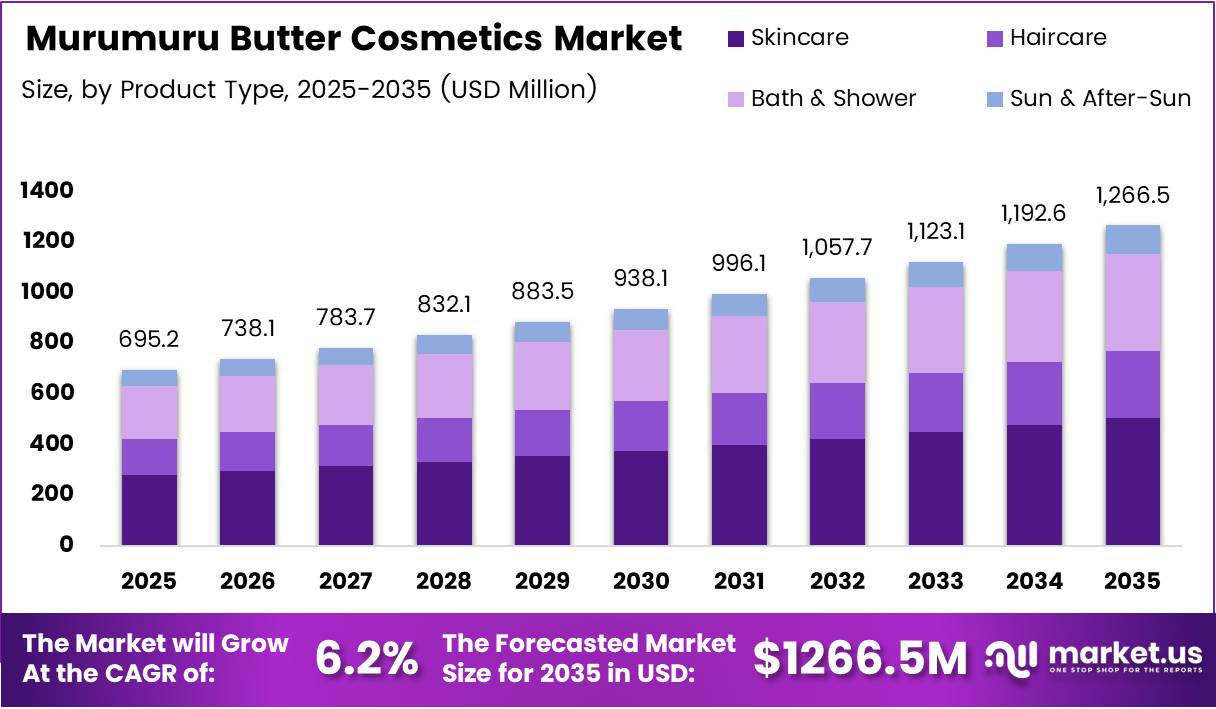
Global Murumuru Butter Cosmetics Market size is expected to be worth around USD 1,266.5 Million by 2035 from USD 695.2 Million in 2025, growing at a CAGR of 6.2% during the forecast period 2026 to 2035.
Murumuru butter, extracted from the seeds of the Amazonian palm Astrocaryum murumuru, has shifted from a niche exotic ingredient to a core formulation component in premium skincare and haircare. Its distinctive fatty acid profile enables deep moisturization and natural shine without synthetic silicones — a combination that resonates with today’s clean beauty buyer.
The market’s commercial foundation rests on its utility across multiple product categories. Formulators use murumuru butter in conditioners, lip balms, body creams, and sun-care products. This versatility reduces category risk for ingredient suppliers and expands the total addressable market beyond any single beauty segment.
Consumer behavior now favors ingredient transparency. Shoppers actively scan labels for plant-derived alternatives to petrochemicals and silicones. Murumuru butter satisfies this demand with a naturally low melting point and smooth skin feel — advantages that synthetic emollients struggle to replicate at equivalent cost positions.
Global cosmetic brands have accelerated their integration of Amazonian botanical ingredients into premium and mass-market lines alike. In December 2025, Brazil Edition launched as a dedicated haircare brand built around Amazonian ingredients including murumuru butter, paired with peptides in its Restorative Peptide Hair Mask — signaling that ingredient-forward brand positioning has moved from niche to mainstream.
Regulatory tailwinds in the European Union and North America, where sulfate and silicone restrictions are tightening formulation choices, push manufacturers toward compliant natural alternatives. Murumuru butter clears these regulatory hurdles while meeting performance benchmarks in conditioning and moisture retention.
According to pureoilsindia.com, murumuru butter contains 40% to 50% lauric acid — a fatty acid concentration that makes it structurally superior to many conventional emollients for penetrating the hair shaft. This composition explains why formulators prefer it over lower-lauric alternatives when targeting dry or chemically treated hair.
Additionally, according to pureoilsindia.com, replacing just 2% shea butter with 5% murumuru butter in a conditioner formula improved detangling performance by 40%. For haircare manufacturers competing on functional claims, this performance differential justifies the higher ingredient cost and supports premium price positioning.
Key Takeaways
- The Global Murumuru Butter Cosmetics Market was valued at USD 695.2 Million in 2025 and is forecast to reach USD 1,266.5 Million by 2035.
- The market advances at a CAGR of 6.2% during the forecast period 2026 to 2035.
- By Product Type, Skincare leads with a 37.9% share, reflecting premium formulation demand.
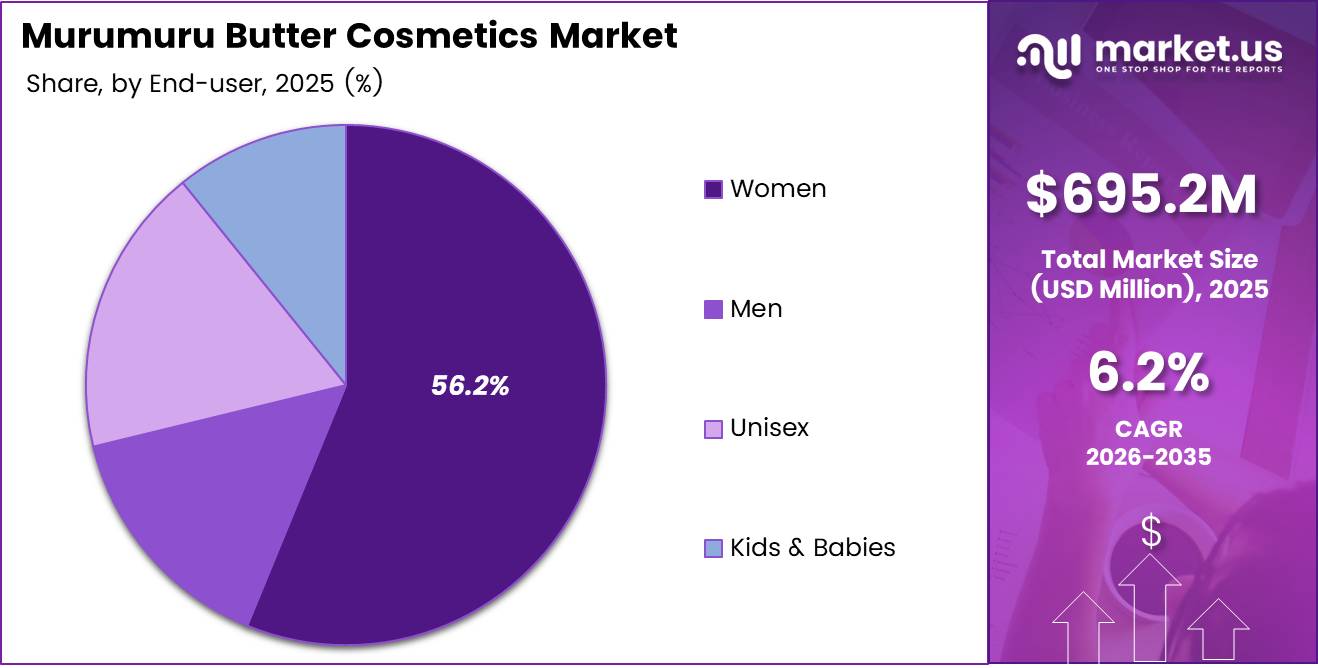
- By End-User, Women hold the dominant position at 56.2% share of the market.
- By Distribution Channel, E-commerce commands 41.6% share, the largest of any channel.
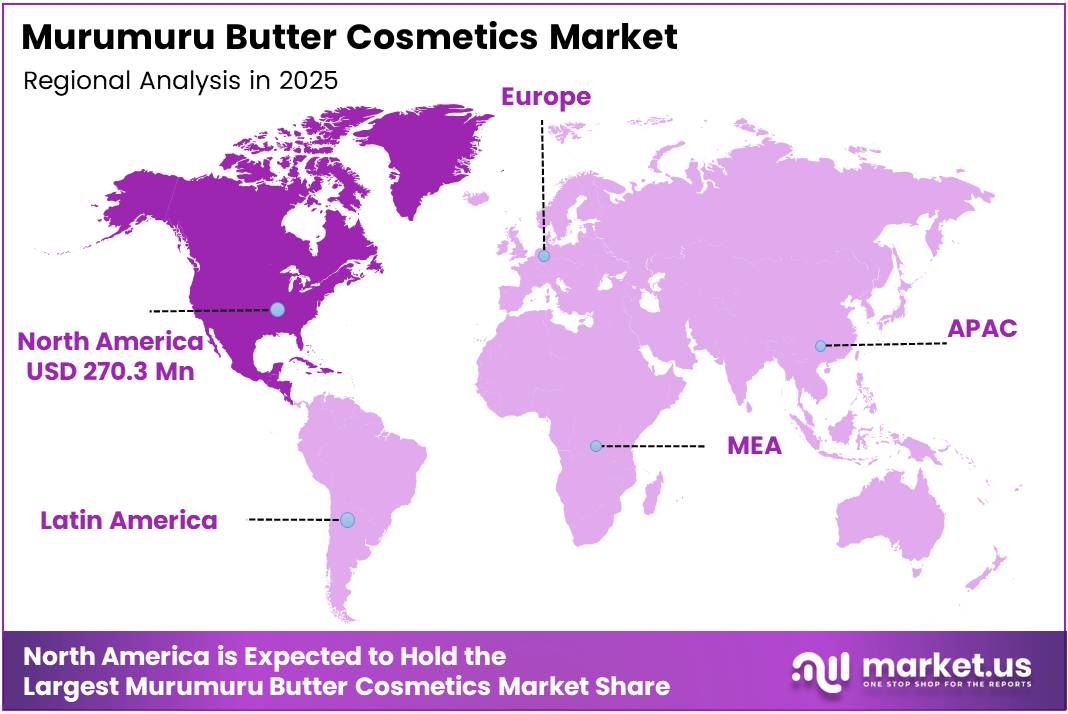
- North America dominates regionally with a 38.90% share, valued at USD 270.3 Million.
Product Type Analysis
Skincare dominates with 37.9% due to premium moisture barrier formulation demand.
In 2025, Skincare held a dominant market position in the By Product Type segment of the Murumuru Butter Cosmetics Market, with a 37.9% share. Formulators in face creams, serums, and body lotions rely on murumuru butter’s lauric acid concentration to deliver measurable barrier-repair performance — a claim increasingly required by dermatology-adjacent skincare brands competing in the premium tier.
Haircare carries the second-largest revenue contribution within the product type segment. Murumuru butter’s natural conditioning action and low melt point make it a drop-in alternative to silicones in conditioners and hair masks. Its demonstrated detangling performance validates its use in sulfate-free and silicone-free formulations that now define the functional clean haircare category.
Bath & Shower serves as the entry point for mass-market murumuru butter applications. Body washes, shower butters, and bath oils use the ingredient primarily for skin softening and fragrance retention. This segment expands the addressable consumer base beyond premium buyers, giving ingredient suppliers a volume channel alongside higher-margin skincare placements.
Sun & After-Sun differentiates through its functional overlap between UV exposure recovery and skin barrier restoration. Murumuru butter’s emollient properties support after-sun cooling formulations. Though this remains a smaller category, its seasonal demand concentration creates predictable procurement cycles — an operational advantage for manufacturers managing supply chain constraints around Amazonian raw materials.
End-User Analysis
Women dominate with 56.2% due to higher skincare and haircare product consumption.
In 2025, Women held a dominant market position in the By End-User segment of the Murumuru Butter Cosmetics Market, with a 56.2% share. Female consumers represent the primary buyer group across skincare, haircare, and body care — the three categories where murumuru butter delivers its strongest functional performance. This concentration signals that brand messaging focused on natural moisturization and clean formulations finds its highest commercial return among female demographics.
Men represent a structurally underpenetrated segment with measurable upside. Male grooming has expanded beyond basic hygiene into performance-oriented skincare and haircare. Murumuru butter’s non-greasy finish and functional conditioning properties align well with male consumer preferences for efficacy without perceived heaviness — attributes that formulators are beginning to highlight in gender-targeted product lines.
Unisex products position murumuru butter as an inclusive ingredient suitable across demographic boundaries. This positioning reduces marketing costs for brands while broadening distribution reach. Unisex formulations in body care and hair masks allow brands to capture volume across gender segments without maintaining parallel product lines.
Kids & Babies constitute a smaller but high-trust segment where ingredient safety requirements are non-negotiable. Murumuru butter’s natural origin and gentle fatty acid profile make it a credible inclusion in sensitive-skin baby lotions and toddler hair care. Regulatory scrutiny in this category is high, which creates a barrier to entry that protects brands with established compliance credentials.
Distribution Channel Analysis
E-commerce dominates with 41.6% due to direct-to-consumer brand reach and ingredient transparency.
In 2025, E-commerce held a dominant market position in the By Distribution Channel segment of the Murumuru Butter Cosmetics Market, with a 41.6% share. Online platforms allow indie and emerging clean beauty brands to reach ingredient-educated consumers without the shelf placement costs of traditional retail. This dynamic accelerates murumuru butter’s commercial exposure, as DTC brands disproportionately lead the clean formulation movement that drives demand for exotic botanical ingredients.
Specialty Beauty Stores serve as the critical credibility channel for premium murumuru butter products. Curated retail environments allow sales associates to communicate ingredient benefits — a conversion advantage that digital-only brands cannot fully replicate. Placement in specialty beauty retail signals formulation quality to consumers who use channel choice as a proxy for product positioning.
Supermarkets & Hypermarkets deliver volume scale that no other channel matches. Mainstream retail placement confirms that murumuru butter has crossed from specialty ingredient to broadly accepted formulation component. For large cosmetic manufacturers, this channel validates mass-market commercialization and reduces unit economics for sustainable sourcing programs.
Pharmacies & Drugstores anchor the dermatology-adjacent positioning of murumuru butter products. Placement in pharmacy channels signals clinical credibility to health-conscious consumers who treat personal care as a wellness category. This channel is particularly strategic for therapeutic skincare brands targeting dry skin, eczema, or post-procedure recovery formulations.
Salons & Spas function as a professional endorsement channel. When salons incorporate murumuru butter treatments into service menus, they validate the ingredient’s performance credentials to consumers who later seek retail equivalents. This channel generates downstream demand in e-commerce and specialty retail, making its commercial influence larger than its direct revenue share suggests.
Key Market Segments
By Product Type
- Skincare
- Haircare
- Bath & Shower
- Sun & After-Sun
By End-User
- Women
- Men
- Unisex
- Kids & Babies
By Distribution Channel
- E-commerce
- Specialty Beauty Stores
- Supermarkets & Hypermarkets
- Pharmacies & Drugstores
- Salons & Spas
Drivers
Consumer Preference for Clean, Plant-Based Ingredients Pushes Murumuru Butter Into Mainstream Cosmetic Formulations
Consumers now scrutinize ingredient labels as a routine purchase behavior. This shift directly benefits murumuru butter, which delivers deep moisturizing and barrier-repair performance without synthetic additives. Formulators targeting the premium skincare and haircare tier increasingly position plant-derived butters as functional replacements for petrochemical-based emollients.
The clean beauty movement is not a fringe preference — it has restructured purchasing decisions across mass and premium channels. Global cosmetic brands have committed to removing silicones and sulfates from product lines, creating a formulation gap that Amazonian botanical butters fill with credibility. Murumuru butter’s documented performance profile gives formulators a technically defensible alternative.
In May 2025, ChemQuest International announced a distribution partnership with Bielus Ingredients to expand U.S. access to sustainably sourced Amazonian butters including murumuru butter. According to pureoilsindia.com, murumuru butter has a melting point of 33°C to 36°C — a range that enables smooth skin application without heating, making it a practical formulation choice that supports clean-label claims alongside functional performance.
Restraints
Supply Chain Dependence on Amazon Rainforest Harvesting Limits Scalable Production of Murumuru Butter
Murumuru butter originates exclusively from the Astrocaryum murumuru palm, native to the Amazon basin. Geographic concentration in a single biome creates a structural supply risk that no logistics optimization fully resolves. Disruptions from deforestation, seasonal variability, or community harvesting capacity constraints translate directly into raw material shortfalls for cosmetic manufacturers.
Higher production and processing costs compound the supply constraint. Murumuru butter requires specialized extraction and refining relative to widely available conventional emollients such as palm stearin or synthetic cetyl alcohol. This cost differential limits adoption among mid-tier cosmetic manufacturers competing on price and restricts volume scaling for mass-market applications.
For brands that have built marketing claims around sustainably sourced Amazonian ingredients, supply disruption carries reputational as well as operational consequences. Reformulation with alternative butters risks undermining clean beauty positioning, while absorbing cost increases to maintain supply integrity pressures margins — a difficult trade-off that restrains aggressive capacity expansion across the supply chain.
Growth Factors
Organic Beauty Expansion and Dermatology-Focused Skincare Create New Commercial Entry Points for Murumuru Butter
The organic and vegan beauty product segments have moved from lifestyle niches to mainstream retail categories. Murumuru butter’s plant-derived origin and clean fatty acid profile make it a natural fit for certified organic formulations. Brands seeking COSMOS or USDA Organic certification require plant-based alternatives to synthetic emollients — a compliance need that directly expands the ingredient’s addressable market.
Dermatology-focused skincare brands are incorporating murumuru butter for its barrier-repair properties in therapeutic applications. Products targeting eczema, dry skin, and post-procedure recovery represent a high-margin segment where ingredient performance claims must withstand clinical scrutiny. In November 2025, Shay and Company added murumuru butter as a standalone offering, specifically citing its utility in lotions, balms, and lip care — product categories with strong overlap in therapeutic positioning.
According to madarcorporation.com, refined murumuru butter carries an acid value specification of ≤ 30.0 mg KOH/g, confirming its stability for premium formulation use. Premium lip care, body butter, and anti-aging formulations represent emerging revenue pools where this stability profile supports long shelf-life claims — a commercial requirement for retail-facing products that commands a higher price position.
Emerging Trends
Amazonian Botanical Ingredients Gain Traction in Indie and Luxury Brands Through Social Media-Driven Natural Beauty Narratives
Social media has accelerated consumer awareness of exotic natural ingredients at a pace that traditional beauty marketing cannot match. Amazonian botanicals carry a dual appeal — geographic authenticity and environmental narrative — that resonates with both indie brand communities and luxury beauty buyers seeking ingredient differentiation. Murumuru butter benefits directly from this content-driven discovery dynamic.
Multi-functional hybrid products that address skin and hair in a single formulation represent a structural format shift in beauty. Formulators use murumuru butter’s versatility to create crossover products that reduce consumer routine complexity. This trend aligns with convenience-oriented purchasing behavior and expands the ingredient’s presence across adjacent categories simultaneously.
According to madarcorporation.com, refined murumuru butter has a saponification value of 150.0 to 270.0 mg KOH/g — a range that supports both rinse-off and leave-on formulations. This technical flexibility enables product innovation across formats, allowing early-mover brands to differentiate through proprietary formulation while the broader market catches up to Amazonian ingredient adoption.
Regional Analysis
North America Dominates the Murumuru Butter Cosmetics Market with a Market Share of 38.90%, Valued at USD 270.3 Million
North America commands 38.90% of the global market, valued at USD 270.3 Million. The region’s dominance reflects early adoption of clean beauty regulatory standards, a mature DTC e-commerce infrastructure, and a consumer base conditioned to pay premiums for botanically derived personal care. These structural advantages give North American brands first-mover positioning in murumuru butter formulations that other regions are only beginning to replicate.
Europe Murumuru Butter Cosmetics Market Trends
Europe holds the second-largest regional position, supported by strict EU cosmetic regulations that restrict synthetic ingredients and push formulators toward compliant natural alternatives. Countries including Germany, France, and the UK have well-developed clean beauty retail ecosystems. EU sustainability disclosure requirements further incentivize brands to source traceable, ethically harvested botanical ingredients like murumuru butter.
Asia Pacific Murumuru Butter Cosmetics Market Trends
Asia Pacific represents the highest-velocity expansion opportunity for murumuru butter suppliers. China, Japan, South Korea, and India each host large beauty markets where natural and K-beauty-influenced formulations are reshaping consumer expectations. The region’s growing middle class and rising premium personal care spending create the commercial conditions for Amazonian ingredient penetration to accelerate.
Latin America Murumuru Butter Cosmetics Market Trends
Latin America holds a strategically distinct position as both a supply origin and consumption market for murumuru butter. Brazil’s proximity to Amazonian sourcing communities reduces logistics costs and enables traceability claims. Regional brand development centered on native botanical heritage is strengthening domestic demand alongside export-oriented ingredient processing for global cosmetic manufacturers.
Middle East and Africa Murumuru Butter Cosmetics Market Trends
The Middle East and Africa remain an emerging consumption region for murumuru butter cosmetics. Gulf Cooperation Council markets show appetite for premium imported beauty products, and South Africa’s developed retail infrastructure provides a distribution gateway for the broader continent. Rising disposable incomes and a growing awareness of ingredient quality create the preconditions for measurable market entry by global clean beauty brands.
Key Regions and Countries
North America
- US
- Canada
Europe
- Germany
- France
- The UK
- Spain
- Italy
- Rest of Europe
Asia Pacific
- China
- Japan
- South Korea
- India
- Australia
- Rest of APAC
Latin America
- Brazil
- Mexico
- Rest of Latin America
Middle East & Africa
- GCC
- South Africa
- Rest of MEA
Key Company Insights
Natura &Co. operates with a vertically integrated Amazonian sourcing model that converts supply chain proximity into a competitive barrier. Its direct relationships with Brazilian harvesting communities provide traceability credentials that global rivals cannot easily replicate. In April 2024, Clariant completed its acquisition of Lucas Meyer Cosmetics for USD 810 million, deepening industry access to ethically sourced Amazonian ingredients — a move that validates Natura’s long-held positioning in this sourcing territory.
RG Cosmetics positions itself within the professional and specialty distribution channels, where ingredient storytelling carries more commercial weight than mass-market shelf placement. Its focus on formulation quality over volume scale allows it to target the premium salon and specialty retail segments — the channels where murumuru butter’s performance claims generate the highest return on formulation investment.
Earth Rhythm builds its brand equity through transparent sourcing narratives and clean-label certification. Its approach targets the growing consumer segment that treats ingredient origin as a trust signal. By anchoring product communication around Amazonian botanical heritage, Earth Rhythm competes on brand authenticity rather than price — a strategy that insulates margins in the face of conventional emollient cost competition.
EcoBerry differentiates through its focus on sustainable and eco-certified beauty formulations. Its positioning aligns with retail buyer requirements from specialty beauty chains that mandate environmental credentials as a listing condition. This regulatory alignment gives EcoBerry a structural advantage in accessing shelf space that competitors without certification frameworks cannot reach as efficiently.
Key Players
- Natura &Co.
- RG Cosmetics
- Earth Rhythm
- EcoBerry
- Physicians Formula
- Liberty Natural Products
Recent Developments
- April 2024 — Clariant completed the acquisition of Lucas Meyer Cosmetics for USD 810 million, strengthening its Care Chemicals division with enhanced access to ethically sourced Amazonian ingredients. The deal included murumuru butter within its expanded ingredient portfolio, reinforcing Clariant’s strategic positioning in the natural cosmetic actives space.
- May 2025 — ChemQuest International announced a distribution partnership with Bielus Ingredients to expand U.S. access to sustainable Amazonian butters including murumuru butter. The collaboration targets personal care formulators seeking ethically sourced, Brazilian-community-harvested ingredients for clean beauty product development.
- November 2025 — Shay and Company added murumuru butter to its ingredient lineup as a new single-ingredient offering, highlighting applications in lip care, hair conditioning, lotions, balms, and soaps. The launch reflects growing formulator interest in standalone exotic butter options for flexible product development.
- December 2025 — Brazil Edition launched as a new haircare brand built around Amazonian ingredients including murumuru butter combined with peptides. Its debut Restorative Peptide Hair Mask and Leave-In Treatment target damaged hair repair, signaling that ingredient-led brand positioning around Amazonian botanicals has achieved mainstream commercial viability.
Report Scope
Report Features Description Market Value (2025) USD 695.2 Million Forecast Revenue (2035) USD 1,266.5 Million CAGR (2026-2035) 6.2% Base Year for Estimation 2025 Historic Period 2020-2024 Forecast Period 2026-2035 Report Coverage Revenue Forecast, Market Dynamics, Competitive Landscape, Recent Developments Segments Covered By Product Type (Skincare, Haircare, Bath & Shower, Sun & After-Sun), By End-User (Women, Men, Unisex, Kids & Babies), By Distribution Channel (E-commerce, Specialty Beauty Stores, Supermarkets & Hypermarkets, Pharmacies & Drugstores, Salons & Spas) Regional Analysis North America (US and Canada), Europe (Germany, France, The UK, Spain, Italy, and Rest of Europe), Asia Pacific (China, Japan, South Korea, India, Australia, and Rest of APAC), Latin America (Brazil, Mexico, and Rest of Latin America), Middle East & Africa (GCC, South Africa, and Rest of MEA) Competitive Landscape Natura &Co., RG Cosmetics, Earth Rhythm, EcoBerry, Physicians Formula, Liberty Natural Products Customization Scope Customization for segments, region/country-level will be provided. Moreover, additional customization can be done based on the requirements. Purchase Options We have three licenses to opt for: Single User License, Multi-User License (Up to 5 Users), Corporate Use License (Unlimited User and Printable PDF)  Murumuru Butter Cosmetics MarketPublished date: Feb 2026add_shopping_cartBuy Now get_appDownload Sample
 -
-
- Natura &Co.
- RG Cosmetics
- Earth Rhythm
- EcoBerry
- Physicians Formula
- Liberty Natural Products
Our Clients

- 179998
- Feb 2026






