


Global Mosquito Repellent Market Size, Share, Growth Analysis By Product Type (Coil, Spray, Cream and Oil, Vaporizers, Others), By Bite Type (Lotion, Balm, Gel, Roll-on), By Ingredients Type (Synthetic Ingredients, Natural Ingredients), By Raw Material (Chemically Derived Repellents, Plant-based Repellents), By Distribution Channel (Supermarkets and Hypermarkets, Convenience Stores, Departmental Stores, Online, Others), By Region and Companies - Industry Segment Outlook, Market Assessment, Competition Scenario, Statistics, Trends and Forecast 2026-2035
- Published date: Feb 2026
- Report ID: 180120
- Number of Pages: 243
- Format:
-
keyboard_arrow_up
Quick Navigation
Report Overview
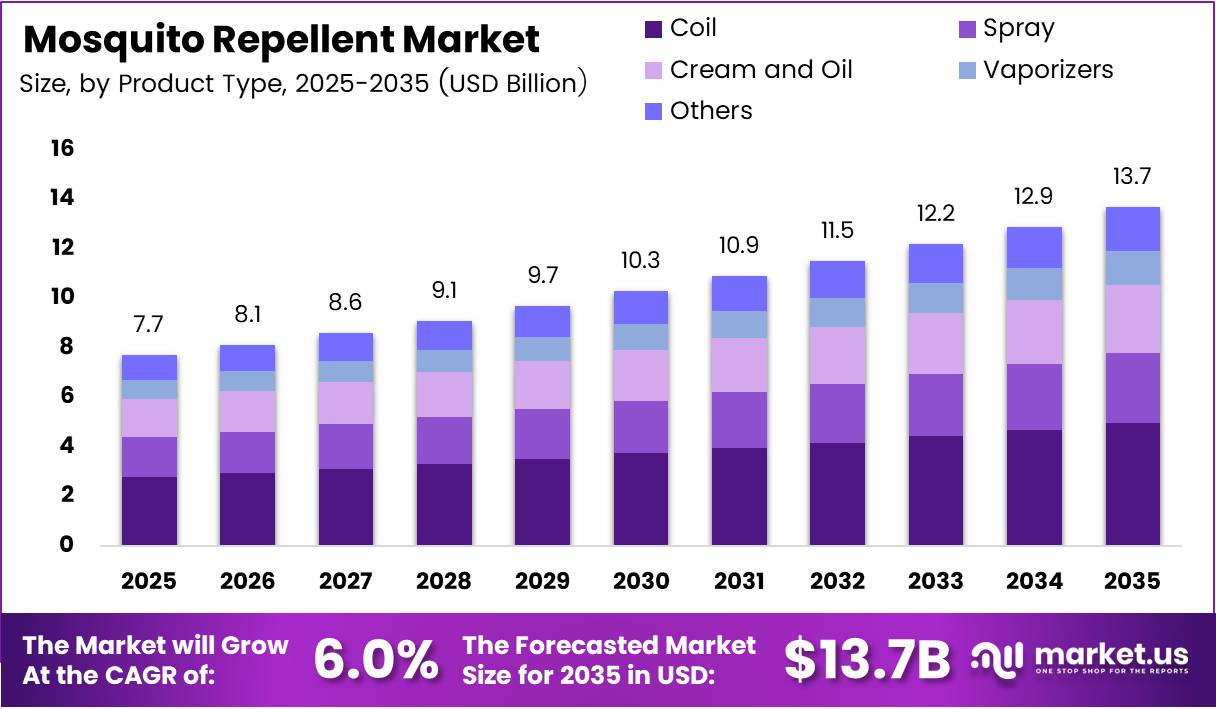
Global Mosquito Repellent Market size is expected to be worth around USD 13.7 Billion by 2035 from USD 7.7 Billion in 2025, growing at a CAGR of 6.0% during the forecast period 2026 to 2035.
The mosquito repellent market encompasses a broad portfolio of protection products — coils, sprays, creams, vaporizers, and wearable formats — designed to shield consumers from vector-borne diseases. Demand is sharpest in tropical and subtropical regions where dengue, malaria, and chikungunya are endemic, making repellents a daily household necessity rather than a discretionary purchase.
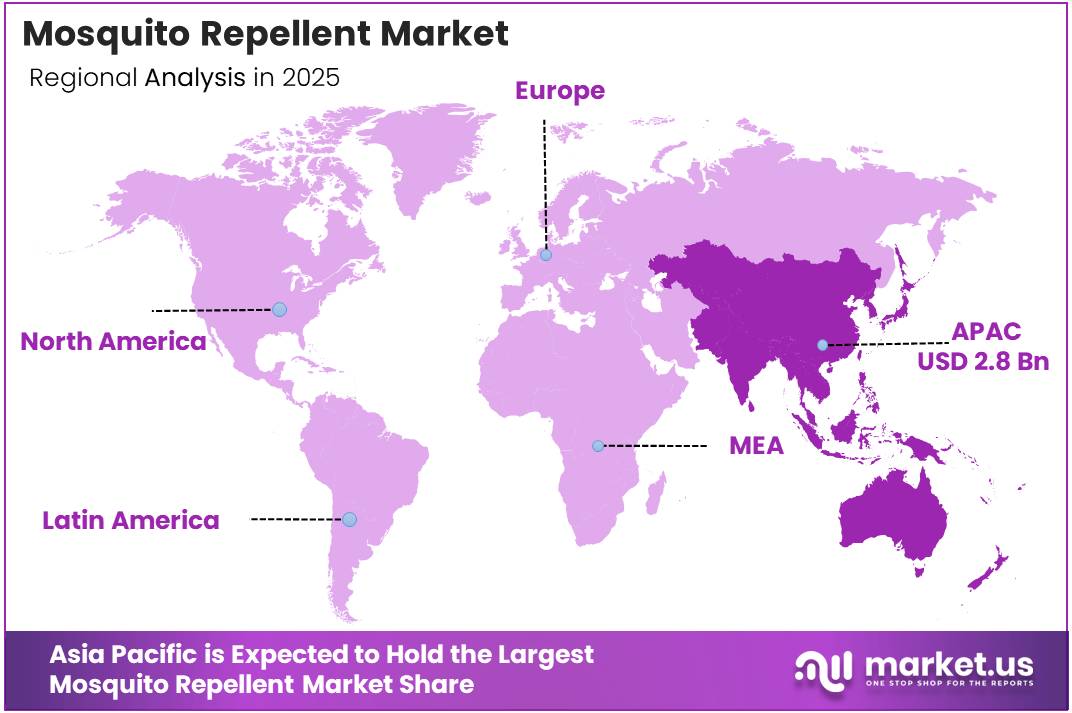
Asia Pacific anchors global consumption, holding 37.9% of the market and valued at USD 2.8 Billion. This concentration reflects the region’s dense population base, high disease burden, and the rapid expansion of modern retail and e-commerce channels that have lowered the barrier to repellent access in previously underserved markets.
Synthetic ingredients command 65.8% of the market by ingredient type, with DEET, Permethrin, and Picaridin as the dominant active compounds. These formulations offer proven efficacy and longer-lasting protection, which explains why mass-market and institutional buyers consistently favor them over plant-based alternatives despite growing consumer interest in natural products.
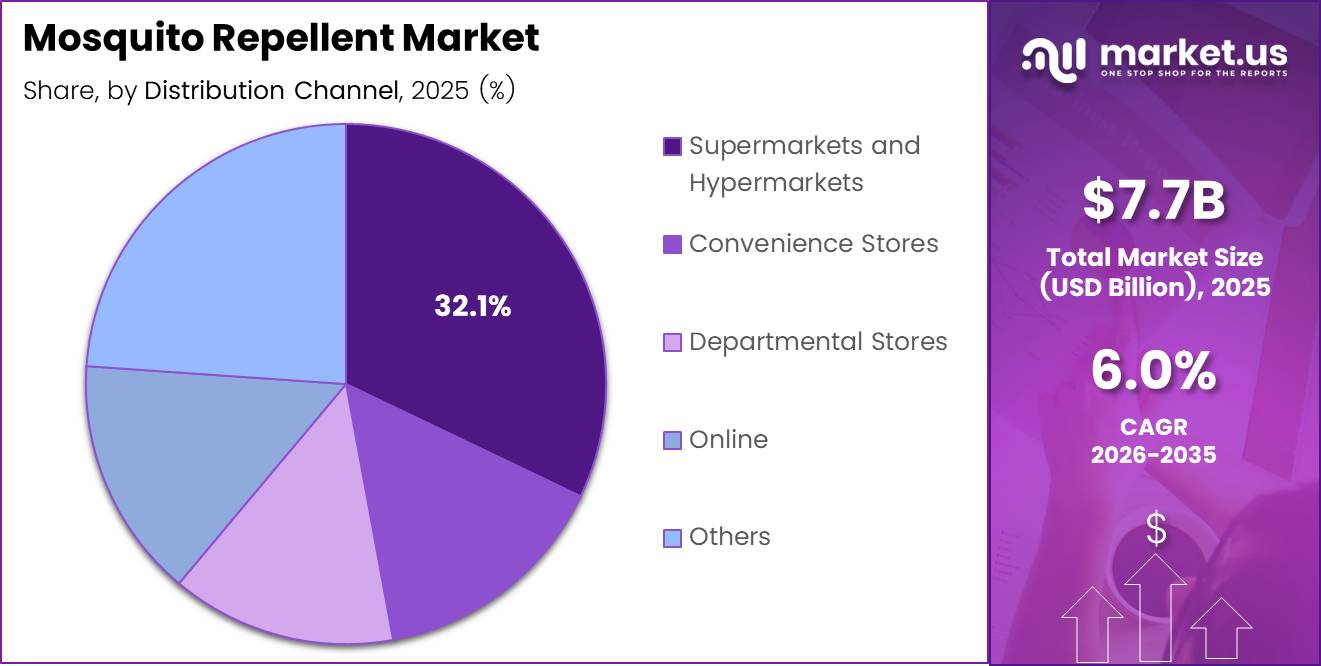
Supermarkets and hypermarkets lead distribution with a 32.1% share, reflecting the impulse-driven and need-based nature of repellent purchases. However, the online channel is reshaping how specialized formats — including wearable bands, child-safe formulas, and premium natural products — reach consumers who seek product reviews and ingredient transparency before buying.
According to a study published in BMC Public Health, 91.8% of respondents in the Netherlands and 92.2% in Spain reported using at least one mosquito prevention measure including repellents. This near-universal adoption signals that mosquito protection has become a normalized health behavior in Europe — a structural condition that supports premiumization and format diversification beyond basic coil and spray products.
According to research published in Parasites and Vectors, 59% of respondents in the Netherlands and 61% in Spain reported using mosquito repellents as a personal protection method. These figures reveal that while mosquito prevention is nearly universal, dedicated repellent use still leaves room for conversion — presenting product marketers with a clear opportunity to shift consumers from passive barriers to active personal protection formats.
Key Takeaways
- The global mosquito repellent market is valued at USD 7.7 Billion in 2025 and is forecast to reach USD 13.7 Billion by 2035 at a CAGR of 6.0%.
- Asia Pacific dominates with a 37.9% market share, valued at USD 2.8 Billion, driven by high disease prevalence and large consumer base.
- By Product Type, Coil leads with a 36.2% share due to low cost and wide household penetration.
- By Bite Type, Lotion holds the largest share at 38.6%, favored for direct skin application and portability.
- By Ingredients Type, Synthetic Ingredients account for 65.8% of the market, with DEET, Permethrin, and Picaridin as key actives.
- By Raw Material, Chemically Derived Repellents hold 59.9% share, reflecting the preference for proven chemical efficacy.
- By Distribution Channel, Supermarkets and Hypermarkets lead with a 32.1% share.
- The forecast period spans 2026 to 2035, with base year estimation set at 2025.
Product Analysis
Coil dominates with 36.2% due to low cost and mass rural distribution.
In 2025, Coil held a dominant market position in the By Product Type segment of the Mosquito Repellent Market, with a 36.2% share. Coils remain the default protection format across low- and middle-income households in Asia, Africa, and Latin America because they require no electricity and cost less per use than any alternative format. According to a study published by NCBI, 19% of surveyed travelers reported using mosquito coils or burning methods — a figure that underscores how widespread this format remains even among globally mobile consumers.
Spray carries the highest margin per unit within the repellent category. Sprays offer consumers flexible application across clothing and skin surfaces, making them the format of choice for outdoor and travel use cases. Their premium positioning in retail environments allows manufacturers to capture higher revenue per SKU compared to coils, and the segment benefits from recurring purchase cycles driven by portability and ease of use.
Cream and Oil serves as the entry point for family-oriented and dermatology-focused product lines. These formats attract parents seeking low-irritation options for children, and they support premiumization through ingredient differentiation — particularly plant-based and hypoallergenic formulations. Consequently, cream and oil products typically command higher retail prices and stronger brand loyalty than coil or spray alternatives.
Vaporizers differentiate through indoor continuous-protection positioning. Electric vaporizers create a recurring revenue stream from refill cartridge sales, which gives manufacturers a consumable business model within the repellent category. Their adoption is closely tied to electricity access and household income, making them a growth lever in urbanizing middle-class markets across Asia Pacific and Latin America.
Others within the product type segment capture emerging wearable and patch-based formats. This sub-segment is small today but structurally significant — wearable formats remove the friction of topical application and address consumer preferences for non-skin-contact protection, particularly for children. Innovation in this sub-segment is outpacing mainstream formats and is attracting new brand entrants targeting lifestyle-oriented buyers.
Bite Type Analysis
Lotion dominates with 38.6% due to direct skin application and broad consumer familiarity.
In 2025, Lotion held a dominant market position in the By Bite Type segment of the Mosquito Repellent Market, with a 38.6% share. Lotions provide full-skin coverage and allow precise dosing, which makes them the preferred format for parents applying protection to children and for consumers in high-exposure environments. Their broad retail distribution and compatibility with both synthetic and natural active ingredients reinforce this format’s structural advantage across all consumer segments.
Balm serves a concentrated, targeted protection role where portability is the primary purchase driver. Solid balm formats travel without spill risk, making them standard inclusions in travel toiletry kits and outdoor activity packs. However, limited body coverage per application restricts balm primarily to supplementary or on-the-go use, which caps its share relative to lotion.
Gel differentiates through its fast-absorbing, non-greasy consumer experience. Gel formats appeal strongly to adult male consumers and active outdoor users who reject the tactile residue of lotions and creams. Additionally, gels are increasingly used as the delivery medium for premium natural ingredient formulations, positioning them as the growth format within the natural repellent sub-category.
Roll-on carries a functional advantage in precision application around sensitive facial areas and hairlines. The controlled dispensing format reduces product waste and skin irritation, which has made roll-ons particularly popular among health-conscious urban consumers. Moreover, their compact size and low minimum purchase price make them accessible as trial formats for consumers new to a specific brand or ingredient system.
Ingredients Type Analysis
Synthetic Ingredients dominate with 65.8% due to clinically proven efficacy and mass-market formulation efficiency.
In 2025, Synthetic Ingredients held a dominant market position in the By Ingredients Type segment of the Mosquito Repellent Market, with a 65.8% share. According to a study published by NCBI, 93.3% of respondents in Western Australia who used mosquito repellents reported using chemical-based repellents. This near-total reliance on synthetic formulations reflects the established clinical credibility of compounds like DEET and Picaridin, which provide measurable, predictable protection durations that natural alternatives cannot yet match at comparable price points.
DEET remains the benchmark active ingredient against which all alternatives are evaluated. Despite decades of use and some consumer concern over skin absorption, DEET retains institutional endorsement from health authorities globally for use in high-risk malaria and dengue zones. Its continued dominance signals that efficacy outweighs ingredient anxiety in markets where disease risk is acute.
Permethrin occupies a structurally distinct role as a clothing and gear treatment rather than a skin-applied repellent. This positions permethrin as an additive layer of protection rather than a standalone product, which expands the total addressable market by targeting outdoor apparel buyers and military procurement channels alongside conventional household consumers.
Picaridin carries growing share among synthetic alternatives due to its skin-friendly profile and odorless formulation. As consumer preferences shift toward comfort-oriented protection — particularly in European and North American markets — picaridin benefits from a positioning advantage over DEET while retaining the efficacy credibility of synthetic chemistry.
Others within synthetic ingredients include IR3535 and newer molecules such as Renofluthrin, co-developed by Shogun Organics and Godrej Consumer Products in July 2024 through a formal patent partnership. The emergence of proprietary synthetic molecules signals that ingredient differentiation is becoming a key competitive axis, giving patent-holding manufacturers sustainable pricing power in a market otherwise dominated by commoditized actives.
Natural Ingredients serve the fastest-restructuring segment within the repellent category. Health-conscious and family-oriented consumers actively seek plant-derived alternatives, especially for child-use products. However, natural ingredients face a structural challenge: efficacy duration is shorter than synthetic compounds, which limits their penetration in high-risk disease environments where consistent protection is non-negotiable.
Oil of Lemon Eucalyptus holds the strongest efficacy credentials within the natural ingredients segment. The U.S. CDC recognizes it as the only plant-based active with protection comparable to low concentrations of DEET, which positions it as the ingredient of choice for natural repellent brands targeting credibility-driven consumers rather than simply wellness-oriented buyers.
Citronella is the most widely recognized natural repellent ingredient globally, used in candles, sprays, and personal care applications. According to a study published by NCBI, 51.7% of respondents in Western Australia reported using citronella-based mosquito repellent products. This penetration reflects citronella’s brand familiarity and wide retail availability, though its short protection window makes it primarily a supplementary rather than primary repellent solution.
Raw Material Analysis
Chemically Derived Repellents dominate with 59.9% due to formulation scalability and raw material cost efficiency.
In 2025, Chemically Derived Repellents held a dominant market position in the By Raw Material segment of the Mosquito Repellent Market, with a 59.9% share. Chemically derived formulations benefit from consistent raw material supply chains, standardized manufacturing processes, and predictable active ingredient concentrations — all of which reduce production risk and support high-volume retail pricing strategies that plant-based competitors cannot easily replicate.
Plant-based Repellents represent the raw material segment with the most active product development investment. Manufacturers are reformulating plant-based products to extend protection duration and improve sensory profiles, directly targeting the gap that has historically limited natural repellent market share. As formulation science improves, plant-based repellents are positioned to capture a structurally larger share of the premium and family consumer segments.
Distribution Channel Analysis
Supermarkets and Hypermarkets dominate with 32.1% due to impulse-purchase placement and high foot traffic.
In 2025, Supermarkets and Hypermarkets held a dominant market position in the By Distribution Channel segment of the Mosquito Repellent Market, with a 32.1% share. These channels benefit from seasonal promotional placements, high-frequency shopper visits, and the ability to merchandise repellents near household health and personal care categories — all of which drive spontaneous purchase decisions rather than planned brand selection.
Convenience Stores serve as high-margin emergency purchase points, particularly in tropical regions where consumers buy repellents at point-of-need during peak mosquito season. The per-unit margins in convenience retail exceed supermarket equivalents, making this channel strategically important for manufacturers seeking profitability over volume.
Departmental Stores provide a platform for premium and lifestyle-oriented repellent formats. Multi-functional products — such as moisturizing lotions with embedded repellent actives or premium natural ingredient formulations — find their optimal retail environment in departmental stores where consumers compare products on ingredient quality and brand positioning rather than price alone.
Online channels are reshaping repellent product discovery and trial for newer formats. Direct-to-consumer brands and specialty natural repellent labels use online marketplaces to bypass traditional retail gatekeepers and reach health-conscious consumer segments directly. Additionally, subscription models for refillable vaporizer cartridges and regular-use lotions are emerging as a structural revenue opportunity within this channel.
Others in distribution include pharmacies, clinics, travel retail, and government procurement channels. Pharmacy and clinic distribution carries unique credibility for repellents positioned as health-grade protection tools, while government procurement — especially for malaria-endemic regions — represents a high-volume institutional channel that operates independently of consumer retail dynamics.
Key Market Segments
By Product Type
- Coil
- Spray
- Cream and Oil
- Vaporizers
- Others
By Bite Type
- Lotion
- Balm
- Gel
- Roll-on
By Ingredients Type
- Synthetic Ingredients
- DEET
- Permethrin
- Picaridin
- Others
- Natural Ingredients
- Oil of Lemon Eucalyptus
- Citronella
- Others
By Raw Material
- Chemically Derived Repellents
- Plant-based Repellents
By Distribution Channel
- Supermarkets and Hypermarkets
- Convenience Stores
- Departmental Stores
- Online
- Others
Drivers
Rising Disease Burden and Expanding Urban Density in Tropical Regions Intensify Household Demand for Personal Mosquito Protection
Mosquito-borne diseases — dengue, malaria, and chikungunya — are not declining. Accelerating urbanization in tropical and subtropical regions compounds the problem by concentrating susceptible populations in areas where standing water and inadequate sanitation create ideal vector breeding conditions. This disease-risk reality converts repellent use from a seasonal preference into a daily household necessity. According to the Malaria Journal, 77.3% of participants in a Uganda community survey reported ever using mosquito repellents, confirming that consumer awareness and product adoption are already high in disease-endemic markets — the commercial opportunity lies in converting occasional users into consistent ones.
Consumer awareness about preventive healthcare is reshaping purchasing behavior beyond endemic disease zones. Urban middle-class households in Asia Pacific and Latin America increasingly treat repellent use as a routine personal care behavior, not just a crisis response to disease outbreaks. This behavioral shift broadens the addressable consumer base and supports the introduction of premium formats — lotions, roll-ons, and wearables — that command higher retail prices than traditional coil products.
The expansion of diverse product formats across retail and e-commerce channels directly amplifies market penetration. In July 2024, Shogun Organics and Godrej Consumer Products jointly developed and patented the Renofluthrin molecule — a new synthetic active ingredient that offers manufacturers a differentiated formulation platform. New molecules like Renofluthrin expand the product development pipeline, enabling manufacturers to address unmet needs in efficacy, skin tolerance, and protection duration simultaneously.
Restraints
Health Concerns Over Chemical Actives and Availability of Subsidized Alternatives Constrain Market Conversion Among Price-Sensitive and Risk-Aware Consumers
Regulatory scrutiny over DEET, pyrethroids, and related synthetic compounds creates a persistent headwind for mainstream repellent producers. As health authorities in the EU and North America tighten safety evaluation frameworks for chemical actives in personal care products, manufacturers face reformulation costs and potential ingredient restrictions that slow product development cycles and add compliance risk to category investment decisions.
Government vector control programs — including insecticide-treated net distribution and indoor residual spraying — directly substitute for personal repellent use in high-risk markets. In countries where national malaria programs subsidize bednets and environmental control measures, household repellent spending competes with free or low-cost public health interventions. This structural competition constrains market conversion rates in precisely the regions — sub-Saharan Africa, South and Southeast Asia — where disease prevalence is highest.
According to the Malaria Journal, only 8.2% of respondents in the Uganda study reported consistent use of mosquito repellents. This gap between awareness (77.3% ever used) and consistent use (8.2% regular users) reveals that barriers to habitual adoption — cost, skin sensitivity, and access to alternatives — are substantial. For manufacturers, closing this conversion gap requires either significant price reductions or a compelling efficacy or convenience advantage that free alternatives cannot offer.
Growth Factors
Natural Formulations, Rural Market Penetration, and Smart Device Integration Open High-Value Growth Segments Beyond the Household Coil Category
Plant-based and natural ingredient repellents are the fastest-developing product tier within the market. Health-conscious consumers — particularly parents of young children — are actively seeking DEET-free, dermatologically tested alternatives that offer skin safety without sacrificing protection. According to a study published by NCBI, 37% of U.S. travelers reported using mosquito repellent sprays or topical repellents during travel, confirming that portable, skin-applied formats already command strong adoption among high-awareness consumer segments — a behavioral base that natural ingredient brands are positioned to capture.
Emerging and rural markets represent the structural underpenetration opportunity in this market. Large portions of disease-endemic rural populations in Asia, Africa, and Latin America rely primarily on coils and nets rather than personal repellent formats. As disposable income rises and modern retail infrastructure expands into secondary cities and rural trade zones, manufacturers with affordable spray and lotion offerings can capture first-time repellent buyers who are transitioning away from open-burning coil methods.
Smart and electronic repellent devices — including programmable vaporizers and ultrasonic indoor protection units — create a product category with recurring consumable revenue. In April 2025, Godrej Consumer Products launched an upgraded Kala HIT Mosquito Spray featuring Thunderbolt Technology with Metofluthrin for faster mosquito elimination, demonstrating that technology-enhanced formulations can command a premium positioning even within high-volume mass-market product lines. Innovation at the device and formulation level signals that the market is transitioning from commodity formats toward performance-differentiated products.
Emerging Trends
Wearable Formats, Eco-Friendly Formulations, and Long-Lasting Protection Technologies Are Redefining Consumer Expectations in the Repellent Category
Wearable repellent products — bands, stickers, and clip-on devices — are the fastest-growing format within the non-topical protection segment. These products eliminate the skin application friction that deters consistent repellent use, particularly among children and active outdoor consumers. The wearable format also supports higher retail price points and premium packaging, making it an attractive development target for consumer health brands seeking margin expansion beyond coil and spray commodities.
Eco-friendly and essential oil-based repellents are capturing share among consumers who actively read ingredient labels and prioritize non-toxic household environments. According to a study published by NCBI, 51.7% of respondents in Western Australia reported using citronella-based repellent products, demonstrating that natural ingredient formats already command substantial consumer familiarity. This penetration creates a ready market for brands introducing next-generation natural actives with extended protection windows, moving beyond citronella’s traditional limitation of short-duration efficacy.
In January 2025, a Spanish biotech startup launched a broad-spectrum insect repellent protecting against multiple mosquito vectors — Aedes, Anopheles, and Culex — alongside additional biting insects. This multi-vector positioning signals a trend toward broader-protection formulations that address consumer concern about diverse insect threats simultaneously. Additionally, product innovation in slow-release vaporizer technology and advanced repellent delivery systems indicates that protection duration is becoming the primary competitive differentiator across both retail and professional channels.
Regional Analysis
Asia Pacific Dominates the Mosquito Repellent Market with a Market Share of 37.9%, Valued at USD 2.8 Billion
Asia Pacific leads the global mosquito repellent market with a 37.9% share, valued at USD 2.8 Billion. The region’s dominance reflects a structural convergence of factors: the highest global burden of dengue and malaria, population density across tropical urban centers, and rapidly expanding modern retail networks that have widened product access in historically underserved rural markets.
North America Mosquito Repellent Market Trends
North America holds a strong share anchored by mature consumer health awareness, established regulatory frameworks for chemical actives, and high per-capita spending on personal protection products. The U.S. market specifically benefits from strong outdoor recreation culture and year-round demand in the southern states, where mosquito activity extends well beyond traditional peak seasons. Premium and DEET-free formats are gaining traction in the region’s health-conscious consumer base.
Europe Mosquito Repellent Market Trends
Europe’s repellent market operates under tighter ingredient regulatory scrutiny than other regions, which has accelerated the shift toward picaridin and natural-based formulations among European manufacturers. Near-universal mosquito prevention behavior — documented at over 91% in Spain and the Netherlands — signals a market with high consumer engagement but one that increasingly demands ingredient transparency and dermatological certification from product brands.
Latin America Mosquito Repellent Market Trends
Latin America presents a bifurcated market structure: Brazil and Mexico hold the largest volumes driven by dengue and Zika disease burden, while smaller markets across Central America and the Andes remain underpenetrated by branded personal repellent formats. Urban population growth and improving retail infrastructure in secondary cities are driving first-time branded repellent adoption at scale in this region.
Middle East and Africa Mosquito Repellent Market Trends
The Middle East and Africa region offers the largest volume-expansion opportunity for repellent manufacturers over the forecast period. Sub-Saharan Africa carries the world’s highest malaria mortality burden, yet personal repellent penetration remains low relative to disease prevalence. SC Johnson’s January 2025 investment in a new manufacturing facility in Nairobi, Kenya — capable of producing up to 20 million units annually — directly signals commercial confidence in this region’s supply chain development potential.
Key Regions and Countries
North America
- US
- Canada
Europe
- Germany
- France
- The UK
- Spain
- Italy
- Rest of Europe
Asia Pacific
- China
- Japan
- South Korea
- India
- Australia
- Rest of APAC
Latin America
- Brazil
- Mexico
- Rest of Latin America
Middle East & Africa
- GCC
- South Africa
- Rest of MEA
Key Company Insights
3M positions itself in the mosquito repellent market through its expertise in materials science and personal protective equipment, leveraging existing distribution relationships with industrial, outdoor, and consumer health retailers. Its cross-category manufacturing capability allows 3M to compete on product reliability and format innovation — particularly in wearable and gear-applied repellent formats — rather than on household brand recognition alone.
S.C. Johnson & Son, Inc. operates the most strategically diversified repellent portfolio in the market, spanning household spray, vaporizer, and spatial protection formats through its established brands. Its August 2025 WHO policy endorsement for the Guardian and Mosquito Shield spatial repellent tools delivers a credibility advantage that no competitor currently matches — institutional health authority endorsement converts product claims into verified public health efficacy, directly strengthening procurement access in high-risk international markets.
Godrej Consumer Products Ltd holds a structural advantage in Asia Pacific and Africa through its deep retail penetration in price-sensitive mass-market channels. Its April 2025 launch of the upgraded Kala HIT Mosquito Spray with Thunderbolt Technology demonstrates a clear intent to defend and grow share through formulation performance improvements rather than price competition alone. Godrej’s co-development of the Renofluthrin molecule also positions it as an innovation-led manufacturer with proprietary active ingredient assets.
Reckitt Benckiser Group Plc commands consumer health shelf space across both developed and emerging markets through powerful brand equity in the household hygiene category. Its repellent business benefits from co-distribution with category-adjacent brands in pharmacies, supermarkets, and modern trade channels globally. However, its premium pricing architecture creates exposure in price-sensitive markets where local and regional brands consistently undercut on cost for equivalent efficacy.
Key Players
- 3M
- Coghlan’s Ltd.
- Dabur
- Godrej Consumer Products Ltd.
- Homs LLC
- New Avon LLC.
- PIC Corporation
- Reckitt Benckiser Group Plc
- S.C. Johnson & Son, Inc.
- Spectrum Brands Holdings Inc.
Recent Developments
- March 2025 – Thermacell introduced the E65 Rechargeable Mosquito Repeller with Fast Charging Dock, extending outdoor protection capability with faster charging cycles and longer battery life for consumers requiring sustained zone-based repellent coverage in outdoor settings.
- August 2025 – SC Johnson secured a World Health Organization policy recommendation for its spatial mosquito repellent tools — Guardian and Mosquito Shield — formally recognizing them as innovative prevention tools for malaria and other insect-borne diseases, a milestone that supports institutional procurement and public health program adoption globally.
- January 31, 2025 – SC Johnson, through its Guardian brand, launched a new mosquito repellent manufacturing line in Nairobi, Kenya, with an annual production capacity of up to 20 million units, directly addressing supply constraints in sub-Saharan Africa’s high-burden disease markets.
Report Scope
Report Features Description Market Value (2025) USD 7.7 Billion Forecast Revenue (2035) USD 13.7 Billion CAGR (2026-2035) 6.0% Base Year for Estimation 2025 Historic Period 2020-2024 Forecast Period 2026-2035 Report Coverage Revenue Forecast, Market Dynamics, Competitive Landscape, Recent Developments Segments Covered By Product Type (Coil, Spray, Cream and Oil, Vaporizers, Others), By Bite Type (Lotion, Balm, Gel, Roll-on), By Ingredients Type (Synthetic Ingredients: DEET, Permethrin, Picaridin, Others; Natural Ingredients: Oil of Lemon Eucalyptus, Citronella, Others), By Raw Material (Chemically Derived Repellents, Plant-based Repellents), By Distribution Channel (Supermarkets and Hypermarkets, Convenience Stores, Departmental Stores, Online, Others) Regional Analysis North America (US and Canada), Europe (Germany, France, The UK, Spain, Italy, and Rest of Europe), Asia Pacific (China, Japan, South Korea, India, Australia, and Rest of APAC), Latin America (Brazil, Mexico, and Rest of Latin America), Middle East & Africa (GCC, South Africa, and Rest of MEA) Competitive Landscape 3M, Coghlan’s Ltd., Dabur, Godrej Consumer Products Ltd., Homs LLC, New Avon LLC., PIC Corporation, Reckitt Benckiser Group Plc, S.C. Johnson & Son, Inc., Spectrum Brands Holdings Inc. Customization Scope Customization for segments, region/country-level will be provided. Moreover, additional customization can be done based on the requirements. Purchase Options We have three licenses to opt for: Single User License, Multi-User License (Up to 5 Users), Corporate Use License (Unlimited User and Printable PDF) 
-
-
- 3M
- Coghlan's Ltd.
- Dabur
- Godrej Consumer Products Ltd.
- Homs LLC
- New Avon LLC.
- PIC Corporation
- Reckitt Benckiser Group Plc
- S.C. Johnson & Son, Inc.
- Spectrum Brands Holdings Inc.
Our Clients

- 180120
- Feb 2026






