


Report Overview
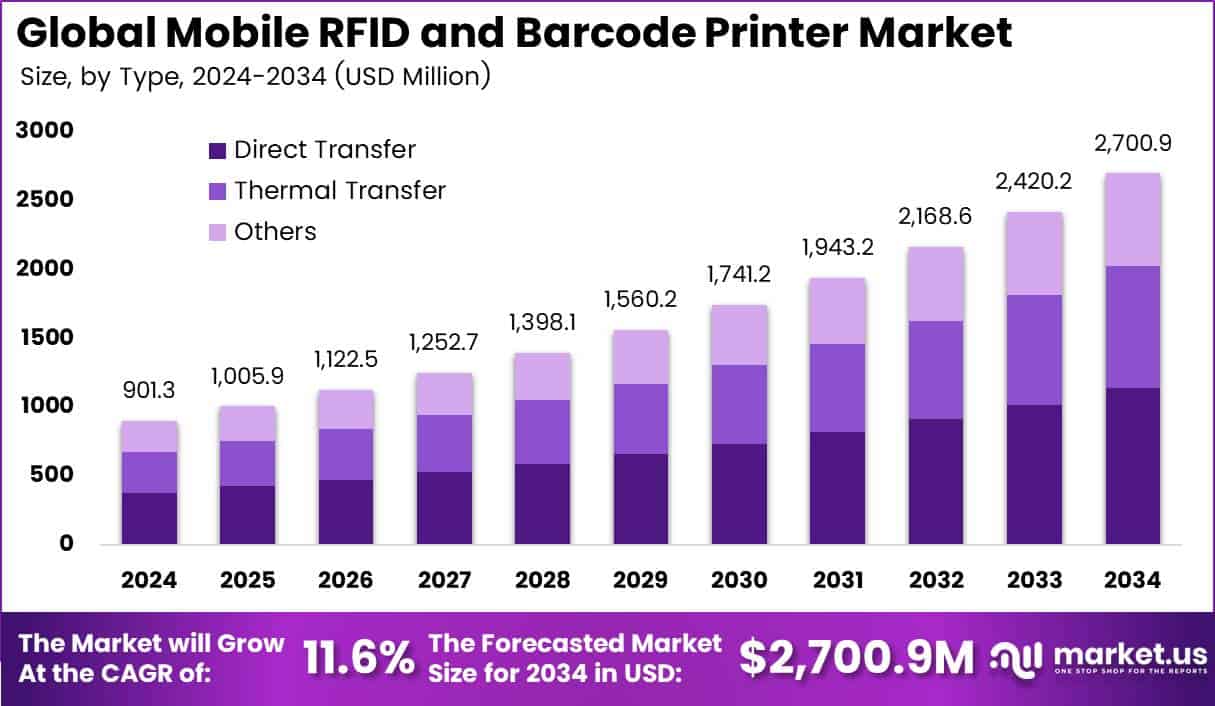
In 2024, the Global Mobile RFID and Barcode Printer Market was valued at USD 901.3 million. The market is projected to grow at a CAGR of 11.6% during 2024–2034, reaching approximately USD 2,700.9 million by 2034. North America dominated the global market in 2024, accounting for 32.4% of the total market share and generating approximately USD 292.01 million in revenue.
UN Trade and Development (UNCTAD) estimates that business e-commerce sales across 43 economies reached almost USD 27 trillion in 2022, up 10% from 2021. This creates far more orders, cartons, returns, and inventory movements that must carry readable barcode or RFID labels.
Mobile devices allow staff to print labels directly in warehouses, stores, loading areas, and field locations instead of moving goods to a fixed printer. GS1 US reports that RFID-enabled order reconciliation can achieve more than 99.9% order accuracy, compared with 31% using UPC-based processes in its cited study, giving businesses a clear reason to invest in RFID printing and labeling systems.
The U.S. Census Bureau reported USD 7.041 trillion in U.S. retail sales in 2022, while electronic shopping and mail-order sales reached USD 1.117 trillion, up 9.5% year on year. Higher online order volumes increase the need for on-demand shipping labels, return labels, and RFID tags across distribution centers and last-mile operations. As retailers seek fewer shipping errors and better stock visibility, mobile printers become operating tools rather than optional office equipment
Key Takeaways
- The global Mobile RFID and Barcode Printer Market was valued at USD 901.3 million in 2024.
- The global Mobile RFID and Barcode Printer Market is projected to grow at a CAGR of 11.6% and is estimated to reach USD 2,700.9 million by 2034.
- On the basis of type, the Direct Transfer segment dominated the market, accounting for 42.1% of the total market share.
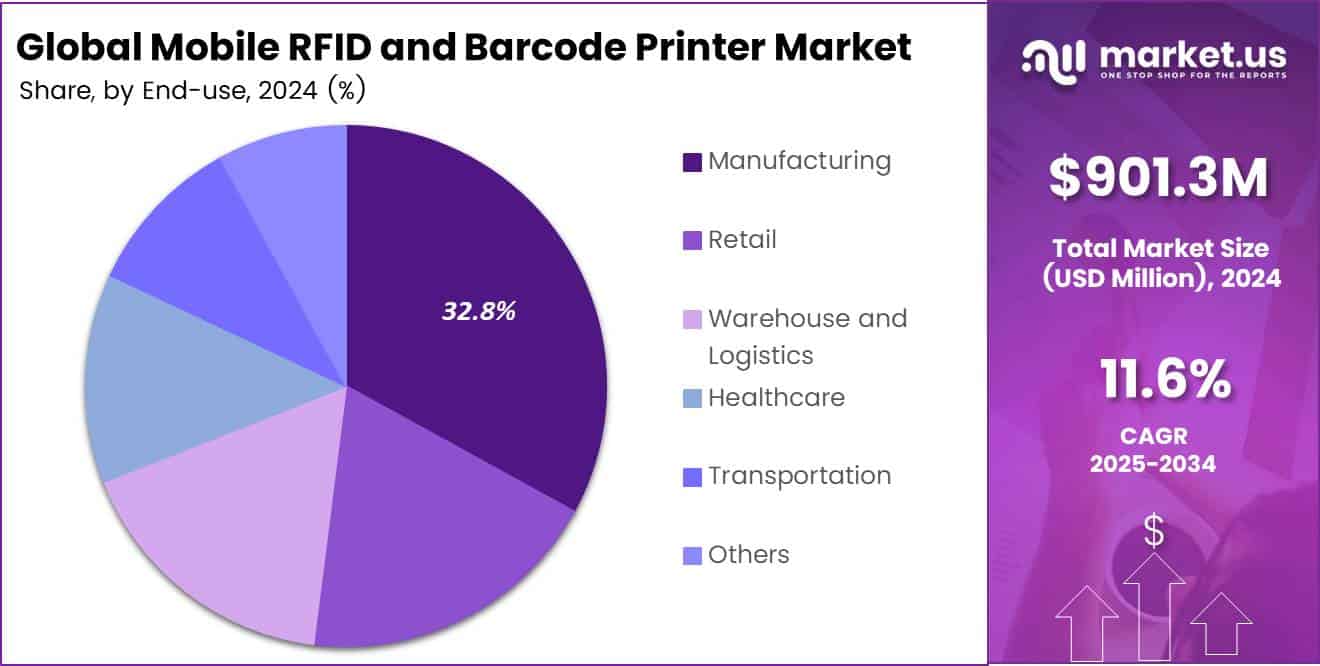
- By end-user, the Manufacturing segment dominated the market, accounting for 32.8% of the total market share.
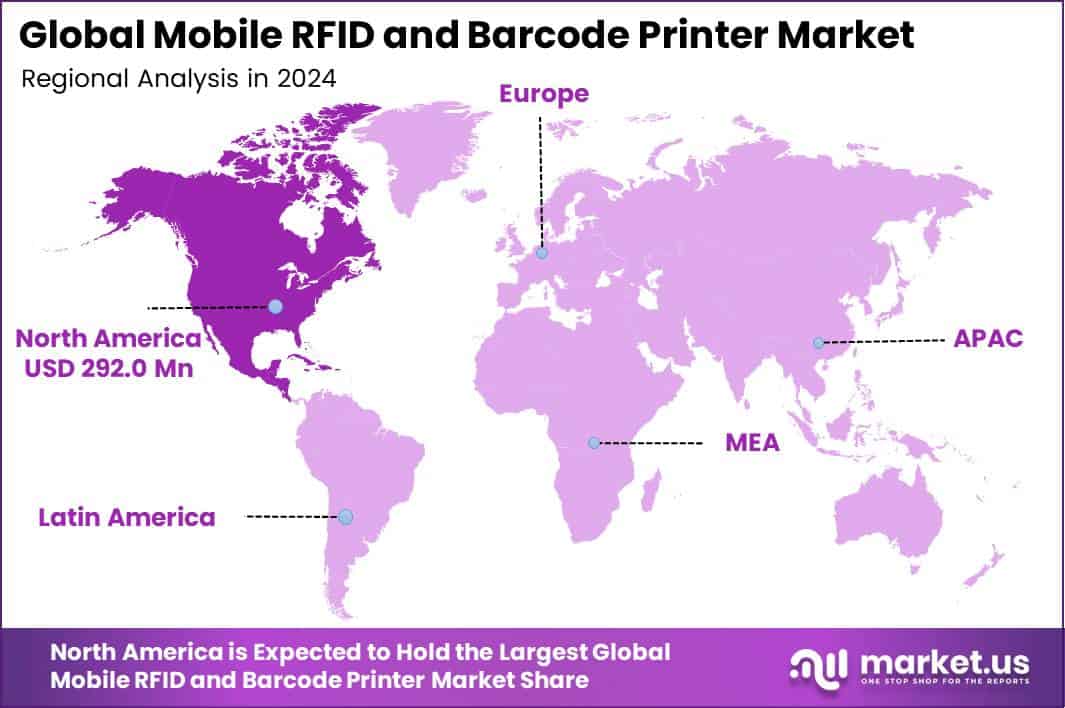
- In 2024, North America was the most dominant region in the Mobile RFID and Barcode Printer Market, accounting for 32.4% of the total market share and generating approximately USD 292.01 million in revenue.
By Type
Direct Transfer dominates with 42.1% due to fast ribbon-free labels for short-use workflows.
Direct Transfer leads the type group because mobile teams need a printer that starts quickly, carries no ribbon, and produces clear labels at the exact point of work. Operators use these labels for parcel handover, shelf tasks, receipts, short-life inventory marks, and ticketing, where speed matters more than long label life.
The 42.1% share also reflects a lower supply burden: workers carry labels, not ribbon rolls, and teams avoid ribbon loading during busy shifts. Zebra operates 114 facilities and employs about 9,900 people, showing the wide enterprise base that supports demand for mobile printing. Its 2025 fourth-quarter sales reached $1.475 billion, up 10.6% year on year, which points to continued spending on connected frontline operations.
By End User
Manufacturing dominates with 32.8% due to continuous traceability across production workflows.
Manufacturing leads the end-user group because factories must identify raw materials, work-in-process parts, finished goods, tools, and returnable containers across each shift. Mobile RFID and barcode printers let operators create a correct label beside the line, which supports traceability and reduces delays. Manufacturing holds 32.8% of demand because many plants run quality checks and need consistent identification from receiving through shipment.
The U.S. manufacturing sector employed 12.611 million people in the latest Bureau of Labor Statistics series, creating a large base of frontline users for on-demand labels. The series recorded a 29,000-job gain over six months, supporting activity in production sites. Warehouse and Logistics is the fastest-growing end-user group as e-commerce, faster delivery promises, and order volumes push operators to scan and label more items at receiving, picking, packing, and dispatch.
U.S. retail e-commerce sales reached $326.7 billion in the first quarter of 2026 and increased 2.7% from the prior quarter. Warehousing and storage employed 1.8346 million workers in July 2026, while stock clerks and order fillers numbered 457,740 in 2025. These operations gain from mobile printing because workers can label cartons and RFID tags where inventory moves, improving handoffs and stock visibility.
Key Market Segments
By Type
- Direct Transfer
- Thermal Transfer
- Others
By End User
- Manufacturing
- Retail
- Warehouse and Logistics
- Healthcare
- Transportation
- Others
Investment and Business Benefits
Investment in the Mobile RFID and Barcode Printer Market offers businesses significant opportunities for growth and efficiency improvements. With the market projected to experience strong growth over the coming years, businesses can benefit from enhanced operational efficiency, cost reductions, and increased productivity.
Implementing RFID and barcode technologies improves inventory management, accelerates supply chain operations, and enhances data accuracy, providing businesses with a competitive edge. Additionally, as industries increasingly adopt automation and real-time data collection, early investments in these technologies allow companies to stay ahead of the curve.
Businesses investing in this space can leverage advancements in AI, cloud computing, and IoT for long-term scalability and innovation. The growing demand for eco-friendly solutions, coupled with regulatory requirements, provides further avenues for growth, making the market an attractive investment for businesses seeking to improve operational processes while meeting sustainability goals.
These factors combine to offer strong returns for businesses that integrate mobile RFID and barcode printing solutions into their operations. Annual Sales Growth: Expected to grow by 20-30% across industries. Long-Term Impact: Businesses investing in RFID technology could see a 25-35% increase in sales and operational efficiency in the next 10 years.
Regional Analysis
In North America, the Mobile RFID and Barcode Printer Market is projected to reach USD 292.01 million in 2024. This region is expected to dominate the global market, driven by the extensive use of mobile printing solutions across industries such as logistics, retail, and healthcare. North America’s technological advancements, coupled with the growing demand for efficient inventory management and tracking solutions, contribute to its market leadership.
The adoption of mobile RFID and barcode printers in various sectors is anticipated to continue driving the region’s growth. In 2024, an estimated 20% market growth by 2034 is expected, with 20-25% annual growth, leading to sustained dominance.
Additionally, continuous advancements in mobile printing technologies, including faster and more reliable solutions, are expected to support the expansion of the market. With the growing emphasis on automation and supply chain optimization, North America is likely to maintain its strong market position moving forward.
Key Regions and Countries
- North America
- US
- Canada
- Europe
- Germany
- France
- The UK
- Spain
- Italy
- Rest of Europe
- Asia Pacific
- China
- Japan
- South Korea
- India
- Australia
- Singapore
- Rest of Asia Pacific
- Latin America
- Brazil
- Mexico
- Rest of Latin America
- Middle East & Africa
- South Africa
- Saudi Arabia
- UAE
- Rest of MEA
Drivers
| Driver | (~) % Impact on CAGR Forecast | Geographic Relevance | Impact Timeline |
|---|---|---|---|
| Omnichannel fulfillment automation | +2.4% | North America, Europe, East Asia | Short term (≤ 2 years) |
| Healthcare bedside identification | +1.9% | North America, Western Europe | Short term (≤ 2 years) |
| 2D barcode migration | +1.7% | Global retail markets | Medium term (2–4 years) |
| Mobile workforce digitization | +1.5% | Asia-Pacific, North America | Short term (≤ 2 years) |
| Warehouse labor productivity | +1.3% | Global logistics hubs | Medium term (2–4 years) |
Omnichannel fulfillment automation
Persistent order fragmentation across store, warehouse, curbside, and last-mile workflows is shifting label issuance from fixed packing stations to the point of activity, increasing demand for rugged wireless mobile RFID and barcode printers.
Deployments commonly target scan-and-label accuracy above 99% and cycle-time reductions of roughly 15%–30%. The shift accelerated as GS1 expanded retail guidance for multipurpose 2D barcodes in 2022 and 2023, while retailers intensified fulfillment-network automation, supporting higher device attachment per active worker, service-contract revenue, and replacement demand for wireless fleets.
Restraints
| Restraint | (~) % Impact on CAGR Forecast | Geographic Relevance | Impact Timeline |
|---|---|---|---|
| RFID conversion capital burden | -1.9% | Global, concentrated in smaller enterprises | Short term (≤ 2 years) |
| High borrowing-cost CapEx deferrals | -1.5% | North America, Europe, Latin America | Short term (≤ 2 years) |
| Low-cost legacy barcode fleets | -1.3% | Emerging markets, small enterprises | Medium term (2–4 years) |
| Consumable-price procurement limits | -1.1% | Global | Short term (≤ 2 years) |
| Privacy-sensitive tracking bans | -0.8% | Europe, selected public-sector buyers | Medium term (2–4 years) |
RFID conversion capital burden
RFID adoption requires buyers to fund more than the mobile printer: encoded tags, compatible label media, readers, middleware, site surveys, and process redesign create a bundled conversion decision that is materially larger than replacing a conventional barcode printer.
RFID labels can carry a unit-cost premium of several times a standard thermal label in low-volume programs, while encoding failure rates above roughly 1%–2% can rapidly erode the expected labor and inventory benefit; many smaller operators therefore require payback within 12–24 months before authorizing rollout.
Challenges
| Challenge | (~) % CAGR Friction Drag | Geographic Relevance | Mitigation Horizon |
|---|---|---|---|
| Legacy system integration | -1.6% | Global installed-base markets | Medium term (2–4 years) |
| RFID read reliability | -1.4% | Global industrial environments | Medium term (2–4 years) |
| Battery uptime management | -1.1% | Global field operations | Short term (≤ 2 years) |
| Wireless security maintenance | -1.0% | North America, Europe, East Asia | Long term (≥ 4 years) |
| Label media qualification | -0.9% | Global regulated industries | Medium term (2–4 years) |
Legacy system integration
Mobile printers must exchange identifiers, print templates, user permissions, and event data with warehouse-management, enterprise-resource-planning, mobility-management, and inventory systems that may have accumulated over more than 10 years.
A single incompatible template, driver, encoding rule, or application-programming-interface can produce reprints, interrupted receiving flows, and manual exception handling; even a 1% print or encoding exception rate becomes operationally material in high-volume distribution environments.
Opportunities
| Opportunity | (~) % Potential CAGR Upside | Geographic Relevance | Execution Window |
|---|---|---|---|
| Digital product passport workflows | +2.1% | European Union, export supply chains | Medium term (2–4 years) |
| Managed print fleet subscriptions | +1.8% | North America, Europe, developed Asia | Medium term (2–4 years) |
| Linerless mobile labeling | +1.5% | Europe, North America, Japan | Medium term (2–4 years) |
| Field-service traceability bundles | +1.4% | North America, Asia-Pacific | Short term (≤ 2 years) |
| Circular asset-return programs | +1.0% | Europe, global enterprise accounts | Long term (≥ 4 years) |
Digital product passport workflows
Digital product passport workflows remain future white space rather than a current market driver because the European Union’s Ecodesign for Sustainable Products Regulation entered into force on 18 July 2024, but product-specific data-carrier requirements and implementation schedules were still being developed.
A unified device-and-software offer could lift recurring software and consumables gross-margin potential by roughly 10–20 percentage points versus a hardware-only transaction and reduce label-changeover labor by approximately 20%–40%.
Key Players Analysis
Tier 1: Zebra Technologies and Honeywell command an estimated 50–60% of global mobile RFID/barcode-printer value, based on enterprise AIDC channels, mobile-print portfolios and financial scale; this is an analyst estimate, not a company-reported share.
Zebra is the specialist leader: FY2025 revenue was $5.4 billion, with $593 million in R&D, about 11% of sales. Its $1.3 billion cash acquisition of Elo Touch Solutions expands its frontline workflow portfolio, with $25 million in annual EBITDA synergies expected by year three. Honeywell remains the diversified challenger, reporting $37.4 billion in FY2025 net sales and R&D of roughly 4.5% of sales, supporting rugged mobility, warehouse automation and printing solutions.
SATO Holdings, Toshiba Tec and Brother Industries represent an estimated 25–35% share, competing through established service networks, label ecosystems and mobility applications. SATO’s FY2024, ended March 2025, net sales reached ¥154.8 billion, with ¥4.5 billion in R&D supporting Auto-ID, consumables and lifecycle services.
Toshiba Tec’s Retail Solutions revenue rose 7% to ¥333.6 billion in FY2025, while its Workplace Solutions R&D allocation reached ¥5.55 billion, including expansion of its A-BRID barcode-printer range. Brother’s Printing & Solutions segment generated ¥544.8 billion in FY2025 and spent ¥29.4 billion on segment R&D, including TD-2D thermal label-printer launches. Zebra retains the strongest RFID and enterprise software integration.
Top Key Players
- Zebra Technologies
- Honeywell International Inc.
- Brother Industries, Ltd.
- SATO Holdings Corporation
- Bixolon Co., Ltd.
- Epson America, Inc.
- TSC Auto ID Technology Co., Ltd.
- Godex International Co., Ltd.
- Datalogic S.p.A.
- Citizen Systems Japan Co., Ltd.
- Other Major Players
Recent Developments
- In March 2025, a leading mobile RFID and barcode printer manufacturer launched a new range of printers with cloud connectivity, enhancing real-time data synchronization and operational efficiency across multiple platforms.
- In December 2024, a prominent mobile printing brand unveiled a rugged mobile printer designed for warehouse environments, offering water resistance and extended battery life, making it ideal for harsh working conditions.
Report Scope
| Report Features | Description |
|---|---|
| Market Value (2024) | USD 901.3 Million |
| Forecast Revenue (2034) | USD 2,700.9 Million |
| CAGR(2025-2034) | 11.6% |
| Base Year for Estimation | 2024 |
| Historic Period | 2020-2023 |
| Forecast Period | 2025-2034 |
| Report Coverage | Revenue forecast, AI impact on Market trends, Share Insights, Company ranking, competitive landscape, Recent Developments, Market Dynamics, and Emerging Trends |
| Segments Covered | By Type (Direct Transfer, Thermal Transfer, Others), By End User (Manufacturing, Retail, Warehouse and Logistics, Healthcare, Transportation, Others) |
| Regional Analysis | North America – US, Canada; Europe – Germany, France, The UK, Spain, Italy, Russia, Netherlands, Rest of Europe; Asia Pacific – China, Japan, South Korea, India, New Zealand, Singapore, Thailand, Vietnam, Rest of Latin America; Latin America – Brazil, Mexico, Rest of Latin America; Middle East & Africa – South Africa, Saudi Arabia, UAE, Rest of MEA |
| Competitive Landscape | Zebra Technologies, Honeywell International Inc., Brother Industries, Ltd., SATO Holdings Corporation, Bixolon Co., Ltd., Epson America, Inc., TSC Auto ID Technology Co., Ltd., Godex International Co., Ltd., Datalogic S.p.A., Citizen Systems Japan Co., Ltd. |
| Customization Scope | Customization for segments, region/country-level will be provided. Moreover, additional customization can be done based on the requirements. |
| Purchase Options | We have three licenses to opt for: Single User License, Multi-User License (Up to 5 Users), Corporate Use License (Unlimited Users and Printable PDF) |





































