


Global Mobile Phishing Protection Market Size, Share Report Analysis By Component (Software, Services), By Operating System (Android, Ios, Others), By Deployment Mode (Cloud-based, On-premises), By Organization Size (Small and Medium Enterprises, Large Enterprises), By End-User (BFS, Healthcare, Retail, IT and Telecom, Government, Education, Others), By Regional Analysis, Global Trends and Opportunity, Future Outlook By 2025-2034
- Published date: Dec. 2025
- Report ID: 170324
- Number of Pages: 336
- Format:
-
keyboard_arrow_up
Quick Navigation
- Report Overview
- Key Takeaway
- Key Statistics
- Role of Generative AI
- U.S. Market Size
- Component Analysis
- Operating System Analysis
- Deployment Mode Analysis
- Organization Size Analysis
- End-User Analysis
- Emerging Trends
- Growth Factors
- Key Market Segments
- Drivers
- Restraint
- Opportunities
- Challenges
- Key Players Analysis
- Recent Developments
- Report Scope
Report Overview
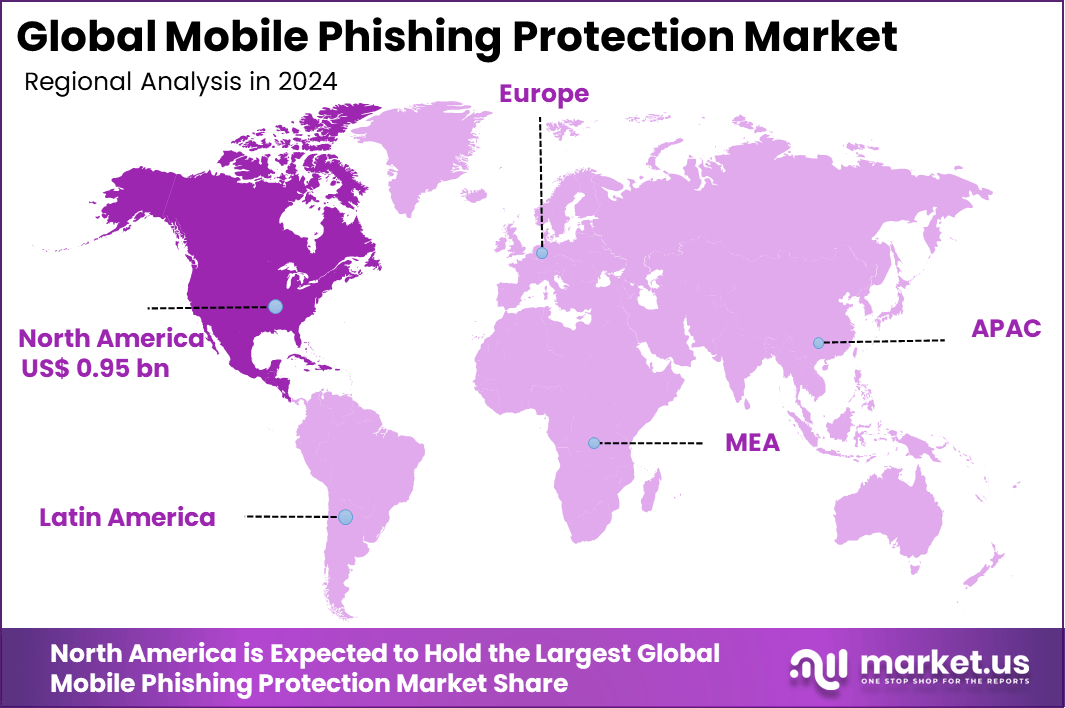
The Global Mobile Phishing Protection Market size is expected to be worth around USD 15.99 billion by 2034, from USD 2.67 billion in 2024, growing at a CAGR of 19.6% during the forecast period from 2025 to 2034. North America held a dominant market position, capturing more than a 35.7% share, holding USD 0.95 billion in revenue.
The mobile phishing protection market includes cybersecurity solutions that protect smartphones and tablets from phishing attacks such as malicious texts, fake apps, and deceptive mobile websites. With mobile devices widely used for communication, payments, and work, securing them against phishing threats has become critical for enterprises and consumers.
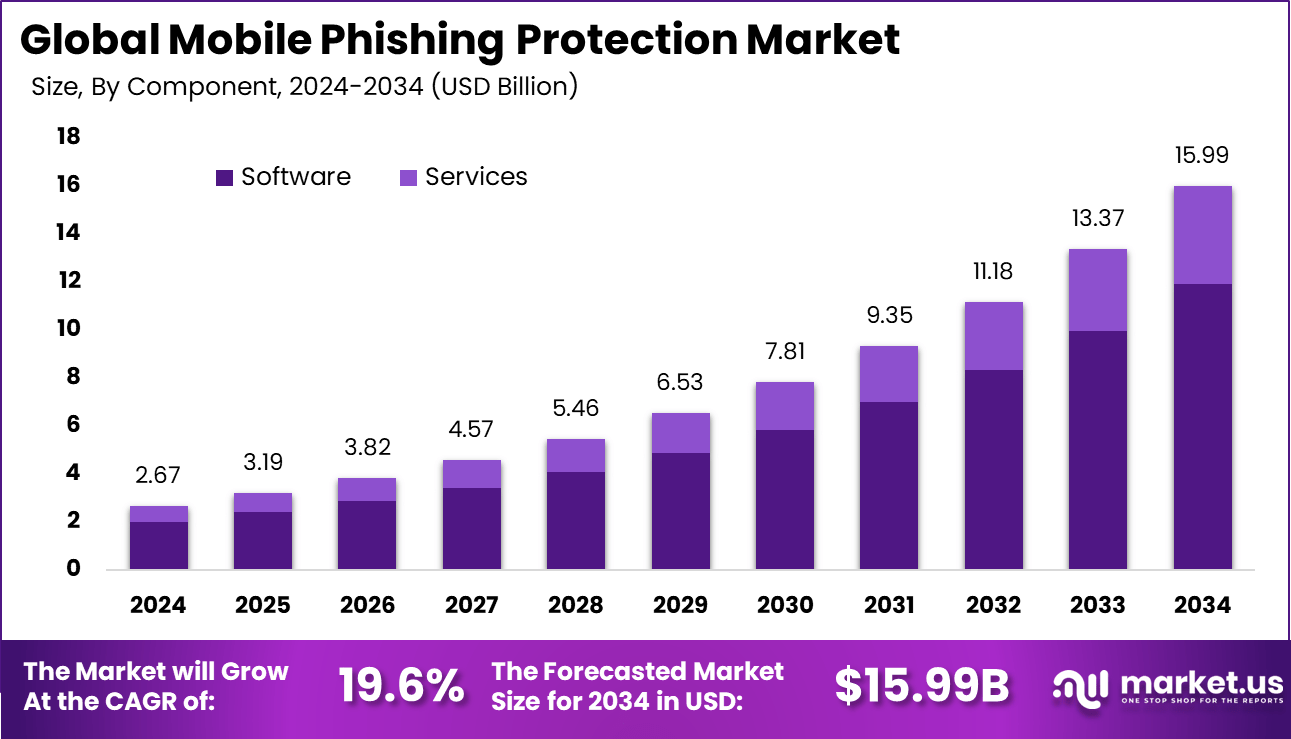
The market for mobile phishing protection is driven by the rapid shift of critical activities such as banking, payments, and enterprise communication to smartphones, which makes mobiles a prime target for attackers. Growing volumes of smishing, messaging app scams, and QR-based phishing are pushing enterprises to secure both corporate and BYOD devices. Rising regulatory pressure around data protection and breach disclosure further encourages investment in mobile-focused security.
For instance, in May 2025, Proofpoint signed a deal to buy Hornetsecurity for over $1 billion, grabbing their AI-powered Microsoft 365 security to beef up protection for SMBs through MSPs. Hornetsecurity’s 365 Total Protection packs email security, backup, and awareness training, giving Proofpoint a huge edge in serving smaller businesses globally. This move plugs a big gap in human-centric mobile defenses as M365 becomes hackers’ favorite target.
Key Takeaway
- Software solutions dominated with 74.6% in 2024, showing strong reliance on mobile threat detection, anti-phishing analytics, and real-time protection platforms.
- Android held 65.4%, reflecting its large global user base and higher exposure to mobile phishing attacks.
- On-premises deployment accounted for 58.9%, as enterprises prioritized data control and internal security governance.
- Large enterprises captured 72.2%, driven by widespread mobile workforce usage and higher phishing risk exposure.
- The BFSI sector led with 36.8%, supported by strict regulatory requirements and rising mobile-based financial fraud attempts.
- The U.S. market reached USD 0.81 billion in 2024 and is expanding at a 16.7% CAGR, reflecting sustained investment in mobile security solutions.
- North America held more than 35.7%, backed by advanced cybersecurity adoption and growing awareness of mobile phishing threats.
Key Statistics
- About 80% of phishing attacks now target mobile devices, as smaller screens and multitasking make warning signs harder to detect.
- Smishing has become a leading attack method, with employees being 6–10x more likely to fall for SMS-based phishing than email attacks.
- QR code phishing campaigns surged by 331% year over year, reflecting rapid exploitation of contactless habits.
- More than 50% of personal mobile devices were exposed to phishing attacks, while enterprises saw record mobile phishing waves in 2023.
- Around 76% of phishing sites aimed at business users use HTTPS, creating a false sense of security among victims.
- Device-specific redirection is increasingly used, where phishing sites appear safe on desktops but turn malicious on mobile devices.
- A successful mobile phishing attack costs businesses an average of USD 4.5 million, highlighting the financial severity of these incidents.
- Nearly 24% of smartphone users have already fallen victim to mobile phishing.
- Despite strong security awareness, more than 50% of organizations reported incidents where employees fell for executive impersonation scams via text messages.
Role of Generative AI
Generative AI steps in to fight mobile phishing by creating smart models that learn normal message patterns and flag odd ones right away. 82% of phishing emails now use AI to look real, but defenses turn the same tech around to spot these fakes faster than old rules-based systems. This shift helps cut down on surprises from new attack styles.
Tools powered by this AI also run practice runs on phones to train users without real risk. Teams see fewer clicks on bad links after these sessions, as the AI crafts tests that match real threats. Overall, it builds a stronger shield by mixing tech smarts with human habits.
U.S. Market Size
The market for Mobile Phishing Protection within the U.S. is growing tremendously and is currently valued at USD 0.81 billion, the market has a projected CAGR of 16.7%. The market is growing due to surging smartphone adoption in banking and work apps, where phishing via SMS and fake links hits hard.
Enterprises face rising threats like mishing and QR code scams targeting Android devices, pushing demand for real-time software defenses. Strict data rules and hybrid work setups force large BFSI firms to layer on-premises controls that block attacks before breaches occur. Users expect seamless protection without slowing down daily mobile use.
For instance, In September 2025, Lookout launched Smishing AI, an AI powered solution that uses large language models to detect SMS phishing by analyzing message intent and context beyond malicious links. This development strengthens enterprise protection against advanced mobile social engineering attacks and reinforces U.S. leadership in mobile threat defense.
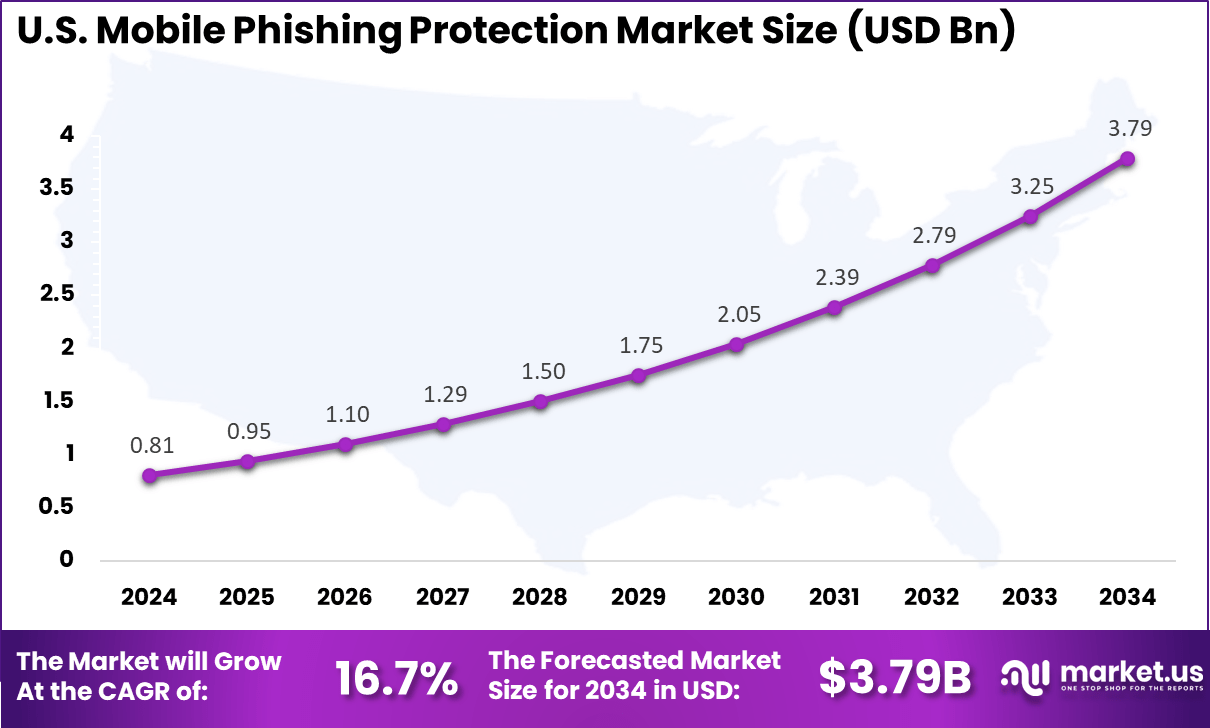
In 2024, North America held a dominant market position in the Global Mobile Phishing Protection Market, capturing more than a 35.7% share, holding USD 0.95 billion in revenue. This dominance stems from high smartphone penetration in daily banking and remote work, where SMS phishing and app-based scams often strike.
Large enterprises in BFSI lead adoption of software tools for Android devices, blending on-premises controls with real-time alerts. Regulators push strict breach reporting, while vendor hubs speed up advanced defenses against evolving threats like QR codes and social engineering on mobiles.
For instance, in July 2025, Zimperium released research warning of a sophisticated phishing campaign using malicious PDFs disguised as U.S. Postal Service communications, exploiting mobile users’ trust to steal credentials via hidden links that bypass endpoint security. The San Francisco-headquartered firm highlighted advanced evasion techniques, underscoring North American innovation in combating evolving mobile phishing threats.
Component Analysis
In 2024, The software segment leads with 74.6%, showing that most mobile phishing protection solutions are delivered through security software platforms. These tools focus on detecting malicious links, fake applications, and fraudulent messages across mobile devices in real time.
Growth in this segment is supported by the rising use of mobile banking, enterprise apps, and remote work tools. Software-based protection allows faster updates, centralized management, and continuous threat monitoring, which improves overall mobile security.
For Instance, in September 2025, Lookout launched Smishing AI, the first tool built to fight SMS phishing on mobile devices. This software solution uses AI to spot tricky social engineering attacks that target phones directly. It fits right into enterprise setups and helps security teams catch threats before users click bad links.
Operating System Analysis
In 2024, Android accounts for 65.4%, reflecting its large global user base and wide adoption across enterprises. The open ecosystem of Android increases exposure to phishing attacks through apps, browsers, and messaging platforms.
Organizations prioritize Android security due to higher phishing attempts targeting this platform. Mobile phishing protection tools help identify unsafe apps and suspicious activity, reducing risk for both employees and customers.
For instance, in September 2025, Zimperium uncovered a global Gigabud malware campaign hitting Android banking apps through phishing sites. Their software detected over 79 fake sites pushing malicious apps that steal data. This highlights Android’s top spot in mobile threat defenses.
Deployment Mode Analysis
In 2024, On premises deployment holds 58.9%, indicating strong preference among organizations that require direct control over security infrastructure. Enterprises rely on internal systems to manage sensitive threat data and enforce strict security policies.
This deployment mode supports integration with existing security operations and compliance frameworks. On premises solutions are often favored by regulated industries that must meet strict data protection requirements.
For Instance, in May 2025, Check Point rolled out Harmony Mobile with on-premises options for zero-click spyware blocks. It scans messaging apps and integrates with internal networks to stop phishing without cloud reliance. Teams keep full control over threat data and rules.
Organization Size Analysis
In 2024, Large enterprises represent 72.2%, highlighting their higher exposure to mobile phishing risks due to large employee bases and complex IT environments. These organizations manage thousands of mobile endpoints that require continuous security monitoring.
Adoption is driven by strong cybersecurity budgets and strict internal governance standards. Large enterprises use mobile phishing protection to reduce breach risks, protect intellectual property, and maintain business continuity.
End-User Analysis
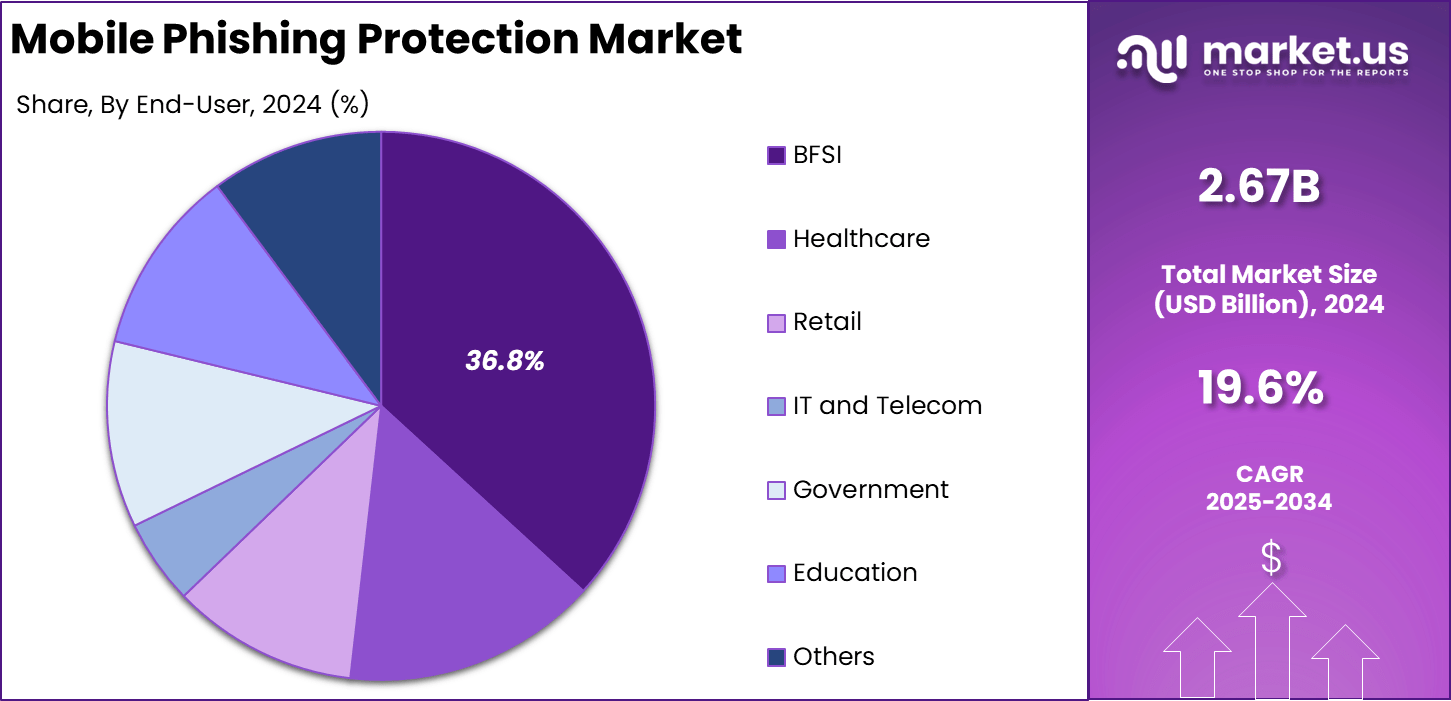
In 2024, The BFSI segment held a dominant market position, capturing a 36.8% share of the Global Mobile Phishing Protection Market. Fake apps mimic login pages to grab card details during transfers. Protection blocks these in seconds to save funds and trust. Rules demand strong checks on every phone used for work. Other sectors follow, but finance sets the pace.
Daily transactions on phones make a quick response key to stop losses. Alerts train staff on new phishing styles like voice calls. Partnerships with carriers add network-level blocks. This focus keeps customer data locked tight. As mobile banking rises, defenses strengthen to match. Sector growth ties straight to better tools.
For Instance, in August 2025, Zimperium blocked PhantomCard NFC-relay malware targeting Brazilian bank users on Android. This on-device software caught phishing that relayed card data, protecting financial apps in high-stakes banking environments.
Emerging Trends
A key trend is the rise of smishing and messaging-based phishing. Attackers increasingly use SMS, messaging apps and social platforms to deliver deceptive links, since users tend to trust these channels more than email. This shift has pushed security vendors to develop deeper inspection capabilities for messaging traffic and real-time link evaluation.
Another trend is the integration of phishing protection into mobile operating systems and enterprise mobility solutions. Modern mobile security tools now offer built-in URL scanning, app risk scoring and identity verification. Organizations are adopting unified solutions that protect devices, cloud accounts and personal data through a single monitoring layer.
Growth Factors
One major growth factor is the sharp increase in mobile-first activities related to finance, shopping, healthcare and remote work. As more sensitive actions happen on mobile devices, phishing attempts targeting credentials, payment data and corporate access points have grown. This rise in high-value targets creates demand for advanced protection.
Another growth factor is the expansion of mobile-based work environments. Employees frequently log into corporate tools from personal devices, which increases the need for mobile phishing protection. Companies invest in these solutions to prevent account takeovers, unauthorized access and data theft across distributed workforces.
Key Market Segments
By Component
- Software
- Services
By Operating System
- Android
- iOS
- Others
By Deployment Mode
- Cloud-based
- On-premises
By Organization Size
- Small and Medium Enterprises
- Large Enterprises
By End-User
- BFSI
- Healthcare
- Retail
- IT and Telecom
- Government
- Education
- Others
Regional Analysis and Coverage
- North America
- US
- Canada
- Europe
- Germany
- France
- The UK
- Spain
- Italy
- Russia
- Netherlands
- Rest of Europe
- Asia Pacific
- China
- Japan
- South Korea
- India
- Australia
- Singapore
- Thailand
- Vietnam
- Rest of Latin America
- Latin America
- Brazil
- Mexico
- Rest of Latin America
- Middle East & Africa
- South Africa
- Saudi Arabia
- UAE
- Rest of MEA
Drivers
A primary driver is the growing sophistication of phishing techniques. Attackers create convincing login pages, brand imitations and credential traps that are hard for users to detect. Mobile screens also make it difficult to review URLs or security details. Protection tools help close this gap by providing automated detection and blocking.
Another driver is regulatory and compliance pressure for organizations that handle personal or financial data. Industries such as banking, healthcare and government must protect user information across devices. Mobile phishing protection helps organizations meet these security expectations and reduce the risk of data exposure.
For instance, in March 2025, Barracuda spotted a million phishing-as-a-service attacks in a week. They tracked tools like Tycoon 2FA dodging checks. Their email security now layers AI to catch these fast. Teams report fewer breaches from mobile lures. This push fits the surge in phone-targeted scams.
Restraint
A key restraint is the limited user awareness of mobile phishing risks. Many individuals believe phishing only occurs through email, leading to lower vigilance on mobile channels. This reduces the effectiveness of protection tools unless training and awareness programs accompany them.
Another restraint is the challenge of protecting personal devices used for work. Bring-your-own-device policies create varied device types and security settings, making it harder for organizations to enforce consistent protection. This variation can slow adoption of unified security tools.
For instance, in September 2025, Proofpoint’s Human Factor report called out URL phishing tricks. Workers miss signs even with training reminders. AI deepfakes fool most in tests. Their tools now flag odd patterns in clicks. Still, humans slip slow full rollout of protections.
Opportunities
There is strong opportunity in expanding AI based detection systems that analyse URLs, app behaviour and user interaction patterns. These systems can identify phishing attempts that traditional filters may miss. As phishing methods evolve quickly, AI supported solutions can offer more adaptive protection.
Another opportunity exists in securing mobile financial services. Growth in mobile banking, digital wallets and payment apps creates demand for protection tools that safeguard login processes and payment flows. Providers who offer solutions tailored to financial transactions can capture significant interest from banks and fintech companies.
For instance, in May 2025, Check Point launched Harmony Mobile with AI smishing blocks. It neutralizes fake links in messages before taps. Ties into identity tools for full checks. Firms adopt it for remote work phones. Cloud links make updates seamless across devices.
Challenges
Evolving Attack Tricks
Cybercriminals constantly change their strategies, using voice cloning, deepfake audio, and QR-based scams to deceive unsuspecting users. Traditional detection systems struggle to keep pace with these evolving threats, especially when attacks exploit messaging and chat platforms in subtle ways. The rapid shift in tactics forces security teams to update protocols constantly.
At the same time, stricter privacy rules and outdated filters can cause legitimate communications to be flagged as suspicious, disrupting workflows. Maintaining the right balance between protection and usability is a continual challenge. The fight against mobile threats has become an ongoing process requiring constant adjustment and innovation.
For instance, in April 2025, Sophos tracked phishing via QR codes in emails. These lead to fake login pages on phones. Their report shows small firms hit most. Filters miss image-based lures often. Balancing blocks without workflow stops proves tough.
Key Players Analysis
Lookout, Proofpoint, Symantec (Broadcom), McAfee, and Zimperium lead the mobile phishing protection market with AI-driven threat detection and real-time mobile threat defense platforms. Their solutions protect users from malicious links, fake apps, and credential-harvesting attacks targeting smartphones and tablets. These companies focus on behavioral analysis, zero-day threat detection, and seamless integration with enterprise mobility systems.
Wandera (Jamf), Trend Micro, Kaspersky, IBM Security, Cisco Umbrella, Palo Alto Networks, and Check Point strengthen the market with cloud-based phishing prevention and secure mobile access controls. Their platforms combine URL filtering, network traffic inspection, and threat intelligence. These providers help enterprises secure mobile endpoints without impacting user experience.
Sophos, Barracuda Networks, Trellix, ESET, Avast, MobileIron (Ivanti), Cybereason, ZeroFOX, and other players expand the market with lightweight mobile security tools and social-media phishing protection. Their solutions emphasize rapid deployment, automated response, and centralized visibility. These companies serve organizations seeking cost-effective and scalable mobile protection.
Top Key Players in the Market
- Lookout
- Proofpoint
- Symantec (Broadcom)
- McAfee
- Zimperium
- Wandera (now part of Jamf)
- Trend Micro
- Kaspersky
- IBM Security
- Cisco (Umbrella)
- Palo Alto Networks
- Check Point Software Technologies
- Sophos
- Barracuda Networks
- FireEye (now Trellix)
- ESET
- Avast
- MobileIron (now part of Ivanti)
- Cybereason
- ZeroFOX
- Others
Recent Developments
- In April 2025, Lookout’s Annual Threat Landscape Report showed iOS devices facing roughly twice as many phishing attempts as Android, and reported that nearly 60% of organizations had at least one incident tied to mobile phishing, underlining why phishing controls on smartphones now sit at the center of data‑protection strategies.
Report Scope
Report Features Description Market Value (2024) USD 2.6 Bn Forecast Revenue (2034) USD 15.9 Bn CAGR(2025-2034) 19.6% Base Year for Estimation 2024 Historic Period 2020-2023 Forecast Period 2025-2034 Report Coverage Revenue forecast, AI impact on Market trends, Share Insights, Company ranking, competitive landscape, Recent Developments, Market Dynamics and Emerging Trends Segments Covered By Component (Software, Services), By Operating System (Android, Ios, Others), By Deployment Mode (Cloud-based, On-premises), By Organization Size (Small and Medium Enterprises, Large Enterprises), By End-User (BFS, Healthcare, Retail, IT and Telecom, Government, Education, Others) Regional Analysis North America – US, Canada; Europe – Germany, France, The UK, Spain, Italy, Russia, Netherlands, Rest of Europe; Asia Pacific – China, Japan, South Korea, India, New Zealand, Singapore, Thailand, Vietnam, Rest of Latin America; Latin America – Brazil, Mexico, Rest of Latin America; Middle East & Africa – South Africa, Saudi Arabia, UAE, Rest of MEA Competitive Landscape Lookout, Proofpoint, Symantec (Broadcom), McAfee, Zimperium, Wandera (now part of Jamf), Trend Micro, Kaspersky, IBM Security, Cisco (Umbrella), Palo Alto Networks, Check Point Software Technologies, Sophos, Barracuda Networks, FireEye (now Trellix), ESET, Avast, MobileIron (now part of Ivanti), Cybereason, ZeroFOX, Others Customization Scope Customization for segments, region/country-level will be provided. Moreover, additional customization can be done based on the requirements. Purchase Options We have three license to opt for: Single User License, Multi-User License (Up to 5 Users), Corporate Use License (Unlimited User and Printable PDF)  Mobile Phishing Protection MarketPublished date: Dec. 2025add_shopping_cartBuy Now get_appDownload Sample
 -
-
- Lookout
- Proofpoint
- Symantec (Broadcom)
- McAfee
- Zimperium
- Wandera (now part of Jamf)
- Trend Micro
- Kaspersky
- IBM Security
- Cisco (Umbrella)
- Palo Alto Networks
- Check Point Software Technologies
- Sophos
- Barracuda Networks
- FireEye (now Trellix)
- ESET
- Avast
- MobileIron (now part of Ivanti)
- Cybereason
- ZeroFOX
- Others
Our Clients

- 170324
- Dec. 2025









