


Global Microalgae-Based Products Market Size, Share and Report Analysis By Product Type (Astaxanthin, B-Carotene, Spirulina, Chlorella, Lutein, Others), By Microalgae Strain (Chlorella, Spirulina, Haematococcus pluvialis, Dunaliella salina, Arthrospira, Crypthecodinium cohnii, Euglena), By Cultivation Method (Open Ponds, Raceway Ponds, Tubular Photobioreactors, Flat-Panel Photobioreactors, Stirred Tank Photobioreactors, Airlift Photobioreactors), By End Use (Food And Beverage, Dietary Supplement And Pharmaceutical, Personal Care, Animal Feed And Aquaculture, Others) , By Region and Companies - Industry Segment Outlook, Market Assessment, Competition Scenario, Trends and Forecast 2025-2034
- Published date: Jan 2026
- Report ID: 175876
- Number of Pages: 205
- Format:
-
keyboard_arrow_up
Quick Navigation
Report Overview
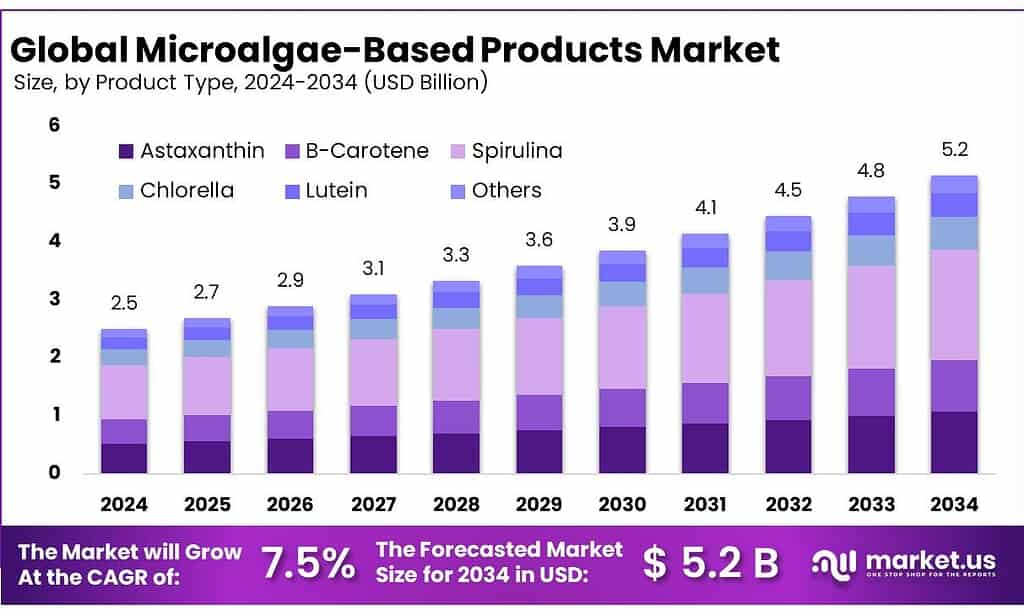
Global Microalgae-Based Products Market size is expected to be worth around USD 5.2 Billion by 2034, from USD 2.5 Billion in 2024, growing at a CAGR of 7.5% during the forecast period from 2025 to 2034. In 2024 North America held a dominant market position, capturing more than a 46.6% share, holding USD 1.1 Billion in revenue.
Microalgae-based products sit at the intersection of nutrition, food innovation, and low-impact manufacturing. In commercial terms, they include Spirulina (Limnospira) and Chlorella powders and tablets, DHA/EPA-rich algal oils used in infant formula and functional foods, and high-value ingredients such as natural pigments and antioxidants.
- The broader algae supply chain is no longer niche: FAO’s global view of seaweeds and microalgae shows total algae production rising to 35.82 million tonnes in 2019, underscoring how algae cultivation has become an established food-adjacent industry rather than a pilot-only concept.
Industrial activity is now split into two clear lanes. The first is “nutrition-first” biomass—mostly Spirulina/Chlorella—produced in open ponds or controlled photobioreactors, then dried and standardized for supplements and food fortification. An FAO technical review highlights how China’s Spirulina output was recorded at 19,080 tonnes (2003) and then 41,570 tonnes (2004), illustrating early industrial scaling and processing capacity development.
Regulation and formal authorizations are a major reason microalgae products are increasingly used by large food brands. In the EU, Schizochytrium sp. oil rich in DHA and EPA has been authorized as a novel food for use across defined food categories under Commission implementing rules, which helps reduce buyer risk and speeds procurement decisions. In the United States, FDA’s GRAS notice documentation for algal oil provides safety benchmarks used by industry; for example, one reviewed dossier cites a 22,000 mg/kg body weight NOAEL from toxicity work referenced in the notice, supporting product formulation and internal risk assessments.
Demand-side drivers are also strengthening. Aquaculture is expanding and needs stable lipid and protein inputs; FAO-reported totals show fisheries and aquaculture production reaching 223.2 million tonnes in 2022, with aquaculture contributing 130.9 million tonnes. This matters because algal DHA/EPA offers a pathway to reduce pressure on marine-derived omega-3 supply chains while keeping nutrition targets intact in farmed seafood.
Key Takeaways
- Microalgae-Based Products Market size is expected to be worth around USD 5.2 Billion by 2034, from USD 2.5 Billion in 2024, growing at a CAGR of 7.5%.
- Spirulina held a dominant market position, capturing more than a 37.4% share.
- Spirulina held a dominant market position, capturing more than a 41.2% share.
- Open Ponds held a dominant market position, capturing more than a 44.1% share.
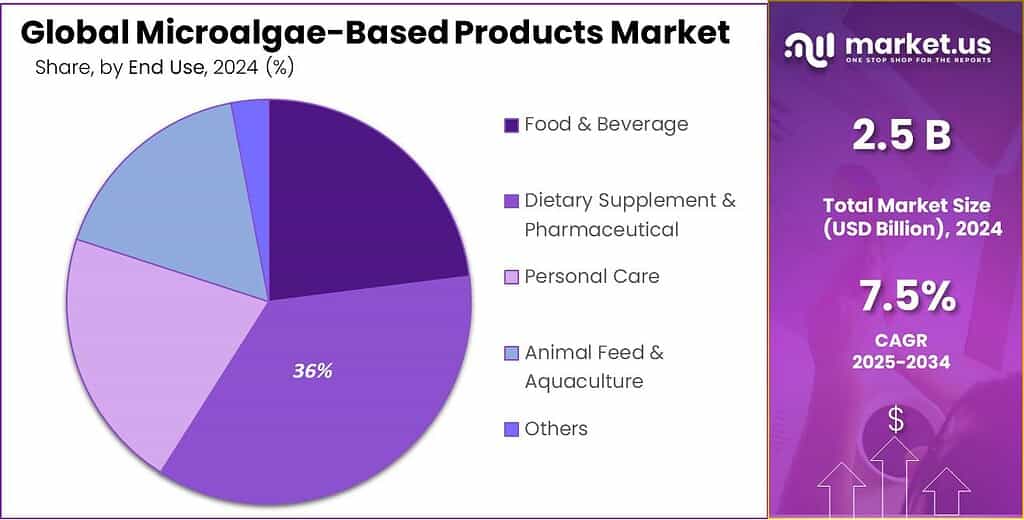
- Dietary Supplement & Pharmaceutical held a dominant market position, capturing more than a 36.8% share.
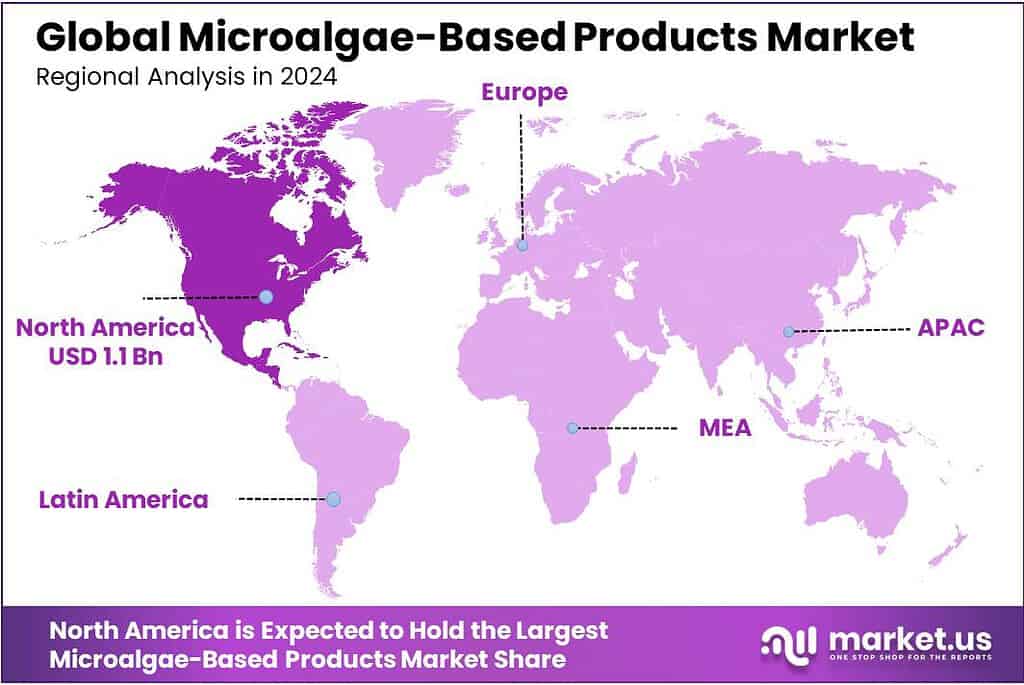
- North America held a leading position in microalgae-based products, accounting for 46.6% of the market and reaching USD 1.1 Bn.
By Product Type Analysis
Spirulina leads the microalgae-based products landscape with a strong 37.4% share, reflecting its growing nutritional and commercial relevance.
In 2024, Spirulina held a dominant market position, capturing more than a 37.4% share, supported by its long-standing acceptance in dietary supplements, functional beverages, and fortified foods. The year marked a clear shift toward microalgae ingredients with clean labeling and high-value protein content, and Spirulina stayed ahead because it is already familiar to consumers and widely adopted by global food brands. Its naturally high protein level, vivid pigment profile, and antioxidant concentration positioned it as the most commercially mature microalgae product in 2024.
By Microalgae Strain Analysis
Spirulina leads the microalgae strain category with a strong 41.2% share, supported by its wide acceptance in global nutrition markets.
In 2024, Spirulina held a dominant market position, capturing more than a 41.2% share, reflecting its long-standing strength as the most commercially established microalgae strain. Its popularity continued to rise during the year as consumers and manufacturers increased their preference for natural, nutrient-rich, and plant-based ingredients. Spirulina’s naturally high protein level, essential amino acids, and antioxidant content made it an easy choice for supplement brands, functional drink companies, and health-focused food producers looking for an ingredient with a proven safety record and consistent quality.
By Cultivation Method Analysis
Open pond systems lead microalgae cultivation with a strong 44.1% share, reflecting their cost-efficient and scalable production model.
In 2024, Open Ponds held a dominant market position, capturing more than a 44.1% share, driven by their long-standing use in large-scale Spirulina and Chlorella production. These systems remained the most preferred cultivation method because they offer lower operating costs, easier setup, and the ability to produce biomass at commercial volumes. Throughout 2024, manufacturers relied heavily on open pond systems to meet rising product demand in dietary supplements, functional foods, natural pigments, and feed applications.
By End Use Analysis
Dietary supplements and pharmaceutical applications lead microalgae usage with a solid 36.8% share, backed by strong health and wellness demand.
In 2024, Dietary Supplement & Pharmaceutical held a dominant market position, capturing more than a 36.8% share, reflecting the growing reliance on microalgae-derived ingredients for human health and preventive nutrition. Spirulina, Chlorella, and algal omega-3 oils continued to be widely adopted in capsules, tablets, powders, and liquid formulations as consumers increasingly sought natural sources of protein, antioxidants, and essential fatty acids.
Key Market Segments
By Product Type
- Astaxanthin
- B-Carotene
- Spirulina
- Chlorella
- Lutein
- Others
By Microalgae Strain
- Chlorella
- Spirulina
- Haematococcus pluvialis
- Dunaliella salina
- Arthrospira
- Crypthecodinium cohnii
- Euglena
By Cultivation Method
- Open Ponds
- Raceway Ponds
- Tubular Photobioreactors
- Flat-Panel Photobioreactors
- Stirred Tank Photobioreactors
- Airlift Photobioreactors
By End Use
- Food & Beverage
- Dietary Supplement & Pharmaceutical
- Personal Care
- Animal Feed & Aquaculture
- Others
Emerging Trends
Algal omega-3 is moving into everyday foods, not just supplements, as regulators and large nutrition supply chains make it easier to use
A clear latest trend in microalgae-based products is the shift from “capsules and powders” into mainstream food formulations, led by algal omega-3 oils (DHA/EPA). In 2024 and into 2025, food developers increasingly treated algal DHA as a practical fortification ingredient for products that aim to look and feel familiar—plant-based meals, dairy alternatives, ready-to-drink nutrition, and family wellness foods. The logic is simple: consumers want omega-3 benefits, but brands want a supply chain that is predictable and less tied to wild fish variability.
Regulatory updates are one reason this trend is accelerating. In the European Union, the conditions of use for Schizochytrium sp. oil rich in DHA and EPA were amended to extend its use into fish analogues and meat analogues, at 300 mg/100 g. That single change has a real commercial impact: it allows plant-based food brands to add omega-3 in a controlled, standardized way, without needing to treat it like a one-off innovation project.
The same direction is visible in how companies plan infant and early-life nutrition. U.S. regulatory documents around algal oils used for DHA repeatedly reference a target DHA concentration in term infant formulas of 0.5% of total fat (as DHA). This matters because infant formula is one of the most specification-driven categories in food. In 2025, FDA GRAS-related response letters also show how suppliers tighten specifications, which supports more consistent formulation in food manufacturing.
Another reason the “everyday food” trend is strengthening is the scale of aquatic and algae production already present in the global food system. FAO’s 2024 reporting on the State of World Fisheries and Aquaculture notes that global fisheries and aquaculture production reached 223.2 million tonnes in 2022, including 37.8 million tonnes of algae.
Drivers
Algal Omega-3 demand is accelerating microalgae products, as food and nutrition systems look for reliable, scalable sources
One major driving factor for microalgae-based products is the fast-growing need for algal omega-3 (DHA/EPA) in everyday nutrition—especially infant formula, supplements, and aquaculture-linked foods—where buyers want a dependable supply that does not rely on wild fish oil. This shift is practical, not just trendy. FAO reported that total fisheries and aquaculture production reached 223.2 million tonnes in 2022, including 37.8 million tonnes of algae.
The aquaculture side is a clear pull factor in 2024–2025. FAO’s SOFIA 2024 shows global aquaculture production reached 130.9 million tonnes in 2022, valued at USD 312.8 billion. When aquaculture scales at that size, the industry needs stable, traceable lipids and functional nutrients. Algal oils fit this need because DHA/EPA can be produced under controlled conditions and delivered with consistent specifications.
Regulatory comfort is another reason this driver is strong. In the U.S., FDA GRAS communications have discussed the use of algal oil in infant formula, including guidance in an agency response letter noting intended use “at levels up to 0.5% (w/w) of total fat as DHA” (within stated conditions). In the EU, Schizochytrium sp. oil rich in DHA and EPA is listed as an authorized novel food, and the Commission has updated conditions of use—such as allowing use in fish analogues and meat analogues at levels of 300 mg/100 g.
Government-led support is also reinforcing this demand-driven pull. In the U.S., the Department of Energy’s Bioenergy Technologies Office announced funding of up to $10 million (January 16, 2025) to advance algae cultivation and preprocessing R&D—work that can improve yields and processing efficiency, and indirectly supports cost and supply stability for algae-based inputs used across sectors.
Restraints
Food-safety testing and contamination risk can slow microalgae adoption, adding cost and reputational pressure
One major restraining factor for microalgae-based products is the extra food-safety burden that comes with algae powders and blends—especially when they are sold as “greens,” “superfood,” or daily wellness products. The category often looks simple to consumers, but manufacturers and retailers know it can be operationally demanding. Algae can pick up unwanted microbes or toxins if controls slip during harvesting, drying, blending, or packaging. When something goes wrong, it does not just hurt one brand—it can make shoppers skeptical of the whole shelf.
A clear example of how costly this risk can become showed up in January 2026, when U.S. regulators linked a multi-state Salmonella outbreak to a greens dietary supplement powder. The FDA reported 45 illnesses across 21 states, with 12 hospitalizations and no deaths at the time of the update. Illness onset dates ranged from August 22, 2025 to December 30, 2025, and 16 of 20 people with available information reported consuming the product before becoming ill.
This kind of event pushes companies to invest more heavily in prevention—supplier audits, pathogen testing, environmental monitoring, lot traceability, and stronger hygiene controls. Those steps are good for consumers, but they raise the cost to operate and can slow product launches. After the outbreak link, the FDA recommended recall action, and the firm initiated a voluntary recall while production was suspended during the investigation.
Toxin risk adds another layer of complexity. The FDA has warned about microcystins as a concern in some “blue-green algae” products, noting that contamination can occur when toxin-producing species are present and testing is not done properly. At the state level, Oregon set a numeric benchmark often referenced in safety discussions: a limit of 1 μg/g microcystin for certain blue-green algae dietary supplement products sold in Oregon, established because toxin-producing contaminant species can co-occur.
Opportunity
Microalgae can scale as a nutrition input for aquaculture and plant-based foods, especially through algal omega-3 oils
A major growth opportunity for microalgae-based products is the expansion of food-grade algal ingredients into aquaculture-linked nutrition and mainstream “better-for-you” foods, led by algal omega-3 (DHA/EPA). In 2024, the global food system gave a strong signal that demand for nutrient inputs will keep climbing: FAO reported total fisheries and aquaculture production at 223.2 million tonnes (2022), including 37.8 million tonnes of algae, and highlighted that aquaculture reached a record 130.9 million tonnes.
In practical terms, the opportunity shows up in two places. First, aquaculture’s growth keeps pushing the feed and nutrition chain toward ingredients that are more consistent, traceable, and less exposed to wild supply swings. FAO’s SOFIA 2024 reporting notes aquaculture’s value at USD 312.8 billion (2022). When an industry operates at that size, it tends to professionalize inputs quickly: buyers want predictable specifications, stable quality, and reliable delivery.
Second, algal omega-3 has a clear runway in plant-based and alternative foods, where companies need the nutritional “finish” that consumers expect—especially when replacing seafood or enriching everyday diets. Europe’s regulatory pathway supports this kind of product expansion. The EU updated conditions of use for Schizochytrium sp. oil rich in DHA and EPA, explicitly extending use to fish analogues and meat analogues at 300 mg/100 g.
In 2025, government-backed R&D support strengthened the same opportunity from the supply side. The U.S. Department of Energy’s Bioenergy Technologies Office announced up to $10 million (January 16, 2025) for algal systems research focused on cultivation and preprocessing. Even though this program is not “food-only,” it targets the core bottlenecks that food-grade algae producers also care about—yield, stability, and processing efficiency. Better cultivation and preprocessing reduce cost pressure, improve consistency, and make it easier for food manufacturers to commit to longer-term ingredient contracts.
Regional Insights
North America dominates the Microalgae-Based Products Market with a 46.6% share, valued at USD 1.1 Bn.
In 2024, North America held a leading position in microalgae-based products, accounting for 46.6% of the market and reaching USD 1.1 Bn, as the region continues to convert “health ingredients” into repeat, large-volume purchases. A key support pillar is the mature dietary supplement culture—CDC data shows 57.6% of U.S. adults used a dietary supplement in the past 30 days, which helps explain why spirulina/chlorella powders and algae-based softgels find steady demand through mainstream retail and e-commerce channels.
Another regional advantage is how quickly microalgae ingredients move from innovation to regulated, food-grade use. The U.S. FDA’s GRAS notice records algal oil intended for infant formula at levels up to 0.5% (w/w) of total fat as DHA, which strengthens buyer confidence for broader DHA fortification strategies in foods and beverages.
Key Regions and Countries Insights
- North America
- US
- Canada
- Europe
- Germany
- France
- The UK
- Spain
- Italy
- Rest of Europe
- Asia Pacific
- China
- Japan
- South Korea
- India
- Australia
- Rest of APAC
- Latin America
- Brazil
- Mexico
- Rest of Latin America
- Middle East & Africa
- GCC
- South Africa
- Rest of MEA
Key Players Analysis
DSM’s nutrition-focused portfolio supports algal-derived lipids and specialty ingredients used in food and supplements. In 2024, DSM B.V. reported net sales of €7,803 million, with a net loss from continuing operations of €19 million (noted as improved versus 2023). These figures underline scale, and the ability to fund regulated, high-spec nutrition solutions.
DIC operates globally in chemicals and pigments and has a strong footprint in color and materials used across food-contact and packaging value chains. In FY2024, consolidated net sales were ¥1,071.1 billion. The company lists consolidated headcount at 21,184 (as of December 31, 2024), showing large manufacturing scale and downstream reach relevant to algae-based natural color and ingredient ecosystems.
EID Parry runs diversified agri-food operations and also maintains nutraceutical manufacturing that includes microalgal production plants in Tamil Nadu. In FY 2023–24, consolidated revenue from operations was ₹29,413 crore (vs ₹35,244 crore prior year). The company reported 2,319 employees as of March 31, 2024, reflecting the operational depth behind its ingredient and nutrition businesses.
Top Key Players Outlook
- Cyanotech Corporation
- DSM N.V
- DIC Corporation
- EID Parry (India) Ltd
- BGG
- Divi’s Laboratories Ltd.
- Fuji Chemicals Industries Co. Ltd.
- Fuqing King Dnarmsa Spirulina Co. Ltd.
- Algatechnologies Ltd.
Recent Industry Developments
In 2024, DSM N.V. reported net sales of €12,799 million and EBITDA of €1,991 million, with a total workforce of 28,214 people—scale that helps it industrialize regulated, food-grade lipid ingredients rather than treating them as niche additives.
In fiscal 2024, Cyanotech Corporation reported net sales of $23.071 million, and in fiscal 2025 net sales increased to $24.215 million (a 5.0% rise), showing steady demand even in a cautious consumer environment.
Report Scope
Report Features Description Market Value (2024) USD 2.5 Bn Forecast Revenue (2034) USD 5.2 Bn CAGR (2025-2034) 7.5% Base Year for Estimation 2024 Historic Period 2020-2023 Forecast Period 2025-2034 Report Coverage Revenue Forecast, Market Dynamics, Competitive Landscape, Recent Developments Segments Covered By Product Type (Astaxanthin, B-Carotene, Spirulina, Chlorella, Lutein, Others), By Microalgae Strain (Chlorella, Spirulina, Haematococcus pluvialis, Dunaliella salina, Arthrospira, Crypthecodinium cohnii, Euglena), By Cultivation Method (Open Ponds, Raceway Ponds, Tubular Photobioreactors, Flat-Panel Photobioreactors, Stirred Tank Photobioreactors, Airlift Photobioreactors), By End Use (Food And Beverage, Dietary Supplement And Pharmaceutical, Personal Care, Animal Feed And Aquaculture, Others) Regional Analysis North America – US, Canada; Europe – Germany, France, The UK, Spain, Italy, Rest of Europe; Asia Pacific – China, Japan, South Korea, India, Australia, Singapore, Rest of APAC; Latin America – Brazil, Mexico, Rest of Latin America; Middle East & Africa – GCC, South Africa, Rest of MEA Competitive Landscape Cyanotech Corporation, DSM N.V, DIC Corporation, EID Parry (India) Ltd, BGG, Divi’s Laboratories Ltd., Fuji Chemicals Industries Co. Ltd., Fuqing King Dnarmsa Spirulina Co. Ltd., Algatechnologies Ltd. Customization Scope Customization for segments, region/country-level will be provided. Moreover, additional customization can be done based on the requirements. Purchase Options We have three licenses to opt for: Single User License, Multi-User License (Up to 5 Users), Corporate Use License (Unlimited User and Printable PDF)  Microalgae-Based Products MarketPublished date: Jan 2026add_shopping_cartBuy Now get_appDownload Sample
 -
-
- Cyanotech Corporation
- DSM N.V
- DIC Corporation
- EID Parry (India) Ltd
- BGG
- Divi’s Laboratories Ltd.
- Fuji Chemicals Industries Co. Ltd.
- Fuqing King Dnarmsa Spirulina Co. Ltd.
- Algatechnologies Ltd.
Our Clients

- 175876
- Jan 2026






