


Global Methyl Anthranilate Market By Source (Synthetic and Natural), By Grade (Food Grade and Industrial Grade), By End-Use (Food And Beverages, Personal Care And Cosmetics, Pharmaceuticals, Agrochemicals, Insect Repellents, and Others), By Region and Companies - Industry Segment Outlook, Market Assessment, Competition Scenario, Trends and Forecast 2025-2034
- Published date: Feb 2026
- Report ID: 177873
- Number of Pages: 308
- Format:
-
keyboard_arrow_up
Quick Navigation
Report Overview
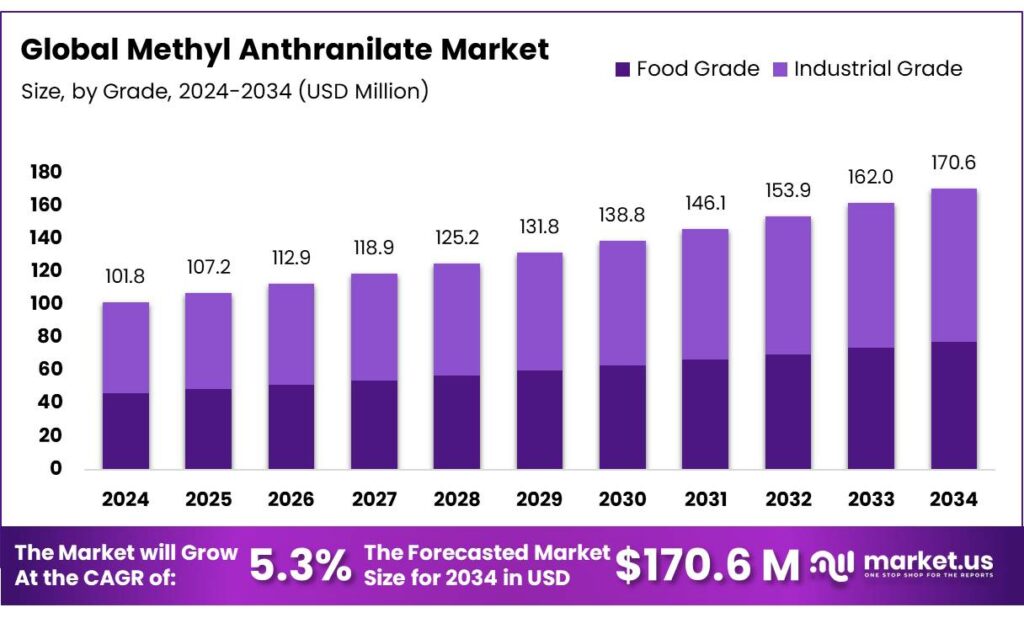
The Global Methyl Anthranilate Market is expected to be worth around USD 170.6 Million by 2034, up from USD 101.8 Million in 2024, and is projected to grow at a CAGR of 5.3% from 2025 to 2034. The North America segment maintained 46.8%, supporting a Methyl Anthranilate value of USD 0.7 Bn.
Methyl anthranilate is a naturally occurring organic compound known for its strong, sweet, fruity aroma, giving concord grapes their distinct smell. Its market is driven by its diverse applications across multiple industries, particularly in food and beverages, fragrances, and agriculture. It is widely used in the food and beverage sector as a flavoring agent, adding a grape-like or fruity note to drinks, candies, and snacks. The growing demand for unique, natural flavors has boosted its use in this space.
- The grape flavor has seen double-digit year-over-year growth in the flavored malt and RTD categories. Additionally, according to the National Confectioners Association (NCA), in the US alone, the total sales of confectionery items reached around US$54.2 billion. The rise in these numbers, particularly with the increasing demand for grape-flavored products, has boosted methyl anthranilate usage.
Additionally, in fragrances, it is valued for its floral, sweet scent, making it a key component in perfumes, air fresheners, and personal care products. Furthermore, the agricultural sector leverages its pest-repellent properties, especially as a bird deterrent in fruit farming, by irritating the trigeminal nerves of the birds.
While synthetic methyl anthranilate dominates due to its cost-effectiveness and scalability, natural alternatives are gaining interest, particularly among eco-conscious consumers. However, despite its broad appeal, the compound’s use in pharmaceuticals and insect repellents remains more niche, with demand concentrated in specific applications.
Key Takeaways
- The global methyl anthranilate market was valued at USD 101.8 million in 2024.
- The global methyl anthranilate market is projected to grow at a CAGR of 5.3% and is estimated to reach USD 170.6 million by 2034.
- Based on the source, synthetic methyl anthranilate dominated the market, with a substantial market share of around 68.9%.
- On the basis of grade, the market is dominated by industrial grade methyl anthranilate, comprising 54.4% share of the total market.
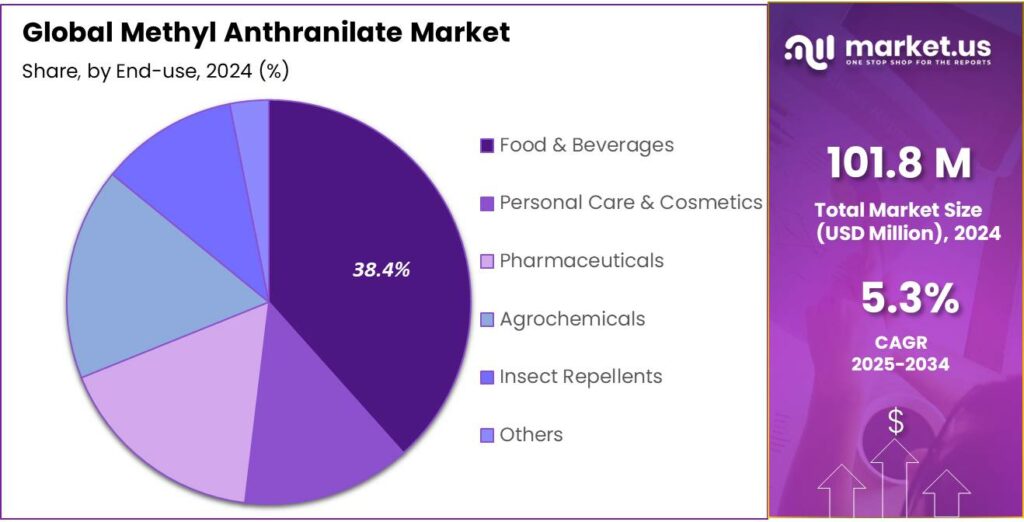
- Among the end-uses of methyl anthranilate, the food & beverages sector held a major share in the market, 38.4% of the market share.
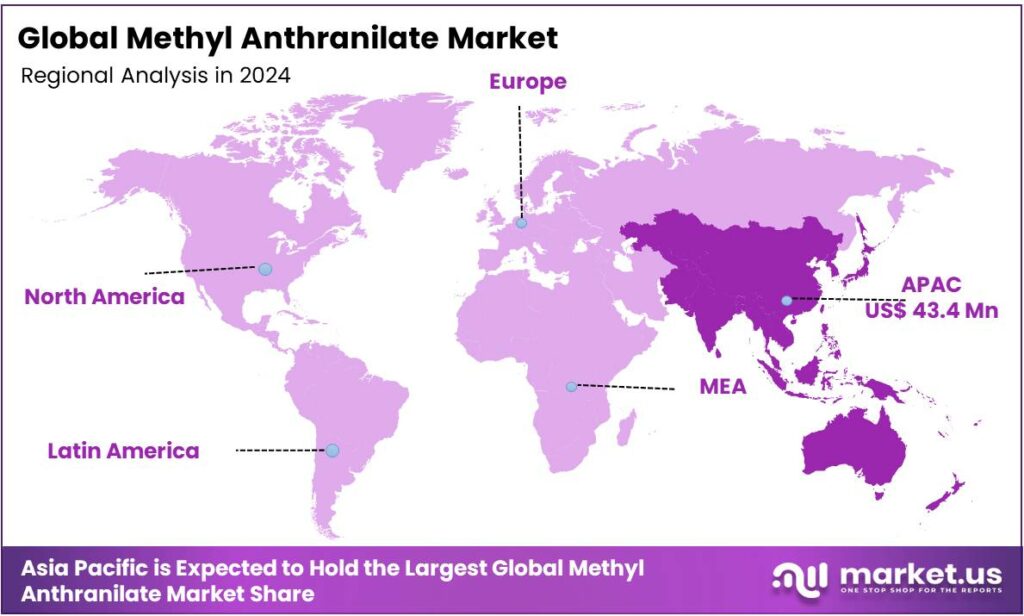
- In 2024, the Asia Pacific was the most dominant region in the methyl anthranilate market, accounting for around 42.6% of the total global consumption.
Source Analysis
Synthetic Methyl Anthranilate is a Prominent Segment in the Market.
The methyl anthranilate market is segmented based on source as synthetic and natural. The synthetic methyl anthranilate dominated the market, comprising around 68.9% of the market share. Synthetic methyl anthranilate is more widely used than its natural counterpart, mainly due to its lower production costs and scalability. Manufacturing synthetic methyl anthranilate in large quantities is more efficient and cost-effective compared to extracting it from natural sources, such as grapes.
Natural methyl anthranilate, being derived from plant materials, can be more expensive due to the costs involved in sourcing, processing, and ensuring consistent quality. Additionally, synthetic versions can be produced with a high degree of purity and consistency, which is crucial for industries such as food, beverages, and fragrance, where uniformity is key. Similarly, the demand for large volumes in commercial applications makes synthetic methyl anthranilate the preferred choice for manufacturers, making it more accessible and widely used.
Grade Analysis
Industrial Grade Methyl Anthranilate Dominated the Market.
On the basis of grades of methyl anthranilate, the market is segmented into food grade and industrial grade. The industrial-grade methyl anthranilate dominated the market, comprising around 54.4% of the market share, due to its broader range of applications and higher demand in various industries. Industrial-grade methyl anthranilate is widely used in manufacturing sectors, including agriculture (as a bird repellent) and fragrances, which require large quantities for production.
In contrast, food-grade methyl anthranilate is subject to more rigorous regulations, limiting its application to specific products, such as flavoring agents in small quantities. As industrial applications often consume larger volumes of methyl anthranilate, the revenue generated from industrial-grade versions surpasses that of the food-grade type.
End-Use Analysis
The Food & Beverages Sector was the Most Used Technology for Methyl Anthranilate.
Based on the end-use of methyl anthranilate, the market is divided into food & beverages, personal care & cosmetics, pharmaceuticals, agrochemicals, insect repellents, and others. The food & beverages sector dominated the market, with a market share of 38.4%, due to its appealing fruity flavor, which is highly sought after in flavoring agents for products such as soft drinks, candies, and snacks. In addition, its natural aroma makes it a preferred choice for creating refreshing taste profiles, particularly in non-alcoholic beverages and confectionery.
While it is used in personal care, cosmetics, agrochemicals, and insect repellents, its applications in these industries are more niche and specialized. Furthermore, the food and beverage market demands larger quantities and is driven by consumer preference for unique, natural flavors, ensuring steady demand. Further industries, such as cosmetics and agrochemicals, use methyl anthranilate in much smaller volumes, where it often serves a supplementary role in fragrance or pest control rather than being a primary ingredient.
Key Market Segments:
By Source
- Synthetic
- Natural
By Grade
- Food Grade
- Industrial Grade
By End-use
- Food & Beverages
- Beverages
- Confectionery
- Others
- Personal Care & Cosmetics
- Skin Care
- Hair Care
- Fragrances
- Deodorants
- Perfumes
- Others
- Pharmaceuticals
- Agrochemicals
- Insect Repellents
- Others
Drivers
Expansion of the Food & Beverage Industry Drives the Methyl Anthranilate Market.
The food & beverage industry has been a key driver of the methyl anthranilate market, primarily due to its role as a flavoring agent. Methyl anthranilate is widely used in beverages, candies, and other food products to impart a distinct, fruity aroma and taste. Its application has grown in popularity, particularly in non-alcoholic drinks such as sodas and fruit juices, as well as in flavored confections.
- According to the Organic Trade Association (OTA), in 2024, the organic food sales in the US alone reached US$71.6 billion, marking a 5.2% increase from 2023.
The rise of natural and organic food products has contributed to the growth of the market, as consumers increasingly seek out flavoring agents that are perceived as safer or more authentic. As more food and beverage companies shift towards unique and exotic flavors to meet evolving consumer tastes, methyl anthranilate continues to gain importance as a versatile ingredient in food production.
Restraints
Commercial Production Challenges Might Delay the Growth of the Methyl Anthranilate Market.
Methyl anthranilate, widely appreciated for its distinctive concord grape aroma and its occurrence in high-value essential oils such as neroli, ylang ylang, and jasmine, encounters prominent challenges in commercial production. For instance, extraction from natural plant sources is not economically viable due to the extremely low concentrations of methyl anthranilate, which leads to insufficient yields.
Consequently, industrial production is predominantly based on petroleum-derived chemical synthesis, most often through acid-catalyzed esterification processes. These methods require substantial quantities of strong homogeneous acids, generate hazardous waste streams, and involve complex and costly disposal procedures, posing environmental and regulatory challenges.
Furthermore, methyl anthranilate produced via chemical synthesis is classified as an artificial flavor, which is increasingly misaligned with consumer preferences for natural and clean-label products. Although enzymatic and microbial biotransformation approaches have been investigated as more sustainable alternatives, their industrial application remains limited by low yields, prolonged reaction times, formation of undesired byproducts, and reliance on petrochemical feedstocks.
Opportunity
Booming Fragrance Industry Creates Opportunities in the Methyl Anthranilate Market.
The booming fragrance industry is playing a significant role in creating opportunities for the methyl anthranilate market, as this compound is highly valued for its sweet, fruity scent, which closely resembles that of grape blossoms. It is often used in perfumes, colognes, and air fresheners, contributing to the growing trend for more complex and natural fragrances.
- A case study revealed that 73% of Gen Z wear fragrance at least three times per week, and annual fragrance spending among teenage boys grew by 44% in 2024. Additionally, approximately 23% of the growth of the beauty industry is contributed by fragrance products. With global fragrance consumption on the rise, the role of methyl anthranilate in the creation of signature, lasting fragrances continues to present growth opportunities for the compound in the industry.
The compound methyl anthranilate is particularly sought after for its ability to provide a fresh, floral note in high-end and mass-market products. As consumer preferences shift towards more refreshing, natural, and fruity scents, brands are increasingly incorporating this compound into their formulations.
Trends
Adoption of Methyl Anthranilate in Crop Protection.
The methyl anthranilate in crop protection is gaining traction due to its effectiveness as a natural repellent against a variety of pests, particularly birds. Farmers are increasingly utilizing this compound as a safer, eco-friendly alternative to synthetic pesticides. Methyl anthranilate’s strong, grape-like odor is known to deter birds from damaging crops.
- In a case study, methyl anthranilate was studied as a bird repellent on cherries, blueberries, and grapes, which recorded a slight production gain of 2.5% for Bing cherries, a 57% damage reduction for wine grapes, and for hingbush berries, a 80% damage reduction was found.
Additionally, its non-toxic nature to humans and animals makes it an attractive option for organic farming and sustainable agriculture. For instance, vineyards have increasingly used methyl anthranilate to prevent bird predation during harvest seasons, reducing the requirement for harmful chemical interventions. As the agricultural industry embraces greener practices and moves away from harmful chemicals, methyl anthranilate’s role in crop protection is likely to expand, aligning with global sustainability efforts.
Geopolitical Impact Analysis
Geopolitical Tensions Are Impacting the Trade Dynamics of Methyl Anthranilate.
The geopolitical tensions have had a noticeable impact on the methyl anthranilate market, disrupting both supply chains and trade dynamics. The ongoing global supply chain challenges, exacerbated by conflicts and sanctions, have led to increased costs and delays in raw material sourcing. For instance, China is the major exporter of methyl anthranilate, and sanctions on Chinese imported goods have significantly increased the prices of the compound, impacting the vertical industries.
Similarly, as most of the compound is produced synthetically through petrochemicals, the disruption in the petrochemical industry supply chains due to conflicts, such as the Russia-Ukraine war and disruption in major maritime routes, has impacted the market negatively. These geopolitical factors have impacted the timely delivery of essential raw materials, pushing up prices and limiting availability.
In contrast, the increased demand for locally sourced or sustainable products in response to these tensions has led to greater interest in domestically produced alternatives to imported chemicals, including methyl anthranilate. Moreover, the uncertain political climate has caused some companies to reconsider their reliance on international suppliers, leading to more regional partnerships and innovations in production.
Regional Analysis
Asia Pacific Held the Largest Share of the Global Methyl Anthranilate Market.
In 2024, the Asia Pacific dominated the global methyl anthranilate market, holding about 42.6% of the total global consumption, largely driven by the region’s strong presence in the food and beverage, fragrance, and agricultural sectors. Countries such as China and India are major consumers of methyl anthranilate due to the growing demand for flavored beverages, candies, and natural fragrances.
In addition, the region is a key player in agriculture, where methyl anthranilate is increasingly used as a bird repellent in fruit farming. For instance, India’s extensive fruit production, especially in crops such as grapes and pomegranates, has driven the adoption of methyl anthranilate to protect harvests.
Additionally, the rapidly expanding cosmetics and personal care industry in countries such as South Korea and Japan has contributed to the demand for the compound in fragrance formulations. As Asia Pacific continues to urbanize and industrialize, its increasing consumer base and shifting preferences for natural, sustainable products ensure that it remains a dominant force in the methyl anthranilate market.
Key Regions and Countries
- North America
- The US
- Canada
- Europe
- Germany
- France
- The UK
- Spain
- Italy
- Russia & CIS
- Rest of Europe
- APAC
- China
- Japan
- South Korea
- India
- ASEAN
- Rest of APAC
- Latin America
- Brazil
- Mexico
- Rest of Latin America
- Middle East & Africa
- GCC
- South Africa
- Rest of MEA
Key Players Analysis
The companies in the market focus on diversifying their product applications, targeting industries such as food and beverages, fragrance, and crop protection. By developing tailored solutions for different sectors, they try to cater to a broader customer base. Additionally, these companies prioritize strengthening their supply chain by establishing local production facilities or securing reliable raw material sources, reducing dependence on global supply chains.
Furthermore, the players emphasize investments in research and development (R&D) to improve the efficiency and acquisitions of the local players to expand their product portfolio and enhance their geographic expansion. Moreover, they emphasize strategic partnerships with key players in agriculture, cosmetics, and food sectors for better customer reach, further solidifying their position in the market.
The Major Players in The Industry
- Givaudan
- Anshul Specialty Molecules Private Limited
- Foodchem International Corporation
- Axxence Aromatic GmbH
- Zhengzhou Alfa Chemical Co., Ltd.
- Mubychem Group
- Ambernath Organics Pvt. Ltd.
- Wujiang New Sunlion Chemical Co., Ltd.
- Rang Sarjan Chemicals
- Other Key Players
Key Development
- In April 2025, Axxence, a natural aroma ingredient supplier, announced the acquisition of Purely Natural, a Florida-based supplier of natural flavor ingredients, to expand its presence in the U.S. market.
- In December 2025, Givaudan, the global leader in fragrance & beauty, announced the acquisition of the Belle Aire Creations, a prominent US-based fragrance house known for its creative expertise and strong regional customer relationships.
Report Scope
Report Features Description Market Value (2024) US$101.8 Mn Forecast Revenue (2034) US$170.6 Mn CAGR (2025-2034) 5.3% Base Year for Estimation 2024 Historic Period 2020-2023 Forecast Period 2025-2034 Report Coverage Revenue Forecast, Market Dynamics, Competitive Landscape, Recent Developments Segments Covered By Source (Synthetic and Natural), By Grade (Food Grade and Industrial Grade), By End-Use (Food & Beverages, Personal Care & Cosmetics, Pharmaceuticals, Agrochemicals, Insect Repellents, and Others) Regional Analysis North America – The US & Canada; Europe – Germany, France, The UK, Spain, Italy, Russia & CIS, Rest of Europe; APAC– China, Japan, South Korea, India, ASEAN & Rest of APAC; Latin America– Brazil, Mexico & Rest of Latin America; Middle East & Africa– GCC, South Africa, & Rest of MEA Competitive Landscape Givaudan, Anshul Specialty Molecules Private Limited, Foodchem International Corporation, Axxence Aromatic GmbH, Zhengzhou Alfa Chemical Co., Ltd., Mubychem Group, Ambernath Organics Pvt. Ltd., Wujiang New Sunlion Chemical Co., Ltd., Rang Sarjan Chemicals, and Other Players. Customization Scope Customization for segments, region/country-level will be provided. Moreover, additional customization can be done based on the requirements. Purchase Options We have three licenses to opt for: Single User License, Multi-User License (Up to 5 Users), Corporate Use License (Unlimited Users and Printable PDF) 
-
-
- Givaudan
- Anshul Specialty Molecules Private Limited
- Foodchem International Corporation
- Axxence Aromatic GmbH
- Zhengzhou Alfa Chemical Co., Ltd.
- Mubychem Group
- Ambernath Organics Pvt. Ltd.
- Wujiang New Sunlion Chemical Co., Ltd.
- Rang Sarjan Chemicals
- Other Key Players
Our Clients

- 177873
- Feb 2026






