


Global Massage Therapy Service Market Size, Share, Growth Analysis By Massage Type (Swedish Massage, Deep Tissue Massage, Sports Massage, Hot Stone Massage, Thai Massage, Others), By Service Provider (Spas and Salons, Massage and Physical Therapists, Hotels and Resorts, Others), By End Use (Women, Men), By Region and Companies - Industry Segment Outlook, Market Assessment, Competition Scenario, Statistics, Trends and Forecast 2026-2035
- Published date: Feb 2026
- Report ID: 180015
- Number of Pages: 261
- Format:
-
keyboard_arrow_up
Quick Navigation
Report Overview
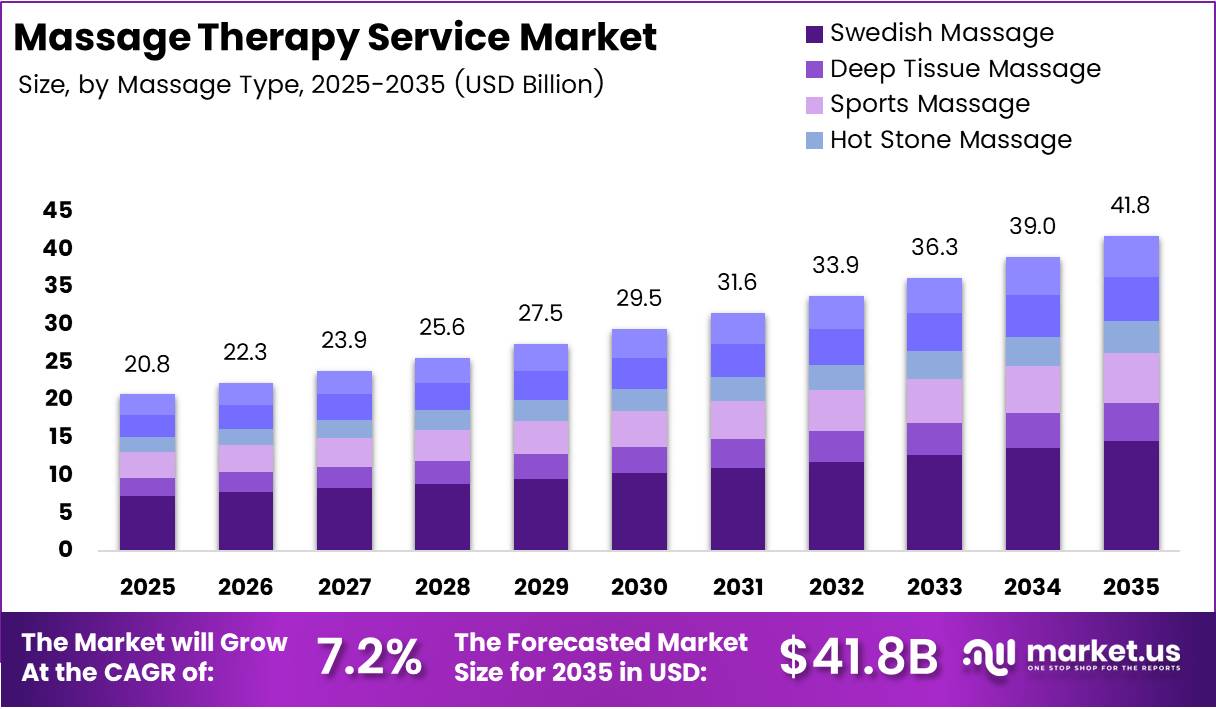
Global Massage Therapy Service Market size is expected to be worth around USD 41.8 Billion by 2035 from USD 20.8 Billion in 2025, growing at a CAGR of 7.2% during the forecast period 2026 to 2035.
The massage therapy service market covers professional therapeutic touch services delivered across spas, clinics, hotels, and on-demand home settings. These services address pain relief, stress management, sports recovery, and general wellness. The market spans Swedish, deep tissue, sports, hot stone, and Thai massage modalities, each serving distinct consumer segments with different price tolerances and therapeutic goals.
Consumer behavior in this market has shifted decisively toward preventive care. Buyers no longer treat massage as a luxury — they treat it as a recurring health expenditure. This shift compresses discretionary spend sensitivity and increases visit frequency, which directly benefits subscription-based franchise operators and membership wellness chains.
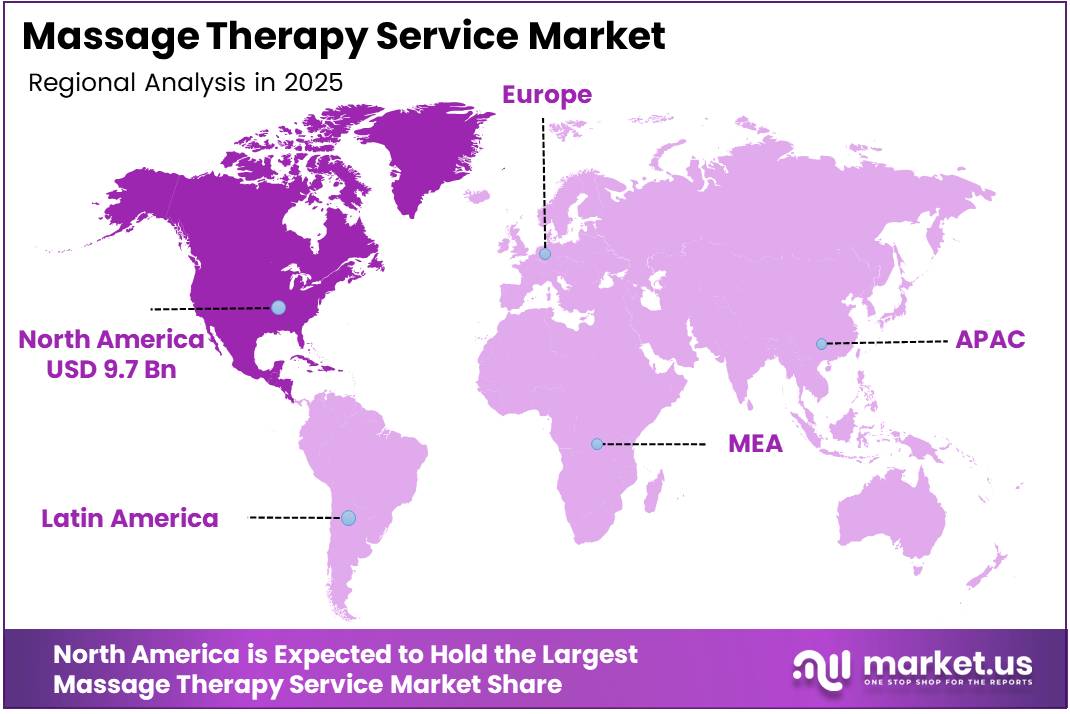
North America holds the largest regional position, accounting for 47.1% of global revenue, valued at USD 9.7 Billion. This dominance reflects mature consumer wellness infrastructure, established franchise networks, and strong insurance and employer wellness program linkages that do not yet exist at scale in other regions.
Women represent 69.1% of end-use demand, underscoring that female consumers form the primary revenue base for spas, salons, and wellness centers. Operators who design service menus, loyalty programs, and marketing channels primarily for this demographic hold a structural pricing and retention advantage.
In March 2025, XWELL announced plans to acquire select medical spas, signaling that wellness operators now view clinical-grade spa assets as strategic revenue diversification. This move points toward a converging market where cosmetic, medical, and therapeutic services increasingly compete for the same consumer wallet.
According to the American Massage Therapy Association 2025 Massage Therapy Industry Fact Sheet, 79% of surveyed individuals received their last massage for health, wellness, or stress reduction reasons. This figure confirms that therapeutic intent — not leisure — now drives the majority of session bookings, reshaping how providers must position and price their services.
According to the American Massage Therapy Association, 91% of individuals surveyed in the twelve months ending June 2025 view massage as beneficial to overall health and wellness. When nine in ten consumers already hold a positive health perception of massage, the primary growth barrier is access and affordability — not awareness or conviction.
Key Takeaways
- The Global Massage Therapy Service Market was valued at USD 20.8 Billion in 2025 and is forecast to reach USD 41.8 Billion by 2035.
- The market grows at a CAGR of 7.2% during the forecast period 2026 to 2035.
- By Massage Type, Swedish Massage leads with a 34.6% share in 2025.
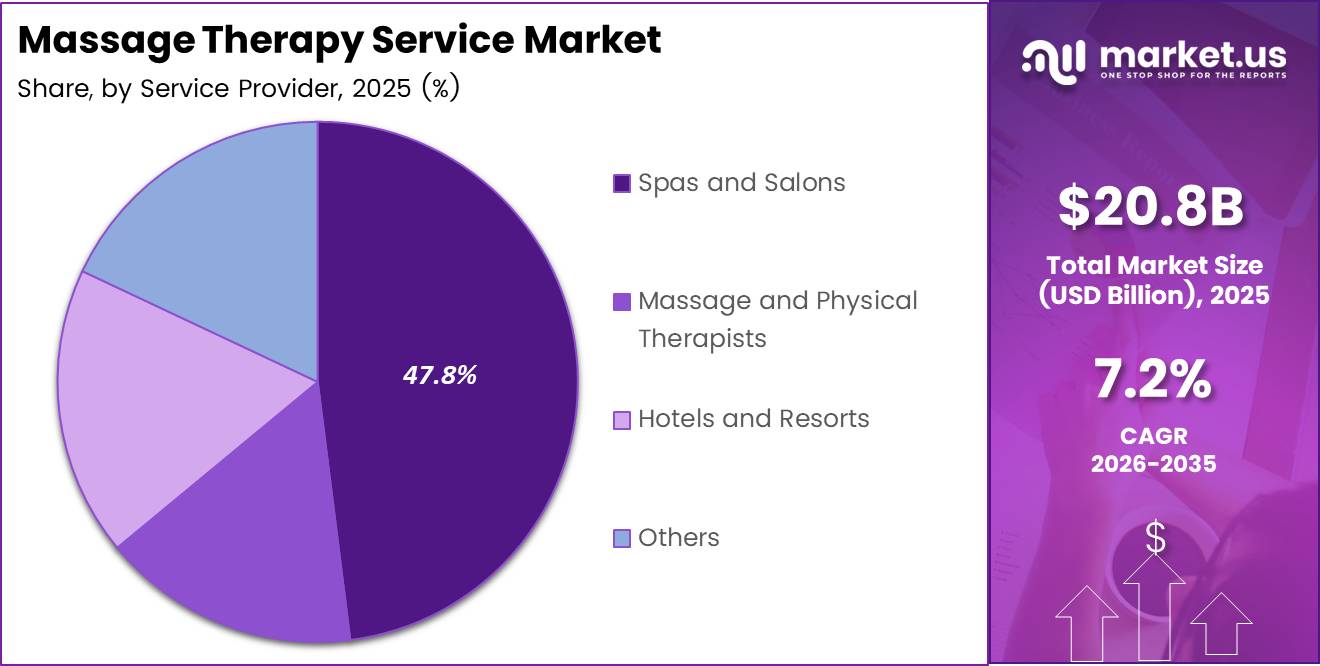
- By Service Provider, Spas and Salons hold the dominant position with a 47.8% share.
- By End Use, Women account for 69.1% of total market demand.
- North America dominates regionally with a 47.1% share, valued at USD 9.7 Billion.
Product Analysis
Swedish Massage dominates with 34.6% due to broad consumer accessibility and low entry barrier.
In 2025, Swedish Massage held a dominant market position in the By Massage Type segment of the Massage Therapy Service Market, with a 34.6% share. Its gentle, full-body technique appeals to first-time and repeat clients alike, making it the default entry point across spas, salons, and wellness chains. This broad accessibility anchors Swedish massage as the highest-volume revenue driver in the service mix.
Deep Tissue Massage carries a higher per-session price point than Swedish massage, attracting clients with chronic pain and musculoskeletal conditions. Its therapeutic positioning aligns closely with the medical and rehabilitation demand channel, where referral-based bookings reduce client acquisition costs. Moreover, therapist specialization requirements give providers who offer deep tissue a differentiation edge in premium urban markets.
Sports Massage serves a distinct, outcome-driven client base of athletes and active individuals seeking faster recovery and injury prevention. Demand correlates directly with gym membership density, sports event calendars, and corporate wellness program adoption. Consequently, sports massage providers embedded within fitness centers or sports medicine clinics capture a recurring, high-frequency booking pattern that standalone spas cannot easily replicate.
Hot Stone Massage differentiates through its premium sensory experience and higher session price, positioning it firmly in the luxury and resort wellness segment. It commands greater per-session revenue than standard modalities, but therapist setup time and equipment requirements limit throughput. Therefore, hot stone massage generates high per-client value but contributes a smaller share of total session volume.
Thai Massage operates as a culturally distinct modality that attracts wellness enthusiasts seeking active, stretch-based therapy. Its growing visibility in urban wellness centers and boutique spa environments reflects consumer appetite for diverse therapeutic techniques beyond Western tradition. Additionally, Thai massage training programs support a pipeline of certified therapists capable of expanding service availability in metropolitan markets.
Others in the massage type segment include lymphatic drainage, prenatal massage, reflexology, and aromatherapy-integrated services. These specialized techniques address niche but underserved medical and wellness needs, enabling providers to build differentiated service menus. As personalization becomes a competitive lever, operators who expand into specialized modalities can capture premium pricing and reduce direct competition with volume-based chains.
Service Provider Analysis
Spas and Salons dominate with 47.8% due to established consumer trust and multi-service bundling.
In 2025, Spas and Salons held a dominant market position in the By Service Provider segment of the Massage Therapy Service Market, with a 47.8% share. Their ability to bundle massage with beauty, skincare, and wellness treatments drives higher per-visit spend and repeat visits. This multi-service model creates retention advantages that single-modality providers and independent therapists cannot match at scale.
Massage and Physical Therapists occupy the clinical and rehabilitative segment of the market, where therapeutic outcomes rather than ambiance drive client selection. Referrals from physicians and physical therapists create a structured demand pipeline that is less price-sensitive than retail spa consumers. However, the median annual pay for massage therapists reached $58,500 in 2025, according to the U.S. Bureau of Labor Statistics — a cost structure that pressures independent practitioners and small clinic operators on margin.
Hotels and Resorts serve a high-value but episodic client base of travelers and vacationers, making them dependent on tourism volumes and occupancy rates. Luxury properties use spa and massage services as a premium amenity that supports room rate justification and guest loyalty. However, reliance on travel demand makes this provider segment more cyclically sensitive than community-based wellness operators.
Others in the service provider segment include corporate wellness operators, mobile therapists, and on-demand app-based platforms. In November 2024, Hand and Stone Massage and Facial Spa converted 30 LaVida Massage locations into its franchise network, illustrating that consolidation across provider types is accelerating. Operators who establish scale through franchising or acquisitions gain pricing power and brand recognition that independent providers cannot access.
End-Use Analysis
Women dominate with 69.1% due to higher wellness engagement and preventive healthcare spending.
In 2025, Women held a dominant market position in the By End Use segment of the Massage Therapy Service Market, with a 69.1% share. Female consumers demonstrate higher engagement with preventive wellness, stress management services, and recurring spa memberships. This behavioral pattern translates into superior lifetime client value and higher session frequency compared to male consumer segments.
Men represent a smaller but structurally distinct segment with concentrated demand in sports recovery, deep tissue therapy, and corporate wellness contexts. Male consumer adoption of massage therapy has grown alongside gym culture and increased awareness of physical recovery needs. Consequently, providers who market therapeutic outcomes — rather than relaxation — to male audiences can unlock incremental demand from an underserved demographic.
Key Market Segments
By Massage Type
- Swedish Massage
- Deep Tissue Massage
- Sports Massage
- Hot Stone Massage
- Thai Massage
- Others
By Service Provider
- Spas and Salons
- Massage and Physical Therapists
- Hotels and Resorts
- Others
By End Use
- Women
- Men
Drivers
Healthcare Positioning and Therapeutic Demand Accelerate Massage Therapy Adoption Across Consumer Segments
Consumer spending on preventive healthcare now directly funds massage therapy session growth. Buyers increasingly replace pharmaceutical pain management with therapeutic massage, reducing their dependence on over-the-counter and prescription medications. According to the American Massage Therapy Association, 94% of individuals surveyed in the twelve months ending June 2025 believe massage therapy can effectively reduce pain — a conviction that converts into consistent booking behavior.
Workplace stress and sedentary office lifestyles create a sustained, non-discretionary demand base for therapeutic massage. Musculoskeletal disorders linked to prolonged desk work drive repeat visits to massage therapists and physical rehabilitation providers. This demand pattern is not seasonal or trend-dependent — it reflects a structural health consequence of modern work environments that sustains service frequency regardless of broader economic cycles.
Wellness tourism and luxury hospitality have expanded the premium end of the massage service market. Resorts and destination spas now position massage as a core guest experience rather than an optional add-on, justifying higher service pricing. Additionally, sports rehabilitation programs at professional and amateur levels have integrated massage therapy into standard recovery protocols, establishing recurring institutional demand from athletic organizations and fitness operators.
Restraints
Therapist Supply Shortages and Premium Pricing Combine to Constrain Market Reach in Key Consumer Segments
A shortage of certified and licensed massage therapists limits service capacity in emerging markets and rural geographies. Training programs require significant time and financial investment from candidates, and licensure requirements vary by jurisdiction, creating uneven supply across regions. This supply constraint prevents providers from scaling operations to meet demand, particularly in underserved suburban and rural markets where wellness infrastructure remains underdeveloped.
According to the American Massage Therapy Association, 29% of respondents in the twelve months ending June 2025 used massage therapy for pain relief — a meaningful share, but one that reflects how cost and access barriers still exclude a large portion of pain-affected consumers. High session prices at premium spas and wellness centers make regular massage therapy financially inaccessible for middle-income consumers who would otherwise benefit from it.
The cost barrier creates a bifurcated market where affluent consumers access full-service wellness experiences while mid-market consumers limit visits to occasional or event-driven sessions. This segmentation restricts total addressable volume and limits operator revenue predictability. Consequently, providers who cannot offer affordable membership models or insurance-aligned pricing face slower client acquisition rates and higher churn among price-sensitive segments.
Growth Factors
Digital Platforms, Corporate Wellness Programs, and Medical Integration Create New Revenue Channels for Massage Providers
Digital booking platforms and on-demand home massage applications remove the access barriers that historically limited service reach to physical locations. Providers who invest in app-based scheduling capture mobile-first consumers who prioritize convenience over in-venue experience. According to the American Massage Therapy Association, 71% of massage consumers used massage for a health or medical reason in the twelve months ending June 2025 — a statistic that validates demand for clinically positioned, accessible service delivery models.
Corporate wellness programs represent a structured institutional demand channel that delivers predictable, recurring bookings to service providers. Employers integrating workplace massage therapy into employee benefits packages reduce per-session acquisition costs for providers and increase session frequency among working adults. Furthermore, 86% of consumers in the twelve months ending June 2025 agree that massage therapy should be considered a form of healthcare, according to the American Massage Therapy Association — a perception that supports employer health benefit classification and third-party payment inclusion.
Medical massage therapy within physiotherapy clinics and rehabilitation centers opens a referral-driven revenue stream that bypasses traditional consumer marketing costs. In January 2025, SPS PoolCare acquired Frontline Pool and Spa Services to strengthen its operational capabilities, reflecting broader sector momentum toward consolidation and service scope expansion. Personalized wellness packages combining massage, aromatherapy, and complementary treatments further increase per-visit revenue and deepen client retention across all provider types.
Emerging Trends
Technology Integration and Specialized Techniques Redefine Service Delivery and Consumer Expectations in Wellness Markets
Mobile and at-home massage service models have changed the competitive calculus for established spa operators. On-demand platforms allow consumers to receive professional massage services without visiting a physical location, directly competing with traditional brick-and-mortar providers. According to data trends reported via AMTA 2025, 40% of clients found massage therapists through online locator services, 32% used websites, and 31% used social media — confirming that digital discovery now dominates client acquisition across the entire market.
AI-based scheduling and customer management systems reduce operational overhead for wellness centers by automating appointment bookings, client follow-ups, and therapist allocation. In April 2025, Aescape raised $83 million in strategic funding to accelerate U.S. expansion and scale production of its AI-powered robotic massage therapy system. This capital raise signals institutional confidence that technology-assisted massage delivery can operate at commercial scale, potentially lowering per-session labor costs for high-volume operators.
CBD-infused massage oils and specialized techniques such as lymphatic drainage have moved from niche offerings to mainstream service menu items. Providers who adopt these modalities early capture premium pricing from wellness-informed consumers willing to pay for perceived therapeutic differentiation. Additionally, lymphatic drainage and advanced deep tissue protocols appeal to post-surgical recovery and medical wellness segments, which carry higher session values and lower price sensitivity than general relaxation clients.
Regional Analysis
North America Dominates the Massage Therapy Service Market with a Market Share of 47.1%, Valued at USD 9.7 Billion
North America holds a 47.1% share of the global massage therapy service market, valued at USD 9.7 Billion in 2025. This position reflects decades of established franchise infrastructure, high consumer health-awareness, and the growing integration of massage therapy into employer wellness benefits and physical rehabilitation programs. The mature U.S. market sets pricing and service benchmarks that other regions progressively adopt.
Europe Massage Therapy Service Market Trends
Europe represents the second-largest regional market, driven by strong spa culture in Western European countries and rising awareness of massage as a preventive health tool. Germany, the UK, and France anchor regional demand through established wellness hospitality sectors and increasing consumer spending on personal healthcare services. Additionally, European regulatory frameworks for massage therapist certification create quality standards that support consumer confidence and premium pricing.
Asia Pacific Massage Therapy Service Market Trends
Asia Pacific combines a deeply rooted traditional massage culture with a rapidly expanding urban middle class seeking structured wellness services. Countries including China, India, and South Korea drive demand through growing hospitality sectors and rising disposable income. Moreover, traditional Asian massage modalities such as Thai massage and Ayurvedic treatments have strong domestic demand bases, giving regional operators a culturally differentiated product that commands consumer loyalty.
Middle East and Africa Massage Therapy Service Market Trends
The Middle East and Africa region shows concentrated demand within luxury resort and hotel wellness facilities, particularly in the GCC countries. High-net-worth consumer populations and substantial tourism inflows to destinations such as Dubai and Abu Dhabi support a premium service tier. However, limited certified therapist supply outside major urban centers restricts broader market penetration across the African continent.
Latin America Massage Therapy Service Market Trends
Latin America presents an early-stage growth profile, with Brazil and Mexico leading regional adoption through expanding urban spa networks and wellness tourism infrastructure. Rising healthcare awareness and growing middle-class consumption support gradual service volume increases. Consequently, international franchise operators entering Latin America now position themselves ahead of the consumer wealth curve, gaining brand recognition before domestic competition scales.
Key Regions and Countries
North America
- US
- Canada
Europe
- Germany
- France
- The UK
- Spain
- Italy
- Rest of Europe
Asia Pacific
- China
- Japan
- South Korea
- India
- Australia
- Rest of APAC
Latin America
- Brazil
- Mexico
- Rest of Latin America
Middle East & Africa
- GCC
- South Africa
- Rest of MEA
Key Company Insights
Massage Envy Franchising LLC operates as the largest franchise network in the U.S. massage therapy sector, leveraging a membership-based model that converts one-time visitors into recurring revenue subscribers. This subscription structure reduces client acquisition costs and creates predictable cash flow that independent operators cannot replicate. In April 2025, AMTA awarded five $10,000 grants funded by Massage Envy to advance massage therapy education, reinforcing the company’s strategic role in shaping therapist supply and brand credibility simultaneously.
Hand & Stone Massage and Facial Spa has built a differentiated position by combining massage with facial services under one membership roof, increasing per-visit spend and cross-sell conversion. The company’s aggressive franchise expansion is illustrated by its conversion of 30 LaVida Massage locations into its network in November 2024, a move that simultaneously eliminated a competitor and expanded its geographic footprint. This acquisition-led growth strategy accelerates market penetration faster than organic unit development alone.
Elements Massage positions itself around a customization model, allowing clients to tailor each session to their specific therapeutic needs rather than selecting from fixed service menus. This approach targets outcome-focused consumers who value functional results over standardized spa experiences. By enabling therapist-client session design, Elements builds stronger loyalty among clients managing chronic conditions — a segment with higher visit frequency and lower price sensitivity than general wellness consumers.
Massage Heights focuses on the neighborhood wellness model, placing franchise locations within convenient retail environments that lower the commitment threshold for first-time clients. Its membership tiers allow flexible pricing access, which broadens the addressable consumer base beyond premium spa users. This proximity-first strategy reduces client travel friction and supports higher visit frequency, directly translating into stronger membership retention metrics compared to destination-only wellness concepts.
Key Players
- Massage Envy Franchising LLC
- Hand & Stone Massage and Facial Spa
- Elements Massage
- Massage Heights
- The Woodhouse Day Spa
- MassageLuXe
- Soothe Inc.
- The NOW Massage
- Spavia Day Spa
- LaVida Massage
Recent Developments
- April 2025 — Aescape raised $83 million in strategic funding to accelerate U.S. expansion and scale production of its AI-powered robotic massage therapy system, signaling institutional confidence in technology-assisted service delivery at commercial scale.
- November 2025 — GoSaga acquired Squeeze Massage to expand its wellness portfolio, reflecting ongoing consolidation among mid-market wellness operators seeking to build multi-brand service ecosystems.
- April 2025 — AMTA announced a call for massage school grant applications funded by Massage Envy, awarding five $10,000 grants to advance the massage therapy profession and address the certified therapist supply gap.
Report Scope
Report Features Description Market Value (2025) USD 20.8 Billion Forecast Revenue (2035) USD 41.8 Billion CAGR (2026-2035) 7.2% Base Year for Estimation 2025 Historic Period 2020-2024 Forecast Period 2026-2035 Report Coverage Revenue Forecast, Market Dynamics, Competitive Landscape, Recent Developments Segments Covered By Massage Type (Swedish Massage, Deep Tissue Massage, Sports Massage, Hot Stone Massage, Thai Massage, Others), By Service Provider (Spas and Salons, Massage and Physical Therapists, Hotels and Resorts, Others), By End Use (Women, Men) Regional Analysis North America (US and Canada), Europe (Germany, France, The UK, Spain, Italy, and Rest of Europe), Asia Pacific (China, Japan, South Korea, India, Australia, and Rest of APAC), Latin America (Brazil, Mexico, and Rest of Latin America), Middle East & Africa (GCC, South Africa, and Rest of MEA) Competitive Landscape Massage Envy Franchising LLC, Hand & Stone Massage and Facial Spa, Elements Massage, Massage Heights, The Woodhouse Day Spa, MassageLuXe, Soothe Inc., The NOW Massage, Spavia Day Spa, LaVida Massage Customization Scope Customization for segments, region/country-level will be provided. Moreover, additional customization can be done based on the requirements. Purchase Options We have three licenses to opt for: Single User License, Multi-User License (Up to 5 Users), Corporate Use License (Unlimited User and Printable PDF)  Massage Therapy Service MarketPublished date: Feb 2026add_shopping_cartBuy Now get_appDownload Sample
 -
-
- Massage Envy Franchising LLC
- Hand & Stone Massage and Facial Spa
- Elements Massage
- Massage Heights
- The Woodhouse Day Spa
- MassageLuXe
- Soothe Inc.
- The NOW Massage
- Spavia Day Spa
- LaVida Massage
Our Clients

- 180015
- Feb 2026






