Report Overview
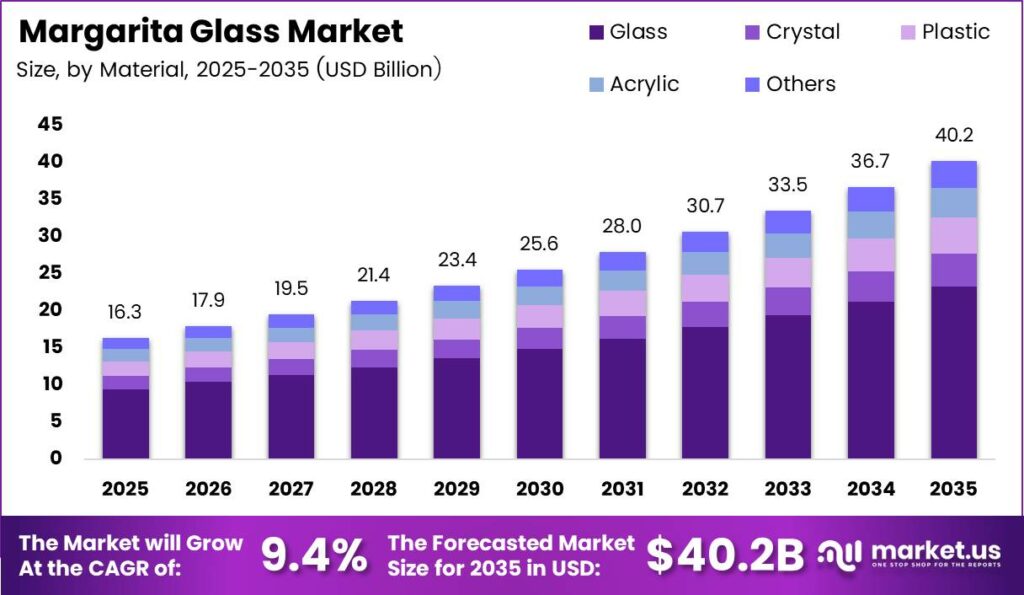
Global Margarita Glass Market size is expected to be worth around USD 40.2 Billion by 2035 from USD 16.3 Billion in 2025, growing at a CAGR of 9.4% during the forecast period 2026 to 2035.
The margarita glass market covers the design, manufacture, and distribution of purpose-built vessels used to serve margarita cocktails across commercial and residential settings. The market spans traditional stemmed glasses, stemless formats, coupe-style variants, and wide-rim designs, produced in materials including standard glass, crystal, plastic, and acrylic. Products serve hospitality operators, home entertainers, and specialty retailers across global channels.
Key Takeaways
- The global Margarita Glass Market was valued at USD 16.3 Billion in 2025 and is forecast to reach USD 40.2 Billion by 2035.
- The market is projected to grow at a CAGR of 9.4% during the forecast period 2026 to 2035.
- By Material, Glass dominates the market with a 58.00% share in 2025.
- By Capacity, the 8 to 12 oz segment holds a leading share of 39.00%.
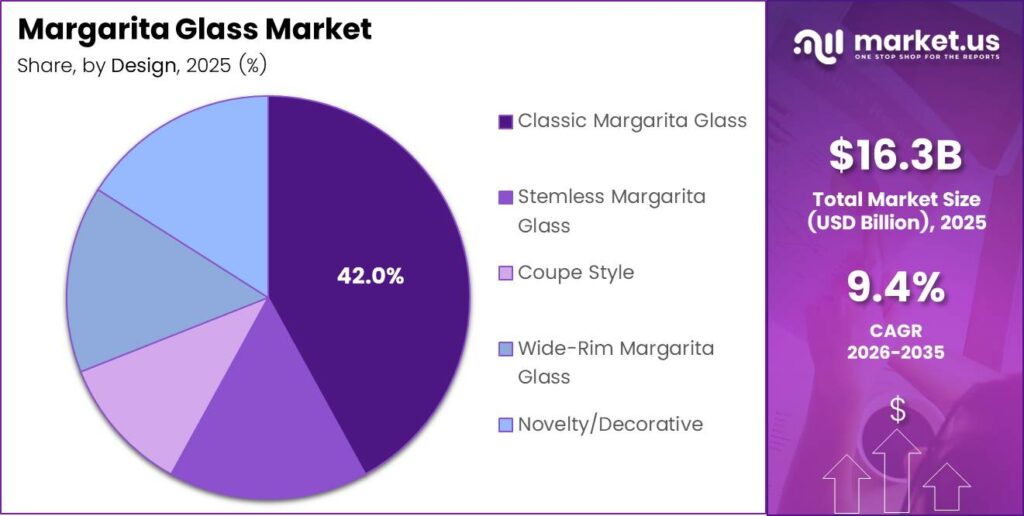
- By Design, Classic Margarita Glass leads with a 42.00% share.
- By End User, the Commercial segment accounts for 61.00% of total demand.
- By Distribution Channel, Offline channels dominate with a 57.00% share.
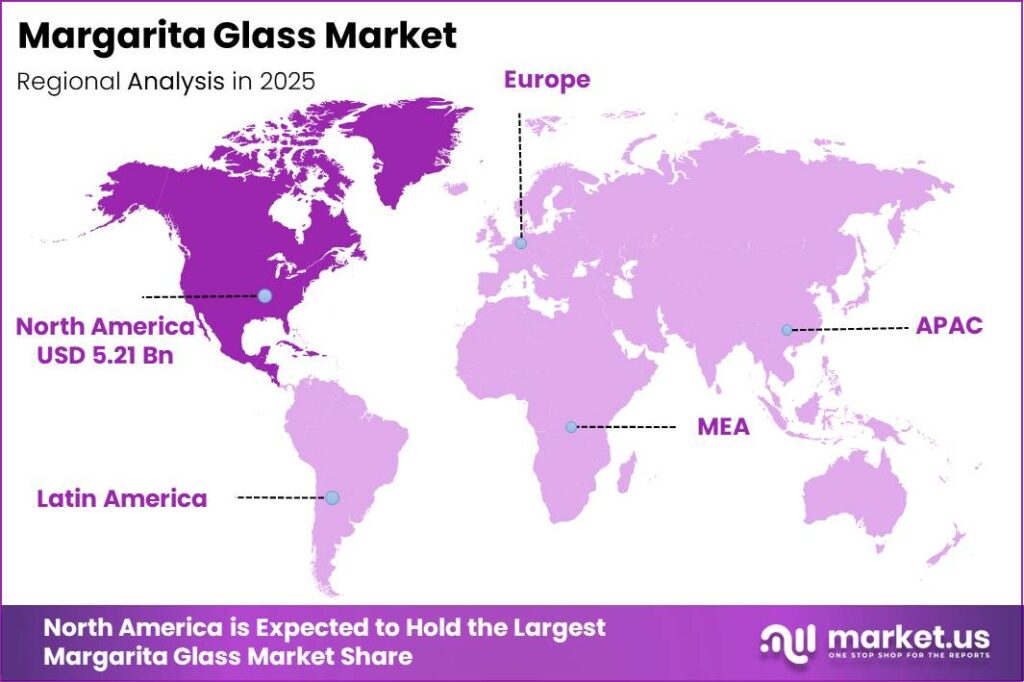
- North America is the leading region, holding a 32.00% market share valued at USD 5.21 Billion.
Government policy and tourism infrastructure investment directly shape procurement cycles for commercial glassware. As per our research, hospitality operators in regions with active resort development programs refresh tableware assortments every two to four years, creating predictable replacement demand. Regulatory frameworks covering food-contact materials in the EU and North America also influence product specifications, pushing buyers toward certified glass over unregulated plastics in professional settings.
The scale of foodservice activity confirms the commercial foundation for this market. According to the U.S. Census Bureau, U.S. food services and drinking places posted sales of USD 1,144,365 Million in 2024. This volume signals structural procurement activity across bars, restaurants, and hotels. Vendors with established foodservice distribution channels are better positioned to convert this baseline spend into recurring glassware orders.
European household consumption trends reinforce residential demand. Data from Eurostat shows EU household final consumption expenditure rose 1.5% in real terms in 2024. This growth reflects expanding discretionary budgets available for home entertaining products. In April 2025, JOYJOLT completed the acquisition of portable mini-refrigerator brand Cooluli, signaling that glassware-adjacent brands are building broader lifestyle product portfolios to capture this residential spending trend.
Material Analysis
Glass dominates with 58.00% due to preferred food-contact safety certification.
In 2025, Glass held a dominant market position in the By Material segment of the Margarita Glass Market, with a 58.00% share. Standard soda-lime glass remains the primary material for commercial procurement because it meets food-contact regulations in the EU, U.S., and key Asian markets without additional certification costs. The International Trade Administration notes that the U.S. imported over USD 1.2 Billion worth of glassware in 2023. Operators favor glass for its clarity, temperature neutrality, and cost-efficient replacement economics compared to premium alternatives.
Crystal glassware commands a premium positioning across luxury hotels and destination bars. The lead or lead-free crystal segment benefits from growing premiumization in the hospitality sector, where presentation differentiates the guest experience. According to OECD data, per capita expenditure on hospitality services among high-income economies rose by 3.1% in real terms between 2022 and 2024. Vendors targeting this tier require stricter dimensional tolerances and higher-grade raw materials, limiting entry to established glassware manufacturers with precision forming capabilities.
Plastic and acrylic variants serve outdoor hospitality venues, stadium operators, and poolside environments where glass-free policies apply. The World Health Organization estimates over 1.8 Billion people regularly consume beverages at outdoor or semi-permanent food-service locations globally. These formats hold the remaining share collectively alongside other specialty materials. Suppliers serving this tier compete primarily on impact resistance, UV stability, and compliance with outdoor venue procurement rules rather than aesthetic differentiation.
Capacity Analysis
8 to 12 oz dominates with 39.00% due to standard single-serve commercial pour alignment.
In 2025, the 8 to 12 oz segment held a dominant market position in the By Capacity segment of the Margarita Glass Market, with a 39.00% share. This format matches the standard commercial margarita pour volume used by the majority of bar operators in North America and Western Europe. The U.S. Alcohol and Tobacco Tax and Trade Bureau reports that spirits consumption in the U.S. reached 289 Million 9-liter cases in 2023, reflecting the high-volume channel through which purpose-specific glassware procurement is driven. Operators standardizing on this size reduce inventory complexity and per-unit cost.
The 12 to 16 oz capacity tier serves frozen margarita programs and large-format cocktail menus popular in casual dining and resort settings. These venues prioritize visual impact and portion value, and the larger bowl dimension supports blended presentation. According to the U.S. Census Bureau’s Economic Census, eating and drinking establishments generated over USD 938 Billion in receipts in 2022. Venues operating high-throughput frozen-drink programs replace this format on a more frequent cycle than standard stemware, creating a recurring volume opportunity for suppliers.
The under 8 oz and above 16 oz tiers collectively serve specialty and novelty applications. Sub-8 oz formats appear in tasting menus and cocktail flights, while above-16 oz formats address promotional and events-driven consumption. Both sub-segments hold smaller individual shares. Suppliers that build catalog depth across all four capacity tiers capture cross-segment procurement from hotel groups and national restaurant chains that manage multi-venue menu programs under a single purchasing agreement.
Design Analysis
Classic Margarita Glass dominates with 42.00% due to universal menu recognition across commercial operators.
In 2025, Classic Margarita Glass held a dominant market position in the By Design segment of the Margarita Glass Market, with a 42.00% share. The traditional wide-bowl, long-stem silhouette is the reference format recognized by consumers and operators across all major markets. The Distilled Spirits Council of the United States reported that tequila and mezcal volumes reached 32.1 Million 9-liter cases in 2024, a category closely tied to margarita consumption and commercial glass procurement cycles. Operators default to this design for menu photography, staff training, and brand consistency.
Stemless Margarita Glass formats appeal to casual dining chains and residential buyers seeking dishwasher durability and storage efficiency. These formats reduce breakage at the stem, lowering replacement frequency for high-turnover venues. In February 2025, JOYJOLT announced its Whitney Collection featuring wine glasses, barware, and stemless drinkware with ombré and reverse-ombré designs, confirming that lifestyle aesthetics are now a primary differentiator in the stemless tier. This positions stemless as the fastest-evolving design sub-segment in residential channels.
Coupe Style and Wide-Rim designs each target distinct occasions. The coupe format crosses over into craft cocktail menus at premium bars, while wide-rim designs maximize salt or sugar rim presentation for signature serves. Novelty and Decorative formats address gifting, seasonal retail, and branded merchandise. In March 2026, Zwiesel Glas announced Début, a five-piece collection developed for non-alcoholic drinks including kombucha and sparkling tea, demonstrating that occasion-led design innovation is extending the glass form into new beverage categories. These sub-segments hold the remaining share collectively.
End User Analysis
Commercial dominates with 61.00% due to high-volume hospitality procurement replacing breakage continuously.
In 2025, Commercial held a dominant market position in the By End User segment of the Margarita Glass Market, with a 61.00% share. Bars, pubs, restaurants, hotels, and catering operators drive the majority of purchasing volume through recurring replacement cycles rather than one-time fit-out orders. Eurostat data shows EU household expenditure on restaurants and accommodation services increased 1.6% in real terms in 2024, and this category accounted for 9.2% of total EU household consumption at current prices. Sustained channel activity at this scale creates predictable annual replenishment volumes for glassware suppliers.
Bars and Pubs represent the highest-velocity sub-segment within commercial end users because cocktail-specific glassware sustains the highest breakage rate per cover. High-throughput cocktail bars in metropolitan markets replace their margarita glass inventory multiple times per year. The International Labour Organization estimates the global accommodation and food service sector employs over 330 Million workers. This workforce scale reflects the structural depth of the commercial channel and the procurement infrastructure through which glassware suppliers can build long-term distribution agreements.
Restaurants and Hotels purchase in larger case quantities but at lower replacement frequency than bars. Hotel and resort procurement follows renovation and menu refresh cycles, often tied to star-rating compliance programs. Catering and Events operators represent a structurally different demand pattern, purchasing for seasonal peaks and one-off contracts. The Residential end user holds the remaining share. As per our research, residential buyers increasingly seek design-led collections that replicate commercial aesthetics, expanding the addressable market for premium glassware brands beyond professional procurement channels.
Distribution Channel Analysis
Offline dominates with 57.00% due to hospitality operator preference for physical vendor assessment.
In 2025, Offline held a dominant market position in the By Distribution Channel segment of the Margarita Glass Market, with a 57.00% share. Commercial buyers favor in-person evaluation of glassware for clarity, weight, and dimensional consistency before committing to case-quantity orders. Specialty stores and foodservice distributors remain the primary procurement channel for hospitality operators managing multi-venue assortments. The U.S. Census Bureau reports that general merchandise and food-related retail trade generated over USD 5.2 Trillion in annual sales in 2022, underlining the structural dominance of physical retail infrastructure through which glassware reaches both commercial and residential buyers.
Supermarkets and Hypermarkets within the offline channel serve residential buyers seeking accessible price points and immediate availability. Department stores address mid-range home entertaining purchases through curated tableware sections. The remaining offline sub-segments include specialty kitchenware retailers that serve both categories. Online distribution through E-commerce Platforms and Company-owned Websites holds the remaining share. As per our research, online channels are gaining traction among residential buyers for premium and novelty designs, where detailed product imagery and customer reviews substitute for physical evaluation and enable higher average order values.
Key Market Segments
By Material
- Glass
- Crystal
- Plastic
- Acrylic
- Others
By Capacity
- Up to 8 oz
- 8 to 12 oz
- 12 to 16 oz
- Above 16 oz
By Design
- Classic Margarita Glass
- Stemless Margarita Glass
- Coupe Style
- Wide-Rim Margarita Glass
- Novelty/Decorative
By End User
- Residential
- Commercial
- Bars & Pubs
- Restaurants
- Hotels
- Catering & Events
- Others
By Distribution Channel
- Offline
- Specialty Stores
- Supermarkets & Hypermarkets
- Department Stores
- Others
- Online
- E-commerce Platforms
- Company-owned Websites
Regional Analysis
North America Dominates the Margarita Glass Market with a Market Share of 32.00%, Valued at USD 5.21 Billion
North America commands the largest regional share because the United States represents the world’s largest tequila consumption market and the geographic home of margarita culture. Commercial operators across the U.S. run dedicated margarita programs at scale, driving both initial procurement and high-frequency replacement purchasing. As per our research, the density of casual dining chains, resort properties, and independent cocktail bars across the U.S. Southwest and coastal markets creates a structural procurement base that no other region currently matches in volume or program consistency.
Asia Pacific represents the fastest-growing region for the margarita glass market. Rising disposable incomes, hotel expansion programs, and the rapid growth of Western cocktail menus in urban centers across China, India, and Southeast Asia are pulling purpose-specific glassware into new commercial accounts. In June 2025, Zwiesel Glas introduced Enoteca Colors, extending its premium collection with coloured stems, signaling that design-led European brands are actively targeting Asia Pacific’s premiumizing hospitality sector with differentiated product lines ahead of volume consolidation.
Europe holds a structurally important share driven by Germany, France, the UK, Spain, and Italy, where cocktail culture has expanded significantly in metropolitan bar districts. The Middle East and Africa region is growing through Gulf market hotel and resort development, where alcohol-licensed venues procure commercial glassware to international specification standards. Latin America, anchored by Mexico and Brazil, maintains steady baseline demand supported by indigenous margarita consumption culture and growing export-oriented hospitality infrastructure serving international visitors.
Key Regions and Countries
North America
- US
- Canada
Europe
- Germany
- France
- The UK
- Spain
- Italy
- Rest of Europe
Asia Pacific
- China
- Japan
- South Korea
- India
- Australia
- Rest of APAC
Latin America
- Brazil
- Mexico
- Rest of Latin America
Middle East and Africa
- GCC
- South Africa
- Rest of MEA
Market Dynamics
Market Opportunity Analysis - Underexploited segments and emerging regions signal the next growth phase for glassware vendors
The Residential end user segment remains structurally underdeveloped relative to its share of total household consumption activity. Commercial buyers at 61.00% dominate current procurement, but residential buyers are demonstrating clear appetite for design-led collections that replicate commercial aesthetics. Vendors that build a dedicated residential product line with accessible price points and strong digital presentation can capture incremental volume from this segment without competing directly on the commercial replacement cycle.
The Online distribution channel holds the minority share at below 57.00% of total offline dominance, but it carries disproportionate growth potential for premium and novelty designs. Residential buyers rely on product imagery and reviews rather than physical evaluation. This means brands with strong e-commerce content capabilities face lower barriers to entry in the online channel than in specialty or foodservice distribution, where incumbent relationships and logistics infrastructure determine access.
Secondary cities in India, Southeast Asia, and Latin America represent a largely uncontracted regional opportunity. These markets lack established local glassware distributor networks capable of serving the volume and specification requirements of fast-expanding hotel and restaurant chains. The Asia Pacific region is the fastest-growing globally, as established in the regional analysis, but current supply concentration in major metropolitan centers leaves secondary-city hospitality operators dependent on informal procurement. Vendors that build regional distributor partnerships in these cities gain first-mover volume before category consolidation occurs.
The alcohol-free occasion segment is emerging as a distinct procurement category. In March 2026, Zwiesel Glas announced Début, a five-piece collection designed specifically for non-alcoholic drinks including kombucha, water kefir, and sparkling tea. This product action confirms that occasion-specific design represents a real and addressable revenue track. Brands that launch dedicated non-alcoholic collections early will benefit from both the novelty premium and the absence of established competitive alternatives in this sub-category.
Technology and Innovation Landscape - Material science advances and occasion-driven design are redefining product differentiation in the margarita glass category
Tritan crystal-glass technology represents the most commercially significant material innovation in the premium glassware segment. Developed and commercialized by Zwiesel Glas, Tritan combines the visual clarity of traditional crystal with impact resistance well above standard soda-lime glass. In March 2026, Zwiesel Glas introduced its Click collection of stackable Tritan tumblers in 3 sizes, demonstrating that the material’s properties enable new form factors including stackability that standard crystal cannot achieve. Hospitality operators benefit from lower breakage replacement costs without conceding the aesthetic standard expected in premium venues.
Double-wall insulation technology is expanding from premium drinkware into the novelty and licensed product tier. In April 2026, DRAGON GLASSWARE’s Masters of the Universe collection included 8-ounce double-wall Skeletor glasses, applying thermal insulation technology to licensed character merchandise. This crossover confirms that functional material features are no longer exclusive to utilitarian or professional categories. Brands that embed performance features into licensed and novelty formats create a defensible product position based on both IP value and functional specification.
Occasion-specific design innovation is emerging as a distinct product development discipline. Rather than producing multipurpose vessels, manufacturers are commissioning specialist designers and beverage professionals to engineer glasses for defined serve occasions. In March 2026, Zwiesel Glas introduced Début in collaboration with beverage specialists specifically for non-alcoholic serves including kombucha and sparkling tea. This design methodology creates higher perceived value per unit and justifies premium pricing to both commercial buyers and residential consumers who associate specialist design with quality assurance.
Glass-refinement capabilities represent a manufacturing technology track that separates premium-tier producers from commodity suppliers. The acquisition of EISCH by Zwiesel Fortessa Group in May 2025 explicitly expanded the group’s glass-refinement capabilities, indicating that post-forming surface treatment and finishing are becoming core competencies rather than optional add-ons. Manufacturers that invest in refinement processes can serve luxury hotel and fine-dining accounts that require customized finishes, coloured stems, and decorative treatments, commanding a structural price premium over unrefined commercial stock.
Drivers
Recovering international travel is the primary structural driver pushing commercial glassware procurement forward. UN Tourism reported international-arrival growth of 11% in 2024 and a further 4% in 2025. Hotels, resorts, and destination restaurants respond to higher occupancy by replenishing cocktail glassware rather than operating with depleted assortments. This dynamic favors account-based supply arrangements and scheduled replenishment contracts, giving established glassware distributors a competitive advantage over transactional importers in high-traffic hospitality corridors.
Established margarita menu penetration and at-home cocktail purchasing compound the tourism-led commercial driver by activating residential demand alongside institutional procurement. North America, Mexico, and Western Europe maintain deep menu penetration for margarita serves, creating recurring stock replacement across thousands of licensed venues. Decorative glassware premiumization adds a parallel revenue layer as buyers in North America, Europe, and Gulf markets upgrade from standard commercial stock to branded or design-led collections, supporting higher average selling prices and widening margin potential for vendors that serve both channels.
| Driver | (~) % Impact on CAGR Forecast | Geographic Relevance | Impact Timeline |
|---|---|---|---|
| Tourism-led hospitality procurement | +0.55% | Global; Mediterranean, Caribbean, Southeast Asia | Short term (≤ 2 years) |
| Established margarita-menu penetration | +0.35% | North America, Mexico, Western Europe | Short term (≤ 2 years) |
| At-home cocktail equipment purchasing | +0.25% | North America, Europe, urban Asia-Pacific | Short term (≤ 2 years) |
| Decorative glassware premiumization | +0.20% | North America, Europe, Gulf markets | Medium term (2–4 years) |
| Installed-base replacement purchasing | +0.15% | Global hospitality markets | Short term (≤ 2 years) |
Restraints
Weak restaurant profitability creates a direct purchasing barrier by forcing operators to cancel discretionary stemware upgrades while retaining serviceable existing inventory. The National Restaurant Association’s survey of more than 900 restaurants found median pretax income equivalent to only 2.8% of sales for full-service respondents in 2024, versus 4.0% for limited-service respondents. For margarita-glass suppliers, this translates into deferred assortment expansion and smaller opening orders rather than outright cancellations. Staged deliveries and smaller case quantities can preserve sales without margin-eroding discounts.
Multipurpose-glass substitution and canned-cocktail serve displacement compound the profitability restraint by reducing the perceived necessity of purpose-specific margarita vessels. Space-constrained beverage outlets replace dedicated margarita stock with all-purpose stemware, cutting per-venue procurement volume. Glass-free venue procurement policies at poolside locations, stadiums, and outdoor events eliminate the category entirely from those channels. Long household replacement intervals in mature glassware markets further suppress residential reorder frequency, limiting the addressable base for regular volume replenishment programs.
| Restraint | (~) % Impact on CAGR Forecast | Geographic Relevance | Impact Timeline |
|---|---|---|---|
| Restaurant purchasing-budget compression | -0.45% | North America, Europe; independent operators | Short term (≤ 2 years) |
| Existing multipurpose-glass substitution | -0.30% | Global; space-constrained beverage outlets | Short term (≤ 2 years) |
| Canned-cocktail serve displacement | -0.20% | North America; convenience-led consumption | Short term (≤ 2 years) |
| Glass-free venue procurement policies | -0.15% | Poolside venues, stadiums, outdoor events | Short term (≤ 2 years) |
| Long household replacement intervals | -0.10% | Mature household-glassware markets | Long term (≥ 4 years) |
Challenges
Wide bowls and projecting stems create a structural fulfillment vulnerability in parcel channels because additional cushioning increases carton dimensions, handling requirements, and the cost of failed deliveries. FedEx recommends double-boxing fragile items with approximately 3 inches of cushioning around the inner box and an outer box at least 6 inches larger in each dimension. Reducing an assumed damage-and-reshipment rate from 4% to 2% avoids approximately 2 replacement shipments per 100 original orders. Sustained mitigation requires molded inserts, validated packaging by glass geometry, and regional inventory placement.
Furnace energy cost volatility and thin-stem production yield variability compound fulfillment challenges by adding manufacturing-side cost pressure that erodes the margin available for packaging investment. European glass manufacturers face the highest exposure given energy-import dependency across key production hubs. Assortment forecasting and inventory imbalance create downstream friction for distributors managing omnichannel retail commitments. Food-contact documentation complexity adds compliance cost to cross-border decorated-glass supply chains. Together these execution challenges create a revenue opportunity for vendors that solve them systematically through process investment rather than reactive discounting.
| Challenge | (~) % CAGR Friction Drag | Geographic Relevance | Mitigation Horizon |
|---|---|---|---|
| Fragile parcel fulfillment economics | -0.30% | Global; parcel-based retail channels | Short term (≤ 2 years) |
| Furnace energy cost volatility | -0.25% | Europe; energy-import-dependent manufacturing hubs | Medium term (2–4 years) |
| Thin-stem production yield variability | -0.20% | Global glassware manufacturing clusters | Medium term (2–4 years) |
| Assortment forecasting inventory imbalance | -0.15% | Global distributors and omnichannel retailers | Short term (≤ 2 years) |
| Food-contact documentation complexity | -0.10% | Cross-border decorated-glass supply chains | Medium term (2–4 years) |
Opportunities
Contracted private-label customization platforms represent the clearest near-term revenue expansion path for established glassware manufacturers. Converting uncontracted bespoke orders into standardized programs with reusable artwork, minimum annual commitments, and scheduled production releases improves margin predictability for both buyer and supplier. An illustrative unit-economic model shows that standardized decoration can support a 12% selling-price premium while raising unit production cost by only 6%, lifting gross margin from 30% to approximately 33.8%. Early movers that lock in program contracts with national hospitality chains establish a structural advantage that deters lower-cost competitors.
Dedicated alcohol-free occasion collections and regional foodservice distributor partnerships in secondary cities across India, Southeast Asia, and Latin America represent conditional upside that current market structure has not yet captured. Dessert-service adjacent product lines and corporate gifting procurement programs add incremental volume through channels that operate outside the core bar and restaurant replacement cycle. Collectively, the five identified opportunity rows carry a conditional potential of 1.30 percentage points of additional CAGR upside, implying an upper execution scenario of 7.8% against the baseline. Vendors that execute across two or more of these tracks simultaneously compound their growth advantage.
| Opportunity | (~) % Potential CAGR Upside | Geographic Relevance | Execution Window |
|---|---|---|---|
| Contracted private-label customization platforms | +0.40% | North America, Europe, Gulf markets | Medium term (2–4 years) |
| Dedicated alcohol-free occasion collections | +0.30% | Europe, Gulf markets, urban Asia-Pacific | Medium term (2–4 years) |
| Regional foodservice distributor partnerships | +0.25% | Secondary cities in India, Southeast Asia, Latin America | Medium term (2–4 years) |
| Dessert-service adjacent product lines | +0.20% | Global cafés, patisseries, banquet operators | Medium term (2–4 years) |
| Corporate gifting procurement programs | +0.15% | North America, Europe, urban Asia-Pacific | Short term (≤ 2 years) |
Key Company Insights
Libbey Inc. holds a structural advantage in North American commercial glassware through its integrated manufacturing and direct distribution model, which supports both large hospitality chains and independent operators from a single supply relationship. In April 2026, Libbey announced it would become the exclusive U.S. distributor of Bauscher porcelain dinnerware from June 1, 2026, adding a premium tabletop brand to its existing Schönwald, Playground, and Heart & Soul distribution portfolio. This expansion reduces Libbey’s dependency on glassware alone and positions it as a full tabletop solutions provider to commercial buyers.
Zwiesel Glas (part of Zwiesel Fortessa Group) positions itself at the intersection of premium hospitality supply and design-led innovation, using proprietary Tritan crystal-glass technology to differentiate on durability and clarity simultaneously. In May 2025, the group announced that EISCH would join its brand portfolio effective October 1, 2025, expanding its luxury glassware and glass-refinement capabilities. This acquisition signals a deliberate strategy to consolidate premium-tier brands under one group structure, building negotiating power with high-end hotel chains and fine-dining accounts that require coordinated multi-brand assortments.
Key Players
- Libbey Inc.
- Arc Holdings / Arc International
- Bormioli Rocco
- Ocean Glass Public Co., Ltd.
- RONA
- Şişecam / Paşabahçe
- Bormioli Luigi
- Anchor Hocking
- ADERIA GLASS / Ishizuka Glass Co., Ltd.
- Duralex
- RCR Cristalleria Italiana
- Stölzle Lausitz
- Schott Zwiesel / Zwiesel Glas
- Nachtmann
- Vetroelite
Recent Developments
- April 2026: DRAGON GLASSWARE launched its officially licensed Masters of the Universe movie drinkware collection, including 8-ounce double-wall Skeletor glasses, 18-ounce stemless wine glasses, 16-ounce Castle Grayskull tankards, and 24-ounce insulated tumblers, expanding licensed novelty drinkware into mainstream entertainment IP.
- April 2026: Lifetime Brands introduced Mikasa Black Label, a premium tabletop collection spanning glassware, dinnerware, and flatware, signaling a move toward integrated tabletop premiumization under an established brand.
- March 2026: Zwiesel Glas introduced Perfect Match by Antoine Pétrus, comprising 2 wine glasses: No. 1 for red and white wines, and No. 2 for rosé and sparkling wines, extending sommelier-designed drinkware into multi-varietal format programs.
- March 2026: Zwiesel Glas introduced Click, a collection of stackable Tritan crystal-glass tumblers available in 3 sizes for beverages including non-alcoholic drinks, whisky, and beer, addressing multi-occasion use in commercial and residential settings.
- June 2025: Zwiesel Glas introduced Enoteca Colors, extending its Enoteca collection with champagne, red-wine, and white-wine glasses featuring coloured stems in beryl green, cherry red, and light blue.
Geopolitical Impact Analysis
Trade policy shifts are directly reshaping the cost structure of global glassware supply chains. According to the World Trade Organization’s October 2025 update, world merchandise trade volume rose 5.5% year over year in Q1 2025 and 4.3% in Q2 2025. However, U.S. tariff increases on Chinese manufactured goods — with rates on some categories reaching 145% — are forcing glassware importers to reroute procurement toward Southeast Asian and Eastern European producers. This shift increases lead times and minimum order thresholds, compressing working capital flexibility for mid-tier glassware distributors.
Shipping cost volatility compounds the tariff exposure. As reported by UNCTAD’s Review of Maritime Transport 2025, maritime shipping moves more than 80% of the world’s merchandise trade. The value of world merchandise trade in current U.S. dollars rose 6% in the first half of 2025, according to WTO data, but spot freight rate volatility on key Asia-to-Europe and Asia-to-North America lanes adds unpredictable landed cost variability to glassware imports. Suppliers without locked freight contracts face margin compression that directly limits their ability to hold listed prices for commercial procurement accounts through the remainder of 2025 and into 2026.
Report Scope
| Report Features | Description |
|---|---|
| Market Value (2025) | USD 16.3 Billion |
| Forecast Revenue (2035) | USD 40.2 Billion |
| CAGR (2026-2035) | 9.4% |
| Base Year for Estimation | 2025 |
| Historic Period | 2020-2024 |
| Forecast Period | 2026-2035 |
| Report Coverage | Revenue Forecast, Market Dynamics, Market Opportunity Analysis, Technology and Innovation Landscape, Competitive Landscape, Recent Developments |
| Segments Covered | By Material (Glass, Crystal, Plastic, Acrylic, Others), By Capacity (Up to 8 oz, 8 to 12 oz, 12 to 16 oz, Above 16 oz), By Design (Classic Margarita Glass, Stemless Margarita Glass, Coupe Style, Wide-Rim Margarita Glass, Novelty/Decorative), By End User (Residential, Commercial [Bars & Pubs, Restaurants, Hotels, Catering & Events, Others]), By Distribution Channel (Offline [Specialty Stores, Supermarkets & Hypermarkets, Department Stores, Others], Online [E-commerce Platforms, Company-owned Websites]) |
| Regional Analysis | North America (US and Canada), Europe (Germany, France, The UK, Spain, Italy, and Rest of Europe), Asia Pacific (China, Japan, South Korea, India, Australia, and Rest of APAC), Latin America (Brazil, Mexico, and Rest of Latin America), Middle East and Africa (GCC, South Africa, and Rest of MEA) |
| Competitive Landscape | Libbey Inc., Arc Holdings / Arc International, Bormioli Rocco, Ocean Glass Public Co., Ltd., RONA, Şişecam / Paşabahçe, Bormioli Luigi, Anchor Hocking, ADERIA GLASS / Ishizuka Glass Co., Ltd., Duralex, RCR Cristalleria Italiana, Stölzle Lausitz, Schott Zwiesel / Zwiesel Glas, Nachtmann, Vetroelite |
| Customization Scope | Customization for segments, region / country-level will be provided. Additional customization can be done based on requirements. |
| Purchase Options | We have three licenses to opt for: Single User License | Multi-User License (Up to 5 Users) | Corporate Use License (Unlimited User and Printable PDF) |