


Global Magnetorheological Fluids Market Size, Share and Report Analysis By Base Fluid (Hydraulic Oil, Mineral Oil, Silicon Oil, Others), By Product (Ready-To-Use Magnetorheological Fluid, Semi-Concentrated Magnetorheological Fluid, Concentrated Magnetorheological Fluid, Others), By Application (Automotive, Building And construction, Aerospace, Others) , By Region and Companies - Industry Segment Outlook, Market Assessment, Competition Scenario, Trends and Forecast 2025-2034
- Published date: Feb 2026
- Report ID: 179095
- Number of Pages: 387
- Format:
-
keyboard_arrow_up
Quick Navigation
Report Overview
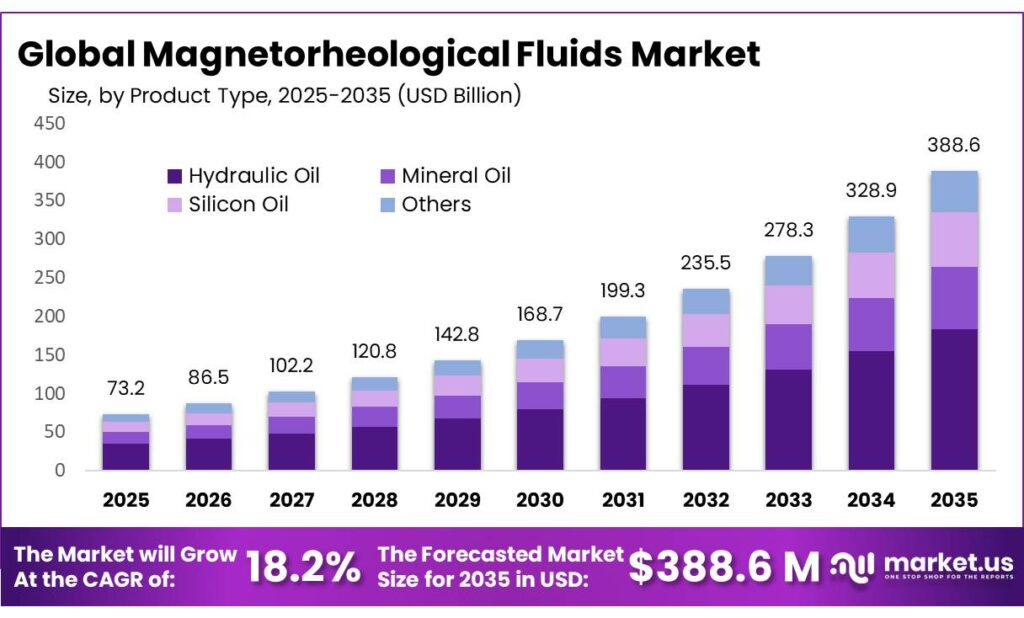
The Global Magnetorheological Fluids Market is expected to be worth around USD 388.6 Million by 2035, up from USD 73.2 Million in 2025, at a CAGR of 18.2% from 2026 to 2035. The North America segment maintained 43.6%, supporting a Magnetorheological Fluids value of USD 31.9 Mn.
Magnetorheological (MR) fluids are smart suspensions of micron-scale magnetic particles dispersed in a carrier oil. Under no field they flow like a conventional viscous liquid, but when a magnetic field is applied their viscosity and yield stress rise sharply and reversibly, and the fluid can change from liquid-like to nearly solid in just a few milliseconds.
- Recent formulations using high-magnetization FeCo nanoparticles have achieved yield stresses around 2,729 Pa at applied fields of about 616.7 kA/m, demonstrating performance comparable with the best MR fluids reported in the literature.
Industrial use is strongest in automotive, aerospace, machine tools and medical devices. In vehicles, MR dampers and mounts support semi-active suspensions, seat and cab vibration control, and adaptive ride systems. The rapid expansion of electric vehicles reinforces this demand: the International Energy Agency (IEA) reports that electric car sales neared 14 million units in 2023, around 18% of all cars sold, and exceeded 17 million in 2024, accounting for more than 20% of global car sales.
Key driving forces are closely tied to global safety and efficiency agendas led by public institutions. The World Health Organization estimates that approximately 1.19 million people die every year due to road traffic crashes, making road injuries the leading cause of death for children and young adults aged 5–29.
These policy objectives indirectly favor semi-active suspension, steer-by-wire and brake-by-wire concepts where MR fluids can enhance stability, shorten stopping distances and improve handling. At the same time, Europe’s automotive sector alone invested €72.8 billion in R&D in 2022, a 23.2% increase over the previous year, signalling sustained funding for advanced materials and control systems that improve comfort, safety and energy efficiency.
On the technology side, ongoing research is steadily broadening the performance envelope. Laboratory devices based on MR fluids can tune stiffness over wide ranges; for example, an MR-based “artificial skin” apparatus designed for blood-pressure tonometry adjusted stiffness from roughly 300 N/m to 900 N/m as the magnetic field increased from 0 to 36 mT, enabling realistic simulation of age-dependent tissue properties.
Public and institutional funding is a key driving factor behind this progress. Switzerland’s National Research Programme “Smart Materials” (NRP 62), run by the Swiss National Science Foundation, allocated CHF 11 million to smart-material research, explicitly including electro- and magnetorheological microfluidic systems for engineering applications. The Canadian Space Agency awarded a CAD 200,000 contribution to Exonetik Inc. to evaluate MR-fluid actuators for human-robot interaction in space, focusing on issues such as launch vibration and low-outgassing formulations.
Key Takeaways
- Magnetorheological Fluids Market is expected to be worth around USD 388.6 Million by 2035, up from USD 73.2 Million in 2025, at a CAGR of 18.2%.
- Hydraulic Oil held a dominant market position, capturing more than a 47.8% share in the global magnetorheological (MR) fluids market.
- Ready-To-Use Magnetorheological Fluid held a dominant market position, capturing more than a 59.2% share.
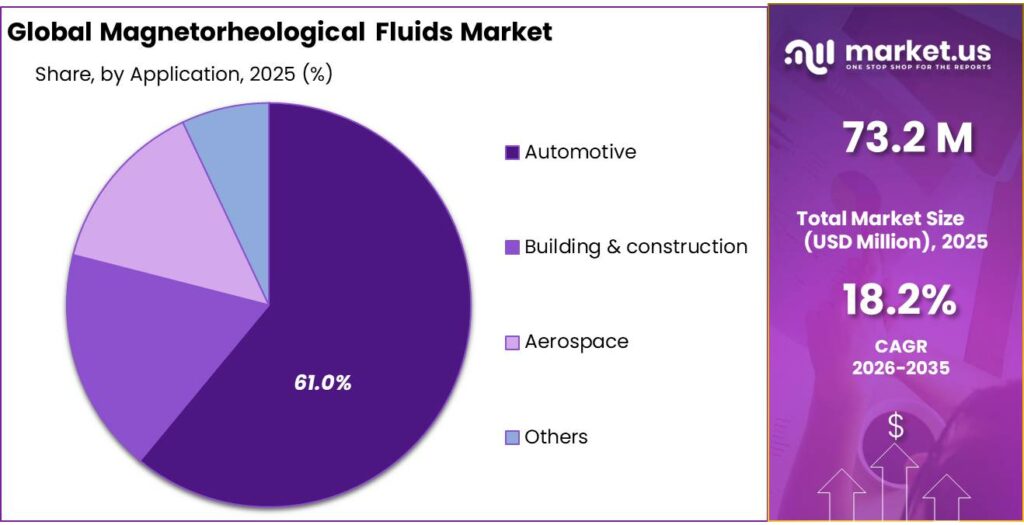
- Automotive held a dominant market position, capturing more than a 61.3% share.
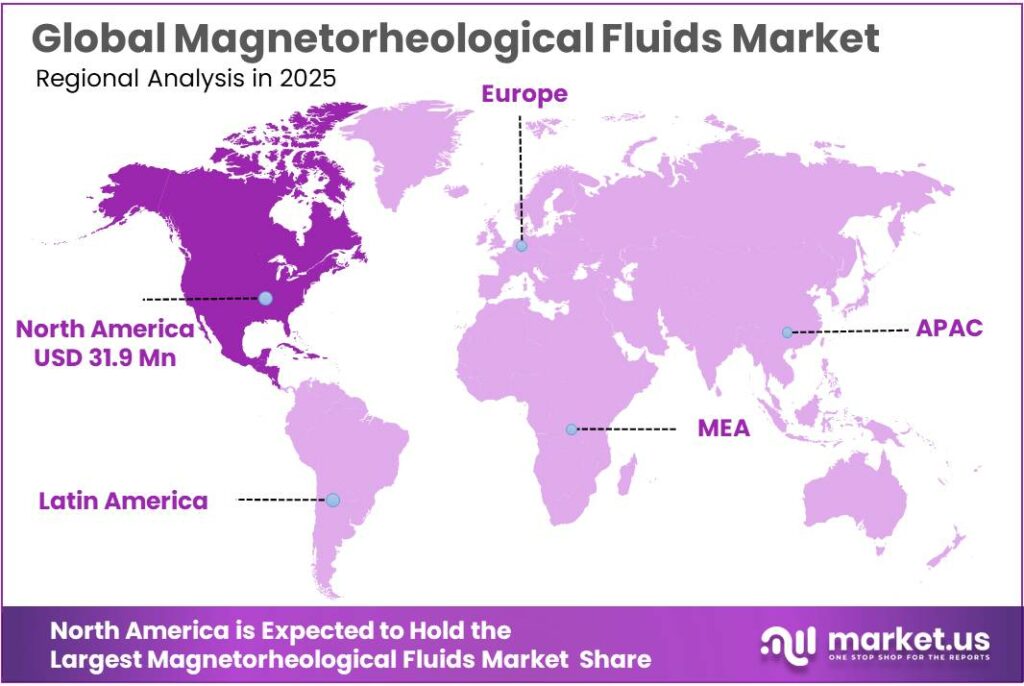
- North America is the clear powerhouse in the magnetorheological (MR) fluids market, with North America holding about 43.6% of global revenues, valued at roughly USD 31.9 Million.
By Base Fluid Analysis
Hydraulic Oil leads the MR fluids space with a strong 47.8% share
In 2024, Hydraulic Oil held a dominant market position, capturing more than a 47.8% share in the global magnetorheological (MR) fluids market. This base fluid remained the preferred choice because it offers stable viscosity, smooth flow characteristics, and strong compatibility with magnetic particles—qualities that industries like automotive, robotics, and heavy machinery rely on. During 2024, manufacturers increasingly used hydraulic-oil-based MR fluids in semi-active suspension systems, precision dampers, and vibration-control units, mainly because the fluid maintains dependable performance under changing loads and temperatures. Its ability to deliver fast response and long-term operational reliability has kept it ahead of other formulations.
By Product Analysis
Ready-To-Use MR Fluids take the lead with a strong 59.2% share
In 2024, Ready-To-Use Magnetorheological Fluid held a dominant market position, capturing more than a 59.2% share as industries increasingly preferred solutions that require no additional blending or preparation. This segment gained wide acceptance because it eliminates formulation errors, reduces installation time, and provides consistent performance straight from the container. Automotive suspension manufacturers, robotics developers, and precision engineering companies relied heavily on ready-to-use MR fluids in 2024 because the products came optimized with stable particle dispersion, predictable response under magnetic fields, and minimal settling issues during long operating cycles.
By Application Analysis
Automotive leads the MR fluids market with a solid 61.3% share
In 2024, Automotive held a dominant market position, capturing more than a 61.3% share as car manufacturers continued adopting magnetorheological (MR) fluids for advanced suspension systems, adaptive dampers, braking components, and ride-comfort technologies. The push for smoother driving, better handling, and more responsive vehicle dynamics helped this segment stay ahead. Automakers also leaned on MR fluids in 2024 to meet growing expectations for vibration control in electric vehicles, where quiet cabin performance and precision damping are becoming essential. The technology’s ability to react within milliseconds to road conditions made it a natural fit for next-generation automotive designs.
Key Market Segments
By Base Fluid
- Hydraulic Oil
- Mineral Oil
- Silicon Oil
- Others
By Product
- Ready-To-Use Magnetorheological Fluid
- Semi-Concentrated Magnetorheological Fluid
- Concentrated Magnetorheological Fluid
- Others
By Application
- Automotive
- Building & construction
- Aerospace
- Others
Emerging Trends
Magnetorheological fluids moving into smarter, robot-ready food production lines
One of the clearest recent trends around magnetorheological (MR) fluids is their quiet move from niche automotive parts into smart, highly automated food and packaging plants. The food industry itself is huge and heavily mechanised. In the United States alone, there were 42,708 food and beverage manufacturing establishments in 2022, turning raw commodities into packaged products that need careful, vibration-controlled handling.
- In the EU-27, the food and drink industry counts over 300,000 enterprises, employs 4.7 million people, and generates about €266 billion in value added, making it the region’s largest manufacturing sector.
Another piece of this trend comes from the growing pressure to cut food loss and waste. FAO and UN partners estimate that around 14 % of the world’s food, worth roughly USD 400 billion per year, is lost between harvest and retail, while a further 17% – about 931 million tonnes – is wasted at retail and consumer level, together accounting for 8–10% of global greenhouse gas emissions.
This is happening at the same time as a wider boom in industrial automation and robotics. UNIDO notes that manufacturing value added grew by about 2.9% in 2024 and represents nearly 80% of total industry value added worldwide, underlining how central factories remain to the global economy. Within those factories, robots are spreading quickly: the International Federation of Robotics reports that 542,000 industrial robots were installed globally in 2024, more than double the number ten years earlier, with annual installations above 500,000 units for four straight years.
Drivers
Driving factor – smarter, cleaner machinery for a huge and waste-pressed food industry
A major force behind the adoption of magnetorheological (MR) fluids is the push for more precise, hygienic and reliable machinery in the global food and beverage chain. Food processing is a massive, equipment-intensive industry. In the United States alone, there were 42,708 food and beverage manufacturing establishments in 2022, spread across all states, with California, Texas and New York hosting the largest clusters.
At the same time, the sector is a big employer: one 2024 study notes that U.S. food processing plants employed about 1.7 million workers across 41,080 plants in 2021, underlining how much hardware, automation and process control is installed just in one country.
The pressure to reduce food loss and waste adds another layer of motivation. According to the Food and Agriculture Organization (FAO) and UN partners, roughly 14% of the world’s food—worth about USD 400 billion per year—is lost between harvest and retail, and a further 17% is wasted at retail and consumer level. Fruit and vegetables are hit especially hard, with FAO estimating loss rates of 25.4% for these products before they even reach consumers.
Policy initiatives are pushing in the same direction. The FAO-backed “Food is Never Waste” coalition, launched under the UN Food Systems Summit process, is explicitly aimed at cutting food loss and waste through better technology and practices along the supply chain. In Europe, Horizon 2020 projects such as BIOSMART and other smart-packaging programmes have channelled public funding into “active and smart” bio-based food packaging that can better protect products and monitor quality through the distribution chain.
Restraints
High equipment and operational costs slow down MR fluids adoption
One of the biggest restraining factors for the growth of magnetorheological (MR) fluids in industrial applications is the high cost and complexity of system integration and maintenance, especially in sectors like food processing where margins are tight and reliability has to be absolute. Many food manufacturers operate on lean profit structures, and unrealistic cost burdens have a direct impact on investment decisions.
For example, automation systems used in food facilities are already expensive: the global food processing automation market is projected to be worth USD 16.46 billion in 2025, even before reaching its full digital and mechanical potential. It is expected to grow to about USD 18.12 billion in 2026, reflecting an ongoing appetite for automation but also underscoring how costly this shift can be for many companies.
Food processors, particularly small and medium enterprises (SMEs), often struggle to justify the upfront cost of advanced actuation technologies that include MR fluids. Many of the challenges in automation come from the financial side: installing new systems, integrating them with legacy equipment, and training staff to maintain and repair them can be prohibitively expensive. Detailed industry reports note that high initial investments and ongoing maintenance costs are among the main barriers to automation adoption globally—and this extends to any new motion-control technologies as well.
In food manufacturing, unplanned production outages are also incredibly costly. One analysis found that average food processing plants can lose about USD 2.3 million annually due to misplaced tools, production delays, and the costs of replacing parts or idle production time. When MR fluid systems are added into complex lines with little room for unscheduled repair or maintenance, the threat of downtime becomes a real concern. Companies know that advanced damping or precision motion systems can improve performance, but they also have to weigh these benefits against real monetary losses if a new technology fails or requires specialist support.
Opportunity
Growth opportunity – riding the wave of smarter food and manufacturing automation
A big growth opening for magnetorheological (MR) fluids sits right where food, agriculture and advanced machinery meet. Food systems keep getting larger and more complex, and they lean heavily on equipment that has to be fast, gentle and reliable at the same time. FAO estimates that global agriculture value added reached USD 4.0 trillion in 2023, up from USD 3.9 trillion in 2022, showing how much economic activity depends on crops and raw food materials that later move through processing plants. As those plants modernise, there’s room for smarter motion control technologies such as MR-fluid dampers, clutches and valves.
The physical volume behind this is huge. FAO data show that the global harvested area of major primary crops reached 1.5 billion hectares in 2024, an increase of 197 million hectares compared with 2010, with oil crops and roots and tubers seeing the largest gains. All of that production eventually flows into storage, handling, processing and packaging lines. Every extra tonne that passes through a conveyor, filler or sealer puts more pressure on engineers to manage vibration, shock and speed accurately. MR fluids, which can change stiffness and damping in milliseconds under a magnetic field, are well suited to this kind of fine control.
The food industry itself is a major industrial employer and a heavy user of machinery. In the United States alone, there were 42,708 food and beverage manufacturing establishments in 2022, spread across all states, according to USDA’s Economic Research Service. In the wider ag-and-food economy, about 22.1 million jobs—10.4% of total U.S. employment—were linked to agriculture and food sectors in 2022, including farming, processing, distribution and food services.
At the same time, manufacturing as a whole is still growing and getting more automated. UNIDO’s 2025 global highlights report notes that manufacturing value added accounted for nearly 80% of total industry value added and grew by 2.9% in 2024. That growth sits alongside a rapid increase in factory robotics. The International Federation of Robotics reports that 542,000 industrial robots were installed worldwide in 2024, more than double the volume a decade earlier, and that annual installations have stayed above 500,000 units for four years in a row.
Policy and long-term demand trends add another tailwind. The OECD-FAO Agricultural Outlook projects that global food consumption, measured in calories, will grow by about 1.3% per year over the next decade, driven by population growth and changing diets. Governments and international bodies are investing in more resilient and efficient food systems, often with a focus on automation, energy efficiency and waste reduction.
Regional Insights
North America commands 43.6% share worth USD 31.9 billion
North America is the clear powerhouse in the magnetorheological (MR) fluids market, with North America holding about 43.6% of global revenues, valued at roughly USD 31.9 Million. This dominance is closely tied to the region’s deep industrial base and strong focus on advanced motion-control technologies. The United States alone generated about USD 2.91 trillion in manufacturing value added in 2024, making its manufacturing sector comparable in size to some of the world’s largest national economies.
This scale supports intensive investment in high-performance suspensions, vibration control, precision machining and testing systems where MR fluids are most relevant. North America is also one of the largest vehicle-producing hubs: regional light-vehicle production for 2024 is projected at around 15.5 million units, providing a broad installed base for adaptive dampers, engine mounts and brake systems using MR technology.
Automation trends further reinforce this leadership. The International Federation of Robotics reports that the Americas installed about 50,100 industrial robots in 2024, marking the fourth consecutive year above the 50,000-unit level. In the U.S., automotive and component manufacturers alone installed 14,678 robots in 2023, accounting for roughly 33% of all new industrial robot deployments in the country.
Key Regions and Countries Insights
- North America
- US
- Canada
- Europe
- Germany
- France
- The UK
- Spain
- Italy
- Rest of Europe
- Asia Pacific
- China
- Japan
- South Korea
- India
- Australia
- Rest of APAC
- Latin America
- Brazil
- Mexico
- Rest of Latin America
- Middle East & Africa
- GCC
- South Africa
- Rest of MEA
Key Players Analysis
Parker Hannifin, founded in 1917 and headquartered in Ohio, is a global motion-and-control major with about 61,120 employees and roughly US$19.8 billion in revenue in FY 2024, operating in more than 45 countries. Through its LORD business, Parker supplies MR fluids such as MRF-122EG and MRF-140CG, hydrocarbon-based formulations used in shocks, dampers and brakes, where particle volume fractions of about 20–40 % enable strong field-dependent yield stress for semi-active suspension and vibration-control systems.
QED Technologies International, based in Rochester, New York, is a specialist in precision optics equipment and commercialized its first fully automated magnetorheological finishing (MRF) system in 1998, bringing sub-nanometre (<1 nm) surface microroughness and λ/20 figure correction into volume production. Listed as established in 2006 with estimated annual revenue between US$25–49.9 million, QED today offers multiple MRF platforms and metrology tools used by optics makers across semiconductor, defence and space markets worldwide.
Kurimoto, Ltd., founded around 1909 and employing approximately 1,001–5,000 people, is a Japanese industrial group active in lifeline, machinery-systems and construction-materials businesses. In MR fluids it has developed proprietary lines such as SoftMRF® and NanoMRF, silicone-based formulations with sub-micron iron particles whose particle distributions remain stable over several months, improving sedimentation behaviour versus conventional MR fluids and enabling medical devices like lower-limb orthotic joints and other torque-control components.
Top Key Players Outlook
- Parker Hannifin Corp
- QED Technologies
- Liquids Research Ltd.
- ARUS MR TECH
- KURIMOTO, LTD.
- CK Materials Lab Co., Ltd.
- Ferrotec Corporation
- AKEBONO BRAKE INDUSTRY CO., LTD.
- ABM Nano LLC.
- Anton Paar GmbH
Recent Industry Developments
From a market-watch perspective, 2024 is a useful reference year: the latest accounts to 31 March 2024 show cash of £108,075 and working capital of £176,514, down 18.65% and 1.36% respectively versus the prior year, suggesting a lean but stable balance sheet for a niche materials producer.
Founded in 1996 in Rochester, New York, the company was acquired by Cabot Microelectronics (now CMC Materials) in 2006 for about $23.5 million, and later sold by Entegris to a Quad-C affiliate in 2023 for roughly $134.3 million, underlining how its MRF technology has grown in strategic value over nearly 30 years.
Report Scope
Report Features Description Market Value (2025) USD 73 Mn Forecast Revenue (2035) USD 390 Mn CAGR (2026-2035) 18.2% Base Year for Estimation 2025 Historic Period 2020-2024 Forecast Period 2026-2035 Report Coverage Revenue Forecast, Market Dynamics, Competitive Landscape, Recent Developments Segments Covered By Base Fluid (Hydraulic Oil, Mineral Oil, Silicon Oil, Others), By Product (Ready-To-Use Magnetorheological Fluid, Semi-Concentrated Magnetorheological Fluid, Concentrated Magnetorheological Fluid, Others), By Application (Automotive, Building And construction, Aerospace, Others) Regional Analysis North America – US, Canada; Europe – Germany, France, The UK, Spain, Italy, Rest of Europe; Asia Pacific – China, Japan, South Korea, India, Australia, Singapore, Rest of APAC; Latin America – Brazil, Mexico, Rest of Latin America; Middle East & Africa – GCC, South Africa, Rest of MEA Competitive Landscape Parker Hannifin Corp, QED Technologies, Liquids Research Ltd., ARUS MR TECH, KURIMOTO, LTD., CK Materials Lab Co., Ltd., Ferrotec Corporation, AKEBONO BRAKE INDUSTRY CO., LTD., ABM Nano LLC., Anton Paar GmbH Customization Scope Customization for segments, region/country-level will be provided. Moreover, additional customization can be done based on the requirements. Purchase Options We have three licenses to opt for: Single User License, Multi-User License (Up to 5 Users), Corporate Use License (Unlimited User and Printable PDF)  Magnetorheological Fluids MarketPublished date: Feb 2026add_shopping_cartBuy Now get_appDownload Sample
 -
-
- Parker Hannifin Corp
- QED Technologies
- Liquids Research Ltd.
- ARUS MR TECH
- KURIMOTO, LTD.
- CK Materials Lab Co., Ltd.
- Ferrotec Corporation
- AKEBONO BRAKE INDUSTRY CO., LTD.
- ABM Nano LLC.
- Anton Paar GmbH
Our Clients

- 179095
- Feb 2026






