


Global Living & Dining Room Market Size, Share, Growth Analysis By Product Type (Seats & Sofas, Chairs, Coffee & Side Tables, TV Stands & Cabinets, Dining Tables, Dining Chairs & Benches, Ottomans & Poufs, Others), By Material (Wood, Metal, Plastic & Acrylic, Glass & Stone, Others), By End User (Household/Residential, Commercial), By Region and Companies - Industry Segment Outlook, Market Assessment, Competition Scenario, Statistics, Trends and Forecast 2026-2035
- Published date: Feb 2026
- Report ID: 177471
- Number of Pages: 307
- Format:
-
keyboard_arrow_up
Quick Navigation
Report Overview
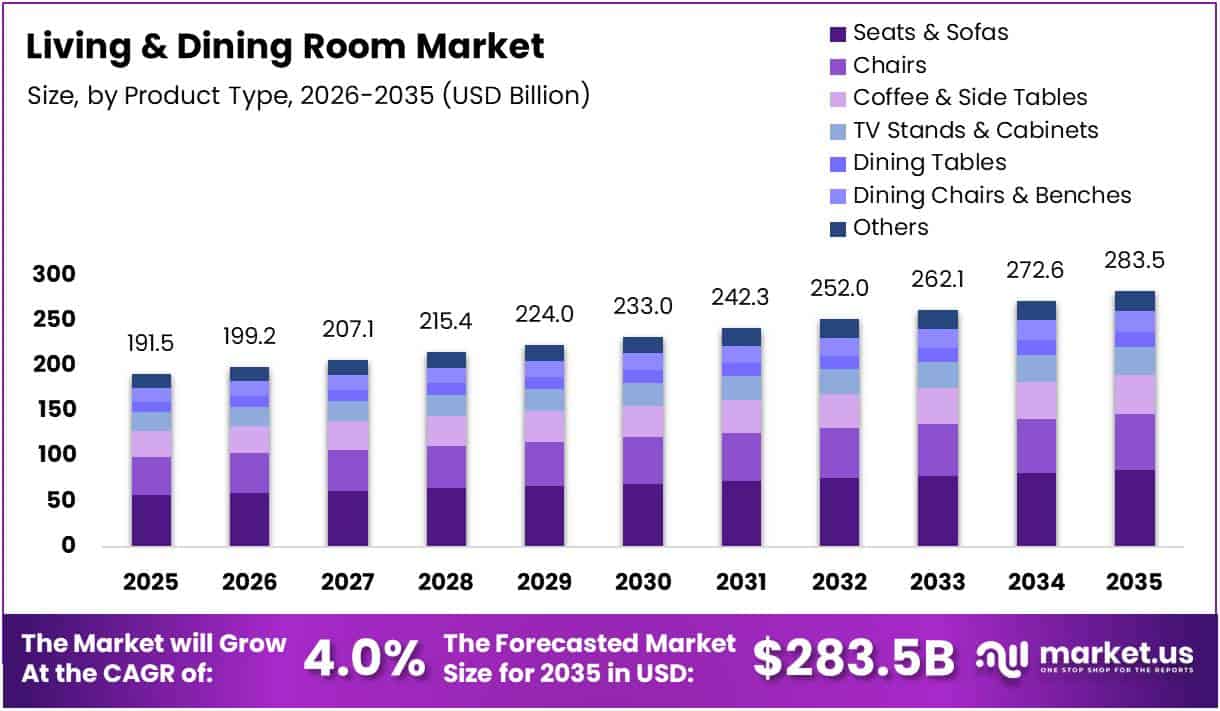
The Global Living & Dining Room Market size is expected to be worth around USD 283.5 Billion by 2035 from USD 191.5 Billion in 2025, growing at a CAGR of 4.0% during the forecast period 2026 to 2035.
The living and dining room market encompasses furniture products designed for residential and commercial spaces. These include seating solutions, storage units, tables, and decorative elements that enhance functionality and aesthetics. Moreover, this market serves both household consumers and commercial establishments seeking interior furnishing solutions.
Urban household formation drives significant demand for living and dining furniture globally. Rising disposable incomes enable consumers to invest in premium, designer furniture pieces. Additionally, the growing trend of home ownership and apartment living fuels consistent market expansion across diverse geographic regions.
Consumer preferences increasingly favor modular furniture and space-optimized furniture designs. Multi-functional pieces that maximize limited urban living spaces gain popularity. Furthermore, aesthetic considerations influenced by social media platforms shape purchasing decisions. Consequently, manufacturers innovate to meet evolving design expectations and functional requirements.
The residential real estate sector directly impacts furniture market dynamics. New housing completions generate immediate demand for complete furnishing solutions. However, renovation activities among existing homeowners create sustained replacement demand. Therefore, market growth correlates strongly with construction industry performance and housing market cycles.
Sustainability emerges as a critical consideration for modern consumers. Eco-friendly materials and certified production processes attract environmentally conscious buyers. According to Homes and Gardens, curvy and irregular-shaped furniture continue to be popular, with 43% of designers identifying them as trends for 2026. Additionally, wicker and rattan furniture maintained their appeal, cited by 27% of designers.
Digital transformation reshapes furniture shopping experiences significantly. According to Cylindo, 58% of consumers prefer buying furniture in-store, while 42% prefer online channels. Virtual visualization tools enhance online purchasing confidence. Moreover, direct-to-consumer brands leverage technology to offer customization options and competitive pricing.
Consumer spending patterns reflect market segmentation clearly. According to ESRI consumer expenditure data, sofas averaged approximately $425 in spending per household unit in U.S. consumer expenditure patterns. Furthermore, U.S. households spent approximately $119.99 on kitchen and dining furniture, demonstrating distinct category preferences and budget allocations.
Key Takeaways
- Global Living & Dining Room Market valued at USD 191.5 Billion in 2025, projected to reach USD 283.5 Billion by 2035
- Market growing at a CAGR of 4.0% during the forecast period 2026-2035
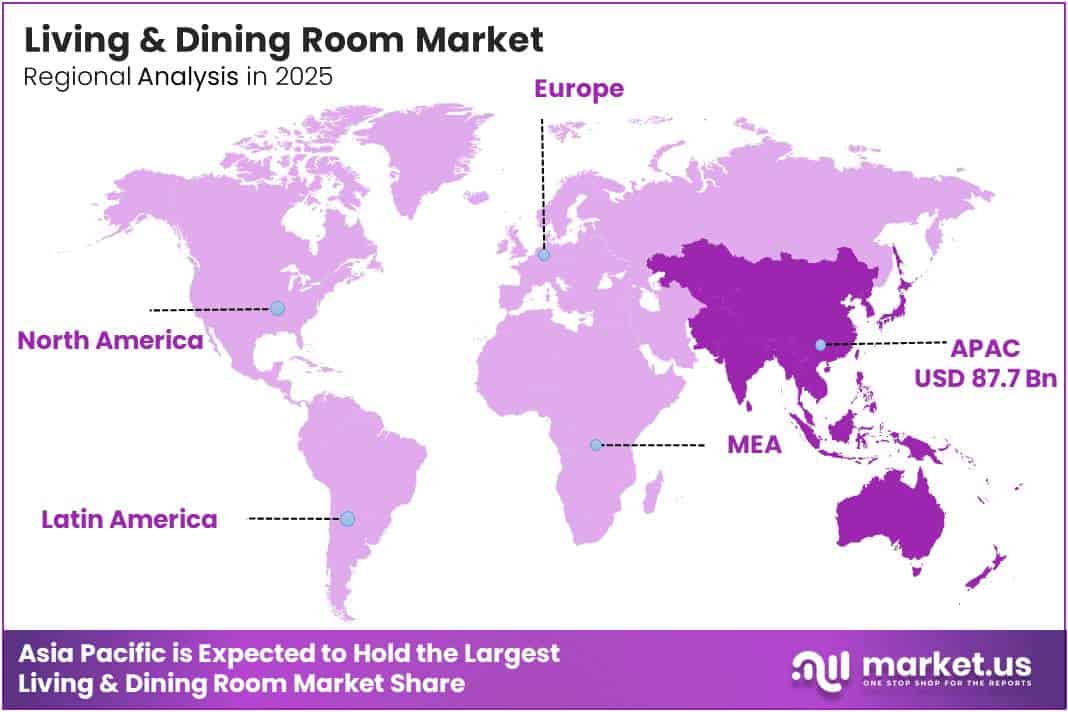
- Asia Pacific dominates with 45.80% market share, valued at USD 87.7 Billion
- Seats & Sofas segment leads Product Type category with 29.3% market share
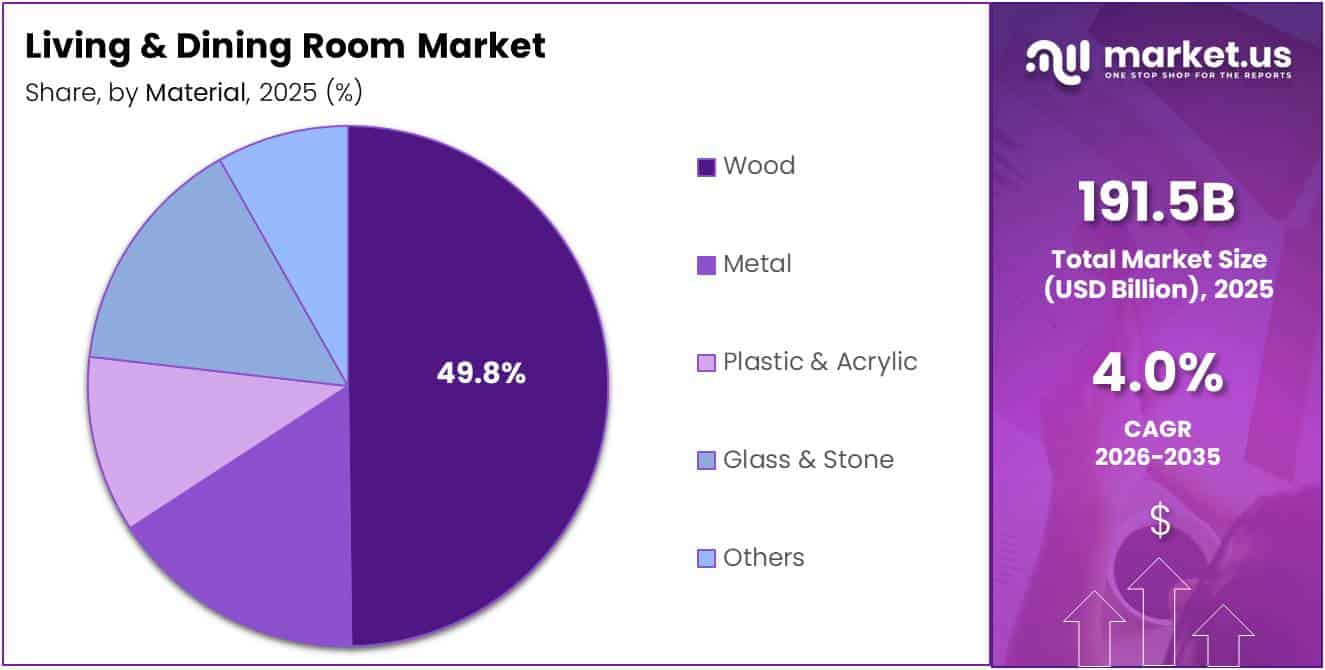
- Wood Material segment commands 49.8% share in material category
- Household/Residential end user segment holds 77.1% market dominance
Product Type Analysis
Seats & Sofas dominates with 29.3% due to essential role in living room configurations and premium spending patterns.
In 2025, Seats & Sofas held a dominant market position in the By Product Type segment of Living & Dining Room Market, with a 29.3% share. This category represents the cornerstone of living room furniture investments. Consumers prioritize comfortable seating as primary focal points for social gatherings and relaxation. Moreover, premium upholstery options and modular configurations drive higher average transaction values across this segment.
Chairs constitute a versatile product category serving multiple functional requirements. Dining chairs, accent chairs, and occasional seating solutions address diverse consumer needs. Additionally, design flexibility allows manufacturers to offer extensive customization options. Therefore, this segment maintains consistent demand across both residential and commercial applications throughout various interior design themes.
Coffee & Side Tables provide essential complementary furniture for living spaces. These pieces combine functionality with decorative elements to enhance room aesthetics. Furthermore, compact designs suit modern apartment living constraints. Consequently, consumers invest in tables that offer storage solutions while maintaining visual appeal and spatial efficiency.
TV Stands & Cabinets address entertainment system organization and media storage needs. Modern designs incorporate cable management and technology integration features. However, evolving streaming habits influence configuration preferences. Additionally, multifunctional units that combine display and concealed storage capabilities gain market traction among space-conscious consumers.
Dining tables represent a significant investment in home furnishing. Size, material quality, and expandability features determine purchasing choices. Moreover, dining tables serve as gathering points for family meals and social occasions. Therefore, durability and aesthetic alignment with the overall home furnishing and interior themes drive consumer selection criteria.
Dining Chairs & Benches complement dining table purchases with coordinated or contrasting designs. Ergonomic considerations influence comfort-focused buying decisions. Additionally, stackable and space-saving options appeal to urban dwellers. Furthermore, upholstered versus non-upholstered choices reflect budget constraints and maintenance preferences across different consumer segments.
Ottomans & Poufs deliver flexible seating and storage solutions for contemporary living spaces. These pieces add texture and color accents to room designs. Moreover, lightweight mobility enables easy reconfiguration for different occasions. Consequently, younger consumers and renters favor these adaptable furniture options for dynamic living arrangements.
Others category encompasses specialty furniture including console tables, buffets, and decorative storage units. Niche products cater to specific design requirements and premium market segments. Additionally, artisanal and custom-made pieces appeal to luxury consumers. Therefore, this diverse category addresses unique functional and aesthetic demands beyond standard furniture classifications.
Material Analysis
Wood dominates with 49.8% due to timeless appeal, durability expectations, and perceived value across price segments.
In 2025, Wood held a dominant market position in the By Material segment of Living & Dining Room Market, with a 49.8% share. Natural wood materials convey quality craftsmanship and traditional furniture values. Consumers associate wooden furniture with longevity and investment-grade purchases. Moreover, diverse wood species enable varied aesthetic expressions from rustic to contemporary design preferences.
Metal materials provide modern industrial aesthetics and structural durability. Steel, aluminum, and wrought iron constructions suit minimalist interior themes. Additionally, metal frames reduce visual bulk while maintaining strength. Furthermore, powder-coated finishes offer color variety and corrosion resistance. Therefore, metal furniture appeals to contemporary design enthusiasts seeking sleek, low-maintenance solutions.
Plastic & Acrylic materials deliver affordability and lightweight portability benefits. Molded designs enable innovative shapes and vibrant color options. However, durability perceptions sometimes limit premium market penetration. Additionally, outdoor and casual dining applications leverage weather-resistant properties. Consequently, budget-conscious consumers and temporary furnishing needs drive this segment’s market presence.
Glass & Stone materials introduce elegance and visual lightness to furniture designs. Tempered glass tabletops create sophisticated dining and coffee table solutions. Moreover, stone elements like marble and granite convey luxury positioning. Additionally, combination designs pairing glass with metal or wood frames optimize aesthetic and functional attributes.
Others category includes composite materials, engineered wood, and fabric upholstery options. Sustainable bamboo and reclaimed materials attract environmentally conscious buyers. Additionally, mixed-material constructions combine benefits of different components. Therefore, innovation in material science expands design possibilities and addresses specific performance requirements across diverse consumer preferences.
End User Analysis
Household/Residential dominates with 77.1% due to large consumer base and recurring replacement cycles driven by lifestyle changes.
In 2025, Household/Residential held a dominant market position in the By End User segment of Living & Dining Room Market, with a 77.1% share. Residential consumers represent the primary demand driver for living and dining furniture globally. Home ownership rates, family formations, and relocation activities generate continuous purchasing requirements. Moreover, emotional connections to home environments motivate quality investments in comfortable, personalized furniture selections.
Commercial segment encompasses hospitality establishments, corporate offices, and institutional facilities. Hotels and restaurants require durable, high-traffic furniture with consistent aesthetic appeal. Additionally, office environments increasingly incorporate lounge-style seating for collaborative workspaces. Furthermore, commercial buyers prioritize bulk purchasing, warranty terms, and supplier reliability. Therefore, this segment drives volume sales despite representing smaller overall market share.
Key Market Segments
By Product Type
- Seats & Sofas
- Chairs
- Coffee & Side Tables
- TV Stands & Cabinets
- Dining Tables
- Dining Chairs & Benches
- Ottomans & Poufs
- Others
By Material
- Wood
- Metal
- Plastic & Acrylic
- Glass & Stone
- Others
By End User
- Household/Residential
- Commercial (Hospitality, Offices, Others)
Drivers
Rising Urban Household Formation and Premiumization of Residential Interiors Drive Market Expansion
Urbanization accelerates globally, creating millions of new households requiring complete furnishing solutions annually. Young professionals and growing families prioritize quality furniture investments for long-term use. Additionally, rising disposable incomes enable consumers to upgrade from basic to premium furniture categories. Therefore, demographic shifts and economic prosperity fuel sustained market growth across emerging and developed economies.
Consumer aspirations increasingly emphasize personalized, designer-quality interiors reflecting individual tastes and lifestyles. Social media exposure to diverse interior design concepts elevates aesthetic expectations significantly. Moreover, home environments gain importance as remote work and entertainment hubs. Consequently, households allocate larger budgets toward creating comfortable, stylish living and dining spaces that enhance daily life quality.
Modular and space-optimized furniture solutions address urban living constraints effectively. Compact apartments and smaller floor plans require intelligent furniture selections maximizing functionality. Additionally, convertible and multi-purpose designs enable flexible space utilization. Furthermore, manufacturers innovate continuously to meet evolving consumer demands for efficiency without compromising style. Therefore, solution-oriented product development strengthens market competitiveness and consumer satisfaction.
Restraints
Supply Chain Disruptions and Extended Delivery Timelines Limit Market Growth Potential
Global supply chain complexities create unpredictable lead times for furniture manufacturers and retailers. Raw material availability fluctuations impact production scheduling and inventory management. Additionally, international shipping delays frustrate customers expecting timely deliveries. Moreover, customized furniture orders face particularly extended waiting periods. Consequently, delivery uncertainties discourage some consumers from completing purchases, especially for time-sensitive relocation or renovation projects.
Transportation cost increases directly affect final product pricing and profit margins. Logistics challenges intensify for bulky furniture items requiring specialized handling and storage. Furthermore, last-mile delivery complications in dense urban areas add operational expenses. Therefore, companies struggle balancing competitive pricing with rising fulfillment costs, potentially limiting market accessibility for price-sensitive consumer segments.
Housing market volatility creates unpredictable furniture demand patterns across different economic cycles. Mortgage rate fluctuations influence home purchasing decisions and subsequent furnishing expenditures. Additionally, economic uncertainty causes consumers to delay discretionary furniture investments. Moreover, seasonal variations in residential real estate transactions create uneven revenue streams. Consequently, manufacturers and retailers face inventory planning challenges and cash flow management complexities throughout market downturns.
Growth Factors
Expansion of Direct-to-Consumer Online Furniture Brands Accelerates Market Accessibility and Competition
Digital-first furniture brands eliminate traditional retail intermediaries, offering competitive pricing and convenient shopping experiences. Virtual visualization tools enable customers to preview furniture in their actual spaces using augmented reality. Additionally, detailed product videos and customer reviews build purchasing confidence online. Moreover, flexible return policies reduce perceived risks of remote furniture buying. Therefore, e-commerce platforms democratize access to diverse furniture styles and price points.
Environmental consciousness drives consumer preference for sustainable and certified eco-friendly furniture options. Responsibly sourced wood, recycled materials, and low-emission manufacturing processes attract values-driven buyers. Additionally, transparency regarding supply chain practices builds brand trust and loyalty. Furthermore, certifications like FSC and GREENGUARD provide tangible assurance of environmental commitments. Consequently, sustainability positioning differentiates brands and captures growing market segments prioritizing ecological responsibility.
Technological integration introduces smart furniture featuring built-in charging ports, LED lighting, and connectivity capabilities. Modern consumers value convenience enhancements that complement digital lifestyles seamlessly. Additionally, wireless charging surfaces and USB ports eliminate cable clutter. Moreover, voice-activated features and app-controlled elements appeal to tech-savvy demographics. Therefore, innovation in smart furniture creates premium product categories and expands addressable market opportunities beyond traditional furniture attributes.
Emerging Trends
Minimalist and Scandinavian-Inspired Interior Themes Reshape Consumer Preferences and Product Development
Clean lines, neutral color palettes, and functional simplicity define contemporary furniture design directions. Scandinavian aesthetics emphasizing hygge principles resonate with consumers seeking calm, uncluttered living environments. Additionally, minimalist approaches reduce visual noise and enhance spatial perception in compact homes. According to Homes and Gardens, 22% of designers cited organic patterns as a top choice. Therefore, manufacturers adapt product portfolios toward restrained elegance and timeless design appeal.
Multi-functional living-dining hybrid layouts reflect changing residential architecture and lifestyle patterns. Open-plan designs blur traditional room boundaries, requiring versatile furniture solutions. Additionally, space constraints in urban dwellings necessitate furniture serving dual purposes effectively. Moreover, flexible arrangements accommodate both intimate family meals and larger social gatherings. Consequently, demand increases for adaptable pieces transitioning seamlessly between different functional contexts throughout the day.
Customization options for upholstery colors, finishes, and configurations empower consumer personalization desires. Technology enables efficient mass customization without prohibitive cost premiums. Additionally, online configurators let customers visualize personalized selections before ordering. Furthermore, unique combinations create distinctive interiors reflecting individual personalities. Therefore, customization capabilities become competitive differentiators attracting consumers seeking exclusive, tailored furniture solutions beyond standard catalog offerings.
Regional Analysis
Asia Pacific Dominates the Living & Dining Room Market with a Market Share of 45.80%, Valued at USD 87.7 Billion
Asia Pacific leads global furniture consumption driven by massive population bases and rapid urbanization rates. China and India represent enormous household formation volumes requiring complete furnishing solutions. Additionally, rising middle-class prosperity enables increased furniture spending across the region. Moreover, manufacturing capabilities position Asia Pacific as both major producer and consumer. The region held a dominant 45.80% market share valued at USD 87.7 Billion, reflecting its critical importance.
North America Living & Dining Room Market Trends
North America maintains substantial market presence supported by high per-capita furniture expenditures and housing market activity. Premiumization trends drive consumer preference for quality, domestically manufactured furniture options. Additionally, e-commerce penetration facilitates convenient purchasing experiences. Moreover, home renovation investments sustain replacement demand beyond new construction cycles, ensuring steady market growth.
Europe Living & Dining Room Market Trends
Europe demonstrates strong appreciation for craftsmanship, heritage brands, and sustainable production practices. Diverse national design traditions influence regional aesthetic preferences significantly. Additionally, stringent environmental regulations promote eco-friendly manufacturing standards. Moreover, compact urban living throughout European cities drives demand for space-efficient furniture solutions that optimize limited residential square footage.
Latin America Living & Dining Room Market Trends
Latin America experiences growing furniture demand correlating with economic development and urban population expansion. Brazil and Mexico lead regional consumption with expanding middle-class demographics. Additionally, increasing housing construction supports market growth potential. However, economic volatility creates periodic demand fluctuations requiring adaptive business strategies from furniture manufacturers and retailers.
Middle East & Africa Living & Dining Room Market Trends
Middle East & Africa presents emerging opportunities driven by infrastructure development and hospitality sector expansion. Luxury furniture demand concentrates in Gulf Cooperation Council nations with high-income populations. Additionally, urbanization in African markets creates nascent but growing residential furniture needs. Moreover, commercial developments including hotels and offices generate substantial contract furniture requirements.
Key Regions and Countries
North America
- US
- Canada
Europe
- Germany
- France
- The UK
- Spain
- Italy
- Rest of Europe
Asia Pacific
- China
- Japan
- South Korea
- India
- Australia
- Rest of APAC
Latin America
- Brazil
- Mexico
- Rest of Latin America
Middle East & Africa
- GCC
- South Africa
- Rest of MEA
Key Company Insights
KOKUYO Co., Ltd. maintains prominent position in the Asian furniture market through comprehensive product portfolios and established distribution networks. The company emphasizes ergonomic design principles and functional innovation across office and residential furniture categories. Additionally, strong brand recognition in Japan and regional markets supports consistent revenue performance. Moreover, KOKUYO leverages manufacturing efficiency and supply chain integration to deliver competitive pricing while maintaining quality standards.
Okamura Corporation specializes in high-quality seating solutions and office furniture with expanding residential product lines. The company’s reputation for durability and ergonomic excellence attracts commercial and household consumers. Additionally, Okamura invests in research and development to incorporate advanced materials and sustainable practices. Furthermore, strategic partnerships and international expansion initiatives strengthen global market presence beyond its Japanese home base.
Godrej & Boyce Manufacturing Company Limited represents India’s leading diversified conglomerate with significant furniture manufacturing capabilities. The company serves diverse market segments from budget-conscious to premium consumer categories effectively. Additionally, extensive retail presence across Indian cities ensures broad market accessibility. Moreover, Godrej’s brand heritage and trust accumulated over decades provide competitive advantages in rapidly growing South Asian markets.
Inter IKEA Systems B.V. revolutionized global furniture retail through flat-pack design philosophy and affordable Scandinavian aesthetics. The company’s self-service warehouse model and in-house design teams enable exceptional value propositions. Additionally, IKEA’s sustainability commitments and circular economy initiatives resonate with environmentally conscious consumers worldwide. Furthermore, continuous store network expansion and e-commerce investments maintain market leadership across multiple continents.
Key players
- KOKUYO Co., Ltd.
- Okamura Corporation
- Godrej & Boyce Manufacturing Company Limited
- Inter IKEA Systems B.V.
- HNI Corporation
- Kimball International, Inc.
- Herman Miller, Inc.
- AFC Systems
- Ashley Furniture Industries, Inc.
- Berco Design
Recent Developments
- October 2025 – Twin Star Home, backed by Z Capital Group (ZCG), acquired Walker Edison for approximately $20 million, expanding its portfolio of furniture brands and strengthening market position in the direct-to-consumer furniture segment through enhanced product offerings and distribution capabilities.
- October 2025 – Hamilton Spill Furniture Group announced its relaunch under new ownership after Polygroup acquired an ownership stake, with plans to introduce new living room and dining room collections targeting contemporary consumer preferences and design trends in residential furniture markets.
- December 2025 – HNI Corporation completed acquisition of Steelcase Inc., creating a combined entity with expanded capabilities across office and residential furniture segments, enhanced manufacturing scale, and broader geographic reach to serve diverse commercial and household customer requirements.
Report Scope
Report Features Description Market Value (2025) USD 191.5 Billion Forecast Revenue (2035) USD 283.5 Billion CAGR (2026-2035) 4.0% Base Year for Estimation 2025 Historic Period 2020-2024 Forecast Period 2026-2035 Report Coverage Revenue Forecast, Market Dynamics, Competitive Landscape, Recent Developments Segments Covered By Product Type (Seats & Sofas, Chairs, Coffee & Side Tables, TV Stands & Cabinets, Dining Tables, Dining Chairs & Benches, Ottomans & Poufs, Others), By Material (Wood, Metal, Plastic & Acrylic, Glass & Stone, Others), By End User (Household/Residential, Commercial) Regional Analysis North America (US and Canada), Europe (Germany, France, The UK, Spain, Italy, and Rest of Europe), Asia Pacific (China, Japan, South Korea, India, Australia, and Rest of APAC), Latin America (Brazil, Mexico, and Rest of Latin America), Middle East & Africa (GCC, South Africa, and Rest of MEA) Competitive Landscape KOKUYO Co., Ltd., Okamura Corporation, Godrej & Boyce Manufacturing Company Limited, Inter IKEA Systems B.V., HNI Corporation, Kimball International, Inc., Herman Miller, Inc., AFC Systems, Ashley Furniture Industries, Inc., Berco Design Customization Scope Customization for segments, region/country-level will be provided. Moreover, additional customization can be done based on the requirements. Purchase Options We have three licenses to opt for: Single User License, Multi-User License (Up to 5 Users), Corporate Use License (Unlimited User and Printable PDF)  Living & Dining Room MarketPublished date: Feb 2026add_shopping_cartBuy Now get_appDownload Sample
 -
-
- KOKUYO Co., Ltd.
- Okamura Corporation
- Godrej & Boyce Manufacturing Company Limited
- Inter IKEA Systems B.V.
- HNI Corporation
- Kimball International, Inc.
- Herman Miller, Inc.
- AFC Systems
- Ashley Furniture Industries, Inc.
- Berco Design
Our Clients

- 177471
- Feb 2026






